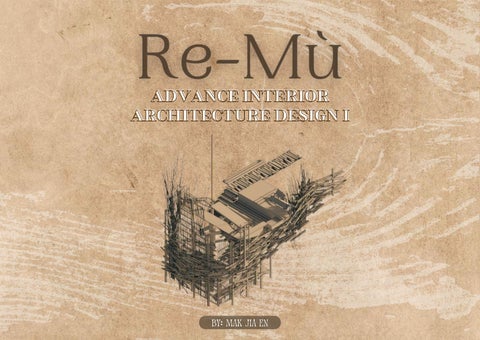
Our project aims to explore and express the unique narrative of the site by creating live installation scenarios that are deeply responsive to the architectural context. By doing so, we seek to engage and interact with the community in meaningful ways. These installations will not only reflect the history and essence of the location but also invite active participation, allowing the community to experience and connect with the space in a new and dynamic manner.
MODEL MODEL
CRIT 1 CRIT 1
CONCLUSION CONCLUSION
At this stage, I have learned the importance of understanding and developing the topic, just as Ms. Chelsea said that Phase 1 is like a bullet—when you have a deep understanding of your topic, such as how wood is related to the site and how it develops afterward.
When I visited Petaling Street, I found it to be a place rich in culture and history. Many people think of it as a beautiful street with traditional shops, delicious street food, and a variety of goods. But it also faces some hidden problems, such as a lot of waste.
At the beginning, I set my topic as waste, but waste is too general, as every place has waste, so it doesn't showcase the uniqueness of Petaling Street. Therefore, when I delved deeper into understanding what special kind of waste there is, I disc comes from human activities. While we have made good progress in reusing old buildings, it has also cr large wood items like pallets often get discarded on the streets because they are too big to be easily discarded items rot and become part of the garbage problem for my final year project, I decided to foc this wood waste. I chose the theme "re-mu," which stands for repurposing and reusing discarded wood to
These pieces of wood used to be part of buildings, like windows and door frames. However, when they are discarded by the roadside, they slowly rot and enter nature's lifecycle. In a natural environment, these pieces of wood decompose, turn into nutrients, and return to the soil, nourishing new trees. This is a complete natural cycle. But in the city, if these wood pieces are not properly handled, they become trash and pollute the environment.
By doing so, I hope to show that these discarded pieces of wood can be transformed into something valuable and beautiful.I created a model using these "trash" wood pieces. This model costs almost nothing because the materials are all discarded wood I found in Petaling Street. The idea came from a visit to Petaling Street, where I saw many discarded wood pieces. I picked up a few rotten pieces to study. I found that each piece of rotten wood has unique textures, which inspired me to use these pieces to show their original role in Petaling Street as part of building structures.
SPATIAL SPATIAL INSTALLATION INSTALLATION
PHRASE 2 OVERVIEW
Our project aims to explore and express the unique narrative of the site by creating live installation scenarios that are deeply responsive to the architectural context. By doing so, we seek to engage and interact with the community in meaningful ways. These installations will not only reflect the history and essence of the location but also invite active participation, allowing the community to experience and connect with the space in a new and dynamic manner.
PROGRESS PHOTOS PROGRESS PHOTOS
CONCLUSION CONCLUSION
In Phase 2, I learned the importance of collaboration in working on a community project with my classmates. This process was filled with discussions, and I’m grateful that our group managed to avoid major conflicts.
During the weaving process, I realized the need for patience, and I discovered that teamwork can make Working together allowed us to share ideas, support each other, and solve problems more efficiently.
What I found particularly enjoyable about this phase was the sense of unity and collective effort. Eac own unique strengths and perspectives, which enriched the project and made it more meaningful. The exp with my classmates not only helped me develop better communication skills but also taught me the value a team setting.
This phase was truly enjoyable for me as it was not just about completing a task but also about buildi another. The sense of accomplishment we felt at the end was shared by everyone, making it a memorable
GLIMPSES OF KITH GLIMPSES OF KITH
SPATIAL IMAGINATION SPATIAL IMAGINATION
In Phase 3, we aim to synthesize and expand upon the concepts and narratives developed in Phase 1. This phase is dedicated to re-inventing and transforming these narratives into tangible spatial ideas. Our task involves selecting a sequence of spaces within our chosen site in the vicinity of Kuala Lumpur. These selected spaces will be further detailed and articulated using spatial depiction techniques.
PHRASE 3 OVERVIEW
CURATED CURATED STAIRCASE STAIRCASE
MODEL MODEL
CRIT 1 CRIT 1
CRIT 2 CRIT 2
CRIT 2 CRIT 2
CONCLUSION CONCLUSION
In Phase 3, I noticed that as the discarded wood pieces became moldy and brittle over time, they revealed various textures and levels of damage. Rather than detracting from their value, this decay enriched the wood's textures, uncovering a unique natural beauty. Inspired by this transformation, I chose to use these natural textures as the foundation for my work in this phase.
My design philosophy embraces these evolving textures and qualities of the wood. Although the design might appear worn, I believe this "worn" aesthetic better highlights the wood's imperfections and uniqueness. Each piece of wood carries its own story and characteristics, and through this design, I aim to convey the natural beauty of wood and the concept of sustainable reuse.
My project curated is divided into two parts: a Sensory Experience Collage and a Gardening Workshop.
SENSORY EXPERIENCE COLLAGE
The goal of this part is to create a collage that engages the senses, enhancing the experience of being in the space. Each sense will play a role in deepening the connection with the environment and the materials used.
GARDENING WORKSHOP
This workshop delves into the new life and nutritional value that wood can offer. Participants will explore how wood ash, rich in essential minerals like potassium and phosphorus, can enhance plant growth by improving soil pH and structure, serving as a natural fertilizer. Additionally, the workshop will demonstrate the process of compressing wood into nutrient-rich fibers, which have excellent water retention, making them ideal for growing mushrooms and other fungi. This workshop highlights the versatility of wood reuse and its significant role in the ecological cycle, showcasing the diverse ways wood can be repurposed to sustain and nurture new life.
DETAILED ELEMENTS
2.
1. Wood Display Rack: Under the stairs, there is a small display area featuring real wood bark. This area invites visitors to closely observe and touch the natural textures and features of the wood.
3.
Wood Collection Pipe: This pipe extends from the first floor to the second, collecting waste wood from Petaling Street. It serves a dual purpose: it is functional, and it acts as a dynamic display, allowing visitors to witness the process of wood being collected and moved through the pipe.
Historical Wood Display: Nearby, display racks showcase wood with historical value. These displays tell the story of Petaling Street's history and culture through the wood’s textures and stories.
Wood Exchange Machines: In the storage area, machines allow visitors to scan their discarded wood and exchange it for souvenirs. This interactive element encourages community participation and promotes sustainable practices. 4.