ISSUE 48 2025
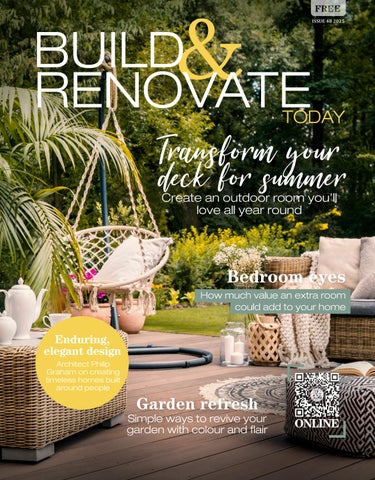
Transform your
deck for summer Create an outdoor room you’ll love all year round
Bedroom eyes How much value an extra room could add to your home
Enduring, elegant design Architect Philip Graham on creating timeless homes built around people
Garden refresh
Simple ways to revive your garden with colour and flair
ONLINE
EXCAVATION (GPS) | CARTAGE | LAND CLEARING FARM MAINTENANCE | GRADING BULK EARTHMOVING | SILAGE | AGGREGATE SUPPLY
0800 487 539 | admin@jrcivil.nz
16
30
In this issue... 7.
Nestled in nature A breathtaking Picton home where craftsmanship, colour and connection shine
12. Transform your deck for summer
Smart styling ideas to create an outdoor room you’ll love all year round
16. Dulux colour forecast 2026
20. Master Builders House
ISSUE 48 2025 BUILD&RENOVATE TODAY MAGAZINE - ISSUE 48 2025
Discover the calming, optimistic and grounded palettes shaping Kiwi homes
7 Transform your
deck for summer
of the Year
Award-winning homes showcasing the best in design, detail and innovation
26. Enduring, elegant design Architect Philip Graham on creating timeless homes built around people
Create an outdoor room you’ll love all year round
Bedroom eyes How much value an extra room could add to your home
Enduring, elegant design Architect Philip Graham on creating timeless homes built around people
Garden refresh
Simple ways to revive your garden with colour and flair
ONLINE
30. Bathroom trends & award winners
Inside New Zealand’s top bathroom designs and the styles leading 2025
36. Innovation in the Great South How climate, policy and new materials are reshaping construction in Otago
42. Summer garden refresh Simple ways to revive your garden, deck or balcony with colour and flair
46. Perfectly imperfect interiors Expert advice on unifying mismatched spaces with texture, tone and intention
50. The value of an extra bedroom
Why adding one more room could deliver one of the biggest returns on investment
4 | www.buildandrenovate.co.nz
07 20
Lifestyles By Ben O’Connell
ROTUNDA TEAL VASE A beautifully shaped vase, perfect as a décor piece or filled with your favourite flowers. A delicate stoneware with a gradient blue hue and a biophilic texture. RRP $44.99 NZD www.adairs.co.nz
KODA TABLE LAMP Complete your space with this retro table lamp. Its deep blue metal shade and base, along with brushed brass metalware, are sure to enhance your home with a pop of colour and flair. RRP $100 NZD www.mitre10.co.nz
MAX DINING CHAIR
Elevate your entertaining game in the dining room with this next-level luxe dining chair, with a plush seat and back cushioning. Seen here in the shade ivy velvet. RRP $129 NZD www.earlysettler.co.nz
SUNBEAM RADIANCE TOASTER With the collection’s sleek, linear, textured design, glossy finish, and pop of blue, add a stylish statement piece to your bench top and brighten up your mornings. RRP $119 NZD www.heathcotes.co.nz
BEANZ BIG BEAN Their most loved bean bag, get comfy with this one at home, both inside and out, on the deck, by the pool or on a mission to the bach. RRP $89.95 NZD www.beanzlifestyle.com
VIVIENNE VELVET PET BED Upholstered in a vibrant blue-green teal, this super comfortable pet bed is not only cosy, but it also makes a striking accessory in your home with a touch of vintage-luxe elegance. RRP $139 NZD www.earlysettler.co.nz
DISCLAIMER: Please note prices listed here are recommended retail pricing. Prices are subject to change at the discretion of the seller. The information on this page is for information purposes only. AMark Publishing NZ Ltd assumes no liability or responsibility for any inaccurate, delayed or incomplete information, nor for any actions taken in reliance thereon.
www.buildandrenovate.co.nz
| 5
EDITOR’S LETTER As the long, warm days arrive, we open this issue with Transform Your Deck for Summer — a reminder of how small changes can turn even the simplest outdoor space into a place to unwind, entertain and enjoy the season. It’s a theme that runs throughout the magazine: thoughtful design that elevates everyday living. Inside, we explore homes where craftsmanship and creativity shine, from serene retreats nestled in nature to bold award-winning builds that set new benchmarks in quality. We spotlight the Dulux Colour Forecast 2026, dive into the latest bathroom design trends, and hear from architects and designers shaping the future of New Zealand homes. Whether you’re planning a major build, refreshing a single room, or simply seeking inspiration, this issue brings ideas, expertise and stories to guide your next step. Enjoy the read, and enjoy creating a home you love.
PUBLISHER Academy Group - 38 Lowe Street, Addington, Christchurch 8011
MANAGING DIRECTOR Gary Collins
GENERAL MANAGER OF OPERATIONS Kylie Palermo
SALES MANAGER Angela Elley - 03 961 5184 sales@academygroup.co.nz
GROUP EDITOR Stuart Dye - 021 676 320 stuart@academygroup.co.nz
ART DIRECTOR Jarred Shakespeare - 03 961 5088 jarred@academygroup.co.nz Design: Sarah Betman, Jessica Ann
PRODUCT CO-ORDINATOR MANAGER Amber Mundy - 03 961 5075 amber@academygroup.co.nz
ADMINISTRATION 03 961 5050 accounts@academygroup.co.nz
ISSN 2463-381X (print) ISSN 2463-3828 (online)
Group Editor
www.buildandrenovate.co.nz
Disclaimer: This publication is provided on the basis that AMark Publishing NZ Ltd is not responsible for the results of any actions taken on the basis of information in these articles, nor for any error or omission from these articles and that the firm is not hereby engaged in rendering advice or services. AMark Publishing NZ Ltd expressly disclaim all and any liability and responsibility to any person in respect of anything and of the consequences of anything done, or omitted to be done, by any such a person in reliance, whether wholly or partially upon the whole or any part of the contents of this publication. Advertising feature articles are classified as advertising content and as such, information contained in them is subject to the Advertising Standards Authority Codes of Practice. Contents Copyright 2012 by AMark Publishing NZ. All rights reserved. No article or advertisement may be reproduced without written permission. You can read the full list of terms and conditions on: www.academygroup.co.nz/terms-conditions | www.academygroup.co.nz/competition-terms/
6 | www.buildandrenovate.co.nz
nature
Nestled in
Among tree-clad hills, this two-storey rectilinear home commands a beautiful outlook over Picton and the Marlborough Sounds. Its refined exterior belies the thoughtful planning behind its design and construction.
On the first floor, internal sliding stacker doors create a seamless flow from the living areas to a sheltered outdoor room, enhancing both comfort and connection to the landscape. At the heart of the home lies a striking kitchen, illuminated by a slimline skylight that bathes the work surfaces in natural light. This harmonious blend of form and function sets the project apart, earning Roger Hogg Builders welldeserved recognition. The bathroom continues this theme of understated excellence. Simple yet sophisticated, it showcases superb craftsmanship from floor to ceiling. The shower features pale blue-green tiles over a ceramic tray, while the surrounding walls combine deep-blue paint with lively, colourful wallpaper. Each element contributes to a space that is truly greater than the sum of its parts.
Throughout the home, creativity and craftsmanship shine. The interior design thoughtfully reflects the owners’ vibrant personalities, embracing bold colours, varied textures, and a love of indoor plants. A custom plant shelf in the kitchen highlights this connection to nature, while the careful coordination of wall coverings, materials, and fixtures creates a cohesive visual story. Every detail has been considered, resulting in a home that feels lively, warm, and beautifully curated. Overall, this home exemplifies the successful fusion of aesthetic vision, practical planning, and meticulous execution. It is a testament to the skill and sensitivity of Roger Hogg Builders, whose work brings together creativity, craftsmanship, and an intimate understanding of how people truly live.
8 | www.buildandrenovate.co.nz
www.buildandrenovate.co.nz
| 9
Providing Transport, Contracting & Earthmoving Services since 1928
Takaka Head Office 98A Commercial Street Phone: 03 525 9843 Christchurch Depot 9 Sir James Wattie Drive, Hornby Phone: 03 349 2948 Blenheim Depot Riverlands Roadhouse 3535, SH 1, Riverlands 7274 Phone: 03 265 4210 Richmond Depot 32 McPherson Street Phone: 03 544 5511
Sollys enable the success of others by connecting people and products Our service is the difference - Anyone can move your products but it is the service we provide as well as the value we add that makes us different to everyone else. Delivering quality is the key to ensuring your deliveries are on time and in one piece.
FREIGHT Bulk / General / Livestock CONTRACTING Earthmoving / Land Maintenance / Subdivisions / Pile Driving AGGREGATES Rock / Metal / Sand G B PREMIX Foundations / Driveways etc FERTILISER Dolomite / Biological Mixes / Lime
0800 176 559
www.sollys.co.nz
Transform your deck
for summer By Shelley Sweeney
Summer is here, along with longer days, warmer weather and the perfect excuse to spend more time outside. If you have a deck, now’s the time to think about how to make it more than just a bare expanse. With the right touches, your deck can become an outdoor room where you can relax, entertain and enjoy the fresh air year-round. Here are some ideas to help you transform your outdoor space into a room you’ll love in every season.
Create zones for living Think about how you want to use your deck. Whether it’s for family dinners, weekend barbeques, or quiet morning coffees, a good deck layout works a lot like an indoor living room. Arrange your space in zones. Place your dining table near the barbecue or kitchen door for easy serving and keep your lounge seating separate to create a spot for relaxation. Adding an outdoor rug under each area defines the space with a textural element that invites relaxation.
Add louvres for shade and shelter Summer weather can be unpredictable, so finding ways to weather proof your plans is money well spent. Shade sails and screens are easy options to provide some shelter from the elements. A louvred roof provides more shelter and control over how much sun or shade you get. Open them up for light and airflow, tilt them for a bit of shade, or close them completely if rain arrives. Motorised systems make it even easier, turning your deck into a room you can use rain or shine. Pair louvres with outdoor blinds or screens and you’ll also block out wind and gain some extra privacy.
One of the best things about an outdoor room is how easily you can update it. In spring and summer, use bright cushions, fresh flowers and lightweight throws. In autumn and winter, switch to warmer colours, thicker rugs and extra blankets.
Stay warm on cool nights Even in summer, evenings can cool off quickly. Outdoor heating is the key to making your deck enjoyable year-round. Options include freestanding gas heaters, wall-mounted infrared panels, or the ever-popular fire pit. A fire pit doubles as a centrepiece for entertaining, while a sleek builtin fireplace can make your deck feel like a true extension of your living room.
Choose comfy, weather-ready furniture If you want your deck to feel like an outdoor room, the furniture needs to be just as inviting as your indoor pieces. Invest in modular outdoor sofas with deep cushions, just make sure the fabric is weather-resistant. Throw in some colourful outdoor cushions, soft blankets and a couple of side tables and suddenly your deck is ready for lazy afternoons and evening catch-ups.
fresh flowers and lightweight throws. In autumn and winter, switch to warmer colours, thicker rugs and extra blankets. Combine this with louvres and heating and your deck can stay in use all year round.
Don’t forget the fun extras Think about the little touches that make outdoor living special. An outdoor bar cart is great for summer entertaining, a hanging egg chair adds a spot for lounging with a book and if
you’ve got the space, an outdoor projector can turn your deck into the ultimate movie-night destination. With the right mix of shelter, heating, comfortable furniture and seasonal styling, your deck can go from being a fair-weather space to one of the most loved rooms in your home. This spring, think of your deck as an extension of your living space. Your new outdoor living room can be a place to gather, unwind and enjoy no matter the season.
Layer in décor and greenery This is where you can really make your deck your own. Add personality with string lights, lanterns, or solar-powered lamps for a cosy evening glow. Potted plants or a vertical garden will soften the space and bring a lush, natural feel. Herbs in planter boxes are a great idea too, they’re both practical and decorative.
Switch It up with the seasons One of the best things about an outdoor room is how easily you can update it. In spring and summer, use bright cushions, www.buildandrenovate.co.nz
| 13
AIR TESTING FOR CLEANER INDUSTRY
NZ’s First IANZ-Accredited Industrial Air Testing Specialists, Delivering Standards-Compliant Emissions Data You Can Trust
About Us
Our Testing
In August 1992, Air Resource Management was established. We provide efficient and reliable service to industries concerned about air emissions and compliance with the Resource Management Act. Test Results remain confidential between the client and Air Resource Management. Our client database is also confidential.
Whether you’re seeking routine monitoring, occupational health data, or resource consent support, we deliver a streamlined, professional service—no matter the size or scope of the job. Let us handle the testing, so you can focus on running your operation.
Contact Us Get in touch for a free proposal or expert advice on your emissions testing needs. We offer flexible scheduling, fast reporting, and a fully self-contained service. Whether you need compliance support, odour testing, or full stack analysis —we’re here to help. All enquiries confidential. Let’s make it easy.
m 09 627 3531 k glenn@armnz.kiwi o 12A Rangitata Place, Lynfield, Auckland Mon – Fri 7:30 a.m. to 4:30 p.m.
Our Equipment
Sampling Probe
Heated Probe
Filter Box
Pump Box
Probe in Stack
Heated Probe
We Offer
Industries We Test
• Free Proposals
• Acid Plants
• Standard Test Methods
• Ashphalts Plants
• Resource Consent Preparation
• Boilers
• RMA 4th Schedule Requirements
• Cement Plants
• Occupational Health Testing
• Chemical Manufacturing
• Competitive Prices
• Furnaces
• Full Data Spreadsheets
• Incinerators
• Stand-Alone Reports
• Municipal Waste Combustors
• Efficient data processing & reporting
• Petroleum Refineries
• Scientific Support for Interpretation of results
• Power Plants
• Expert Evidence
• Pulp and Paper Mills
• Odour Testing
• Smelters • Steel Mills
Dulux colour forecast 2026 By Shelley Sweeney
New Zealand’s Dulux Colour and Design Specialist Davina Harper, shares the 2026 Colour Forecast from the Dulux Colour team.
The Ethereal Palette
The annual Dulux Colour Forecast is grounded in extensive, yearround research into global and local trends set to shape Kiwi interior design and the way we live. Since its inception in 1999, the forecast has become a trusted guide for designers, architects and homeowners alike. The three 2026 palettes are about a sense of tenderness and connection through colour
This palette features a delicate pastel-like blend of soft and mid-tone hues, gentle greens,
Behind the scenes with the Dulux Colour Forecast Team The Dulux Colour Team closely collaborates with international brands, attends design shows and seminars, runway
Dulux Ethereal invites a soft form of escapism, creating playful and whimsical spaces filled with serenity, tenderness, and a dreamlike sense of calm.
presentations and global events such as Milan Design Week. They also draw from customised trend research and insights accessed through Dulux’s global network across the UK, Europe and AsiaPacific. As members of the Color Marketing Group (CMG), they analyse key reports from CMG as well as forecasting firms such as Color Hive-Mix Magazine and LS:N Global to ensure the forecasting reflects what’s ahead.
16 | www.buildandrenovate.co.nz
mauves, and blush pinks that evoke a sense of serenity and joy. With romantic tones like Dulux Snowdon Forest, Dulux Different Pink and Dulux Mask, alongside subtle pastels such as Dulux Wainui Beach, Dulux Lake Camp and Dulux Waitiki Landing, this palette feels playful, uplifting, and quietly luxurious.
Evoke Palette Dulux Evoke is an optimistic, bold and expressive palette that channels individuality, reminiscence and emotional warmth. This palette celebrates the resurgence of maximalism and individual style, a desire for change and support for local and global designers. Rooted in vintage aesthetics it embraces imperfection and cherishes treasures, blending elements of the past and future to create a fresh and eclectic style. The colours in Dulux Evoke lean into rich, comforting tones instead of brights. This creates depth, character and warmth. Clay pinks like Dulux Benhar, muted oranges such as Dulux Ligar Bay and warm mustard golds like Dulux Desert Road form a versatile base, while dramatic shades, including Dulux Warkworth, Dulux Red Jacks, Dulux Wink and Dulux Deep Aqua, add contrast and a cultured edge.
The Elemental Palette Dulux Elemental offers a calm, grounded counterbalance to the overwhelm of modern life. This palette is a tonal, grounded and built around warm whites and neutrals such as Dulux Whale Bay and Dulux Duvauchelle.
Elemental is enriched with golden brown hues such as Dulux Kingsland and Dulux Herald Island. Subtle layers of warm grey, including Dulux Godley Head and Dulux Boulder Beach, bring stillness and structure, while darker charcoal tones add depth and dimension.
"JC Operators provides great training The perfect way to move your career forward"
Training Courses include: Mobile Cranes • Crawler Cranes • Rigger Dogman • Transportation
Jason Campbell
m 027 242 6502 18 | www.buildandrenovate.co.nz
k jason@jcoar.co.nz
www.jcoar.co.nz
Your Trusted Source for HVAC Excellence We Provide Commercial and Industrial Air Conditioning, Mechanical and Ventilation Solutions Including: • Design and Installation • IQP Inspections • Preventative and Proactive Maintenance Services • Energy Saving Assessments and Implementations • Project Management Services • Peer Reviews • Fault Finding and Repairs • Electrical Services WE BELIEVE IN PROVIDING THE HIGHEST LEVELS OF QUALITY SERVICES FOR OUR CUSTOMERS, RIGHT FIRST TIME.
EDDIE GARDEN 3/308 WILSONS ROAD, OPAWA 03 365 8943 | 027 438 1440 | eddie@qbsl.co www.qbsl.co.nz www.buildandrenovate.co.nz
| 19
Master Builders House of the Year Awards 2025 Celebrating New Zealand’s finest homes By Shelley Sweeney
Velvin Building
On 22 November, the Master Builders House of the Year Awards 2025 showcased New Zealand’s top 100 exceptional homes. These highly anticipated awards annually celebrate bold design, superior craftsmanship, and innovation across the country. In addition to the Supreme Winners, the awards recognised seventeen category winners, a Craftsmanship Award, a Special Award, and five Lifestyle Awards. Esteemed judges, builder Mark Metzger and architect Richard Harris shared their insights on this year’s winners and emerging trends in New Zealand’s building industry. Mark and Richard developed a close rapport early that served them well in their eight weeks on the road reviewing the 100 homes in competition. “We
came together with no egos and combined our different skill sets to listen and learn from each other,” says Mark. Despite maintaining independent scoring sheets, the judges were largely aligned in their evaluations. “There are 2,000 points on offer, so to be regularly within five points apart is remarkable,” adds Richard. Both expressed feeling privileged to serve as judges and were inspired by the craftsmanship demonstrated by this year’s entrants.
20 | www.buildandrenovate.co.nz
Velvin Building
Supreme House of the Year – Over $1 Million
Supreme House of the Year – Under $1 Million
The National Supreme House of the Year over $1 million Award was presented to Velvin Building. Located on a steep site above the Frankton Arm Walkway, the home also won awards for National Kitchen Excellence and National Resene New Home $2–$4 million.
In Raglan, Nixon Homes received the National Supreme House of the Year under $1 million Award and the National Altus Window Systems New Home $750,000–$1 million category award. The home demonstrated what can be achieved within a disciplined budget.
“The house maximises indooroutdoor flow, shelters from the wind, and offers stunning lake views. It was seamless and beautifully crafted,” says Mark. Richard adds, “The design prioritises social connection,
bold colour choices, and natural materials. The details are executed perfectly in unexpected ways, making it innovative in many respects.” Highlights included prefabricated Strandboard panels with a dark wash, sustainably sourced Southland beech interiors, recycled blackbutt Australian hardwood exteriors, and Corten steel sliding screens. Mark notes, “The collaboration between architect and builder is evident in every element.”
“Three discrete pods are linked by walkways and roof elements,
Nixon Homes
creating both sheltered courtyards and open spaces with estuary views,” says Richard. Mark highlights the durability and practicality of the materials: “Concrete floors, GIB walls, and Colorsteel cladding perform exceptionally well in the rugged coastal environment. It’s also an Airbnb for the owners, and the separate pods work perfectly for that purpose.”
Emerging trends in New Zealand homes Judges observed several emerging trends in New Zealand homes:
Gudsell Designer Homes
• Sustainability is increasingly integrated, with photovoltaic panels and Passive House principles becoming more common.
Mitre 10 Trade Craftsmanship Award Gudsell Designer Homes won the Mitre 10 Trade Craftsmanship Award for their exceptional Tauranga waterfront home.
• Interiors are being considered holistically, with strong attention to design, materials, and flow between indoor and outdoor spaces.
“The in-situ concrete evokes the bark of Pohutukawa trees,” says Mark. “From top to bottom, the house uses raw materials, concrete and timber. Every element is flawless.” Richard adds: “The craftsmanship is exceptional. Skylights and thoughtfully designed bathrooms contribute to the remarkable ambiance throughout.”
• Natural materials such as stone, steel, and timber are more prevalent, alongside locally sourced products and textured finishes. Richard notes: “Homes are not just finished — they’re fully considered, inside and out, including the surrounding landscape.” Mark adds: “Although we are not judging the landscape, the integration of exterior and interior spaces enhances the overall experience. New products and innovative approaches continue to inspire and elevate the industry.” Gudsell Designer Homes
22 | www.buildandrenovate.co.nz
Supreme Renovation of the Year Howe Construction’s Queenstown renovation earned the National Supreme Renovation of the Year Award and the National Renovation over $2 million category. Judges praised the meticulous detailing and the transformation of a dated penthouse into a sophisticated open-plan living space with panoramic views of Lake Wakatipu.
“It connects every space seamlessly, with sleek transparent partitions and outdoor living areas including a spa,” says Mark. Richard adds: “The design draws you naturally through the home to the living areas, where the incredible views are revealed. Beneath the design’s graceful simplicity lies a surprisingly complex renovation.”
Creating a warmer, healthier New Zealand. Get in touch today for great pricing and knowledgeable advice. Howe Construction
Warmerinsulation@gmail.com +64 22 591 4761
W H AT C A R T W R I G H T S CA N O F F E R YO U
01
E X P E R I E N C E D A DV I S O R S
w w w.c a r t w r i g h t s .c o. n z
Take control of your insurance & mortgage needs.
C a r t w r i g h t s h ave q u a l i f i e d advisors specialising in Insurance, B u s i n e s s I n s u r a n c e , L i fe & H e a l t h , F i r s t H o m e B u ye r s , P ro p e r t y I nve s t m e n t & m u c h m o re .
02
OFFERS OPTIONS
C a r t w r i g h t s p rov i d e yo u w i t h t h e k n ow l e d g e a n d ex p e r i e n c e t o h e l p yo u m a ke b e t t e r i n s u r a n c e a n d m o r t g a g e d e c i s i o n s . We h ave a c c e s s t o a n ex t e n s i ve r a n g e o f p o l i c i e s a n d p ro d u c t s .
OUR PRODUCTS • PERSONAL INSURANCE • BUSINESS INSURANCE • LIFE & HEALTH INSURANCE • RURAL INSURANCE • FIRST HOME BUYERS • PROPERTY INVESTMENT • REFINANCING LOANS • COMMERCIAL LENDING
Phone: 03 307 9700
Email: info@cartwrights.co.nz
107 Tancred Street, Ashburton | Unit 8, 16 Izone Drive, Rolleston
03
M A N AG I N G C L A I M S
C a r t w r i g h t s h e l p yo u t h ro u g h t h e w h o l e p ro c e s s o f m a n a g i n g yo u r c l a i m s . M a k i n g s u re yo u g e t t h e b e s t re s u l t p o s s i b l e . www.buildandrenovate.co.nz
| 23
• PLUMBING • ROOFING • DRAINLAYING • GAS SUPPLIER & FITTING 11 Purkiss Street, PO Box 925, BLENHEIM 7240
t: 03 578 0060 e: info@morganplumbing.co.nz
www.morganplumbing.co.nz
We work alongside the Historic Trust, local Iwi, archaeologists etc, and are always mindful of hazardous materials and contaminated soils with procedures and methodology in place to leave any site clean and usable.
Norwest are the only true local deconstruction company in the Top of the South. We deconstruct as opposed to demolish, which means less waste – demolition with a conscience.
We carefully deconstruct, collect and re-furbish timber (such as, native floor timber), doors, windows and other character pieces. A great affordable option for builders, renovators and tiny home creators. Bring character to your home, whether it’s a villa, bungalow, art deco or new build.
Whether renovating, insurance work, construction work, EQC or private, we cover the Top of the South from Nelson through Tasman, Marlborough and the West Coast, we can help you.
If you’re looking to add history and character, match existing materials and save money, we have a large range of reclaimed materials on offer.
3 Kotua Place Wakatu Estate Nelson
24 | www.buildandrenovate.co.nz
www.norwest.kiwi
027 667 3386
Complete Electrical and Tech Solutions For Your Home or Business.
Solar Installations
Repairs & Maintenance Client Focused
Looking for a reliable and professional local electrician? Look no further than our team. We provide comprehensive electrical solutions for both residential and commercial customers, ensuring that your needs
• • • • • • • • •
Commercial and Residential Grid Tied Solar Hybrid Solar (batteries) Off Grid Solar EV Chargers Heat Pumps New Builds & Renovations Repairs and Maintenance Smart Home Automation
027 825 9554 info@sspservices.co.nz www.sspelectrical.com
Enduring, elegant design By Ben O’Connel
Architects must take a dual approach — one that realises the client’s vision with heart while keeping the realities of building front of mind Salmond Reed Architects associate director Philip Graham tells Build and Renovate. A truly protean architect, Philip Graham is skilled across residential, commercial, and heritage architecture and has been involved in many awardwinning projects. And that adaptability and experience remain cornerstone values after 25 years of great architecture. “We get to work on a diverse range of projects, each project brings its own unique challenges and opportunities, no two are ever the same,” says Philip. Despite the range of projects, his core philosophy remains steadfast: to create spaces that are both beautiful and functional. “Simple, elegant, functional, beautiful spaces; that is ultimately what we are after, a great place for the client to live.” Salmond Reed Architects, with its established reputation, continues to evolve while staying true to its roots. “We still have a strong heritage background and that’s something we’re proud of. At the same time, our contemporary architectural work is thriving.” For Philip, style is not something imposed – it’s something that emerges naturally. “In today’s fast-paced digital world, it’s easy to get swept up in the latest architectural trends, but many of those fade within just a few years. We’ve seen how quickly trenddriven designs can date. “What we’ve learned is to stay grounded – to look beyond the moment and focus on what truly matters: people and place.
26 | www.buildandrenovate.co.nz
That’s why we focus on creating spaces that are deeply personal and tailored to each client’s lifestyles and values. “When a design truly reflects who someone is, how someone lives, it becomes timeless – it doesn’t go out of style because it’s rooted in authenticity. Every project we undertake is bespoke, considered, and crafted to last.” Salmond Reed has an extensive portfolio of successful heritage alterations and adaptations. The award-winning Allendale House and Annex project in Ponsonby, Auckland, is just one of many projects Philip and the firm have tackled. The Category One 19th-century Italianate building is now home to Foundation North, the nation’s largest philanthropic funder. “We approach each building with respect for its story,” Philip explains. “A 1960s mid-century home requires a different design response than a Victorian villa. It’s about knowing how to tastefully blend, harmonise and contrast between old and new.” Philip says New Zealand’s pioneering spirit, geography, and appreciation for our heritage combine to form a unique architectural style. “We’re an innovative people and always have been. We import and borrow a lot, but we always make it our own. That’s what gives New Zealand architecture its unique character.”
While acknowledging that engaging with an architect comes with costs, Philip believes the value is clear. “Building beautiful, lasting buildings takes time and skills. Unfortunately, architects contribute to a relatively small portion of the built environment – and you can often tell which buildings were designed with care and which weren’t.” Ultimately, Philip believes architects hold a unique and privileged role – one that goes far beyond building in brick and mortar. “We’re not just designing buildings; we’re shaping the way people live, connect and experience the world around them. “It’s an incredibly personal process. You’re invited into someone’s life, their routines, their dreams, their challenges – and you help turn that into a space that supports and inspires them every day.” It’s a responsibility he doesn’t take lightly. “There’s something really special about that level of trust. It’s intimate, but it’s also an honour. To be part of someone’s story in such a lasting way – that’s what makes this work so meaningful.”
Dunedin Builders With over 20 years experience in the building industry, they strive to offer quality homes with a personalised service that allows you to enjoy your building experience from the very beginning through to completion.
He advises all emerging architects to stay curious, open-minded and in touch with the wider industry. “You’re designing the spaces where people live their lives. So, understanding how people live – their routines, values and aspirations – is essential to good design.” Philip Graham
“It’s an incredibly personal process. You’re invited into someone’s life, their routines, their dreams, their challenges – and you help turn that into a space that supports and inspires them every day.”
021 0837 4302 tim@highmarkhomes.co.nz www.highmarkhomes.co.nz
We offer nationwide capability by delivering excellence locally, everywhere and every time. Aotea Electric Timaru
143 Hilton Highway, Washdyke, Timaru
• Commercial Electrical • Residential Electrical • Industrial Electrical • Structured Cabling • Fire Alarms
• Audio Visual • Security • MATV • Air Conditioning • Heat Pumps
m 03 688 5358
k timaru.reception@aoteaelectric.co.nz www.aoteagroup.nz
2025 NKBA
award winning bathrooms and trends By Shelley Sweeney Images NKBA website
Each year the National Kitchen and Bathroom Association awards recognise excellence in design and celebrate the talents and efforts of professionals in the New Zealand kitchen and bathroom industry. 2025 award winning bathrooms The 2025 NKBA Supreme Bathroom winner was the Structured Serenity ensuite designed by Nicola Manning Design. The Outstanding Bathroom Renovation features a monochromatic scheme with industrial style black steel beams, light grey wall tiles and black
floor tiles, complemented by a striking stone vanity with integrated basins and a spa-like feature shower with a seat. Judges praised its resemblance to a high-end hotel, with a strong sense of wellness and rejuvenation. Standout features include a suspended shelf over the bath and a recessed storage niche. Quiet Geometry
Nicola designed the bathroom to fit with the complexities of the existing structure of the twostorey penthouse. The judges liked the beautifully executed vanity wall with its bold colour palette and the luxurious mitred-stone vanity top results in a well-considered, technically impressive design that balances practicality with visual impact. Quiet Geometry
Structured Serenity
30 | www.buildandrenovate.co.nz
The award acknowledged the project’s collaboration with various trades and suppliers, highlighting Nicola Manning Design’s contribution to excellence in New Zealand bathroom design. Nicola Manning’s Quiet Geometry bathroom also won the 2025 Outstanding Bathroom Renovation Award. The space features a similar monochromatic scheme with steel beams exposed and painted black, light grey wall tiles and black floor tiles to balance the strength of the beams.
The design was recognised as a creative and well-executed bathroom that showcases the designer’s skill in overcoming architectural challenges. The judges praised the clever detailing including dual heated towel rails, twoway hooks and a soft curtain that adds both elegance and functionality. The generous walk-in-shower and delightful free-standing bath create a sense of light and space. The judges liked the excellent plans and the restrained palette that reflects a confident, creative design approach. These two award-winning New Zealand bathrooms combine the 2025 design trends of luxurious spa-like experiences, sustainable products and functional, bold finishes, especially in smaller spaces. Natural stone, textured tiles, and seamless benchtop-to-splashback designs are also prominent.
Key bathroom trends
The NKBA’s 2025 New Zealand bathroom trends highlight the creation of a relaxing sanctuary through features like creative lighting and floating vanities, with a strong preference for porcelain and mixed metals as popular materials. NKBA designers say that in recent years bathrooms have become statement room. No longer an afterthought, homeowners are utilising designers to create functional and brilliantly appointed bathrooms.
Looking ahead, NKBA designers predict that bathrooms will embrace earthy and neutral aesthetics, alongside a luxurious and relaxing vibe with creative lighting and floating vanities as the two key elements. Focus on relaxation The main aim is to create a luxurious and relaxing space, a tranquil sanctuary for self-care. Creative lighting Lighting is a key element in bathroom designs, enhancing the mood and functionality of the space. Floating vanities Floating vanities are predicted to be a significant design feature.
Porcelain popularity Porcelain is the top material choice for many designers, favoured for its aesthetic and durability. Natural materials Designers are incorporating more natural elements, such as natural stone, textured tiles, and stained wood, for a serene, organic feel.
Quiet Geometry
Mixed metals There is a trend toward using mixed metals to add depth and a contemporary touch to bathroom designs. Seamless surfaces A seamless transition from the vanity to the splashback is a continuing trend, offering an aesthetically pleasing and easy-to-clean design. Sustainable products Sustainable materials and practices are becoming increasingly important in bathroom design. Bold finishes While natural elements are popular, there’s also a trend for bold finishes, especially in smaller bathrooms, to add personality and a sense of luxury. Structured Serenity
JUDE VAN BRANDENBURG LANDSCAPE ARCHITECT jvblandscapeanddesign.com
Image - Dennis Radermacher
www.buildandrenovate.co.nz
| 31
Keeping Central Otago moving safely At the helm of Aspiring Traffic is founder Tama Gilbert, a seasoned professional with decades of experience on New Zealand roads. Known for his hands-on approach and unwavering commitment to safety and compliance, Tama ensures every project is managed with integrity, local know-how, and regulatory expertise. His leadership shapes a team that consistently delivers high-quality, reliable Temporary Traffic Management (TTM) services across the South Island. Based in Alexandra, Central Otago, Aspiring Traffic provides expert TTM solutions for roadworks, civil projects, and events. Our mission is simple: to keep your project running smoothly while safeguarding both workers and the public.
With a focus on efficiency, compliance, and safety, we take the complexity out of traffic management so you can focus on your core work. We handle every aspect of TTM, from Traffic Management Plans (TMPs) to full site setup and supervision. Our team designs site-specific TMPs and submits them for approval to relevant authorities. Once approved, we manage the installation of signage, cones, barriers, traffic lights, beacons, and staff competent personnel to monitor the site. At project end, we handle removal and cleanup with minimal disruption. For clients who already have some equipment, we offer dry hire of compliant traffic gear, including signs, cones, paddles, lights, and safety vests. All our services fully adhere to NZGTTM and CoPTTM regulations.
Aspiring Traffic actively supports local communities through sponsorship of sports teams, events, and educational initiatives, including school road safety resources. We give back by championing road safety, helping to raise awareness and promote responsible behaviour on our roads for the benefit of everyone in the community. Over the years, we’ve collaborated with NZTA, CODC, and QLDC, delivering cost-aware, efficient traffic management.
Whether your project is large or small, temporary or long running, we tailor each service to your requirements, prioritising safety, compliance, and peace of mind every step of the way. Contact us today to discuss your traffic needs or book our services. Phone: 03 448 5323 or 027 419 7492 Email: office@aspiringtraffic.co.nz Address: 36 Centennial Avenue, Alexandra, Central Otago.
TTM done right - safe, compliant, every time
Adventures Without Limits
We will go anywhere, embrace Everything!
TRAFFIC MANAGEMENT PLANS COMPLETE SITE SET-UP & MANAGEMENT DRY HIRE Let us guide you confidently through these requirements!
For all your temporary traffic management requirements within the Central Otago region and beyond
m 03 448 5323
k Office@aspiringtraffic.co.nz
K www.aspiringtraffic.co.nz
QUALITY PAINTING & DECORATING
DESIGN, MANUFACTURE AND INSTALLATION Kitchens ,Wardrobes, Storage units, Laundries, Shop, Office & Motel Joinery
P 0800 826 733 M 027 2811 290 www.kitchensrevamped.co.nz
INTERIOR PAINTING • WALLPAPERING EXTERIOR PAINTING • PLASTERING LET’S TURN YOUR DREAMS INTO REALITY
Phone 027 654 3248 stephens@paintingdecor.co.nz | paintingdecor.co.nz
Unlock the potential of your Real Estate Dreams We are dedicated to providing you with exceptional results no matter what your property journey. Whether you are buying your first home, selling an investment or you are wanting to know the value of your property in today's current market, we are here to guide you every step of the way.
Licensed REAA 2008
0211 797 786 randa@nicolrealty.co.nz www.nicolrealty.co.nz
Building a dream home By Shelley Sweeney
Part II How to work with your architect
Working with an architect to design your home is one of the most rewarding and important steps in creating a property that fits your lifestyle, budget and vision. Once Tania Moore and her partner had chosen an architect for their West Melton home, they got started on the design process. “My partner has built about three houses before. We bought the block and had it for about two years and slowly designed what we wanted. Then we went to our architect and got them to draw it up for us.” Here are the key things to consider to make the design process smooth, collaborative and successful:
Set a realistic budget Your architect can help you make the most of your budget, but they’ll need clear parameters from the start. Include build costs, professional fees, consents, landscaping and contingency funds (typically 10– 15%). If your site is on a hillside, you may need more contingency to cover engineering fees and additional foundation costs. Be honest about your financial limits. This helps the architect design smartly and avoid surprises later. When Tania and her partner reached out to their architect, they had a clear vision and budget for the design.
34 | www.buildandrenovate.co.nz
“Prioritise where to spend and where to save,” says Tania. “We’ve got a lot of glass in the house and for the sake of where the block is it was worth doing. With the views out there it’s phenomenal.”
Understand the architect’s role Architects do much more than draw plans. They: • Manage the design, consent and documentation process • Coordinate with engineers, surveyors and builders • Ensure your home meets building code and local council regulations • Can oversee construction to make sure your vision is built as intended
Knowing what’s included (and not included) in their services will help avoid misunderstandings. Tania’s architect visited the site in the early stages of the project and managed the consent process. They were also available for the builder to answer any questions that came up on site.
Understand the design process The process usually includes: • Client brief – refining the requirements of the design including site analysis • Concept design - early sketches exploring ideas and layout • Developed design - refining details, materials, structure and rendered drawings • Building consent
Once Tania Moore and her partner had chosen an architect for their West Melton home, they got started on the design process. “My partner has built about three houses before. We bought the block and had it for about two years and slowly designed what we wanted. Then we went to our architect and got them to draw it up for us.”
documentation - technical drawings for council approval • Construction observation optional, but valuable for quality control Ask your architect to explain each stage, what’s expected of you and the timeline involved. Tania recommends having a clear idea of non-negotiables or musthaves to ensure that you and
your architect are on the same page from the beginning. “We asked the architect to make sure we had views of the mountains from every window. We wanted a really big lounge and to make it all open plan with a decent sized scullery,” says Tania. Three large double bedrooms, an office and a really big garage for two fourwheel drives were also non-negotiables. Keep in mind that feedback is an important part of the process. Architectural professionals can provide you with rendered images to give you a sense of the space and to give you an idea of how things will fit in each room. If your budget or site restricts the size of your home, architects have the skills to maximise space with clever design solutions and built-in furniture. Tania recommends visiting show homes to get a sense of how large you’d like each room to be. “Look at the size of rooms and the size of hallways,” says Tania. “See if you can make the rooms a foot or two feet bigger. It is nice just to have that little bit of room everywhere.”
Communication is key It’s important that the process of working with an architectural professional feels comfortable and collaborative. Here are some ways to manage the process:
• Regular, open communication helps keep the project on track • Schedule check-ins or design reviews at key stages • Be honest about feedback, architects appreciate clear direction • Keep written records of design decisions and cost updates
Trust the process Great homes are built on collaboration and trust. Once you’ve chosen an architect you connect with, give them creative freedom within your brief. Their expertise often turns good ideas into brilliant, liveable design.
Architect and builder collaboration Architects and builders in New Zealand typically work together through a collaborative, staged process that aligns design intent with practical construction considerations. During the concept and detailed design phases, architects develop the overall vision, layout, materials, and compliance pathways, while builders or construction companies may be consulted early to provide price estimates, feasibility insights and advice on buildability. Early contractor involvement (ECI) is increasingly common in New Zealand, especially for complex or high-performance homes, as it helps identify
cost-saving opportunities, refine structural choices and ensure the design can be achieved within the client’s budget. This early collaboration also supports clearer planning for Building Code compliance, particularly for structural integrity, energy efficiency, moisture management and accessibility. Once construction begins, architects and builders work together to ensure the project is delivered as designed and meets all required standards under the Building Act and the New Zealand Building Code. Architects may conduct site observations, answer technical queries and issue variations or clarifications as needed, while builders coordinate subcontractors, manage timelines and implement the design on the ground. Communication between the architect and builder is key. While some projects may be quite straight forward and require minimal communication between the architect and builder; other more complex projects may dictate regular site meetings to help resolve any queries or issues quickly. Strong collaboration between architects and builders reduces the risk of delays or expensive changes at a later stage. In the case of the West Melton project, Tania’s builder contacted the architect directly with a few queries which were easily resolved. “The process was great with the architect and the builder has been great too,” says Tania. “I wouldn’t change anything. Everything has been really easy.”
Part I To read the first part of this ongoing series go to www.buildandrenovate. co.nz/how-to-choose-anarchitect-and-builder/
Innovation in the great south Building a sustainable future By Shelley Sweeney
From Queenstown’s alpine suburbs to Dunedin’s coastal streets and the growing towns of Central Otago, innovation is reshaping how and where we build. Climate pressures, government policy and the region’s environment are driving builders, councils and designers to prioritise sustainability.
• Roof & deck membranes • Waterproofing & tanking • Concrete protection & repairs • Floor levelling, toppings & coatings • Grouting & sealants • Flooring screeds - epoxy & polyester • HP injection epoxy & polyurethane • Swimming pool sealing & coating
Responding to policy and climate pressures National building policy has shifted markedly in recent years, with the New Zealand Building Code now placing greater emphasis on insulation,
resilience and energy efficiency. For colder southern climates like Otago, these updates are especially significant. The most influential change came in 2021, when MBIE introduced staged increases to the H1 Energy Efficiency requirements. For South Island climate zones, this meant higher insulation standards, improved glazing and joinery, and a stronger focus on airtightness and passive heat retention. These measures have improved the thermal performance of new homes while reducing heating demand and household carbon footprints. Local authorities are reinforcing this direction. The Otago Regional Council and district councils increasingly align development approvals with sustainability outcomes, encouraging lowimpact stormwater design, native planting and efficient water use — particularly important in areas facing water scarcity or runoff challenges. Continues on page 38 >
Guaranteed full heating capacity... even on the coldest days!
Qualified Electricians Heatpump Specialists
SUPPLY - INSTALL - MAINTENANCE Qualified Refrigeration Engineer
DUNEDIN (03) 453 0791 • dn@adhesionsealing.co.nz
Phone 027 235 8063 dawsonelectrical55@gmail.com 36 | www.buildandrenovate.co.nz
Quality craftsmanship For over 100 years, JK’s Engineering has been offering their wealth of experience and history to Southland. They manufacture high quality products and regularly exceed their customers expectations. Their facilities are equipped with state-of-the-art technology and operated by skilled professionals. JK’s Engineering is the largest and longest serving engineering workshop in Southland. They’re very active in the heavy fabrication and structural steel areas as well as having Southlands largest machine shop. The team believe in building long-term relationships with their customers by continuously manufacturing the highest quality products.
engineering, JK’s Engineering offer a wide range of services. They offer lintels, portals and frames, work on new builds, house steelwork and site installation. JK’s Engineering can also manage seismic strengthening, lifting and shifting, profile cutting and much more. JK’s Engineering pride themselves on their quality craftsmanship and working in an environment of continual improvement. Their large premises mean they keep more stock on hand for clients. For excellent services and skills in Southland, get in touch with JK’s Engineering. For more information, visit www.jks.co.nz or give the team a call on 0800 200 522. You can visit the team at 190 Mersey Street, CBD, Invercargill.
From fabrication and metalwork to machining and general
Engineering in Southland for over 100 years!
STRUCTURAL STEEL SEISMIC STRENGTHENING FABRICATION MACHINING METALWORK GENERAL ENGINEERING
Freephone: 0800 200 522 or 03 218 7096 Email: reception@jks.co.nz Address: 190 Mersey Street, Invercargill
LIFTING & SHIFTING PROFILE CUTTING WORKSHOP
jks.co.nz www.buildandrenovate.co.nz
| 37
Otago’s climate makes it an ideal testing ground for passive solar design and ultra-efficient buildings. The Passive House standard—once rare in New Zealand—is now more visible across the South Island.
Green building and low-carbon materials Architects, engineers and builders are experimenting with materials and methods that cut emissions and waste. Cross-laminated timber (CLT) and engineered wood products are now common in commercial and community buildings. Firms such as Breen Construction and Cook Brothers Construction favour mass timber for its carbon-sequestering ability and suitability for prefabrication. Timber’s aesthetic quality also complements the region’s landscape-driven design culture.
Concrete innovation is advancing as well, with companies trialling low-carbon cement alternatives such as geopolymer mixes and concrete incorporating recycled aggregates. With construction responsible for a substantial share of national emissions, these materials offer practical pathways to decarbonise the sector. Builders are also improving waste minimisation through on-site recycling, off-site modular fabrication and reuse schemes. Otago Polytechnic’s School of Architecture, Building and Engineering continues to expand training on waste-
efficient design and sustainable construction practice.
Passive house and net-zero living Otago’s climate makes it an ideal testing ground for passive solar design and ultra-efficient buildings. The Passive House standard—once rare in New Zealand—is now more visible across the South Island. Several certified homes and public facilities have been completed, with more
Carpets & Drapes Fiordland 2019 Garden Café 201 Milford Road, Te Anau
03-249 8830 carpetdrapefiord@gmail.com
underway. These buildings rely on airtightness, continuous insulation and mechanical ventilation to maintain comfort with minimal heating. In Queenstown and Wānaka, community hubs and high-end homes increasingly target Passive House certification. In Dunedin, University of Otago research is exploring ways to apply passive principles to older housing stock, which remains a major source of energy loss.
Nichol’s Garden Café Invercargill is a convenient coffee and food destination year-round. 200 North Road, Invercargill Open daily from 7:30am to 4:00pm
Carpets and Drapes Fiordland
www.carpetsanddrapesfiordland.nz
38 | www.buildandrenovate.co.nz
03-215 8101 • admin@nicholsgardencafe.co.nz www.nichols.co.nz
Net-zero and off-grid design is also gaining traction. Solar PV systems, battery storage, rainwater collection and heat-recovery ventilation are becoming more common, reducing operational costs and improving resilience — particularly in remote Central Otago locations.
trade associations offer training that increasingly includes carbon accounting, sustainable materials and life-cycle analysis.
Smart technology and data-driven design Digital tools are transforming how buildings are planned and managed. Building Information Modelling (BIM) is now widely used to simulate performance, coordinate teams and optimise material use. Drone surveying and 3D scanning support accurate site assessment, crucial in Otago’s sloped or wateradjacent terrain. After construction, sensors and energy-management systems help track real-time performance. Councils and the University of Otago are using these technologies to
reduce energy consumption across commercial and educational buildings.
Sustainable urban growth and community design Sustainability also depends on how communities grow. Rapid expansion in Queenstown, Cromwell and other hubs has intensified conversations about transport, infrastructure and environmental impacts. Councils are responding by promoting compact, mixed-use development that supports public transport, cycling and walking. Queenstown Lakes District Council’s Spatial Plan and Climate
and Biodiversity Plan outline pathways for reducing emissions through better urban form and low-carbon building methods. Developers are integrating sustainability at the subdivision scale through EV-charging infrastructure, shared green spaces and native revegetation designed to enhance biodiversity and reduce runoff.
Education, collaboration and industry leadership Otago benefits from strong collaboration between academia, industry and government. The University of Otago, Otago Polytechnic Te Pūkenga and local
Regional networks — such as the Queenstown Lakes Climate Action Network and the Sustainable Business Network — support knowledge-sharing and low-carbon transitions. Designers and builders are also engaging with Green Star and Homestar certification frameworks to benchmark sustainability.
Looking ahead Despite rapid progress, challenges persist. Labour shortages, construction costs and supply-chain pressures make it difficult for some builders to adopt new technologies or meet higher standards. Retrofitting remains a major priority: many older homes across Otago remain poorly insulated, contributing significantly to energy loss and emissions. However, these challenges present opportunities.
Looking for the best results?
ible
oss We make it p
Whether you’re buying or selling. I’m here to help.
KATE CROY
WANAKA | QUEENSTOWN | ARROWTOWN | HAWEA
Your trusted local specialist in exterior cleaning and sealing services, residential and commercial.
• Exterior House Washing • Commercial Building Wash • Concrete Cleaning • Concrete Sealing • Ōamaru Stone Cleaning & Sealing • Wood & Deck Cleaning and Staining • Epoxy Floor Coating • Moss & Lichen Removal and Treatments • Roof Washing • Exterior Window Cleaning • Gutter Cleaning • Solar Panel Cleaning
Residential Sales Consultant
021 993 083 kate.croy@harcourts.co.nz KateCroy
Highland Real Estate Group Ltd Licensed Agent REAA 2008 www.dunedin.harcourts.co.nz
0800 BLAST IT | 0800 252 7848 dan@slwaterblasting.co.nz www.southernlakeswaterblasting.co.nz www.buildandrenovate.co.nz
| 39
Government reviews of building consent processes and climatealigned policy could support greater uptake of prefabrication, digital design and sustainable materials. As climate impacts intensify, Otago’s move toward smart, efficient and environmentally connected construction is increasingly essential. The region’s evolving building culture reflects its values — resilient, resourceful and deeply tied to its landscape.
5 Generations of experience you can trust With decades of experience and plenty of happy customers, we pride ourselves on being punctual, affordable and transparent.
PLUMBING • GASFITTING • DRAIN LAYING Residential and Commercial
SPECIALISED IN FLEET WASHES MOBILE AUTO GROOMING, I COME TO YOUR HOME OR WORKPLACE
021982102 squeakycc@yahoo.com www.squeakycarclean.co.nz Squeaky Car Clean Dunedin
HOURS Mon-Fri 8:00am-4:30pm
PH 03 455 0899 MB 0274318086 EM blair@mcnabplumbing.co.nz
www.mcnabplumbing.co.nz
SUPPORT LOCAL
Reliability, Workmanship and Product Guaranteed!
EARTHMOVING
EXCAVATION
TRENCHING
HOUSING FOUNDATION
excavation and earth moving services throughout Dunedin and surrounding regions. They have the skill, the experience and the machinery to tackle your project with ease. Contact Robert Laing Contracting and the friendly team today!
Phone 021 55 77 88 for a FREE no obligation consultation & quotation or for more information, visit our website: www.robertlaingcontracting.co.nz
SECURITY. FENCING. SOLUTIONS.
We can help Security Fencing 4 Security Gates (Hinged or Sliding) 4 Compounds & Enclosures 4 Repairs 4
Razor Wire 4 Tennis Court Fencing 4 Safety Fencing 4 Pool Fencing 4
Call or Email us now Freephone 0800 4 A Fence (0800 423 362) Phone (03) 374-3510
Office & Factory: 327 Tuam Street Christchurch info@kcfencesystems.co.nz
kcfencesystems.co.nz
Give your garden a simple summer refresh By Shelley Sweeney
Over 10 Years service removing asbestos for Schools, Councils, Builders, Developers and Insurance Companies
Class A and Class B licenced Asbestos Removals
Summer is the perfect time to give your outdoor spaces a fresh new look. Whether you have a sprawling garden, a cosy deck, or a compact balcony, a few simple updates can turn any area into a vibrant, welcoming retreat for relaxing, entertaining, or enjoying the sunshine. Tidy and refresh your space
Add colour and texture with plants
Start by clearing debris, trimming hedges and sweeping patios, decks and paths. For garden beds, add a fresh layer of compost or mulch to retain moisture and improve soil health during the hotter months. On decks or balconies, tidy existing pots, prune overgrown plants and repot where needed. A clean, well-organised base makes the space instantly more inviting. To refresh your seating, remove cushions and brush off loose dirt. Wash fabric covers with mild soap and warm water, then air-dry completely in the sun to prevent mould or mildew.
In regular gardens, plant summer-flowering favourites such as geraniums, petunias, agapanthus, salvias, and nasturtiums for vibrant colour. Hardy natives like hebes, coprosmas, flax (phormium), or dwarf pōhutukawa provide structure, year-round interest, and resilience. For decks and balconies, focus on container-friendly varieties: trailing plants like bacopa, dichondra, or creeping thyme soften edges, while compact shrubs or edible plants such as cherry tomatoes, chillies, or herbs like basil and parsley thrive in pots on sunny spots.
CALL US TODAY:
0210 267 5078 info@premierroofingdunedin.com premierroofingdunedin.co.nz
• Asbestos Testing • Asbestos Surveys • Asbestos Removal • Asbestos Controlled Demolitions
027 820 2556 | 03 768 7872 info@pcpasbestos.co.nz www.pcpasbestos.co.nz
42 | www.buildandrenovate.co.nz
OUR SERVICES • New Roofs • Re Roofing • Roof Repairs • Clay Tiles • Cladding Services • Gutter Installation & Repair • Roof Inspection • Velux Skylight Installation • Fascia • Commercial Roofing and Wall Cladding • Internal Gutter Conversions
Choose the right containers The right planter makes a huge difference. Terracotta pots are breathable and ideal for Mediterranean-style herbs or succulents but require regular watering. Concrete planters retain moisture, suit larger shrubs or native plants, and add a modern feel. Glazed ceramic pots provide colour and durability, while fibreglass or resin containers are lightweight and easy to move, perfect for rearranging small decks or balconies. Always use pots with drainage holes to keep roots healthy.
Creative arrangements and layering Maximise space by clustering pots of different heights, using plant stands, or hanging baskets. Taller plants at the back or corners with trailing
or cascading varieties at the edges create depth and visual interest. In gardens, mix textures and colours in borders and beds to make the space feel lush and dynamic.
Comfort and ambience Revive outdoor furniture with cushions or a fresh coat of paint. Shade sails or umbrellas protect both plants and people from the sun. String lights, solar lanterns, or LED candles add a cosy vibe in the evenings. Consider small water features, bird baths, or decorative garden ornaments to personalise your space further. With these simple updates, thoughtful planting, stylish containers, and cosy touches; your garden, deck, or balcony can become a vibrant, inviting outdoor haven, ready for a full summer of relaxation, entertaining, and enjoying nature’s beauty every day.
REALLY NEAT FLOORING
SCAFFOLDING
Quality floor coverings at great prices
Servicing the Southland / Central Otago areas
Flooring / Curtains and Blinds
Very experienced friendly team who pride ourselves on our great service and reliability. Locally owned and operated.
Carpet • Solution-dyed Nylon • Wool Triexta • Polyester • Commercial Garage Carpet • Commercial Carpet Tiles
• Residential • Commercial • Industrial • Security Fencing • Propping
• Temp Roofs • Shrinkwrapping
Hard Flooring Vinyl Planking • Sheet Vinyl • Laminate Timber Flooring
Carpet Plus (03) 544 0990 reallyneatflooring@xtra.co.nz nz
Phone Brett - 027 281 9199 | Phone Rex - 027 288 1891 100 Inglewood Road, Invercargill
199 Queen St, Richmond, Nelson www.carpetplus.co.nz
www.scafftech.nz
www.buildandrenovate.co.nz
| 43
Lawn Mowing Dunedin and Surrounding Areas Lawn Care & Maintenance Garden Care & Maintenance Tree & Shrub Services Property Clean Ups Small landscaping projects Additional Services
J.W Contracting Services, led by Jo Walsh, is a trusted and reliable lawn mowing and property maintenance company based in Dunedin.
Contact Us
m 021 425 811 k j.wlawnguy@gmail.com K jwcontractingservices.co.nz
What is your design perspective? I care about how a space feels to live in. I like mixing old and new and working with natural materials wherever possible. I think design should be comfortable, personal, and practical. A home should reflect the people who live there and let them feel settled when they walk in the door.
Perfectly imperfect
By Ben O’Connell
The reality for most New Zealanders is that their home is a mismatched collection of tchotchkes and furniture amassed over the years. Despite wanting a cohesive interior space, we might find ourselves unable to part with key items that clash. Sam Tuuta at Tuuta Home and Design shares her perspective on finding intention and unity in curating our perhaps mismatched spaces. How can texture unify mismatched pieces? Texture does a lot of quiet work in a room. You can have furniture from different eras or styles, but repeating certain materials helps them speak to each other. Timber, rattan, wool, and linen all carry a natural warmth. When a few of these textures appear throughout a space, the room starts to feel settled and intentional. Can colour and tone add cohesion? Yes. Choose a tonal direction, either warm or cool, and stick with it. Then repeat one or two colours throughout the space in smaller ways. A cushion, a vase, artwork, or even a pile of books will do it. Cohesion is not about
matching everything. It is about gentle repetition, so the room feels calm to the eye. How should storage handle cluttered, varied items? Not everything needs to be in view. Utilise closed storage for items in everyday use, and save open shelving for pieces you want to enjoy seeing. When styling shelves, group small clusters of objects together in a similar tone or material. Leave some empty space. A little breathing room makes the whole shelf feel more considered. How do you balance personality with cohesion? Personality brings life to a home. Choose one or two pieces to stand out and let the rest support them. This keeps the room feeling thoughtful instead of busy. You don’t have to be neutral or quiet, just intentional. Is it okay for pieces to intentionally clash? Yes. A deliberate clash can add energy. For it to work, keep one thing constant. If the patterns clash, let the colours relate. If the styles clash, let the scale or shape create balance. What’s important is that it looks like a choice, not an accident.
46 | www.buildandrenovate.co.nz
What if I’m ashamed of my mismatched space? Homes hold real life in them. They are never meant to be perfect. Just start small: clear one shelf, or reconfigure one corner. Move one object you love into a better place. Small changes alter the feeling of a room far more than you believe. Mismatched can be full of character; disorder is temporary.
Visit tuuta.co.nz for more expert advice and interior design inspiration.
Personality brings life to a home. Choose one or two pieces to stand out and let the rest support them. This keeps the room feeling thoughtful instead of busy. You don’t have to be neutral or quiet, just intentional.
Safe options for disposal of household and small power-tool batteries in Waimakariri District. Household batteries deteriorate if not in use and need to be disposed of safely. As New Zealand currently lacks the infrastructure to recycle batteries, we’ve partnered with Phoenix Recycling Group to collect undamaged batteries from our sites and ship them offshore under strict hazardous waste permits. Phoenix works exclusively with approved facilities that are equipped to safely process the batteries, recover valuable materials, and minimise environmental impact. If your old phone doesn’t have a removable battery, drop it off at a Vodafone, Spark, or 2Degrees retailer, and it will be recycled. The Council will also accept mobile phones at Southbrook Resource Recovery Park, Kaiapoi
Loose batteries that can be dropped off for free in the specialised Battery Recycling Units: • AA, AAA, C and D cell batteries • Alkaline cell • Lithium • 9-volt • Cr123 camera batteries • Dry cell and zinc • Li-ion batteries • NiCd • NiMH Library, Oxford Library and Rangiora Library. Lead-acid and Gel car batteries can be dropped off at the Southbrook Resource Recovery Park and Oxford Transfer Station recycling area.
Save your old batteries… Drop your used household batteries at your local transfer station’s battery recycling station. — Find out more recycling tips at rethinkrubbish.co.nz
rethinkrubbish.co.nz
• Driveways • Earthquake Repairs • New Home Specialists • Patios & Paths tel: 0508 873 7483 email: sales@affordableconcrete.co.nz www.affordableconcrete.co.nz
Freeman Roofing Ashburton –
Canterbury’s Trusted Roofing Contractors
Freeman Roofing Ashburton is the first port of call when it comes to roofing Timaru and Ashburton homes. We manufacture steel roofing products and accessories for the Canterbury building industry, as well as providing roof repairs, installation and re-roofing services to Canterbury home owners. Contact us now for a free, no obligation quote.
OUR SERVICES
48 | www.buildandrenovate.co.nz
Roofing, wall cladding & rainwater products manufacturer.
Ashburton
|
03 307 0593
ashburton@freemanroofing.co.nz www.freemanroofing.co.nz 42 J B Cullen Drive, Ashburton
Supplying quality roofing products across New Zealand. We’ve got you.
Family owned since 1956
AUTHORISED SUPPLIER
www.buildandrenovate.co.nz
| 49
How much does an extra bedroom renovation boost your property value? When it comes to property value, adding another bedroom could be one of the smartest investments New Zealand homeowners can make. According to Vanessa Williams, spokesperson for realestate.co.nz, “Property owners who are willing to roll up their sleeves and add another bedroom through a smart renovation will likely benefit when selling.”
Auckland:
highlights just how valuable even a small upsizing can be in New Zealand’s largest city.
that second bedroom could be a particularly smart move.
Auckland saw the sharpest increase for smaller homes, with buyers paying 50 percent more on average to move from a one-bedroom to a two-bedroom property. Between July 2024 and July 2025, the average asking price jumped from $513,668 for a one-bedroom to $772,483 for two bedrooms.
Wellington:
Four bedrooms add the most value
The steepest increase from one to two bedrooms
While the increases were more gradual for larger homes, this
The numbers are compelling. Nationally, there’s nearly a $400,000 increase in value between a three-bedroom and four-bedroom home and almost half a million dollars between a four-bedroom and a five-bedroom home. Beyond boosting sale price, an extra bedroom also makes a property more liveable and appealing to a wider pool of buyers.
50 | www.buildandrenovate.co.nz
strong gains for smaller properties In the capital, Wellington buyers saw a 45 percent price increase between one and two-bedroom properties, rising from $435,116 to $629,991. For three, four and five-bedroom homes, the increases were steadier at around 30 percent. This suggests that for Wellington homeowners, adding
Waikato and Canterbury:
In Waikato and Canterbury, the biggest payoff comes when upsizing from three to four bedrooms. In Waikato adding a fourth bedroom meant a $288,519, a 39 percent increase in value in the last year. In Canterbury the price jump was $255,437 or 36 percent between three and fourbedroom homes. For families looking for space, four-bedroom homes in these regions are proving especially desirable.
Central Otago: The highest extra bedroom leap
In Central Otago an extra bedroom comes with a price tag of half a million dollars. The Central Otago and Lakes District recorded some of the most dramatic jumps in the country
From Auckland to Central Otago, the data shows that adding bedrooms adds extra value. For homeowners considering renovating, adding another bedroom is more likely to offer a sound return on investment. between mid-2024 to mid-2025. Between two and three-bedroom homes, the average asking price soared by 64 percent, increasing from $858,387 to $1,412,870; a difference of $554,483. Four-bedroom homes saw a further 53 percent increase, a difference of $754,970. Upsizing from four bedrooms to five-plus delivered nearly a $1 million jump, reaching over $3 million on average. What this means for buyers and sellers For sellers, these figures underline the value of renovating with bedrooms in mind. Adding a well-designed extra bedroom
Timaru
can transform a property’s appeal and deliver one of the biggest financial returns at sale time. For buyers, it’s important to recognise the premium on extra bedrooms when upsizing. As Vanessa Williams notes, “These homes are often seen as the ‘forever home,’ so buyers are willing to stretch further to secure them.” From Auckland to Central Otago, the data shows that adding bedrooms adds extra value. For homeowners considering renovating, adding another bedroom is more likely to offer a sound return on investment.
• Residential • Commercial • Industrial • Agriculture
03 688 2732 timaru@laserelectrical.co.nz E Laser Electrical Timaru
We specialize in high-quality new builds, renovations, retaining walls and decks and light commercial construction throughout Queenstown and the Otago region. With over 50 years of combined expertise, we are your trusted partner in delivering top-tier craftsmanship, energy efficiency, and reliable project management.
Fencing contractor covering the Southern Lakes, Central Otago & Glenorchy area.
027 370 1077 info@shotoverconstruction.co.nz www.shotoverconstruction.co.nz Licensed Builders in Queenstown
Phone 022 136 2384 jacksonwallace733@gmail.com www.buildandrenovate.co.nz
| 51
The power of local expertise Why established providers deliver better results Whether you are designing a new development, managing a complex build, planning a renovation, or simply upgrading part of your property, the professionals you choose to work with can define the success of the entire project. For designers, planners, project managers, developers, tradies, property owners, and even those undertaking their first build, one of the smartest decisions you can make is choosing a respected, longestablished local service provider. While national chains and lowcost online options may seem convenient, local businesses offer distinct advantages that are nearly impossible to replicate from afar. Their commitment to the region, connection to the
community, and established track record all contribute to smoother, more reliable project outcomes.
A reputation that stands the test of time
sense of accountability and pride in every job. If issues arise, support is nearby, and longstanding providers are far more likely to act quickly to protect the reputation they’ve worked hard to earn.
Designers and homeowners benefit from insights into regional styles, materials, and construction techniques that are proven to stand up to local conditions.
Established industry relationships
Working with a long-established local business means partnering with people whose reputation is built on years, sometimes decades, of real work in your region. Designers and project managers can easily review past projects, speak to previous clients, or even visit completed builds to assess workmanship and professionalism. Property owners and the general public gain reassurance knowing the provider is known and trusted by those around them.
Local knowledge that improves outcomes For planners, developers, and project managers, working with a local company means benefiting from their understanding of council processes, regulatory expectations, and site-specific considerations. Experienced local providers know how the land behaves, what materials perform best in the local climate, and how to approach compliance efficiently.
One of the greatest strengths of a well-established local provider is its network. Over years of operation, they have built strong relationships with suppliers, subcontractors, engineers, inspectors and other trades. For project managers and developers, this means streamlined coordination and improved scheduling. For tradies, it fosters better collaboration and reliability on-site.
Because their client base is local, respected service providers rely heavily on word-of-mouth referrals. This drives a strong
This knowledge reduces miscommunication, minimises delays, and helps ensure plans translate seamlessly into practice.
These connections can speed up material procurement, ensure consistent quality across all contributing trades, and make
NEW BUILDS ALTERATIONS MAINTENANCE WET BACK SYSTEMS PUMPS & FILTERS GASFITTING k ken@ktpl.co.nz m 03 421 6829 or 021 2 TOOHEY E facebook.com/KenTooheyPlumbing K www.ktpl.co.nz
52 | www.buildandrenovate.co.nz
Get The Best Repair Service in Christchurch For Your Home Appliance!
Tims Appliance Repairs Contact me if you have an appliance not behaving as it should. I will detect the fault and fix it quick smart.
• Dish Washers • Ovens • Washing Machines • Tumble Dryers • Fridges
021 128 3024 tims.repairs@outlook.com www.timappliancerepair.co.nz
it easier to resolve challenges quickly. In an industry where timing affects everything – from budgets to occupancy dates – these efficiencies are invaluable.
Supporting your local industry and community Choosing a respected local provider also has broader benefits. Designers, developers, and tradies help sustain local jobs and encourage continual skills development within the region. Property owners and the general public contribute to a stronger local economy by keeping spending within the community. Local businesses are also more invested in long-term regional wellbeing. Their commitment goes beyond individual projects and into the wider community, supporting apprenticeships, engaging in local initiatives, and contributing to regional industry growth.
Environmental considerations also play a role. By reducing travel time and sourcing materials locally where possible, projects can lessen their carbon footprint and minimise unnecessary transportation costs.
Choosing a respected local provider also has broader benefits. Designers, developers, and tradies help sustain local jobs and encourage continual skills development within the region.
A smart choice for everyone involved Whether you’re designing, planning, managing, building, developing, owning, or just dreaming of your next project, partnering with a long-established, highly respected local service provider offers genuine advantages at every stage. You gain the benefit of trusted expertise, responsive support, stronger communication, and an unmatched understanding of the local environment. Local providers bring reliability, craftsmanship, and community commitment, qualities that elevate every project, large or
small. By choosing local, you’re not just investing in your build. You are investing in a partnership
that delivers lasting value long after the tools are packed away.
Your Mini Excavator Hire Specialist in Prebbleton
027 251 3700 - CALL LUCAS 161 Ellesmere Road Prebbleton 7674 www.diggermate.com
BENCH TOPS • Kitchens • Vanities • Laundries • Caravans • Bars • Buses • Anything Considered • Custom Made or Made to Specifications
The original and safest dog fence system on the market. TRAINING | INSTALLATION | CONDITIONING
RETAIL & WHOLESALE LAMINATE FABRICATOR
Phone 03 684 8477
FIND US ON
14 Redruth Street, Timaru blacksbenchtops@xtra.co.nz
• Make a call • We visit your place • Choose your fence • We install your fence • We train your pet 3 Dog safe at home Also available: • Bark Collars • Training Collars
027 640 8171 | ben@hiddenfence.co.nz www.hiddenfencesouth.co.nz www.buildandrenovate.co.nz
| 53
Concepts
26 Belfast Rd, Belfast Christchurch 0800 best windows 03 323 8887 Info@fairviewconcepts.co.nz www.fairviewconcepts.co.nz
ALUMINIUM JOINERY SPECIALISTS
Commercial
Architectural
Retro Glazing/Renovation
Multi Unit
Fairview Concepts crafting quality aluminium joinery Since 2013 Fairview Concepts has delivered high-quality, custom solutions for residential, commercial, retro fitting and renovation projects across the South Island. Prioritising innovation, sustainability, and customer satisfaction, while offering premium, eco-friendly products.
Your Trusted Trade Professional We are a friendly, locally-owned-and-operated business that utilises local sub-trades. With over 19 years of excellent experience in the construction industry, you will be in safe and capable hands when working with us.
RENOVATIONS | NEW BUILDS & ARCHITECTURAL WORKS | LANDSCAPING
¼027 303 7128 ºadmin@ragnarokbuilders.co.nz www.ragnarokbuilders.co.nz