Maple Bear Granja Viana
28/08/2024- fourth edition

Maple Bear Granja Viana
28/08/2024- fourth edition
Uderstand the causes and consequences of this catastrophic tragedy and how to help Its victims

By Marcela Araujo
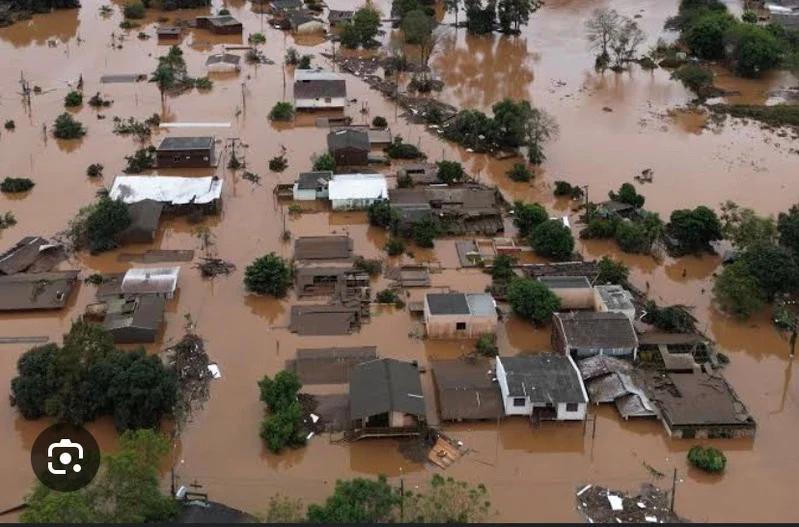
Violent deaths, unfair displacements, and devastating destruction have been only a part of the many horrific scenarios habitants of the Brazilian state of Rio Grande do Sul have been experiencing since the beginning of the biggest flooding in the state’s history in early April, an event that has been widely spread ever since and impacted people from all around the world with Its shocking and touching images and reports, a crisis that has caused true humanitarian damage and requires urgent aid. Therefore, my aim with this text is to provide an insightful analysis on the causes and outcomes of this conflict, in addition to how we, citizens, could help Its victims get through these desolating times.
Although the causes of the flooding might be uncertain and open to much debate, scientists believe a couple of factors led to such an uncontrollable and unexpected phenomenon, as none of the previous rainfalls at this time of the year had caused this much damage to the state; These factors include the increase in precipitation levels impulsed by phenomenons like the El Nino, a climate phenomenon that occurs every 2 to 7 years in the central and eastern tropical Pacific Ocean responsible for the warming of sea surface temperatures, the South Atlantic Convergence Zone (SACZ), a climatic feature in the Southern Hemisphere, where warm, moist air from the tropical Atlantic Ocean meets cooler air from the southern mid-latitudes, creating a zone of convergence and increased cloudiness, typically resulting in enhanced rainfalls and thunderstorms, and the effects of climate change and deforestation in general. Furthermore, the impacts of these already intense and unexpected precipitation levels were amplified considering the supposedly inadequate drainage infrastructure set in the river passing through the state’s capital, Porto Alegre, which was built with ineffective prevention to support heavy rainfalls.
As consequences, the tragedy has led to genuinely catastrophic outcomes, affecting over 95% of the state and leaving over 180 fatalities and 537,380 displacements, in addition to enormous structural damages that may require years and over 19 billion Brazilian reais to be rebuilt, huge economic losses for the state, crises in public health and refugee systems, and many other unimaginable horrific situations experienced by the victims, making the situation a truly disastrous humanitarian emergency. Furthermore, the desolating situation the state is in has also, unfortunately, opened space for an enormous increase in crime rates and similar schemes, with countless assault, rape, and even online robbery reports that have been concerning citizens and government agents from all across the country.
However, at the same time, it was also a moment of a truly inspiring union among the Brazilian community, with huge engagement from the whole country either through donations, volunteering, or simply awareness posts on social media, giving the event much greater visibility and providing Its victims with a place to be heard and supported. These efforts, showing us the power of a nation united in solidarity, combined with donations from many international associations and the efforts from the State and federal governments themselves to resolve this catastrophe’s impacts (for example, through public housing systems and investments in infrastructure) has lead to over R$ 91,7 billion Brazilian reais invested by the government to reconstruct the state, and over 100 million donated to charity institutions by the citizens themselve
However, even with these positive data and the latest decrease in water levels, allowing many of the Rio Grande do Sul habitants to begin returning to their “regular lives,” it is more important than ever that we, citizens, don’t allow this tragedy to fall into the hole of forgetfulness and continue helping in whichever way we can, as a long phase of reconstruction in the state is only beginning; until this day, many individuals are still grieving their loved ones, many families remain without being able to return to their houses, and many have lost absolutely everything, from money to personal items in the dreadful flooding. The water level may be lower, but their fight for survival and to move on continues.
With this, some ways to act and continue helping these flooding victims can be donations, volunteering, social media engagement, providing psychological support, and many more possibilities. Check the end of this page for some possible charitable institutions to donate to the Rio Grande do Sul victims.
In conclusion, this essay explored some of the main causes and consequences of the latest catastrophic floodings in the Brazilian state of Rio Grande do Sul, as well as the importance of continuing to support the state and effective ways to do so.
-ACNUR.org
Instituto Redemptor
-Central Única das favelas (CUFA)
-Correios
Por Júlia
