Maple Bear Granja Viana 30/10/2023- first edition
The Maple
The voices of students withputh filter; reflecting and amplifying community voices
The Hamas x Israel conflict It was a Tuesday afternoon, and the surrounding sky turned opaque grey, and the smell of smoke started penetrating the lungs of those nearby that the lives of thousands of citizens were changed forever as the group Hamas (a strong Palestinian nationalist movement) began Its invasion of land, sky, and water over the State of Israel. So far, the conflict has provoked over 1,400 brutal deaths and an enormous number of seriously injured, disappeared, and held hostage by the attacker, worrying numbers that continue to rise without perception of a peaceful ending any time soon, especially as the Israeli counterattacks continuously increase these statistics. However, to fully comprehend the roots for this seemingly inhumane conflict, we must go back in time to carefully analyze Middle East politics across history. Long before the creation of Israel was even rumored, the city of Jerusalem had provoked many religiously-influenced conflicts (for example, the Crusades, military expeditions financed by catholic churches to ocupate Jerusalem during the Middle age) due to the biblical importance of the city for Jewish, catholic and Islamic doctrines, making the competition for domain and occupation high. However, the fundamental tensions between Palestine and the Jewish movement arose in the late 1800s with the populational rise of Zionist Jews, a trend following the principles of a book written by Theodor Herzl, where he defended the creation of a Judaic State in the Palestinian territory (This area was chosen since the Jewish used to live there in ancient times). Furthermore, during the holocaust, many Jews began to emigrate from Europe to Middle East countries, like Palestine, to escape Nazi persecution, increasing the Jewish population in Palestine significantly, despite the limit of Hebrews imposed by the Palestinian government that year. Another critical point to understand the hostility between both States is the historical impact of Great Britain, who commanded Palestine from 1918 until 1948, on Middle East politics. Shortly before the British occupation of Palestine began, the controversial Balfour declaration was issued, a letter written by the then-Brittish foreign secretary Arthur Balfour, in which he declared “His Majesty’s Government view with favor the establishment in Palestine of a national home for the Jewish people, and will use their best endeavors to facilitate the achievement of this object.”. During Britain’s regiment, this letter was an essential part of their approach, and many of their policies were focused on the support to Zionist Jews, facilitating their entrance into the country, which caused the percentage of Hebrews living in Palestine to increase from 9% to 27% of the total population between 1922 and 1935. Furthermore, this was amplified when, shortly before the British colonization ended in 1948, they sent armaments to Zionist Jews in order to help create their homeland.
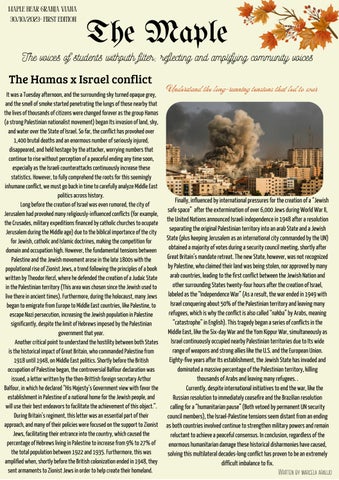
Understand the long-running tensions that led to war
Finally, influenced by international pressures for the creation of a “Jewish safe space” after the extermination of over 6,000 Jews during World War II, the United Nations announced Israeli independence in 1948 after a resolution separating the original Palestinian territory into an arab State and a Jewish State (plus keeping Jerusalem as an international city commanded by the UN) obtained a majority of votes during a security council meeting, shortly after Great Britain’s mandate retreat. The new State, however, was not recognized by Palestine, who claimed their land was being stolen, nor approved by many arab countries, leading to the first conflict between the Jewish Nation and other surrounding States twenty-four hours after the creation of Israel, labeled as the “Independence War” (As a result, the war ended in 1949 with Israel conquering about 50% of the Palestinian territory and leaving many refugees, which is why the conflict is also called “nakba” by Arabs, meaning “catastrophe” in English). This tragedy began a series of conflicts in the Middle East, like the Six-day War and the Yom Kippur War, simultaneously as Israel continuously occupied nearby Palestinian territories due to Its wide range of weapons and strong allies like the U.S. and the European Union. Eighty-five years after Its establishment, the Jewish State has invaded and dominated a massive percentage of the Palestinian territory, killing thousands of Arabs and leaving many refugees. . Currently, despite international initiatives to end the war, like the Russian resolution to immediately ceasefire and the Brazilian resolution calling for a “humanitarian pause” (Both vetoed by permanent UN security council members), the Israel-Palestine tensions seem distant from an ending as both countries involved continue to strengthen military powers and remain reluctant to achieve a peaceful consensus. In conclusion, regardless of the enormous humanitarian damage these historical disharmonies have caused, solving this multilateral decades-long conflict has proven to be an extremely difficult imbalance to fix.
Written by marcela araujo