The Maple

By Marcela Araujo
Uderstand the causes and consequences of this catastrophic tragedy and how to help Its victims
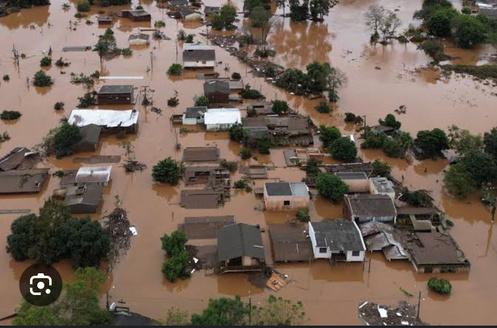
Violent deaths, unfair displacements, and devastating destruction have been only a part of the many horrific scenarios habitants of the Brazilian state of Rio Grande do Sul have been experiencing since the beginning of the biggest flooding in the state’s history in early April, an event that has been widely spread ever since and impacted people from all around the world with Its shocking and touching images and reports, a crisis that has caused true humanitarian damage and requires urgent aid Therefore, my aim with this text is to provide an insightful analysis on the causes and outcomes of this conflict, in addition to how we, citizens, could help Its victims get through these desolating times
Although the causes of the flooding might be uncertain and open to much debate, scientists believe a couple of factors led to such an uncontrollable and unexpected phenomenon, as none of the previous rainfalls at this time of the year had caused this much damage to the state; These factors include the increase in precipitation levels impulsed by phenomenons like the El Nino, a climate phenomenon that occurs every 2 to 7 years in the central and eastern tropical Pacific Ocean responsible for the warming of sea surface temperatures, the South Atlantic Convergence Zone (SACZ), a climatic feature in the Southern Hemisphere, where warm, moist air from the tropical Atlantic Ocean meets cooler air from the southern mid-latitudes, creating a zone of convergence and increased cloudiness, typically resulting in enhanced rainfalls and thunderstorms, and the effects of climate change and deforestation in general. Furthermore, the impacts of these already intense and unexpected precipitation levels were amplified considering the supposedly inadequate drainage infrastructure set in the river passing through the state’s capital, Porto Alegre, which was built with ineffective prevention to support heavy rainfalls.
As consequences, the tragedy has led to genuinely catastrophic outcomes, affecting over 95% of the state and leaving over 180 fatalities and 537,380 displacements, in addition to enormous structural damages that may require years and over 19 billion Brazilian reais to be rebuilt, huge economic losses for the state, crises in public health and refugee systems, and many other unimaginable horrific situations experienced by the victims, making the situation a truly disastrous humanitarian emergency. Furthermore, the desolating situation the state is in has also, unfortunately, opened space for an enormous increase in crime rates and similar schemes, with countless assault, rape, and even online robbery reports that have been concerning citizens and government agents from all across the country
\
However, at the same time, it was also a moment of a truly inspiring union among the Brazilian community, with huge engagement from the whole country either through donations, volunteering, or simply awareness posts on social media, giving the event much greater visibility and providing Its victims with a place to be heard and supported. These efforts, showing us the power of a nation united in solidarity, combined with donations from many international associations and the efforts from the State and federal governments themselves to resolve this catastrophe’s impacts (for example, through public housing systems and investments in infrastructure) has lead to over R$ 91,7 billion Brazilian reais invested by the government to reconstruct the state, and over 100 million donated to charity institutions by the citizens themselve
However, even with these positive data and the latest decrease in water levels, allowing many of the Rio Grande do Sul habitants to begin returning to their “regular lives,” it is more important than ever that we, citizens, don’t allow this tragedy to fall into the hole of forgetfulness and continue helping in whichever way we can, as a long phase of reconstruction in the state is only beginning; until this day, many individuals are still grieving their loved ones, many families remain without being able to return to their houses, and many have lost absolutely everything, from money to personal items in the dreadful flooding The water level may be lower, but their fight for survival and to move on continues.
With this, some ways to act and continue helping these flooding victims can be donations, volunteering, social media engagement, providing psychological support, and many more possibilities. Check the end of this page for some possible charitable institutions to donate to the Rio Grande do Sul victims
In conclusion, this essay explored some of the main causes and consequences of the latest catastrophic floodings in the Brazilian state of Rio Grande do Sul, as well as the importance of continuing to support the state and effective ways to do so
-ACNUR.org
Instituto Redemptor
-Central Única das favelas (CUFA)
-Correios
Understand the current situation of this devastating conflict and find out about Its most recent solution trial
By Melissa Hernandes
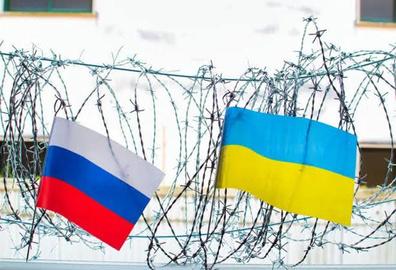
Underneath darkened skies, smoke, and ruins, it’s where more than 315 000 people spent their last moments. Families struggle to sustain their lives and seek shelter in their homes, as the fear of being bombed and attacked permeates their minds This has been the reality for many people living in Ukraine for the past two years, during the ongoing conflict between Russia and Ukraine. Many organizations have been established in response to this war, and people made various attempts to stop the conflict, but nothing seemed to help There were innumerable meetings between plenty of countries so that they could somehow alleviate the bloodshed, but none of them reached an agreement.
However, during the days fourteen and fifteen of June 2024, the world leaders met at a summit in Switzerland to discuss this unceasing encounter. Lamentably, some of the most acclaimed world leaders couldn’t, unfortunately, participate in the event, or straightforwardly denied engagement to the conference, and the assembly has led to no endorsement, consequently not resulting in a positive outcome.
The gathering led to a significant statement in support of national sovereignty– signed by over 80 countries. Some of the signatories included countries such as Hungary and Israel. Hungary, known for its typically pro-Russian stance, and Israel, initially neutral, have now shifted to a more critical position towards Russia This shift comes after Russia’s unrestrained support for Hamas following the October 7 terrorist attacks.
One of the biggest quarrels revolving around the meeting was undeniably the fact that Russia wasn’t invited. However, as was said before, many world leaders were not attending the gathering. For example, Joe Biden was absent during the assembly and sent Kamala Harris to fill in for him
Despite the high hopes and significant diplomatic efforts, the summit ultimately highlighted the complexities and deep divisions that characterize the ongoing conflict. The absence of key world leaders and the exclusion of Russia underscored the challenges in achieving a unified global stance. While the declaration supporting national sovereignty marked a symbolic victory, the lack of concrete steps toward peace leaves Ukraine's future uncertain. The summit in Switzerland serves as a stark reminder that diplomatic resolutions require more than agreements on paper they demand active, cohesive participation and the willingness to engage in difficult conversations, even with adversaries The world watches and waits, hoping for a breakthrough that can bring an end to the suffering and restore peace to Ukraine.
Find out about the battle that inspired our school’s street’s name and Its historical importance
By Melissa hernandes
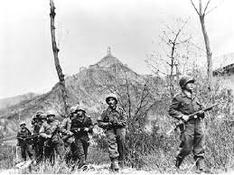
We take the same route to school every day along Monte Castelo Street. The street was named in honor of a battle that took place from November 25, 1944, to February 21, 1945, during World War II. The battle occurred in Italy, specifically 40 km north of Pistoia in Gaggio Montano.
The battle took place in the context of the Italian Campaign, a series of military operations carried out by the Allies in the Italian peninsula against Axis forces, more specifically Nazi Germany. Monte Castello, located in the Apennine region, was a strategic point crucial for the Allied offensive towards northern Italy.
The Brazilian Expeditionary Force (FEB) was sent to Italy as part of the Allied effort. That is because Brazil broke diplomatic relations with the Axis and sent troops in June 1944, being the only South American country to do so under its flag. Composed of around 25,000 men, the FEB was the only military force in Latin America to fight in Europe during World War II. The battle of Monte Castello was one of the most significant and challenging encounters faced by the FEB.
The first attempt to take over Monte Castello by the FEB happened in November 1944 but it faced strong German resistance and adverse weather conditions, resulting in failure. Further attempts in December 1944 were also unsuccessful, putting the persistence of Brazilian forces to the test.
Finally, on February 21, 1945, after careful planning and support from artillery and other Allied units, the FEB managed to take Monte Castello, overcoming German resistance. The capture of Monte Castello was a significant milestone for the FEB, demonstrating the capacity and bravery of Brazilian troops. This victory contributed to the Allied advance into Italy, helping to weaken German resistance in the region.
This battle marked a turning point in Brazil's military history and national pride. The successful capture of Monte Castello showcased the determination and capability of Brazilian forces, dispelling any doubts about their effectiveness on the global stage. It was a moment of immense national pride, as the FEB's triumph brought recognition and honor to Brazil, highlighting its contribution to the Allied victory in World War II. The battle also served as a testament to the resilience and bravery of the Brazilian soldiers who fought under harsh conditions and against a formidable enemy. Their perseverance in the face of adversity is remembered as a symbol of national strength and unity. In conclusion, the Battle of Monte Castello is not just a historical event but a cornerstone of Brazilian military heritage. It represents the courage and determination of the Brazilian Expeditionary Force and its vital role in the broader context of World War II. As we walk down Monte Castelo Street, we are reminded of the sacrifices made and the legacy left by those who fought for freedom and justice. Their story continues to inspire and resonate, serving as a poignant reminder of the cost of war and the enduring spirit of those who strive for peace.
By Marcela Araujo
Whether for Its pertinent political critiques or Its complex dystopic world, the book "1984", written by the British author George Orwell in 1949, has proved to be a truly timeless piece of scientific fiction, having been used for studies all around the world and responsible for sparking changes in many individual's political thoughts and opinions until the modern days. Therefore, my aim with this text is to analyze the society and ideals presented to us in the novel, how they operate, and compare them to the system we live in.
W. Written in the aftermath of World War II and amid the rise of totalitarian regimes, the story is mainly centered around the life of our protagonist, Winston Smith, a seemingly obedient and ordinary proletarian living among an autocratic reality of tyranny, control, and manipulation in the dystopian nation of Oceania. With a regular and unsuspecting life, the book describes Winston's routine as we continuously unravel the dangerous revelry and revolutionary thirst stained in his mind, becoming each time harder to hide as he attempts to survive and, at the same time, seek the real truth, in a world filled with ideological control, persecution, and mass manipulation.
With a society filled with posters written "The big brother (leader of this particular political party) is watching you," meticulous cameras in each corner, and persecution of all those with contrary opinions, the book could easily be interpreted by Its readers as simply a representation of a typical dictatorship in our modern society, a cruel, unfair reality, but unmysterious. However, with a careful analysis of the way Orwell portrays each character's ideals and actions, it becomes clear how the novel, in fact, brings a much deeper approach of a unique way of viewing the nature of power that is hidden behind the idea we have of autocracy and tyranny.
This idea of power, adopted by the omniscient party in this reality, is frequently combined throughout the novel in one fundamental principle presented to us from the very first pages: the direct association between power and control of the individual's mind. Therefore, the book introduces us to an idea that the only "effective" autocratic system that would survive with time is not constituted by the popularized idea of decimating or killing all those with different ideas but, instead, changing the individual's mind to accept and agree with the values cherished by the government, like expressed in the phrase "Power is to rip the human brain and put it back together giving the shape you want" since convincing and manipulating others to think as you want them to instead of abolishing all those with different thoughts is the only way to avoid a revolution, to avoid mass revolt.

All these issues are amplified when, throughout the book, Orwell begins approaching the importance of preserving individual freedoms by showing us how this party's active goal is to create an identiless society in which each human being is seen as nothing but a complementary, insignificant item to be manipulated, with, in fact, even the Big Brother himself not being a human creature, but instead a concrete, omniscient character to represent an immortal political party and generate mass hysteria and idolization with a symbolic figure, as a way to show that never-ending tasks, duty, and responsibility are always more reliable than particular humans, with feelings and identities. This is also represented in the way personal pleasures and feelings that constitute the human race, like love, affection, friendship, relationships, and hobbies, are repulsed and prohibited: Mother and child relationships aren't allowed, couples are forbidden from having any romantic bond between them and are used as a reproductive-useful only device, and friendships are strongly repulsed, while all these heartwarming and affectionate natural values of human beings are substituted by an imposed mass and blind fanatism by their leaders and their jobs.
Furthermore, another topic approached in various parts of the novel as a key aspect of the society created by Orwell is the manipulation of knowledge, information, and truth. This happens since, in the story, the government, responsible for controlling the whole nation, can basically alter any historical event to become the absolute truth due to the truth ministry (Ironically, the same as Winston worked), which was responsible for altering any possible evidence that might counterstate what the government declared true.
With this, the author presents to us a completely different idea of history, in which concrete past events are, at the end of the day, an illusion that can be rewritten over and over again; for example, during the story, the narrator tells us multiple times about how the nation of Oceania was constantly alternating between being allies with a nation and enemies with the other, but, by altering any evidence that they were ever in war with another country, it was like they were always with the same enemies and allies. In fact, the name "1984" (which, at the time, was in the future) was given to the piece to represent how the story would occur at some point in the future without even the citizens themselves knowing the exact year with this whole manipulation and indifference of the truth.
As a result, we see a completely blind, fanatic, and obsessed society with these inhumane values fixed in their operational system, creating a vicious cycle from generation to generation, with multiple deep and underwhelming scenarios throughout the novel to show this: Gelid, unaffectionate citizens gathered in monstrous auditoriums to pledge their leaders and offend what the government wanted them to believe was their enemy; Citizens unquestioningly defending a party they were simply taught to believe in, without being allowed to question; Kids being raised to believe inpreciselyy the same values from an early age and being able to identify those who think against the government and report them, even with their own family members, once again showing a society replacing their own humanity for a sickening obsession not only for their omniscient leader "The Big Brother," but for power, control, and manipulation like they are raised to believe in.
Allll these topics are approached in more detail as we dive deep into Winston's thoughts, perceptions, and actions, who we later discover is secretly against the system and begins trying to find silent methods to preserve the humanity and justice sense in him without being manipulated by the party. Firstly, he began writing a diary, which is not only itself a suspicious action against the government's principles as it would show Winston cherished individual thoughts and feelings, but, in it, he also criticized the Big Brother several times. Later, he began joining an association for the fall of this system, dating a woman (Julia) with romantical attractions, which is seen as against the inhumanity wanted from them, keeps a confusing but meaningful friendship with a coworker he believes to share the same opinions as him, and, most importantly, he continues an internal fight to always remember the truth and escape the undeniable faith of becoming just another lifeless, indistinguishable individual. I. n summation, all these aspects we clearly see represented in 1984 contribute to the representation of an, although seemingly exaggerated and absurd, reality that hiddenly is present in our modern society, and that, despite being written as a comparison to the rising post-WW2 dictatorships, seems to continue an extremely pertinent point of view that is becoming each timeless fictional in a world filled with wars, disputes for domination, rising fanatism and nationalism, and manipulation from both governments as well as presses and social medias, showing how Orwell's vision of a world stripped of individuality and truth serves as not merely a work of fiction, but a profound critique on the nature of power and its potential to corrupt and destroy.
Marcela Arantes Araujo (Y8)
Melissa Hernandes Linares (Y8)