The Studio of
Lori Putnam
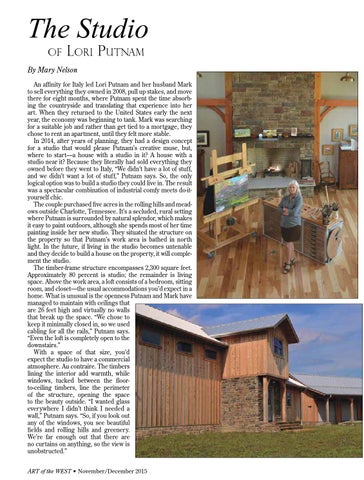
By Mary Nelson An affinity for Italy led Lori Putnam and her husband Mark to sell everything they owned in 2008, pull up stakes, and move there for eight months, where Putnam spent the time absorbing the countryside and translating that experience into her art. When they returned to the United States early the next year, the economy was beginning to tank. Mark was searching for a suitable job and rather than get tied to a mortgage, they chose to rent an apartment, until they felt more stable. In 2014, after years of planning, they had a design concept for a studio that would please Putnam’s creative muse, but, where to start—a house with a studio in it? A house with a studio near it? Because they literally had sold everything they owned before they went to Italy, “We didn’t have a lot of stuff, and we didn’t want a lot of stuff,” Putnam says. So, the only logical option was to build a studio they could live in. The result was a spectacular combination of industrial comfy meets do-ityourself chic. The couple purchased five acres in the rolling hills and meadows outside Charlotte, Tennessee. It’s a secluded, rural setting where Putnam is surrounded by natural splendor, which makes it easy to paint outdoors, although she spends most of her time painting inside her new studio. They situated the structure on the property so that Putnam’s work area is bathed in north light. In the future, if living in the studio becomes untenable and they decide to build a house on the property, it will complement the studio. The timber-frame structure encompasses 2,300 square feet. Approximately 80 percent is studio; the remainder is living space. Above the work area, a loft consists of a bedroom, sitting room, and closet—the usual accommodations you’d expect in a home. What is unusual is the openness Putnam and Mark have managed to maintain with ceilings that are 26 feet high and virtually no walls that break up the space. “We chose to keep it minimally closed in, so we used cabling for all the rails,” Putnam says. “Even the loft is completely open to the downstairs.” With a space of that size, you’d expect the studio to have a commercial atmosphere. Au contraire. The timbers lining the interior add warmth, while windows, tucked between the floorto-ceiling timbers, line the perimeter of the structure, opening the space to the beauty outside. “I wanted glass everywhere I didn’t think I needed a wall,” Putnam says. “So, if you look out any of the windows, you see beautiful fields and rolling hills and greenery. We’re far enough out that there are no curtains on anything, so the view is unobstructed.” ART of the WEST • November/December 2015
A massive floor-to-ceiling rock fireplace on one wall begs for overstuffed, comfortable chairs, which it will get in time. “We’ve done a lot of the work ourselves, and there is still a lot to do,” Putnam says. “Purchasing furniture has not been our number-one priority, but we’ll eventually have nice chairs around the fireplace.” Living space is important, she adds, “but the precedence is, where is the best place for the easel and the tabaret for the most creativity? [I want the work space] to feel good, and the living part will fold around that.” To help Putnam keep her creative juices flowing at peak capacity, she has selected an entire 36-foot wall—although it currently is unfinished—to house built-in alder wood cabinets and bookshelves that will reach far up the wall. “I’m a super organized person, and I have to put things away to feel creative,” she says. “All these cabinets will allow me to do that. It will be huge and open and nice and neat.” The only existing dividing wall is at the entrance to the studio and
separates that area from the kitchen. To the left are wine racks and a high bar area that looks into the kitchen, which is Mark’s domain. He likely will be the main attraction as visitors sip wine or coffee while watching him put his culinary skills to work. Turn left at the end of the dividing wall and you enter the studio, where the long wall with cabinets and shelves eventually will be to your left. When completed, that area will include 28 feet of base cabinets, a long counter area with shallow cabinets above it, and bookshelves running the entire length above. The highest bookshelf will be nine feet above the floor, which means that Putnam will need to employ the services of a rolling library ladder in order to access that space. Interspersed among the cabinets and shelves will be antiques from both sides of the couple’s families. “This is what will make the space homey and cozy, which is odd, because we are typically open glass and metal people,” Putnam says. “It’s interesting that we’ve built a structure like this.” A long, open space past the kitchen features double doors that look out onto a loading dock. That area is level with the
November/December 2015 • ART of the WEST
back end of a truck, making it easy to load large canvasses and frames. From the dock, it’s a straight shot right to the workroom, or left to Putnam’s easel, which sits in front of the mammoth fireplace. “When we lived in Italy, we had a fireplace big enough to build a fire in one portion, and then move coals over where we could cook on a little rack,” Putnam says. “That’s where we would grill pork chops and [other foods] in the winter. My husband wanted to replicate that here, so he designed this huge fireplace.” The workroom, which is directly beneath the bedroom, is the same size as the kitchen, except its ceilings are 10 feet high, because of the loft overhead. Putnam has dubbed this the room where she does her dirty work. It houses all her tools, boxes, and shipping supplies and is littered with frames stacked against the wall, but she has a identified a solution for the clutter: the void under the stairway that leads to the loft. Within the next six months, she plans to cut channels into the framing under the stairs and build high, narrow drawers that will slide out and where she will store her frames. “When it’s finished, I’ll just be able to pull out a tall, skinny drawer and there the frames will be, nice and protected, not dusty and not in my way,” she says. A do-it-yourself masterpiece of the studio is the floor: hand picked, mottled hickory. Putnam insisted that she and Mark lay the floor. “We put down 2,300 square feet of hardwood ourselves, and we probably placed each piece ART of the WEST • November/December 2015
Top - Dahlia Days
Bottom - August Blue Lake
four or five times to get the pattern I wanted,” she says. “I was afraid, if someone else did it, they’d put too many of the same mottled values together.” Because of the sheen on the floor and the number of windows above it, Putnam worried that a reflection from the floor would require curtains on the windows to filter the light. Much to her surprise, the light “is absolutely perfect all day long,” she says. “It is the most beautiful light. I don’t know how that worked out, but it’s my favorite part of the studio.” Because one wall in the studio faces true north and provides most of the light for Putnam’s work, she installed three sets of French doors. Above them are three large plate-glass windows that fill the spaces between the timbers rising to the ceiling. The entire wall is almost all glass and leads out onto a deck that runs the length of the house. Putnam’s studio—open and airy and situated in a beautiful, rural area—provides her the perfect space in which to work. The endless hours spent designing and creating the space has resulted in a structure that could not be more perfect. Mary Nelson is a writer living in Minneapolis, Minnesota.