plein air portfolio
Nocturnes, Sunsets & Sunrises
A
n increasing number of nocturnal paintings are being included in plein air competitions, in part because the artists enjoy the challenge of working in the dark and in part because the novelty attracts patrons to plein air festivals. Observers who become buyers are attracted to the painted records of the mysterious and fascinating play of lights. Here is how several plein air painters handled that challenge.
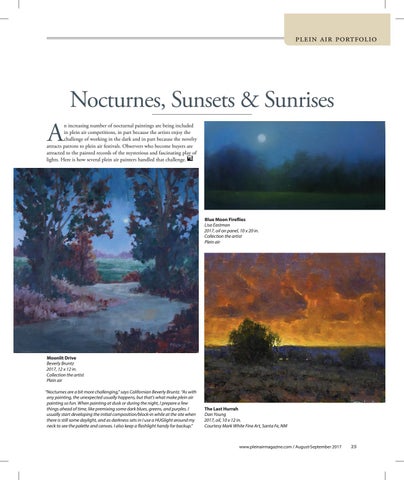
Blue Moon Fireflies Lisa Eastman 2017, oil on panel, 10 x 20 in. Collection the artist Plein air
Moonlit Drive Beverly Bruntz 2017, 12 x 12 in. Collection the artist Plein air “Nocturnes are a bit more challenging,” says Californian Beverly Bruntz. “As with any painting, the unexpected usually happens, but that’s what make plein air painting so fun. When painting at dusk or during the night, I prepare a few things ahead of time, like premixing some dark blues, greens, and purples. I usually start developing the initial composition/block-in while at the site when there is still some daylight, and as darkness sets in I use a HUGlight around my neck to see the palette and canvas. I also keep a flashlight handy for backup.”
The Last Hurrah Dan Young 2017, oil, 10 x 12 in. Courtesy Mark White Fine Art, Santa Fe, NM
www.pleinairmagazine.com / August-September 2017
25
plein air portfolio
St Croix Nocturne Mary Pettis 2017, oil on linen, 24 x 36 in. Collection the artist Studio based on plein air studies
December’s Breath George Bodine 2017, oil on primed linen, 16 x 12 in. Collection the artist Plein air “The most difficult aspect of nocturnal painting is color,” says George Bodine. “It’s not the values, or drawing, but it is finding the right way to express myself in the color. If I rely on the lights often present in the scene, like a typical sodium overhead street light, they change the color of my paints. However, keying a painting to a more yellowish, harmonious light can unify a painting. Also, certain colors naturally remain warm as they are illuminated, and keeping a color as deep as possible will give the illusion of light. “As with any painting, using one’s understanding of light and color is just as important as observation. I developed a series of nocturnal paintings relying mostly on my understanding of how artificial light illuminates form. The light in most of those paintings is imaginary. They were created in the studio from a very bad, quickly shot photo taken while walking in an alley in Paris. Finding a harmony in a painting like that is critical, and with nocturnes that harmony comes from a unifying light source. “For supplies, I use the same brushes, same medium(19th Century Copal Oil medium because of its quick-forming tackiness), and pretty much the same paint I use during the day. I really like to use a powerful yellow, such as Michael Harding lemon yellow, and Indian yellow! Originally, Indian yellow was not permanent, but today a good manufacturer like Harding will sell a permanent Indian yellow.”
26
August-September 2017 / www.pleinairmagazine.com
Past Midnight James Kroner 2017, oil on panel, 13 x 13 in. Private collection Plein air “When creating nocturnes en plein air, I am interested in the color of the night sky, the atmosphere, and the lights,” says James Kroner. “During an overcast or rainy evening, the clouds are illuminated by the city lights, and that causes the whole atmosphere to light up with reflected light. I found that working the opposite is helpful in the beginning when keying those night colors. Instead of working dark-
to-light or midtone-to-light, I first paint in the color of the sky and some of the night lights in order to gauge the darks. Then I proceed to work from back to front, building up the dark and the light with each pass. “Plein air at night is only possible with a headlamp or a clamp light that attaches to the side of the easel. I tried painting under a streetlight and found there was not enough illumination to see my painting and palette. I usually complete the plein air as a small study and use it to develop a studio piece, changing the composition and format to make the larger piece.”
Night Watch Lori Putnam 2016, oil on linen, 18 x 24 in. Collection the artist Studio
Duluth at Night Francesco Fontana 2016, watercolor, 10 x 12 in. Collection the artist Plein air
www.pleinairmagazine.com / August-September 2017
27
plein air portfolio
Full Moon Rising Biki Chaplain 2017, oil on canvas, 16 x 20 in. Collection the artist Plein air
Behind the Massage Parlor Carl Bretzke 2017, oil on linen, 22 x 28 in. Private collection Plein air
28
August-September 2017 / www.pleinairmagazine.com