Can higher insurance premiums due to short-term stays be charged to Airbnb owners?
Page 4 | Strata Insurance Solutions
Can I rent out my privately owned car space in a commercial strata?
Page 10 | The Knight
Are AGM minutes required to record proxies present at the AGM?
Page 18 | Melbourne Owners Corporation Services
About Us
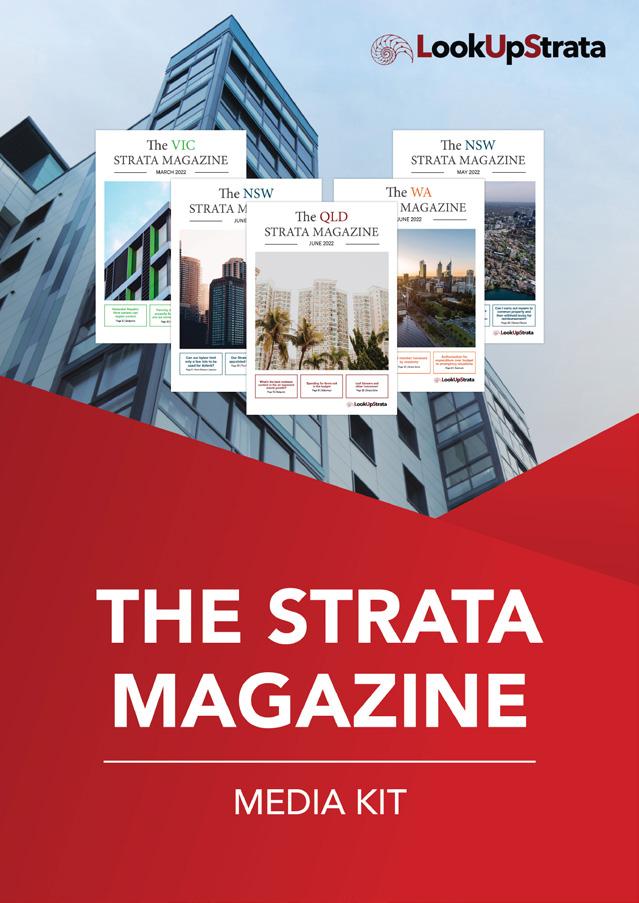
Welcome to the latest issue of The LookUpStrata Magazine!
For over a decade, LookUpStrata has been Australia’s premier resource for everything related to strata living. Our mission is to keep strata communities informed and connected, providing thousands of lot owners, strata managers, and professionals with reliable, unbiased, easy-to-understand information to help you solve your strata problems and make informed decisions.
The VIC Strata Magazines, published monthly, are just one of the many ways we’re dedicated to supporting you. They’re packed with articles from industry experts and include our comprehensive printable strata directory.
Beyond these pages, we also offer:
• Q&A Service: Our team of leading strata specialists answer hundreds of your questions every month, which helps shape the magazine topics we cover.
• Newsletters: Our weekly newsletters deliver timely updates on legislative changes and the latest strata news straight to your inbox.
• Webinars: Join our founder, Nikki Jovicic, for weekly webinars where she hosts and partners with industry experts to discuss key topics.
• The LookUpStrata Directory: A free resource that showcases hundreds of trusted strata service professionals nationwide. You’ll find it at the end of every magazine and on our website.
• Website: Find all our resources, articles, and news in one convenient location, accessible 24/7.
Subscribe now at no cost. To enjoy unrestricted access and connect with our strata community simply click here
Stay Connected - follow us on LinkedIn, Facebook, and YouTube.
Thank you for being a vital part of what makes our community so vibrant and trusted.
Nikki Jovicic Managing Director I Founder lookupstrata.com.au
20 Are nominee’s biographies and “how to vote” guides a usual inclusion in AGM papers?
Did you know about the maintenance plan loophole that allows committees to approve works without a special resolution?
Strata budgets should reflect past expenses, expected increases and owner priorities
Ongoing levy debts require separate tribunal recovery
Are owners corporations required to provide accessible parking for residents?
Can higher insurance
premiums due to shortterm stays be charged to Airbnb owners?
Do short-term stays affect strata building insurance? Must the owners corporation or building management notify the insurer if they occur?
Do short-term stays impact the insurance of a building under an owners corporation, stratum title, or company share structure? If Airbnb or similar short-term rentals are known to be happening, does the building manager or committee have a duty to inform the insurer?
If the owners corporation does not take steps to prevent or disclose shortterm letting, how can residents protect themselves from possible insurance issues or premium increases?
Most states in Australia allow the owners corporation to recover additional costs from the lots that contributed to the increased premium.
Short-term stays and holiday letting (such as Airbnb) can impact a building’s insurance, but the effect depends on how much of the building is being used this way. If it’s only a small proportion of lots—generally less than 10% and with many insurers even up to 20%—then even when disclosed, it usually doesn’t affect the premium. However, once the level of short-term letting increases beyond what an insurer considers a typical residential use, the insurer may apply premium loadings.
Each insurer has a different tolerance for shortterm letting, so it’s important for the owners corporation to inform the insurer or broker if they are aware of lots being used for short-term accommodation. This ensures there are no issues with non-disclosure if a claim arises. If short-term letting does cause an increase in the premium, most states in Australia allow the owners corporation (or equivalent body) to recover those additional costs from the specific lots that contributed to the increased premium.
In Victoria, this right is specifically supported under section 23(3A) of the Owners Corporations Act 2006 (Vic), which provides that:
The owners corporation may levy an additional annual fee on a lot owner if the owners corporation has incurred additional costs arising from the particular use of the lot by the lot owner.
This means that if the use of certain lots for short-term stays results in a higher insurance premium, the owners corporation can lawfully recover that additional cost from those lot owners rather than spreading it across all owners.
Mention this offer when requesting a quote from us, and we will provide a discount off our standard fee for service of $250 (GST Inc) for buildings with 10-25 lots or $500 (GST Inc) for buildings with more than 25 lots for the first year you insure with Strata Insurance Solutions
To redeem this offer email a copy of your current policy schedule to Strata Insurance Solutions within 1 month of the publication of this magazine Your policy can expire any time in the next 12 months However we can only provide quotes 30 days prior to the expiry of your policyif your policy is not due now, we will schedule a quote at the appropriate time To ensure we apply this offer to our quotes, please specifically mention you would like to redeem the "LookUpStrata Special Offer"
Take the test todaysee how much you can save.
Whether to treat or replace rusted rebar in concrete cancer repairs
In a Victorian strata building with concrete cancer, how much rust on reinforcing steel is acceptable before it must be replaced?
Concrete cancer treatment has started on our Victorian strata building. The contractor advised that they will only remove and repair areas of concrete that have visibly spalled, even though it appears that all of the reinforcing steel has some level of rust. In several places, rusted rebar ends protrude from the concrete. What level of rust on the reinforcing steel is considered acceptable before it must be exposed, cleaned, and treated, and at what point should the rebar be replaced entirely?
Reinforcement bar is usually only replaced if the steel has degraded to a point where it has lost its structural integrity.
Reinforcement bar is usually only replaced if the steel has degraded to a point where it has lost its structural integrity. Otherwise, the steel is treated depending on the specific circumstances.
Only a qualified structural engineer should make these determinations when there are significant problems, as often there are multiple factors to
Helping the strata community navigate
their building concerns
BUILDING CONSULTANCY
• Defect reports and forensic engineering
• Scope of works
• Dilapidation and risk surveys
• Dispute mediation and expert witness
• Contrator procurement and cost validation
• Construction management
• Capital works funds / maintenance plans
• Digital capability
• Façade assessments
REPAIR SOLUTIONS
• Emergency make safe
• Fire water damage restoration
• Leak detection
• Contamination response
• Building repairs
• Cost validation services
• Digital capability
Can I rent out my privately owned car space in a commercial strata?
Can I rent out my car parking space in a commercial strata building? Do I need approval from the committee or owners corporation manager?
I own a car parking space in a commercial building that is part of an owners corporation (OC). I rent out my car space. Another lot owner told me I am not allowed to do this, and threatened to report me to the owners corporation manager.
There is nothing in the OC rules that says I cannot rent out my space. Am I allowed to rent out my car parking space? If so, do I need approval from the committee or the owners corporation manager?
Letting your OC know would be a courteous thing to do.
Generally, parking spaces are privately titled, which means they can be rented out the same way an apartment can be.
If you are the lot owner, and there is nothing in the OC rules prohibiting it, you should be okay to continue. If you are a tenant, check if your tenancy agreement prohibits sub-leasing.
Having said this, your OC may have processes in place to manage this type of arrangement effectively.
For example, if you have provided a fob to access a secure car park, this fob may need to have building access turned off to protect the security of fellow owners. Or, if you are renting the space for short periods (e.g. a few days/ weeks at a time), this may pose additional security risks
Further, there may be other OC rules for the person to be aware of, particularly around their use of the common property, which they will likely be using to access the parking space.
For these reasons, letting your OC know would be a courteous thing to do. It will enable them to put appropriate measures in place and protect the safety and peaceful enjoyment of all other lots.
The Knight ella@theknight.com.au
Will all-inclusive strata management agreements replace fee-for-service models
With more businesses exploring fee-for-service models, will this model become standard across the industry, or are we still a long way from moving beyond all-inclusive agreements?
It will happen at different paces at different times, but we will get there.
The shift is on for different service models. The transformation of this is 2 to 3 years if we start now, and some people have. If laws are passed saying commissions are gone, it could happen faster because committees will demand that.
It’s interesting to study what happened when financial planning weaned itself off commissions and went fee-for-service. It took between one and three years. Some got there faster than others.
The members of SCA (ACT) have led the charge and said, “We’re just getting on with it. We want government to outlaw commissions, but we’re getting on with it”. Some of the bigger firms in Canberra are really well down the track of eliminating commissions.
It will happen at different paces at different times, but we will get there. The question referred to all-inclusive fees. That might not necessarily happen. We may still have fixed fees for commodities and hourly rates for other services, but we need to move away from conflicts of interest payments, commissions, and related-party transactions.
Michael Teys | Michael Teys Strata Advisory admin@michaelteys.com
READ MORE HERE
& Risk Under the Microscope: Emerging Threats and How to Respond
Insurance is one of the fastest-moving challenges in strata today. Premiums are rising, underwriters are more cautious, and exclusions are widening. Building age, combustible cladding, lithium battery fire risks and climate -related weather damage are all driving insurers to demand more evidence of sound risk management.
For strata managers, this means moving from a reactive stance to a proactive one. Rather than waiting for issues to surface through claims or complaints, the priority should be prevention and preparedness. Routine inspections help identify hazards early, detailed documentation shows the scheme is meeting its duty of care, and independent reports safeguard owners’ assets while reducing the risk of claim delays
Where QIA Group helps: Our Safety Reports identify compliance and safety issues before they escalate into costly claims, while our Insurance Valuations ensure schemes maintain accurate cover and avoid the risks of underinsurance. Together, these reports give strata managers and committees the confidence to demonstrate due diligence and protect their communities.
Expert Owners Corporation Lawyers
Hot Water Services - Can’t I put them anywhere?
So what is the case?
The case is Fok v Chen (Owners Corporations) [2025] VCAT 679
What is it about?
This proceedings was a dispute as to whether a lot owner was entitled to install their hot water service in another lot owners private lot
This case involved a dispute between Ellen and Billy Fok, owners of Unit 4 in a 1970s s uburban development, and their neighbour Huizhen (Lily) Chen, owner of the adjacent Unit 3 At the heart of the matter was the placement of the Foks’ hot water system, which had been installed without consent within the boundaries of Ms Chen’s private car park space
Complicating matters was the broader issue of fences and sheds erected by various lot owners over common property, a problem not uncommon in aging Owners Corporations that haven’t adapted to modern living arrangements.
While the Foks’ hot water system had been in place for years, it came under scrutiny after Ms Chen attempted to sell her unit in 2022, marketing it as having a “fully fenced backyard ” The Foks objected to this claim, and Ms Chen eventually withdrew the listing Ms Chen decommissioned the Foks’ hot water system, promptin g further legal action
The Foks brought proceeding OC307/2023 seeking compensation and broad orders including the removal of fencing across the development Ms Chen counterclaimed (OC146/2025), seeking removal of the hot water unit from her title
VCAT made an order requiring Foks to remove their hot water system from Ms Chen’s private property and relocate it lawfully - either onto their own land or onto common property with the Owners Corporation’s consent
So why did the Tribunal make the order?
The trespass was clear, evidence, including site plans and photos, showed the hot water service was well within Ms Chen’s private lot car space
The Foks’ argument that others were also unlawfully using common property (e g , fencing off backyard space) did not excuse their own trespass
The Owners Corporation had moved to grant 99-year peppercorn leases to regularise existing fenced areas of common property which was an appropriate remedy
In an interesting statement the Tribunal said: “In the absence of any legal authority being cited to me, establishing that peppercorn rental leases can only be used in an Owners Corporation environment if all lot owners ‘receive’ an equal area of common property for the private use, I must reject Edwin Fok’s argument ”
The Tribunal noted the Foks could relocate their hot water unit to the front of their unit, where an air conditioner was already installed, and obtain a similar lease from the OC
This case underscores the importance of clear delineation between private and common property, particularly in older subdivisions It also illustrates how Owners Corporations can use lease mechanisms to resolve longstanding encroachments without forcing widespread demolition of backyard improvements
Importantly, the Tribunal rejected the argument that one party’s unlawful use of land does not justifies another’s
Takeaways for Owners Corporations and Lot Owners
1. Encroachments onto common or private property should be regularised through formal leases, not informal agreements or inaction.
2. Lot owners must not assume that long-standing use of land creates a legal property entitlement.
3. Owners Corporations can and should act proactively to address safety, legal compliance, and access issues.
4. Legal action can be avoided through transparent communication and clear governance protocols.
Phillip Leaman LLB (HONS), BCOM Principal Lawyer 03 8600 9314 pleaman@tlfc com au
Need advice or assistance in a VCAT case?
Phillip Leaman, principal of the Owners Corporations practice group of Tisher Liner FC Law and his very experienced team can provide assistance to Owners Corporations, committees, lot owners and managers in a range of Owners Corporations legal matters. We have substantial experience in taking actions against builders, building surveyors, architects and plumbers for original building defects on common property and private lot property
We also act for lot owners and Owners Corporations in respect to Owners Corporation governance and assisting managers and committees
We believe Owners Corporations want to maintain peaceful, functional living environments for owners Our mission is to provide a fresh perspective on resolving legal disputes and to inspire Owners Corporations to achieve outcomes that preserves the value of assets and restores harmony We are expert Owners Corporations lawyers For advice or assistance, please contact Phillip Leaman
TLFC Blogs Archive
As one of Victoria’s leading firms in Owners Corporation law, Tisher Liner FC Law provides timely legal commentary and case law analysis to support the strata community This blog archive features our most recent publications, offering expert perspectives on legislative updates, dispute resolution and compliance obligations
Stay informed with the most recent articles and expert commentary from across the strata and Owners Corporation Whether you ’ re a lot owner, committee member, or strata manager, these blogs offer valuable perspectives on governance, compliance, insurance, and community living Register for our Owners Corporation Blog list to receive our latest blogs.
Disclaimer: This article is not intended to, nor should it be relied on as a substitute for legal or other professional advice It is a general commentary not to be relied upon without specific instructions to us and advice to you. Your needs and situation are unique, and each may yield different results.
Owners corporation obligations when facilities are unused or unsafe
What are the owners corporation’s obligations for maintaining or upgrading disused common property laundry rooms?
Our owners corporation property consists of 10 apartments across two buildings connected by open car parking. Two of the 10 apartments don’t have their own internal laundry. Each building has a shared laundry room with troughs and cold taps for washing machines. The buildings date back to the 1980s, and the laundries have been locked for years after vagrants began using one. A tenant recently asked to use a laundry.
What are the owners corporation’s obligations regarding these disused laundry rooms? Must the OC supply washing machines or upgrade the laundry rooms to include hot water? Do the minimum rental housing standards apply to the OC in this situation?
The rooms form part of common property and lot owners are entitled to use them so the OC should take steps to make those areas safe and usable.
The owners corporation (OC) has a duty under section 46 of the Owners Corporations Act 2006 (Vic) to repair and maintain common property, which includes the common laundry rooms. However, this duty does not extend to upgrading or modernising facilities unless the OC resolves to do so.
There is no obligation under the Act for the OC to install washing machines or provide hot water as an upgrade. The OC’s responsibility is to ensure that the existing infrastructure (such as taps and drainage) is safe and functional.
If the rooms have been locked due to safety concerns, it seems the OC was entitled to restrict access to protect residents and property. However, the rooms form part of common property and lot owners are entitled to use them so the OC should take steps to make those areas safe and usable.
Under the Residential Tenancies Regulations 2021 (Vic), rental properties in Victoria must meet minimum rental standards before a renter moves in. These standards are set out in Schedule 4 of the Regulations and apply to all rental agreements that started on or after 29 March 2021. There are 14 categories of minimum standards.
The standard regarding laundries says: If there is a laundry on the property, it must be connected to a reasonable supply of hot and cold water. This relates to laundries within a rented property, although the term ‘property’ is not defined in the Act.
The minimum rental standards under the Residential Tenancies Act 1997 apply to individual rental properties and are the responsibility of the rental provider (landlord), not the OC. However, under section 75A of that Act, the rental provider may join an owners corporation in an application relating to a breach of the duty to maintain premises relating to damage or defects to common property that adjoins the premises. This may arise in situations where repairs or urgent maintenance are needed to common property (such as roof leaks, broken lifts, defective water pipes) that impact a rented lot, or where tenants or rental providers have experienced loss, damage, or amenity reduction as a result of this failure. It is unlikely VCAT would find that a functional laundry room with cold water constitutes a failure to maintain for these purposes.
Experienced and Professional Owners Corporation Managers in Melbourne
At Horizon Strata, we make sure the job gets done properly without all the fuss.
Owners Corporation management requires expert knowledge as well as forward logical thinking to allow residents to live harmoniously, and owners to have peace of mind.
Horizon takes great pride in operating under these principles. This allows us to provide premium and transparent management for any strata-titled property.
Together with the day to day running of your Owners Corporation we provide comprehensive services which support owners through some of the most difficult & complex projects.
We are experienced in handling:
• Combustible Cladding
• Building Defects
• Financial Management
• Insurance Matters
Horizon does not take commissions or rebates from any supplier or Insurance provider. Our buildings under management range from 20 to 400 Lots so you can be assured we have the capability to manage your Owners Corporation, no matter the size.
Are AGM minutes required to record proxies present at the AGM?
Can an owner request amendments or a vote recount if proxy attendance is unclear in the AGM minutes?
The minutes from our last AGM list members present, proxies received, apologies, and other attendees, but there’s no section showing the names of proxies present. Eleven proxies were given to people who weren’t lot owners, and that omission changes the voting outcome. After inspecting the records, I confirmed that two of those proxy holders attended online, but there’s no record of the third person (who held eight proxies) being present.
I formally requested that the AGM minutes be amended to include proxies present and asked for a vote recount. The committee refused, saying it’s not mandatory to list proxies in attendance. Is this correct? Are AGM minutes required to record proxies who are present?
Your request for amending the AGM minutes to record which proxies are present is in accordance with the legislation.
Section 81 of the Owners Corporation Act 2006 states that the minimum information to be recorded in the minutes includes both the names of lot owners who have provided proxies and the names of proxies present. Therefore, your request to amend the minutes to state which proxies are present is in accordance with the legislation.
We also note that only proxies present at the meeting can vote on behalf of the lot owner. Also, there is a restriction on the number of proxies an individual may hold, depending on the size of the owners corporation.
Alex Smale | Melbourne Owners Corporation Services alex@mocs.com.au
We’ll secure the best deal for you.
We specialise exclusively in Strata Business Sales. No rent rolls, no distractions – just strata.
Why Choose Us?
12+ Years of Proven Strata Brokerage Experience
Nationwide Network of Serious Buyers Ready to Invest
Confidential and Secure Transactions to Protect Your Privacy
Comprehensive Information Memorandum Created to Show Your Business’s Strengths
Our fact-driven valuation process is backed by in-depth calculations and over a decade of industry experience, ensuring you get the best price.
Are nominee’s biographies and “how to vote” guides a usual inclusion in AGM papers?
What are the rules for including committee nominee biographies and how to vote guides in AGM notices?
Two years ago, our strata manager distributed biographies written by committee nominees to all lot owners and also circulated a how to vote guide written by the committee secretary. There was no formal committee motion authorising the strata manager to do either of these.
This year, when I sent my nominee form and bio to the strata manager, I was told that, “as per requirement under the Act”, the biography must be no more than 300 words. When I asked where this was stated, they admitted it’s not in the Act but said the bio is a privilege and compared it to the 300-word limit for explanatory notes on motions. Can you please confirm the actual requirements for including nominee biographies in AGM papers and whether the secretary can send how to vote notices to owners?
Nominee biographies are not required by law, nor is there a word limit in the Act.
1. Nomination Biographies
There is no requirement in the Owners Corporations Act 2006 (Act) or the Owners Corporations Regulations 2007 (Regulations) for nomination biographies to be submitted or distributed.
• The Act does not prohibit the inclusion of a biography by a nominee.
• There is no reference to a word limit (e.g. 300 words) for biographies under the Act or Regulations.
• The reference the strata manager made to a “300-word limit” relates to a completely different section of the Act—specifically:
• Under section 13(2) of the Act, an explanatory note for a motion submitted to a general meeting must not exceed 300 words.
• This limit only applies to explanatory material for motions, not biographies or election materials.
2. Distribution of Biographies by the Strata Manager
The strata manager is a service provider of the owners corporation and must act within their delegated authority under a contract or OC resolution.
• If the strata manager sends out bios or other materials without an OC resolution or written delegation, this may be outside their authority.
• A formal decision by the OC or its committee should authorise such communications, especially if they may be seen to influence voting.
The OC committee (or the OC at a general meeting) should consider passing a motion if it wants the strata manager to distribute nomination bios.
3. How to Vote Communications by the secretary
There is no provision under the Act or Regulations allowing or requiring the secretary to issue how to vote guides to lot owners.
• The secretary’s role is administrative (e.g. sending notices, keeping records), not political.
• Sending how to vote guides, especially if biased, could be seen as an inappropriate use of office and contrary to the principles of good governance under the Act.
A how to vote document should not be distributed by the secretary unless:
• It is formally authorised by a committee resolution, and
• It is neutral and purely instructional (e.g. explaining how to cast a vote), not promoting certain candidates.
Conclusion
• Nominee biographies are not required by law, nor is there a word limit in the Act. The 300word rule applies only to motions, not bios.
• The OC or committee should formally authorise the strata manager to distribute nomination materials.
• The secretary should not issue partisan voting instructions. Any such communication should be formally authorised and neutral in content.
For best governance, the OC should adopt a clear policy on election communications, including:
• Whether bios are accepted and their format.
• Guidelines about who is authorised to distribute them.
• Prohibition of unauthorised or partisan communications.
Ben Quirk | TOCS
ben.quirk@tocs.co
Did you know about the maintenance plan loophole that allows committees to approve works without a special resolution?
Can a committee alter a maintenance plan to approve works that would normally require a special resolution, creating a potential loophole in the legislation?
If a committee can amend a maintenance plan at any time, does this create a loophole in the legislation that allows committees to make significant changes—normally requiring a special resolution—by first approving those changes through an updated maintenance plan?
Vic certainly has a maintenance plan ‘loophole’, of sorts.
Yes, it is certainly a ‘loophole’, of sorts. In the context of very large owners corporations, there is arguably a need for this loophole, to which a committee is still accountable to their owners at the AGM, as passing a special resolution to change the colour of the paint in the gym, or add couches to the foyer, or info-screens to the lift, etc. Although these are all potentially debatable as ‘significant’, they would otherwise be an insurmountable obstacle.
Interestingly, the Victorian government appears at least partially aware. During their recent solar panel grants for apartments program, they have allowed for owners corporation to approve the panels being installed on common property by either special resolution, OR incorporation into a maintenance plan (and not requiring the special resolution).
One good way to fix the situation would be to provide a definition of the word ‘significant’ in the regulations, which can be amended quite readily by the government.
Alex McCormick | SOCM alex@socm.com.au
Excellence Transparency Partnership
Contact SOCM for a free and confidential assessment of your owners corporation functions, or a formal proposal for your management needs.
W socm.com.au E info@socm.com.au T 03 9495 0005
OWNERS CORPORATION MANAGEMENT SERVICES
At SOCM, we have developed an approach that focuses on delivering personalised service of the utmost quality and demonstrating exceptional professionalism in every aspect of our work. Our impressive property portfolio and positive testimonials serve as evidence of our position as a top Owners Corporation Management company in Victoria. We consistently maintain this position by prioritising comprehensive communication and promptly responding to our clients’ needs.
ACCOUNTING & FINANCIALS
COMMISSION FREE INSURANCE
DOCUMENTATION
MEETINGS & BALLOTS
LEGISLATIVE ADVICE & GUIDANCE
MAINTENANCE
“SOCM has provided an extensive service in Owners Corporation Management for more than a decade.”
Strata budgets should reflect past expenses, expected increases and owner priorities
What financial strategies can a body corporate use to manage levy income and expenses effectively? Should committees seek professional tax advice when preparing budgets?
As the treasurer of our body corporate, I’d like to explore whether there are more effective accounting and budgeting practices we could adopt to manage our levy income and expenses more efficiently. What financial considerations should committees take into account when deciding how to fund works?
Is it good practice to seek professional tax advice when preparing budgets, or do most committees rely on guidance from the strata manager alone?
Tax in strata is relatively simple.
It’s my understanding that many committees rely on their strata manager for budgeting advice. Of course, this is all relative to the manager, but generally speaking, this is ok.
Very often, a budget should be the prior year’s expenses rounded up. You may be aware that certain items, such as management fees, increase by 5% annually. Insurance premiums, being the exception lately, sometimes increase by 20%. Then, for new expenditure, budgeting is a best guess, or you may have quotes.
Then, levy income budgets are meant to either equal expenses, exceed expenses by any brought forward deficit (excluding loans), or exceed expenses to build up a surplus. All dependent on what the owners want to do. There is always a wide variety of owner’s income within a building that prevents a surplus from being realistic. A budget is an estimate/ plan that is ruined by anything unforeseen. Seeing the unforeseen is quite difficult.
Tax in strata is relatively simple, with the only real issue being the deductibility of levies to investor owners, which is the realm of your personal tax agent.
Matthew Faulkner | Matthew Faulkner Accountancy PTY LTD matt@mattfaulkner.accountants
Finance without the Fights
Real Choices. Real Support.
Hybrid Loans that give owners choice and committees control
Flexible funding and exceptional support every step of the way Defect Rectification Insurance Premiums Refurbishment Litigation Green Initiatives
Ongoing levy debts require separate tribunal recovery proceedings
Can the amount claimed in tribunal or court proceedings for levy recovery be increased to include additional levies that accrue before the ruling?
Once tribunal proceedings for a levy debt begin, can the amount we’re claiming be increased to include levies that continue to accrue during the lengthy period before a ruling? Otherwise, it seems the owners corporation must begin new recovery action for the next round of unpaid levies, which results in ongoing legal fees that quickly erode any recovered funds. Is this correct? Is there a more effective approach to managing these situations without having to repeatedly start new proceedings?
Any levies that do not form part of the original claim will not be automatically added after an application has been made or court proceedings have commenced.
This situation often arises when there is ongoing or recurring debt. Levies that become payable after an application has been made or proceedings have been commenced cannot be added to the tribunal or court proceedings. This applies consistently across all states.
Unfortunately, if it takes some time, for example a year, to recover those levies, the strata company will need to commence a new recovery process for any additional amounts that have become due since the commencement of proceedings.
Whilst the need to make a new application or commence new proceedings is frustrating, a new action may be commenced before the existing proceedings have been paid. If the cycle is ongoing, the owners corporation may need to seek advice about the options available to it.
Petra Lohmann | Bugden Allen petra@bagl.com.au
Are owners corporations required to provide accessible parking for residents?
Should an owners corporation provide an accessible parking space for disabled residents, or allow them to use the visitors’ disabled space if no resident space is available?
I am a disabled resident with a valid disability parking permit. Our building has a visitor car park with one accessible parking space, but I’ve been told I’m not allowed to use it because it’s for disabled visitors only. The problem is that the sign doesn’t clearly state it’s for visitors, and there are no accessible parking spaces allocated to residents.
Is the owners corporation required to provide an accessible parking space for residents, or at least allow me to use the visitors’ disabled space when it’s vacant?
Do they need to provide a disabled spot for residents as well, or allow me to use the spot they claim is for visitors if it remains vacant?
An owners corporation is not required to provide lot owners with a designated disability compliant car space (nor any car space).
Visitor spaces are usually (but not always) required to be provided as a condition of a planning permit and form part of the requirements that permitted the development.
If the planning permit requires that certain spaces be used for visitors, then the owners corporation is not able to reallocate those spaces to lot owners, etc. The purpose of visitor spaces is to reduce the car parking burden on the street. An owners corporation is entitled to make rules about the use of car spaces.
An owners corporation is not required to provide lot owners with a designated disability compliant car space (nor any car space). Car spaces are generally purchased with the lot and comprise common property. It is unusual for an owners corporation to control car parking that is anything other than designated visitor spaces.
Phillip Leaman | Tisher Liner FC Law ocenquiry@tlfc.com.au