Ongoing levy debts require separate tribunal recovery proceedings
Page 10 | Bugden Allen
Meeting procedures carry hefty legal consequences
Page 16 | Redchip Strata Law
Should a committee member receive a commission for arranging a body corporate loan?
Page 30 | Strata Solve and Mahoneys
About Us
Welcome to the latest issue of The LookUpStrata Magazine!
For over a decade, LookUpStrata has been Australia’s premier resource for everything related to strata living. Our mission is to keep strata communities informed and connected, providing thousands of lot owners, strata managers, and professionals with reliable, unbiased, easy-to-understand information to help you solve your strata problems and make informed decisions.
The QLD Strata Magazines, published monthly, are just one of the many ways we’re dedicated to supporting you. They’re packed with articles from industry experts and include our comprehensive printable strata directory.
Beyond these pages, we also offer:
• Q&A Service: Our team of leading strata specialists answer hundreds of your questions every month, which helps shape the magazine topics we cover.
• Newsletters: Our weekly newsletters deliver timely updates on legislative changes and the latest strata news straight to your inbox.
• Webinars: Join our founder, Nikki Jovicic, for weekly webinars where she hosts and partners with industry experts to discuss key topics.
• The LookUpStrata Directory: A free resource that showcases hundreds of trusted strata service professionals nationwide. You’ll find it at the end of every magazine and on our website.
• Website: Find all our resources, articles, and news in one convenient location, accessible 24/7.
Subscribe now at no cost. To enjoy unrestricted access and connect with our strata community simply click here
Stay Connected - follow us on LinkedIn, Facebook, and YouTube. Thank you for being a vital part of what makes our community so vibrant and trusted.
Nikki Jovicic Managing Director I Founder lookupstrata.com.au
Practical solutions to a ban on balcony clotheslines
Can I be forced to remove a discreet, colour-matched clothesline that’s been on my balcony for years? What options can the committee and owners consider?
I live in Brisbane and installed a fold-out clothesline on my level 4 balcony about five years ago. It’s colour-matched to the building and not visible from the street, obscured by trees and the façade. The clothesline only became an issue when it appeared in a photo on a real estate listing. At a recent committee meeting, the main concern the committee raised was that others might follow my example, even though many units already have portable clotheslines clearly visible from the street. The strata manager seemed unsure if anything could ultimately be done.
Can the committee make me remove the clothesline after it’s been there for years without complaint? And can I raise a motion for the body corporate to consider approving colour-matched fold-out clotheslines as a standard option for owners who want to install them?
You and the body corporate might want to think about how to adopt a more practical position.
Washing line by-laws still serve some purpose, but body corporates have to be realistic about their application. If a lot hangs washing in such a way that it makes the site look messy, it’s not unreasonable to ask that they be more considerate. On the other hand, if people want to hang their washing neatly, then there needs to be some acceptance of that.
Units are homes that people live in, and their washing has to go somewhere. It’s unrealistic to think that people can always dry washing inside or that everyone should have a dryer. I think your manager is asking the right question about how a body corporate would enforce an issue like this. OK, issuing a breach notice may help bring people in line, but after that, is it worthwhile for the body corporate to take owners through a legal process to enforce this by-law, and what would the outcome be?
Moving forward, think about how you and the body corporate might adopt a more practical position. This would likely be achieved by introducing a new by-law to establish reasonable and achievable guidelines. As you indicate, this could be to allow clotheslines, provided they were properly installed and matched the scheme colours. Would that be so bad?
William Marquand | Tower Body Corporate willmarquand@towerbodycorporate.com.au
Insurance risk when one owner in a duplex neglects common property maintenance
In our duplex, the other owner avoids maintenance. Will this affect our building insurance?
I’m one owner in a two-lot body corporate with a shared roof. I’ve noticed deterioration around the eaves and fascia that looks like it needs repair, but the other owner doesn’t think it’s serious. If we delay the work and the damage worsens during a storm, could our insurer reject a future claim because we were aware of the issue? Should I contact the insurer to disclose the problem?
If the other owner keeps avoiding maintenance, can I arrange work through the body corporate and pay for repairs from the sinking fund?
A cooperative approach will usually result in a faster and more cost-effective resolution.
Based on the information provided, it appears your duplex is likely registered under a building format plan, meaning the roof forms part of the common property. Under section 31 of the Body Corporate and Community Management (Specified Two-lot Schemes Module) Regulation 2011, the body corporate (in your case, the two lot owners together) is responsible for maintaining the common property in good and structurally sound condition, including roofing structures that protect the lots.
Body Corporate Responsibility for Repairs
If the roof is damaged, the body corporate has a statutory obligation to ensure it is maintained and kept structurally sound. In practice, there may be an element of maintenance involved, particularly with roof leaks.
Where the issue is purely maintenance-related (for example, worn sealant, blocked gutters, or general deterioration), the body corporate must pay for these works directly, as they form part of the maintenance obligations rather than an insurance event.
However, if the roof is damaged (for example, in a storm) or a maintenance issue has caused resultant damage (for example, water ingress damaging ceilings or walls), that consequential damage may be claimed under the insurance policy, provided it meets the policy’s terms, conditions and exclusions.
If one owner is unwilling to cooperate, the other owner (as part of the body corporate) can take reasonable steps to have the work arranged, and the costs can be recovered in accordance with each owner’s lot entitlement. If you cannot reach an agreement, the matter may be referred to the Office of the Commissioner for Body Corporate and Community Management for dispute resolution.
Insurance Implications
Most strata and building insurance policies contain exclusions for non-rectification of known defects, errors, or omissions. If you are aware of an issue (such as a roof leak) and do not take reasonable steps to rectify it, the insurer may later decline a claim arising from that defect.
Insurance policies generally respond to sudden and accidental damage, not gradual deterioration or long-term water ingress. If the problem develops over time, it may not fall within the scope of cover.
Duty of Disclosure
Under the Insurance Contracts Act 1984, there is a duty of disclosure requiring you to inform your insurer of any matter you know (or could reasonably be expected to know) that might be relevant to their decision to insure you.
Technically, an unrepaired leak or known defect should be disclosed at renewal. While the insurer must prove that non-disclosure was deliberate or materially influenced their decision (a high threshold), failure to disclose could still give them grounds to reduce or deny a claim, or to refuse renewal, if the defect contributed to a later loss.
Final Comment
While the legislation and insurance considerations are clear, in practice, it is always best to seek agreement with the other owner rather than escalating the issue into conflict. A cooperative approach will usually result in a faster and more cost-effective resolution, maintaining good neighbourly relations and ensuring the property remains well protected and insurable.
Mention this offer when requesting a quote from us, and we will provide a discount off our standard fee for service of $250 (GST Inc) for buildings with 10-25 lots or $500 (GST Inc) for buildings with more than 25 lots for the first year you insure with Strata Insurance Solutions
To redeem this offer email a copy of your current policy schedule to Strata Insurance Solutions within 1 month of the publication of this magazine Your policy can expire any time in the next 12 months However we can only provide quotes 30 days prior to the expiry of your policyif your policy is not due now, we will schedule a quote at the appropriate time To ensure we apply this offer to our quotes, please specifically mention you would like to redeem the "LookUpStrata Special Offer"
Take the test todaysee how much you can save.
Ongoing levy debts require separate tribunal recovery proceedings
Can the amount claimed in tribunal or court proceedings for levy recovery be increased to include additional levies that accrue before the ruling?
Once tribunal proceedings for a levy debt begin, can the amount we’re claiming be increased to include levies that continue to accrue during the lengthy period before a ruling? Otherwise, it seems the body corporate must begin new recovery action for the next round of unpaid levies, which results in ongoing legal fees that quickly erode any recovered funds. Is this correct? Is there a more effective approach to managing these situations without having to repeatedly start new proceedings?
Any levies that do not form part of the original claim will not be automatically added after an application has been made or court proceedings have commenced.
This situation often arises when there is ongoing or recurring debt. Levies that become payable after an application has been made or proceedings have been commenced cannot be added to the tribunal or court proceedings. This applies consistently across all states.
Unfortunately, if it takes some time, for example a year, to recover those levies, the strata company will need to commence a new recovery process for any additional amounts that have become due since the commencement of proceedings. Whilst the need to make a new application or commence new proceedings is frustrating, a new action may be commenced before the existing proceedings have been paid. If the cycle is ongoing, the body corporate may need to seek advice about the options available to it.
Petra Lohmann | Bugden Allen petra@bagl.com.au
Setting reasonable compliance conditions for lot owner’s renovation approvals
What compliance conditions should a body corporate apply to lot renovations? Is the body corporate responsible for independently certifying the work?
I am on a body corporate committee in Queensland. Lot owners must apply to the committee for approval before carrying out renovations to their lots. These works are usually non-structural but can include wet area waterproofing, plumbing and electrical work, and penetrations through fire-rated ceilings and concrete floor slabs for services such as air conditioning.
What compliance conditions should the body corporate include when it approves these renovations, for example, compliance with the Building Code of Australia, Australian Standards, licensing and certification requirements? Is the body corporate responsible for obtaining its own independent certifications for renovation work, or can it rely on lot owners to arrange and provide them?
The costs of obtaining appropriate reports and evidence of compliance should be placed upon the lot owner requesting permission to carry out works.
Often, the by-laws will include standard conditions that apply to every approval, together with some flexibility for the committee to impose additional conditions and requirements as the circumstances require (depending on the nature of the work involved).
For instance, it may be appropriate that an owner obtain an appropriate report from an acoustic consultant where any hard-flooring works are involved to ensure that the installed flooring meets any prescribed standard under the by-law, or some other reasonable standard imposed by the committee as part of its consent to the works. If internal walls are being removed or reconfigured, it may be appropriate to require an engineer’s report confirming that the work will not affect or compromise the building’s structural integrity.
Other types of conditions, such as ensuring the works meet all relevant provisions of the building code and Australian Standards, have Council approval (where required), and are carried out by licensed contractors with appropriate public liability insurance, are generally always appropriate regardless of the exact nature of the works.
Certainly, the costs of obtaining appropriate reports and evidence of compliance should be placed upon the lot owner requesting permission to carry out works. They should not be a cost borne by the body corporate. However, it is important to ensure that, even though the owner, rather than the body corporate, will bear the costs, any conditions imposed for obtaining expert reports remain reasonable and appropriate in the circumstances.
For instance, where the works are nonstructural in nature, it would be unreasonable to impose a condition that the works be certified by an engineer.
Helping the strata community navigate their building concerns
BUILDING CONSULTANCY
• Defect reports and forensic engineering
• Scope of works
• Dilapidation and risk surveys
• Dispute mediation and expert witness
• Contrator procurement and cost validation
• Construction management
• Capital works funds / maintenance plans
• Digital capability
• Façade assessments
REPAIR SOLUTIONS
• Emergency make safe
• Fire water damage restoration
• Leak detection
• Contamination response
• Building repairs
• Cost validation services
• Digital capability
Will all-inclusive strata management agreements replace fee-for-service models
With more businesses exploring fee-for-service models, will this model become standard across the industry, or are we still a long way from moving beyond all-inclusive agreements?
It will happen at different paces at different times, but we will get there.
The shift is on for different service models. The transformation of this is 2 to 3 years if we start now, and some people have. If laws are passed saying commissions are gone, it could happen faster because committees will demand that.
It’s interesting to study what happened when financial planning weaned itself off commissions and went fee-for-service. It took between one and three years. Some got there faster than others.
The members of SCA (ACT) have led the charge and said, “We’re just getting on with it. We want government to outlaw commissions, but we’re getting on with it”. Some of the bigger firms in Canberra are really well down the track of eliminating commissions. It will happen at different paces at different times, but we will get there. The question referred to all-inclusive fees. That might not necessarily happen. We may still have fixed fees for commodities and hourly rates for other services, but we need to move away from conflicts of interest payments, commissions, and related-party transactions.
Michael Teys | Michael Teys Strata Advisory admin@michaelteys.com
Insurance & Risk Under the Microscope: Emerging Threats and How to Respond
Insurance is one of the fastest-moving challenges in strata today. Premiums are rising, underwriters are more cautious, and exclusions are widening. Building age, combustible cladding, lithium battery fire risks and climate -related weather damage are all driving insurers to demand more evidence of sound risk management.
For strata managers, this means moving from a reactive stance to a proactive one. Rather than waiting for issues to surface through claims or complaints, the priority should be prevention and preparedness. Routine inspections help identify hazards early, detailed documentation shows the scheme is meeting its duty of care, and independent reports safeguard owners’ assets while reducing the risk of claim delays
Where QIA Group helps: Our Safety Reports identify compliance and safety issues before they escalate into costly claims, while our Insurance Valuations ensure schemes maintain accurate cover and avoid the risks of underinsurance. Together, these reports give strata managers and committees the confidence to demonstrate due diligence and protect their communities.
Meeting procedures carry hefty legal consequences
Serving on a body corporate committee can often feel like dancing on legal eggshells, and the innocent volunteer can quickly find themselves ankle-deep in a procedural omelette.
For example, is there really that much difference between a meeting voting on an ordinary resolution versus a special resolution?
In short: Yes, there is
Unlike ‘the vibe’ from the classic Australian film The Castle, courts tend to adhere to the black letter of the law, even when the intent is clear
As the body corporate for one Gold Coast strata scheme has discovered to its cost, it’s not just a case of semantics: terms such as ‘ordinary resolution’ and ‘special resolution’ carry specific meaning in legislation.
In a case heard before the Supreme Court of Queensland, the body corporate for Oceana on Broadbeach commenced proceedings against the developer and the builder of a project on an adjoining property, seeking damages for trespass and nuisance There were allegations of a boundary fence and vegetation being removed, and excavations that damaged utilities on Oceana’s property All these issues are proper things to have arguments about.
In brief, all the parties subsequently signed a licence agreement, and the building work could continue
However, just months later Oceana claimed the agreement had been breached and commenced proceedings in the Supreme Court seeking a permanent restraint on the developer and the builder from entering Oceana’s property
This is where the procedural eggshells started to crack.
Under the BCCM Act, a body corporate can only initiate legal proceedings for something of this nature under the authority of a special resolution of the body corporate
According to the minutes of Oceana’s AGM in November 2024, the agreement to pursue legal action against the neighbouring developer and
builder was passed an as ordinary resolution (30 in favour, 2 opposed, and 4 abstains)
The defendants’ lawyer seized on that, arguing that the proceeding was incompetent because it was not authorised by a special resolution
There is insufficient space here to detail the difference in voting requirements between the two types of resolutions, but suffice to say this was procedural crack number one.
Further cracks emerged in the procedure to retrospectively approve the body corporate’s decision to undertake legal proceedings in the first place and in a BCCM adjudicator’s jurisdiction to truncate the period of notice for an extraordinary general meeting to try to urgently rectify the noncompliance
As Chief Justice Bowskill noted: “There is an understandable sense of frustration in such a conclusion, because it seems quite apparent that there is overwhelming support from the body corporate for the action taken against the defendants, both in September 2024 and now. However, that practical consideration cannot overshadow the operation of the legislation ”
As this was a case of “compounding procedural and technical irregularities or failures to comply with the mandatory terms of the legislation” the proceedings were stayed (with a hope for an ultimate resolution) Costs are to be determined at the time of writing.
All of which has been a long, ongoing and expensive undertaking that highlights the importance of a body corporate being mindful of the importance of following the legal process
The full background and ruling from the Supreme Court can be found at: https://www sclqld org au/caselaw/154616
Frank Higginson, Partner Redchip Strata Law
When electrical upgrades are needed for new installations, who pays?
In QLD, who pays for electrical upgrades of a unit’s switchboard if an owner wants to install ceiling fans?
I live in a complex of eight units and want to install ceiling fans in my apartment. The electrician advised that I need to upgrade my switchboard to include a safety switch and single pole circuit breaker before he can install fans. Are electrical upgrades my responsibility as the lot owner, or are they covered by the body corporate?
It may sound simple, but if your electrical setup is old, minor adjustments can often have knock-on effects.
The switchboard is usually a body corporate responsibility . If changes are required, they need to be authorised by the body corporate.
As an owner, you need to make an application to change the common property. Submit your quote along with your proposal.
As this change benefits your lot only, expect that if the body corporate grants approval, it would be on the basis that you pay the costs.
An alternative could be to suggest an upgrade for the whole switchboard. This would be at body corporate cost and would benefit all owners. You could get a quote for this or ask the committee to get one.
One consideration for the committee in approving an application for your lot only would be whether giving any extra capacity to your lot would restrict the possibility of giving the same capacity to other lots. Requests like this often seem simple on the surface, but if your electrical setup is old, minor adjustments can often have knock-on effects. Any application you make should consider this.
William Marquand | Tower Body Corporate willmarquand@towerbodycorporate.com.au
Altogether EV solutions.
Future-proofing developments with smart EV charging infrastructure.
As a leader in embedded energy infrastructure and EV charging solutions, Altogether partners with property developers, owners’ corporations, and strata managers to integrate scalable, costeffective, and future-ready EV infrastructure.
Our expertise ensures developments meet evolving sustainability standards while enhancing property value and resident appeal. find out more
EV charging enhances a building’s desirability, providing residents and tenants with a critical service while supporting longterm asset value.
Partner with Altogether for a Smarter EV Future.
As EV adoption accelerates — expected to reach 50% of new car sales by 2030 — proactive investment in EV infrastructure is essential for maintaining competitive and sustainable developments.
Contact us to learn how our solutions can benefit your community.
altogethergroup.com.au
Is the AGM the only time approval for lot renovations can be granted?
Can renovation approvals in a QLD strata lot be granted outside the AGM?
In Queensland, can a body corporate consider and approve renovation requests, such as for an apartment bathroom renovation, only at the annual general meeting, or can these types of approvals also be decided at other meetings held during the year?
There is no difference in approval type between an annual general meeting or an extraordinary general meeting.
For a bathroom renovation that doesn’t affect common property, the need for approval will be determined by whether the by-laws regulate the need for approval.
Either way, any such approval does not need to wait for the AGM. If the committee can approve it, it can be approved by VOCM, and even if a general meeting is needed, this can be
Can an owner install
privacy panels around a common property pool?
Can an owner install privacy panels around the common property pool?
In our complex, one owner wants to install privacy panels on or around the common property pool fence permanently for personal comfort. Are owners allowed to add privacy screens to common property, or would that be considered taking privacy too far?
People cannot just annex or take over a section of common property at their choosing. There’s a process to go through.
If an owner is installing a ‘privacy panel’ on a common property pool, then without knowing all the details, we’d think that is someone making an improvement to common property – and they will likely need permission from either the committee or a general meeting to do that. People cannot just annex or take over a section of common property at their choosing. There’s a process to go through.
We stress, we know nothing of these ‘panels’ or ‘fences’, so we couldn’t tell if this is, for example, a fixture or if it is something transportable. Both of those things may make a difference. Certainly your comment about ‘permanently’ suggests something is being affixed, which in turn makes us think
permission would be needed for that first.
If a resident at the scheme is concerned about their privacy, or is concerned for their safety, enough to want to install something to prevent someone else from getting close to them, that’s a different issue and should be treated seriously. Police may need to be contacted.
Chris Irons | Strata Solve chris@stratasolve.com.au
Solve helps untangle and resolve strata issues, and in the process protect the value of your strata asset, without the need for time-consuming, expensive and stressful legal proceedings.
Director and Founder of Strata Solve Chris Irons (pictured with the late Ernest, Strata Solve mascot) has an unrivaled strata perspective. As Queensland’s former Commissioner for Body Corporate and Community Management, Chris has seen and heard virtually every strata situation and nuance. He knows that while legislation provides a framework, there are many ambiguities to navigate through and in which pragmatism, common-sense and effective communication are vital.
As an independent strata consultant, Chris provides services based of his experience as an accredited mediator and which are all about empowering owners, committees, managers, caretakers, tenants, not-for-profits and others, to protect their strata interests. Chris uses tailored solutions to help his clients: one size definitely does not fit all in strata. Book a f free, initial consultation now to find out how we can work with you to resolve your strata issue.
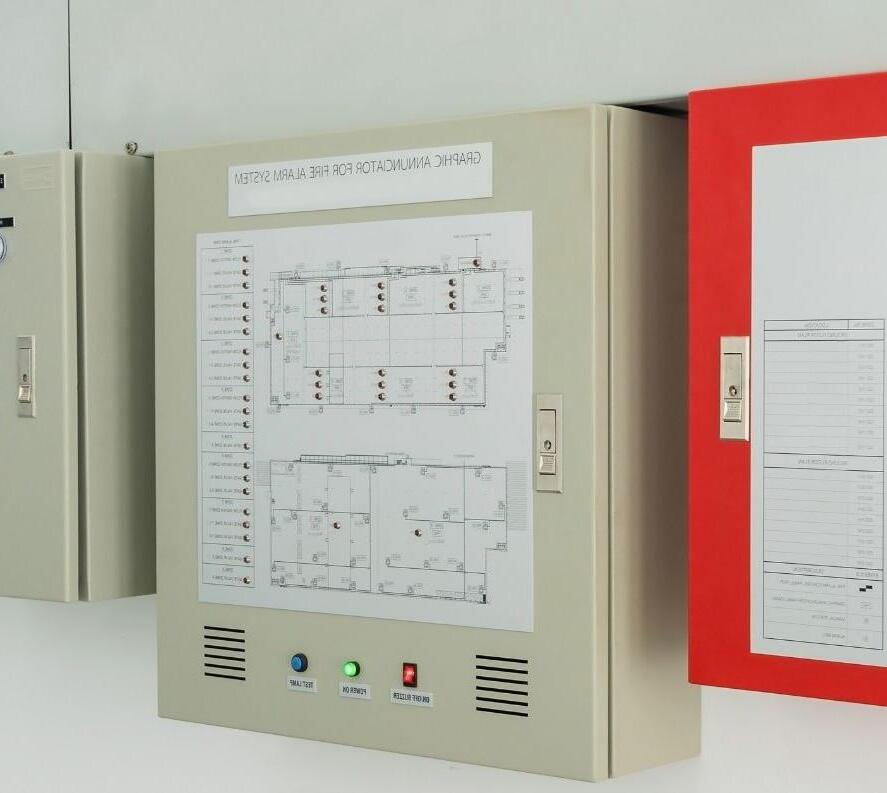
Requirements for installing a door over a fire control panel in our building’s foyer
Can we install a hinged door over the fire control panel in our foyer? What signage do we need?
We would like to install a simple hinged door to cover the fire control panel in the entrance foyer of our apartment building to improve the appearance of the area and for protection. The door would open easily and have clear signage indicating the fire control panel. Can we do this, provided access remains unobstructed? Also, where can we find the correct standard wording or design for the required signage?
Signage must be in contrasting colours so it is highly visible against the background.
You can install a simple hinged door over a fire control panel provided that:
• The door is not lockable and can be easily opened without the use of a key or tool.
• The door does not obstruct access to the panel or reduce visibility in an emergency.
• Clear signage is fixed to the outside of the door indicating the presence of the fire indicator panel. This signage must be in contrasting colours so it is highly visible against the background.
Regarding signage, you can usually obtain compliant fire panel signs through safety signage suppliers, fire equipment companies, or online safety product stores. These suppliers provide signage that meets Australian Standards for fire safety and building compliance.
Stefan Bauer | Fire Matters sbauer@firematters.com.au
F i r e S a f e t y D a t a
Is your compliance at risk from third-party software?
Fire service contractors are increasingly using third-party software systems to manage scheduling, site data, asset registers, inspection reports and statutory compliance records These platforms promise operational efficiency but also introduce risks for body corporates and building managers as it is your legal duty to maintain and produce verifiable fire safety records on request
Third-party platform risks include:
Inaccessible Records: If records are locked in a contractor’s cloud platform, you cannot produce them onsite for a fire authority inspection. “The system is down” is not a valid excuse, and the resulting penalties are yours to bear.
DON’T RISK IT!
If a retrospective investigation finds any aspect of your fire safety non-compliant, you risk voided insurance, hefty fines and even jail That’s why it’s crucial to get an independent third-party consultant to audit your building.
Altered Evidence: Some platforms allow contractors to edit or delete historical reports without an audit trail. In the event of an incident or dispute, this makes it impossible to prove what was originally reported, jeopardising insurance claims and legal defences.
Data Hostage: A commercial dispute between your contractor and their software vendor can see your entire compliance history suddenly suspended or deleted You may have no legal right to recover it
Protect your building and your liability
Insist your contractor delivers all inspection reports, certificates and logs in unalterable PDF format.
Maintain onsite copies of this documentation for auditors and emergency responders
Compliance is your responsibility, so ensure your fire safety records are secure, verifiable and permanently in your possession.
Stefan Bauer Fire Matters
READ MORE HERE
Fire Matters provides an unbiased fire compliance assessment that could save you thousands We also ensure your residents are fully trained in the event of a fire, giving you peace of mind when signing your occupier’s statement.
How can elderly owners without email return voting papers for electronic meetings?
How can elderly owners without email or scanning access return voting papers securely when all meetings are electronic?
Our building has several elderly owners who don’t use email or computers and can’t scan documents. They receive their voting papers by post, but with ongoing mail delivery issues, they’ve asked to hand-deliver a hard copy instead. The secretary lives off-site, so owners can’t hand-deliver the papers, and we hold all meetings electronically. Can these owners complete their papers and place them in the secretary’s or body corporate mailbox? If the secretary can’t collect them, can they authorise the chairperson to retrieve, scan, and forward them to the strata manager for inclusion?
The body corporate could grant a specific authorisation for the chairperson to collect voting papers from the body corporate’s mailbox on behalf of the secretary.
Submitting hard copy voting papers requires that a voter cast a written vote by giving the voting paper to the secretary (by hand, by post or by facsimile) before the start of the meeting. You can read the specific legislative reference here:
95 Casting a hard copy vote—open motion.
This means that you cannot provide the voting paper to someone else to give to the secretary, even the chairperson, as they are considered an intermediary. That said, placing a voting paper in the body corporate mailbox complies with the requirement to deliver it to the secretary. The next issue is the chairperson retrieving the voting papers from the mailbox, then scanning and sending them to the body corporate manager for processing before the meeting.
This potential break in the chain of voting paper delivery directly to the secretary or the body corporate manager, who is typically authorised by agreement to perform the functions of the secretary, could become a dispute if another lot owner was concerned that the chairperson is acting as an intermediary. I suggest this concern could be overcome by the body corporate granting a specific authorisation for the chairperson to collect voting papers from the body corporate’s mailbox on behalf of the secretary, just like the authorisation given to a body corporate manager to perform this function of the secretary.
A simpler way to overcome the issue of submitting voting papers is with the use of a smartphone, if available, to take a picture and send the voting paper via email. No post or hand delivery to a mailbox is required, and there is no potential for disputes.
Grant Mifsud | Archers the Strata Professionals grant.mifsud@abcm.com.au
Should a committee member receive a commission for arranging a body corporate loan?
If the treasurer arranges a body corporate loan, should the commission be paid to them personally or to the body corporate?
Our body corporate needs to take out a large loan of around $500,000 to cover unexpected maintenance costs, with repayments to be made through a loan levy. The treasurer introduced the loan to the financial institution and intends to take a rolling commission from the loan over the 20-year term, regardless of whether they remain on the committee.
Should there be a commission? If so, should the body corporate, rather than the committee member, be the introducing party so that the commission is paid into the body corporate account for the full duration of the loan and the benefit of all owners?
It would seem unusual for the committee member to obtain the benefit of any commission
Chris Irons, Strata Solve:
Your query touches upon several possibly relevant areas.
Let’s remember that a committee is a creature of statute, designed only to do what legislation empowers it to do, and that a committee is obliged by legislation to ‘act reasonably’. Moreover, committee members are only protected from liability to the extent they act in good faith. There are also Code of Conduct
provisions that apply to committee members, including those regarding conflicts of interest Another issue is that a body corporate is not meant to be a commercial enterprise (including making money from a body corporate function).
So in your scenario, we are not sure – to say the least – how the committee member in question has met their obligations with any or all of the above. It’s also not clear from your query the extent to which the committee and the specific committee member have adequately disclosed these arrangements: even if there isn’t an express requirement to disclose these specific instances, one would think owners would like (need?) to know about this.
Liam Boudin, Mahoneys:
While there is nothing in the legislation which requires the body corporate to be the introducing party in relation to a loan, the code of conduct for committee voting members (Code of Conduct) relevantly provides that a committee member must:
1. act in the best interests of the body corporate; and
2. must disclose to the committee any “conflict of interest” the member may have in a matter before the committee.
In circumstances where the loan agreement would be between the lender and the body corporate (rather than the individual committee member or lot owner), it would seem unusual for the committee member to obtain the benefit of any commission.
However, this may depend on the terms and conditions of the loan agreement, and it may be reasonable for the body corporate not to approve any loan where it is not the party receiving the commission.
In any event, where the committee member is proposed to take the benefit of a commission under the agreement, the committee member is:
1. not likely to be acting in the best interests of the body corporate if entry into the loan agreement is for their own financial benefit, in breach of the Code; and
2. required to disclose this conflict of interest to the committee for any committee decisions being made (such as agreeing to put a loan motion on the agenda of the general meeting).
In this regard, section 66 of the Body Corporate and Community Management (Standard Module) Regulations 2020 relevantly provides:
1. A member of the committee must disclose to a meeting of the committee the member’s
direct or indirect interest in an issue being considered, or about to be considered, by the committee if the interest could conflict with the appropriate performance of the member’s duties regarding the consideration of the issue.
2. If a member required under subsection (1) to disclose an interest in an issue is a voting member, the member is not entitled to vote on a motion involving the issue.
The committee member ought to also ensure that it complies with any obligation to avoid a secret commission being retained, which again is dealt with through disclosure.
Chris Irons | Strata Solve chris@stratasolve.com.au
Delegation is a dirty word in Queensland strata
Can a committee delegate tasks to a caretaking service contractor if the tasks are not included in the caretaker contract?
Under the standard module, is a committee allowed to delegate responsibilities to a caretaking service contractor, such as authorising them to seek legal advice, if that task isn’t specified in the caretaker’s agreement?
If such delegation is allowed, does it need to be approved by a formal committee resolution, and would that resolution continue to apply to future committees?
The committee are there to make decisions, and decisions they should make.
Delegation is a dirty word in Queensland strata. There is nothing wrong with sending people out to get quotes or the like, but ultimately, the decision to engage a contractor (whether it be a lawyer or a pool fence repair) should be that of the committee.
The committee are there to make decisions, and decisions they should make. It is not for people not on the committee to decide how the body corporate should do things, whether that be spending money or otherwise.
Frank Higginson | Redchip Strata Law FrankH@redchip.com.au
Since 2001, Seymour Consultants has applied professionalism, honesty and integrity to every project and built a reputation as a market leader in the Strata Industry.
With a background of over 25 years experience in Quantity Surveying, Construction and Development, you can be sure to benefit from our experience for your reporting and project based needs.
Call us today on 07 5573 4011 Email us on: info@seymourconsultants.com.au Visit our website: www.seymourconsultants.com.au
Our main objective is to work in partnership with you as we share a joint interest in the success of each and every project.
Specialising in:
• Fire Safety Auditing, Evacuation Planning & Training
• Pool Certification
• Facility Manager & Caretaker Recruitment
• Lot Entitlement Reporting
• Building Condition Reports
• Quantity Surveying
• Health & Safety
• Sinking Fund Forecasts
• Asbestos Auditing
• Insurance Valuations
• Caretaking Performance Reviews
• Caretaking Remuneration Reviews –Time & Motion Study
• Management Rights – Suitability Interview & Assessment