For the year ended 31 July 2025
AN INTRODUCTION FROM THE VICE-CHANCELLOR
I’m pleased to present this annual report which reflects on a year of achievements and progress for LJMU.
It has been a successful year for the university and this report showcases some of the highlights of the last 12 months and how the work we do makes a positive difference to our students, communities and the world around us.
I am delighted that student satisfaction levels at the university are high, with our latest National Student Survey results showing increases in all seven themes and LJMU outperforming the sector average in a number of them. New data this year also ranked us as one of the best performing universities in the UK for growing graduate earnings and helping students secure highly-skilled jobs. These findings demonstrate our commitment to providing excellent teaching, an outstanding university experience and preparing our students for the next stage in their futures.
We are proud to have earned a number of external awards during the year, celebrating LJMU’s positive impact on sustainability and the environment, pro bono work supporting our communities and much else besides. It is extremely satisfying to see our work recognised in this way and a testament to the dedication and expertise of our staff, students and alumni.
As this report shows, we have delivered world-leading research across our schools during the year, making a real difference in everything from tackling health inequalities to developing green construction techniques. Our research changes people’s lives for the better locally, nationally and internationally.
In 2024/25, we set out bold new initiatives for the coming years. They include the launch of the LJMU Global Centre
for Maritime Innovation to deliver impactful research, education and training, while we are also at the forefront of the MusicFutures project which will catalyse growth and innovation in the music sector over the next five years. These initiatives and many others reflect not only our university’s expertise but also our commitment to working closely with our partner organisations.
As well as looking to the future, this has also been a year to reflect on our proud history and celebrate the people and achievements who have helped make LJMU the special institution it is today. We celebrated the bicentenary of our art school, the oldest in England outside London, with its origins dating back to 1825. We also marked half a century since launching the UK’s pioneering first sports science degree.
My sincere thanks go to all colleagues at LJMU for their exceptional commitment to the university and our students. I would also like to thank the Board of Governors for their support and oversight, and our Executive Leadership Team for their strategic leadership. We also recognise and appreciate the excellent contributions of our students, partners and alumni.
I am proud of everything we have achieved together in 2024/25 and look forward to building on it in the year ahead.
Professor Mark Power Vice-Chancellor and Chief Executive


STRATEGIC OVERVIEW
Liverpool John Moores University is an inclusive civic university transforming lives and futures, placing our students at the heart of everything we do.
This university is anchored within the city of Liverpool, defined by the communities we serve and committed to making an impact through our work and the opportunities we provide for social cohesion and inclusion.
Our authentic and ethical leadership in the city has facilitated a shared history of aspiration and endeavour through the generations. We couldn’t exist anywhere else and have shaped this place to which we belong.
Our values underpin our commitment to providing opportunities for people of all backgrounds and supporting them to flourish.
We can’t do this alone; together, with our partners, students and alumni, we transform lives and deliver real, impactful change to the people and world around us.
LJMU STRATEGY 2030
The LJMU Strategy 2030 sets out a vision for an excellent education that unlocks the potential of students and meets the needs of employers; for driving positive change and economic growth through outstanding research and knowledge exchange; and for building skills, society, and community through authentic engagement with the city to which its purpose and prospects are tied, our Strategy 2030 speaks both to the university’s roots and to the road ahead.
Refracting its founding spirit and purpose through a 21st Century lens, it expresses its core identity and its enduring purpose.
PRINCIPLES, AIMS AND ENABLERS
Two key PRINCIPLES are woven through the whole strategy and are touchstones for all our decisions:
Priority of people. Our strategy is for and through our people, both the staff and students who form our core community and the broader set of stakeholders, networks, and communities of which we are privileged to be part. We will put people first in every part of our life as a university and strive to be a community to which they belong, of which they are proud, and in which they are supported and empowered.
Sustainability. We will seek to operate sustainably in every aspect of our activity, from the management of our finances and broader resources to our care for the environment. We have declared a climate emergency and are aligning our activities both with our target of becoming net zero for carbon emissions by 2035, and with the broader call to a way of living and being that advances the advent of a sustainable, prosperous future for people and planet.
Our AIMS are our core strategic goals:
1. EDUCATION AND STUDENT EXPERIENCE:
transforming lives and futures through an excellent education that equips our students with the knowledge, skills and mindset valued by employers.
‘Transforming lives and futures’
Students sit at the core of our vision. We have a proud history of attracting talented students from a wide range of backgrounds and are committed to providing an outstanding education that expands their horizons, unlocks their potential, and transforms their future lives.
Through an excellent programme of study, comprehensive support, and a wide range of student opportunities, we will develop graduates who are confident, critical, digitallyskilled and globally-engaged, sought after by employers and equipped with the knowledge and skills to succeed in achieving their professional goals and personal aspirations.
We will develop a broad, flexible portfolio that welcomes students at all stages of learning and life to engage flexibly with
education offered in diverse modes and models. And we will inspire, advise, encourage and challenge our students both through the staff who stand alongside them in every dimension of their journey, and through the alumni and employers who help to raise their aspirations and to bring their learning to life
PRIORITIES:
• To deliver outstanding teaching and learning.
• To enhance graduate employment prospects, cultivating graduates who are innovative in approach and confident, collaborative leaders and change-makers.
• To diversify our portfolio and student community.
• To embed effective, responsive support at every stage of the student journey.
• To provide an excellent student experience beyond the academic programme, with a rich menu of activities to help students build networks, skills and confidence and to broaden their horizons.
KEY PERFORMANCE INDICATORS
• Student experience
• Graduate employment
• Continuation
• Access and participation
2. RESEARCH AND KNOWLEDGE EXCHANGE: delivering curricula inspired by current thought and high-impact knowledge exchange through our curiosity and creativity.
‘Curiosity, creativity and impact’
Research and knowledge exchange are fundamental to our identity and ambition. The Research Excellence Framework 2021 verified the quality and depth of our activity, placing us in the top 50 in the UK for ‘Research Power’ and identifying world-leading scholarship in every corner of the university.
This outcome signals our success in significantly increasing engagement with research and knowledge exchange, while continuing to deliver exceptional activity in our strongest research areas.
Building from our current platform, we will continue to embed a culture that supports the growth of our research community and promotes our areas of excellence. We will draw upon our high-quality scholarship to deliver inspiring curricula shaped by current thought, engage in transformational knowledge exchange with a wide range of partners and sectors, and support a growing postgraduate research community following diverse programmes of study.
PRIORITIES:
• To grow our research community, support research excellence and embed an inclusive research culture.
• To deliver teaching inspired by our research and knowledge exchange work and the staff and students who undertake it.
• To engage with our partners in impactful, connected knowledge exchange that delivers transformative benefit.
• To develop a vibrant, diverse and intellectually curious postgraduate research community.
KEY PERFORMANCE INDICATORS
• Research-active staff
• Research-informed teaching
• Grant capture
• Doctoral community
3. PLACE AND PARTNERSHIP: building skills, the economy, society and community through local and global collaboration.
‘Building skills, economy, community’
The university is deeply embedded in its place. It educates the nurses, police, teachers and pharmacists of tomorrow, works with business and industry to support the local and regional economy, and is written into the fabric of the city and local communities through a wide range of collaborations and connections. We are committed to contributing our knowledge to partnerships and projects that will accelerate economic recovery, positively impact the climate emergency, enhance the prospects of places and communities, and build the skills required for the region and its people to look to the future with confidence.
Given its history as a major port, Liverpool’s sense of place also has a global inflection, and the university has a growing international dimension across its activity base. We are committed to augmenting our visibility as a student destination and education partner, to supporting the interests of the city and region through our global connections and influence, and to forging research collaborations across the world that help to build economies, reduce poverty and enhance health and education outcomes.
PRIORITIES:
• To strengthen the regional skills base through flexible, responsive, workforce-facing education.
• To collaborate with business and industry to drive local economic growth.
• To catalyse social inclusion and change in collaboration with a range of agencies and partners.
• To grow our community of international students and partners.
ENABLERS
Supporting these key aims, our ENABLERS express the culture and environment required to deliver our goals.
Realisation of our ambitions will require a supportive, empowering environment. Our culture must enable our people to thrive, by promoting our collective purpose, reflecting our values and ensuring that all of our staff and students feel accepted and represented. Our organisational approach will be efficient and effective, releasing innovators and change agents and increasing our headroom for strategic activity.
The physical and digital estate also have powerful roles to play in building a sense of community and enabling innovation across our activity base. Our Student Life Building places students at the heart of the university and the university at the heart of the city; we will continue to develop spaces and facilities that support interaction with Liverpool and its Knowledge Quarter, and deploy technologies that encourage collaboration, public engagement and creativity in teaching and research.
Our strategy will be underpinned by a sustainable financial plan. We are committed to optimising the strategic and reputational return from our resources in a challenging financial climate, through the generation of income across a balanced portfolio of revenue streams and the careful management of costs.
PRIORITIES:
• To build a positive, inclusive, culture and community.
• To embed an organisational approach marked by agility, efficiency and innovation.
• To build an enabling digital and physical estate, shaped by academic goals.
• To secure financial sustainability.
KEY PERFORMANCE INDICATORS
• Skills delivery
• Business engagement
• Social impact
• Internationalisation
BY FACULTY:



UNDERGRADUATE 20,319 | POSTGRADUATE 5,383 MODE OF STUDY
INTERNATIONAL 1,743 AGE GROUP YOUNG 16,557 MATURE 9,145 UK 23,575 LCR 9,220 / 39% TOTAL REGISTERED STUDENTS 25,702
EU 384
Type of Employment:

OPERATING OVERVIEW
STUDENT EXPERIENCE
LJMU aims to transform lives and futures through an excellent education founded on outstanding teaching that equips our students with the knowledge, skills and mindset valued by employers.
Our students are at the heart of everything we do at LJMU. We are committed to providing them with an outstanding university experience, expanding their horizons, unlocking their potential and enabling them to succeed.
STUDENT SATISFACTION INCREASES AT LJMU
Student satisfaction at LJMU rose across all seven themes in the National Student Survey this year.
The independent survey of all final year undergraduates in the UK was carried out in early 2025 and provides an insight into students’ experiences.
The findings demonstrate LJMU is outperforming the higher education average in a number of areas:
Learning opportunities: 85.1% (HE average: 84.3%)
Assessment and feedback: 82.6% (HE average: 80.9%)
Academic support: 89.3% (HE average: 87.8%)
Organisation and management: 82.4% (HE average: 78.4%)
Learning resources: 91.7% (HE average: 87.9%)
Teaching on my course: 86.1% (HE average: 86.9%)
Student voice: 78.3% (HE average: 77.4%)
In addition, students gave a score of 79.5% for how well John Moores Students’ Union (JMSU) represents their academic interests (HE average is 76%) and 83.8% for how well LJMU communicates information about its mental wellbeing support services (82.3% is the higher education average).
l
STUDENT SUPPORT
At every step of their journey with LJMU, our students have access to a wide range of services to support them and their specific circumstances.
LJMU has implemented a number of new actions including additional resources to support students, guidance and mandatory training for students and staff, policy development and enforcement, and an emphasis on protecting the
principles of freedom of speech.
There was an increased demand for the Student Support Fund during the year, with a total of 10,970 separate payments issued. The Student Money Advice team also successfully trialled a project with Raise Ltd, a registered charity that provides expert benefit advice in the wider community, to help students access funds to which they are entitled.
Further support for students saw a 20% discount at our catering outlets redeemed 566,015 times, providing students with a combined saving of £221,881.50.
In line with requirements from the Office for Students (OfS), we this year applied a new condition of registration to support students throughout their university experience. The new condition for all universities focuses on harassment and sexual misconduct and the impact that such activities can have on the ability of students to remain in and achieve within higher education.


Throughout the year, our Student Futures team delivered a wide range of activity to support our students with their employability and skills development.
The university ran 119 employability and skills events, generating 5,475 student registrations. In addition, 2,036 students attended one-to-one Careers, Information, Advice and Guidance (CIAG) meetings, with a further 633 attending drop-in CV cafés.
Our medium and large-scale jobs fairs engaged 125 employers across three events, the best attended being the Graduate Jobs Fair (951 students) and the Part Time Jobs Fair (836 students).
We offered 183 Discovery Internships - fully-funded 105 to 140hour extracurricular projects for students in local SMEs, public and charitable organisations.
Unitemps, the university’s on-campus recruitment agency, provided valuable opportunities for students to access paid work during the year. A total of 12,608 students engaged with the service in 2024/25, with more than £3m paid in wages.
Meanwhile, LJMU’s Unitemps service won ‘Branch of the Year’ at the Unitemps Annual Awards 2024. The team was rated as the top branch out of 19 Unitemps providers across UK universities.
GROWING GRADUATE EARNINGS
LJMU was ranked as one of the best performing universities in the UK for growing graduate earnings and helping students secure highly-skilled jobs.
Data released this year shows that the proportion of the university’s undergraduates gaining high-skilled roles has grown by 7% over the last four years - four times faster than
the UK’s higher education sector overall. LJMU’s postgraduate leavers are also more likely to be in highly-skilled employment.
Meanwhile, the rate of earnings for LJMU graduates has also leapt in the same period, with average salaries jumping by 9.8% in a single year.
The positive impact of LJMU’s emphasis on employability and skills is demonstrated by supplying more graduate employees into the Liverpool City Region economy than any other university - 28% of the region’s overall graduate intake each year.
Meanwhile, LJMU’s commitment to student and graduate entrepreneurship through its Start-up Hub has helped more than 1,000 businesses and contributes over £20 million in income to the city region economy each year.
LJMU AMONG BEST FOR VALUE FOR MONEY AND JOBS
The university was rated as offering some of the best job prospects and value for money in higher education by students.
The StudentCrowd University Awards 2024 ranked institutions based on thousands of verified student reviews across 11 different categories.
LJMU was ranked 13th for job prospects and 15th for value for money, as well as seventh for support from personal tutors.
Meanwhile, LJMU was also ranked 14th in the country for the quality of work placements and experience by independent platform RateMyPlacement.
NATIONAL AWARD FOR INCLUSIVE EMPLOYABILITY SUPPORT
LJMU won a national award for its innovative work supporting students to give them the best possible employability outcomes.
The university’s Student Futures team won the EDI Champion Award at the Association of Graduate Careers Advisory Services (AGCAS) Awards for Excellence.
The honour recognises Student Futures’ work with and support for under-represented and disadvantaged groups. In particular, it reflects the success of the Co-creation Interns Project in supporting students with disabilities, neurodivergence and health conditions to tailor career resources to their specific needs.
Initially launched in 2022, the project has since developed further to include LGBTIQ+ students, care-experienced/ estranged students, mental health conditions and Black, Asian and Ethnic Minority students.
LJMU SECOND IN ‘UNI COMPARE TOP 100’ FOR SECOND YEAR RUNNING
The university placed second in the Uni Compare Top 100 University Rankings for the second consecutive year.
The rankings use real student reviews data, pairing category ratings with written reviews to give a thorough picture of what students’ views are. Using reviews from both current and recent graduates, 97% said they would recommend studying at LJMU.
Not only did LJMU place second in the overall ranking, but the university also ranked in the top 10 for several other categories, including second for accommodation, third for student life, sixth for employability and seventh for course quality.
CELEBRATING MAJOR LJMU MILESTONES
This year, LJMU celebrated two significant milestones in areas of teaching excellence, with the bicentenary of our art school and 50th anniversary of sports science.
The Liverpool School of Art and Design – now the Liverpool School of Art and Creative Industries – is the oldest in England outside of London, with its origins tracing back to 1825.
Among the commemorations of its 200th anniversary, the school’s design show for 2025 showcasing our students’ creativity was themed ‘This is what we do’.
Meanwhile, the university held a special event to mark half a century since launching the UK’s first sports science degree, with students, staff, former colleagues and alumni celebrating its excellence and impact.
The School of Sport and Exercise Science profiled its work with a series of fascinating presentations and demonstrations of its varied activity, from performance analysis in top-level football to how nutrition fuels sporting success.
The family of Professor Tom Reilly – one of the pioneers of LJMU’s programme and the UK’s first Professor of Sports Science – were among the special guests.

It is estimated that LJMU students volunteer 1.08 million hours for good causes per year.
Source: Amion Consulting, 2025

SPECIALIST TEACHER TRAINING EXPERTISE
The university has expanded its training of specialist teachers for pupils with sensory impairments of sight and hearing.
The School of Education has become one of only a handful in the UK to offer teaching specialisms in all three areas: visually impaired, hearing impaired and multi-sensory impaired.
The expanded portfolio followed the announcement of two significant partnerships with:
• The Seashell Trust to offer a collaborative programme for the Qualified Teacher of the Multisensory Impaired (QTMSI) status.
• Mary Hare School to provide a programme for the Qualified Teacher of the Deaf (QToD) status, as well as an Educational Audiology course.
These partnerships round off our portfolio in the discipline, alongside longstanding partner, St Vincent’s School, for the Qualified Teacher of the Visually Impaired (QTVI).
BUSINESS SCHOOL OF THE YEAR 2025
LJMU earned the title of Business School of the Year at the Educate North Awards 2025.
The event is known as the north’s most prestigious education awards and winners were announced across 25 categories.
Liverpool Business School received the honour for exemplifying transformative partnerships and innovative initiatives that bridge academic excellence with realworld impact.
With a strong focus on inclusivity, leadership and policy influence, the judges praised LBS for demonstrating exceptional regional, national and global reach, setting new benchmarks and making a meaningful difference in education and business.
Meanwhile, LBS also received the prestigious National Centre for Entrepreneurship in Education (NCEE) Entrepreneurial Award.
The school achieved a ‘very good’ rating and has been granted the accreditation for the next three years. The independent review panel was particularly impressed by LBS’s ‘deeply embedded commitment to enterprise and entrepreneurship across its strategic planning, innovative curriculum design, and community partnerships’.
MORE OPPORTUNITIES TO STUDY ABROAD AFTER £1M GRANT
Dozens more students were able to study or work abroad as part of their LJMU experience in 2024/25 after the university doubled its Turing Scheme funding to more than £1m.
The money enabled students to travel the world to enjoy exchanges, internships, summer school and other study, work and volunteering opportunities. The grants go towards living costs for students while abroad, with priority given to students from disadvantaged backgrounds.
The extra funding enabled LJMU to increase the number of students who undertake a global opportunity by just over 50%.
Turing funding also supports faculty and school projects, with more than 55 taking place in 2024-25, providing opportunities for 300 undergraduate, masters and PhD students from across the university to undertake international placements.
BATHGATE GROUP TO SUPPORT LJMU DEGREE APPRENTICES WITH £250,000 DONATION

The Bathgate Group pledged £250,000 to support degree apprenticeship learners at LJMU who are striving to forge successful careers in the construction industry.
Over the next five years, the Bathgate Early Career Launchpad Fund will boost the opportunities available for aspiring and current degree apprentices studying with the university’s School of Civil Engineering and Built Environment.
From small grants for equipment to bridge funding as apprentices graduate from their studies, the fund enhances the support already on offer from LJMU for degree apprentices.
Focused on learners from challenged groups, this additional support is helping to remove barriers to early career experience and broaden access to roles within the construction sector for individuals who might not otherwise be able to secure them.
ENHANCING SUPPORT FOR CARE EXPERIENCED STUDENTS
A generous donation is helping care experienced and estranged students to bridge the gap as they graduate from the university and begin the next stage in their lives.
Honorary fellow and alumni Gary Millar donated £50,000 via the Cornerstones Foundation - a unique local charity that exists to make a difference to the lives of young people in Liverpool by helping them create the future they want and deserve.
Gary grew up in care with his two brothers and made the donation in memory of his brother Leslie who passed away in 2022.
The money will further enhance LJMU’s support of care experienced and estranged students beyond graduation with financial help and mentoring.
LJMU STUDENTS INTERVIEW MUSIC SUPERSTAR
Six LJMU students got the experience of a lifetime when they interviewed music legend Miley Cyrus for the BBC Radio 1 Breakfast Show.
The students, who are all members of JMSU’s Moores Student Radio Society, were invited to the station’s broadcasting truck ahead of the Radio 1 Big Weekend in Sefton Park.
What they didn’t know was that they would be sitting in on a video interview with Miley by presenter Greg James. They put
their own questions to the American singer-songwriter, who advised them, “Never stop learning. Never be afraid to start something new.”

LJMU ART AND SCIENCE EXHIBITED AT GLASTONBURY 2025
Students and researchers showcased their innovative sci-art research at the Glastonbury Festival, as part of the vibrant Science Futures area in the Green Futures Field.
The practice-based research was on display in Glastonbury’s Futurarium tent, a hub for exploring how science shapes our daily lives and included a packed line-up on the Laboratory Stage where visitors enjoyed science-themed music, comedy, panel discussions, film previews and more.
The exhibition featured work from students on the MA Art in Science and BA (Hons) Fine Art programmes at the Liverpool School of Art and Design, alongside researchers from Face Lab and the Institute of Art and Technology.
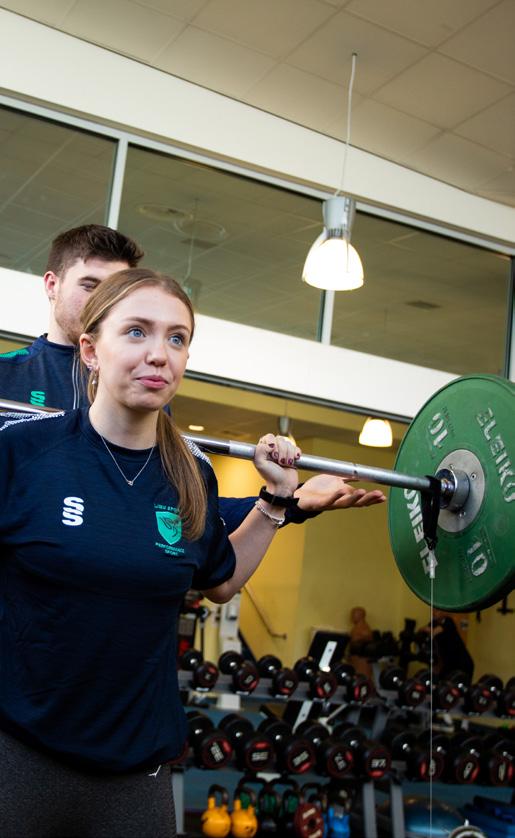
SPORT AND EXERCISE SCIENCES ACHIEVES ATHENA SWAN SILVER
The School of Sport and Exercise Sciences became the first in the university to achieve the Athena SWAN Silver Award.
Athena SWAN is a national benchmarking scheme to advance the careers of women in science, technology, engineering, maths and medicine but now applies across all disciplines in higher education.
Good practice awards were noted for the school’s work on gender equality, an inclusive curriculum, diversity and inclusion, and for the appointment of a strategic lead for EDI.

HOSPITAL EXECUTIVE DEGREE FIRST IN UK
LJMU has designed a unique degree course for one of the UK’s toughest jobs – hospital senior manager.
The university is providing the UK’s largest private hospital group, Circle Health Group, with a new, bespoke degreelevel qualification to drive up standards as the sector comes under increasing scrutiny.
The one-year course from Liverpool Business School is a UK first and recognises the complexity of the role of hospital senior management, with training ranging from patient safety and clinical standards, and overseeing the hospital estate, hospitality services and commercial issues. It also looks at navigating the management of specialised consultants and interacting with coroners and families.
CELEBRATING OUR GRADUATES



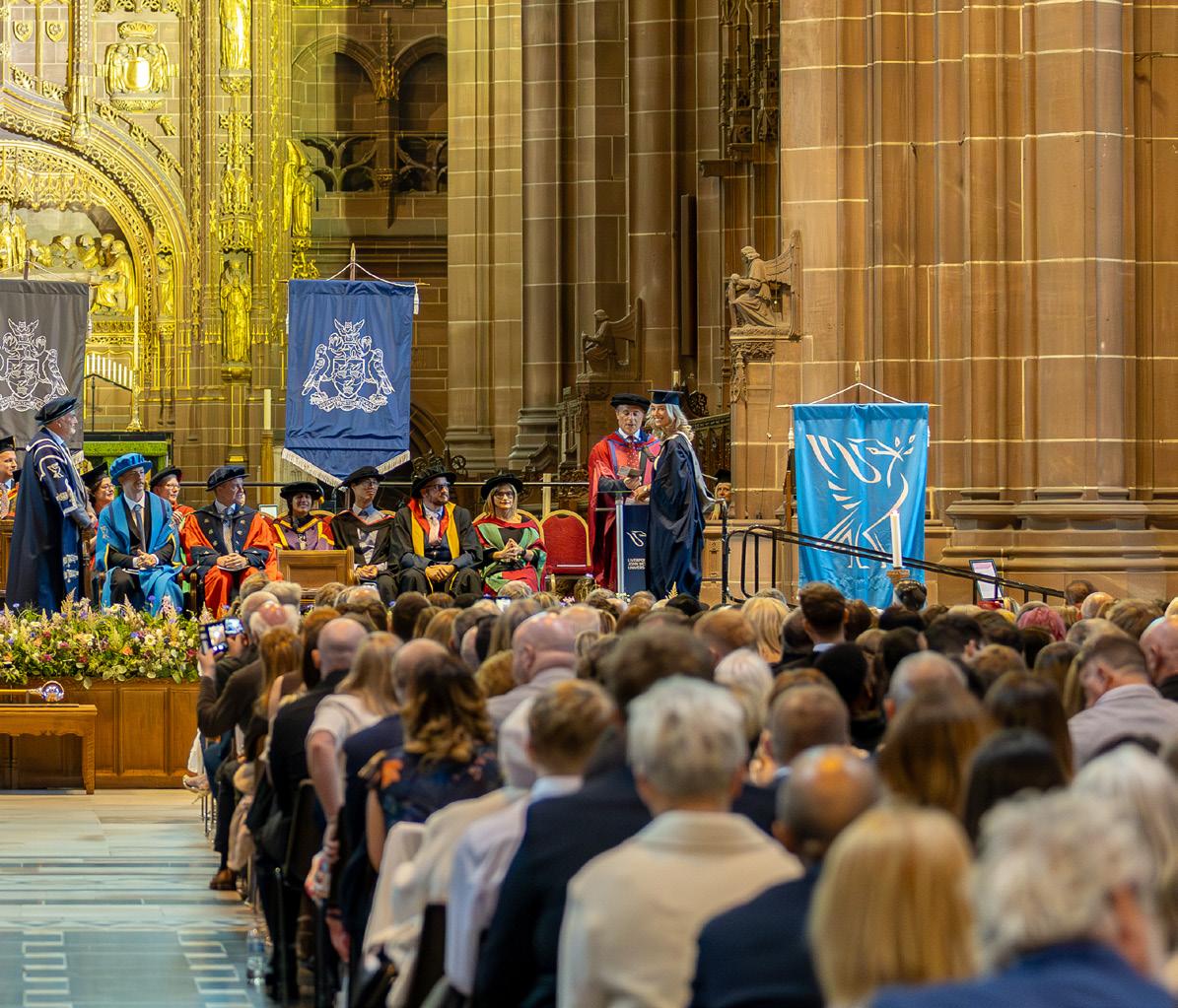
GRADUATION 2025
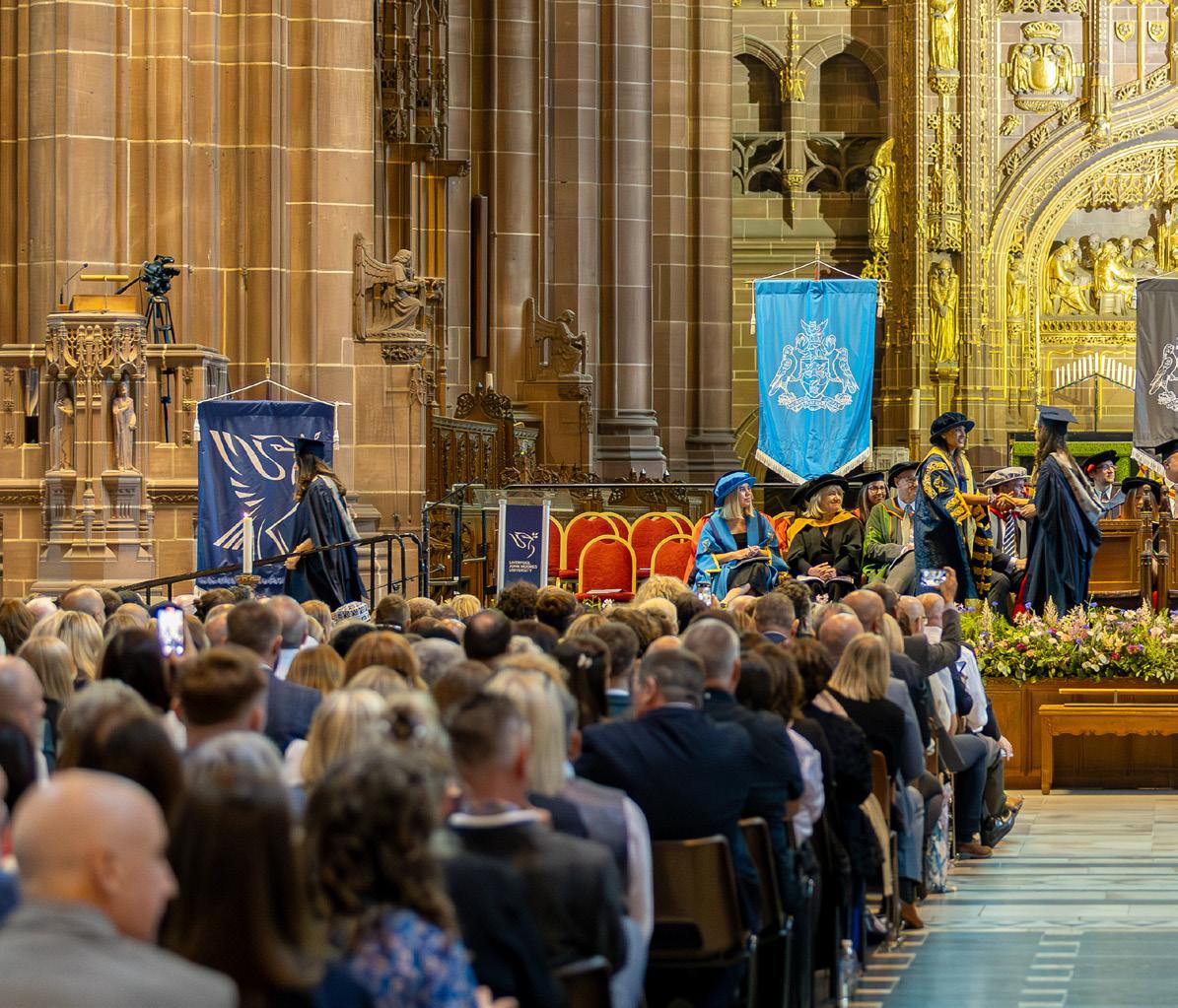
More than 7,400 students officially graduated from LJMU in a series of spectacular spring and summer ceremonies at Liverpool Cathedral.
Graduates celebrated in style alongside their families and friends, as well as staff from faculties and professional services who have been with the students during every step of their studies.
Ceremonies were also held in a number of other countries for students receiving LJMU awards from partner institutions - YPC International College in Kuala Lumpur, the Sri Lanka Institute of Information Technology, Oryx Universal College in Qatar, the Sino-British College at the University of Shanghai for Science and Technology (USST) and Westford University College in Dubai.
LJMU also congratulated graduates who successfully completed courses with our partner upGrad - one of Asia’s largest integrated training and lifelong learning institutions.
Meanwhile, 100 people graduated from the first LJMU Graduate Diploma in Professional Policing Practice with Police Now.
The qualification represents a new first in the training of police officers in England and Wales, with a blend of learning and on the job training.
The course, designed in conjunction with Police Now - an independent, not-for-profit organisation - focuses on the skills, behaviours and knowledge required to be effective community police officers and problem solvers.
OPERATING OVERVIEW
OUR PEOPLE
MARKING 1,315 YEARS OF COMBINED SERVICE
Staff were celebrated at a long-service event for achieving LJMU career milestones.
Thirty-three members of staff attended the event and were celebrated for working at the university for 25, 35, 45 or 50 years. Together, they have worked at the university for a combined 1,315 years.
The event to mark their dedication and commitment to LJMU was held at St George’s Hall.

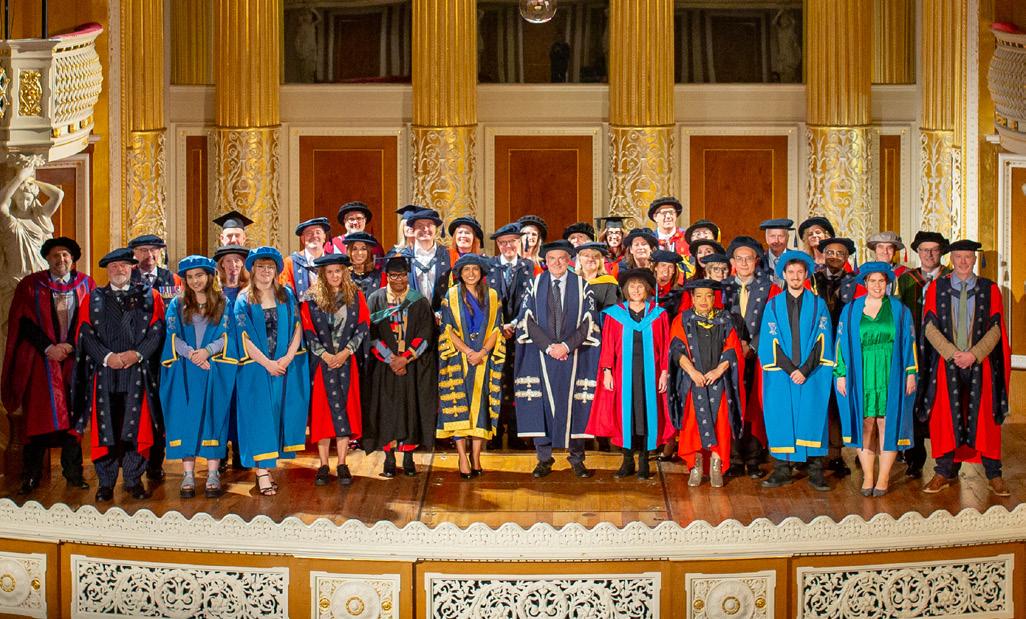
NEW HONORARY FELLOWS
LJMU honoured a number of new honorary fellows during the year in recognition of their outstanding professional achievements, the values they share with the university and their contributions to society.
A group of 16 fellows received their awards at a special ceremony at St George’s Hall.
Representing a wide range of backgrounds - health, education, music, television, the maritime industry and charitable organisations – the fellows received the university’s highest honour in front of an audience of family, friends and LJMU staff and students.
Each person was invited to be a fellow because they are incredible role models for our students and represent all that our students can aspire to.
THE
NEW FELLOWS ARE:
• Sonia Bassey MBE
Chair LCVS; Chair Mandela 8; community activist and artist
• Sean Curran
Parliamentary Correspondent for BBC News
• Bea Freeman
Independent documentary maker, producer/director
• Professor Gregory Lip
Director of the Liverpool Centre for Cardiovascular Science
• Commander Cedric Loughran RD MNM VR RNR
Former Captain of HMS Eaglet
• Claire Madeloso
Headteacher of Archbishop Blanch
• Claire McColgan CBE
Director of Culture and Major Events at Liverpool City Council
• Julia Midgley
Printmaker and reportage artist
• Simon O’Brien
British television actor and radio presenter
• Mike Palmer MBE
Co-founder of 3 Dads Walking
• Laura Pye CEO of National Museums Liverpool
• Jan Saron-Ross.
Chief Executive of the Walton Centre
• Chris Shirling-Rooke MBE CEO Maritime UK
• Richard Sinnott
Co-founder of Warrington Rowing Club
• Dato Thavalingam C. Thavarajah
Managing partner of T Thavalingam and Co
• Commodore Phil Waterhouse DL Royal Navy
Group Corporate Affairs Director, APCL and former Naval Regional Commander North of England
Meanwhile, golfing great Tommy Fleetwood and internationallyrenowned painter Sir Christopher Le Brun received honorary fellowships at LJMU’s spring graduation ceremonies.
As he accepted his fellowship at Liverpool Cathedral, Tommy gave an inspirational speech in which he encouraged students to “be the best person you can be. Your journey is your journey only. There will always be somebody with something you might want or be somewhere you might want to be but at the same time you will always be somebody people aspire to as well. Learn from others but stay focused on your path and your path only.”
Tommy received his fellowship in recognition of his sporting achievements and his work with LJMU’s School of Sport and Exercise Sciences.
Sir Christopher – who made his name creating figurative and abstract work in painting, sculpture and print – was honoured for his achievements and his support of the Liverpool School of Art and Design. He was a double prize winner at the John Moores Liverpool exhibitions of 1978 and 1980 and subsequently returned
as a jury member for the John Moores Painting Prize some years later. In 2019, he came to LJMU to deliver a highly engaging Roscoe Lecture on the subject of ‘The artist as public figure: how artists contribute to decision-making in the arts’.
Sir Christopher fittingly received his award on stage, close to two of his commissioned works of art – the Prodigal Son and the Good Samaritan – which are on display in the choir stalls as part of the Cathedral’s public art collection.

Tommy Fleetwood
OPERATING OVERVIEW
ON CAMPUS
The university manages a connected, accessible estate that provides outstanding facilities for teaching, learning, research and social activity. Throughout the year, we have continued to enhance our campuses for the benefit of students and staff and to support the delivery of the LJMU Strategy 2030.
NEW AND IMPROVED FACILITIES ON CAMPUS
This year, LJMU delivered brand-new teaching spaces and a host of improved facilities for students and staff across the university estate.
We carried out a number of projects to provide flexible, modern teaching, learning and social spaces, as well as enhancing sustainability and efficiency on campus.
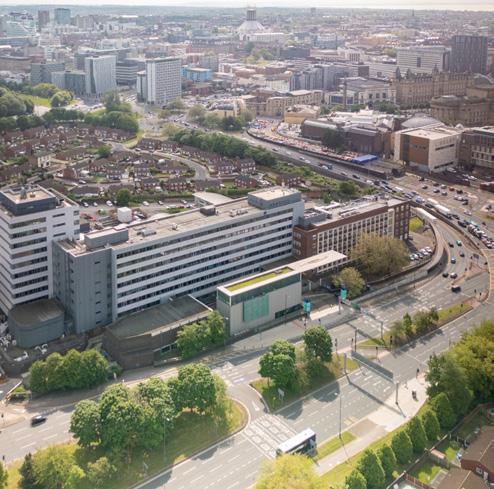
A major investment in James Parsons Building has brought new teaching rooms on the first floor, new staff accommodation on the first and second floors, two brand-new large IT suites on the third floor and refurbishment of a student social area.
There is a new ventilation system throughout these areas and improved heating efficiency in the building.
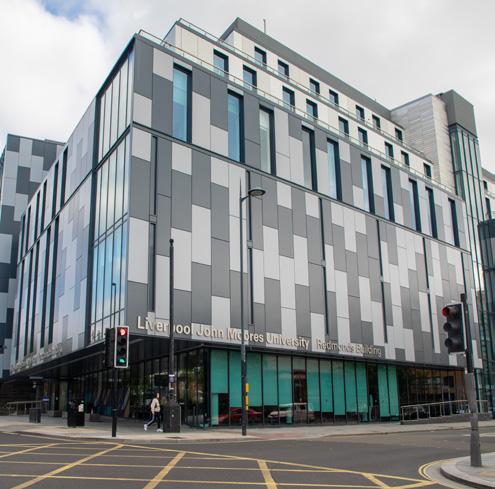
Refurbishment works in Redmonds Building have upgraded lighting and air conditioning systems and installed 24 additional solar photovoltaic (PV) panels on the roof. The panels are expected to generate approximately 8.4 mWh of electricity annually and save around 1.64 tonnes of CO2e – the equivalent of planting 75 trees every year.
A £1.2m government grant has supported a major decarbonisation project at the John Lennon Art and Design Building. Funding from the Public Sector Decarbonisation Scheme has enabled the removal of all gas boilers from the building and replacement with two air source heat pumps which use electricity instead of gas to produce heat.
The project has also included the installation of solar panels and the replacement of all remaining fluorescent lights with more efficient and sustainable LED lighting.
It is estimated that the works will save around 188 tonnes of carbon every year.
An air source heat pump has also been installed in the Max Perutz Building in our City Campus. It is anticipated that this will save around 50 tonnes of carbon each year, which is around a 60% reduction.
CLIMATE ACTION
NEW SUSTAINABILITY TARGETS
LJMU has set out its sustainability targets for the next five years to move towards our ambition of reaching net zero carbon.
The university published its Climate and Sustainability Plan 20252030 which outlines the steps we are taking to reduce our carbon footprint and promote sustainable practices across all university activity.
The plan contains key actions across a range of themes from biodiversity and green spaces to sustainable procurement and community engagement.
The targets in the plan align with UN Global Sustainability Goals and are based around strong collaborations both within the university and with external partners locally, nationally and globally.
The university’s key performance indicators and targets for the next five years include:
• Reducing Scopes 1, 2 and 3 carbon emissions by lowering energy and water consumption and increasing the electricity generated on site
• Working with local transport partners to get a fair and practical pricing structure for sustainable travel for our commuting students and staff
• Achieving 70% recycling rate and maintaining 100% of nonrecyclable waste being sent to energy-from-waste
• Providing carbon awareness or sustainability training courses for staff and students
• Increasing the environmental sustainability of our research and innovation work by enabling and encouraging a sustainable research culture at LJMU
• Creating new green spaces which are engaging and available to the public and our LJMU community
• Increasing species richness across our estate by 10% against a 2025 baseline
HUNDREDS OF TREES BEING PLANTED AND GREEN SPACES ENHANCED
LJMU is putting students at the heart of a new campus sustainability plan to protect nature and adapt to climate change.
The university published its first ever Biodiversity Plan which aims to enhance the estate’s biodiversity value over the next five years,
targeting three key areas: habitat quality, green space provision and climate resilience.
The delivery plan not only offers benefits to wildlife but LJMU students as well, providing scores of opportunities to conduct species and climate surveys, maintain wildlife installations, plant trees and shrubs and conduct research projects.
The installation of new green walls at our City Campus, hedgehog housing across campus, pollinator-friendly planting at Tithebarn Building, and the planting of native trees across LJMU’s estate have already begun.
Works planned for the upcoming year include the planting of 420 native tree saplings, the installation of bat and bird boxes, and soil improvements.
Meanwhile, a number of wishing trees were planted this year across the LJMU estate.
Inspired by an initiative by Yoko Ono, five native field maple trees were bought for the launch of the Liverpool Research Institute for Climate and Sustainability (LiRICS) in December. At the launch event, guests wrote down their wishes for the environment on wildflower seed paper and hung them from the branches.
Each tree has been sponsored by a different group within LJMU and planted in locations across the estate – outside the Student Life Building, John Lennon Art and Design Building, Byrom Street and Tithebarn Building.
The trees enhance biodiversity across the estate, which previously had only one field maple tree among its different green spaces. The seed paper will be used in future wildflower planting projects on campus.

AWARD-WINNING ENVIRONMENTAL INITIATIVES
LJMU was recognised for our work around sustainability and the environment with a number of major awards during 2024/25.
GOLD AWARD FOR SUSTAINABILITY
LJMU earned gold status for its sustainability and environmental initiatives after a review by external inspectors.
The university was awarded the honour by EcoCampus, an environmental management scheme for higher and further education.
Inspectors visited LJMU to review facilities, policies and procedures, and interview members of staff.
NET ZERO CARBON AWARD
LJMU won a national energy and sustainability award for its work to cut carbon emissions.
The university earned the Net Zero Strategy 2024 award from the Energy Managers Association (EMA), a leading association for UK professionals delivering carbon reduction, net zero and sustainable green recovery strategies.
The award recognises LJMU’s comprehensive approach to decarbonising its estate and activities.
The university’s initiatives are delivering significant results, with gas consumption cut by 25% over the last two years and electricity use down by 10% in the same period. The replacement of gas boilers with air source heat pumps at the Henry Cotton Building has cut carbon emissions by 30%.
BYROM STREET PROJECT EARNS ENVIRONMENTAL AWARD
The university received industry recognition for its commitment to sustainability in the delivery of the programme to transform our Byrom Street site.
The works have created the new student zone on the ground floor of James Parsons Building, a new staff lounge, further enhancements to facilities in the School of Pharmacy and Biomolecular Sciences and a new design makers space for the School of Engineering.
The project received a SKA silver rating in recognition of its environmental good practice and sustainability goals.
SKA considers criteria across a range of issues including energy and carbon, materials, waste and wellbeing. LJMU received the award for:
• Energy efficiency (such as lighting, LEDs and lighting controls; energy efficient heat pumps; energy efficient hot water; and energy efficient heating, ventilation and air conditioning)
• Limiting the amount of waste generated and reusing materials
• Measures to reduce pollution by using systems with lower carbon impact
• Water efficiency and measures to reduce water usage
• Enhancing staff and student wellbeing through a thermal comfort assessment and implementing improved heating controls and installing user controlled lighting in a number of areas.
ONE OF REGION’S BEST ENVIRONMENTAL PERFORMERS
LJMU has been ranked as one of the best performing universities in the North West for environmental and ethical performance.
The university has been ranked fifth in the region in People and Planet’s University League, a comprehensive and independent league table of institutions across the UK.
It assesses universities’ performance in energy sources, carbon reduction, waste and recycling, and water reduction. It also judges policy based on information made public by the universities themselves.
In 2024/25, LJMU has leapt 14 places in the overall rankings to joint 43rd.
The university scored particularly highly in the categories of carbon management, waste and recycling, and workers’ rights.
SUSTAINABLE LABORATORIES
LJMU earned a bronze award in the Laboratory Efficiency Assessment Framework (LEAF), which aims to improve sustainability and efficiency within laboratories globally.
LJMU has won the award for its best practice in a Pharmacy and Biomolecular Science teaching lab in James Parsons Building.
The work towards the award included staff training, assessing waste streams, fume cupboard usage, labelling processes and reducing single-use plastics.
RESEARCH AND KNOWLEDGE EXCHANGE

We have world-leading research across every part of our university, according to REF 2021, and an ambition to focus and grow our results in new areas. Underpinning our approach is research and knowledge exchange which explores new boundaries and has an impact on the world around us.
RESEARCH AND KNOWLEDGE EXCHANGE INCOME AND NEW AWARDS
Research and Knowledge Exchange income for 2024/2025 totalled £17.3m, with £13m of this relating to HESA research.
There were 256 new research and knowledge exchange awards secured in year, with a total value of £19.2m to the university. £16m will fund research and innovation through grant schemes and direct funding from industry and the public sector.
A total of £6.5m in new awards has been received from UK Research and Innovation (UKRI) funding councils.
Highlights include:
• LJMU secured an impressive three Marie Skłodowska-Curie Actions (MSCA) Postdoctoral Fellowships. The projects will see high-performing early career researchers from Pakistan
and China produce the next generation of materials for construction and road building. Part of Horizon Europe, the EU’s key funding programme for research and innovation, MSCA Postdoctoral Fellowships is the flagship funding programme for doctoral education and postdoctoral training and is highly competitive.
• The university secured funding as part of SEA4FUTURE, an €8m consortium. LJMU is one of 22 partners delivering an EU Horizon Europe Innovation Action. The project will produce a set of practical tools for the fisheries industry, leading to more ecologically sustainable practices.
• £731,058 was secured from the UKRI as part of a consortium led by Middlesex University. The project aims to develop a Crisis and Resilience Digital Twin (CRDT) specifically focusing on transport systems and infrastructure resilience, with the Port of Liverpool, Liverpool City Region Freeport and its connected transport networks as the primary case study.
• LJMU continues to grow directly funded industry research contracts which see researchers working across a number of sectors including digital technology, energy, healthcare, manufacturing, sport, legal and life sciences.
• Partners have included The Football Association, global energy groups, multiple NHS trusts, The Pandemic Institute, the College of Policing and the Department for Environment, Food and Rural Affairs (DEFRA).
• LJMU is working with public and private sector partners in the Liverpool City Region to tackle climate change and find solutions to 21st Century challengess.
New awards secured in year included trialling innovative decarbonisation proposals around local roads life cycles and contract research within the field of construction environmental impact to strive for net zero site construction.
This year LJMU has secured three classic Knowledge Transfer Partnerships (KTPs). The projects include an engineering KTP with Teledyne UK to explore digital manufacturing processes.
SUPPORTING INNOVATION AND LOW CARBON INITIATIVES
LJMU has secured additional funding for projects supporting SMEs with their innovation and low carbon journeys.
The Liverpool City Region Combined Authority will support the Low Carbon Eco-Innovatory (LCEI) project to deliver research and grant support until March 2026 through its UK Shared Prosperity Funding (UKSPF) allocation. Meanwhile, the Horizons project has been granted additional UKSPF funding to support a further 50 high-growth SMEs until March 2026.
LCEI is a partnership between LJMU and the University of
Liverpool. It offers low carbon assistance alongside match-funded grants of up to 50% for low carbon installations and equipment to help LCR businesses decarbonise.
Horizons is a partnership between LJMU, the University of Liverpool and Edge Hill University, which directly addresses challenges facing 21st Century SMEs. LJMU’s expert team of innovation solution providers focuses on practical innovation support, collaboration and growth strategies and is backed by academic colleagues in the Faculty of Health, Innovation, Technology and Science (HITS), providing world-class crossdisciplinary knowledge-based solutions.
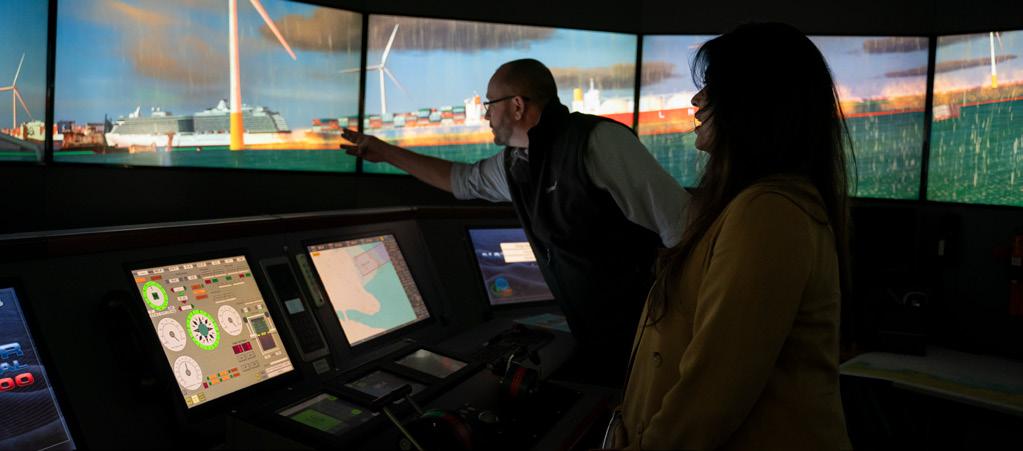
LJMU LAUNCHES GLOBAL CENTRE FOR MARITIME INNOVATION
The university has brought together its world-leading maritime education, research and innovation through a new global centre.
The LJMU Global Centre for Maritime Innovation is providing new opportunities for collaboration and engagement between academics, external partners and the wider industry to deliver impactful research, education and training.
The university is recognised internationally for its long-standing maritime excellence and expertise, and its contributions to the industry worldwide.
The centre will strengthen our links across the industry on a regional, national and international level, ensure our work continues to meet current and future sector requirements, and equip our students for their future careers.
PRESTIGIOUS GLOBAL MARITIME ROLE
LJMU has been selected to take on a key role with the prestigious International Association of Maritime Universities (IAMU).
The university has taken a seat on the International Executive Board of the IAMU - the global network of leading maritime universities providing education and training - for 2025-2027.
The position is a recognition of LJMU’s ongoing contribution to the organisation, including leading research projects, and the global maritime industry more widely.
Founded in 1999, the IAMU now has 75 member organisations across the globe, all working together on a range of scientific and academic studies, developments and practical applications associated with maritime education and training.
Meanwhile, LJMU was a winner at the prestigious Mersey Maritime Industry Awards 2024. The university won the Technology and Innovation award in recognition of the outstanding work we are doing to further the thriving maritime industry in the Liverpool City Region and across the globe.
CLIMATE AND SUSTAINABILITY INSTITUTE OFFICIALLY LAUNCHED
The university this year officially launched its new research institute to address the key issues around climate and sustainability.
Academic and professional services staff from across LJMU attended an event to mark the beginning of the Liverpool Research Institute for Climate and Sustainability (LiRICS).
LiRICS brings together LJMU’s world-leading research around climate and sustainability and its development was one of the key objectives in LJMU’s Climate Action Plan, which sets out the university’s commitment to working towards a net zero carbon future.
The institute has developed a five-year strategy and aims to increase external income, increase the volume of internationally excellent and world-leading outputs, create educational opportunities for behaviour change and enable collaborative engagement and impact initiatives for internal and external stakeholders.
SCIENCE AND ART RECREATE FACE OF ROBERT THE BRUCE
A reconstruction of the face of Robert the Bruce by LJMU’s Face Lab was unveiled to mark the 750th anniversary of his birth.
The three-dimensional model of the Scottish king’s headdescribed as the most realistic ever produced – went on display at Dunfermline Abbey in Scotland.

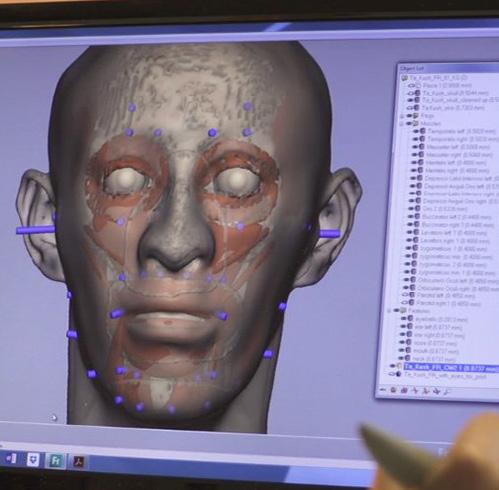
The reconstruction was created as part of a collaboration between historians from the University of Glasgow and craniofacial experts led by Professor Caroline Wilkinson at the Liverpool School of Art and Design.
The model was produced using details from two virtual images of Robert the Bruce, who led the Scots to victory over English troops led by King Edward II at the Battle of Bannockburn in 1314.
MY KINGDOM FOR A VOICE!
Face Lab was also part of a British team which recreated the living voice of King Richard III.
The team worked with linguists and historians and used digital avatar technology to recreate the 15th Century monarch’s speech from the shape of his skull and knowledge of his environment.
The voice was heard publicly for the first time in a world first production at York Theatre Royal.
It follows the reconstruction of the face of the monarch in 2013.
PRESTIGIOUS AWARD FOR MEDICAL ILLUSTRATIONS
A transformative cross-faculty LJMU project to enhance endoscopy research and training has earned a prestigious award for medical illustration.
The Transforming Polypectomy Education project received a gold award in the 2024 Institute of Medical Illustrators Awards for its creation of innovative digital training tools for colonoscopists.
The work to develop digital 3D polyp models is a collaboration between digital medical artists (LJMU’s Liverpool School of Art and Design), advanced allied health practitioners (LJMU’s School of Nursing and Advanced Practice) and endoscopists (North West Endoscopy Academy) and enables endoscopy trainees to visualise complex anatomical structures of colorectal polyps in unprecedented detail.
The project is improving the technical skills of allied health professionals, boosting their diagnostic accuracy and ultimately enhancing patient care.
AWARD FOR SUICIDE PREVENTION PROGRAMME
A project led by LJMU and funded by the National Institute for Health Research has been recognised in the North West Coast Awards 2025.
The Multi-Modal Approach to Preventing Suicide in Schools (MAPSS) Programme won the Ruth Young Award for Research Implementation and Impact at the event hosted by Health Innovation North West Coast and Applied Research Collaboration North West Coast (ARC NWC).
MAPSS is the first UK suicide prevention trial in schools. The programme targets Year 10 pupils and aims to reduce suicide risk and encourage young people to seek help.
The trial has so far provided approximately 800 pupils with suicide prevention education. It also identified those young people at risk and in need of support.
SUPPORTING A MORE SUSTAINABLE MARITIME SECTOR
LJMU is leading a consortium of local government and research organisations to accelerate the greening of Liverpool’s £5bn maritime industry.
The Maritime and Last Mile Net Zero project aims to fast-track research impact to support a more sustainable maritime sector. Universities and industry will work more closely with local government to apply emerging solutions, such as alternative fuels, ship retrofitting and digitisation, as the maritime sector works towards net zero by 2050.
This £2.5m (£2.1m to LJMU) project will run for four years and brings together Liverpool City Region Combined Authority, Sefton Council, Wirral Council, Knowsley Council, LCR Freeport and both the University of Liverpool and Queen’s University Belfast.
The project is funded through the Engineering and Physical Sciences Research Council (EPSRC) Place Based Impact Acceleration Account (PBIAA) scheme.

ESTABLISHING THE CITY REGION AS A MUSIC R&D POWERHOUSE
LJMU, together with the University of Liverpool, is leading the MusicFutures project which will catalyse growth and innovation in the Liverpool City Region’s music sector.
The £6.75m (£430,241 to LJMU) project is funded by the Arts and Humanities Research Council (AHRC) on behalf of UK Research and Innovation (UKRI).
Over the next five years, MusicFutures will establish the Liverpool City Region as a hub for music research and development (R&D). It brings together more than 20 strategic partners from across the Liverpool City Region—including the ACC Liverpool Group, operators of Liverpool’s M&S Bank Arena, convention centre and exhibition centre, Adlib, Royal Liverpool Philharmonic, Liverpool City Region Combined Authority and Liverpool City Council. By providing new funding opportunities for both small and mediumsized enterprises (SMEs), bespoke training for music makers and industry mentorship, MusicFutures will fuel artistic, technological and IP breakthroughs that will diversify and strengthen the UK’s position at the forefront of the global music industry.
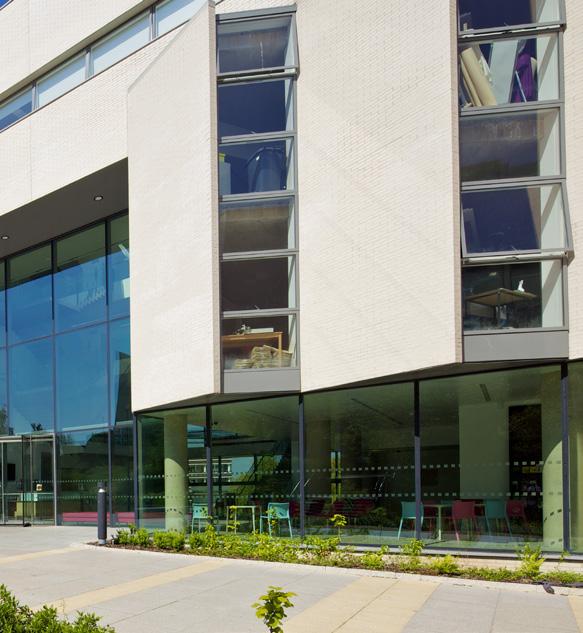
INITIATIVE TO CREATE NEW MEDICINES
LJMU is working with partners to grow the regional biologics ecosystem, addressing challenges in the manufacture and commercial scale-up of new medicines.
Led by the Liverpool School of Tropical Medicine (LSTM), the project has been awarded close to £5m by Research England’s University Commercialisation Ecosystem fund. Biologics are complex medical products derived from living organisms, designed to prevent or treat a diverse range of infections and diseases, including emerging infectious diseases, cancer and antimicrobial resistance.
BRITE (Biologics Regional Innovation and Technology Ecosystem Programme) seeks to plug the existing gaps in infrastructure so that world-class academic discoveries can be turned into new medicines.
DIGITISING THE HISTORY OF ART AT LJMU
The university is providing open access to rare 19th century archive material related to the history of LJMU and its antecedent colleges (Liverpool Mechanics’ Institute) in a project supported by a digitisation grant (£16,100.43) from the Paul Mellon Centre for the Study of British Art.
‘Our Most Beautiful Mechanical Contrivances: Exhibiting Empire in Nineteenth Century Liverpool’, investigates the intersection of working-class education, exhibition culture, LJMU, and British imperialism in 19th Century Liverpool.
The digitisation of this material has been completed and is now in post-production. The digital resource will go live towards the end of 2025. This event is timed to coincide with the bicentenary celebrations of the School of Art and is connected to the LJMU Enslavement and Empire project.
NEW HUMANITIES AND SOCIAL SCIENCES RESEARCH CENTRE
A new LJMU research centre will bring together expertise around humanities and social sciences to drive forward the impact of their work.
The Liverpool Centre for Cultural, Social and Political Research (CSPR) has been established to deliver outstanding research and impact, high quality publications, secure external funding and develop new collaborative links.
The CSPR creates a multidisciplinary research space for colleagues from the School of Humanities and Social Sciences
The estimated total combined impact of LJMU’s related activities is £474m gross value added to the Liverpool City Region economy last year.
Source: Amion Consulting, 2025
(HSS), Liverpool Business School, Liverpool Screen School, the School of Education and other HSS departments.
A key objective for CSPR is to build an enhanced research culture to support the development and submission of case studies for REF 2029.
The shape and scope of CSPR has been informed by an extensive consultation process with colleagues, which revealed a desire from staff for a centre that encourages them to do more, fosters connections beyond teaching and promotes interdisciplinary learning.
POLICE TURN TO WEARABLE TECH TO IMPROVE SLEEP AND FITNESS
A series of LJMU studies are helping Merseyside Police to use wearable technology to keep officers and staff fit and healthy.
One hundred and twenty officers and staff were recruited to wear a Biostrap band for seven months. Of those officers who wore the bands, 93% believe the technology helped increase their health awareness, 82% believed it helped them identify behaviour change and 72% agreed that it led to actual changes to improve health and wellbeing.
LJMU worked with Oscar Kilo, the National Police Wellbeing Service, to design studies of the benefits of wearable technologies.
DEVELOPING GREEN CONSTRUCTION SOLUTIONS
The university has entered into a unique collaboration with a major construction solutions company to develop innovations to make homes greener, warmer and cheaper to run.
Together with Wienerberger, LJMU experts have retro-fitted three laboratory houses on our City Campus to test the latest eco-home innovations around energy performance and environmental monitoring. Two modular homes on the site have also been retro-fitted with the latest low carbon solutions.
Meanwhile, LJMU has also teamed up with urban developer Starship Group to pioneer new advances in modular construction. The project, funded through the Higher Education Innovation Fund (HEIF), has seen research engineers helping to optimise the structural system and improving the environmental performance of developments, including social housing.
A group of Merseyside families are having their home energy monitored for a year under an innovative project by LJMU and Livv Housing Group.
Construction experts at the university have teamed up with Livv as it launched its ‘road to net-zero’ pilot project which tracks energy use in 15 brand-new affordable rent homes at Copthorne Walk, Kirkby.
The partners are monitoring a range of technologies in the homes – including air source heat pumps, triple-glazed windows and solar panels - to gather vital insights for future design.
UN SUSTAINABLE DEVELOPMENT GOALS
LJMU placed in the top 300-400 institutions worldwide in the Times Higher Education Impact Rankings for the second year in a row. The rankings also put LJMU in the top 60 universities in the UK.
This is the second year LJMU has submitted to the rankings, which outlines the university’s commitment to the UN Sustainable Development Goals (SDGs).
LJMU provided evidence submissions for seven of the 17 Sustainable Development Goals and particularly excelled in the climate action, life on land, and peace, justice and strong institutions goals.
HEALTH DETERMINANTS RESEARCH COLLABORATION (HDRC) LIVERPOOL
LJMU is continuing to play a leading and strategic role in the £5m National Institute for Health and Care Research-funded HDRC Liverpool.
In partnership with Liverpool City Council, University of Liverpool and Liverpool’s community and voluntary sector, LJMU is helping to build research capacity within local government and supporting evidence-informed decisionmaking to address health inequalities across the city.
Now coming to the end of its second year, HDRC Liverpool has transitioned from mobilisation to delivery, with progress including the establishment of a programme board and working groups, rapid evidence reviews, community researcher roles and joint academic appointments.
PLACE AND PARTNERSHIP

Through our place within local communities, the Liverpool City Region and beyond, LJMU is committed to working in partnership with people and organisations to make a difference.
LEADING THE WAY IN PARTNERSHIPS AND GROWTH
LJMU is ‘leading the way’ in building partnerships to make a difference and drive growth in the Liverpool City Region.
The university this year launched its Place and Partnership Plan, which sets out its priorities in working in collaboration to support students, communities and partners in the public, private and third sectors.
At the launch of the plan, partners from across the six local authority areas of the city region highlighted the positive impact of working with LJMU to support business and innovation, employment and skills development, community projects, and health and education initiatives.
The plan sets out four key priorities for LJMU over the next five years:
• To strengthen the regional skills base through flexible, responsive, workforce-facing education.
• To collaborate with local business and industry to drive inclusive economic growth.
• To catalyse social inclusion and change for students and communities in collaboration with partners.
• To grow our community of international students and look for opportunities to grow our existing collaborative partners.
Steve Rotheram, Mayor of the Liverpool City Region, said: “LJMU is massive to the future prospects of us getting the economic growth that we need in the Liverpool City Region. LJMU has led the way and our other universities and institutions are pulling in the same direction.”
SUPPORTING LOCAL CHARITIES TO MAKE A DIFFERENCE
LJMU entered partnerships with four local charities to support their work in the Liverpool City Region.
Building upon its established relationships with each charity, the new partnerships provide further opportunities for collaboration. The charity partners are:
• Claire House Children’s Hospice - a 24-hour, seven days a week service that offers a wide range of support to seriously and terminally ill babies, children and young people between the ages of 0 and 25.
• The Girls’ Network - a one-to-one mentoring scheme for girls, based on research showing that conversations and personal relationships can have a big impact on challenging stereotypes and expectations.
• Local Solutions which has been at the heart of ‘Empowering People and Supporting Communities’ across the region for over 50 years. The charity is dedicated to helping individuals achieve their goals, make informed choices and unlock their full potential.
• Micah Liverpool - a social justice charity set up to relieve Liverpool residents from social injustice and poverty. It runs
projects to combat unemployment and deliver emergency food aid and affordable food.
The partnerships are providing opportunities to explore new student internships, work placements and projects, enabling students to build their experience in the workplace while helping each charity to deliver in their ambitions to break down barriers, combat social injustice, empower communities and support those in their moment of need.
DONATING TO HELP LOCAL PEOPLE IN NEED
LJMU donated £13,000 to charity partner Micah Liverpool to support people across the city who need emergency food parcels.
The university pledged to donate to Micah for every National Student Survey completed by eligible final year students. LJMU also made donations on the back of the Postgraduate Taught Experience Survey and First Year Experience Survey.
The significant donation will be used to provide emergency food parcels to some of the hundreds of local people who visit Micah’s foodbanks and pantries each week.
NATIONAL AWARD FOR WINDRUSH ADVICE
LJMU’s Legal Advice Centre won ‘Best New Pro Bono Activity’ at the 2025 Law Works and Attorney General Student Pro Bono Awards.
The event, held at the House of Lords, celebrates the best pro bono activities undertaken by law students and law schools across the UK.
The award celebrated LJMU’s Windrush Community Law Clinic, which is run by staff, students and local legal firms, and offers free advice to people seeking redress or status from the government.
The clinic provides two-fold support to people eligible for the Windrush Compensation Scheme (WCS), of which there are thought to be around 1,200 in the Merseyside area.
The first aspect involves casework support to apply to the WCS and/or signposting for other immigration law advice. The second aspect involves the creation of a user-friendly app allowing members of the public to check their eligibility for the WCS. Both aspects of the project are supported by 15 students from LJMU.
GOLD AWARD FOR SUPPORT OF THE ARMED FORCES COMMUNITY
The university was proud to receive a gold award from the Ministry of Defence Employer Recognition Scheme (ERS), acknowledging how it provides support to the Armed Forces community.
The award, the highest of those available from the MoD, recognises how LJMU continues to actively demonstrate support for the Armed Forces community since signing the Armed Forces Covenant in 2021.
In particular, the gold award acknowledges how the university proactively demonstrates its forces-friendly credentials as part of its recruitment and selection processes, its support for reservists and cadet force volunteers within the workforce, and how it advocates support to defence people issues both within the university and with external partner organisations.
RECIPROCAL MENTORING
LJMU launched a pioneering Reciprocal Mentoring Programme aimed at strengthening race equality across the region. The university is working in close partnership with the Liverpool City Region (LCR) Combined Authority Race Equality Hub.
The year-long initiative pairs 40 senior white leaders from across public, private and voluntary sectors with 40 Black and ethnically diverse professionals in meaningful, two-way mentoring partnerships.
Led by LJMU’s Diversity and Inclusion team and Liverpool Business School, the programme creates space for honest conversations, shared learning and mutual growth.

ASSOCIATION OF CHARTERED CERTIFIED ACCOUNTANTS ENDORSES LJMU ACCOUNTING CLINIC
The Association of Chartered Certified Accountants (ACCA) recognised LJMU for the innovative work of its Accounting Clinic, which provides a pro bono service for charities delivered by student advisers.
The endorsement and accreditation by the ACCA recognises the value of the accounting and finance students’ experiences, and the positive impact it is making in our communities.
NEW PARTNERSHIP TO SUPPORT BUSINESSES IN KNOWSLEY
LJMU and Knowsley Chamber of Commerce entered into a partnership agreement to support businesses and drive economic growth in the borough.
The Strategic Partnership Agreement will see the two organisations collaborate and share expertise to help local businesses start-up, grow and prosper, as well as creating opportunities for students and graduates.
LJMU already works closely with a wide range of businesses in Knowsley, providing expert support, research and knowledge exchange to encourage innovation and increase productivity.
Meanwhile, a broad range of employers in the borough provide employment opportunities and experience for LJMU students, including through the university’s successful degree apprenticeship programmes.
DIVERSITY IN MARITIME PLEDGE
The university set out its commitment to promoting inclusivity in the maritime industry. LJMU adopted the Diversity in Maritime Pledge to ensure that every person in the sector feels valued, respected and empowered.
LJMU – one of the world’s leading maritime universities –joined a number of other key maritime organisations in signing the pledge.
The university is working closely with Maritime UK to become a Diversity in Maritime Charter organisation.
DUAL AWARD AGREEMENT EXTENDED WITH UNIVERSITY OF SHANGHAI FOR SCIENCE AND TECHNOLOGY
LJMU and the University of Shanghai for Science and Technology (USST) have extended their dual award agreement which provides qualifications for international students in Electrical and Electronic Engineering and Mechanical Engineering.
A delegation from USST, led by their President, Zhu Xinyuan, joined LJMU colleagues in Liverpool to discuss further opportunities for collaboration and to officially sign the agreement extension.
As part of the agreement, BEng (Hons) programmes are also delivered through the Sino-British College (SBC), also based in Shanghai and which was jointly established by USST and nine British universities, including LJMU.
TRAINING FUTURE LEADERS IN THE POLICE SERVICE
The Liverpool Centre for Advanced Policing at LJMU will be an assessment partner for a programme, run by the College of Policing, aimed at training future leaders in the police service.
LJMU was selected to assess and moderate the learners’ academic assignments for the Executive Leaders Programme due to its extensive experience and proven track record in delivering leadership programmes.
The university is overseeing two written assignments on the Executive Leaders Programme, ensuring that participants receive quality support and learning opportunities. The collaboration is supporting the training of around 100 officers and staff working in policing and wider law enforcement over two years.
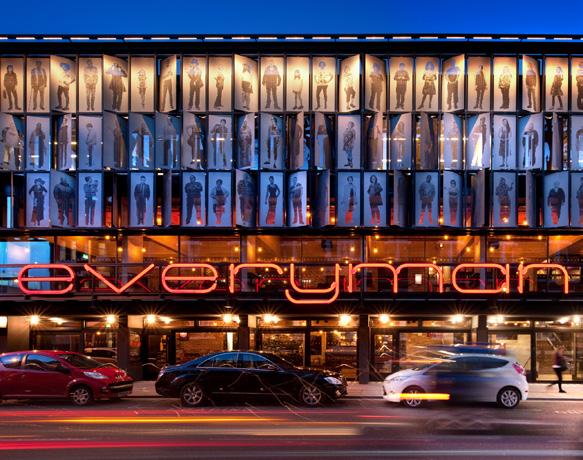
MARKING 60 YEARS OF AN ICONIC LIVERPOOL THEATRE
The university’s Special Collection and Archives partnered with the Liverpool Everyman to celebrate the 60-year history of the theatre.
The Ever Forward: Everyone Starts Somewhere exhibition was hosted by LJMU and showcased the theatre’s history, Liverpool connections and the rich archive held at the university. The celebration provided a range of opportunities for LJMU students and graduates to get involved in everything from designing the promotional materials to writing, directing and starring in productions.
More than 202,600 people attended free public events hosted by LJMU last year including exhibitions, public lectures and workshops.
Source: Amion Consulting, 2025
MOWGLI DOG SHOW 2025
LJMU was proud to be the main sponsor of the Mowgli Dog Show 2025 in support of charity partner Claire House Children’s Hospice.
The hugely successful event – founded by our Chancellor, Nisha Katona MBE – attracted hundreds of visitors and featured student-led activities, as well as showcasing LJMU expertise in areas such as technology, engineering and environmental sciences.
All profits went to Claire House to support local people.
WORKING WITH THE COMMUNITY TO TACKLE OBESITY
Academics and students joined forces with community groups and public health experts for a project to tackle obesity in Knowsley.
Together, they developed a brand-new cookbook with a Mediterranean-inspired diet to help try and curb the issue of obesity and its associated health risks, such as fatty liver disease.
The cookbook is a collaboration between LJMU academics and nutrition students, local community groups and doctors and patients from the Millbrook Medical Centre in Kirkby and is backed by leading liver specialists from Aintree Hospital.
The Kirkby Kitchen Cookbook features 26 healthy recipes that can all be cooked in an air fryer or slow cooker and replicate family favourite meals but with simple twists that make them more nutritious and better for your overall health.
The project has received an overwhelmingly positive response from the local community.
COMMUNITY ENGAGEMENT
LJMU has been engaged with a wide range of community groups throughout the year as part of the university’s commitment to widening access to higher education and providing opportunities for people of all backgrounds.
Highlights of activity in 2024/25 include:
• A student-led, 15-week tutoring/mentoring programme to support secondary school pupils in the Liverpool 8 area, particularly those from Somali backgrounds. In collaboration with Dery Community Centre CIC, LJMU students provided structured, localised academic support to 33 pupils who grew in confidence, raised their grades and re-engaged with learning.
• A five-week afterschool pilot programme with North Liverpool Academy titled, ‘So you want to be ….?’. This programme included one-hour sessions delivered to Year 12 pupils by



LJMU academic staff and student advocates. Academic sessions focused on nursing, paramedic science, law, business and engineering.
• A visit to campus by The Girls Network, which encouraged 70 female students’ participation in HE. Throughout the workshops, mentees were given the opportunity to learn from students about their experiences at LJMU.
• Dozens of pupils from local schools attended the International Women’s Day event, ‘Strength in Action: Women Redefining Change’.
POST-16 PROMOTION AND INFORMATION, ADVICE AND GUIDANCE
LJMU provided wide-reaching information and guidance on higher education to schools and colleges in the Liverpool City Region and across the UK and Ireland.
During the year, we reached more than 68,351 prospective students across 713 schools and colleges through presentations, workshops, school careers fairs and bespoke visits to campus. We also hosted events specifically about university finance, managing money as a student and how to apply for bursaries and scholarships.
LJMU delivered a series of activities in Northern Ireland – where we are established as the most popular university destination outside Northern Ireland for domiciled students – engaging with 165 schools and colleges to reach approximately 20,000 prospective students.
UNDERGRADUATE HIGHER EDUCATION EXHIBITIONS ACROSS THE UK AND IRELAND
The outreach team provided advice to young people on their higher education choices and information about studying at LJMU at recruitment events across the UK and Ireland, attended by 4,062 schools and colleges, and approximately 158,000 prospective students.
PRE-16 WIDENING ACCESS PROGRAMMES
The university delivered a series of programmes through the year to under-16s to help with their knowledge, confidence and ability to progress to higher education.
The Step-Up programme reached 375 pupils from five schools in the city region focussing on career choices and student-led subject taster sessions. Access All Areas, a programme aimed at motivating boys from the most socio-economically disadvantaged backgrounds, supported 90 students during the year, while
the Law Factor gave Year 10 pupils an insight into the legal profession.
Meanwhile, the local consortium of Uni-Connect – which raises higher education aspirations in targeted areas of the city region – welcomed learners on to campus for a range of activities and delivered a series of collaborative programmes to boost attainment, including the successful Absolute Chemistry project to inspire interest in STEM subjects.
LJMU’s summer university programme welcomed more than 100 students from across the UK to experience life as a student, staying in accommodation, experiencing hands-on subject workshops and what Liverpool has to offer as a student city.
ROSCOE LECTURE SERIES
Former Secretary of State for Education, the Rt Hon Justine Greening, examined the critical role of universities and LJMU in driving regional growth as she delivered a Roscoe Lecture at St George’s Hall
The Chair of the Purpose Coalition explored how effective connections and collaboration are key to advancing an inclusive and sustainable economy and driving forward social mobility.
CHIEF CONSTABLE LECTURE SERIES
The university welcomed the Chief Constable of Merseyside Police and the Chair of the National Police Chiefs’ Council to deliver the year’s two Chief Constable Lectures.
Merseyside Police’s Serena Kennedy’s lecture, ‘The progress, the power and the challenge of police communications’ explored the way in which police communicate (and how it has changed over the years), the impact of police communications and also the challenges faced in an era of disinformation.
Chief Constable Gavin Stephens QPM, (NPCC), meanwhile, explored ‘Policing in a Polarised World’, examining a range of modern issues and discussing how the police should respond.
NATIONAL SCHOOLS OBSERVATORY
The National Schools Observatory is an initiative aimed at supporting teachers and inspiring pupils to continue their journey in Science, Technology, Engineering and Maths with free online access to the Liverpool Telescope and other resources which support skill development important to accessing university.
This year, 1,218 new teachers and almost 3,392 new students registered to use the platform, with more than 12,500 observations requested and 22.6 million web hits.
FINANCIAL PERFORMANCE
KEY FINANCIAL HIGHLIGHTS
+ 2023/ 2024 2024/ 2025 £8.5m
£4.4m
£350.5m




(£4.9m)


(£7.7m)
£9.3m

£5.4m

£358.2m


DEFICIT FOR THE YEAR
Deficit for the year on a statutory basis was £4.95m (2023/24 £9.34m Surplus)
OPERATING SURPLUS
Management evaluates financial performance using operating surplus.
Items excluded from the statutory surplus when calculating operating surplus include pension provision movements, the share of operating surplus or deficit in associates and joint ventures, and profit or loss on the disposal of fixed assets. Pension provision movements pertain to the Merseyside Pension Fund (MPF), Universities Superannuation Scheme (USS), and an unfunded pension scheme for employees who took early retirement in the 1990s. These items are excluded since their outcomes are not subject to short-term management control. Pension provision credits were £0.47 (2023/24 £3.7m).
In 2024/25 The University made an operating deficit of £5.76m (2023/24 £5.7m surplus).
TOTAL COMPREHENSIVE INCOME AND EXPENDITURE
The total Comprehensive Expenditure was £7.7m (2023/24 £5.4m Income). This includes an adverse actuarial movement on the MPF pension of £2.8m (2023/24 £3.9m).
INCOME
Total income reduced by £10m (3.7%) to £260.9m.
INCOME ANALYSIS £m
Total tuition fees and educational contracts reduced by £7m to £210.4m (3.2%). The majority of this reduction was in reduced fees from Home and EU students. Our forecasts indicate that tuition fee income will grow due to increased student numbers and fees over future years.
Funding body grants income reduced to £23.5m, and Research Grants income reduced by £1.0m combination due to the timing of activity.
Investment income remained strong at £6.3m
EXPENDITURE
Expenditure on a statutory basis was £266.3m (2023/24 £261.5m).
The majority of expenditure relates to staff costs. Staff costs on a statutory basis were £168.2m (2023/24 £159.5m) and include pension provision credit of £1.5m (2023/24 £3.7m). On a statutory basis staff costs are 64.4% of income (2023/24 58.8%). Excluding pension provision credit, staff costs were £169.7m (2023/24 £163.2m excluding costs) and are 65.0% of income (2023/24 60.2%). Staff costs included restructuring costs of £1.1m (2023/24 £0.6m)
Other operating expenses reduced £2.3m (2.6%) to £83.6m. Expenditure included continued investment in estates and IT expenditure.
EXPENDITURE ANALYSIS £m
n Staff costs
n Other operating expenses
n Depreciation
OTHER ITEMS
The share of surplus in the associate (Sciontec Developments Limited) was £0.08m (2023/24 £nil).
BALANCE SHEET
On 31st July 2025 our net assets had reduced by £7.6m to £350.5m
Net current assets have reduced by £3.3m to £103.6m with cash and short-term net investments of £134.6m.
We anticipate that we will utilise cash holdings for future estates and IT projects as we continue to focus on the student experience.
The University continues to have no external debt following outstanding amounts being paid down in 2023/24.
We have pensions provisions of £6.7m (£6.1m at 31st July 2024) which is an obligation to the unfunded pension scheme (2023/24 £6.1m) The unfunded pension provision is in respect of pension enhancements payable to staff who took early retirement in the 1990’s. Affordability of pensions is a key financial risk which we continue to monitor closely.
CASHFLOW
Cashflow from operating activities was £4.4m (2023/24 £8.5m) which is 1.7% of income.
CAPITAL EXPENDITURE
Capital expenditure was £19.4m (2023/24 £12.0m). We continue to invest in our existing infrastructure but had no expenditure on new buildings in 2024/25.
CONCLUSION AND FUTURE PROSPECTS
The prospects of the University are considered over a 5-year period and regularly reviewed by the Board of Governors.
The financial plan includes annual Income and Expenditure statements, capital expenditure, cashflow and balance sheet statements and an assessment of loan covenant compliance if required.
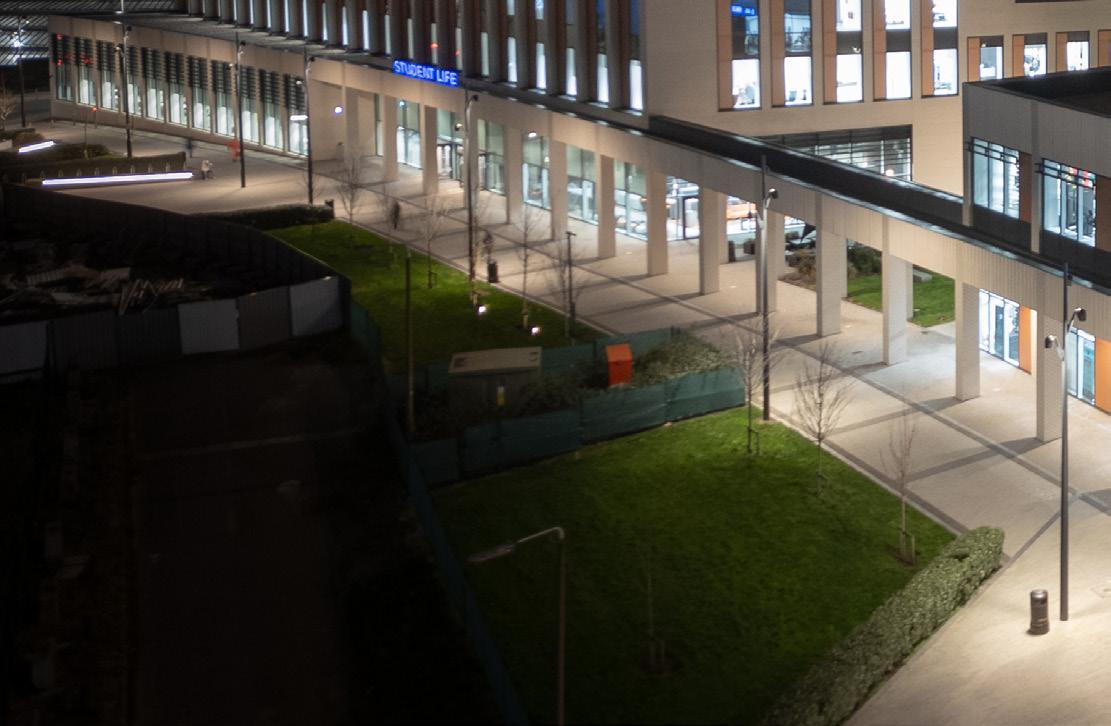
Part of the financial planning process includes scenario planning which stress test key assumptions and principal risks.
Key assumptions and principal risks that are assessed and regularly reviewed by management include:
• Tuition fee rate assumptions
• Student number growth and reductions
• Changes in student population mix
• Pay Award and Pension contributions
• Interest rates and Inflation
Recruitment levels during the August 2025/26 cycle exceeded projections, resulting in a forecasted performance surpassing the budgeted outturn for the year and anticipated improvements in subsequent years.
The University is operating in a challenging external environment, characterised by inflationary pressures affecting staff costs and other expenditures while tuition fees currently remain unchanged. Pension liabilities continue to pose risks amid market volatility. The institution remains committed to prioritising student needs and investing in the overall student experience.
Despite these challenges, the University’s fundamental financial position remains stable.
Based on these accounts and the financial strength of the institution the University is confident that it has sufficient funds to continue to meet all liabilities as they fall due and the accounts continue to be prepared on a going concern basis.


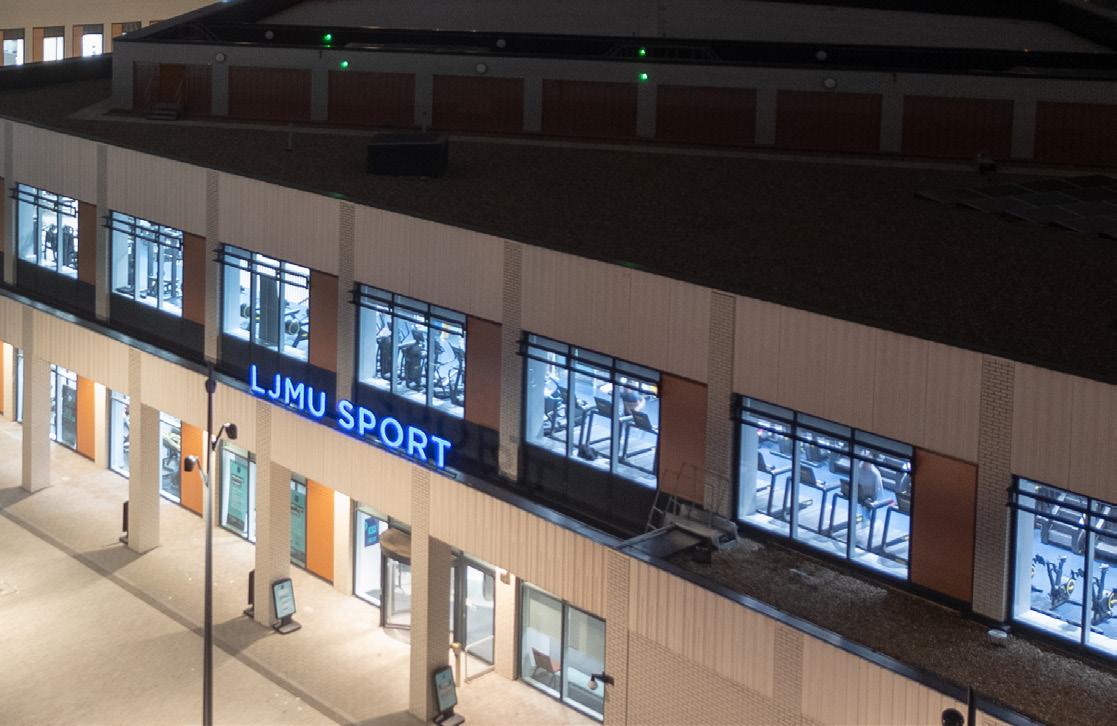
CORPORATE GOVERNANCE STATEMENT – 2024/25
SUMMARY OF THE LJMU STRUCTURE OF CORPORATE GOVERNANCE
The following statement is provided to enable readers of the Annual Report and Statement of Accounts to obtain a better understanding of the governance and legal structure of the university.
The university is committed to adopting good practice in all aspects of corporate governance. It aims to conduct its business in accordance with the principles identified in the Committee on Standards in Public Life (selflessness, integrity, objectivity, accountability, openness, honesty and leadership), the requirements of the HE regulator, the Office for Students (OfS), its Instrument and Articles of Government and the Committee of University Chairs’ (CUC’s) Higher Education Code of Governance. It is the opinion of the Board of Governors that the governance practices of the university are consistent with and satisfy the seven primary elements contained in the Higher Education Code of Governance.
Liverpool John Moores University is a Higher Education Corporation as defined under the Education Reform Act 1988 and the Further and Higher Education Act 1992. The university has exempt charitable status as defined in the Charities Act 2011, with the OfS acting as its principal regulator. The charitable purpose of the university, as defined in the Charities Act 2011, is the advancement of education for the public benefit. The members of the university’s Board of Governors are the charity trustees and are responsible for ensuring compliance with charity law.
The Instrument of Government states that the Board of Governors shall consist of not less than fifteen and not more than twenty-two appointed members, made up of up to fifteen Independent members, two nominees from the Academic Board, two students and two elected staff members. The ViceChancellor and Chief Executive (ex officio) is a member of the Board of Governors.
The role of Chair of the Board of Governors is separate from the role of the university’s Vice- Chancellor and Chief Executive. The Vice-Chancellor is the designated Accountable Officer for the purposes of the OfS terms and conditions of funding and is supported by an Executive Leadership Team (ELT). The Chair is supported by the Deputy Chair of the Board. The matters reserved specifically to the Board of Governors for decision are set out in the Articles of Government of the university, the Scheme of Delegation and in guidance from the OfS.
BOARD OF GOVERNORS
The Board of Governors holds to itself the responsibilities for the educational character, the financial solvency of the university and its strategic direction in accordance with its Strategic Plan 2030.
The Board of Governors meets a minimum of four times a year and maintains a committee structure comprising:
• Audit and Risk Committee
• People Committee
• Finance Committee
• Nominations Committee
• Remuneration Committee
• Academic Board
All of the above committees are formally constituted with terms of reference and each includes Independent members of the Board of Governors. The Finance and People Committees’ membership also includes staff and student governors .
The Vice-Chancellor and Chief Executive is an attendee at meetings of the People, Finance and Nominations Committees and by invitation attends meetings of the Audit and Risk and Remuneration Committees. The Chair and Deputy Chair of the Board are not members of the Audit and Risk Committee and there is no overlap in membership of the Audit and Risk and Finance Committees.
The Board of Governors and its Committees review their terms of reference on an annual basis to ensure that they are embedding risk management effectively into their work and that the terms of reference align with the Higher Education Code of Governance and OfS requirements.
The Audit and Risk Committee advises the Board of Governors on the adequacy and effectiveness of the University’s arrangements for risk management control, governance and value for money (economy, efficiency and effectiveness). It oversees internal and external audit and agrees the audit approach and schedule with the auditors. The Audit and Risk Committee also receives and reviews the Risk Register. The committee is comprised of three independent members . Both the external and independent internal auditors attend the Committee’s meetings. The Committee meets the external and internal auditors at least annually without management, for independent discussions in line with best practice. The Committee also regularly meets with the Vice-Chancellor and Chief Executive to discuss emerging issues. The Committee’s minutes are presented to the full Board meetings. In the last academic year, the Audit and Risk Committee met four times.
The People Committee advises the Board of Governors on issues related to staffing and employment. The responsibilities of the Committee also encompass Equality, Diversity and Inclusivity (EDI) monitoring and the oversight and review of Human Resources (HR) policies. In the last academic year, the People Committee met three times.
The Finance Committee oversees the financial solvency and sustainability of the university. It also keeps under review all significant income and expenditure and at each meeting it receives reports on the university’s performance in relation to approved budgets, estate related capital investment
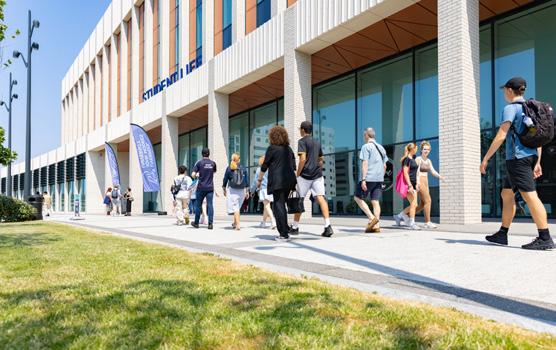
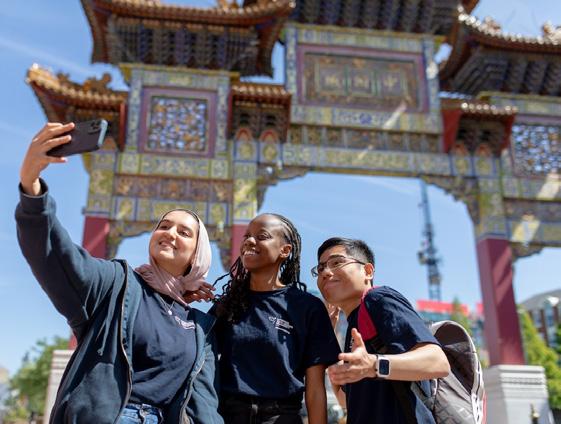
plans and treasury management, and financial reports from the John Moores Students’ Union (JMSU). The Finance Committee met three times in the last academic year.
The Nominations Committee considers membership issues and appointments to vacancies on the Board for non-executive members, based on a skills and diversity analysis.. In the last academic year, the Nominations Committee met three times.
The Remuneration Committee considers the performance and annual remuneration of the Vice-Chancellor and Chief Executive, the Executive Leadership Team and the annual remuneration of the Directorate and Professoriate. The Committee also has oversight of the university’s policy framework on severance payments for senior staff. The Chair of the Remuneration Committee, in line with best practice, is the Deputy Chair of the Board. The Committee met on one occasion during the last academic year.
The Academic Board has twenty six members comprising the Vice-Chancellor and Chief Executive as Chair, the Pro Vice Chancellors, the Registrar and Chief Operating Officer, academic and professional services staff and students and one Independent Governor. (The Vice Chair is the Pro Vice Chancellor, Student Experience). The Academic Board is established as the principal academic body of the university, overseeing the overall planning, co-ordination, development and supervision of the academic work of the university and providing assurance to the Vice-Chancellor and Chief Executive and the Board of Governors for the quality and standards of its awards. The Academic Board, in the last academic year, met four times.
The Board of Governors is committed to continuous monitoring of its performance and regularly reviews its terms of reference, programme of business, and the effectiveness of all its committees. In support of such commitment, independent Governance Effectiveness reviews regularly take place – the last one having been undertaken during 2020/21.
New Governors are required to participate in an induction programme. Governors are given the opportunity to attend training and development activities, which are provided internally and externally commissioned services. Regular bulletins are received regarding the activities across the university and the Higher Education sector along with regular governance briefings on relevant topics.
Upon commencing appointment, Governors are required to declare any pecuniary, family or other personal interest, direct or indirect, and this is noted in the publicly available Register of Members’ Interests. Governors are advised and expected to update their declaration as and when their circumstances change. The university also conducts an annual update in accordance with recommendations from the CUC. There is an item on each and every agenda where
governors are also given the opportunity to declare any conflict of interest.
PUBLIC BENEFIT STATEMENT
The strategic overview on page 2 – see operating review describes how the university has carried out its charitable purposes for the public benefit through its educational research and engagement activities. It also refers to the university’s Access and Participation plan approved by the Office for Students which shows progress to date and future plans for improving equality of opportunity for underrepresented groups to access, succeed in and progress from higher education. The governors have regard to the Charity Commission’s guidance on public benefit when carrying out their duties.
STATEMENT OF INTERNAL CONTROL
The Board of Governors is responsible for ensuring that the university has a sound system of internal control and for reviewing the effectiveness of the university’s system of internal control on an annual basis, whilst safeguarding the public and other funds and assets for which it is responsible. This is in accordance with OfS requirements and consistent with the Higher Education Code of Governance by the Committee of University Chairs (CUC), published in September 2020.
Detailed review and monitoring of the system of internal control is carried out on behalf of the Board of Governors by the Audit and Risk Committee, from which it receives periodic reports concerning internal control, and regular reports from members of the Executive Leadership Team on the steps taken to manage risk within their areas of responsibility.
Such a system is designed to manage rather than eliminate the risk of failure to achieve business objectives and can only provide reasonable and not absolute assurance against material misstatement or loss. It is based on a framework of regular management information, administrative procedures, and a system of managed delegation and accountability.
Key elements of the Universities system of internal control include:
• The university has a Scheme of Delegation which records the reserved powers of the Board of Governors and the delegation of the Board’s powers to its sub-committees, to the Vice Chancellor and beyond.
• There is a medium and short-term planning process
supplemented by detailed annual income, expenditure, capital and cash flow budgets. The Executive Leadership Team, the Finance Committee, the Audit and Risk Committee and the Board of Governors, receive regular financial reports and updates including budgets, monitoring, half year and outturn forecasts in addition to the end of year financial statements.
• The university has Financial Regulations, together with supporting financial policies and procedures, a robust Anti-Money Laundering Policy and Bribery Act Compliance and Criminal Finances Act Statements.
• The university has an agreed Risk Management Policy and a Risk Appetite Statement. Responsibility for identifying and evaluating the major risks faced by the university and for ensuring that appropriate mitigating measures are in place, sits with the Executive Leadership Team, which has considered the institutional register three times in the year ended 31st July 2025. The institutional risk register is reviewed by the Audit and Risk Committee throughout the year and the Finance Committee reviews the high-level financial risks annually. The Board of Governors’ agenda includes a standard item for consideration of relevant or emerging risks and the Board and ELT remain committed to the review and refinement of risk management procedures.
• The university uses externally appointed Internal Auditors to inform the Board of Governor’s review of the effectiveness of the system of internal control. The internal auditors operate to defined professional standards. The internal audit plan is approved by the Audit and Risk Committee and takes into consideration emerging sector issues and required assurances, with clear linkage to the university’s risk register. The Audit and Risk Committee receives regular reports from the independent internal auditors, on specific areas of internal control together with agreed management actions for improvement. A tracking record is presented to the Audit and Risk Committee at each of its meetings to monitor the implementation of audit recommendations. Assessment grading for audits were in the main, either substantial or reasonable and all recommendations made by the Internal Auditors during the year were accepted by management.
• The review of the effectiveness of the system of internal control is also informed by the work of the Executive Leadership Team, who have responsibility for the development and maintenance of the internal control framework and by comments made by the external auditors in their management letter and other
reports. Based on a review of the processes established to ensure effectiveness of internal controls and the range of indicators demonstrating effectiveness, there is an ongoing process for identifying, evaluating and managing the university’s significant risks that has been in place for the year ended 31 July 2025 and up to the date of approval of the financial statements.
LJMU’S MODERN SLAVERY AND HUMAN TRAFFICKING STATEMENT 2024/25 IS AVAILABLE IN FULL AT https://www.ljmu.ac.uk/legal/modern-slavery-acttransparency-statement

EX-OFFICIO MEMBERS
Professor Mark Power Vice-Chancellor and Chief Executive
EXTERNAL INDEPENDENT MEMBERS
Mike Parker Pro-Chancellor and Chair of the Board Chair of Nominations Committee Chair of Chairs’ Group
Chris Airey
Member of Audit and Risk Committee (until November 2024)
Shirley Anderson Chair of People Committee
Sharon Davies
Member of People Committee (since November 2024)
Debbie Francis Chair of Finance Committee (since November 2024)
Lee Gilmore
Deputy Chair of the Board
Chair of Remuneration Committee
Deputy Chair of Finance Committee
Catherine Holmes Member of Finance Committee
Liam Kelly Member of People Committee
Dr Gai Murphy Member of Audit and Risk Committee
Charles Oddy Chair of Audit and Risk Committee (until March 2025)
Stephen Parry Member of Finance Committee
Mark Pennifold Member of People Committee
Graeme Robinson Chair of Audit and Risk Committee (since March 2025)
Jane Tomkinson Chair of Finance Committee (until November 2024)
Damian Waters
Member of Audit and Risk Committee (since November 2025)
Member of Finance Committee (until November 2024)
EXTERNAL CO-OPTED MEMBERS
Graeme Robinson Co-opted member of Audit and Risk Committe (until November 2024)
NOMINEE MEMBERS
Daniel Brenin Firsht Student Governor (JMSU President) ( in attendance until June 2025
Seren Hutchinson Student Governor (JMSU Vice President, Education) ( in attendance until June 2025)
Miles Craven Student Governor (JMSU President) ( in attendance since July 2025
Erin Gerard Student Governor (JMSU Vice President Education) ( in attendance since July 2025)
STAFF MEMBERS
Professor Caroline Wilkinson Staff Governor (Academic)
Emily Walker Staff Governor (Professional Services)
ACADEMIC BOARD NOMINEES
Professor Amos Fatokun in attendance since November 2024
Dr Yog Upadhyay
OFFICERS AND ADVISORS OF THE UNIVERSITY
Vice-Chancellor & Chief Executive Officer
Professor Mark Power
Student Life Building
Copperas Hill
Liverpool L3 5AJ
Bankers
Barclays Bank plc 1st Floor Octagon House
Gadbrook Park
Northwich Cheshire CW9 7RB
Lloyds Bank (from 14 July 2025), 33 Old Broad Street London EC2N 1HZ
External Auditors
KPMG LLP 1 St Peters Square
Manchester M2 3AE
Internal Auditors
Uniac
The Simon Building Oxford Road
Manchester M13 9PL
Solicitors
Brodies LLP 58 Morrison Street
Edinburgh EH3 8BP
Weightmans LLP 100 Old Hall Street
Liverpool L3 9QJ
Mills & Reeve LLP 1 Circle Square 3 Symphony Park
Manchester M1 7FS
Shakespeare Martineau LLP 1 Colmore Square
Birmingham B4 6AA
STATEMENT OF THE BOARD OF GOVERNORS RESPONSIBILITIES IN RESPECT OF THE FINANCIAL STATEMENTS
The Board of Governors is responsible for preparing the financial statements in accordance with the requirements of the Office for Students’ Terms and Conditions of Funding for Higher Education Institutions and Research England’s Terms and Conditions of Research England Grant and applicable law and regulations.
It is required to prepare the group and parent University financial statements in accordance with UK accounting standards and applicable law (UK Generally Accepted Accounting Practice), including FRS 102 The Financial Reporting Standard applicable in the UK and Republic of Ireland. The Terms and Conditions of Funding further require the financial statements to be prepared in accordance with the requirements of the Accounts Direction dated 25 October 2019 issued by the Office for Students (‘the Accounts Direction’) and the 2019 Statement of Recommended Practice – Accounting for Further and Higher Education.
The Board of Governors is required to prepare financial statements which give a true and fair view of the state of affairs of the group and of the parent University and of their income and expenditure, gains and losses and changes in reserves, and of the Group’s cash flows for that period. In preparing each of the group and parent University financial statements, the Board of Governors is required to:
• Select suitable accounting policies and then apply them consistently.
• Make judgements and estimates that are reasonable and prudent.
• State whether applicable UK accounting standards and the 2019 Statement of Recommended Practice–Accounting for Further and Higher Education have been followed, subject to any material departures disclosed and explained in the financial statements;.
• Assess the group and parent university’s ability to continue as a going concern, disclosing, as applicable, matters related to going concern and
• Use the going concern basis of accounting unless it either intends to liquidate the group or the parent University or to cease operations, or have no realistic alternative but to do so.
The Board of Governors is responsible for keeping adequate accounting records that are sufficient to show and explain the parent University’s transactions and disclose with reasonable accuracy at any time the financial position of the parent University. It is responsible for such internal control as it determines is necessary to enable the preparation of financial statements that are free from material misstatement, whether due to fraud or error, and
has general responsibility for taking such steps as are reasonably open to it to safeguard the assets of the group and to prevent and detect fraud and other irregularities.
The Board of Governors is also responsible for ensuring that:
• Funds from whatever source administered by the Group or the university for specific purposes have been properly applied to those purposes and managed in accordance with relevant legislation.
• Income has been applied in accordance with the University’s Statutes funds provided by the Office for Students, UK Research and Innovation (including Research England) and the Education and Skills Funding Agency and the Department for Education have been applied in accordance with the terms and conditions attached to them.
• Ensuring that there are appropriate financial and management controls in place to safeguard public funds and funds from other sources.
• Securing the economical, efficient and effective management of the university’s resources and expenditure.
The Board of Governors is responsible for the maintenance and integrity of the corporate and financial information included on the university’s website. Legislation in the UK governing the preparation and dissemination of financial statements may differ from legislation in other jurisdictions.
Mike Parker, CBE Pro-Chancellor and Chair of the Board
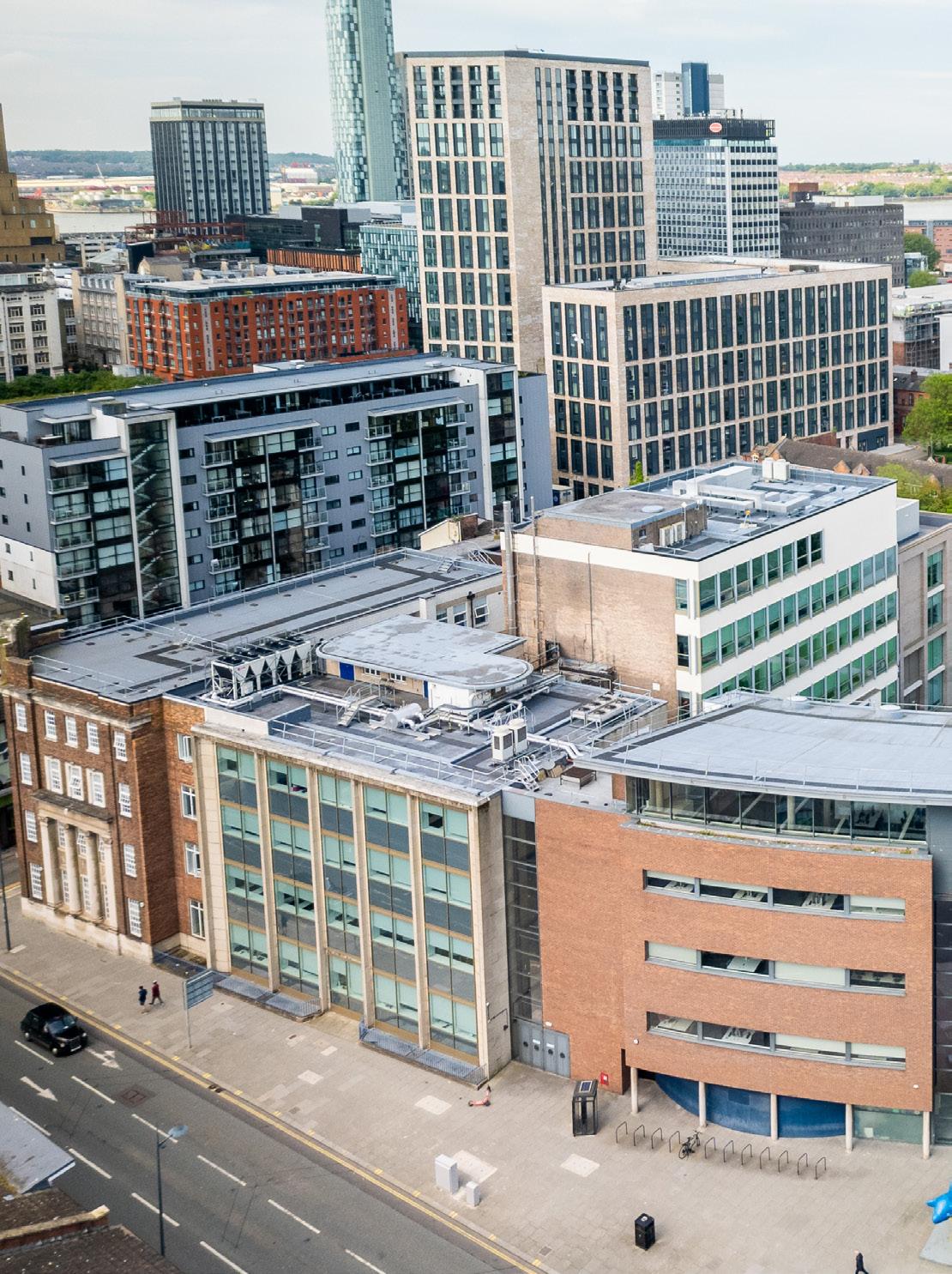
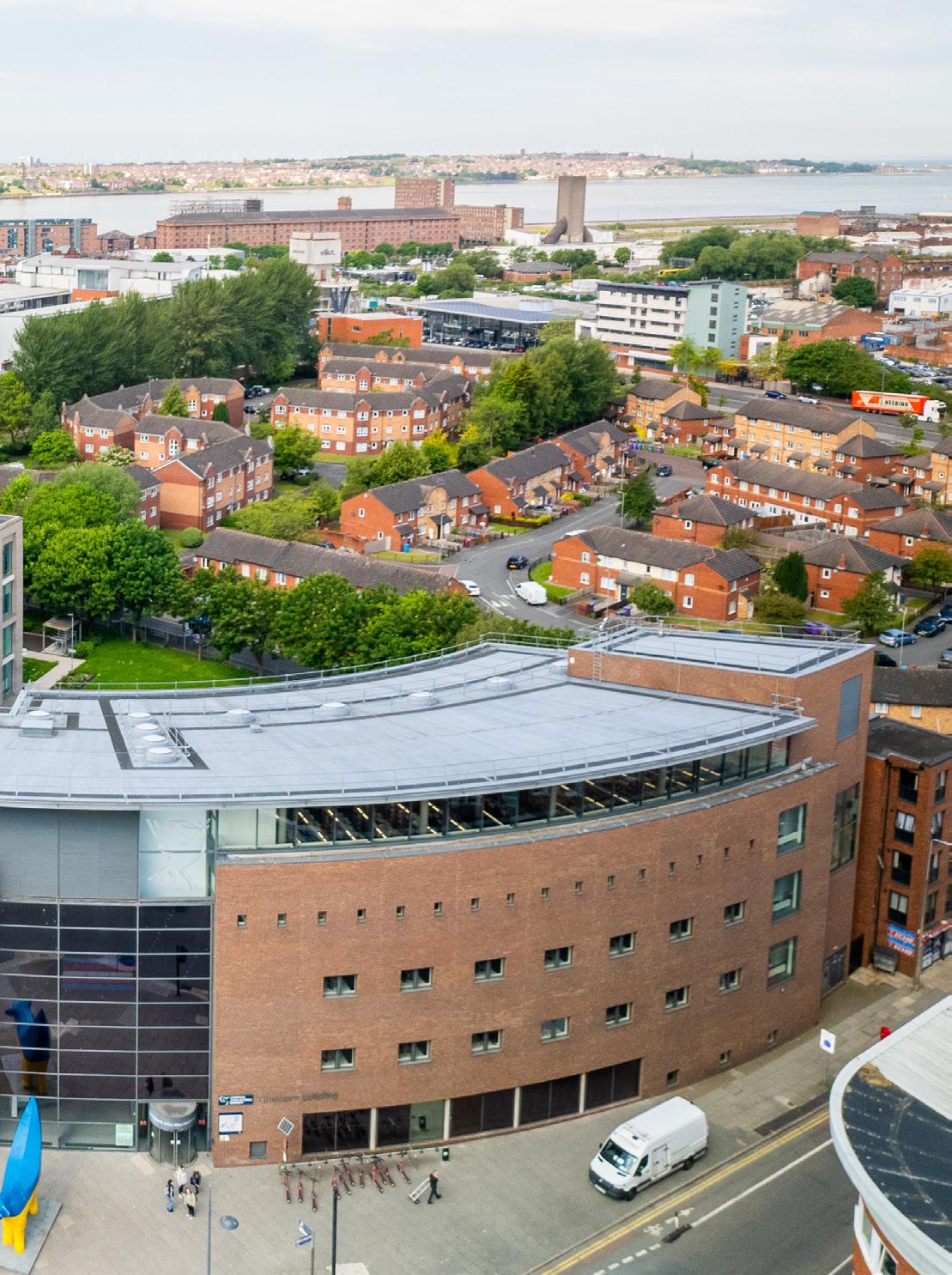
FINANCIAL
streams.
These included those posted to unusual account combinations.