Sustainability by
TableWare International November 2025
Discover our ceramics Royal Goedewaagen is one of the oldest ceramic manufacturers in Europe. All our products are handmade, just like 400 years ago. Today, however, we combine traditional craft with modern production technology. This combination offers endless possibilities. We embrace our heritage, craftsmanship, local identity, and unique experiences of the people who keep these crafts alive. Original, unique and a conscious choice for quality. 100% made in the Netherlands.
Symbiosis of nostalgia & modernity.
BERLIN SERIES TưǨǝƎǠŧşхŗțхǵƉŧхǨǝƎǠƎǵхƺƀхǵƉŧхʹͲǨϭ
Sustainability by
TableWare International
From the
Editor
At the heart of retail To subscribe, email: subs@lemapublishing.co.uk
Published by Lema Publishing Ltd. Unit 1, Broomstick Industrial Estate, High Street, Edlesborough, Buckinghamshire LU6 2JA www.tablewareinternational.com
Tableware Team EDITOR MAIREAD WILMOT mairead@lemapublishing.co.uk
PUBLISHER PAUL YEOMANS pyeomans@lemapublishing.co.uk
MANAGING DIRECTOR MARK NAISH mark@lemapublishing.co.uk
CHAIRMAN MALCOLM NAISH malcolm@lemapublishing.co.uk
PRODUCTION DIRECTOR PAUL NAISH paul@lemapublishing.co.uk
Welcome to the second Sustainability magazine, brought to you by Tableware International. Let’s be very clear, sustainability is an uneasy bedfellow with the tabletop business – ceramics, glassware, steel. It is all too energy intensive, and all too expensive to change. But that doesn’t mean the industry isn’t trying, because it really, genuinely is. Some companies are doing better than others – that is true, but for the most part, the intention to change is there. With this magazine we are very firmly admitting the tableware industry is not perfect when it comes to its sustainability efforts, undoubtedly there is a lot of investment and education needed. But, as our cover star Luzerne’s chief executive officer Elaine Lek tells us: “Real change will come from collaboration, technology and shared commitment across the industry.” In this publication we highlight just some of the tabletop and glassware brands (and believe us, there are many others making great strides in eco-awareness) who are putting sustainability front and centre. These brands are genuinely trying to pin their colours to the mast, telling the world they realise sustainability must play a central role in how they do business, while simultaneously investing what they can in an undeniably challenging business environment. Take Luzerne, they adhere to strict guidelines including a 5R Framework which they tell us about on pages 18 and 19. Meanwhile, we learn about Stölzle Lausitz which has partnered with Stadtwerke Weißwasser (a company local to them) in a move which sees industrial waste heat become a new source of climate-friendly
Sustainability by
TableWare International November 2025
district heating. In layman’s terms, the companies are looking at transforming industrial residual energy into local home heat. “Up to 30 per cent of the city’s heating demand could be covered from this single source, turning industrial waste heat into a benefit for the entire community,” explained Stölzle Lausitz project manager Dr Robert Jurk. Visit page 12 to learn more about the project. Another interesting project comes from Narumi who have successfully started to use eggshells in their production. Turn to page 20 to learn more about how they implemented the change and learn why eggshells are so suited to tableware production. Costa Nova tells us about their investment into eco-friendly production. They see sustainable manufacturing as an opportunity for progression, and the company has not held back, investing €16 million in the opening of a new factory. Miguel Casal, CEO and owner, talks to us on page 34. Other brands such as Denby (page 28) and the Bornego Group (page 38) are all hugely clued in and knowledgeable, seeing sustainable practices as an absolute must when it comes to production. And on the flip side, we hear from Mexican brand Anfora who have implemented their own sustainability practices with little to no government guidance. Read about their efforts on page 11. There is an age old saying “no one is perfect but you can die trying” which I think nicely sums up the tableware industry’s strides towards sustainability – we are not perfect, but we will keep trying. Hopefully this publication can serve as a form of inspiration for those who are, indeed, trying.
Mairead Wilmot
COVER supplied by Luzerne luzerne.com
Get social with
See the latest News: www.kitchenware.international ‘Follow’ & ‘Connect’ on LinkedIn Tableware International ‘Love’ us on Instagram: Tableware_International
CONTENTS November 2025
News 12 News General 14 News Stölzle Lausitz 16 News Ambiente
78
Retail 24 Retail Interview: HOST In focus 18 Cover Story: Luzerne 20 Narumi explains the Eggshell Project 22 Amefa on reducing environmental impact 28 Denby on sustainability being at the heart of its business model 32 Bonna reveals a new premium vitrified collection
18
Costa Nova on investing in the future 36 Crystalex on responsible glassmaking 38 The Bornego Group discuss the brand’s acquisition of Nova Keramiek 42 Vidrios San Miguel on 40 years of sustainable glassmaking 44 ID Fine on why their Sustainably Harmony concept means they are doing things differently 46 Editor’s Choice looks at Fine 2 Dine’s Icon collection 34
24 68
22 32
28 34
34 The views of the contributors expressed in this journal are not necessarily those of the publisher or Lema Publishing Ltd. Comments, letters and criticism are welcome.
Tableware International
tableware_international
@tablewareintmag
tablewareintmag
News
Lucideon updates guide on safe use of ceramic, glass and enamelware in contact with food Fine2Dine introduces EcoMade Belgian brand Fine2Dine has introduced EcoMade – tableware produced entirely emission-free, locally, and without fossil fuels. The company says it is the first tableware brand to innovate with zero per cent emission production. With EcoMade, Fine2Dine is responding to the growing demand for tableware that is not only creative and functional, but also responsible. Each piece proudly bears the green F2D logo with EcoMade certification: the symbol of style,
sustainability, and reliability. EcoMade confirms Fine2Dine’s commitment to creating innovative collections that not only inspire the hospitality industry today, but also prepare it for the future. “We want to prove that design, quality, and sustainability go hand in hand,” says Fine2Dine. “With EcoMade, we show that tomorrow’s table can be not only stylish, but also future-conscious.” The range is available from January 2026 via www.fine2dine.com.
Lucideon recently released an updated edition of its cross-industry reference guide which sets out details on the safe use of ceramic, glass and enamelware in contact with food. Since its original launch in 1972, the guide has provided a single point of reference for testing facilities and ceramic, glass and enamelware manufacturers. Authored by Lucideon’s technical information officer, Chris Thompson, this latest version replaces the 2022 publication and features amended entries including those required by Israel and UAE, as well as confirming existing standards. It also includes US state regulations for children’s products. Chris Thompson, who authored the guide, explains; “Regulation on release of metals from ceramicware is a minefield, with different countries adhering to different standards and limits. The Lucideon Metal Release Guide is designed to be a quick reference guide for manufacturers to point them to the relevant standards and limits for their target market.” Visit www.lucideon.com to learn more.
Did you know?
“True sustainability is not a destination but an ongoing journey. We know we’ve made important progress — but there is always more to do. For us, being truly sustainable means looking critically at every part of our value chain and constantly asking: where can we do better? ” RAK Porcelain Europe’s director of operations Sven Bodry speaking in a recent interview with Sustainability’s sister title Tableware International addressing whether the ceramics industry can ever truly be sustainable.
At the most recent trade event – Host – which saw thousands of industry professionals gather in the Italian city of Milan, sustainability played a huge role. “Host was the first event at Fiera Milano to implement an ESG strategy, integrating environmental sustainability, innovation and inclusion as competitive levers and key elements of its international positioning,” the trade show explained. “This commitment is shared by many exhibitors, who presented ecofriendly products such as beer machines that reuse broken malt during production or designer fitness equipment made from natural and recyclable materials.”
12 Sustainability by TABLEWARE INTERNATIONAL
Anfora drives own advances in sustainability Mexico’s century-old ceramic dinnerware producer, and one of North America’s largest manufacturers, Anfora has admirably set its own sustainability standards. “While environmental regulations drive most sustainability advances in Europe, few manufacturers in developing regions have taken comparable steps on their own,” the brand tells us. Facing minimal government incentives, Anfora decided to act independently to reduce its environmental footprint. The company recently implemented a closed-loop water system that captures and filters over 80,000 liters of glaze and clay runoff each month, fully reusing it in production. This initiative not only conserves potable water but also prevents industrial discharges from entering municipal systems. Recovered glaze materials are refined and reused in the new Tulum EcoCeramics collection (pictured) —fired at 1,280°C for over 12 hours—featuring luminous, food-safe finishes. The line also incorporates four to six per cent of vitrified breakage, ground and reintroduced into the clay body for added strength, diverting significant waste from landfills. Complementing these material innovations, Anfora recently installed 500 kWh of solar energy capacity, all without government subsidies. The company also transitioned to pipeline-delivered natural gas from the Gulf of Mexico and Texas Permian Basin to feed its ten tunnel kilns, further lowering emissions compared to LNG-based sources. In a region where few industrial players pursue environmental goals beyond compliance, Anfora’s self-driven commitment stands out.
In focus:
BHS Tabletop We asked BHS Tabletop to share its approach to sustainability with us… “For us, sustainability is not a trend but a lived commitment. As one of Europe’s leading porcelain manufacturers, we take responsibility — for people, resources, and the future of our industry. Our sites are certified according to ISO 14001 (Environmental Management) and ISO 50001 (Energy Management). With the EcoVadis Silver Medal, we are among the top seven per cent of evaluated companies in our industry. We continuously invest in efficiency and circular processes: ■
■
Zwiesel Fortessa scoops new award Zwiesel Fortessa has been honoured with a new sustainability award. The Best Business Award for Sustainable Corporate Management – now in its 25th year – is one of the oldest awards for sustainable corporate management in Europe. It honours companies who combine economic
success with ecological responsibility and social commitment. Zwiesel Fortessa impressed the jury with its deeply rooted sustainability strategies – from resource-saving production processes and energy-efficient technologies to a strong focus on employee development and regional value creation. Scooping a gold award, the company not only underscores its leading role in the glass industry but also sends a clear signal for sustainable corporate management in international competition. “This award is an incentive to continue on the path we have chosen – with passion, responsibility, and the firm conviction that sustainable business practices and entrepreneurial success are inseparable,” says board member Kathrin Strous.
■ ■ ■
00 kWp photovoltaic system 6 - around 10 per cent selfgenerated electricity at our Schönwald site. Since 2024, 50 per cent of heating energy has been generated from the waste heat of our porcelain kilns. 75 per cent of porcelain mass is returned to the production cycle. 39,000 m³ of water are treated and reused annually. Future project: Use of hydrogen as a sustainable energy source.
Responsibility that goes further Our responsibility does not end at the factory gates. With our Code of Conduct, Supplier Code of Conduct, and an internal reporting system for environmental and human rights risks, we ensure that: sustainability is part of our corporate culture — in all areas and throughout the entire supply chain. We record our emissions according to the international GHG Protocol and are developing a roadmap to CO₂ neutrality by 2045. This is how we shape the future step by step — fact-based and transparent.” Sustainability by TABLEWARE INTERNATIONAL 13
News
Katrin Bartsch, managing director of Stadtwerke Weißwasser pictured with Stölzle Lausitz’s CEO Leopold Grupp
Stölzle Lausitz and Stadtwerke Weißwasser partner on new project to create sustainable home heat Leading glassmaker Stölzle Lausitz has partnered with Stadtwerke Weißwasser in a move which sees industrial waste heat become a new source of climate-friendly district heating. In layman’s terms, the companies are looking at transforming industrial residual energy into local home heat. As part of the Lausitz heat transition, Stadtwerke Weißwasser GmbH (SWW) and Stölzle Lausitz GmbH are sending a clear signal for the future of regional energy supply. With the signing of a joint declaration of intent on August 29, 2025, at the Stölzle Lausitz site in Weißwasser, both companies officially sealed their commitment to explore cooperation in using industrial waste
heat from glass production. Katrin Bartsch, managing director of Stadtwerke Weißwasser, says: “We are transforming industrial residual energy into local home heat. This project is a milestone for Weißwasser. Stölzle Lausitz, as a market leader and one of the city’s key employers, is at the heart of our local economy. The fact that we can now join forces with our major energy partner to unlock this hidden treasure – the unused waste heat from glass production – is a fantastic signal. We’re demonstrating how an energy consumer can become a heat supplier, and how, together, we can shape the energy transition right here in Weißwasser. It’s not
Did you know?
The usable capacity exceeds 2,000 kW – enough to supply more than 1,000 households. Completion of the project is scheduled for January 2027. 14 Sustainability by TABLEWARE INTERNATIONAL
only smart; it also creates a safe and green future for the people of our city.” Every day, unavoidable waste heat is generated in Stölzle Lausitz’s production halls, where machines operate at temperatures of up to 1,500 °C. Instead of letting this energy escape unused, SWW plans to feed it directly into the district heating network, returning it to the city as climate-friendly energy. “Up to 30 per cent of the city’s heating demand could be covered from this single source, turning industrial waste heat into a benefit
for the entire community,” explains Stölzle Lausitz’s project manager Dr Robert Jurk. The usable capacity exceeds 2,000 kW – enough to supply more than 1,000 households. Completion of the project is scheduled for January 2027. This partnership stands for progress, responsibility, and strong regional ties. Both companies demonstrate how sustainable energy supply and economic strength can go hand in hand in Weißwasser for the benefit of local people and the protection of the environment.
News Villeroy & Boch
Villeroy & Boch wins EcoVadis award Platinum medal for Group, who rank among the top one per cent of more than 150,000 companies assessed worldwide… The Villeroy & Boch Group has been awarded the EcoVadis Platinum Medal, the highest distinction in the globally recognised EcoVadis sustainability rating. With an overall score of 85 out of 100, the Group ranks among the top one per cent of more than 150,000 companies assessed worldwide. The rating offers strong assurance to partners, customers, and suppliers that Villeroy & Boch meets the highest sustainability standards. EcoVadis evaluates companies across 21 criteria in four core areas: Environment, Labour & Human Rights, Ethics, and Sustainable
Procurement. The assessment is based on globally recognised standards and provides companies with a data-driven analysis of their sustainability performance. Villeroy & Boch has participated in the assessment annually since 2018 as a benchmark to track progress and strengthen transparency. After two consecutive Silver ratings, the Group has now achieved Platinum status for the first time. Contributing factors include renewed engagement with the UN Global Compact, signing the UN Women’s Empowerment Principles, and validating climate targets with the Science Based
Did you know?
The Villeroy & Boch Group employs in the region of 12,000 employees and is present in around 140 countries worldwide.
Targets initiative. The Group also supports local initiatives, such as expanding the hydrogen network at its Saar sites. Particularly high scores were achieved in Environmental Responsibility and Labour and Human Rights. Notable initiatives include energy efficiency measures in production, investments in workplace safety, leadership development through an internal Leadership Academy, and social audits to ensure human rights and ethical standards in the supply chain. “We are proud to receive the EcoVadis Platinum Medal this year,” said George Loerz, COO Bathroom & Wellness. “It reflects our commitment to responsible business and our ambition to drive positive change – from reducing Scope 3 emissions by 25 per cent by 2030 to achieving zero waste at all ceramic sites and promoting global employee wellbeing.”
Sustainability by TABLEWARE INTERNATIONAL 15
News Ambiente
Ambiente presents new focus
on sustainable design “At the table with nature” is a material showcase exploring the use of sustainable, non-toxic materials in interior and hospitality settings
As sustainability continues to shape the global consumer goods industry, Ambiente 2026 presents a forward-thinking highlight with the new material exhibition called “At the table with nature”. This curated showcase is part of the Interior Design & Architecture Hub in Hall 3.1, the central platform for designers, architects, and project planners. Curated by the Healthy Material Lab Europe and the interior design studio Raumgesichte, the
exhibition explores the use of sustainable, non-toxic materials in interior and hospitality settings. It aims to inspire professionals with innovative solutions that combine aesthetics, functionality, and environmental responsibility. From recyclable surfaces to bio-based finishes, the materials on display reflect a growing industry shift toward healthier, more conscious design practices. The exhibition acts as both a tactile experience
16 Sustainability by TABLEWARE INTERNATIONAL
and a source of knowledge – showcasing how responsible material choices can shape the future of interior environments, particularly in the context of hospitality and contract business. “At the table with nature” invites trade visitors to discover how material innovation can meet modern design expectations while addressing ecological and social challenges. It is a must-see for those looking to align creative vision with sustainable values. Ethical Style at Ambiente 2026 The Ethical Style special interest continues to play an important role across all sectors of the trade fair. While there will not be a dedicated Ethical Style Spot for Ambiente Dining this time, two curated Ethical Style Spots will once again be featured on the fairgrounds, located in the Foyers of Hall 3.1 and Hall 10.1. These spots showcase selected sustainable products across all product groups. Exhibitors participating in Ethical Style are marked:
■ Online: via the Ethical Style filter on the online exhibitor search and in the Ambiente Navigator app. ■ On-site: with the Ethical Style logo displayed directly at the booth. Speaking about how sustainability is shaping the future, Thomas Kastl, director of Ambiente Dining says: “Sustainability is no longer an optional extra – it has become the benchmark by which future-ready products are measured and the foundation of responsible business. At Ambiente, we show how conscious consumption, material intelligence and design quality can come together. Our Ethical Style by Ambiente programme specifically highlights manufacturers who conserve resources, use durable materials or integrate circular principles into their production. The Ethical Style Spots give these products a stage – visible, inspiring and tangible. We guide retailers directly to these offerings, making it clear that sustainability and aesthetics are not opposites. On the contrary, they are two sides of the same approach.”
Unique design in 100% Post-consumer Recycled Glass: A Commitment to Sustainability and Conscious Design In a world where design and sustainability must go hand in hand, these 100% post-consumer recycled glass vases, GRS certified, handcrafted in Valencia, stand as a clear commitment to the future. Ranging from medium to large sizes, their organic and fluid forms represent the perfect fusion of nature and environmental responsibility. The glass used comes from local recycling processes, reducing carbon footprints while promoting the circular economy—an essential pillar in the fight against climate change. Each vase is a unique, handcrafted piece, ensuring originality and attention to detail. The beauty of these pieces lies not only in their aesthetic but also in their deep respect for the natural environment, as they repurpose materials and help reduce waste. By choosing these vases, you’re making a commitment to the planet, opting for a design that not only decorates but tells a story of responsibility and respect for the environment. A piece that goes beyond decoration and becomes a symbol of sustainability. With this proposal, we aim not only to stand out in the design field but also to be a benchmark for responsible innovation, contributing to a greener, more conscious future.
www.vsanmiguel.com | +34 96 236 30 11 | contacto@vsanmiguel.com
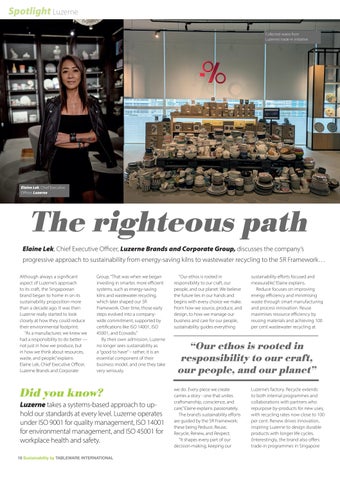
Spotlight Luzerne Collected wares from Luzerne’s trade-in initiative
Elaine Lek, Chief Executive Officer, Luzerne
The righteous path Elaine Lek, Chief Executive Officer, Luzerne Brands and Corporate Group, discusses the company’s progressive approach to sustainability from energy-saving kilns to wastewater recycling to the 5R Framework… Although always a significant aspect of Luzerne’s approach to its craft, the Singaporean brand began to home in on its sustainability proposition more than a decade ago. It was then Luzerne really started to look closely at how they could reduce their environmental footprint. “As a manufacturer, we knew we had a responsibility to do better — not just in how we produce, but in how we think about resources, waste, and people,” explains Elaine Lek, Chief Executive Officer, Luzerne Brands and Corporate
Group. “That was when we began investing in smarter, more efficient systems, such as energy-saving kilns and wastewater recycling, which later shaped our 5R Framework. Over time, those early steps evolved into a companywide commitment, supported by certifications like ISO 14001, ISO 45001, and Ecovadis.” By their own admission, Luzerne no longer sees sustainability as a “good to have” – rather, it is an essential component of their business model, and one they take very seriously.
Did you know?
Luzerne takes a systems-based approach to uphold our standards at every level. Luzerne operates under ISO 9001 for quality management, ISO 14001 for environmental management, and ISO 45001 for workplace health and safety. 18 Sustainability by TABLEWARE INTERNATIONAL
“Our ethos is rooted in responsibility to our craft, our people, and our planet. We believe the future lies in our hands and begins with every choice we make. From how we source, produce, and design, to how we manage our business and care for our people, sustainability guides everything
sustainability efforts focused and measurable,” Elaine explains. Reduce focuses on improving energy efficiency and minimising waste through smart manufacturing and process innovation. Reuse maximises resource efficiency by reusing materials and achieving 100 per cent wastewater recycling at
“Our ethos is rooted in responsibility to our craft, our people, and our planet” we do. Every piece we create carries a story - one that unites craftsmanship, conscience, and care,” Elaine explains passionately. The brand’s sustainability efforts are guided by the 5R Framework; these being Reduce, Reuse, Recycle, Renew, and Respect. “It shapes every part of our decision-making, keeping our
Luzerne’s factory. Recycle extends to both internal programmes and collaborations with partners who repurpose by-products for new uses, with recycling rates now close to 100 per cent. Renew drives innovation, inspiring Luzerne to design durable products with longer life cycles. (Interestingly, the brand also offers trade-in programmes in Singapore
that give used ceramic ware a second life.) And finally, Respect reflects Luzerne’s commitment to people and the environment. “We uphold responsible practices across our value chain — from how we work with suppliers to how we care for our teams and communities,” Elaine says. When it comes to monitoring
— for our people, our partners, and the planet,” explains Elaine. “Ecovadis recognises our performance across key areas such as environment, labour and human rights, ethics, and sustainable procurement. It allows us to benchmark ourselves globally and identify where we can keep improving.
DĂĚĞ ǁŝƚŚ ^ƵƐƚĂŝŶĂď
Five principles to follow… The brand’s sustainability efforts are guided by the 5R Framework; these being Reduce, Reuse, Recycle, Renew, and Respect. Used water is treated in this reservoir and channelled back into production, achieving full water circulation
ůĞ ĨĨŽƌƚƐ
ǁŝƚŚ ƚŽĚĂLJΖƐ ĐŚŽŝĐĞƐ͘ Ă ďƌŝŐŚƚĞƌ ĨƵƚƵƌĞ ƐƚĂƌƚƐ ŶŽǁ ƚ >ƵnjĞƌŶĞ͕ ǁĞ ďĞůŝĞǀĞ ŽƌŬ͕ ǁĞ Ă ƌĞ ƉƌŽƵĚ ƚŚĂƚ >ƵnjĞƌŶĞ ĨĂĐƚŽƌLJ ŝƐ ƚƵƌĞ͘ Ğǁ ĞŶĞƌ ĨƵ 'ƵŝĚĞĚ ďLJ ŽƵƌ ϱZ &ƌĂŵ Ƶƌ ĐŽŵŵŝƚŵĞŶƚ ƚŽ ƐƵƐƚĂŝŶĂďŝůŝƚLJ ĂŶĚ Ă ŐƌĞ ƌŵŝŶŐ Ž ĞƌƚŝĨŝĞĚ ƋƵĂůŝƚLJ ĐŽǀĂĚŝƐͲĐĞƌƚŝĨŝĞĚ͕ ƌĞĂĨĨŝ ƚĞ ƚŚƌŽƵŐŚ /^K ϵϬϬϭͲĐ ƌĂĐƚ ŝĐĞƐ ĂŶĚ hƉŚŽůĚŝŶŐ ĨĂŝƌ ůĂďŽƵƌ Ɖ ĞŶǀŝƌŽŶŵĞŶƚ͕ ĂƐ ĞŶƐ ƵƌŝŶŐ Ă Ɛ ĂĨĞ ǁŽƌŬŝŶŐ ϰϱϬϬϭ ĚĞŵŽŶƐƚƌĂƚĞĚ ďLJ ŽƵƌ /^K ĞůLJ ƐƵƉƉŽƌƚŝŶŐ ŽƵƌ Đƚŝǀ ŝůĞ Ă ͕ ǁŚ ƚŝŽŶ ŝĨŝĐĂ ĐĞƌƚ ƵŐŚ ǀĂƌŝŽƵƐ ^Z ůŽĐĂů ĐŽŵŵƵŶŝƚŝĞƐ ƚŚƌŽ ĂĐƚŝ ǀŝƚŝĞƐ͘
ĐƚƐ͕ ŽĨĨĞƌŝŶŐ ĞƐŝŐŶŝ ŶŐ ĚƵƌĂďůĞ ƉƌŽĚƵ ͕ ĂŶĚ ƐƵƉƉŽƌƚŝŶŐ ƚƌĂĚĞͲŝŶ ƉƌŽŐƌĂŵŵĞƐ ŽƵƌĐŝŶŐ͘ ĐĂů Ɛ ĞƚŚŝ
ZĞĚƵĐĞ
ZĞƐƉĞĐƚ
DŝŶŝŵŝƐŝŶŐ ǁĂƐ 'ͬ>E'͕ ͲĞĨĨŝ ĐŝĞŶƚ ƉƌŽĚƵĐƚŝŽŶ ;>W ŵĂŶĂŐĞŵĞŶƚ͕ ĞŶĞƌŐLJ ^ŵĂƌƚ ŝŶŝŵĂů ƉĂĐŬĂŐŝŶŐ͕ ĂŶĚ ϱ' ŐͿ͕ ŵ LJĐůŝŶ ƚ ƌĞĐ ŚĞĂ ŬŝůŶ ŐLJ DĂŶƵĨĂĐƚƵƌŝ ŶŐ ƚĞĐŚŶŽůŽ ŝŶƚĞŐƌĂƚŝŽŶ͘
ZĞƵƐĞ
ZĞŶĞǁ
й ƵƚŝůŝƐĂƚ ŝŽŶ ƚŚƌŽƵŐŚ ϭϬϬ DĂdžŝŵŝƐŝŶŐ ƌĞƐŽƵƌĐĞ ͘ Ě ŝŶƚĞƌŶĂů ŵĂƚĞƌŝĂů ƌĞƵƐĞ ǁĂƐƚĞǁĂƚĞƌ ƌĞĐLJĐůŝŶŐ ĂŶ
ZĞĐLJĐůĞ
Ě͘ ůů ƌŝ Ξ ϮϬϮϱ >ƵnjĞƌŶĞ WƚĞ >ƚ
ŐŚƚƐ ƌĞƐĞƌǀĞĚ͘
ƌĂŵŵĞƐ ǁŝƚŚŝŶ ƚŚĞ LJ ƚŚƌŽƵŐŚ ƌĞĐLJĐůŝŶŐ ƉƌŽŐ ĞƌƐ͘ ^ƵƉƉŽƌƚ ŝŶŐ ƐƵƐƚĂŝŶĂďŝůŝƚ ŝŽŶƐ ǁŝƚ Ś ĞdžƚĞƌŶĂů ƉĂƌƚŶ ĐŽŵƉĂŶLJ ĂŶĚ ĐŽůůĂďŽƌĂƚ
sustainability, Luzerne has a series of measures in place to ensure company standards are upheld at ground level. Elaine reveals: “We take a systems-based approach to uphold our standards at every level. Luzerne operates under ISO 9001 for quality management, ISO 14001 for environmental management, and ISO 45001 for workplace health and safety. “Our factory integrates 5G Smart Manufacturing and energy-efficient kilns to monitor and optimise resource use in real time. We achieve 100 per cent wastewater recycling and conduct regular audits to ensure every stage — from sourcing to firing — aligns with our sustainability goals.” On top of all this, the brand also tracks key indicators such as waste reduction, water reuse, and energy efficiency, reviewed through internal audits, external assessments like Ecovadis, and periodic management reviews to ensure all their efforts remain on track. Like the aforementioned Ecovadis, Luzerne has some notable certifications to prove its credentials. “These certifications reflect our ongoing commitment to doing better
“Our ISO certifications, 9001, 14001, and 45001, ensure that quality, environmental responsibility, and workplace safety are built into every part of our operations. They help us maintain consistency and accountability to international standards. “The Building and Construction Authority (BCA) Green Mark Platinum certification for our Singapore headquarters is another milestone that reflects our belief that sustainability extends beyond production — into how we design, build, and operate our spaces. We have also received additional recognition through the BCA Super Low Energy (SLE) Certification in October 2025, highlighting our efforts to reduce emissions and improve energy performance. “Together, these certifications keep us focused, transparent, and aligned with our goal of making sustainability part of everyday excellence.” With the efforts Luzerne puts into meeting its own sustainability goals, we asked the brand their thoughts on whether the industry as a whole does enough? “The industry has made progress, but there’s still a long way to go,” Elaine says. “Tableware production is energy-intensive by nature, and transitioning to
ŶůLJ ĚĞͲŝŶ ƉƌŽŐƌĂŵŵĞƐ ĂƌĞ Ž Ύ ƚ ƚŚĞ ŵŽŵĞŶƚ͕ ƚŚĞ ƚƌĂ ͕ ^ŝŶŐĂƉŽƌĞ ĞdžĐůƵƐŝǀĞ ƚŽ dŚĞ ^ŚŽƉ
greener systems requires significant investment and innovation. Access to sustainable materials and renewable energy remains a challenge for many manufacturers, but that’s not a reason to slow down. Real change will come from collaboration, technology, and shared
conscious of how products are made,” Elaine agrees. “They want pieces that are not only beautiful and durable but also responsibly produced. Customers today are beginning to realise they have a responsibility to care for the planet. For us, it’s rewarding to
“Real change will come from collaboration, technology, and shared commitment across the industry” commitment across the industry.” This commitment to the cause goes further than just Luzerne, it spreads to their customer base too, where eco-friendly principles are just as important to both the brand’s consumers and hospitality partners. “Both our hospitality partners and consumers are becoming more
see that the values we’ve long held are now shared by the people who choose Luzerne.” As for what is next from Luzerne, the brand says it will “continue to build on what we’ve started — deepening our sustainability efforts while exploring new ways to innovate through design and technology.”
Sustainability by TABLEWARE INTERNATIONAL 19
Product Narumi
Narumi’s Eggshell
Project unveiled Narumi has been working tirelessly on a new project which uses eggshells to replace 15 per cent of the conventional bone china raw materials. The project has proven so successful that Narumi is now using eggshells in its collections. We shine a light on this new way of producing tableware… The Eggshell Project explained… Narumi Corporation’s Eggshell Project is driven by a desire to “protect the dining tables of the future” and aims for environmentally conscious, sustainable manufacturing. This initiative began with the goal of effectively utilising eggshells, a resource that had not been sufficiently leveraged by other industries, thereby contributing to the efficient use
of resources and the reduction of environmental impact. “We focused on the common element of calcium,” a Narumi spokesperson explains. “Specifically, calcium phosphate, one of the main raw materials for bone china, and calcium carbonate, which is abundant in eggshells. This commonality led to the research and development of using eggshells to replace 15 per cent of the conventional bone china raw materials”.
How it all came together… Success in developing this new material was achieved by bringing together bone china manufacturing technology cultivated over many years (particularly crushing and firing techniques), combined with the reinforcement of the production system through the introduction of new equipment. “This development has enabled the commercialisation of new bone china products
Did you know? Narumi will put eggshells into all its collections going forward. Production using the new material has already started, and Narumi is currently in the process of sequentially transitioning products to utilise it. Moving forward, they plan to expand the lineup of this environmentally friendly bone china. 20 Sustainability by TABLEWARE INTERNATIONAL
formulated with eggshells, without compromising the quality of the conventional product. Production of these items has already begun,” Narumi’s spokesperson explains. Eggshells versus bone china… The greatest characteristic of the new eggshell-based bone china is its maintenance of the high quality inherent to conventional bone china. The strength remains the same as conventional products, and it achieves a sustainable resource utilisation rate exceeding 50 per cent. In short, users gain the value of indirectly contributing to environmental conservation simply by continuing to use this high-quality tableware. Furthermore, although eggshells are used, the new
Fact!
Narumi reduces industrial waste from liquid egg vendors by accepting their discarded eggshells as a raw material material poses no concern regarding egg allergies or similar issues, as the product is fired two or more times at temperatures exceeding 1,100C (2,012F). New opportunities... This project is not merely about replacing Narumi’s own bone china raw materials with upcycled material; it is also creating a new business segment, the manufacturing and the sale of eggshell-derived calcium powder. Dual use of raw material (the “two-sword approach”): The eggshells serve as a raw material for Narumi Corporation’s own bone china (raw material replacement in in-house operations) while simultaneously becoming a product supplied to other companies. Collaboration with other industries: Narumi reduces
materials: calcium derived from eggshells, pulp obtained by dissolving the backing paper of transfer decals, and bone china body that did not meet in-house standards during the manufacturing process. This product is also beginning to be utilized in the market. The environmental impact of using eggshell in production… The most significant environmental impacts are summarised into the following three points: Waste reduction: A large volume of eggshells that were previously discarded (and
classified as industrial waste) are reborn as a resource, leading to a reduction in waste volume. Preservation of earth’s resources: Limestone, which is a component of the raw materials for bone china, is a finite natural resource obtained through mining. By using eggshells as a substitute, the project contributes to the preservation of natural resources by reducing the amount of mined resources. CO2 reduction: Since the eggshells are supplied from nearby liquid egg vendors, it also contributes to CO2 reduction because of shorter transportation distances. Additionally, eggshells have the advantage of being free of iron content and possessing stable quality, which allows us to significantly increase the utilisation rate of sustainable resources while maintaining high quality. Visit www.narumi.co.jp to learn more about this unique project.
We asked… Has Narumi had to change any of its production methods when incorporating the new product into production? “Yes. To ensure the stable incorporation of eggshells, ingenuity and adjustments based on years of expertise were applied to the manufacturing processes, particularly in the firing and crushing techniques. Furthermore, the reinforcement of the production system through the introduction of new equipment was a major factor in realising the mass production of this new eggshell-based bone china. Through this technological innovation, we made it possible to utilise eggshells – a unique natural resource – as a raw material for tableware.”
“Production using the new material has already started” industrial waste from liquid egg vendors by accepting their discarded eggshells as a raw material. Furthermore, we have begun supplying eggshellderived calcium hydroxide to manufacturers who synthesize apatite from eggshellderived calcium components, effectively utilizing Narumi’s large-scale equipment. Sustainable model: In this way, multiple companies are forming a partnership to construct a sustainable business model where new commercial products are born from previously discarded eggshells. In addition, another example of a 100 per cent in-house use case is the production of lime plaster (shikkui). This lime plaster is produced using 100 per cent upcycled and recycled Sustainability by TABLEWARE INTERNATIONAL 21
Interview Amefa
Making meaningful
impact
Amefa’s marketing and sales expert Suzanne Muller reveals changes the brand has made to reduce its environmental impact Amefa has made some key changes in recent years, not only in how it manufactures its cutlery, but also its packaging, swapping out polybags for silk paper. Tell us more about that decision and how easy it was to implement this small change? At Amefa, we believe that meaningful impact often starts with simple, thoughtful decisions. Replacing polybags with silk paper was a deliberate move to reduce single-use plastics in our packaging. Since launching this initiative in 2021, we’ve saved over 129 million
polybags, contributing significantly to our plastic reduction goals. While it required coordination across our supply chain and packaging teams, the transition was embraced quickly thanks to our shared commitment to sustainability and customer experience. Tell us about some other changes Amefa has made over the years to ensure you are complying with government regulations and producing more responsibly? We’ve taken a multi-faceted approach to sustainability. In recent years, we’ve monitored our Scope 1, 2, and 3 emissions since 2023, allowing us to set ambitious climate targets and calculate our full company and product carbon footprint. We’ve joined the Amfori BEPI initiative, improving the environmental performance of our factories.
We’ve also ensured our products are produced at BSCIcertified factories, reinforcing our commitment to ethical sourcing. Amefa has also introduced Slim and Leaves, 100 per cent recyclable, ultra-thin, stainless-steel alternative to disposable plastic and wooden cutlery. Another collection is Phoenix, a cutlery line made from more than 80 per cent recycled stainless steel, which reduces energy consumption and raw material use while maintaining food safety and quality. These initiatives reflect Amefa’s proactive stance in aligning with global sustainability standards and government regulations. As a leading brand how much responsibility does Amefa feel to lead from the front when it comes to environmental and
Recycled cutlery Made of 2.5mm 18/0 stainless steel, Amefa’s Phoenix collection contains a minimum of 80 per cent recycled stainless steel. The recycled material comes from postproduction material and the remaining less than 20 per cent virgin stainless steel is added to guarantee the food safety and an optimal quality. For the production of recycled stainless steel, less energy is needed which is why by choosing recycled cutlery you contribute to reducing the ecological footprint, decreasing the amount of waste and thus to a cleaner planet.
22 Sustainability by TABLEWARE INTERNATIONAL
The alternative choice Cutlery specialist AMEFA presents Slim – the sustainable alternative to plastic and wooden disposable cutlery. It is not only more sustainable but also more pleasant to eat with. It is made of 0.6 mm stainless steel and is lightweight, stackable and dishwasher safe. By choosing Slim you contribute to reducing the ecological footprint, decreasing the amount of waste and thus to a cleaner planet. social responsibility? As a brand with roots dating back to 1931, we feel the responsibility to lead by example. Sustainability is now embedded in our corporate governance, and in 2024 we updated our mission and values to reflect this commitment. We’ve created our second CSR report this year and continue to invest in saving CO2 by biogas and green energy as well as circular materials. Our product innovations reflect this leadership. With collections like Slim and Leaves, made from ultra-thin recyclable stainless steel, and Phoenix, crafted from more than 80 per cent recycled stainless steel, we’re actively reducing waste and energy consumption while maintaining the high standards of quality and food safety our customers expect from us. Every product is rigorously tested, we do over 5,500 tests annually, to ensure it meets our sustainability and food safety benchmarks. For us, leading responsibly also means designing products that are built to last and safe to use while supporting a more circular economy.
̲
Retail Home of Sustainable Things
At the heart of HOST
ReCinder
The Home of Sustainable Things, or HOST, is as much a retailer as it is a home for circular design creativity. Founded in 2018 by Petko Tashev and Desislava Vangelova, HOST takes ordinary things – plates, glasses – and presents them in a meaningful way. These are products with true sustainable principles at heart. We learn more from co-founder Petko Tashev… Petko, we love the concept of your store Home of Sustainable Things or HOST, tell us more about it. Traditionally in design, whether that is an object, form or function is conceived first, and then a material is selected to suit its requirements. These materials are almost always virgin. We approach design from the opposite direction. We begin with the resource itself - materials that already exist, mostly as industrial by-products. These are materials destined for landfill, so by keeping them in use, we optimise their potential and value. This approach also extends to the use of organic and compostable materials, as well as products intentionally designed for a short post-user lifespan. Beyond enabling more efficient use of resources, this also helps reduce landfill accumulation and pollution, conserve energy, and preserve natural materials. Rather than adding to waste, we aim to redesign it - transforming it into functional, environmentally-
astute circular products with low or zero carbon output. Circular design however, does more than reduce waste - it also has the power to educate. This is a naturally occurring yet deeply meaningful outcome of our work, as the issues we address become visible through the products themselves. For an increasingly
and develop design methods that integrate them, creating tangible design solutions for urban environments. Alongside this, we work with newly developed biomaterials, so while design-led, our approach also integrates technology and science. Our role within a design collaboration can vary quite
“Circular design does more than reduce waste - it also has the power to educate” urbanised population, design can serve as an essential bridge, reconnecting us with nature – it invites us to rethink how we consume natural resources, and how we design our homes and buildings. You work with designers and creators to bring low-impact products to life; firstly can you explain more about that? We collaborate with a number of designers and material researchers to identify usable waste streams
24 Sustainability by TABLEWARE INTERNATIONAL
a lot. Some designers are further ahead in their product development, while others are right at the beginning, perhaps exploring a new material in which case, we co-design the entire concept together. Naturally, each collaboration has different needs and we aim to address that and provide the adequate support. We take the time to get to know the people behind these innovations - their stories, their humanity, and often even their families. Our goal isn’t simply to
collaborate but to build a design community, where new creative opportunities emerge. The process of incorporating industrial by-products, however, is far from straightforward. These materials often require additional research and modified or entirely new manufacturing processes to enable their effective use. The challenge is further compounded by the need for infrastructure that complements these processes and works for both suppliers and users of such materials - currently, businesses and organisations aren’t set up to cater for these need. Beyond craft, the market’s expectation of uniformity and perceived perfection presents another barrier to working with upcycled materials. You have a physical store in London, along with an online presence, are your customers coming to you specifically because they are looking for sustainably produced products, or do they find you organically?
“At the beginning of our journey, many customers visited out of curiosity or chance discovery. That has evolved significantly”
A choice for better
HOST supplies two dinnerware lines, the Luna range by Caroline Couzens and ReCinder, co-founder Petko tells us what makes these series stand out from the rest… Caroline Couzens’ Luna range incorporates a high proportion of bone dust - a by-product of the food industry, combined with locally sourced clay, and is produced in limited batches. With ReCinder, we have taken sustainability a significant step further. The collection replaces virgin clay with fired ceramic waste - including broken, defective, and surplus items - addressing one of the most energy-intensive aspects of the ceramics industry. After several years of research and experimentation, we succeeded in developing a clay body composed of nearly 100 per cent ceramic waste, consistent enough for production. The range launched in May and is now available on the market. Considering that ceramics have been produced in much the same way for thousands of years, ReCinder represents a meaningful breakthrough and a genuine innovation in sustainable ceramic practice. Because ceramic waste exists almost everywhere, the process allows for ultralocal sourcing. It benefits all parties involved by reducing waste disposal costs and enabling production closer to the source, thereby eliminating the need for long-distance transport.
Sustainability by TABLEWARE INTERNATIONAL 25
Retail Home of Sustainable Things Luna
We asked… What are your thoughts on greenwashing in homewares marketing, is it an issue you have come across? “Certainly. The definition of “sustainability” is broad and allows for varying interpretation, therefore the need for education is enormous but it will take time. Many companies are fully aware of the fact and use it to obscure facts, delaying meaningful operational change. That said, when it comes to circular design, it’s much harder to misrepresent - it has a more defined and measurable meaning, leaving less room for vague claims or wordplay.”
Yes, we do. That said, we are currently looking for a new location, as our existing lease is coming to an end. At the beginning of our journey, many customers visited out of curiosity or chance discovery. That has evolved significantly - visitors today tend to be well-informed about our work and arrive with a clear understanding of our values and aesthetic. We now welcome people from all over the world Japan, the United States, Canada, Australia, and beyond. HOST has become a must-visit destination for those coming to London in search of innovation in material-led design.
was not the case 30 - 40 years ago. These processes received both time and support to evolve, and they have since become an integral part of modern life. There is no reason why some of the sustainable processes currently being developed cannot achieve similar success. There
Would you agree price can be an issue which hinders many people from buying sustainably made products? What needs to happen for that to change? To a degree, yes. But I think we need to consider a broader set of circumstances. Society has become increasingly useroriented, with less understanding of how things are made - an issue not helped by cheap imports. Products often arrive on the market at unrealistically low prices to sustain commercial targets, but that doesn’t mean someone else in the supply chain isn’t paying the price - whether it’s the environment or low-paid workers. Secondly, we must recognise that many processes which are now highly efficient and costcompetitive were once also quite expensive at the outset of their development - plastic being a vivid example. Today, you can purchase hundreds of metres of plastic at minimal cost, but that certainly
is a true abundance of existing materials that could support largescale, sustainable production. For instance, the ceramic industry in the UK alone generates over 30 million tonnes of waste each year. And finally, we mustn’t overlook how customers choose to spend. The luxury market, for instance, has never been stronger - so it’s also about priorities and values, not just price.
enough and I believe the industry can and should do more to become truly more sustainable. At HOST, we address this issue by broadening our material offering - redefining the use of natural resources while also introducing a range of newly developed biomaterials and
“Meaningful change depends on collaboration between creative thinkers and the established systems that can bring those ideas to scale”
We are specifically interested in tabletop products, in your experience has it been difficult to source truly sustainable tableware? Yes, absolutely. Materials such as glass and ceramics are often portrayed as sustainable, yet a closer look at their production reveals a different reality. They rely on large quantities of finite raw materials - the formation of which takes thousands of years, are difficult to recycle, and require vast amounts of energy to process. Updating packaging alone is not
26 Sustainability by TABLEWARE INTERNATIONAL
regenerative materials that enable low-impact design. Many perfectly good resources remain undervalued and underused, and making better use of these could help ease the strain on overexploited material types. After all, a significant proportion of what we label as waste consists of entirely usable materials that, for
various reasons end up in landfill. What is it you are looking for from your tableware suppliers? Initially, we looked closely at where production takes place, the origin of raw materials, and the scale of manufacturing. We realised there is already an abundance of tableware in existence, so we only wanted to work with suppliers who could produce responsibly - to meet genuine demand, not excess. Finally, do you welcome the opening of conversation in the tabletop industry around producing more sustainably? Absolutely. The industry needs innovation, and innovation needs the industry. While innovation is often seen as a positive and progressive force, it’s frequently met with resistance. But meaningful change depends on collaboration between creative thinkers and the established systems that can bring those ideas to scale. Studio Plastique
Interview Denby
Powering the
future
Denby has been producing its pottery at its home in Derbyshire, England for more than 200 years. The brand is acutely aware that taking great care of its surroundings means taking great care of Denby. Sustainability, has always been at the heart of Denby’s business model, as global marketing director Hayley Baddiley explains… 28 Sustainability by TABLEWARE INTERNATIONAL
Tell us about Denby’s overall sustainability ethos and approach to operating in a more responsible manner? Denby has had sustainability at the heart of its business since it was founded over 200 years ago using a local seam of iron-rich clay to craft their made-to-last ceramics. Denby’s long-standing ethos of ‘buy well, buy once’ resonates strongly with today’s sustainabilityconscious consumer looking for quality, made in England goods. Denby holds ISO 14001 which means that care of the environment and sustainability forms part of the decision-making process across the business. We have cross-departmental teams focused on ensuring that sustainability remains at the heart of our operations and are always
Some of the sustainability measures Denby undertakes ■ The natural properties
of Denby’s Made in England collections are PFAS free which means there are no “forever chemicals” used in its production. ■ Robust materials and
strong design equal a long lifetime of use. Our extensive experience in this space has made us appreciate and understand that there is no silver bullet when it comes to
“For Denby the two most important aspects to tackle in recent times have been the reclaiming of raw materials and the use of solar energy” looking for ways to improve our already strong performance in this important space. Denby has so many different sustainability initiatives, which of these has proven successful?
solid sustainability practices. It requires teams from across the business to work together towards improvement goals and the small actions in lots of areas can create a big impact. The installation of the solar array was one of the biggest
and most visible steps we have taken, but lots of continuous improvement actions and the galvanising of the Denby teams across the business on our ESG agenda, creating an award-winning Environmental Management System and being clear the role which everyone can play is undoubtedly the thing which brings the most success. Energy costs are notoriously prohibitive for the industry, what other avenues does Denby use to supply energy? The recycling of Denby’s raw materials which are excess/wastage during the production process has long been carried out at Denby. Having the capability to produce our own clay allows Denby to incorporate recycled clay directly back into its core recipe. Reclaiming of excess glaze is also fundamental to ensuring the lowest quantity of raw materials are consumed to decorate Denby’s products. These routine systems help ensure no production waste goes to landfill. Though relatively new at Denby, solar energy is proving successful to the business and the environment. Between April and August 2025 Denby achieved 900 carbon-free hours which represents carbon savings of 145.2 tonnes of CO₂ the equivalent to avoiding around 644,000 kWh of grid electricity,
■ All Denby’s stoneware
ranges are still produced with locally sourced clay minimising the impact on the supply chain. ■ Denby was the first UK
tableware manufacturer to claim zero process waste to landfill. ■ Up to 30 per cent of the
annual factory electricity comes from an on-site solar array opened in March 2024 and this array powers 100 per cent of Denby’s Pottery Village visitor centre. ■ All glazes and clay
are recycled during manufacture to minimise the use of new raw materials as well as meaning nothing is sent to waste. ■ Process waters are
captured, cleansed and returned safely to the local water system. ■ Other initiatives include
intelligent lighting systems, recyclable packaging, team PPE and uniforms made from recycled plastic bottles.
Did you know? Between April and August 2025 Denby achieved 900 carbon-free hours which represents carbon savings of 145.2 tonnes of CO₂ the equivalent to avoiding around 644,000 kWh of grid electricity, enough to power approximately 239 typical homes for a year. Sustainability by TABLEWARE INTERNATIONAL 29
Interview Denby Advocating for “buy well, buy once”… “For some years now we have been advocating the use of Denby for all around the home and not just for dining, and well as marketing the use of multi-functional pieces such as bowls and pots in rooms like the bathroom or bedroom for example, we have also launched ceramic items to complement our tabletop pieces such as pet bowls and vases. These actions help with category frequency and customer lifetime value.
“There is no silver bullet when it comes to solid sustainability practices” enough to power approximately 239 typical homes for a year. The solar energy created at Denby not only powers Denby’s operations but also feeds energy back into the grid, helping partly to insure the business from market volatility. Surplus heat from kilns is used in space heating and ware drying. Redirecting what would have gone outside allows a baseline temperature to be delivered all year round into vital production areas.The longer-term strategy is looking for further alternative fuel sources and Denby is proudly part of the East Midlands Hydrogen Consortium for example, but along with our own efficiency measures and solar investments, we continue to work with industry bodies such as Ceramics UK to create an energy playing field which does not disadvantage British manufacture. Tell us more about your hydrogen programme and
where Denby is at with this? The ceramics industry currently has a huge reliance on gasfired kilns. Denby is part of a UK Ceramics Industry consortium headed by Ceramics UK specifically looking at the industrialisation of hydrogen in large scale. As part of this project, Denby have already fired Denby reactive stoneware in a hydrogen/ natural gas-powered kiln (on a trial basis for now) with excellent results. The transition to a low carbon economy obviously creates challenges for an energy intensive industry such as ceramics, and hydrogen use is one important aspect of a wide suite of initiatives that need to be investigated and embedded into our industry. A vital part of any work on hydrogen use is the supply infrastructure, and Denby is part of the East Midlands Hydrogen Consortium, of which hydrogen supply is an important element. Of course, it is also possible that
30 Sustainability by TABLEWARE INTERNATIONAL
low / zero carbon initiatives we may ultimately be using in 2050 as an industry may not even have been invented yet! Is the industry holding back on all the changes it can really make because of the sheer cost of investment? For Denby the two most important aspects to tackle in recent times have been the reclaiming of raw materials and the use of solar energy – ideally Denby would like to take the latter further in time but set up costs mean it can’t be handled immediately – it’s been well documented in the media that the high costs of gas and employment is taking its toll on the ceramic industry. Where does sustainability sit in terms of overall importance for the Denby consumer? The Denby consumer not only wants products that they can rely on through its inherent beauty, durability and versatility they are interested in the product’s sustainability and credentials and knowledge that the handcrafting of their tableware, ovenware, serveware and giftware has had the minimum impact on the environment. Achieving and maintaining ISO 14001 certification for environmental management helps inspire stakeholder trust in Denby and through its framework continually measures and improves environmental performance, but as a business we are always looking to get even better at what we do. We know that the importance of our sustainability credentials to
Additionally, it’s no longer considered compulsory to have allmatching tableware and so customers are happy to mix vintage with contemporary tableware, and Denby’s ‘cherished through the generations’ pieces means we often see vintage Denby mixed with new designs which helps encourage new purchases whilst respecting longevity and durability. Proudly handcrafted in England and made to last Denby is aimed at those of us making more conscious lifestyle and homeware choices and has been included in the book by Tara Button, “A Life Less Throwaway”. With sustainability rightly high on the agenda, this prompted Denby and the charity Shelter to launch a joint campaign called ‘Denby Reloved’ which enables those looking for an update to their collections which may no longer meet their needs to give their old pieces a new life. This in turn creates a more sustainable way to drive ‘turnover’ which along with creating new occasions, more ways to use Denby around the home and encouraging add on pieces to existing collections is a much more long-term way to create sustainable category turnover than you see with cheap, throwaway brands.” consumers will only become more important. Clearly in current market conditions, we appreciate that consumers are also looking for value, and that’s why we’re always keen to advocate the ‘buy well, buy once’ message and find ways to make Denby more accessible to more people. Visit www.denbypottery.com.
Sustainably made since 1809 At Denby, we have been crafting versatile, beautiful and durable made-to-last ceramics for over 200 years on the same site in Derbyshire, England, always subscribing to the ethos of ‘buy well, buy once’. To discover more about our sustainability credentials and our award-winning collections visit denbypottery.com/trade or scan the QR code.
DISCOVER MORE
Feel good ceramics for feel good moments denbypottery.com/trade
7DEOHZDUHB,QWHUQDWLRQDOB$GYHUW 6XVWDLQDELOLW\BHGLWLRQ $ LQGG
Advertorial Bonna As Türkiye’s first 100 per cent HoReCa brand, Bonna has been creating solutions for chefs and gastronomy professionals since 2014. Based in Türkiye, this young and dynamic brand has held the country’s “Export Championship in Tableware” for two consecutive years. Bonna supports this success with sustainable practices across production and distribution, dedicating a significant part of its investments to sustainability initiatives...
High-Durability,
Sustainable
Tableware by A Sustainable Series: Premium Vitrified With its recycled porcelain collections named Cras and Ground, Bonna became the first in the tableware industry to earn an EPD (Environmental Product Declaration) certificate. Taking its responsibility to nature and society a step further, the brand introduced the Premium Vitrified category as an alternative solution, designed for the needs of gastronomy professionals. This series is produced from a dense formulation of raw materials. While standard porcelain is fired twice in industrial kilns, every piece in the Premium Vitrified category is fired only once, a process Bonna calls “Single Firing Technology.” As seen in standard porcelain production, more energy and labor are required; Bonna encourages professionals to choose Premium Vitrified to reduce carbon footprint. Bonna’s General Manager, Erbil Aşkan, explains: “We launched the Premium Vitrified series in the beginning of 2024. Selected plate shapes are covered by our lifetime edge-chip warranty; all our products are highly resistant to scratching and heavy kitchen use. In short, if you choose Premium Vitrified, these products will serve you for many years. Single Firing Technology cuts energy use in half, so we consume less electricity in production. Choosing this category benefits society, the environment, and foodservice operations alike. We’re pleased with the results so far. There is a growing interest in Türkiye and global industry, especially from casual dining restaurants.” 32 Sustainability by TABLEWARE INTERNATIONAL
The Premium Vitrified Family Grows: Meet Ripple Liora Responding to strong market interest and rising market shares for Premium Vitrified collections, Bonna is expanding with new collections and broadening shape, design, and color options in existing lines. One of the newest additions to the sustainable, eco-conscious Premium Vitrified category is the Ripple Liora collection. Like the rest of the category, Liora is produced with Single Firing Technology, and select shapes carry Bonna’s lifetime edge-chip warranty. All pieces are stackable and resistant to scratching and thermal shock. By choosing Premium Vitrified, you can showcase your restaurant’s commitment to sustainability while supporting Bonna’s environmentally conscious approach to manufacturing.
Interview Costa Nova “In our view, the sooner we act, the stronger and more competitive the industry becomes”
A leader in producing sustainable tableware, the Costa Nova Industria Group has paved the way for others to follow. Seeing sustainable manufacturing as an opportunity for progression, the company has not held back, investing €16 million in the opening of a new factory. Miguel Casal, CEO and owner, Costa Nova Industria Group gives insight into why sustainable practices are a necessity and not simply a ‘nice to have’… We are really interested in your investment of €16m in the Ecogres – Cerâmica Ecológica factory which is dedicated to sustainable stoneware production. When did you realise Grestel must “do more” in terms of leading the way in sustainable tableware production? Innovation and sustainability have always been part of our DNA at Costa Nova Industria Group. From day one, back in 1998, when we founded Grestel, the group’s flagship factory, we felt a strong responsibility to do more - to create more innovative products, rethink how we produce them, and set new standards for sustainable manufacturing in our industry. More than a brand or a product, Ecogres is a concept, a factory, and a philosophy. Grestel has always been deeply committed to sustainability, both industrially and socially. The Ecogres factory
is the ultimate example of best practices in sustainable ceramic manufacturing, one of the most advanced industrial facilities in the world in terms of energy efficiency. Ecogres, this is a registered trademark of Costa Nova / Grestel – Produtos Cerâmicos, S.A. (Portugal), developed in partnership with the University of Aveiro – tell us more about how this project developed, and would you agree it changed how you do business? Ecogres was born from our company’s long-term commitment to sustainability and our R&D partnership with the University of Aveiro. This unique raw material, made from recycled components, is created by collecting, recycling, and reusing clays and glazes from Grestel’s own operations, as well as waste from other industries. Today, Costa Nova’s catalogue includes 11 collections crafted from
Did you know? Costa Nova’s catalogue includes 11 collections crafted from Ecogres, serving both retail (B2C) and hospitality markets. 34 Sustainability by TABLEWARE INTERNATIONAL
Ecogres, serving both retail (B2C) and hospitality markets. Many other brands have also added Ecogres collections to their portfolios, which we manufacture through our private label department. It was the success of these collections, combined with our ongoing focus on innovation, that led to the establishment of a dedicated facility for producing this recycled clay body. The plant began operations in early 2023 and now produces 24,000 pieces per day, employing 235 people, while the Group employs 1,090 people and manufactures a total of 60.000 stoneware pieces per day. From a personal point of view, when did you truly realise the tabletop industry needed to change its method of production? And how long before you started to implement those changes at Grestel/ Costa Nova? We were among the first factories in Portugal - and globally - to manufacture tableware using a single-firing system. From there, we continuously pursued glazes with lower percentages of sintered materials; optimised our
factory layouts for greater energy efficiency; excess kiln heat for drying processes and reintroduced it into the firing circuit - a process that also enhanced machinery efficiency and benefited the industry as a whole - and achieved 100 per cent water recycling within production. Sustainability and efficiency have always been a continuous process and investment. Most recently, we were pioneers in testing hydrogen energy for the firing process with intermittent industrial kilns. Because producing more sustainably requires investment, do you think the industry – which, for the most part, is suffering right now – is holding back on all the changes it can really make? At Costa Nova Indústria Group, we’ve always seen sustainability as an opportunity rather than a constraint — an investment that delivers efficiency, innovation, and long-term resilience. Of course, many companies in the industry are currently facing challenges due to the social and geopolitical climate, which has particularly affected retail sales. Sustainability also means profitability and
The numbers… The Ecogres plant began operating in 2023 and now produces 24,000 pieces per day, employing 235 people, while the Costa Nova Industria Group employs 1,090 people and manufactures a total of 60.000 stoneware pieces per day.
“We’ve always seen sustainability as an opportunity rather than a constraint” financial sustainability; we need to be competitive through the development of new products with eco-design. This is a desirable feature the market is starting to recognise and reward. Postponing sustainable transformation only delays progress. In our view, the sooner we act, the stronger and more competitive the industry becomes. The amount of accolades Grestle/ Costa Nova has is impressive and really speaks to the effort you are going to, to produce in a more sustainable way – what would you say to fellow manufacturers who
have not yet fully committed to producing sustainably? Traditional industries like ceramics and tableware must reinvent themselves to stay competitive. Although production is laborintensive, embracing flexibility and creating added value are essential strategies for long-term success. Do you think the consumer genuinely cares about sustainability in tableware? And how does your brand communicate the efforts you have gone to with the hospitality industry and the buying public? Over the past few years, we’ve seen
a clear shift in market and consumer trends -people increasingly care not only about design and quality but also about the story behind the product: how it’s made, where it comes from, and what impact it has on the planet. Sustainability is no longer a niche concern; it’s a key decision factor for both end consumers and hospitality professionals. Costa Nova has been widely recognized for its sustainable innovation and design, earning awards and nominations such as the EquipHotel Innovation Award, REGIOSTARS 2024 finalist, Industry of the Future Award, and the Brand Customer Loyalty Award in South Korea, among others.
What next for your brand – how will you continue to navigate sustainable tableware production? The brand will continue to expand its sustainable offerings, supported by the Group’s ongoing efficiency and manufacturing initiatives. We will continue investing in energy efficiency, including the electrification of selected equipment, and we are preparing to integrate hydrogen firing as soon as it becomes available. Our focus remains clear: advancing efficiency and sustainability across every aspect of our production.
Sustainability by TABLEWARE INTERNATIONAL 35
Interview Crystalex
Modern glassmaking the
responsible way
Motivated to continuously improve, Crystalex is a brand which takes its approach to responsible glassmaking seriously. Here, Ivo Kříž, Crystalex’s production and logistics director, tells us about the company’s efforts to produce its products in an earth-friendly way… When did Crystalex really acknowledge that efforts must be made to produce products sustainably? Sustainability has been an integral part of Crystalex’s philosophy from the very beginning. We have been using electric melting since 1972 – long before environmental awareness became a global topic. From day one, our approach has always been based on the economical and environmentally responsible use of resources, with the goal of minimising the impact of our production on nature and the surrounding region. High energy consumption and gas emission make it notoriously difficult for glassmakers to produce sustainably, how does Crystalex approach the issue? We take great pride in the fact that our glass is among the most ecofriendly melted glass types in the world. Our melting process is fully electric – producing no pollutants and significantly reducing noise, dust,
and heat emissions. Gas is used only as a secondary energy source, and through ongoing optimisation of our furnaces, we managed to reduce gas consumption by more than 30 per cent in 2022, while maintaining the same production volume. We also design and build our own furnaces, which allows us to continuously upgrade them for cleaner and more efficient operation. Using advanced software tools, we monitor and optimise our production systems to extend their lifespan and further reduce energy demand. What can you tell us about Crystalex’s efforts to improve its sustainability footprint? Sustainability is reflected in every aspect of our production. We continuously invest in technologies and processes that reduce our environmental footprint, from using regional raw materials (more than 76 per cent are sourced locally) to optimising energy use and recycling glass waste.
Did you know?
By optimising their furnaces, Crystalex reduced gas consumption by more than 30 per cent in 2022, while maintaining the same production volume. 36 Sustainability by TABLEWARE INTERNATIONAL
Our in-house developed furnaces contribute to higher energy efficiency and longer service life, meaning less waste and fewer emissions over time. Under the Bohemia Crystal brand, we produce glass that is completely free of heavy metals, made from healthsafe raw materials, and fully recyclable. Water management makes up a large percentage of your time, what can you tell us about that? Water is an essential part of glass production, and we handle it with great care. Crystalex operates its own wells and water treatment plant and maintains a closed-loop system where water is continuously cleaned, cooled, and reused. We also recover residual heat from our production units and use it to
preheat water for other processes, further improving our energy efficiency. In the future, we plan to expand our water circulation systems and take advantage of environmental subsidy programs to make our water management even more sustainable. Explain the efforts you have made with your packaging – we understand that is largely recycled? Yes, sustainability extends to our packaging as well – 94 per cent of our packaging materials are recyclable and made from recycled content. All packaging fully complies with FSC (Forest Stewardship Council) standards, ensuring responsible sourcing and minimal environmental impact.
“We continuously invest in technologies and processes that reduce our environmental footprint”
In Focus Bornego Group
Pauline Spin, CCO, Bornego Group and Maarten Lohuis, manager of new business at the Bornego Group, tell us about the brand’s acquisition of the Nova Keramiek brand, how they harness the lessons learned from Royal Goedewaagen becoming a B Corp in 2024 and we discover what they think is a “thorn in the side” of the tableware industry…
Looking homeward
Earlier this year, the Bornego Group, owner of Royal Goedewaagen, bought the Nova Keramiek factory. Tell us more about why that acquisition and why it made sense for the brand? For more than 40 years, Nova Keramiek has been a trusted name, supplying high-quality decorative pottery to customers in the Netherlands and abroad. With an extensive range of flowerpots, bowls, and vases, all produced in the Netherlands (Enschede). We believe that this acquisition will once again preserve a strong name/ brand with a rich history. It is our desire and ambition to
38 Sustainability by TABLEWARE INTERNATIONAL
further expand the proven formula for success. Nova Keramiek has a good market position, a large customer base, and reliable partners. Nova Keramiek’s product portfolio and associated production techniques fit perfectly within our group and brands. With its flowerpots, bowls, and vases, we have the opportunity to strengthen and significantly expand our position in the retail market, both in the Netherlands and the rest of the world. What is Nova Keramiek recognised for? Nova Keramiek produces high-quality vases and flowerpots. Unique and
“Nova Keramiek has a good market position, a large customer base, and reliable partners”
Sustainability by TABLEWARE INTERNATIONAL 39
In Focus Bornego Group
Did you know? Nova Keramiek has been producing pottery in the Netherlands for more than 40 years. The brand was acquired by the Bornego Group in 2025. timeless designs finished in a wide range of colours and combinations. Nova’s consistent quality, extensive collection, and expertise make it truly unique. We are interested in learning more about how Nova Keramiek produces its products and what role sustainability and circular production plays at the factory? Nova Keramiek is a family business that originated in the east of the Netherlands. From the beginning, the focus has been on highquality, locally produced products. Like Royal Goedewaagen, Nova works with locally available raw materials and strives for optimal reuse of production waste and rejected products, as well as energy, such as the heat released during firing. The fully automatic and semi-automatic machines will be integrated into the Royal Goedewaagen factory. The flexibility created by the combination of people and machines enables us to produce more consciously and with greater care and attention to the wishes of our customers and the market. Of course, we can directly apply the knowledge and expertise of Royal Goedewaagen’s professionals and the achievement of B Corp certification to these new developments.
Royal Goedewaagen became a B Corp in 2024, what lessons do you take from that experience and how can other brands within the Bornego Group, such as Nova Keramiek, benefit? Sustainability must be high on everyone’s agenda. It is also a very important topic within our group. It is also something in which we must continue to develop and be open to new ideas and applications.
In your experience, do you think the tableware industry is doing enough in terms of its sustainability ambitions? Unfortunately, to date, it is not always stated where products are manufactured, particularly in the case of brands that have their products manufactured far away, for example in Asia. This means that customers or consumers cannot see where they come from. Furthermore, it is a thorn in the side that some brands or companies pretend to be
“Why suggest that something is made in the Netherlands, for example in Delft Blue, when in reality it comes from China?” Something we like to discuss and talk through with our young people and our professionals in the factories, some of whom have been working with us for decades. This mix of knowledge and expertise ensures that we continue to improve. Achieving B Corp certification at Royal Goedewaagen is still the crowning glory of our hard work and dedication to local production with a focus on people and the environment. Everything we have learned and gained in insights during this journey can be applied more broadly within our group.
40 Sustainability by TABLEWARE INTERNATIONAL
doing very well, but in reality only do so for appearances’ sake or even just to create that impression. Shops and retailers can also play an important role in this. Why suggest that something is made in the Netherlands, for example in Delft Blue, when in reality it comes from China? For many, price and margin are apparently still more important than contributing to sustainability, local craftsmanship, and 100 per cent Dutch production. Something we should be very proud of!
What are the obstacles to progressing sustainable practices for the industry? And in real terms, what more can we – the industry – do, in your opinion? Daring to take the step to produce closer to home. It is not always impossible, in terms of price and volumes. But brands and companies must be willing to do so! In addition, we will have to work together to see how we can use ceramics more economically and differently. At Royal Goedewaagen for example, we participated in a circular chain project for the reuse of fired ceramic material. Anyone can use waste from their own production for firing, but that is no longer enough. The question will be how to use external ceramic waste differently, even waste that has already been fired. By reusing materials and reducing ceramic waste, we are taking important steps towards a more circular future. Finally, what can we now look forward to seeing from the Nova Keramiek brand in the coming year? We are (re)introducing a familiar yet innovative range of vases, pots and planters. We will be presenting ourselves at Ambiente 2026 again with all our novelties. Please feel free to visit us: Hall 12.1 - C26.
Visit the brand at Ambiente… Visit the Bornego Group in Ambiente – Hall 12.1, C26.
)8// 2)
/,)(
Interview Vidrios San Miguel The Big Question Does the glassware industry get enough government support helping it to operate in an eco-friendlier manner, in your view? There is still room for improvement. While there are some encouraging initiatives, the glass industry could benefit from more consistent and long-term support, particularly for companies that have been pioneers in sustainable production. Incentives for renewable energy adoption, recycling infrastructure, and carbon reduction would help accelerate the transition to greener practices across the sector. Collaboration between industry and government is essential if we want to achieve meaningful change.
“Consumers are more informed and demand transparency” With 40 years experience making glass as sustainably as possible, Vidrios San Miguel is a company that has always worked exclusively with post-consumer recycled glass. The brand’s export manager is Juan M. Botella...
In 2025, Vidrios San Miguel marked 40 years in operation. Has your ethos always remained the same? Absolutely. Since our beginnings in 1985, Vidrios San Miguel has been guided by a single, unwavering philosophy — to give glass new life through responsible, circular production. Sustainability has never been a marketing trend for us; it’s our DNA. From day one, we’ve worked exclusively with 100 per cent postconsumer recycled glass, GRS certified, turning waste into beauty and proving that style and sustainability can coexist harmoniously.
proud to have been part of that transformation in the glass industry. In your view, how has the public’s perception of sustainable practices changed over the years? The change has been remarkable. When we started, sustainability was seen as a niche concern; today, it’s an expectation. Consumers are more informed and demand transparency from the brands they support. They
What have you learned as a brand over those 40 years? Over four decades, we’ve learned that consistency and authenticity build trust. Our commitment to sustainability has allowed us to grow, innovate, and stay relevant without compromising our values. We’ve also learned that progress is a collective journey — it’s about engaging with suppliers, customers, and communities to build a truly circular economy. Sustainability is not a destination but an evolving process, and we’re
don’t just want products that look beautiful — they want to know the story behind them. This shift has elevated the importance of authenticity and made environmental responsibility a defining factor in purchasing decisions, particularly in home and tableware. Have you instigated any recent projects at the company to contribute to circular production ? Yes, we have continued to invest heavily in projects that enhance our circularity and reduce our
environmental impact. One of our proudest milestones is that, as of 2025, 100 per cent of our energy supply has been shifted to renewable sources. This achievement represents a huge step forward in our sustainability roadmap and aligns with our mission to minimize CO₂ emissions at every stage of production. In addition, we’re further optimising our processes to recover and reuse heat generated
“Progress is a collective journey — it’s about engaging with suppliers, customers, and communities to build a truly circular economy”
42 Sustainability by TABLEWARE INTERNATIONAL
in our furnaces, reducing energy consumption and improving efficiency. Each of these innovations reinforces our belief that responsible manufacturing and design excellence can — and must — go hand in hand. Do you think the cost of investment in new, greener manufacturing practices is prohibiting companies from making more inroads in producing sustainable products? Initially, yes — the investment can be significant. However, we see it
as a long-term commitment rather than a cost. Investing in greener technologies not only improves efficiency and reduces emissions but also creates a stronger, more resilient business. Over time, these investments pay off economically, socially, and environmentally. The key is to view sustainability not as an expense, but as an investment in the future — for our company, our customers, and the planet. What eco-goals does Vidrios San Miguel have for the next five years? Our focus for the next five years is to keep deepening our sustainability commitments. After achieving 100 per cent renewable energy supply in 2025, our next objectives include further reducing our carbon footprint through process innovation, expanding our use of recycled materials in packaging, and developing new product collections that celebrate circular design. We’ll also continue strengthening partnerships that promote responsible consumption and waste reduction. Ultimately, our goal remains simple yet ambitious — to inspire conscious living through glass that tells a story of care, creativity, and continuity.
In Depth ID Fine
In harmony
with business Levent Bozkurt, president, ID Fine Porcelain, explains why the brand’s Sustainable Harmony concept has changed the way they do business – from how they create collections to the colour glazes used. ID Fine is doing things differently… When ID Fine first introduced the concept of Sustainable Harmony to its client base, people were understandably inquisitive. Is this not just mix and match, many (including me!) asked curiously? It quite quickly became apparent, that no, this is not mix and match and was never intended to be. Rather, Sustainable Harmony is a genuinely considered effort by ID Fine to reinvent how its approachs tableware design; particularly in the hospitality sphere where constant use and frequent breakages make for a high turnover. This is where Sustainable Harmony really comes into its own. “Sustainable Harmony resonated strongly because it offered a real solution to a real challenge in the industry,” Levent Bozkurt, president, ID Fine Porcelain explains. “Over the past year, we witnessed operators, from independent restaurants to major hotel groups, embracing the idea that long-term
compatibility creates more value than fast-changing trends. Instead of replacing collections as styles evolve, our partners continue using their existing pieces and refresh them with new elements that align seamlessly. This approach reduces replacement costs and reinforces continuity in their brand experience.” Officially unveiled at last year’s Ambiente, the concept met with an enthusiastic reception – people understood it, and appreciated ID Fine’s efforts to change how they do business. In fact, Mr Bozkurt goes on to explain that Sustainable Harmony shapes every stage of ID Fine’s product development going far beyond a visual mix-and-match approach. It influences form and proportion for cohesion across series, colour and glaze families designed for long-term alignment and functional parameters like stackability and durability. “As a result, when we launch
44 Sustainability by TABLEWARE INTERNATIONAL
new collections, our clients never start from zero, their current inventory gains new meaning and new possibilities. We often describe it as upcycling within the world of tableware; enhancing what already exists rather than replacing it. This is how a design philosophy becomes a tangible economic and environmental value model.” This approach to creating collections is ID Fine’s way of rewriting their sustainability story. “For us, sustainability is not a communication theme, it is a business model choice,” Mr Bozkurt confesses. “Long-lasting products, consistent quality, and extended service life naturally lead to less waste, fewer replacements, and
What is Sustainable Harmony? In short, Sustainable Harmony is both a design philosophy and a strategic solution for challenges ID Fine observed in the market by allowing existing tableware to blend seamlessly with new items, businesses aren’t required to discard perfectly usable pieces when trends evolve. All of ID Fine’s designs complement each other harmoniously across collections, allowing businesses to continue using existing items instead of feeling forced to replace perfectly functional tableware simply because trends shift. This helps reduce unnecessary consumption, enhances economic sustainability, and supports clients in creating timeless, personalized dining concepts in line with their brands. In essence, Sustainable Harmony encourages upcycling within a tableware context—bringing new life to existing items by ensuring compatibility with newer designs. structure. Sustainable choices must make business sense, otherwise they do not scale.” As to whether or not their hospitality partners have a level of expectation when it comes to sustainability practices, ID Fine
“For us, sustainability is not a communication theme, it is a business model choice” more efficient use of resources. At the core of our approach lies longevity, efficiency, and harmony. “When combined, they create a model that reduces environmental impact while delivering economic sustainability for operators. Our two manufacturing facilities and streamlined product ecosystem also allow us to serve different market segments efficiently and responsibly, under a single strategic
say they do. “Sustainability and long-term value have become essential criteria in procurement. Operators are re-evaluating products through the lens of total cost of ownership, collection lifespan, concept continuity and reduced dependency on short-term trends. More than ever, the market is seeking long-term systems, not seasonal products and this shift
perfectly aligns with our philosophy.” Looking towards 2026 and beyond, Mr Bozkurt says ID Fine will focus on three key directions; advanced modularity, where every new collection will continue to integrate with existing designs. Ritual-focused design, especially for coffee, tea, and tasting culture — offering rich experiences with fewer, more versatile pieces. And
finally, consolidated platform growth, strengthening the brand’s porcelain and stoneware ecosystem across different price and segment positions through ID Fine, 1972, and Roots. “Sustainable Harmony remains both our compass and our call to the industry. We want to build this future together.” Visit www.idfine.com.tr.
“Sustainable choices must make business sense, otherwise they do not scale”
Sustainability by TABLEWARE INTERNATIONAL 45
Editor’s Choice
Editor’s
choice
Meet an Icon As part of its new EcoMade series, Fine 2 Dine launches Icon 2026 – a curated selection of bold, one-of-a-kind pieces, inspired by the textures, forms, and patterns found in nature. Think organic curves, irregular silhouettes, and tactile surfaces giving chefs new ways to frame dishes and tell a story on every plate. Pictured here is the gorgeous pure pearl colourway from the Icon collection, part of the EcoMade series which is produced entirely emission-free, locally and without the use of fossil fuels. Fine 2 Dine first introduced its EcoMade concept at the most recent HostMilano.
46 Sustainability by TABLEWARE INTERNATIONAL
Did you know? The Icon Collection 2026 features statement pieces inspired by 3D scans of real crabs and oysters from nature are transformed into intricate tableware designs. Each season, a new Icon collection will introduce bold, statement pieces that inspire chefs to experiment.
Visit www.fine2dine.com to learn more.
Dining – the global meeting place for table, kitchen and household. ambiente.messefrankfurt.com/dining info@uk.messefrankfurt.com Tel. +44 (0) 14 83 48 39 84
DU: 13.10.2025
EN Driven by curiosity for tomorrow. The Dining area sets the table with the most international and wide-ranging selection of elegant porcelain, innovative kitchen accessories and storage solutions as well as the most trailblazing HoReCa offers and trends.
FRANKFURT / MAIN
77828-009_AM_AZ_Dining_Sustainable_Tableware_International_210x297 • PSO Coated V3 • CMYK • ph |
LIFESTYLE COMPOSITIONS
6.– 10. 2. 2026