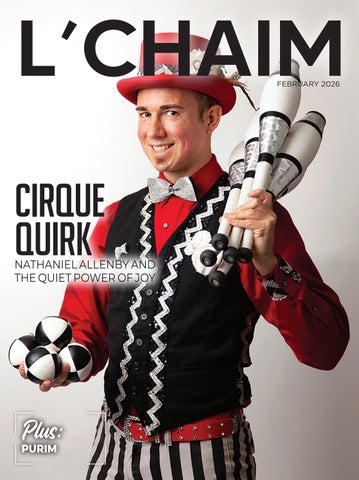
cirque quirk
NATHANIEL ALLENBY AND THE QUIET POWER OF JOY


Your Real Estate Journey Starts Here
Whether selling or buying, I’m here to guide you with care and experience.


With over 2 decades of Real Estate expertise, Kris Gelbart is no stranger to today’s ever changing market. With countless awards, recognitions, and certifications, Kris is your one-stop-shop for everything Real Estate.


Kris Gelbart Cal DRE 01345809 858-395-0761 gelbartrealtygroup.com

PUBLISHERS
Diane Benaroya & Laurie Miller
EDITOR-IN-CHIEF
Alanna Maya
CREATIVE DIRECTOR
Laurie Miller
CONTRIBUTORS
Barbara Birenbaum, Franklin Felber, Donald H. Harrison, Jacob Kamaras, Stephanie D. Gittleman, Salomon Maya, Jana Mazurkiewicz Meisarosh, Mimi Pollack, Rachel Stern, Eva Trieger, Deborah Vietor, Cheri Weiss
ADVERTISING & SALES
Diane Benaroya: dianeb@lchaimmagazine.com


SAN DIEGO, LLC (858) 776-0550 P.O. Box 27876, San Diego, CA 92198
EDITORIAL editor@lchaimmagazine.com
dianeb@lchaimmagazine.com
to
publisher@lchaimmagazine.com


prayers & passages
THE GIFT OF SHABBAT
And God blessed the seventh day and declared it holy—having ceased on it from all the work of creation that God had done. (Genesis 2:3)
Many of us are living in a state of perpetual activity, constant stress, and extensive to-do lists. We find it nearly impossible to turn off the switch in our heads, even as we fall asleep at night in a state of exhaustion. We measure the success (or failure) of a day by how much we accomplished (or did not accomplish). We bring our laptops along with us on vacation, even if we promise ourselves not to work unless it’s an absolute necessity (and somehow there always seems to be a necessity!)
Even when we are not working, our loved ones vie with technology (cell phones, iPads, television, social media, etc.) for our attention. As a result, our most treasured relationships suffer. Our physical and mental health deteriorates. Our ability to really enjoy life is compromised, because even when we have some downtime, we are thinking ahead to what still needs doing rather than focusing on the present precious moments with which we are blessed.
Enter Shabbat: “And God blessed the seventh day and declared it holy.”
From the moment we welcome Shabbat on Friday evening by lighting the candles, we are transported into sacred time. By detaching ourselves from the ordinary and mundane that we face during the rest of the week, on Shabbat we are offered an opportunity to experience the extraordinary.
Blessed are You Lord our God, Ruler of the universe, who has sanctified us with God’s commandments and commanded us to light the Shabbat candles.
Blessings over wine and challah follow this candle blessing. Parents may take these moments to place their hands on their children’s heads and bless them with their own heartfelt words or with traditional Jewish blessings:
(For Boys:) May God make you like Ephraim and Menashe
(For Girls:) May God make you like Sarah, Rebecca, Rachel and Leah
(For all:) May God bless you and keep you.
May God shine light on you and be gracious to you.
May God turn toward you and grant you
peace.
Shabbat is an ideal day for taking walks in nature, enjoying meals with friends, reading books, playing with our pets, and engaging in meaningful conversation with family. Those who find comfort in being in community may wish to attend temple services on Friday night or Shabbat morning or perhaps attend a Torah study session. Forget about doing laundry or other household chores. Even God took a break from the work week!
Just as Shabbat enters by candle-lighting, so it exits with a braided candle during the Havdalah ceremony. We offer blessings over wine, spices, and fire, as well as the separation between the holy and the mundane. And so, we bid farewell to Shabbat and re-enter our ordinary lives. Hopefully by Saturday evening, we have recharged our emotional, mental and physical batteries and now have renewed energy to bring to our work, our communities, and our world.
RABBI-CANTOR
mazel & mishagoss
EVERYTHING IS A SIMCHA IF YOU SQUINT HARD ENOUGH!
My non-Jewish neighbor recently remarked that Jews turn any little thing into a cause for celebration … and a catered one at that! Being a party planner, I can’t deny this. “Low-key” Jewish events are just a myth. That’s because in Judaism, if something happens—and you’re still alive afterward—it qualifies for a big festivity. Examples: A baby boy is born: Party! The baby survives eight days: Bigger party with a slightly terrifying ceremony! This same baby turns three and has never met a scissors (First haircut, gifts, candy, photos, possibly a DJ!)
Other cultures have milestones—birthdays, weddings, graduations, Etc. Jews, on the other hand, focus their energy on the “Etc. We put out a delicious (potato pancake) buffet because a candle burned longer than expected. Wheat or barley harvested? Whoop it up! Someone found parking near the synagogue? Shout, “L’Chaim, to life!” In fact, Jewish history consists of a series of events where something almost went wrong, but luckily didn’t—and now it requires candles, food, blessings, and a detailed explanation of what once occurred that lasts even longer than the event itself. It’s been said, “They tried to destroy us, we survived, let’s eat!” Well sometimes they didn’t even really try to destroy us—we just FELT like they might’ve. Still counts!
Found a Torah? Party! Finished reading the Torah? Bigger party! Finished reading it
and immediately started over? That’s Simchat Torah—singing, wild dancing, and mayhem, causing someone to definitely drop a siddur! How can you tell Jewish revelry is taking place? a) There’s food b) There’s more food than necessary c) Someone complains there isn’t enough food! As a party planner, people call me to organize an event over sheer mishagoss and the tiniest of minutiae. My phone rings for: “A small, intimate simcha” (300 people!) “A simple meal” (requires uplighting and set design!) “Just family” (anyone who’s ever met the family is on the guest list!) Some specific reasons I’ve been asked to organize an affair include a son finishing his vegetables, (balloons shaped like broccoli!) a granddaughter eventually chose a college (Not committed. Chose! Tiramisu was served before she changed her mind!) A mother-in-law admitted she was wrong, (I insisted on written proof before booking the venue on that one!) First time an infant slept through the night (the parents snoozed through the entire gala brunch!) Finally replaced the roof (insurance deductible themed décor!) A great-grandma figured out how to do FaceTime. (But she still never looked at the camera during the entire live-streaming luncheon!)
Every Jewish client of mine begins by saying, “We don’t want anything over-the-top.” This is usually said while simultaneously describing custom engraved napkins and asking
about ice-sculptures. Nothing says restraint like an 8-piece live band.
So it wasn’t surprising when my aforementioned gentile neighbor said they were emulating our people by celebrating the “little things in life.” Would I listen from my backyard to see if they were doing it right? Sure! No problem at all! (I reminded her that bad things NOT happening are also perfect reasons to rejoice.) While they swam and BBQ’d, I overheard someone say, “Nobody hit their head on the bottom when they dove! Let’s party!” Another adult added, “And nobody drowned from cramps because you didn’t wait an hour after eating! Yay!” Followed by, “We cooked over an open flame and the house didn’t burn down.” I shouted “Mazel Tov” over the fence. Next, a parent told a child they were celebrating teeth-cleaning and NOT having cavities! But when the child said he wanted to go to dental school, I realized they’re almost ready to convert! I think I’ve proved that we Jews love to commemorate oil, haircuts, sleeping, and functional smartphone apps. But if you’ll excuse me, I’m about to celebrate this article getting written before my deadline. And yes, I will be serving a huge platter of chocolate rugelach!
STEPHANIE D. GITTLEMAN WILL INJECT HUMOR INTO ANYTHING YOU HIRE HER TO WRITE. EMAIL HER AT THEQUOTEGAL@YAHOO.COM.

Sarah Sassoon's maternal grandmother's Laissez-Passer Passport of No Return issued by Iraq.
PHOTO COURTESY SASSOON FAMILY ARCHIVE
1000 WORDS
SASSOON RECLAIMS THE LOST VOICES OF IRAQI JEWRY
Sarah Sassoon grew up surrounded by the food, music and warmth of an Iraqi Jewish home in Australia—but without the stories that explained where her family came from or why they had left.
That silence, she says, is what ultimately drove her to become a writer.
Sassoon, an author, poet and educator who now lives in Jerusalem with her family, has emerged as a leading voice exploring the 2,600year history of Babylonian Jewry, the experience of refugees and resilience, and the largely untold stories of Middle Eastern Jewish women.
“I grew up with immigrant parents who didn’t speak about their lives in Iraq, or why they had to leave,” Sassoon said. “There was a silence—and writing became a way of traveling where my family didn’t speak.”
That journey has produced a growing body of work, including two award-winning children’s books, Shoham’s Bangle and This Is Not a Cholent, as well as the poetry micro-chapbook, This Is Why We Don’t Look Back, which won the Harbor Review Jewish Women’s Poetry Prize.
The horrific events of Oct. 7, 2023, she said, gave new urgency to her research into Iraqi Jewish history, particularly the 1941 Farhud pogrom in Baghdad.
“All the red flags I saw in my research suddenly became very present,” she said, drawing parallels between the incitement that led to the Farhud and contemporary antisemitism. “The red hands marking Jewish homes in Baghdad—suddenly I’m seeing red hands again,” she said.
FROM SYDNEY TO JERUSALEM
Born in Sydney to Iraqi Jewish parents whose family fled Baghdad in
1951, Sassoon said she was raised in a Middle Eastern cultural world without being given its historical context.
She learned to cook with her maternal grandmother, Nana Aziza. “I wasn’t told about life in Iraq, or why they had to leave, or even about their early years in Israel,” she said. “I grew up with the food and music, but not the language or the stories.”
That changed when she made aliyah after spending several years with her South African-born husband in Johannesburg, where she taught at the Ezra Nehemia Academy. They moved to Jerusalem and she began writing seriously in community workshops.
“For years, I wrote Ashkenazi stories because those were familiar,” she said. “Then one day I wrote a poem about my Iraqi grandparents, and my writing group told me, ‘That’s what you need to write.’ They were right.”
Sassoon said her love of storytelling is rooted in her family, particularly her grandfather, who was known in the family as a gifted raconteur. Though much of his life story was left unspoken while she was growing up, he later committed his memories to writing, producing a memoir late in life that documented the world of Baghdad Jewry he had lost.
Sassoon sees a direct line between his storytelling and her own work today. “My grandfather was a storyteller,” she said. “Stories were how our family made sense of the world. I’m only now learning how much he carried, and how much he passed on without words.”
RECOVERING WHAT WAS LOST
Sassoon said her work is driven by a desire to recover what was lost— not only property or status, but memory.
“How do you put 2,600 years of Babylonian Jewish history into a tent camp?” she asked, referring to the harsh conditions faced by Iraqi Jews after arriving in Israel. “So much was erased. My generation is
SARAH

finally able to say: there is so much to be proud of.”
Yet Sassoon strives to convey complexity.
“For every Jew killed in the Farhud, there were Muslims and Christians who saved Jews,” she said. “That’s the difficult truth—to hold both the violence and the humanity.”
That perspective informs her belief that Jews from Arab lands can help bridge cultural divides in the Middle East.
“We need to stop looking at the region with Western eyes,” she said. “The Middle East speaks the language of family. Protection of the family. Dignity. That’s where real connection happens.”
Sassoon co-hosts a new podcast, Ayuni: Voices of Our Jewish Grandmothers, with Dr. Drora Arussy and Dalya Arussy, focused on uncovering the stories of Middle Eastern and North African Jewish women long left out of mainstream narratives.
As a mother of four sons—two of whom have served in the Israel Defense Forces—Sassoon said the past two years have been deeply personal.
“My sons are there to defend everyone here—Jews, Muslims, Druze, Christians,” she said. “It’s not about religion. It’s about basic humanity.”
That ethos also shapes her children’s books. Shoham’s Bangle draws
“For years, I wrote Ashkenazi stories because those were familiar,” she said.
“Then one day I wrote a poem about my Iraqi grandparents, and my writing group told me,
‘That’s what you need to write.’ They were right.”
on her own family history, telling the tale of a young Iraqi Jewish girl forced to leave Baghdad for Israel and introducing a new generation of readers to the stories of Middle Eastern Jewish refugees.
This Is Not a Cholent is the story of a girl who enters a cholent competition using her Iraqi grandmother’s Shabbat dish, challenging narrow definitions of Jewish tradition.
“It’s about being proud of where we come from,” she said. “Tradition gives us roots, but it also lets us build new communities.”
Her next picture book, The Oud in the Orchestra , soon to be published in Hebrew by Keter, draws on the story of the Al-Kuwaiti brothers—Jewish musicians whose names were erased from Iraqi culture even as their music endured.
“For years, Middle Eastern Jewish culture was treated as something to be hidden,” Sassoon said. “Now we’re saying: this belongs. Our stories belong.”
Despite the pain of recent years, Sassoon remains hopeful.
“The reality is grim,” she said. “But there are almond blossoms on the trees. There are people across the Middle East who look to Israel as a model of freedom and dignity. That is exactly why our enemies hate us—and exactly why we should be proud.”

SINGING & SHARING a variety of traditional Jewish music
We welcome new members!
Email Rita for more info: rheller8@gmail.com


TEST YOUR JEWISH IQTM
1. Which word means the same in biblical Hebrew, in Yiddish, and in English slang?
the compiler of the Mishnah?
a. Antoninus Pius
b. Caligula

a. Putz
b. Chutzpah
c. Kibbitz
d. Kvetch

Listening is a Skill You Can Strengthen
If listening feels harder than it should, for your child at school or for you at work, help is available.
At Levy Audiology, we specialize in auditory processing evaluations and evidence-based auditory training for children and adults. Listening challenges that impact reading, learning, and workplace communication can often be improved.


Start the year with stronger listening.
Schedule an evaluation today.

2. In the last days of the Revolutionary War, which Jew made a crucial loan of $200,000 to the Continental Congress, allowing the colonists to fight to victory?
a. Josian Bartlett
b. Samuel Chase
c. Abraham Clark
d. Haym Solomon
3. About how many Jews made the exodus from Egypt to arrive less than two months later at Mt. Sinai?
a. 30,000
b. 300,000
c. 3,000,000
d. 30,000,000
4. According to the Talmud, who wrote the Book of Ruth?
a. Ruth’s husband, Boaz
b. The prophet Samuel
c. King David
d. King Solomon
5. Ruth Dreifuss, a Jew, became the first woman president of which European country?
a. Denmark
b. Switzerland
c. Austria
d. Hungary
6. Which of these Roman emperors was well-disposed towards the Jews and was even friendly with Judah HaNasi,
c. Hadrian
d. Titus
7. Which of these is an appropriate use today of the Hebrew word, mamash?
a. I love this show, mamash
b. He mamash needs a bath
c. Are you hungry? Mamash!
d. All of the above
8. After Adam and Eve ate from the Tree of Knowledge and realized they were naked, they sewed waistcloths for themselves from the leaves of which tree?
a. A fig tree
b. An apple tree
c. A palm tree
d. A date tree
9. How many categories of work are prohibited on Shabbat?
a. 10
b. 18
c. 39
d. 60
10. Which of these founders of ice cream chains were not Jewish?
a. Irv Robbins & Burt Baskin
b. Tom & Mildred Carvel
c. Reuben & Rose Mattus
d. Ben Cohen & Jerry Greenfield
Answers on page 25. ©2025 Felber, Starmark, Inc., all rights reserved.
Amanda Levy, Au.D. Clinical & Educational Audiologist

PURIM & PERSIA
FROM CHILDREN'S COSTUMES TO AN ANCIENT WARNING THAT ECHOES TODAY
Today, Purim is most visible as a joyful, almost carnival-like holiday, especially for children. Classrooms and synagogues fill with kids in costumes, groggers rattle loudly during the reading of the Megillah, and baskets of sweets and hamantaschen are exchanged among friends and neighbors. It is a celebration marked by laughter, playfulness, and the deliberate embrace of joy, a rare moment on the Jewish calendar when silliness itself is part of the religious experience.
Yet beneath the masks, the noise, and the sugar rush lies a far darker story, one that has echoed across centuries and feels unsettlingly current. In recent years, Israeli leaders have used Purim to remind the world that just as the attempt to annihilate the Jewish people failed in ancient Persia, it will fail again today. The plot did not succeed then, they say, and modern threats emerging from Iran will not succeed now.
That message resonates precisely because Purim is not, at its core, a children’s holiday at all. It is a story about genocide narrowly avoided and about how close to extinction the Jewish people have repeatedly come.
The story of Purim, recorded in the biblical Book of Esther, is set in the vast Persian Empire of the 5th century BCE. Jews living across the empire suddenly found themselves condemned by royal decree after Haman, the king’s chief minister, persuaded the monarch to authorize their destruction. The order was chilling in its scope: all Jews were to be killed on a single appointed day.
This was not mob violence or spontaneous hatred. It was ruler-backed genocide, sealed with the king’s signet ring and disseminated across 127 provinces in many languages. The Jews were not accused of rebellion or wrongdoing; it was their very existence that was intolerable.
What followed was a dramatic reversal of fortune. Esther, a Jewish woman who had risen to become queen, revealed her identity and exposed the plot. The decree by the king could not be revoked, but a counter-decree permitted Jews to defend themselves. Haman was executed, and the Jewish people withstood this threat to their existence.
Unlike many biblical narratives, the Purim story was not set in Israel, Egypt, or Babylon. It unfolded entirely in Persia, the predecessor of modern-day Iran. That geographic coincidence has an added layer of meaning today. For centuries, Persia was home to thriving Jewish communities. Jews lived there long before Esther’s time and remained long afterward. Even now, about 10,000 Jews live in Iran, maintaining synagogues, schools, and traditions, including the annual celebration of Purim itself.
But while ancient Persia ultimately became the setting for Jewish deliverance, modern Iran occupies a very different place in Jewish consciousness. Since the Islamic Revolution of 1979,
a central pillar of Iran’s worldview has been hostility toward Israel. Iranian leaders have repeatedly denied or distorted the Holocaust, supported armed groups dedicated to Israel’s destruction, and used rhetoric that questions the legitimacy of Jewish self-determination. For many Jews, this language feels uncomfortably familiar. The vocabulary has changed, and the tools are more advanced, but the underlying premise, that Jews are a problem to be erased, echoes the logic of Haman’s decree.
When we Jews invoke Purim in this context, we are not simply retelling a biblical story. We are framing modern threats through an ancient lens, reminding ourselves that the Jewish people have faced annihilation before, including from rulers based in Persia, and survived. The message is blunt and deliberate: history has tested Jewish existence repeatedly, and yet ‘am Yisrael chai,’ the Jewish people lives.
Purim insists on memory. Jews are commanded to read the story aloud every year, to hear Haman’s name and blot it out with noise, not because the danger is gone, but because it never fully disappears. This insistence reflects a hard-earned lesson of Jewish history: hatred does not always arrive wearing obvious uniforms. Sometimes it comes clothed in law, ideology, or reason. Sometimes it arrives politely, stamped with official approval.
The holiday’s rituals underscore that truth. The noise of groggers is not childish disruption; it is symbolic erasure. Charity to the poor reinforces communal responsibility. Feasting affirms life in the face of those who sought its destruction.
Costumes, too, are not incidental. On Purim, Jews dress in disguise to reflect the hidden nature of the story itself. Esther conceals her identity. Evil hides behind authority. Survival depends on recognizing danger before it is too late.
In a modern world where antisemitism often appears masked, reframed as political critique, historical revisionism, or selective outrage Purim’s lesson feels particularly sharp. Threats are not always announced openly. They must be identified, named, and confronted.
This is why Purim is both playful and serious, why it invites laughter even as it warns against complacency. Joy becomes an act of resistance. Survival becomes a statement.
For children, Purim is a day of costumes and candy. For adults, it is a reminder that history is not as distant as it sometimes feels. The story Jews tell each year is not ancient folklore; it is a pattern they recognize all too well.
From the palaces of ancient Persia to the speeches and slogans of the modern Iranian theocracy, the names change, but the threat has often sounded the same: Death to the Jews! and Death to Israel! The attempt to annihilate the Jewish people failed in ancient Persia. Purim exists to help ensure that all such attempts will fail in the future.


CIRQUE QUIRK
San Diego’s Top-Rated Circus Entertainment create memories that last a lifetime for you and your guests.

Cirque Quirk has been creating extraordinary live entertainment: LED robots * fire performers *stilt walkers *magicians* jugglers *acrobats *aerial artists * and more
San Diego’s highest-rated professional circus entertainment agency for over 14 years - trusted by families, organizations, and communities to elevate meaningful celebrations into unforgettable moments.
Cirque Quirk is proud to be a familiar presence at Jewish celebrations throughout San Diego, including Bar and Bat Mitzvahs, Purim events, Chanukah celebrations, & community gatherings.
Our mission is simple: to enhance your event, honor its meaning, and leave your guests talking about it long after the celebration ends.
As a thank you to the L’Chaim community, Cirque Quirk is offering 10% off for new clients, repeat clients, and referrals. Use coupon code L’CHAIM when booking. For bookings: 619.800.1887 | CirqueQuirk@gmail.com | www.CirqueQuirk.com | linktr.ee/CirqueQuirk


GAME DAY OR ANY DAY
CHILI THAT WARMS YOU UP
BY TAMAR ROTHENBERG, MS, RDN
Winter meal prep just got a little easier with this Game Day Chili. It’s easy to forget about that can of beans or tomatoes in your pantry, but shelf-stable ingredients are affordable, long-lasting, and perfect for reducing food waste. This high-protein and veggie-packed chili gets better with time, so make a big batch, enjoy it throughout the week, and freeze leftovers for later. Not a football fan? This chili wins every time, no touchdowns required.
GAME DAY CHILI
Serves 6
Ingredients
1 Tbsp olive oil
1 sweet onion, chopped
4 cloves garlic, minced
1 lb ground turkey or meatless alternative
2 tsp ground cumin
1 1/2 tsp chili powder
1 zucchini, chopped
3 carrots, peeled and chopped
1 red bell pepper, chopped
1 (14.5 oz) can fire-roasted diced tomatoes
1 cup low-sodium vegetable broth
1 (15 oz) can red kidney beans, drained and rinsed
1/2 cup fresh cilantro, chopped
Directions
1. Prep: Chop onion, zucchini, carrots, and red pepper. Mince garlic. Drain and rinse kidney beans.
2. In a large pot, sauté onion and garlic in olive oil until soft and fragrant. Add turkey and cook for 3 more minutes.
3. Stir in cumin and chili powder to coat the turkey and vegetables.
4. Add zucchini, carrots, bell pepper, tomatoes, and enough broth to just cover the vegetables.
5. Bring to a boil, then reduce heat and simmer for 20 minutes.
6. Stir in kidney beans and simmer for another 2 minutes.
7. Serve hot, topped with cilantro and hot sauce (if using).
Tip: Keep canned tomatoes, beans, and broth in your pantry rotation. These three ingredients form the base of countless coldweather meals.
TAMAR ROTHENBERG, MS, RDN, IS A REGISTERED DIETITIAN WHO SPECIALIZES IN BREAST AND OVARIAN CANCER IN HER PRIVATE PRACTICE IN LOS ANGELES. SHE HAS A CERTIFICATE OF TRAINING IN VEGETARIAN NUTRITION AND HERBAL FORMULATIONS IN CANCER CARE; AND CO-LED THE CLINICAL STUDY, COPING WITH CANCER IN THE KITCHEN, PUBLISHED IN NUTRIENTS. TAMAR LENDS HER EXPERTISE TO SHARSHERET THRIVERS THROUGH NUTRITION EDUCATION. CHECK OUT TAMAR’S OTHER RECIPES IN HER BOOK, CANCER DIET FOR THE NEWLY DIAGNOSED: AN INTEGRATIVE GUIDE AND COOKBOOK FOR TREATMENT AND RECOVERY. VISIT TAMAR’S WEBSITE AT HTTPS://WWW.TAMARROTHENBERGRD.COM/ FOR MORE INFORMATION.
This recipe was submitted by the non-profit organization, Sharsheret: The Jewish Breast Cancer and Ovarian Cancer Community. If you or someone you love has been impacted by breast or ovarian cancer or has elevated genetic risk, contact Sharsheret for free support and resources. For more information, visit sharsheret.org or call (866) 474-2774.
The Quiet Power of Joy
Nathaniel Allenby: Legacy, and the Cycle that Connects Us All

When General Edmund Allenby entered Jerusalem in 1917, he chose to walk. As the commanding officer of T.E. Lawrence, later known as Lawrence of Arabia, he understood that how one enters history matters. His leadership played a decisive role in the liberation of Israel, and his name remains embedded in the country’s geography through streets, bridges, and public landmarks. For his great-grand-nephew, Nathaniel Allenby, that moment is not simply historical. It is instructive.
Nathaniel Allenby has spent his life translating legacy into lived experience. Artist, circus performer, author, and entrepreneur, he has consistently explored what leadership looks like when it is grounded not in authority, but in service, creativity, and human connection.
That exploration became tangible in his early twenties, when Allenby embarked on a journey that would later become The Cycle of Kindness. Over several years, he pedaled 28,000 miles across 10 countries, primarily Western Europe, and 30 U.S. states, traveling by bicycle with no money, no technology, and no fixed plan. His survival relied entirely on trust.
The journey stripped life down to its essentials. Allenby lived and worked on permaculture farms, eco-villages, and intentional communities, exchanging labor, art, and storytelling for food and shelter. These communities offered living demonstrations of cooperation, sustainability, and shared responsibility. They also revealed how rare, and how necessary, genuine interdependence has become.
The emotional challenge of the journey proved as demanding as the physical one. Accepting help required vulnerability. Asking for support required humility. Over time, Allenby came to understand that generosity functions as a cycle. Kindness offered creates kindness returned. It moves through communities and between strangers, binding people together through trust rather than transaction.
That realization now fuels Allenby’s next chapter. He dreams of building an ongoing movement that encourages and incentivizes acts of generosity and kindness, not as isolated gestures, but as

a cultural practice. He is currently in the process of founding a nonprofit organization to support this work and is actively seeking donors, partners, and app developers who wish to collaborate in transforming kindness into a measurable, scalable force for good. For Allenby, the question is no longer whether kindness works, but how broadly it can be implemented.
Running alongside this mission is Cirque Quirk, the San Diegobased professional circus entertainment company Allenby founded more than a decade ago. Now recognized as the city’s highest-rated circus entertainment company, Cirque Quirk delivers high-quality performances for corporate events, weddings, festivals, and private celebrations. The company has been especially honored to serve Jewish celebrations, including Purim events, Bar and Bat Mitzvahs, and Chanukah gatherings, bringing joy, inspiration, and artistry to moments of deep communal significance. Cirque Quirk remains available for hire and is dedicated to creating magical, memorable experiences that foster connection.
Allenby’s creative output also includes Allenby Art, his visual art
practice exploring themes of movement, transformation, and identity. The work reflects a life shaped by travel, uncertainty, and intentional community, offering viewers an invitation to pause and reflect.
Israel remains a powerful point of reference. With the Allenby name woven into the nation’s physical and historical landscape, Nathaniel speaks with deep respect for his family’s role in its past. He also speaks of aspiration, sharing his dream to visit Israel and spend time on a kibbutz, drawn to communal values that mirror the life he has lived across continents.
In a world marked by fragmentation, speed, and disconnection, Nathaniel Allenby offers a different model of influence. One rooted in joy, humility, and participation. His work reminds us that legacy is not static. It is something we choose to embody and create through how we live, connect, and care for one another.
from agony to ascension

So often, especially since October 2023, the world has felt heavy. The news is painful and relentless. Social media amplifies fear and outrage. Many of us are carrying an “invisible backpack” filled with personal pain, communal grief, and constant uncertainty. We’re told to have hope, to be the light, a philosophy deeply ingrained in our culture. And yes, it only takes one candle to brighten a dark room and light infinite others. But how do we shine when we feel depleted or overwhelmed?
We can’t give light if we’re running on empty. I come from a lineage that understands resilience. My grandparents survived the Shoah and profound hardship, yet they chose to nourish their spirits through song, art, community, nature, and joy. They didn’t deny their past or ignore suffering; they simply focused more on being the light, on finding the good. That philosophy stayed with me.
My own “backpack” got very heavy at 19, when I broke my
back. Every doctor and therapist told me I’d always be in pain and to give up the active life I loved. Treatment centered on managing symptoms, not restoring health. For years, physical pain dominated my attention, reinforced by the limit-inducing “facts” I’d been fed. Frustration unpacked its bags. Anxiety moved in.
Yet now, I’m genuinely grateful I fell.
After 4.5 years of constant pain, overwhelm, and a dysregulated nervous system, desperation pushed me to search for another path. I found an extraordinary teacher-healer who offered something I hadn’t been given before: hope grounded in practical tools. It felt magical, but was also logical. I didn’t just heal my body; I upgraded my life.
I learned that everything is energy, and that our thoughts influence energy and our physical experience something neuroscience is now confirming. I realized I had been feeding the pain. Negative, fearful thoughts were shaping my nervous system and my life experience.
So I began to change my focus. Instead of “I don’t want pain,” I practiced, “I am healing and growing stronger.” Instead of dreading standing up, I reframed it as, “I’m strengthening my core.” It felt fake at first until I realized it’s like putting a kettle of cold water on the stove. You know it will boil. It just takes time.
And it worked. Within six weeks, I began healing. Today, I teach dance, hike, surf, play sports with my kids, and carry what needs carrying including my 18-pound dog and my kids, who weigh… considerably more.
More importantly, I discovered an upgraded way of living with the understanding that where our thoughts go, energy flows, and manifestation grows. Healing is a symphony: when one area improves, everything else relationships, creativity, career, health, purpose, benefits too.
Now, I choose to serve with joy and light rather than obligation. I teach others to feel good in their bodies and to find ease, abundance, and joy every day through small, sustainable shifts in thought and daily practice. We don’t force change. We create awareness, help the body feel safe, and align energy so transformation can unfold.
What began as a broken back became a lifelong commitment: helping people feel seen, supported, and empowered one conscious breath, intentional word, and joyful step at a time.


A LOVE STORY IN FULL VOICE
BY FRANKLIN FELBER AND DIANA LERNER

For 40 years, Albert Kadosch and his wife, Patricia, were a beacon—a love story and an inspiration—for the Jewish community in San Diego, embodying devotion and the highest ideals of hospitality.
Albert’s voice was the spiritual anchor of countless community milestones. At weddings, bar and bat mitzvahs, and funerals across San Diego, his rich, classically-trained tenor elevated every occasion. With a commanding triple cry of “Ya’amod, YA’AMOD, YA’AMOD!” he summoned a young man to the Torah, his voice driving home the spiritual significance of the moment. At funerals, his mournful rendition of the El Malei Rachamim (God, Full of Compassion) offered solace as he helped lay a Jewish soul to rest. Every Friday night at Chabad of Poway, the sanctuary swelled with his unforgettable signature song, Mizmor L’David, the climax of the Psalm cycle, preparing every worshipper for the welcoming of Shabbat.
In the spirit of our first forefather Abraham, Patricia and Albert exhibited boundless hospitality. Their Poway home was the joyful center for Friday night and holiday dinners. Patricia, with her warm Southern grace, and Albert, a culinary artist, created memorable feasts. His lovingly crafted Moroccan dishes—aromatic with exotic spices and accompanied by warm, home-made Moroccan anise challahs—transformed every gathering into a celebration. Long after the children had fallen asleep at the table or on the living room couch, their parents lingered, enjoying animated conversations around the table.
Though they had no children of their own, Patricia and Albert adored them, and children reciprocated with instinctive love. Despite
his blindness, Albert’s face would light up brightly when a child ran up to him for a hug or when a baby was brought to him for his gentle caress. Their affection was generational. They held babies in their arms whose parents they had held as babies decades earlier.
Albert’s background was as rich and complex as his voice. He was born on his father’s horse farm near Tangiers in Spanish Morocco, tracing his lineage back to the expulsion of Jews from the Cordoba and Toledo regions during the Spanish Inquisition of the 15th century. Genealogical analysis confirmed his 100 percent Spanish Jewish ancestry; for five centuries in Morocco, his family had married only within their exiled Spanish community. His surname, Kadosch (meaning “holy” in Hebrew), even suggests an ancestry connected to the major Jewish migration to biblical Tarshish (current-day Spain) that followed the Roman Dispersion in 70 C.E.
His classical Hebrew education began at age three in Spanish Morocco, where discipline forged a phenomenal memory that would serve him well, after he lost his sight. He had memorized virtually the entire siddur (prayerbook), including the intricate holiday variations. His cantorial skills were unmatched, honed over 20 years by Georges Thill, one of the 20th century’s greatest French lyric dramatic tenors. This powerhouse combination of memory, operatic training, and fluency in multiple languages led to his being invited to participate in Passover services internationally, most recently in Morocco in 2019.
Albert’s blindness did not constrain his creativity—it sharpened it. He learned ways to paint with watercolors by shaping thin, putty-like strips into outlines of figures, creating beautiful artwork that graced his home, materials for the Braille Institute, and even the cover of his

children’s underwater-fantasy tale, Cosimo and Cosima Discover the Green Empire, published in 2017. His award-winning sculpture of the Hunchback of Notre Dame is etched in the memory of all who saw it.
Beyond the arts, Albert excelled in practical sciences. Turning his heightened sense of touch to an advantage, he focused on healing as a physical and psychomotor therapist. As a totally blind graduate student, he had earned two master’s degrees at Columbia University, in motor learning and neuropsychology, by hiring assistants to read textbooks to him not available in Braille.
Patricia was a Southern girl born in Oak Ridge, Tennessee, where her father worked at the top-secret uranium enrichment plant after his service as a fighter pilot in the British Royal Air Force in World War II. Her family moved often throughout the South, where she was frequently the only Jewish student in her class.
The joining of these two culturally divergent souls was as unlikely as it was inevitable. In 1970, Patricia moved to Israel to study Hebrew. When she found the Hebrew language ulpan in Haifa was full, she switched to an ulpan in Jerusalem. At lunch, there was one empty seat. This beautiful, young Southern woman sat herself next to a dashing Frenchman—a Moroccan-born, seven-language-fluent, operatic tenor and skilled French/Moroccan chef, who had been blinded in battle. He was the most exotic and handsome man she had ever met. Two years later, they married in France. Their love for each other grew ever stronger over the next half century.
The respect, affection, and abiding love between Patricia and Albert served as a living model for generations of friends and acquaintances in San Diego. For Patricia and Albert, marriage was a sacred covenant, offering many more opportunities for them to perform acts of lovingkindness every day.
Three years before his death, Albert suffered an incapacitating stroke and required caregiving. As Albert fought to recover from this stroke, Patricia’s only goal was to care for him with dignity, respect, and all her love. Patricia calls these years of intensive caring for her beloved husband “the greatest blessing of my life.”
In October, Patricia lost the love of her life, and the Jewish community of San Diego lost an uplifting and inspirational figure. Whenever Patricia would leave Albert, even for a brief errand, he would say to her, “A la paz de Dios,” which means, “May the peace of God be with you.” When this phrase is combined with “mi vida, mi alma” (“my life, my soul”), it becomes a profound blessing, placing someone you love under the protection and tranquility of the Divine, while calling them your life and soul.
Today, Albert lies beneath a massive stone monument on a windswept hilltop in Beit Shemesh, in the land to which he had always dreamed of returning. On the monument, Patricia has these words engraved as an eternal tribute to his warrior spirit and their everlasting love:
My Beloved Warrior and Fighter With Wisdom And Faith In G-D’s Plan You Met Every Challenge And Overcame Every Adversity
A La Paz De Dios Mi Vida Mi Alma
Albert Kadosch and his wife, Patricia


ANSWERS TO TEST YOUR JEWISH IQ
1. b. Chutzpah is the biblical Hebrew, Yiddish, and English slang word for audacity. According to Rashi, “Chutzpah [audacity] is kingship without a crown (Sanhedrin 11:105a)” means that through the power of audacity a person can dominate others as a king, lacking only a crown.
2. d. Haym Solomon was never paid back and died bankrupt.
3. c. The 70 members of Jacob’s family that descended to Egypt swelled after 210 years to a population of many millions of Jews, of whom about 3 million left Egypt with Moses. A census about six months after the Exodus showed 603,550 Jewish males age 20 and older. From this census and the large birth rate, it is estimated that the total number of Jews was about 3 million. It is widely believed that 80 percent of the total Jewish population in Egypt remained behind in Egypt, meaning the original population of Jews in Egypt at the time of the Exodus was about 15 million.
4. a. According to the Talmud (Bava Basra 14b), the prophet Samuel wrote the Book of Ruth.
5. b. Ruth Dreifuss, descended from one of the oldest Jewish families in Switzerland, became President of Switzerland in 1999. She was proud of her Jewish heritage.
6. a. Roman Emperor Antoninus Pius, who reigned from 138 to 161 C.E., repealed many of Hadrian’s harsh edicts, allowed circumcision, and established a more peaceful coexistence with Jews, respecting Jewish wisdom and moral stature.
7. d. Mamash is one of those all-purpose words that adds emphasis, most nearly like “really” in English. A common phrase is “mamash todah,” meaning “really thank you so much.”
8. a. A fig tree (Gen. 3:7).
9. c. Thirty-nine categories of work are prohibited on Shabbat, corresponding to the 39 categories of work performed in the Tabernacle.
10. b. Greek-born Tom Carvel invented soft-serve ice cream after his ice cream truck got a flat tire and he had to sell all his ice cream on the spot. Irv Robbins cofounded Baskin Robbins with his brother-in-law Burt Baskin, using his bar mitzvah money for seed capital. Polish-Jewish immigrants Reuben and Rose Mattus founded Häagen-Dazs and made sure their products were kosher.
0 – 2 Talmid/Talmida (Student)
3 – 5 Melamed/Melamedet (Teacher)
6 – 8
Talmid Chacham/Talmidat Chacham (Scholar)
9 – 10 Gaon/Gaona (Genius) Your
KURT WEILL
DISCOVER GREAT MUSIC BY A JEWISH COMPOSER FOR PURIM SPIEL
BY JUDY BUCHMAN-ZIV | JNS.ORG

For some 10 years, I wrote, directed and produced (such is synagogue life) with some help from my fellow-congregants and the office staff, musical Purim Spiels at my NYC synagogue, which incorporated musical parodies based on well-known Broadway tunes, mostly. Here and there, I would incorporate other well-known songs.
Over the years, I had parodies of songs from Cabaret, The Pajama Game, West Side Story, Gypsy and many others. Most of the songs were written by Jewish composers – such a tribute is important. After many years of hard work with a dedicated ensemble who loved doing
the show every year, and after planning a move to Miami, I had decided to make my 2025 Spiel particularly special. Which Jewish composer would I choose? I chose the one whose music really left a mark on me personally and was unique, for various reasons.
I incorporated several songs from “The Three Penny Opera” as well as the song Moon of Alabama from “The Rise and Fall of Mahagonny”. Do readers of a younger generation, who most certainly have heard the very popular songs, Mack The Knife, September Song and Moon of Alabama, know that they were composed by the extraordinary Jewish composer Kurt Weill?
Kurt Weill and Lotte Lenya at home in 1942. PHOTO BY WIDE WORLD
BACKARCHIVED LINKS, PUBLIC DOMAIN, COMMONS.WIKIMEDIA.ORG/W/INDEX.PHP?CURID=109870037
Kurt Weil’s music is close to my heart for two main reasons. When I studied theater at Tel Aviv University from 1972-1976 [yes, I was there during the Yom Kippur War], I participated in a Hebrew production of “The Three Penny Opera”. It was challenging but fascinating to learn the Hebrew. It was always noted that there were many “yekkes” in Israel. Thus, the Hebrew translation from the original German was top notch. The music was so special that it resonated with me over the decades, leading me to include it in the Purim Spiel.
Weil’s harmonies are much more complex than Rogers and Hammerstein; not quite as catchy as Kander and Ebb, and contain dissonant and brash tones, even more than the opening of A Chorus Line. (The lyrics are by Bertolt Brecht.)
Our Spiel singers had quite a few challenges with some of the songs and perhaps it was to our advantage that the dissonant tones, if not quite reached, were indiscernible, due to their dissonance. All in all, our production was embraced by the congregation very positively.
Another reason Kurt Weil was special to me, is that he and his wife Lotte Lenya [perhaps you are familiar with her from various films and shows, including the James Bond film, From Russia With Love] after escaping Nazi German, made Rockland County, NY their home. I was born and raised in Rockland County, and heard stories about them from my parents.
Yes, Kurt Weill escaped Nazi Germany – and there been several shows written about him, including the Broadway show about his life, relationship with Lotte Lenya as well as his escape from Germany [LoveMusik (2007)]. It is most fortunate that he left Europe in time, to avoid the tragic fate of so many Jewish artists.
Kurt Weill’s life is detailed in Wikipedia, and I quote:
“Coming from a prominent Jewish family, Weill was officially denounced for his political views and sympathies, and became a target of the Nazi authorities, who criticized and interfered with performances of his later stage works.
Weill had ideals of writing music that served a socially useful purpose. His music has been recorded by many famous artists
throughout the years, including Bobby Darin, Louis Armstrong, Nina Simone, The Doors, and others.”
I do hope that readers would consider listening to Kurt Weil’s music, or perhaps would include his music with any tribute performance about prominent Jewish composers, or maybe consider it for a humorous Purim Spiel.
And, as per our Spiel format, we always incorporated a song for the contestants vying for Achashverosh’s favor so as to be selected to be queen, I chose the “Jealousy Duet” from the Three Penny Opera. Here is a snippet. I hope you have a great Purim Spiel, wherever you are!
CHORUS
Both: ACHY and me, he never would refuse me
Both: ACHY and me, and he will never lose me
1: He likes a nice petite girl
2: He likes a big complete girl
Both: Him leave me for a street girl?
Both: MEGUCHACH! ךחוגמ
JUDY BUCHMAN-ZIV HOLDS A B.F.A FROM TEL AVIV UNIVERSITY IN THEATER AND HAS WRITTEN TWO ARTICLES PREVIOUSLY FOR L'CHAIM ON OTHER SUBJECTS.
NEWS TO KNOW NOW
WHAT THEY'RE TALKING ABOUT

KEEPING ISRAELI ARTS & CULTURE ALIVE AFTER OCTOBER 7
The Murray Galinson San Diego–Israel Initiative (MGSDII) will host a special event open to the community: “Keeping Israeli Arts & Culture Alive After October 7th,” on Thursday, March 5, 6:30–8:30 p.m. at Leichtag Commons in Encinitas.
MGSDII Visiting Israeli Professors and guests will host a conversation about the unique role artists, writers, musicians and sports figures are playing in the lives of soldiers, returning hostages and a country in mourning— and how they are rebuilding Israel's cultural life. The conversation will be led by Israel’s Kan radio host and literary expert Yuval Avivi, who will be joined by artist Dana Yoeli and musician Iris London-Zolty. From Tel Aviv University, frequent commentator on CNN and Israeli media Udi Sommer will round out the group.
Learn more and register at mgsdii-israeli-cultural-scene.raiselysite.com.

A MONUMENT TO MEMORY AND PARTNERSHIP
Kavod Charter School recently unveiled their new Gymnasium and Auditorium, a space dedicated to honoring the memory of Ofir Libstein and celebrating the school's enduring partnership with Sha'ar HaNegev, Israel. Libstein, who served as head of the Sha'ar HaNegev Regional Council before being killed in the October 7 attacks, represents the deep connection between these two communities.
“This new space represents more than a building—it stands as a symbol of resilience, unity, and the strong bond between our communities,” said Alexa Greenland, Director of Kavod Charter School. “We are honored to dedicate it in memory of Ofir Libstein and in tribute to the partnership we share with Sha’ar HaNegev.” A commemorative plaque will recognize both Sha'ar Hanegev and Libstein's legacy, ensuring that future generations of students understand the significance of global friendship and shared values.
The new Gymnasium and Auditorium will serve as a central hub for student activities, school gatherings, and community events, further enhancing Kavod Charter School’s commitment to fostering connection, culture, and global awareness.
For more information about Kavod Charter School and the dedication celebration, contact Jordyn Theroux at (858) 386-0887 or jordyn. theroux@kavodcharter.org.
PREPARING STUDENTS FOR THE REAL-WORLD, SAN DIEGO JEWISH ACADEMY INFUSES INNOVATION, ENTREPRENEURSHIP, AND TECHNOLOGY INTO LEARNING EXPERIENCES
To help students tackle real-world challenges and make a difference in the world, San Diego Jewish Academy, a leader in preschool to 12th-grade education, has expanded its innovation, entrepreneurship, and technology (IET) offerings throughout their students’ learning experiences.

“We are passionate about strengthening our students’ innate curiosity and creativity to cultivate learning that helps them excel in college and beyond, said Zvi Weiss, SDJA Head of School. “Experiential learning focused on innovation, entrepreneurship, and technology is critical, and SDJA capitalizes on faculty and teachers who can deliver and inspire our students.”
Led by faculty member Adam Borek, IET at SDJA brings students together school-wide for collaboration and support. The myriad learning opportunities reflect the Jewish tradition of tikkun olam, meaning to repair the world. As students develop leadership skills to create social impact, they learn how their efforts are guided and informed by Jewish teachings in such areas as safeguarding the environment and helping people in need.
“I challenge our faculty to think about where innovation and entrepreneurship can ‘live’ in their lesson plans and projects,” said Adam Borek, who oversees IET learning at SDJA. “We want to inspire our students to improve our community and create positive change to address humanitarian challenges. This isn’t just about creating the most compelling business product. This mentality ensures that our students have both the confidence and skills to grow and be productive citizens in a rapidly changing world.”
For more than 45 years, San Diego Jewish Academy has been a leader in education, inspiring and supporting students with individualized, innovative learning guided by Jewish values. For more information, visit https://www.sdja.com.
POP-UP TOY SHOP AT JEWISH FAMILY SERVICE PROVIDES HOLIDAY GIFTS TO 200 FAMILIES
Two hundred San Diego families working to make ends meet now

have presents to give their children thanks to a toy drive organized by Jewish Family Service of San Diego in collaboration with interfaith partners and community members.
On Dec. 8, the nonprofit transformed a room on its Joan and Irwin Jacobs Campus into a toy store for one night. Families enrolled in its programs were treated to a two-hour private shopping experience.
Parents were provided carts to roam the aisles and select from a variety of toys and stuffed animals, organized by age. Families were invited to hand-select two toys and two stuffed animals per child 12 years or younger.
Parents could choose from a wide assortment, such as books, sports equipment, Lego sets, board games, puzzles, board games, infantand baby toys, and more. Geppetto’s Toys President Brian Miller and his family wrapped presents for shoppers. Volunteers also provided childcare and activities on an outside patio.
The toys and supplies were donated by Geppetto’s Toys, Temple Adat Shalom,Temple Solel, Jewish Women's Foundation, Daniel Fefferman and Define Real Estate, Toys for Tots and Target. One thousand stuffed animals were donated Pastor John Quinata of Our Father’s Grace Ministries. Geppetto's Toys hosted a toy drive at two of its stores located in the Carlsbad Forum and the Del Mar Highlands Town Center on Dec. 4 and matched each donated toy.
“At JFS, our work is focused ensuring that San Diegans have food to eat, a safe place to sleep and a community of support. Many parents enrolled in our programs aren't able to provide holiday gifts for their children, and we wanted to get the community together to change that,” said Melissa Dates, JFS associate director of community and volunteer engagement. “We were honored to partner with Geppetto’s Toys who led the toy drive and greeted and wrapped presents at the event. They were instrumental, along with the other community partners, in creating this unique shopping experience that spread extra joy this holiday season.”
To get help, volunteer, or support JFS, visit jfssd.org or call 858-6373000.


The Esther Effect
Berry-Powered Beauty for Modern Queens
Two mothers—Regina (MBA, Hebrew University) and Fiana (PhD in Cellular and Molecular Biology, Tel Aviv University)—merged their expertise to create Refi, a clean skincare line powered by superberries. Their research revealed that blueberries, cranberries, raspberries, and seabuckthorn produce anthocyanins and polyphenols—compounds that protect against oxidative stress and maintain collagen integrity in your skin. The collection includes six products for morning and night routines, all formulated without parabens or SLS.
Like Queen Esther, who devoted months to preparation rituals before her pivotal moment, Refi honors the truth that self-care isn’t indulgence— it’s strength. Discover the full collection at reficosmetics.com.