The Night and the Silence That Followed
The Tiananmen Square Protest is an important topic to study because it helps us learn about how a different country deals with protest. The Tiananmen Protest happened the night of June 3 into the morning of the 4th 1989. Although it had been stirring since April 15 of that year. The protest happened while China was under martial law so the military had a more rapid and ruinous response. The protesters were fighting a myriad of issues, including government corruption, greater freedom, and less censorship. If we chose not to teach this in history classes, then how are we teaching differently than China.
The Universal Declaration of Human Rights (UNDHR) brought about both social and political change. The document clearly talks about censorship but never specifically bans it, considering how much China censors their media, including any talks about the Tiananmen Square protests which is good for China. The UNDHR talks explicitly about people having the right to their own opinion (article 19), the right to peacefully protest (article 20), and the will of the people should be the basis of the government (article 21). During the crackdown after the Tiananmen square protests the Chinese government violated all three of these articles. Even though the UNDHR is not a legally binding document, China should have experienced some form of repercussions, or even been expelled from the United Nations for a period to show that the UN is serious about human rights.
April 17, 1989 college students start protesting April 18-21 1989 protest escalate in beijing
May 4 1989 Tiananmen square march to remember the 1919 movement
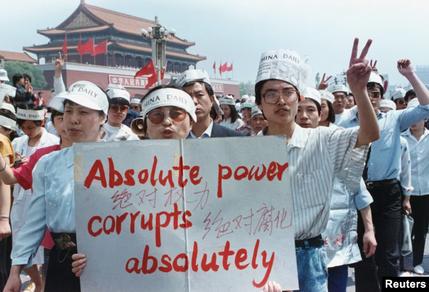
May 16 1989
3,000 people participate in hunger strike
May 17
1989 Deng Xiaoping proposes instating martial law
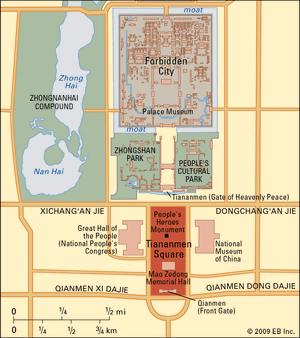
of Tiananmen Square
Map
May 18
1989 Zhao Ziyang visit hospitalized citizens to try and stop them from protesting
May 19
1989 citizens learn of marital law plan and call off hunger strike and organize a mass sit in
May 20
1989 first time in 40 years of communist rule PLA troops occupy Beijing
May 24
1989 troops leave but the government sees this time as a massive humiliation
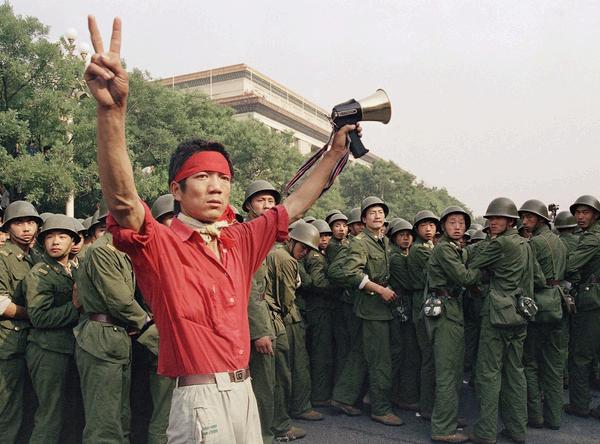
May 25- june 1 1989 demonstrations continue and Beijing operates without police presence
June 2
1989 Party elders approve to clear the square with military force of the “counterrevolution ary riot”
June 3
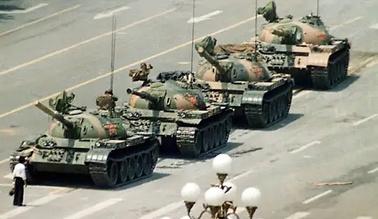
1989 troops start to fire into teh crowd of peaceful protesters with AK-47s loaded with battlefield ammunition
June 4
1989
one in the morning troops reach Tiananmen square.
After 3 hours the students chose to leave then later on protesters came back which is when troops fired into the crowd of citizens.
“Tiananmen Square Massacre”
ByRichard Wlodarski
June 5
1989 army in total control protester are silenceed
Courage not fear In hearts of students
Fear not courage In hearts of tyrants
Democracy for all China answered the call
Massacring their own Killing dog for bone
Tiananmen Square Massacre
Caused an international stir
But President Bush lacked the spine
Chose to dine with cheese and red wine
Trade and investment with tyrant
Was the damned message he had sent
Sacrificing democracy
Brutality and tyranny
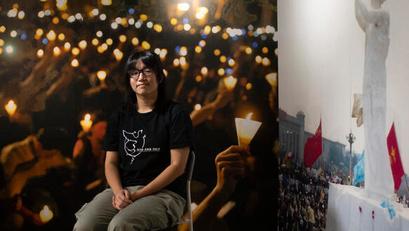
Chow Hang-Tung is an activist that has been imprisoned multiple times in result of talking about the Tiananmen Square incidents. Recently she held a remembrance service, which caused her to be imprisoned for 15 months. She is truly a voice in the silence.
The source “Tiananmen square incident,” written by the editors of Encyclopedia Britannica, is a reliable source because it was created by multiple writers and editors who are experts in their field. A second article, “Tiananmen Square Protests” from History.com, corroborated only the before and during the protest. The place the articles didn’t match is in what happened afterwards; however no official report has ever been published about the death toll, injuries sustained, or the number captured so this makes sense. Due to this discrepancy, each historian has to make either their own estimates or use someone else's estimates. This does not make the Britannica article unreliable, however, because these sources still match in most ways. In this article, the author does not seem biased based on the language they used and the facts presented. When the author talks about what happened, they give a slight opinion but follow that up with specific facts that show why that is an opinion they give in the article. For example, the article says, “However, an attempt by the troops to reach Tiananmen Square was thwarted when Beijing citizens flooded the streets and blocked their way.” This could have been dramatized, such as saying that the troops angrily marched through the crowd who tirelessly stopped the soldiers efforts to get to Tiananmen square. By using language like “attempt ” and “Beijing citizens,” we can conclude that the authors were objective and using only facts when
Dedication
To the teacher who introduced me to this topic, I will never forget and will always appreciate how you pushed me.