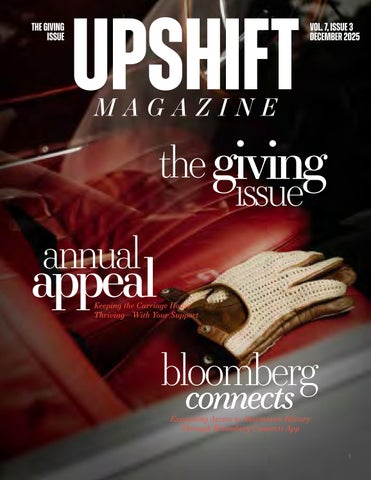
UpShift • The Giving Issue

Page 1


UPSHIFT

Your Gift Fuels the Future of Automotive History, Culture, and Community at Larz Anderson.

FUTURE

The Class of 2001 Imports Making Their Long-Awaited U.S. Debut in 2026

Experience the Larz Anderson Auto Museum anywhere with the Free Bloomberg Connects App

Learn about the Museum’s history

How Trevor Woodward Built a Performance Legacy in Mendon, MA

Meet the team who makes this and every issue possible.

CONTRIBUTORS

Executive Editor

Sheldon Steele

Editor-in-chief

Andrew Newton

Art Director

Jenn Corriveau

Contributors

Andrew Newton

Ryan Phenegar

Rob Siegel

Gibb Phenegar

Jim Travers

Cover Photo

Jenn Corriveau

Photo Contributors

Andrew Newton

Ryan Phenegar

Rob Siegel

Gibb Phenegar

Jim Travers

Jenn Corriveau

Mini

Josh Sweeney

Volvo

General Motors

Hagerty

UpShift

Quarterly Publication of the Larz Anderson Auto Museum

Larz Anderson Auto Museum

Larz Anderson Park 15 Newton St. Brookline, MA 02445 | larzanderson.org 617-522-6547

Throughout this issue, you will find photographs from the events we hosted this season. We truly enjoy welcoming each and every one of you to the Museum year after year!

Photos: Jenn Corriveau

BLOOMBERG CONNECTS

EXPLORE THE MUSEUM

THROUGH A FREE GLOBAL ARTS AND CULTURE PLATFORM

WORDS: Ryan Phenegar

The Larz Anderson Auto Museum is proud to announce its launch on Bloomberg Connects, the free arts and culture app created by Bloomberg Philanthropies.

The Bloomberg Connects app empowers institutions to share their stories with audiences around the world, designed to make arts and culture more accessible to everyone. Bloomberg Connects offers expert-curated content and guides to more than 1,170 museums, galleries, sculpture parks, gardens, and cultural institutions across 43 countries.

Through Bloomberg Connects, visitors can now explore the museum’s historic collections, exhibitions, and stories in a new way, through exclusive digital guides and rich media content, all accessible from a smartphone or tablet. The addition of the Larz Anderson Auto Museum connects its storied automotive collection and historic Brookline Carriage House to a global

community of cultural destinations, inviting audiences everywhere to discover the history and artistry of early automobiles. The app serves as a personal digital guide, allowing visitors to explore exhibits in depth through photos and audio commentary, available in any language. Visitors can discover the Andersons’ passion for car collecting, learn about the evolution of automotive design, and enjoy special exhibition highlights, whether on-site or from home. All the content is completely free, allowing you to experience the museum’s offerings anytime, anywhere.

The Bloomberg Connects app is free to download on the Apple App Store and on Google Play. Visitors can search for “Larz Anderson Auto Museum” to access its digital guide and start exploring the museum’s history, exhibits, and special programs.

ABOUT THE MUSEUM

STEP INTO THE HISTORIC CARRIAGE HOUSE, HOME

TO “AMERICA’S OLDEST CAR COLLECTION,” AND EMBARK ON AN IMMERSIVE JOURNEY THROUGH THE RICH HISTORY OF AUTOMOTIVE INNOVATION.

The Larz Anderson Auto Museum is located in the lavish and original 1888 carriage house on the grounds of the former Weld Estate, now Larz Anderson Park, in Brookline, Massachusetts. The building was inspired by the Château de Chaumont-Sur-Loire in France and designed by Edmund M. Wheelwright, the city architect of Boston. First constructed as a working stable, it later served to house and maintain the Andersons’ growing collection of motorcars.

Larz and Isabel Anderson began their love affair with the automobile before the turn of the century. In 1899, soon after they married, they purchased a new Winton Runabout, a true horseless carriage. From 1899 to 1948, the Andersons purchased at least 32 new motorcars in addition to numerous carriages, thus creating “America’s Oldest Car Collection.”

As each car became obsolete, it would be retired to the Carriage House. By 1927, the Andersons began opening the building to the public for

tours of their “ancient” vehicles. When Isabel Anderson passed away in 1948, it was her wish that the motorcar collection be known as the “Larz Anderson Collection,” and that a separate non-profit organization be created to promote the mission of preserving the collection and automotive history. The grounds of Larz Anderson Park include a romantic pond, a picturesque view of the Boston skyline just four miles away, acres of lush open space with walking paths throughout, and an ice skating rink that is open to the public during the winter months. Today, the Carriage House is on the National Register of Historic Places. A landmark within the community and both a cultural and educational hub in the automotive world, it continues to house and preserve the fourteen motorcars that remain in the Larz Anderson Collection.

DRIVEN BY DREAMS

WOODWARD MOTORSPORT

a family operation with a passion for bmws old and new

WORDS: & PHOTOS: JIM TRAVERS

Trevor Woodward grew up with dreams of making a living working on imported performance cars, with the ultimate goal of one day having his own shop. Woodward Motorsport of Mendon, MA, is the realization of that dream. After opening its doors in 2000, Woodward outgrew its first space in just three months. Today, it’s a bustling operation specializing in the maintenance, repair, and modification of performance cars from BMW and Porsche.

While Woodward is more than qualified to handle the day-to-day duties of routine upkeep, it’s widely known for extracting maximum power and improved handling from street cars, and for taking on everything from minor upgrades to all-out track builds with lightweight carbon-fiber body panels, optimal suspension setups, and a lot more power than stock.

“I’ve wanted to have a business like this since I was a kid,” says Woodward. “We can take a customer’s car and create something unique that nobody else has.”

A recent visit to the Woodward facility leaves no reason to doubt this. The shop hummed with activity on the morning

of our visit, with technicians working on everything from classic models to a virtually brand-new 2025 BMW M3 with every option available. Barely broken in with just 1200 miles, the M3 had stopped in for the full Woodward treatment, including a larger turbocharger, performance exhaust, upgraded suspension and brakes, and a $25,000 body kit. When complete, the car will be a streetable commuter that can also double as a track car, with somewhere around 900-950 horsepower.

“Our customer just wanted something different,” says Trevor in a master stroke of understatement.

Not all customers are looking for something quite so exotic, nor do they have the deep pockets to match. Woodward is happy to work with those enthusiasts, too, and to lavish just as much care on older models. “We work on all BMWs, and we do soup to nuts, whether it’s a race car or grocery getter.”

Among these is a generation of 3-Series models from the mid-2000s to early 2010s, known in BMW circles as the E90. “We have a strong presence in the E90 community,”

said Woodward. “They’re one of our specialties.”

Lighter and more compact than the current 3 Series, M3 models from this generation were also the only 3 Series equipped from the factory with a V-8 engine.

“The E90 is kind of a big deal in BMW circles,” he says. “They are the last BMWs with hydraulic steering, which has better feel than the newer models with electric steering. They just feel better overall, and they’re the last generation to go without a turbo. Response just isn’t the same, and you have turbo lag to deal with.”

Woodward and his staff also believe in putting their money where their enthusiasm is. Three members of the crew drive an E90 of their own, and that includes Trevor. He makes the daily commute from the Rhode Island home he shares with his wife and two young daughters in a heavily modified E90 M3, the most performancefocused 3-Series variant.

“I’ll never sell my M3,” says Trevor. “It’s by far my favorite.”

Trevor and the folks who work for him bring a youthful and infectious enthusiasm to the shop, catering to a younger generation of enthusiasts while still having a healthy respect for the classics. The business continues to grow, thanks to a combination of word

of mouth and use of social media posts on Instagram and Facebook. The shop also hosts regular customer events and Cars and Coffee events.

“We do cars and coffee here, beginning with our May anniversary. We participate in BMW club events, and we’ve participated in BMW days at the Larz Anderson Auto Museum.”

Indeed, Woodward’s connection to Larz and automotive history runs strong. His aunt Donna “Woody” Woodward was something of a legend in local motorsport circles and was a founder of the Moving Violations Motorcycle Club. An adventurer and avid rider who was also a member of the BMW Motorcycle Club of America, she could often be found at Larz events. A photo of her at the museum hangs in Trevor’s office.

Whether that family history of automotive enthusiasm will be passed on to a new generation is another matter, and one that likely won’t be decided until his girls are a little older.

“I don’t know,” he says with a smile. “Maybe the younger one, she’s a daddy’s girl.” He added, “They do yell out BMW when they see one.”

That sounds like a good start.

AVI provides bespoke performance car audio and video. We are capable of providing you with the latest technology and styles available for your vehicle You may add new components to your system or have it rebuilt from the ground up Our professional staff performs custom work at competitive prices

Locally owned and operated, AVI truly has all of the quality products and experience you need to personalize your car We pride ourselves on personalized service and helping make your automotive dreams reality.

We are open Monday through Friday from 8:00am to 5:00pm. Premium consultation services available on Saturday by appointment only.

FUTURE CLASSICS

we proudly present

THE CLASS OF 2001

ONCE FORBIDDEN FRUIT FOR AMERICAN ENTHUSIASTS, THESE FOREIGN-MARKET CARS WILL BE LEGAL TO IMPORT HERE IN 2026

WORDS: ANDREW NEWTON

PHOTOS: TVR, MITSUBISHI, VAUXHALL, NISSAN, RENAULT

Here in the United States, we have the socalled 25-year import rule. Foreign-market cars, ones that were never legal to buy here new or were prohibitively expensive to import ourselves, become exempt from enough Department of Transportation rules that American enthusiasts can import them and register them in most states with relative ease. The 25-year import rule has also created an interesting dynamic, where every year another crop of newly eligible foreign cars becomes available to us. Below are the ones from the class of 2001 that will be importable starting in 2026.

TVR Tuscan S

Often troubled but always exciting, TVR of Blackpool, England, was in something of a golden age during the 1990s to the 2000s. Its cars looked spectacular inside and out. It was making proprietary sixand eight-cylinder engines that, while finicky, delivered serious power and sounded divine. Its products also weren’t particularly expensive considering their style and speed, typically way less than the equivalent Porsche or Ferrari. Unfortunately, aside from video games, the occasional episode of Top Gear or the 2001 movie Swordfish , Americans missed out on this TVR renaissance. The Tuscan came out in 2000, named for TVR’s 1960s Ford-powered coupe but now motivated by the company’s

own 4.0-liter Speed Six engine under its wavy hood. An improved Tuscan S model came out in 2001 with 390hp and 310 lb-ft of torque, plenty for a car that barely weighs 2400 pounds.

Mitsubishi Lancer Evolution VII Mitsubishi started gaining ground in international rallying in 1992 with its first Lancer Evolution, aka “Evo.” The Japanese company incrementally improved its world rally weapon every two or three years, so JDM fans have regularly had a newly importable version to get excited about since 2017, when the first Evo turned 25 years old. The Evo VII debuted in late 2001, boasting an upgraded all-wheel drive system and multiple improvements to its turbocharged 4G63 four-cylinder engine.

The Evo VII is also the last of the Evos that wasn’t available when new in the U.S. After it, there are no more “forbidden fruit” Evos as its successors—Evo VIII, Evo IX and Evo X—were available in American showrooms.

Vauxhall VX220

When it comes to sports cars, General Motors doesn’t deviate from the crossed flags of Corvette very often, but for a brief time in the early 2000s, for British and European buyers at least, there were the VX220 from Vauxhall (GM’s British subsidiary) and the Speedster from Opel (its German one). The whole venture

came out of an agreement with Lotus, where GM funded Lotus’ excellent Series 2 Elise, and Lotus built a pair of sports cars based on the Elise chassis at its factory in England.

The Elise did sell in the U.S. and came with a 1.8-liter Toyota four, but the General couldn’t have that, so the Vauxhall/Opel twins came with either a GM-supplied 2.2-liter naturally aspirated or 2.0-liter turbocharged four. They also ride on a slightly longer wheelbase than the Lotus and can generally be thought of as a slightly more comfortable and civilized version of the Lotus.

The Opel version, called the Speedster, came in left-hand drive and would be a bit more usable on our roads. It debuted in 2000. Production for the right-hand drive Vauxhall VX220 started a bit later, towards the end of 2000, for the ’01 model year.

Nissan Skyline GT-R M-Spec

Like the Lancer Evo VII, the R34-generation of the Nissan Skyline is the last version of that legendary car to be unobtanium in the U.S. market when it was new. Early R34s became eligible to import last year, but the M-Spec was a new-for-2001 model and will be a fresh addition to our roads in 2026. The M-Spec wasn’t revolutionary, but it did add a more luxurious interior with heated leather seats along with “Ripple Control” dampers for a more comfortable ride.

Many regard the R34 (1999-2002) as the bestlooking Skyline, and the LCD multifunction display on its dash is a neat piece of late ‘90s tech nostalgia. But these are not cheap cars. Any running and driving R34 will cost well into six figures.

Renault Clio V6

Millions of Europeans have driven a Clio, Renault’s frugal front-drive hatchback. For some crazy reason, though, Renault teamed up with Tom Walkinshaw Racing (TWR) at the end of the 1990s to completely reengineer the humble, fuel-sipping second-generation version of the Clio that had debuted in 1998. Indeed, by the time it was finished, there wasn’t much Clio left. There was a 3.0-liter 227-hp V-6 stuffed in the back, mated to a 6-speed manual. The car was rear-wheel drive. The bodywork was ridiculously wide. The suspension was all new. The whole exercise echoed Renault’s R5 Turbo rally cars

from the 1980s, but this new Clio V6 raced in a one-make series, and from 2001-02, about 1600 road-going versions were sold to the public.

Reviewers of these early models noted that they were tricky to drive. According to Autocar, the “approach to corners went grip, grip, grip, grip, gone.” They are cool, though, and enthusiasts of a certain age will probably have driven one with their thumbs on one video game or another back in the 2000s.

DIRECTOR EMERITUS

Joe is a sought-after automotive historian, writer, publisher, vintage racer, and car collector, and a longtime Brookline resident. His involvement with the Museum is long and deep: He served as President for several years, and remains a trusted and indispensable advisor. Joe founded Racemaker Press in Boston in 2006, preserving decades of automotive racing lore for future generations, and has earned renown as an influential historian in the automotive world. Among other achievements, he helped to establish the provenance of one of the three most important racecars in the United States, the Duesenberg that is now part of the Simeone Automotive Foundation. Earlier in his career, Joe served in the Peace Corps as a teacher and community developer in Micronesia. He has also held roles as a grant writer with the anti-poverty organization Community Progress and as Boston Coordinator and Associate Director with the Massachusetts Department of Public Health.

HONORARY DIRECTOR

Lloyd is a longtime Brookline resident who was named Honorary Director of the Museum in recognition of his impactful support. He has also served as Director of Rogerson Communities and on the Board of Directors at the Brookline Music School, and he was Senior Warden at the Church of the Redeemer in Chestnut Hill. He also serves as a Director at Club Motorsports, Inc. Prior to his retirement, Lloyd was a Managing Partner at Alphametrics and as General Partner at Claflin Capital Management. He has worked in senior positions for other Boston financial management firms, including Scudder Stevens & Clark, Dahmen Associates, and Franklin Management.

PRESIDENT

Bill is a certified financial planner and Senior Vice President with Merrill Lynch Wealth Management, where he leads The Keeney Group. His mission is to assist business owners, corporate executives, and high-net-worth families with wealth management strategies. A trustee of the Larz Anderson Auto Museum for many years, Bill helped develop the Museum’s popular Cars and Coffee and MotoTour events. He and his wife Lauren have two children, Dillon and Tyler. In his free time, Bill enjoys spending time with his family, driving his Porsche with the top down, and training for triathlons.

VICE PRESIDENT

Mez has called over twenty years South End with and near his three and daughter-in-law. two decades of engineering teams biotech, life science, materials and has Johns Hopkins the Massachusetts Technology. Mez passion for cars, for European marques from the When not participating at Larz Anderson during lawn event enjoys travel, food, and Formula 1.

MEZ

Our DIRECTORS

POLAD

PRESIDENT

Boston home for years and lives in the his wife, Mary Ann, three adult children daughter-in-law. He has over experience leading teams and projects in science, and specialty has degrees from Hopkins University and Massachusetts Institute of Mez has had a lifelong cars, with a preference and Japanese the 1980s and 90s. participating in events Anderson Auto Museum event season, he food, soccer, running

TREASURER

Mark brings a non-profit finance background to his role as treasurer at the Museum. His professional career spans more than thirty years in all aspects of healthcare and non-profit research institution finance. He has worked extensively with boards, federal science and audit agencies, academic leaders and faculty, industry sponsors, and major donors. He is currently Senior Consulting Associate at Attain Partners LLC and has recently managed projects for a number of major research universities in New England, New Jersey, and New York. Mark has been a lifelong sportscar and vintage motorcycle enthusiast and has supported and participated in numerous events over the past 20 years at the Museum. He is a member of the BSA Owners Clubs of New England and Southern California, the NPCA, and the Cape Cod British Car Club. He lives with his wife Janice in Quincy. His family, including two grandchildren, live in the Boston area. Mark and his family have attended many events at the Museum over the years.

Chris serves as Director of Marketing & Pre-Owned Operations for the McGovern Automotive Group, which operates 40 auto dealerships throughout New England. Before that, he was Director of Sales for AutoTrader. com and Kelley Blue Book, the iconic vehicle valuation and automotive research company that is recognized by both consumers and the automotive industry. Chris joined the Board of Trustees in 2019 after serving as a Corporator for five years. He co-founded the Museum’s popular Cars and Coffee gatherings and can be found each year coordinating Tutto Italiano, the Museum’s legendary lawn show of Italian cars. Chris resides in Needham, and when he isn’t working, setting coast-to-coast cannonball records, or playing with cars, he enjoys spending time with his wife, Narine, and their young daughter, Mila.

John is an attorney who is admitted to practice before the Supreme Court. He currently serves as president of the Charles River Mortgage Company, a commercial and multifamily lender and finance provider. He began his professional career at the U.S. Department of Housing and Urban Development. John is a past president of the Larz Anderson Auto Museum and has served on the boards of other nonprofit organizations, including the MSPCA/Angell Memorial Animal Hospital, Ron Burton Training Village, Deutsches Altenheim nursing home and assisted living facility, and the Massachusetts Prostate Cancer Coalition. John resides in Needham with his wife Peggy.

JOHN CARBERRY

BOARD OF DIRECTORS

Tom Coletta is an automotive journalist and content creator on the Tedward Drives YouTube Channel. His innate passion for cars led him to earn a Bachelor’s degree in Mechanical Engineering from Worcester Polytechnic Institute in 2010. After college, he worked in a global role improving garment factories, but felt his true passion was to share the driving experience of rare classic cars. When he’s not filming car videos or shooting photography for auctions, you can find him attending Larz Anderson Lawn Events and Cars and Coffee. He has been a supporter of Larz Anderson Auto Museum since he was a little boy and strives to promote responsible enthusiasm for the next generation of drivers.

Chris is a patent attorney with DLA Piper LLP whose practice mainly focuses on patent litigation, representing global companies in a variety of technology fields including automotive, semiconductors, telecom, and mobile devices.

He has been recognized on the Massachusetts Supreme Judicial Court’s High Honor Roll for his commitment to Pro Bono legal services. Before becoming an attorney, Chris was a mechanical and manufacturing engineer for several auto industry Tier 1 suppliers. Chris resides in Pembroke with his wife Taryne and his car-obsessed daughter Remi. In his spare time, Chris enjoys road trips with his family and working on his small collection of ‘80s‘00s European cars. He joined the Board of Trustees in 2025 after having attended Lawn Events at the museum for over 25 years.

David has more than 25 years’ experience working for agency, technology, and consulting companies, working with clients on engagements ranging from marketing strategy to technology implementation & operations, and from business case development to organizational change management. He is currently a Managing Director at Deloitte Consulting LLP and leads the Healthcare practice within Deloitte Digital, where he provides meaningful solutions for healthcare clients in data management, analytics, marketing operations, content creation, digital media, and technologybased engagement platforms.

David is a life-long resident of Massachusetts and in his free time enjoys spending time with his wife and two children. In addition to serving as a trustee of the Larz Anderson Auto Museum, David serves on the board of the Heritage Museum and Gardens. He is an avid collector of automobiles and enjoys participating in a wide variety of local and national events.

Natalie is a writer enthusiast living Plain neighborhood She earned her in Cognitive Sciences from and took a circuitous her current role Writer at CarGurus. more than 15 years experience in customer service, as well as volunteer previously served of the Johnson non-profit organization Newton, and she the Larz Anderson for several years the board in 2018. Natalie gets to greatest autos, the vintage car attending concours, and other events people together. purchased her first a 2000 Mercedes-Benz which she is looking bringing to Lawn summer.

NATALIE HARRINGTON

writer and automotive living in the Jamaica neighborhood of Boston. her bachelor’s degree and Linguistic Wellesley College circuitous route to role as Senior Staff CarGurus. She also has years of professional in management, service, and marketing, volunteer work. Natalie served as treasurer Johnson String Project, a organization based in she volunteered at Anderson Auto Museum years before joining 2018. As a journalist, drive the latest and but her heart is in car world. She loves concours, car shows, events that bring car together. She recently first “collector car,” Mercedes-Benz SL500, looking forward to Lawn Events this

Paul brings a deep passion for automotive history and business acumen to his involvement with the Larz Anderson Museum. He is honored to be part of the organization, particularly its unique pre-war Anderson Collection housed in the carriage house’s lower level. The Museum’s dynamic community—fostered through lawn events, road tours, and “Laps with Larz”—has provided Paul with invaluable opportunities to deepen his knowledge of the cars he loves. Professionally, Paul is a serial entrepreneur with a keen eye for business growth. He specializes in scaling small companies and identifying their specific market niche within the demanding semiconductor industry. With family scattered globally, international travel is a significant part of his life, fueling his passion for connecting with people and embracing life’s opportunities.

Evan grew up in the Boston area and has been visiting Larz Anderson since childhood, introduced to automotive enthusiasm by his father. They bonded at car events over stories of learning to drive stick on a ’60s VW Bug and the many cars his dad once owned—BMWs, Chevy Novas, Ford Thunderbirds, and the infamous stolen Ford Falcon. These early experiences fueled Evan’s passion for ’90s and early ’00s Porsches and BMWs.

Now living in Boston, Evan stays active with the Larz Anderson Auto Museum, helping organize day-trip drives, track days, and the annual Moto Tour. Professionally, he has spent the past decade managing client onboarding and engagements in financial services, intellectual property, and consulting. Known for his problem-solving, collaboration, and relationship-building, he focuses on delivering clear value.

THE CONTRIBUTORS

Andrew came of age around old cars and vintage racing, and first came to the museum through an internship while attending Clark University. He then served as the Education Manager at Larz Anderson while writing about cars both old and new for Sports Car Digest, James Edition and CarGurus. In 2014, Andrew joined Hagerty as Auction and Valuation Editor to cover the collector car market worldwide and contribute to the Hagerty Price Guide. Andrew has written hundreds of articles on classic car values, market trends and history for Hagerty as well as hosted webinars and attended dozens of auctions each year. He currently lives in Houston, Texas, but gets back to Larz Anderson as often as he can.

JENN CORRIVEAU

As a child, Jenn accompanied her “Car Guy” dad to car events across New England, so it’s fitting she now serves as the Lawn Events Manager at Larz Anderson Museum. In college, Jenn studied Graphic Design and discovered a passion for various design forms, from photography and logos to brochures and wedding invitations. Her skills and role at the Museum are key to shaping its image and message.

Influenced surrounded passion for cars, Ryan love for Joining family in newest addition

As a recent Bridgewater he’s already himself as things audi-related. not tinkering or cleaning you can registration lawn events, is ready to

CONTRIBUTORS

PHENEGAR

EDITOR + CONTRIBUTOR

Influenced by a childhood surrounded with his father’s for modified German Ryan has always had a all things German. the Larz Anderson in 2022, Ryan is the addition to our team. recent graduate from Bridgewater State University, already making a name for as the go-to guy for all audi-related. When he’s tinkering under the hood cleaning one of his cars, find him running car registration at all the Museum events, ensuring every car to go on the lawn.

ROB SIEGEL CONTRIBUTOR

Rob Siegel has written the monthly column The Hack Mechanic™ for Roundel, the magazine of The BMW Car Club of America, for 35 years, and writes weekly online for Hagerty and BimmerLife. Rob has also written for Road & Track, Sports Car Market, and Forbes, and is the author of eight automotive-related books, including The New York Times-reviewed Memoirs of a Hack Mechanic. Rob has owned over 70 BMWs, most of them 1970s-era cars. He currently owns 13 cars including eight vintage BMWs and a Lotus Europa, and yes, his wife knows where all of them are.

JIM TRAVERS CONTRIBUTOR

Jim Travers is a lifelong gearhead, and a freelance writer, editor, and photographer specializing in all things automotive. A classic car enthusiast and collector, Jim is a regular judge on the car show circuit and is the author of the Smithsonian Institute’s Extreme Cars. His work has also appeared in Automobile, Autoblog, BBC Autos, Car and Driver, Cars.com, Car Talk, Consumer Reports, Hagerty, The NY Daily News, US News, and others. He lives in Duxbury, Massachusetts, a town known for both its beach and its dump. On weekends, Jim can often be found at one or the other.

DRIVING GOOD

SUPPORTING THE MUSEUM’S LEGACY THROUGH VEHICLE DONATIONS

WORDS: Ryan Phenegar | PHOTOS: Jenn Corriveau

V

This season of giving offers plenty of ways to support the Larz Anderson Auto Museum, from making a monetary contribution to booking a private event or entering our exciting Porsche 911 sweepstakes. Yet one of the most impactful and continually growing ways to champion America’s Oldest Car Collection is through our Vehicle Donations Program. Whether it’s a dependable daily driver, a classic motorcycle, or a vintage automobile, the museum gladly accepts vehicles of all kinds. Below are some of the remarkable recent donations that help fuel our mission. If you’re looking for a meaningful way to give back, consider donating your vehicle today.

1956 Jaguar XK140 MC

On December 1, 1955, Ernest Cassis purchased this XK140 for $3,270, selecting the OTS (Open Two Seater) body style with Jaguar’s MC performance upgrade. This made his car an especially high-performance roadster, equipped with enhancements such as the cylinder head and camshafts from the Le Mans-winning C-Type race car, larger SU carburetors, and knockoff wire wheels. These modifications boosted the engine’s power output from 190 brake horsepower (bhp) to an impressive 210 bhp, making it an ideal choice for competitive driving and inperiod racing.

Ernest Cassis had a lifelong passion for mechanical things, which began in his youth. In his late teens, he joined the United States Navy, serving as an Electrician’s Mate 2nd Class in the 125th Naval Construction Battalion and as a proud member of the U.S. Navy Seabees during World War II. Following his service, he pursued a career in automotive mechanics, becoming a highly skilled machinist and later a specialized mechanic in the New York Formula Vee racing series. He also served as Chief Technical Inspector for the New York chapter of the Sports Car Club of America (SCCA), a role that placed him at the heart of the region’s competitive racing scene. His career eventually led him to work alongside legendary racing driver and team owner Briggs Cunningham. It was during this time that he developed a deep appreciation for European sports cars, which inspired him to establish Kinematics, a specialized foreign car repair shop that he owned and operated for over four decades. Over the years, Ernest’s XK140 provided him with countless hours of driving pleasure. Eventually, he chose to “semi-retire” the car, storing it in his root cellar. The car spent decades in hibernation before Ernest embarked on a full-scale restoration in the early 2000s, meticulously bringing his beloved Jaguar back to factory-fresh condition. It remained a prized possession throughout his life.

Upon his passing in 2023, Ernest’s estate made the heartfelt decision to donate the car to a museum that would honor his legacy. After carefully evaluating several institutions along the East Coast, the family selected the Larz Anderson Auto Museum as the ideal home for the cherished Jaguar.

1960 Cadillac Series 62

Dring his youth, Paul Macdonald always noticed a not-sohidden gem sticking out of his neighbor’s garage, a 1960 Cadillac Series 62 Flat Top. With the car reaching almost twenty feet in length, the rear end always stuck out of the garage and was impossible to miss. Spending years lusting over the car’s iconic tail fins and unique curved rear window, Paul always wondered if he could own it someday. As he neared high school graduation, he received a college scholarship check totaling $475.00. With the money “burning a hole” in his pocket, he walked over to his neighbor’s front door, offering him the scholarship check in return for the car. At that moment, Paul’s dream came true; he was now the proud owner of a 1960 Cadillac Series 62 Flat Top. Over the next 50 years, he lovingly maintained the car. With countless trips and memories made in the Cadillac, it was hard for Paul to relinquish his cherished Cadillac, but after half a century of ownership, he gave the car to the Larz Anderson Auto Museum’s Car Donation Program.

1954 Humber Super Snipe

The Humber Super Snipe, produced from 1938 and 1967 by Humber Limited of the Rootes Group, was long regarded as one of Britain’s most distinguished luxury sedans. Introduced as a successor to the large Humber Pullman, the Super Snipe combined the Pullman’s stately presence with the chassis and body of the Humber Snipe, resulting in improved

performance and a notable top speed of 79 miles per hour. Its blend of comfort, refinement, and engineering sophistication made it a preferred vehicle for official service and ceremonial roles throughout the mid-20th century.

Among the most historically significant examples of the model is this 1954 Humber Super Snipe, another recent donation. It was originally constructed for one of the most important international diplomatic missions of the era: the 1953–1954 Commonwealth Royal Tour. Designed specifically to chauffeur the late Queen Elizabeth II and the Duke of Edinburgh (Prince Philip), the vehicle played a role in the first major overseas tour of the newly crowned monarch. The Commonwealth Coronation Tour spanned nearly six months, taking the Royal Couple to Bermuda, Jamaica, New Zealand, Australia, Uganda, and several additional Commonwealth nations. To support the complex logistics and ceremonial requirements of the tour, the British royal family purchased six Humber Super Snipe sedans. These vehicles were subsequently sent to London coachbuilder Jones Ltd., where they were professionally converted into open-top touring cars suitable for public appearances, parades, and official engagements across varied climates and terrains.

The Humber Car Club has confirmed that the VIN and unique configuration of this Super Snipe identify it as one of the six convertibles used by Queen Elizabeth II during this landmark international journey. Its provenance directly links it to a pivotal moment in modern Commonwealth history and to the early public life of Britain’s longest-reigning monarch.

Photos: Ethan Pellegrino

WORDS & PHOTOS: Rob Siegel

I’ve written a few pieces for UpShift about my 1969 Lotus Elan +2. I bought it on Halloween 2024, and it mainly needed light sorting out. I’ve since had it out to Larz Anderson on British Car Day and at several Cars and Coffee events. It attracts gobs of attention wherever it goes. I adore this car.

But as I began to drive the Lotus this past spring, I discovered something. It’s what we call a “hot drive”—the combination of engine heat seeping in through the firewall, poor air flow through the ventilation system, and the lack of American-style rotating triangular vent windows to force outside air in. It makes for a roasty experience in hot weather. So, I began to look at installing air conditioning in this little British 2+2.

Now, I’ve retrofitted air conditioning into multiple cars and resurrected it in countless others (indeed, I’m the author of Just Needs a Recharge: The Hack Mechanic Guide to Vintage Air Conditioning, the only book targeted at this subject matter). There’s a recipe for retrofit. You buy a modern rotary-style compressor like a Sanden or one of its ubiquitous clones and a bracket to bolt it to the engine block. Then you run a belt between it and an unused groove on the crankshaft pulley, buy an evaporator assembly for the interior of the car (either an original one or something aftermarket), the biggest condenser that’ll fit in front of the radiator, the biggest fan that’ll fit on the condenser, and connect it all up with fresh hoses and wires. Unfortunately, on the Elan +2, it’s just not that easy. First and foremost, the engine compartment is so tight that there’s basically no room to bolt a compressor to the block. Indeed, Elan +2 A/C retrofits written about on the Lotus Elan forum show the compressor suspended above the alternator. Second, the Elan’s crankshaft pulley has only one groove, and it’s occupied by the fan and water pump belt. With no click-and-buy source for either a compressor bracket or a two-groove pulley, you’re faced with having custom machine work done at substantial cost.

I then pivoted and started looking at the kind of electrically powered compressors used on hybrid and electric vehicles. The big advantage there is that, since they’re not beltdriven, they can be mounted anywhere. Unfortunately, the ones used on Teslas and Priuses and such aren’t applicable for retrofit onto cars with 12-volt electrical systems, because they run at much higher voltages. And when you buy one that does run off 12 volts, you immediately run into the consequences of Watt’s Power Law (power = current x voltage). This shows that, to get a thousand watts of cooling power at 96 volts, it only requires 12.5 amps, but

to do it at 12 volts requires 100 amps.

Plus, an electric compressor uses a belt-driven alternator to generate current, which then runs an inverter that feeds three-phase alternating current to an electric motor, which then spins a mechanical compressor. The laws of thermodynamics tell you that there’s simply no way that this is ever going to be as efficient as a belt-driven compressor.

Nonetheless, I got seduced by the availability of $200 12volt electric compressors on eBay and the fact that they appeared to solve my belt-driven compressor-mounting issues. I decided to give one of them a try.

The little cylindrical electric compressor itself is pretty neat. With its shock-mounted bracket, it’s basically a seven-inch cube that weighs only 13 pounds. On these inexpensive ones, the inverter is external, with a form factor like a paperback novel. It’s a bit of a misnomer that the compressor can be mounted “anywhere,” as it needs to be horizontal, and there’s typically not a lot of horizontal open space in an engine compartment. However, the Lotus is unusual in that the fiberglass nose of the car is mostly empty, so it found a home there. The inverter was then mounted on a nearby vertical space.

The manufacturer’s spec sheet listed the compressor’s draw as 42 to 71 amps, but combined with the required condenser and evaporator fans, I estimated a total draw of 100 amps. Clearly, the Lotus’s 35-amp alternator

Your basic Sanden-clone compressor mounted to the engine block with a bracket.

needed to be replaced. I worked with the eBay vendor BNR Parts and found a 150-amp alternator that fit my existing bracket.

Pumping that much current through the 55-year-old Lotus’s ancient Lucas electrical system required care. I installed a separate circuit wired with 2-gauge cable, a 100-amp Mega fuse, and a relay to turn the compressor on. The fans received their own new 12-gauge wires and a 30-amp fuse.

The condenser was a $50 Amazon purchase that I bolted to the radiator, with two new Spal fans mounted directly to it.

Since none of these cars had A/C from the factory, there was no original evaporator assembly I could source (and due to the design of the dash and transmission hump, there’s no center console in which to mount one), so as an interim measure, I bought a $48 under-dash evaporator assembly from Temu that fit in the passenger’s side footwell.

I got the system assembled and tested on the trailing edge of hot weather in New England back in September. On its first outing, I measured vent temperatures of about 42 degrees while driving, though due to the passengerfootwell-mounted evaporator, the fact that the cold air wasn’t blowing directly at me significantly diminished the cooling effect that I actually felt.

Unfortunately, a major Lotus-specific complication then crept in. The Lotus-Ford Twin-Cam engine in the Elan has a unique water pump that’s integral with the front timing cover, and it can’t be replaced without pulling the head. In order for the alternator to output big amperage, the fan belt needs to be tight, but the bearing in the water pump is fragile, and its lifetime is dramatically shortened by high lateral loads caused by a tight belt. So I installed a Gilmer toothed pulley set (like what’s used on timing belts) to enable the belt to grip without being overly tight. It wound up being the most expensive single component of the installation.

Cost-wise, the inexpensive eBay compressor, Amazon condenser, and Temu evaporator belied the fact that modifications needed for the electric compressor nickeland-dimed the total bill up to about $1600—about twice what I’d usually pay for components to retrofit A/C into a more conventional vintage car.

So that’s where I got to before cold weather shut down

All the $200 12V compressorcompressors on eBay look pretty much like this—a small cylinder with an external inverter.

the final steps in the project. Electric air conditioning is a real thing, but I don’t have all the bugs worked out of it yet, and I wouldn’t recommend it if a conventional compressor can be bolted to the block and run off a belt.

If you’d like to learn more, stay tuned, as I’ll be talking about all this in detail at a presentation at Larz Anderson soon. —Rob

(Rob Siegel has been writing the column The Hack Mechanic™ for BMW CCA Roundel Magazine for 40 years, and is the author of eight automotive books.)

but it’s not awful,

certainly promising.

Left: The mechanical installation was pretty straightforward. Right: The new high-output alternator.
Left: The beefy wiring feeding the relay. Right: Looks almost factory
Left: That doesn’t look factory,
right Right: This was
Photos: Ethan Pellegrino

Opel GT

AFFORDABLE CLASSICS

These baby EuroCorvettes remain temptingly cheap, offering a ton of personality per dollar.”

A GERMAN ODDBALL, COURTESY OF GENERAL MOTORS

WORDS: Andrew Newton PHOTOS: General Motors

The average American probably thinks of jewelry when they hear the word “Opel,” but the Rüsselsheim, Germany-based company is one of the world’s oldest and largest carmakers. And for nearly 90 years, it was the largest European subsidiary of General Motors. Even so, only one Opel model made any kind of splash in this country, and that model was the little Opel GT.

Opel screwed together over 100,000 GTs from 1968-73, and roughly 70,000 of them sold in America via Buick dealerships. A prototype debuted at the 1965 Frankfurt Auto Show, featuring sharp, well-proportioned coupe lines, and it came as a shock to the automotive establishment, which was mostly known for Opel’s production of bland

commuter cars. The production version used the chassis from the basic but somewhat sporty Open Kadett Rallye, with independent suspension up front and a live axle in the rear. An entry-level model utilized a 1.1-liter overhead valve four-cylinder engine, but this wasn’t a particularly popular choice. Most buyers chose the 1.9-liter, 102-hp “camin-head” four that uses a camshaft over the combustion chamber, but isn’t a true overhead cam engine since it operates valves using tappets and rocker arms.

Styling for this German-flavored GM product looked, appropriately enough, like a scaled-down version of the C3generation Corvette that debuted the same year. It was also one of the most aerodynamic cars of its day, thanks to Opel’s time spent in the wind tunnel at the University of Stuttgart. The cockpit

had shades of Corvette as well. The GT’s unique party trick, however, was its headlights, which were more “pop over” than “pop up,” as they rotate sideways via a lever next to the driver’s right knee. Opel contracted with a French firm to paint, trim, and upholster the GT, then Opel did the final assembly. These cars were never fast, but they could run with other sports cars of the day with similar proportions and price, and they never pretended to be more than they were. “Our car may not win at Le Mans or Sebring, but it’s great if you just want to have some fun,” according to one ad.

Despite decent sales, emissions regulations were strangling performance for all performance cars, and upcoming bumper regs for 1974 would necessitate major design work for the little Opel. It quietly disappeared from Buick

showrooms after 1973. In the years since, low prices, neglect, relative obscurity, and rust-prone bodies have taken lots of Opels off the road. Rust is still a consideration for today’s Opel GT buyer, as is the difficulty in finding unique parts and trim pieces. It’s not unheard of to buy a junkyard donor car just for the parts.

With those caveats out of the way, these baby Euro-Corvettes can be temptingly cheap. At current values, driver-quality examples can be had in the low-five-figure to mid-teens range. One in excellent condition might just barely crack 20 grand, and the nicest ones in the world don’t cost much more than 30. One sold online for a little over $40K in 2023, but no others have come close to that. These are still absolutely entry-level classics that offer a lot of personality per dollar.

STARVING FOR CONTENT

WHERE SPEED MEETS FLAVOR:

blending vintage racing culture with local cuisine

WORDS + PHOTOS: GIBB + RYAN PHENEGAR

Every Labor Day weekend, my father and I take the scenic trip down to Lime Rock Park, located in Lakeville, Connecticut, to experience one of the best weekends of racing in New England. Going into its 44th year, the Historic Festival is a weekend dedicated to vintage racing, great food, and the camaraderie of car enthusiasts all converging to one place.

This year’s drive was extra special for me, as I had just gotten back my Tornado Red MK5 GTI from the body shop (Havens Autobody, located in Medway, Massachusetts), after spending the last three months receiving extensive body and paint work. Some might call me crazy for restoring an MK5 GTI, and although I agree, this GTI held a special place in my heart. My Uncle purchased it new in 2007 and lovingly kept it until 2023, when he finally decided to let the car go. With perfect maintenance records and an unbeatable price, I simply

couldn’t say no to giving his prized GTI a new life. Unfortunately, over a decade of New England winters took a toll on the hot hatch. As many of us know, the dreaded road salt slowly ate away at a once glistening Tornado Red body. After receiving new fenders, rocker panels, bumper, and various other bits and pieces, the GTI was finished off with a fresh respray of the glorious Tornado Red paint. Havens completed the work one day prior to us leaving for Lime Rock Park, setting in stone that the GTI was ready for its first, albeit short, road trip.

On a crisp late August morning, we set off from the Boston area to our hotel in Great Barrington, located 30 minutes away from Lime Rock. The drive to Lime Rock often takes you through beautiful Western Massachusetts and the amazing Berkshire County. A trip filled with scenic, windy roads and glorious passing zones, the GTI, fitted with new summer tires, refreshed suspension, and new paint, was ready

for the adventure.

Before we arrived at the hotel in Great Barrington, we stopped in the town of Lenox, Massachusetts, with reservations at a little restaurant called Cello. With only 29 seats, you’ll want to book early to ensure you get a spot at this wonderful gem.

Arriving on a Friday night, we stepped in and were immediately welcomed by Kim, who walked us back to our seats at the Counter. Unlike many similar restaurants whose “Kitchen Counter” is actually a far

distance from the pass, you are literally a handshake away from the small galley kitchen, with Ryan and his Sous Chef being the entirety of the line.

One obvious choice was the Cornbread with local honey, which seems to be an app d’jour these days. That said, this version stood out from the pack with amazing texture and a deep corn taste seldom found amongst the bland, box-like pretenders. It’s good, really good. Moving through to entrees, we ordered the Ragu Bolognese and a chicken confit.

The chicken confit, which I’ve never seen before on a menu, was simply fantastic. Eschewing the traditional duck fat, Ryan divulged he used olive oil with a bit of garlic to confit the chicken, resulting in a “chickeny”, perfectly done dish.

A bit of a confession here: I saw a ragu bolognese on the menu, but I didn’t order it as it’s virtually always a disappointment. Frankly, other than Jake Steven’s version at Leeward, I haven’t had a great one in years.

Until now, anyway. As soon as it hit the counter, I started swooning. An honest-to-God ragu bolognese was staring me in the face. I started babbling when Kim walked by to see how we were doing: rendered pancetta, finely diced mirepoix, fresh ground pork and beef, an incredibly long simmer in whole milk, adding more as it reduces. It’s worth booking a table for this simple, traditional dish.

Of course, there’s always desert. Chocolate cake, Gemma’s Chocolate Cake to be specific. It’s the kind of stuff your great-grandmother, a child of the Depression, might have made for you as a kid. Ryan makes it with mayonnaise just as my own Midwestern German grandmother did. It’s simply amazing.

Finally, a few words about the wine list. It’s very small but mighty, with an even smaller reserve list available. I consider myself pretty darned knowledgeable when it comes to a broad range of wine, but Kim’s list had things I’ve never heard of, let alone tasted. Best bet, just put your trepidation aside and ask for a suggestion. I doubt you’ll be disappointed.

In the end, Cello is clearly a labor of love, turning out fantastic food, unpretentious service, and serving up the kind of experience that keeps you coming back. If you’re ever in the area, you have to give it a try.

TCOLLECTOR CAR MARKET OUTLOOK:

what’s changed as 2025 wraps up THE END IS NEAR

WORDS: Andrew Newton | PHOTOS: Hagerty

here isn’t one single “collector car market.” For the purposes of analysis, conversation, or just for fun, there are endless ways to slice and dice this giant hobby, the vehicles it consists of, and the prices we pay for them. But no matter what cars you’re into, the past half-decade has been one of the most active periods for the car market in living memory, and there are plenty of general trends we can tease out. From lockdowns to a period where just about everything with four wheels shot up in value, change came very quickly, and so did prices. Cars like the Ferrari F355 and R32-generation Nissan Skyline more than doubled from 2020-23, and the world record price for a Porsche Carrera GT was broken six times in 2021-22. One of those records lasted just four weeks.

At the close of 2025, however, sales are calmer, and buyers are behaving differently. Industry pros and experts are using phrases like “cooling off” or “slowdown” to describe the market in general, and words like “picky” or “nuanced” to describe buyer behavior. While the attitude at the peak of the pandemic boom in 2022-23 was something like “I should buy this now before it’s worth more next month,” buyers in 2025 are more selective. Perfect-condition specimens, cars with significant history or ones with desirable hard-to-find specs continue to sell well, while lesser examples that need mechanical attention or could use a paint job are struggling to find a new home.

To put some numbers to this, at the beginning of 2020, the average difference between an “excellent” (#2 condition) vehicle in the Hagerty Price Guide and a merely “good” (#3 condition) one was 23.3%. Five years later, the gap had grown to 31.3%. This further suggests a shift in buyer preferences to cars with no needs, and given the increase in the costs of parts and labor, as well as the complexity of some newer collector vehicles, this trend doesn’t seem likely to reverse. Another big change over the past five years is the approach to auctions. The vast majority of collector

vehicles are still sold privately, but auctions are the most visible component of the market and tend to set the tone and expectations. Online auctions were around before the pandemic, but their popularity exploded when bored enthusiasts found themselves at home with little else to do but buy cars and drive them. More platforms popped up, people got comfortable with buying vintage cars sight unseen, and some even got comfortable enough to buy blue-chip, seven-figure cars via pixels on a screen. As a result, the number of vehicles sold online has consistently grown.

Live auctions have maintained their relevance despite the explosion of online platforms, and the number of vehicles sold on a good-old-fashioned auction block with an auctioneer and gavel has remained somewhat consistent. That said, the number of live auctions held in North America has dropped to less than half of what it was in 2019, suggesting a shift to fewer but larger sales.

As for actual prices, newer enthusiast vehicles from the 1990s and later are also where much of the value growth has been in the market this year. Meanwhile, older and more traditional classic cars from the 1950s, ‘60s, and ‘70s have been flatter. There’s also inflation to think about. Almost all classic car prices are up since 2020, but after adjusting for inflation, the lines on the graph don’t look so sharp. For example, $50,000 at the beginning of 2020 translates to roughly $63,000 at the end of 2025.

Whether you have just a single fun car in the garage or 20, the market at the end of 2025 has seen increased focus on newer cars as younger enthusiasts make their presence—and their preferences—felt. It is also now safe to say that the superheated, I’ll-pay-anything buying sprees of the early 2020s are absolutely over. Demand remains strong, but there’s more rationality than there was a couple of years ago, and that seems like a healthy place to be.

Photos: Jenn Corriveau
Photos: Shoot For Details
Photos: Jenn Corriveau

WHEN TRAVELING, WE ENCOURAGE YOU TO EXPLORE AND SUPPORT OTHER AUTO MUSEUMS. BELOW, YOU’LL FIND A LIST OF AUTO MUSEUMS IN NEW ENGLAND. FOR A COMPREHENSIVE LIST, VISIT AUTOMOTIVEMUSEUMGUIDE. COM.

Connecticut New England Auto Museum Norwalk, CT 06851 neautomuseum.org

Maine

Owls Head Transportation Museum Owls Head, ME 04854 owlshead.org

Seal Cove Auto Museum

Seal Cove, Mount Desert Island, ME 04674 sealcoveautomuseum.org

Maine Classic Car Museum Arundel, ME 04046 mainecarmuseum.com

Massachusetts

Springfield Museums Association Springfield, MA 01103 springfieldmuseums.org

Larz Anderson Auto Museum Brookline, MA 02445 larzanderson.org

Heritage Museums & Gardens Sandwich, MA 02563 heritagemuseumsandgardens.org

Rhode Island

Audrain Automobile Museum Newport, RI 02840 audrainautomuseum.org

Piston Palace Warwick, RI 02886 pistonpalace.com

Vermont Z Motorsports Car Museum South Hero, VT 05486 zmotorsports.org

Photo: Ethan Pellegrino

Turn static files into dynamic content formats.

Create a flipbook
Issuu converts static files into: digital portfolios, online yearbooks, online catalogs, digital photo albums and more. Sign up and create your flipbook.