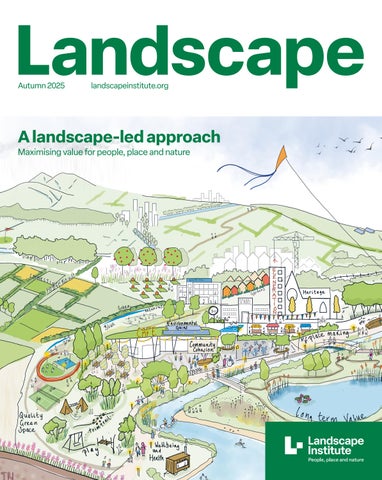
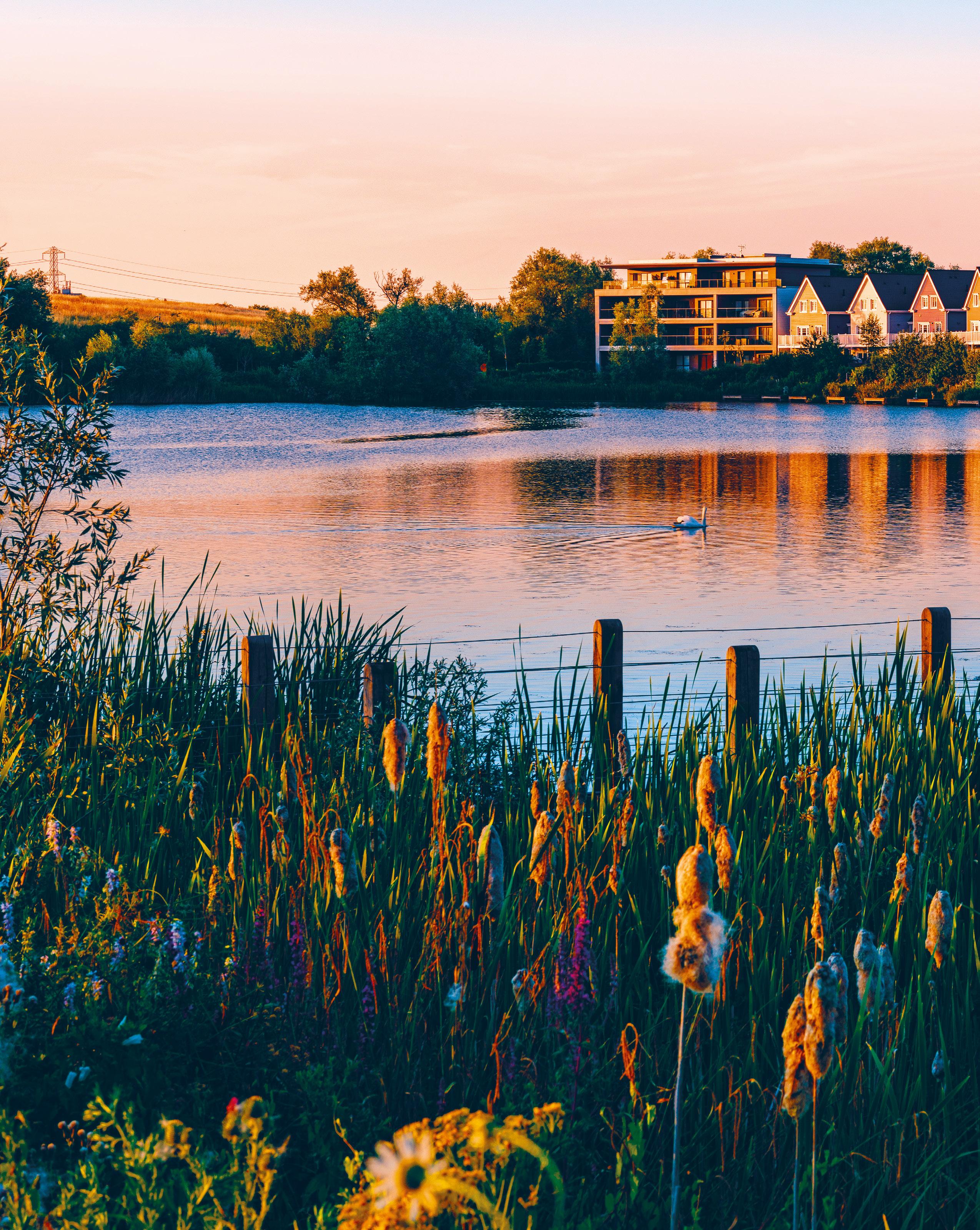
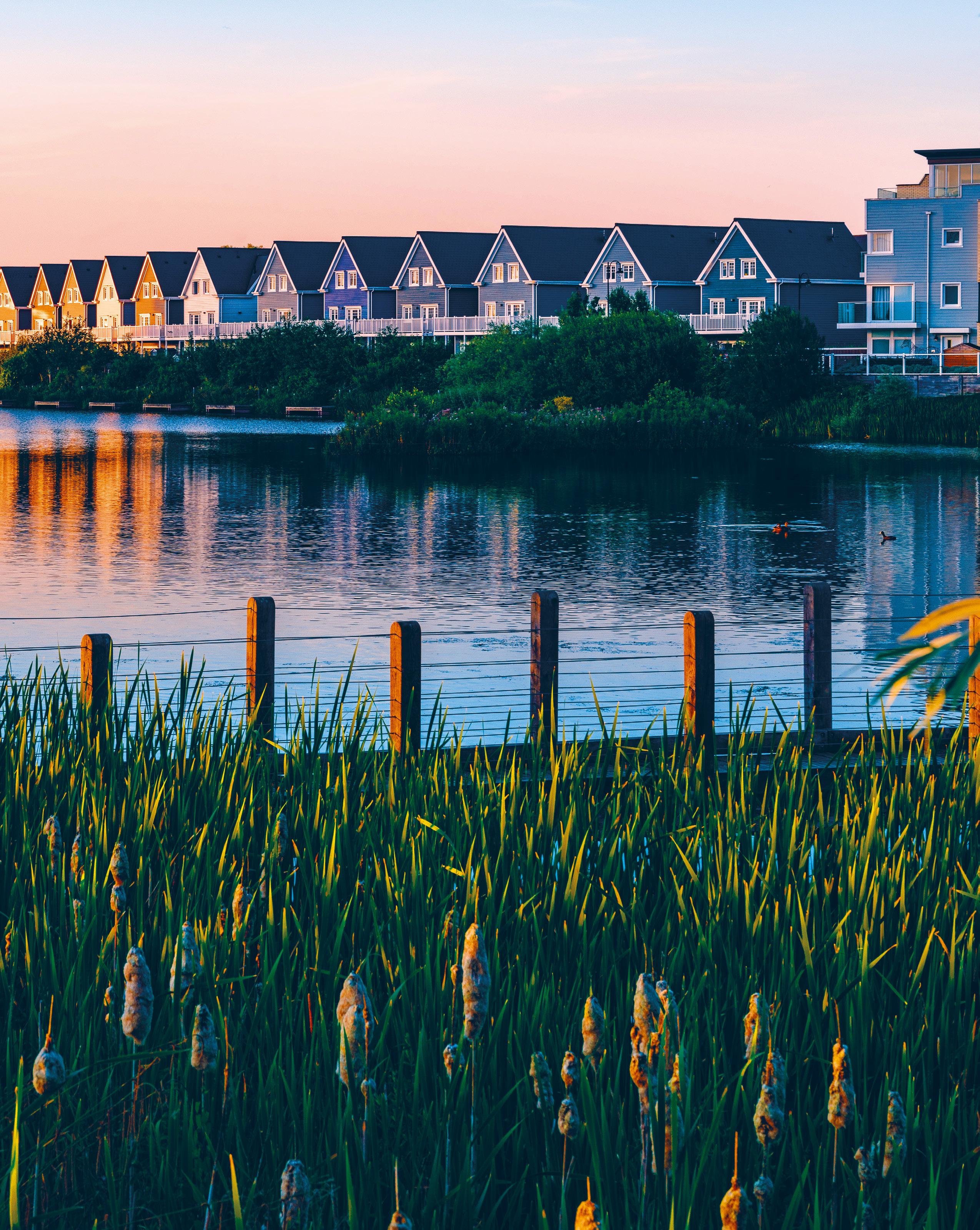
A landscape-led approach: Maximising value for people, place and nature
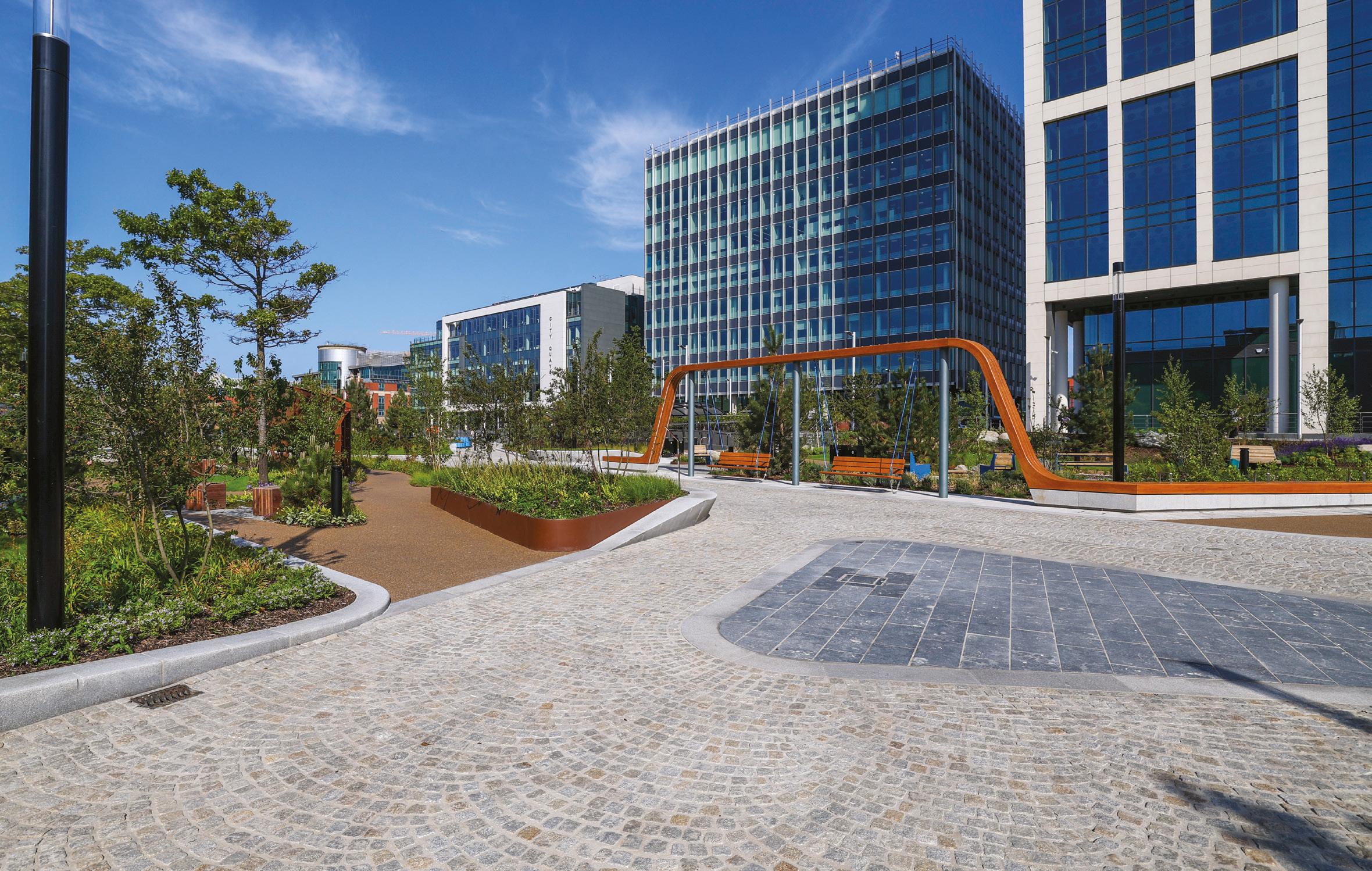
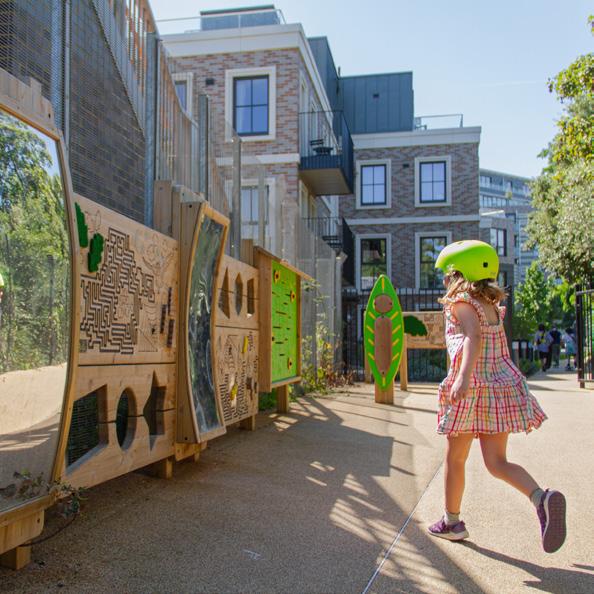
Commercial Stone & Paving for Inspired Public Spaces
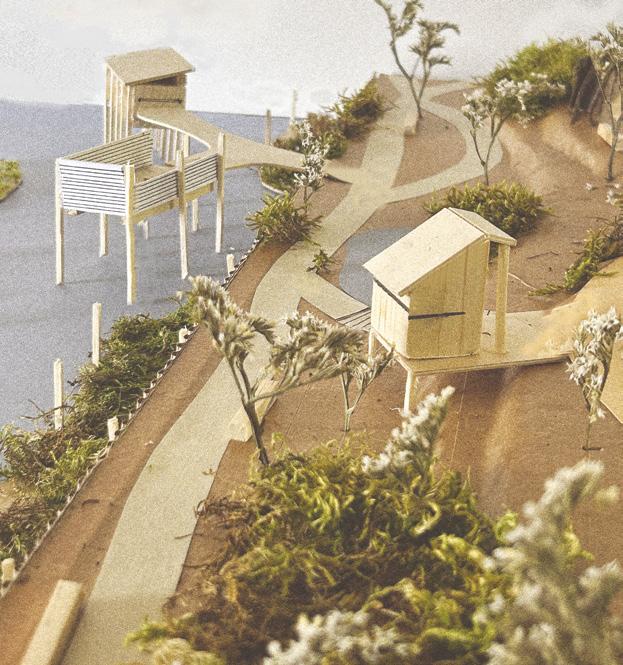
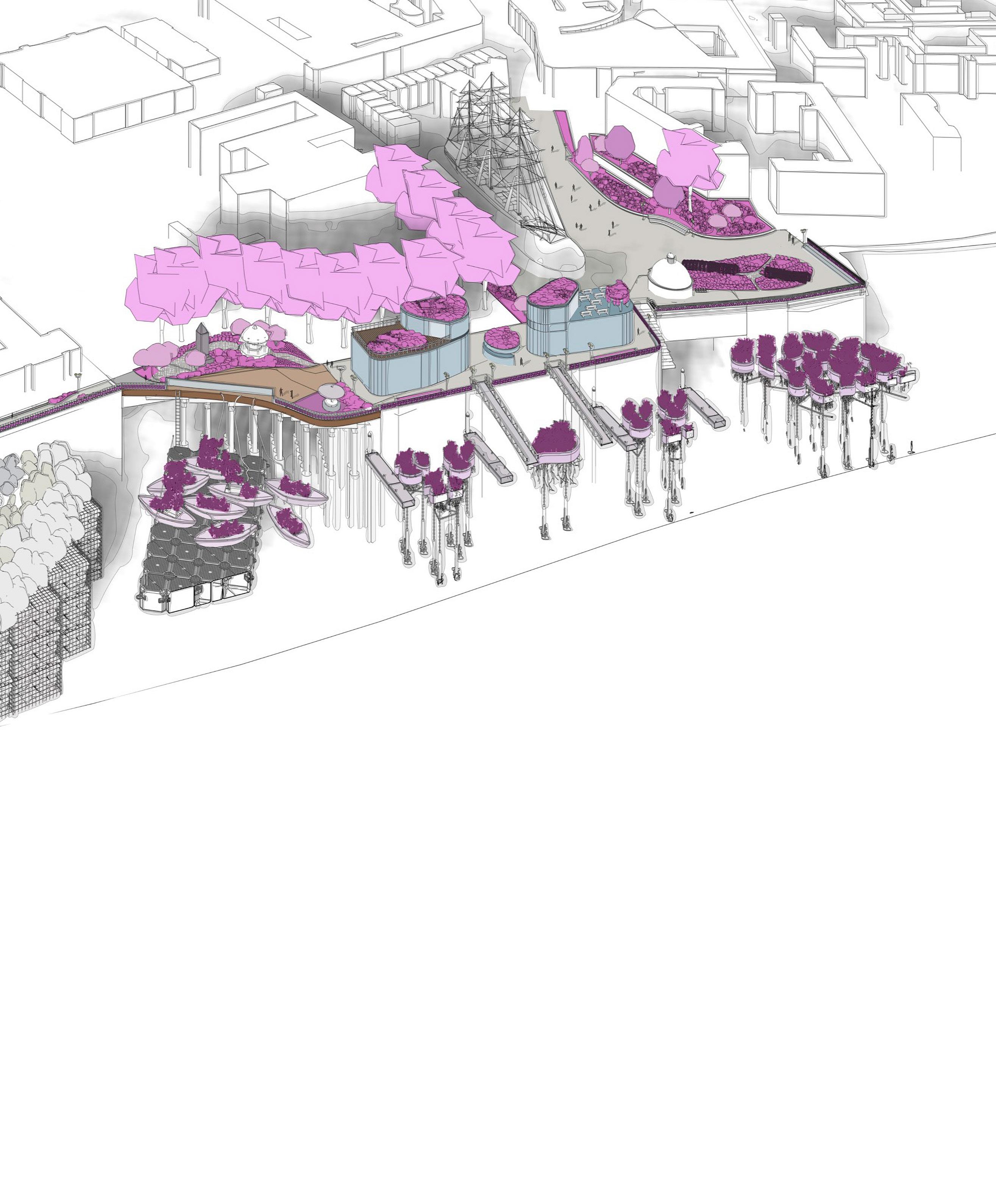
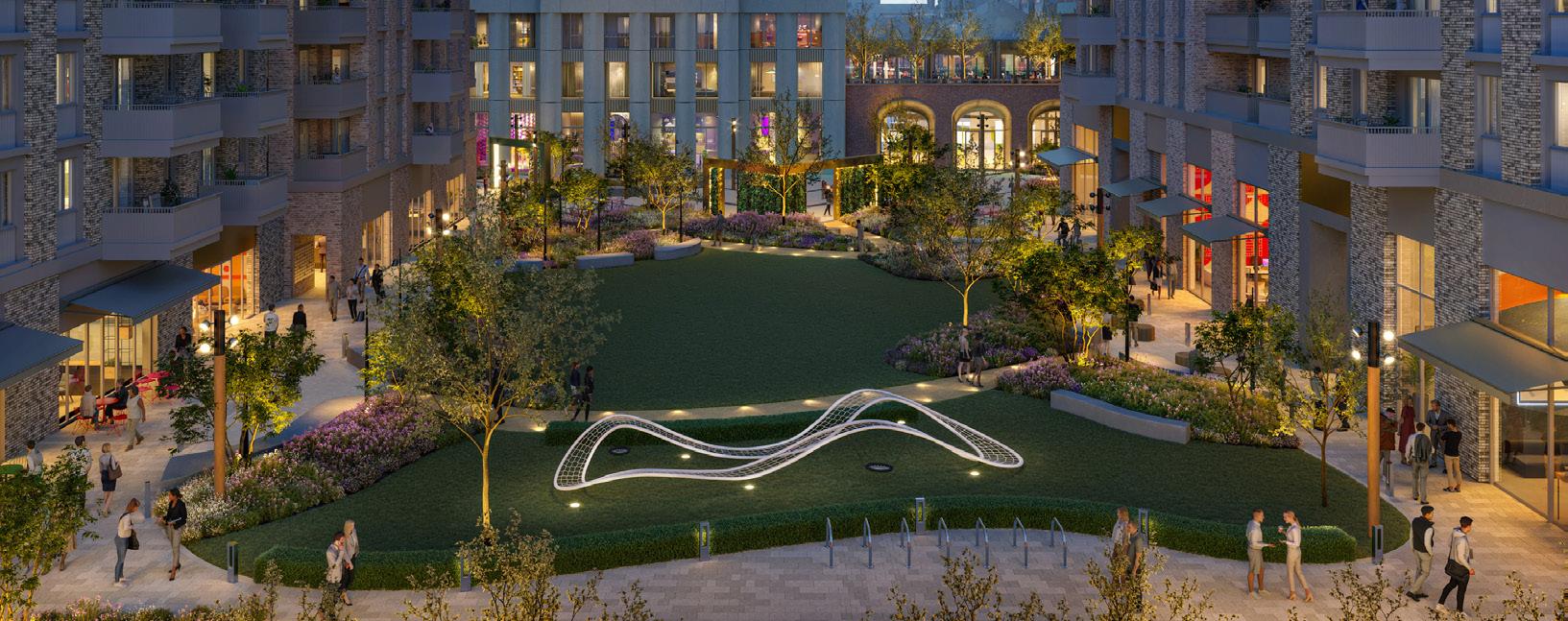
Landscape Architects: Gillespies
Artwork Design: Smiling Wolf
Contractor: Northstone (NI)
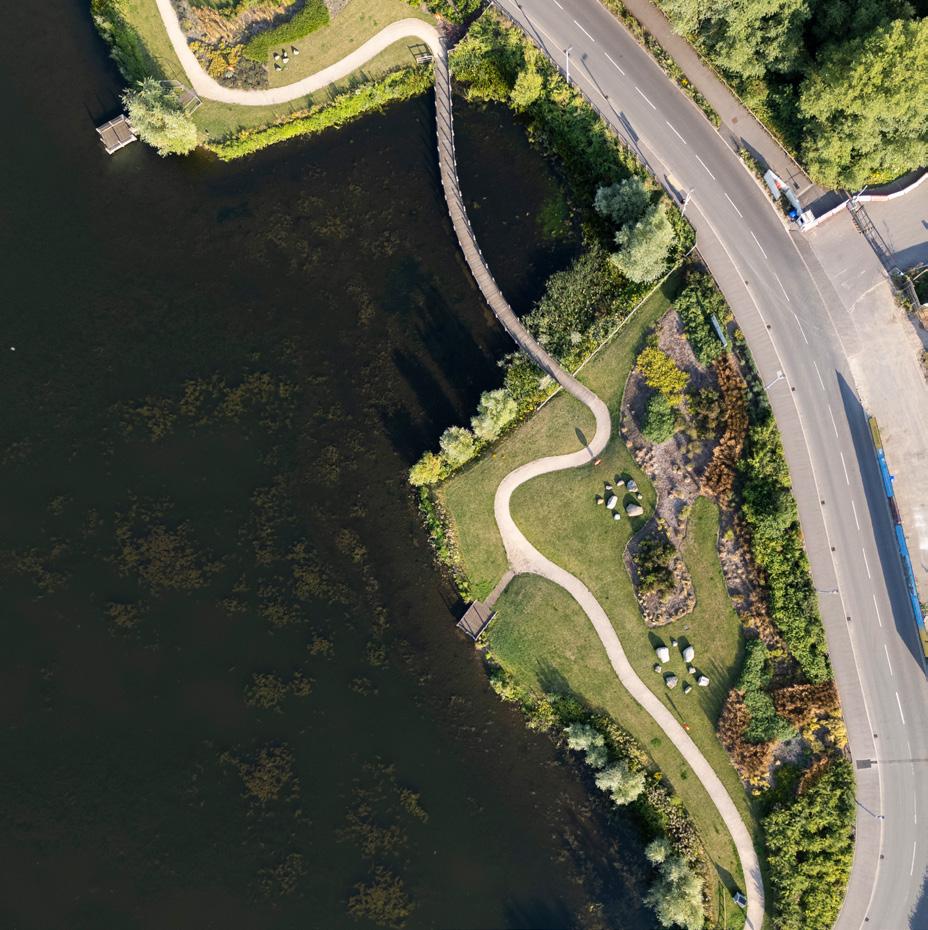
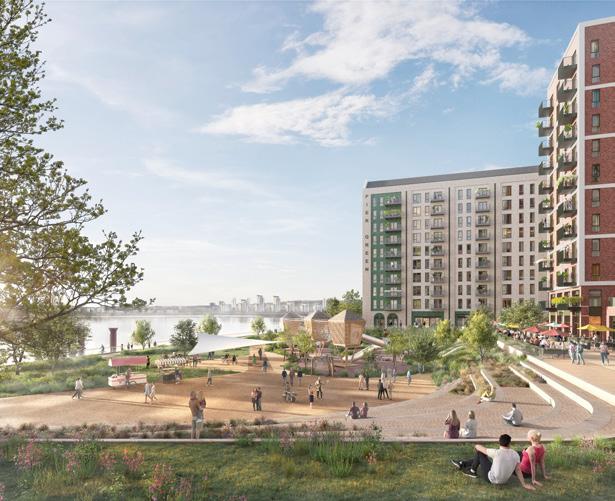
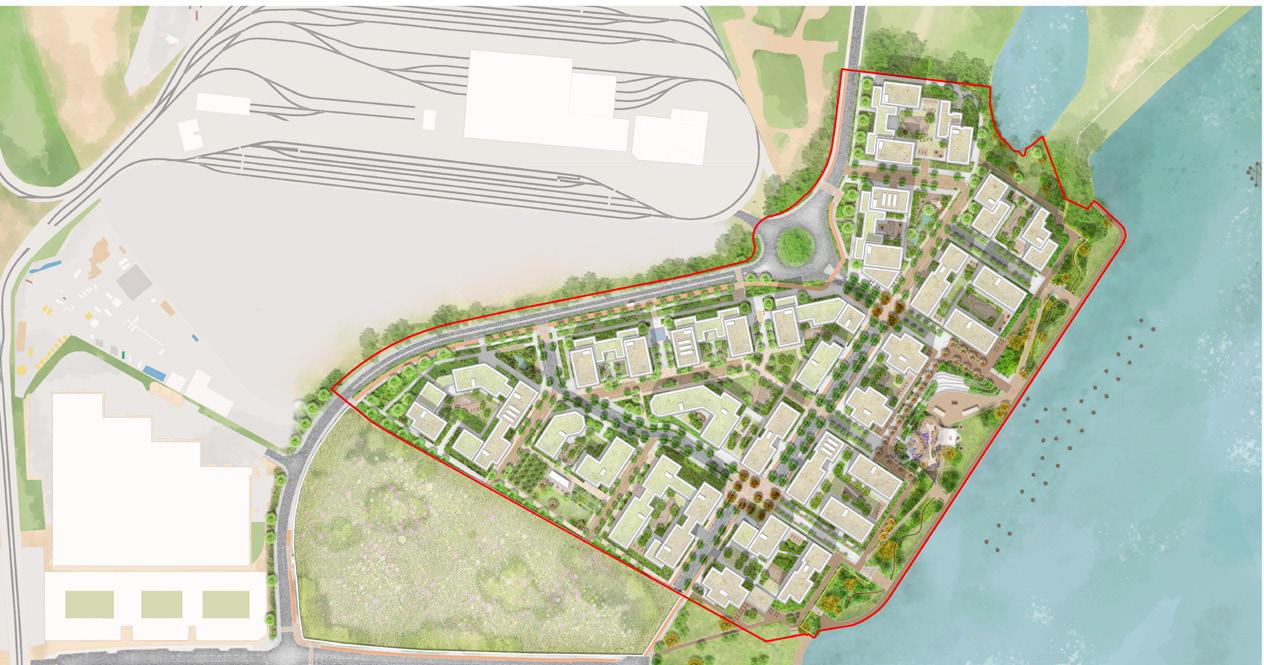
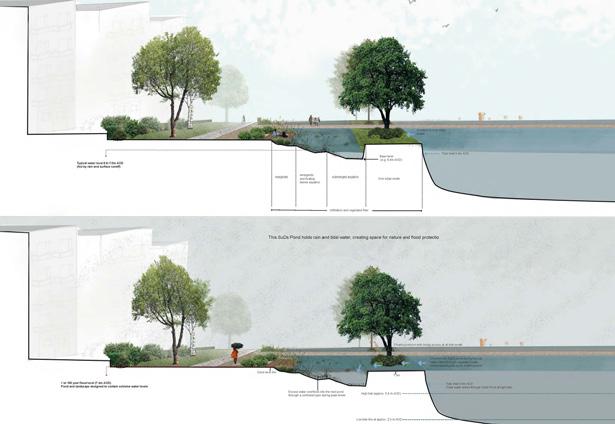
City Quay Gardens, Belfast
Client: Belfast Harbour
Through the art and science of landscape design, planning and management, we deliver wellbeing, sustainability and delight, by enhancing and connecting people, place and nature.
Carolin Göhler, President Rob Hughes, CEO
Find out more on page 12.
A landscapeled vision
This year, the Landscape Institute launched a seminal new briefing paper, Maximising value from built development: How a landscape-led approach delivers more for people, place and nature
As the government seeks to deliver 1.5 million homes over the next five years, putting ‘landscape first’ has never been more critical. The coming years will see the transformation of large areas of UK land and the creation of many new landscapes through new homes and infrastructure.
Where the original briefing set out the key criteria and benefits of landscape-led approaches, this edition of Landscape sets the context, explores the detail, and brings more voices into the conversation.
We explore the key issues driving the need for landscape-led approaches, from housing and health to climate and nature (p12). We take a historical lens to the approach and return to the very foundations of the profession, shining a light on the enduring influence of early pioneers (p24) and invoking its key conventions (p32). We consider the value of landscape in the emerging planning and development system (p38), and celebrate the next generation, who will be implementing the projects of tomorrow (p54).
From residential gardens (p44) to global sustainable development (p28), we show how landscape-led development delivers impact at every scale.
Set against the backdrop of a new corporate strategy (p12), energised leadership (p66, 68), and a new brand (p64), this issue reflects a moment of progress and strength for the Landscape Institute.
We invite colleagues and partners to join us and help deliver our vision of a world of enriching, resilient landscapes where people and nature flourish.
Carolin Göhler Guest Editor President, Landscape Institute
Any proposed built development or change in land use must start with landscape
Landscape-led briefing
They said it
Landscape-led ideas from across the industry
A landscape of opportunity
A vision to support LI members in delivering a landscape-led approach
An introduction to the LI’s essential new briefing paper Pydar Masterplan
The economic benefits of a landscape-led approach
Shoreditch Park
The environmental benefits of a landscapeled approach
The community benefits of a landscape-led approach
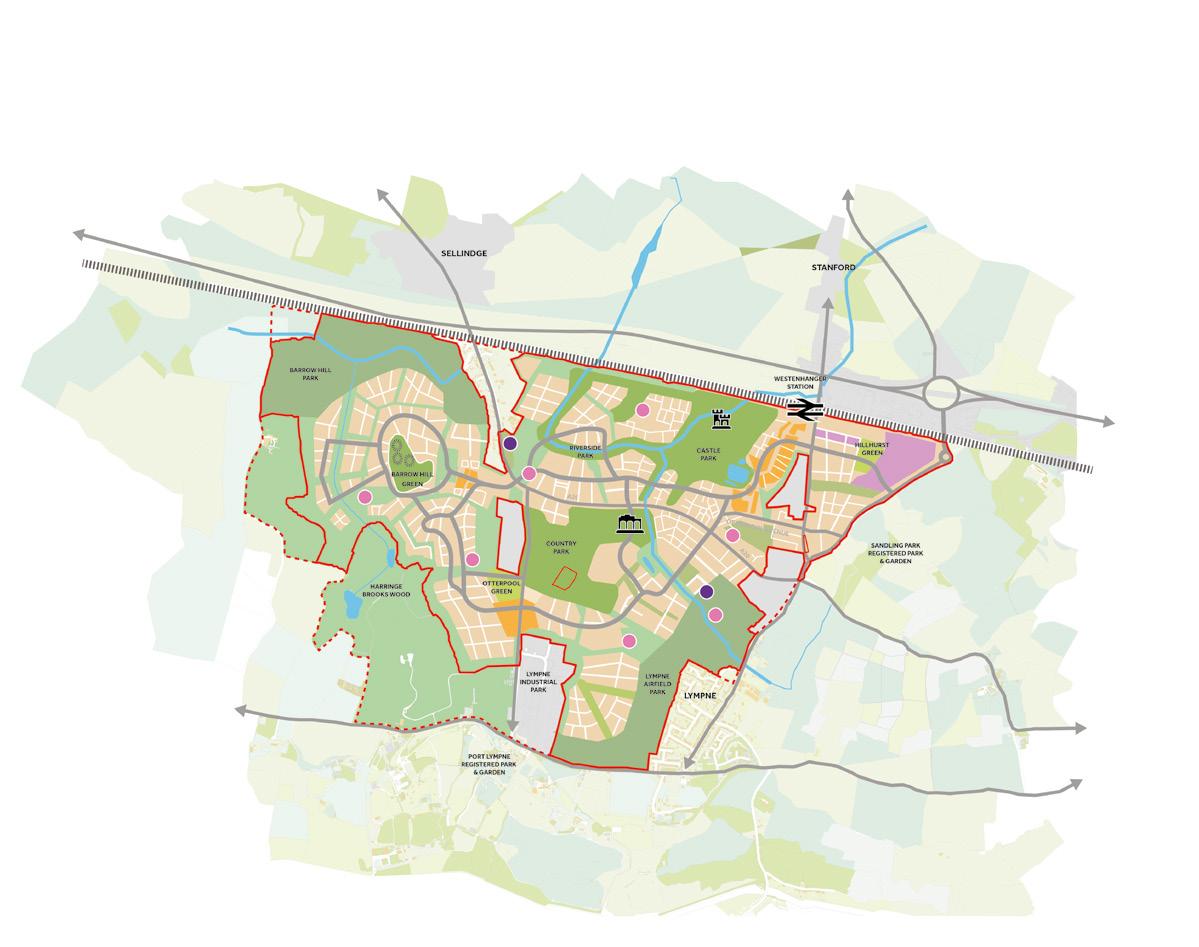
Otterpool Park
The long-term value benefits of a landscapeled approach
Urban GreenUP – The Pollinator Project
The wellbeing and health benefits of a landscapeled approach
Landscape first
1
Carolin Göhler FLI
Landscape is everywhere – but what is landscape? Certainly, there are many individualistic understandings and subjective views taken into account in the development of our flagship briefing, Maximising value from built development: How a landscape-led approach delivers more for people, place and nature. But at the workshops that informed the briefing, all attendees were in agreement that we should argue for quality and holistic design and always think ‘landscape first’.
Promoting an approach centred on landscape in relation to any kind of built development or any other changes to land is especially important at a time when the current UK government wants to build 1.5 million houses within five years. Landscape architects must be involved in strategic land
Any proposed built development or change in land use must start with landscape.
planning and the subsequent detailing of integrated masterplans. They lay the necessary foundations to achieve an efficient, balanced approach of land use solutions, but only if they areinvolved at an early stage, thus enabling the simultaneous removal of potential obstacles.
Thinking landscape first leads to sustainable, more pollution free, climate-resilient (including low-carbon) and biodiverse developments in which people and nature can live well, and where land is appropriately managed and leaves a worthwhile legacy for future generations. As landscape professionals, we are accustomed to co-creating the cultural landscapes of tomorrow, achieving better initial and longer-term community cohesion, creating places for improved health and wellbeing and supporting nature
recovery. This work is particularly important in disadvantaged communities and deprived nature areas. The landscape architect acts as a catalyst for local communities to express themselves, fostering a sense of ownership and shared responsibility, making the maintenance period of any scheme more positive, effective and better integrated.
Landscape architects bring, we bring strategic visioning and imagination, combining functionality with emerging beauty. We don’t see things in isolation but rather understand the varied layers of landscapes, the interrelationship between elements.
Guiding us are innovations such as the European Landscape Convention,1 established 25 years ago (see page 32), backed up by the Landscape Institute’s own Code of Practice,2 which
3 Council of Europe’s Reykjavík Declaration – https://edoc.coe. int/en/the-councilof-europe-inbrief/11619-unitedaround-our-valuesreykjavik-declaration. html
4 Landscape Institute – Maximising value from built development (May 2025) www. landscapeinstitute. org/wp-content/ uploads/2025/05/ Landscape-InstituteLandscape-ledbriefing.pdf
5 UKREiiF – the largest UK Real Investment & Infrastructure Forum with 12,00016,000 attendees joining an annual 3-day conference www.ukreiif.com
first and foremost requires any LI chartered landscape professional to “deliver landscape services in ways that promote sustainable development and the responsible use of resources”.
That the Council of Europe’s (CoE) Reykjavík Declaration3 shifted the administration of the European Landscape Convention to the CoE’s Human Rights Commission now also strengthens the rights of us humans in relation to landscape. Indeed, it is up to all of us landscape professionals to stand up, be proud of what we achieve, and take on the ambassadorial role of articulating the value we bring to small- and large-scale landscape interventions.
A ‘landscape-led approach to development’4 (see page 14) must meet four key criteria:
▪ Consider the landscape first and engage a landscape architect from the outset
▪ Treat the landscape as a system
▪ Involve landscape expertise throughout
▪ Create a legacy for long-term success
We understand that good landscape interventions can unlock long-term value, as they act as an incentive for further financial investment, partnerships and collaboration. Such interventions are to the advantage of local communities and their natural environments, while at the same time maximising value for the client – whether developer, landowner or community.
However, we need to work at a much faster pace to tackle the many challenges ahead, demonstrating action over talking and demonstrating our value to clients to ensure everyone –particularly the most deprived –have access to good landscapes as well as ensuring nature can thrive and sustain our lives. This is not idealism but common sense.
When we launched the landscape-led briefing at UKREiiF5 (May 2025), a developer on our panel discussion stated that including landscape architects early in any scheme is a no-brainer. For a developer, good landscape, particularly if delivered from the
start of a development, increases early community cohesion, achieves higher housing stock values, and enables the faster sale of housing, ensuring a faster financial return for investors.
In an era of rapid development, it is essential that any client, policymaker or decisionmaker understands that landscape is an asset for current and future generations. It’s time to think and implement ‘landscape first’.
They said it…
Landscape architects, working alongside ecologists and planners, in both public and private sectors are ideally placed to help meet the government’s agenda, bringing vital expertise on the planning, design and management of land as a multi-functional resource.
Marian Spain CEO, Natural England
Landscape-led ideas from across the industry
Collaboration between architects and landscape architects is essential to creating sustainable, healthy places that respond to the challenges of climate change and social inequality. By valuing local knowledge, encouraging meaningful participation, and working together from the earliest stages, we can design environments that support wellbeing, strengthen communities, and protect natural systems.
Muyiwa Oki RIBA President 2023–2025
We have long recognised the role of high-quality landscape design in shaping successful, healthy places, and this has been central to our approach to regenerating large-scale brownfield sites.
Louise Clarke
Group Head of Sustainability, Berkeley Group
There is no greater multifaceted investment than landscape-led green infrastructure to provide positive outcomes for people, place and nature when operating at strategic scale.
James Scott
Group Director of Strategy and Planning, Urban & Civic
Taking a landscape-led approach to development provides an opportunity to better connect communities with the natural environment, whilst being mindful of the need for increased house building in this country. Safe, equitable and enhanced access to green and blue spaces is inherent to our health and wellbeing. By working together collaboratively and using a considered landscape-led approach to planning, both people and planet can benefit.
Dr William Bird
CEO, Intelligent Health
Investment in landscape is a no-brainer in terms of the value it offers. Why wouldn’t you do it?
Roger Madelin CBE
Joint Head of Canada Water –British Land
Leading with landscape is transformative.
Richard Hollinson
Assistant Director of Planning Transportation and Highways, Bradford City Council
A landscape of opportunity
Carolin Göhler FLI Rob Hughes
The coming years will bring sizeable environmental and societal challenges to the UK and the wider world. The impacts of the climate crisis are already being felt as extreme weather conditions adversely affect us, our homes, the economy and the environment.
A shortage of housing means that many people cannot afford to buy a home or easily rent a flat or house. Community cohesion is lacking, loneliness is on the rise and health inequalities are growing. Much of our infrastructure is out of date and – most concerningly of all – natural habitats continue to rapidly decline. Our economy, environment, communities, health and wellbeing are all being adversely affected.
But with challenges come opportunities. By addressing climate change, we can positively shift how we live in ways that will enhance our environment, health and
The Landscape Institute sets out a vision to support members in delivering a landscape-led approach, enhancing and connecting people, place and nature.
communities, and through building the homes and infrastructure we need in the most sustainable way possible, we can help restore nature and increase both our connection with it and benefits we derive from it.
In taking a landscape-led
approach to these challenges (see page XX), chartered landscape professionals make rich connections between issues and collaborate with other disciplines and communities to develop ways of addressing them in efficient, effective ways.
What is landscape?
Landscape is everywhere – from gardens, parklands and countryside to urban and developed areas, rural lands and high streets. It can be defined as an area whose character results from the interaction of natural and human factors1 and as an integrating framework that brings together natural, human and perceptual attributes.2 It is the infrastructure on which everything depends. Our landscapes have been shaped by people and nature working together, and the deep connection we feel to them is a part of who we all are culturally. Landscape is the setting in which social, environmental and economic pressures may be managed and tensions reconciled.
1 Definition of Landscape under European Landscape Convention, 2009. A Council of Europe Convention signed by the UK. Separate from EU therefore unaffected by Brexit and the UK remains a signatory to the Convention.
2 European Landscape Convention Part 2: Integrating the intent of the ELC into plans, policies and strategies. Natural England Guidance written by Land Use Consultants, 2009.
The role of landscape
The Landscape Institute is the proud professional home for all landscape professionals, including landscape planners, landscape archaeologists, landscape historians, landscape architects, garden and landscape designers, landscape scientists, landscape engineers, landscape ecologists, garden and landscape plant specialists, garden and landscape managers and urban designers.
Our members design, plan, deliver, develop and advise on maintaining thriving places for the enjoyment and benefit of people and nature. They work in complex situations, bringing together different elements and expertise to deliver successful plans and designs that integrate physical, natural and human systems.
Our Royal Charter gives the Landscape Institute a unique role in setting, upholding and delivering the standards and quality of the landscape professions. Chartered Membership of the Landscape Institute (CMLI and FLI) is a globally recognised mark of excellence, awarded only to those who meet the highest standards in landscape education and practice.
Upholding high professional standards is key to delivering quality outcomes, building public confidence, both for landscape
architects and other landscape professionals. The Landscape Institute sets standards through entry routes into the profession, a commitment to Continued Professional Development (CPD) and lifelong learning and guidance for members. Our competency framework underpins professional standards and educational programmes.
Corporate Strategy 2025–30
As the Landscape Institute approaches its centenary in 2029, we are changing to ensure we are fit for the future and addressing the challenges and opportunities that our society faces.
Our new Corporate Strategy 2025–30, launched earlier this year, sets out how we will build on our long history of creating positive change for people, place and nature, to evolve and deliver over the years ahead.
The Strategy, developed through member consultation, diverse workshops, sessions with the LI’s Council and with approval by the LI Board, sets a new vision: of a world with enriching, resilient landscapes where people and nature flourish. It also sets a clear purpose for the LI and our members in creating that vision: Through the art and science of landscape design, planning and management, we deliver wellbeing,
sustainability and delight, by enhancing and connecting people, place and nature.
To enable our members to fulfil that purpose, the Strategy sets 3 Strategic Outcomes to achieve by 2030:
▪ Landscape-led approaches are recognised as essential to deliver sustainable solutions to societal and nature needs.
▪ Landscape professionals of today and tomorrow work to the highest professional standards, with the expert skills and knowledge needed to design, plan and manage landscapes that enhance quality of life.
▪ The Landscape Institute defines and nurtures an inclusive, trusted community of professionals that lead positive change now and for the future.
▪ Equality, diversity and inclusion and climate and biodiversity are cross-cutting issues that will be addressed in all LI work.
With a strong vision, purpose and outcomes, our members, volunteers and staff will be able to work together to support the success of the landscape profession, enhance landscapes and through that support our environment, health and economy. Collaboration is at the heart of everything we do, and we are looking forward to working with our partners and decision-makers to deliver this crucial strategy.
Together, we must endeavour to make a difference, for people, place and nature.
Carolin Göhler FLI is President of the Landscape Institute Rob Hughes is CEO of the
LI briefing paper:
How a landscape-led approach is essential for people, place and nature
An introduction to the LI’s essential new briefing paper on landscape-led development, setting out where it came from, benefits of the approach, case studies, and next steps.
The Landscape Institute (LI) launched its briefing on landscapeled development at the UK Real Estate Investment and Infrastructure Forum (UKREiiF) in Leeds on 21 May 2025. The publication, Maximising value from built development: How a landscapeled approach is essential for people, place and nature, sets out the case for placing landscape at the heart of planning and development.
Context
Developed in response to the UK’s interconnected challenges of climate change, biodiversity loss, housing need and public health, the briefing demonstrates –through policy analysis, case studies and evidence – the value of a landscape-led approach in delivering better outcomes for people, place and nature.
The value of nature-based solutions, green infrastructure and placemaking is gaining increasing recognition. Against this backdrop, the LI identified a clear need to advocate more strongly for the role of landscape professionals in shaping sustainable growth. The briefing therefore is both a call to action and a practical framework for action.
Developing the briefing
To ensure the briefing reflected the realities and priorities of practice, the LI engaged extensively with its members and professionals across the built environment through a series of focus groups and consultations. These sessions brought together landscape architects, planners, and developers to explore how a landscape-led approach could be more effectively embedded in policy and delivery. Insights from these discussions shaped the briefing’s structure, themes and recommendations, ensuring it speaks directly to the challenges and opportunities faced by those designing, planning and managing the landscapes of the future.
Landscape-led briefing: Key takeaways
What does a landscape-led approach deliver?
▪ Economic growth and placemaking
▪ Long-term value
▪ Environmental benefits
▪ Wellbeing and health
▪ Community cohesion and crime reduction
What criteria must a landscape-led development meet?
Landscape first: Consideration of the development starts with engaging the skills of a landscape architect early in the process.
Landscape as a system: Multiple, interconnected factors are considered together to deliver maximum benefits.
Landscape expertise throughout: A landscape professional is involved at every stage of the development process.
Landscape legacy: The development is future-proofed, minimising the need for regeneration funding. Who can deliver this?
Landscape professionals, including landscape architects, can design, plan, deliver, develop and advise on maintaining thriving places for the enjoyment and benefit of people and nature.
Discover more
To see the landscape-led briefing in full, scan the QR code.
Next steps
Building on the launch of the landscape-led briefing, the Landscape Institute (LI) is now taking forward a programme of targeted activity to embed and promote the principles set out within the publication. These actions are designed to raise public and political awareness, strengthen cross-sector collaboration, and demonstrate the tangible value of landscape-led approaches in practice.
Public polling
The LI will commission a short public poll to gauge perceptions of landscape in new developments. The results will be used to inform media engagement and to help shape public debate around the importance of landscape in creating successful places. Findings will also support engagement with decision-makers, evidencing the public’s growing appetite for higher-quality, naturepositive development.
Convening partners
The Institute will bring together organisations aligned with the landscape- and quality-led agenda to agree how we can jointly promote this approach. Outputs may include collective engagement with the government to advocate for quality, not just quantity, in the building process.
Site visits programme
To illustrate the practical impact of landscape-led development, the LI will invite government ministers, senior officials, and regional mayors to visit sites. These visits will showcase exemplary projects where landscape has driven design quality, environmental resilience and community benefit – providing a powerful platform for direct engagement with decision-makers and reinforcing the case for a national landscape-led agenda.
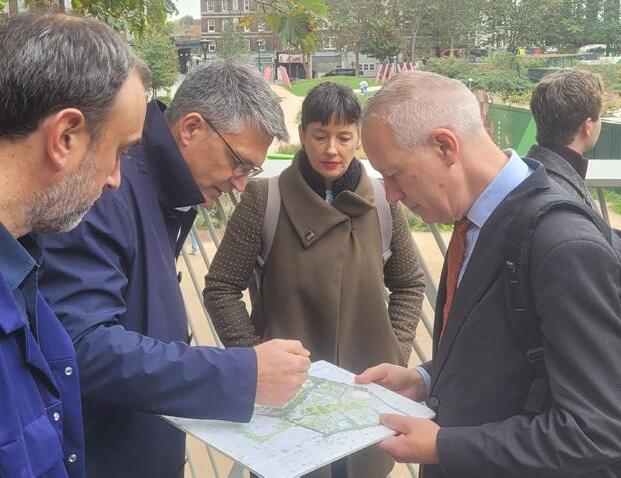
MP Gideon Amos visits landscape-led developments
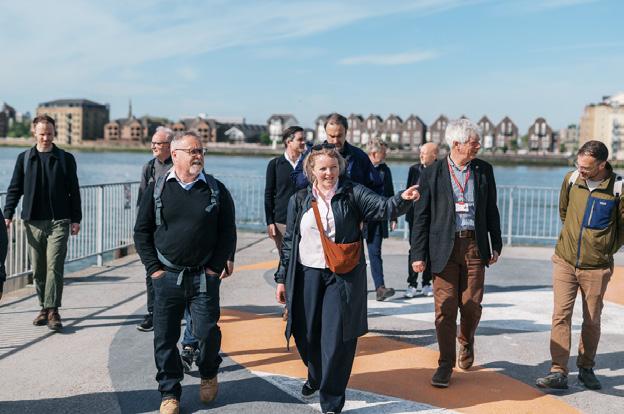
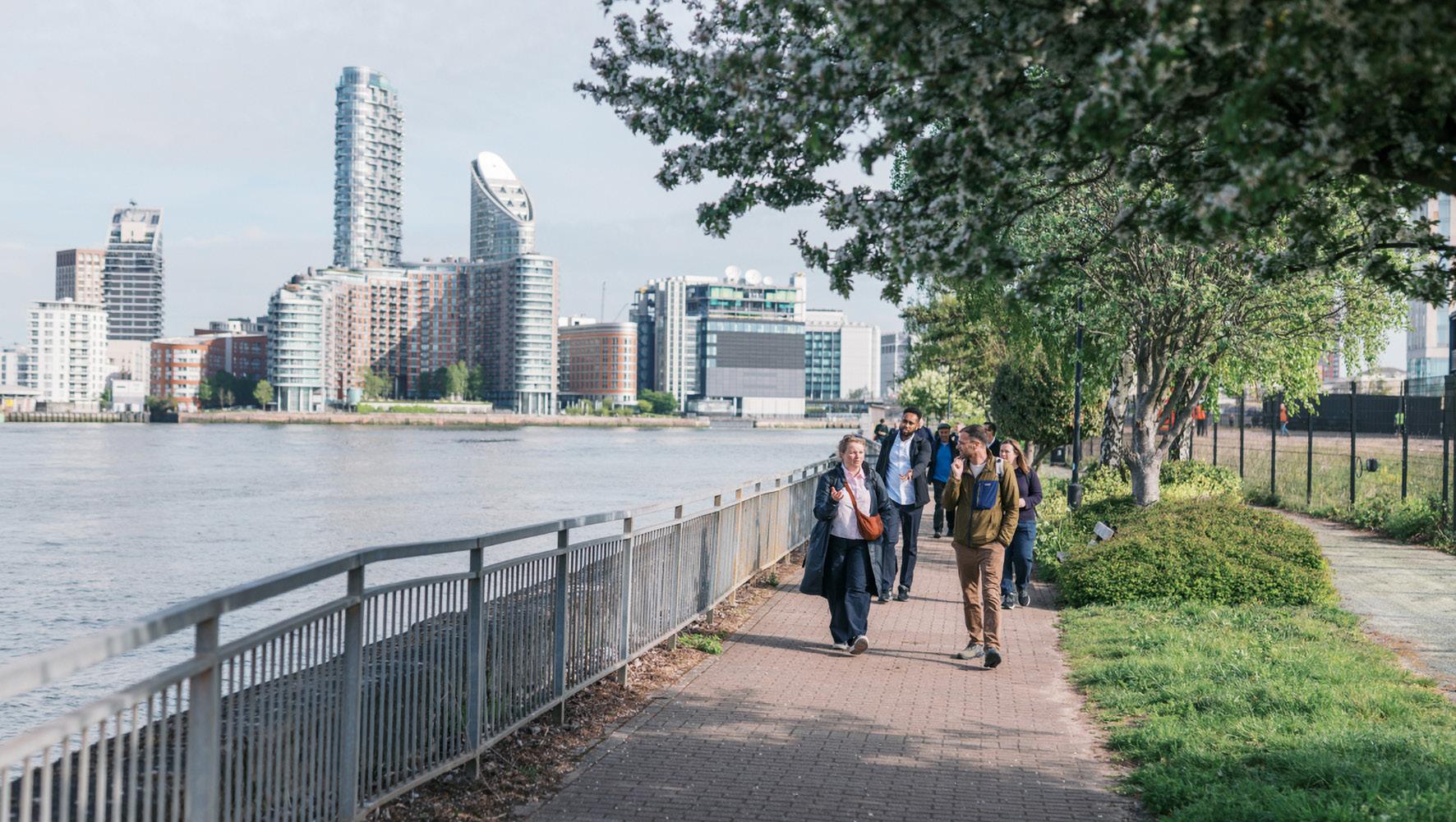
The LI recently welcomed Gideon Amos OBE MP on a member-led tour of Elephant Park and Abbey Orchard Gardens. Armel Mourge, Partner at Gillespies, Ewan Oliver, Director at Placeshaper Development Services and Noel Farrer FLI PPLI, Director of Farrer Huxley, showed Gideon and his team these two sites while explaining the importance of a landscape-led approach to built development. Members discussed specific issues with Gideon such as the importance of early involvement of landscape professionals, the need for support for developers in investing early in green infrastructure, the value of retaining existing natural assets such as trees and the power of well-designed landscapes in shaping positive communities.
“So often nature and development are pitted against each other. What we can see here is how nature is adding value and making places people want to invest in. In the end, we are developing for people.”
– Gideon Amos MP
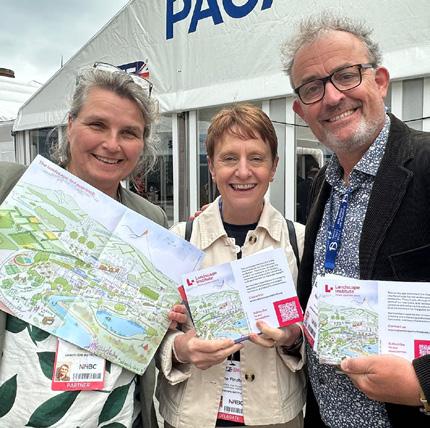
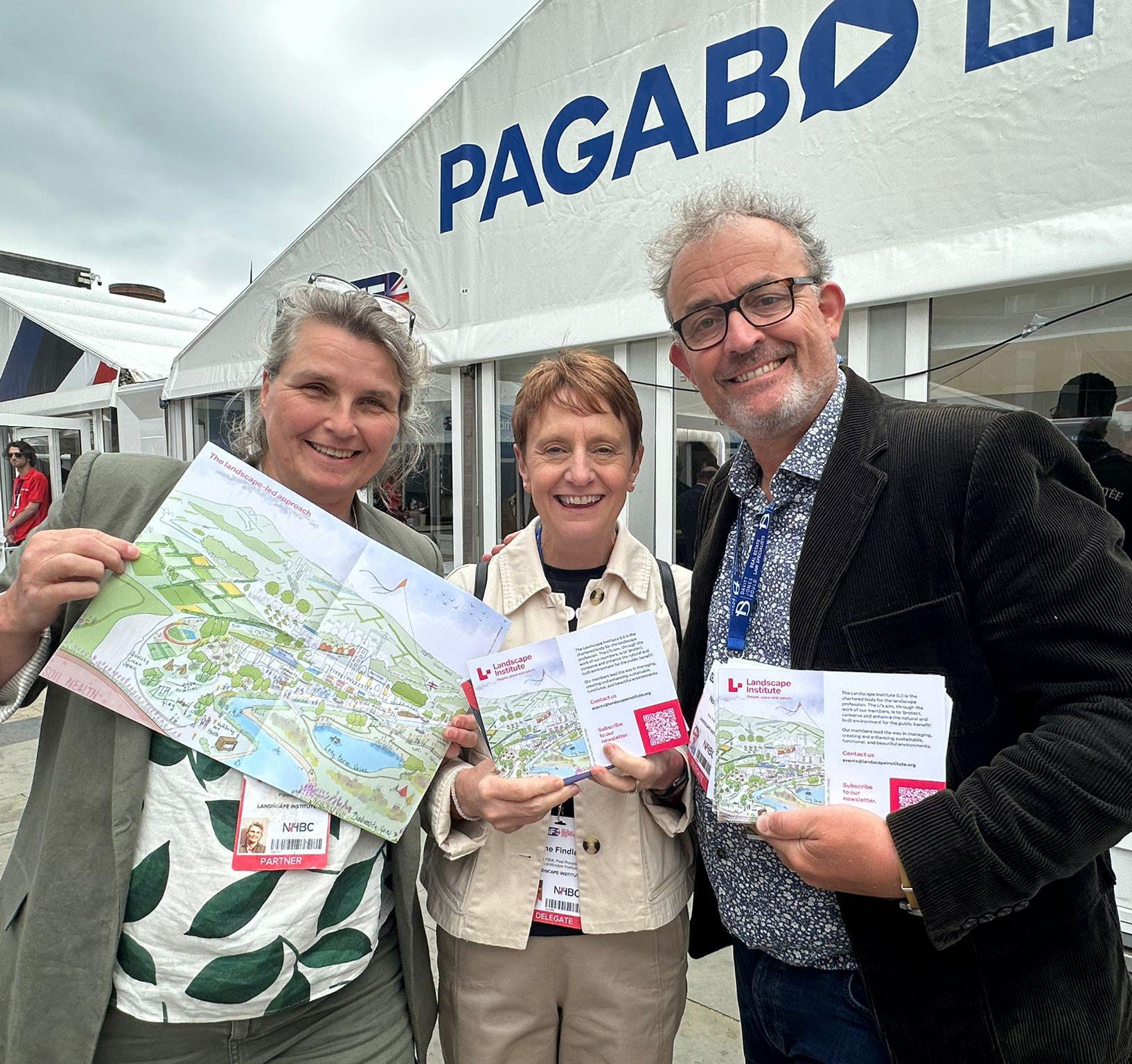
1 Carolin Göhler FLI, Jane Findlay FLI, and Noel Farrer FLI: current and past Presidents of the Landscape Institute at UKREiiF.
Landscape Institute
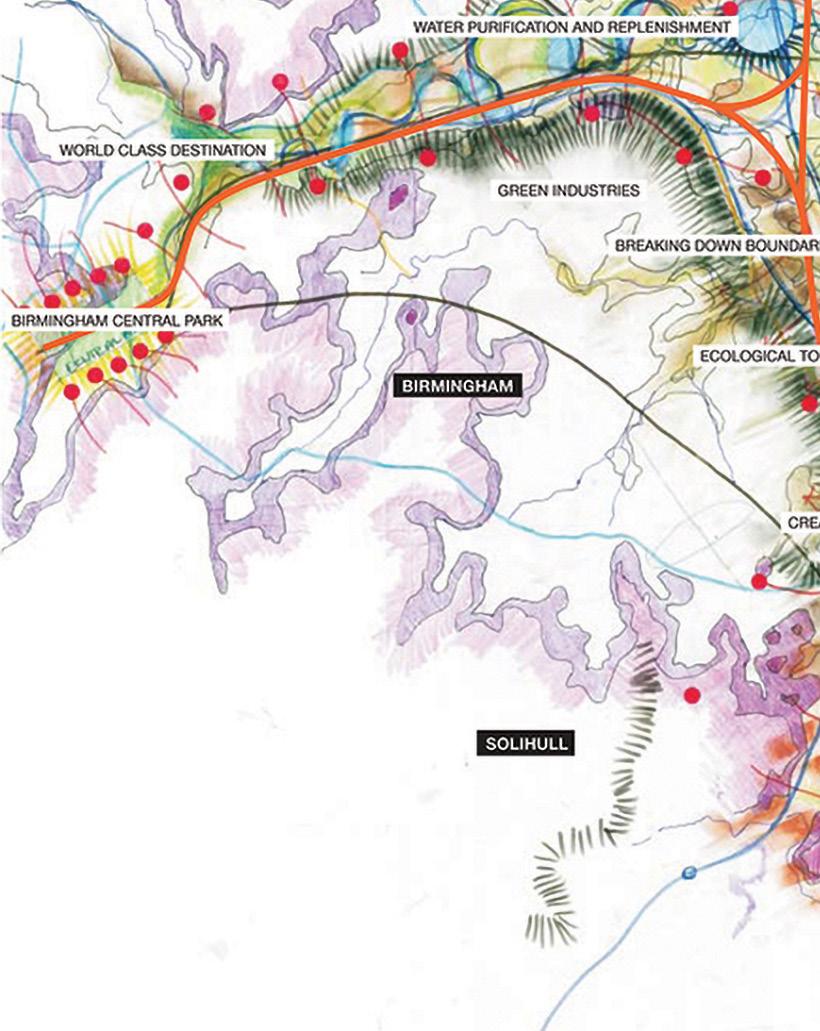
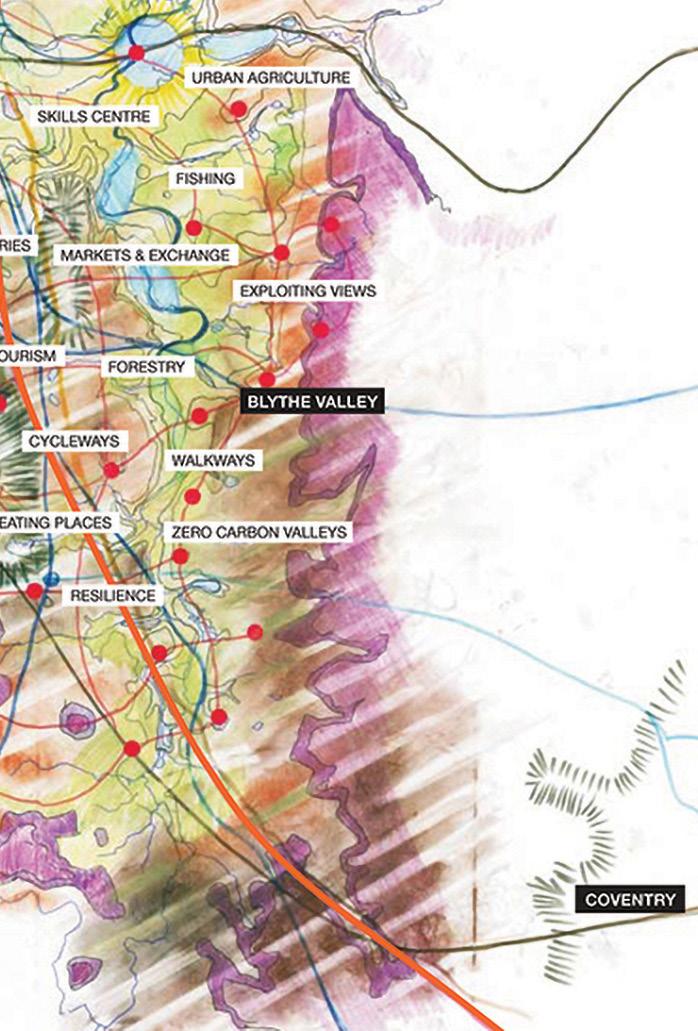
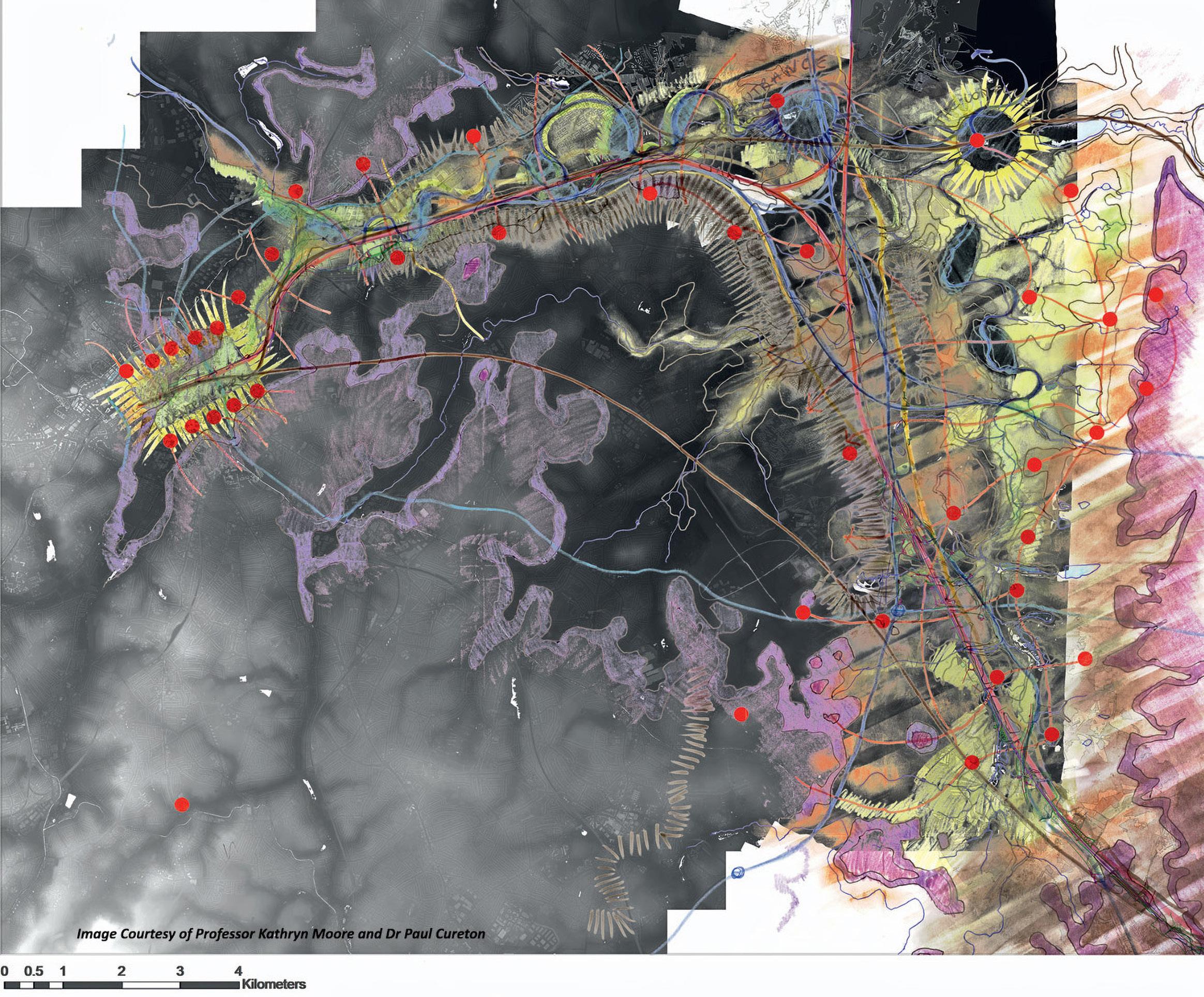
A new perspective
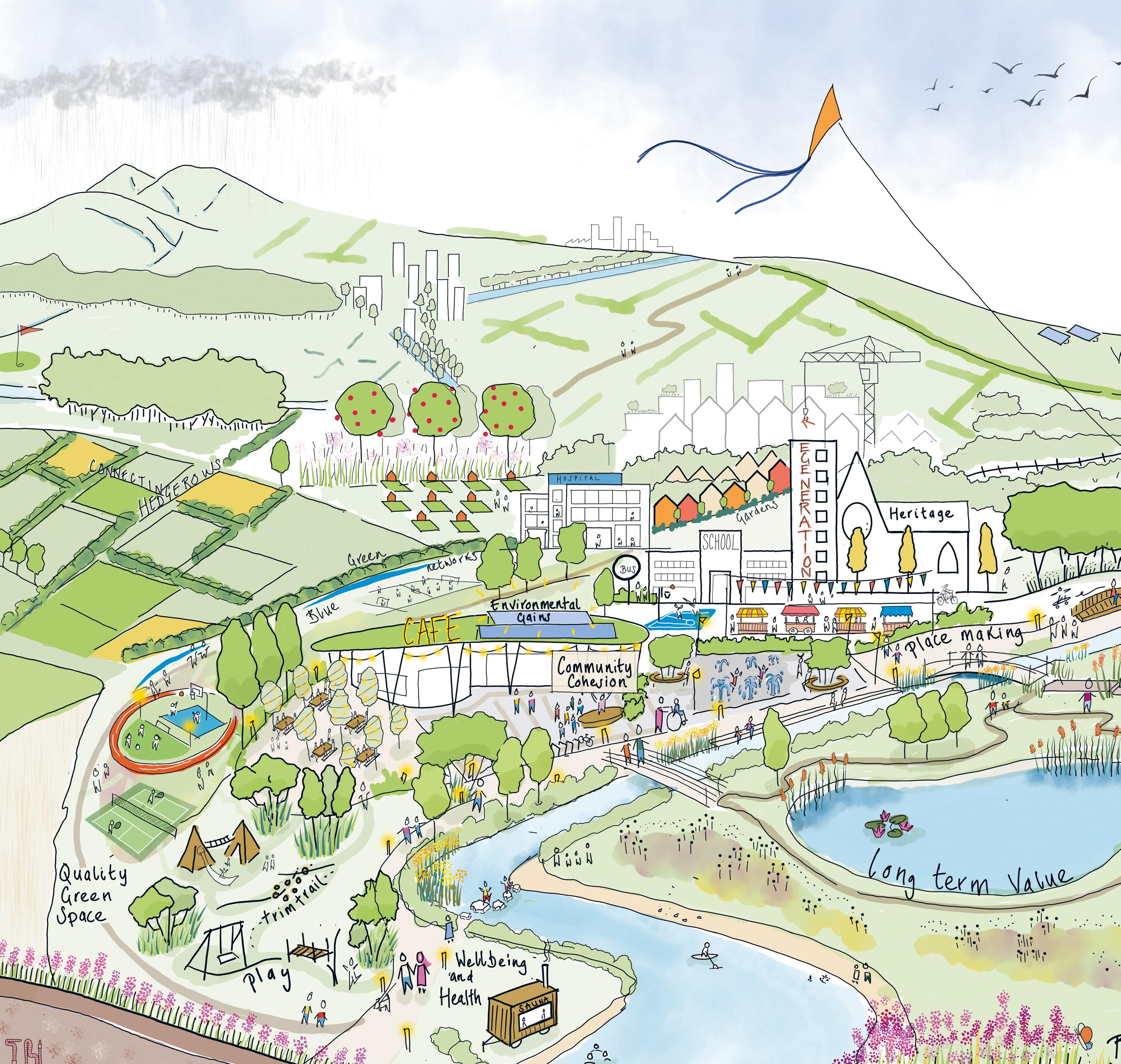
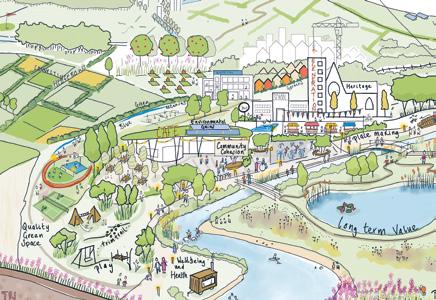
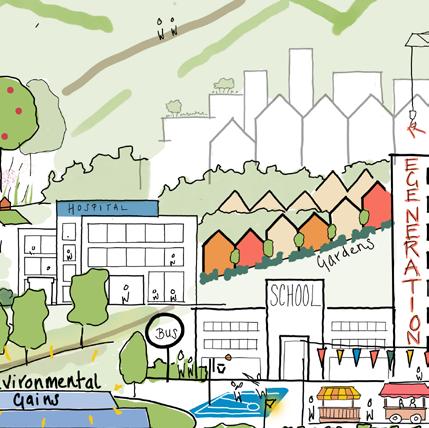
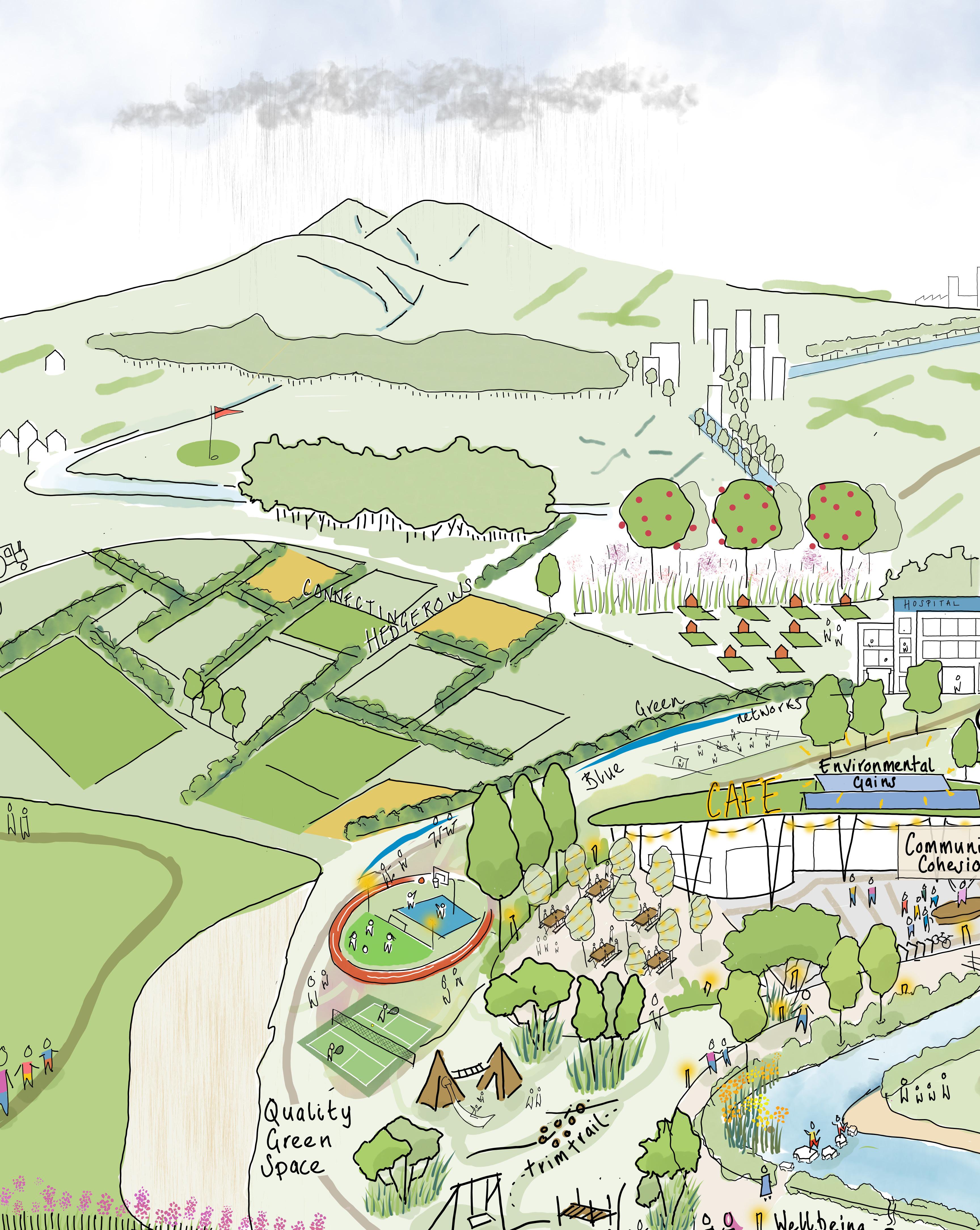
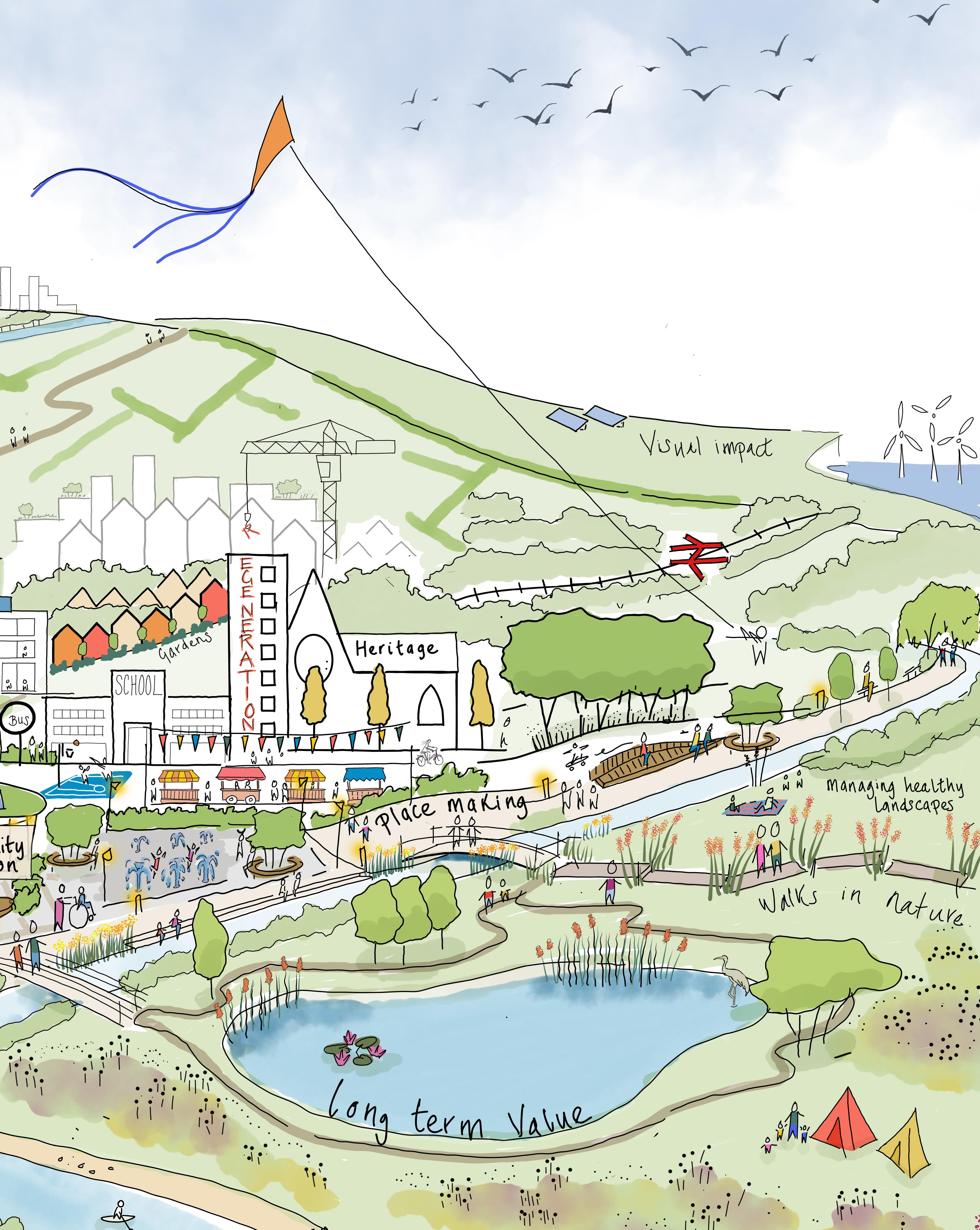
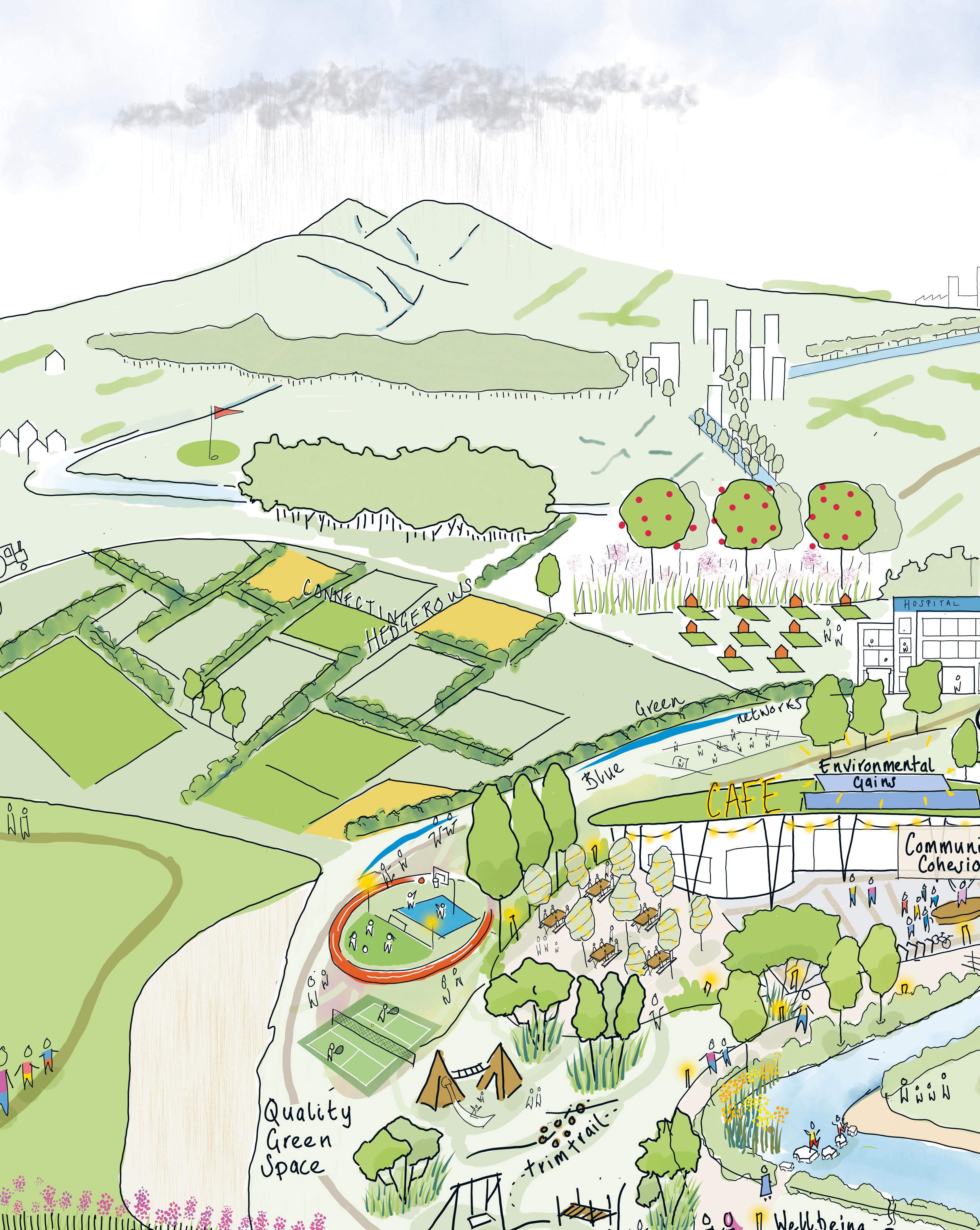
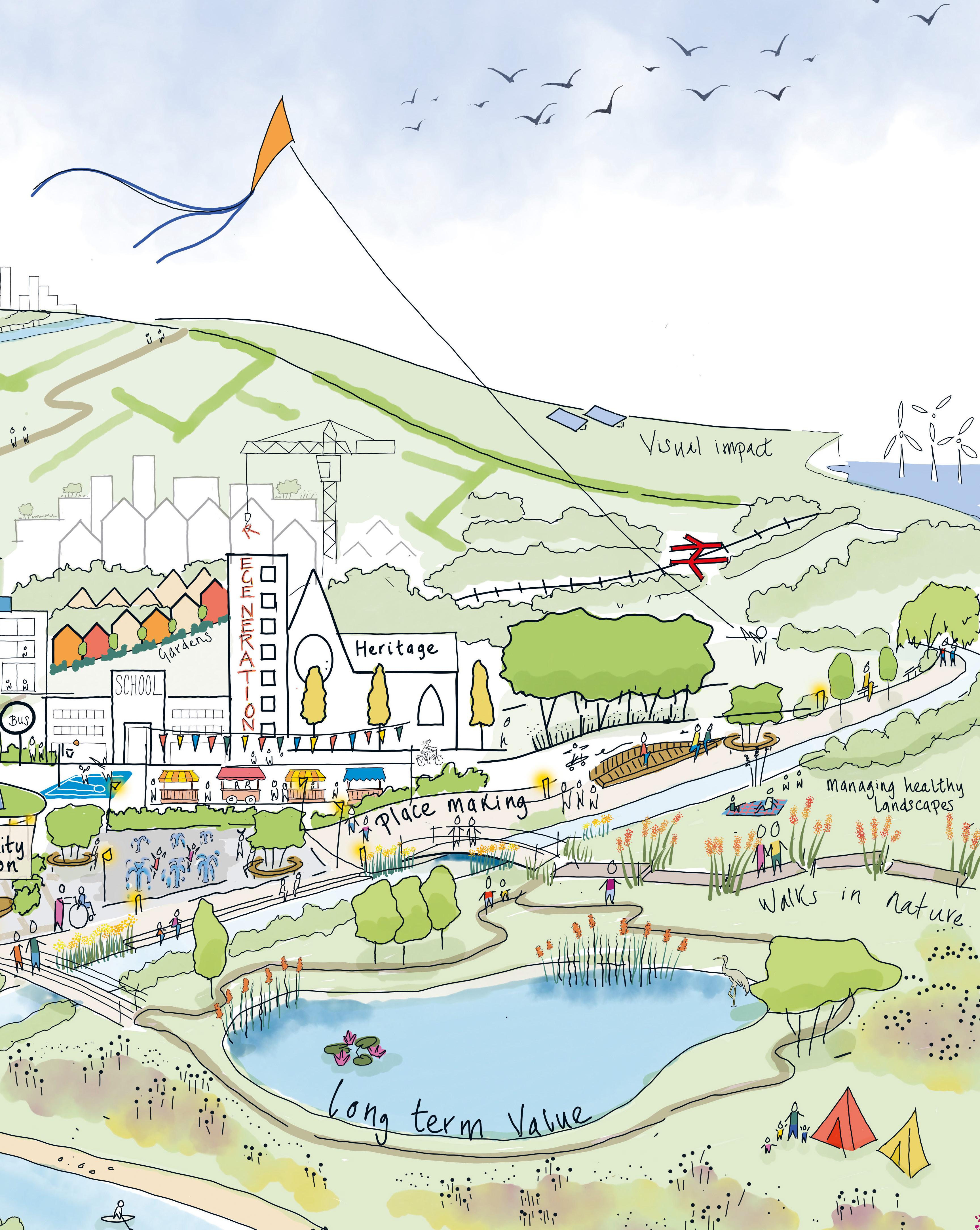
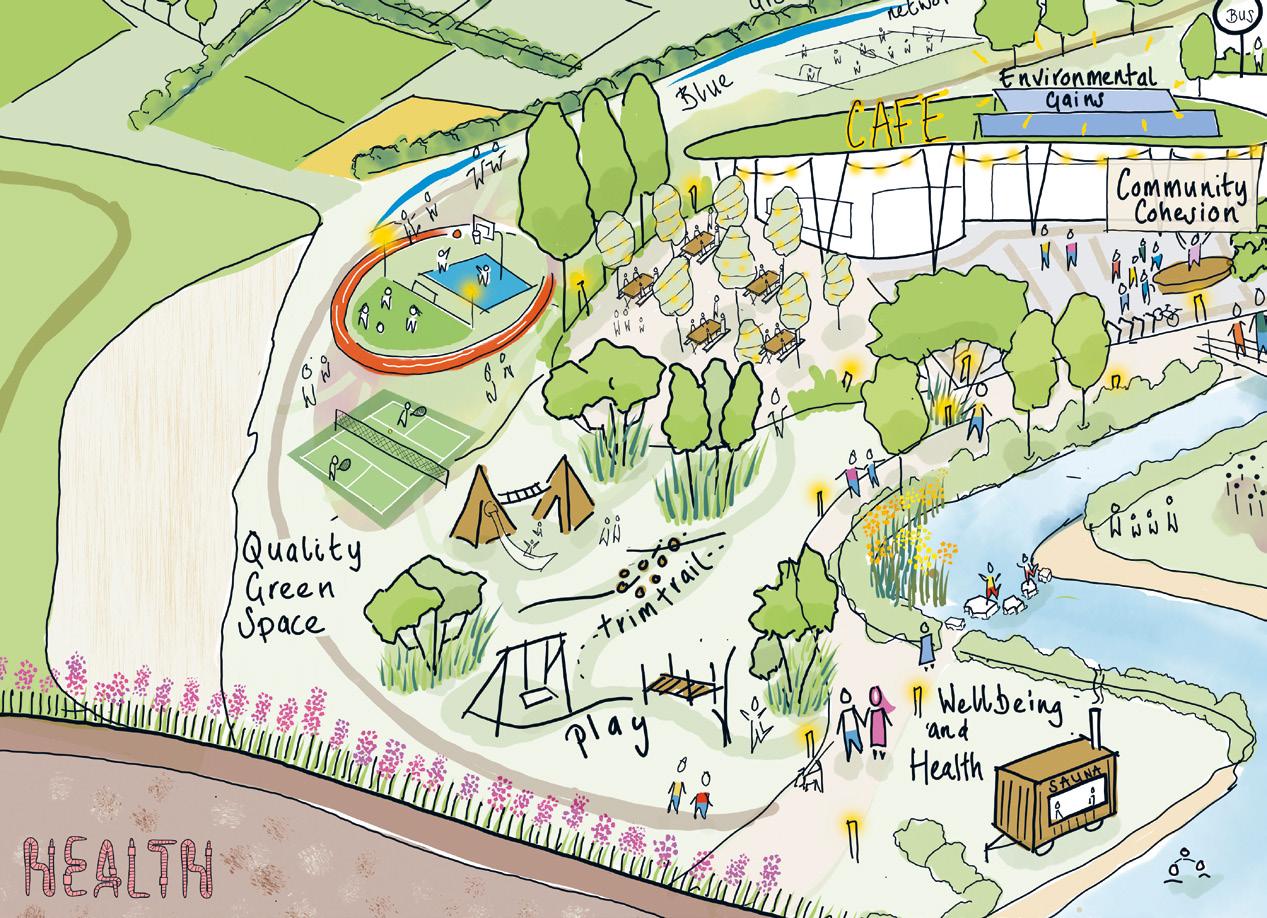
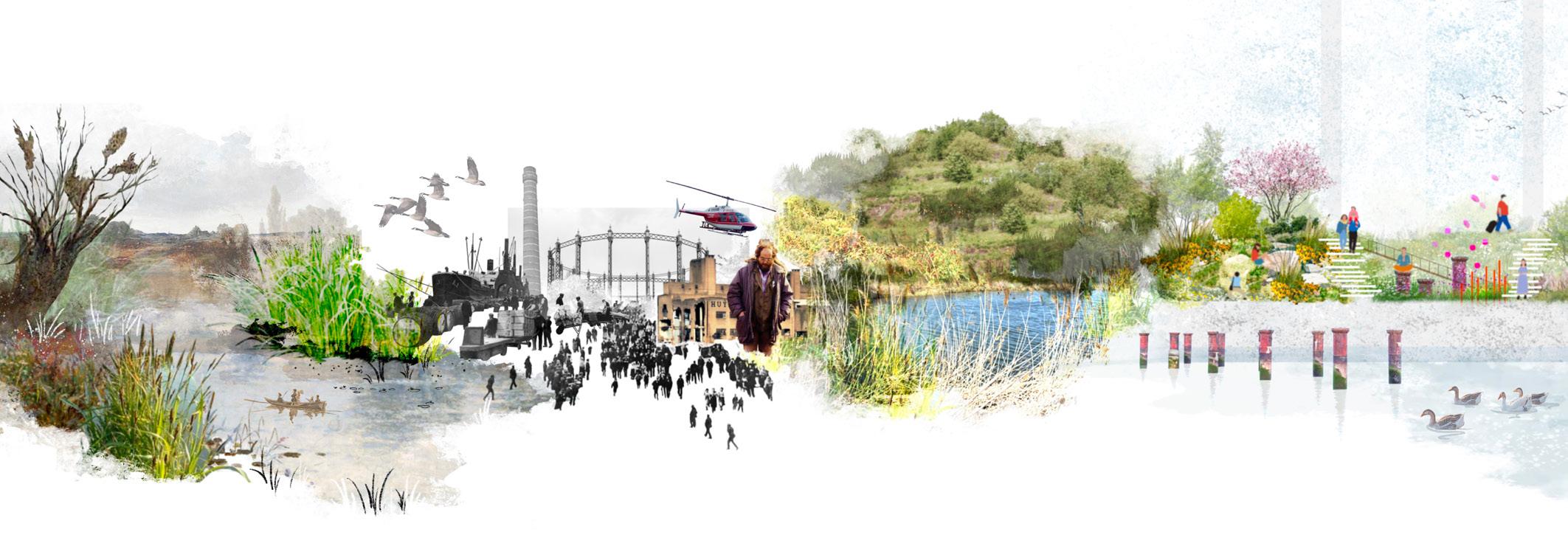
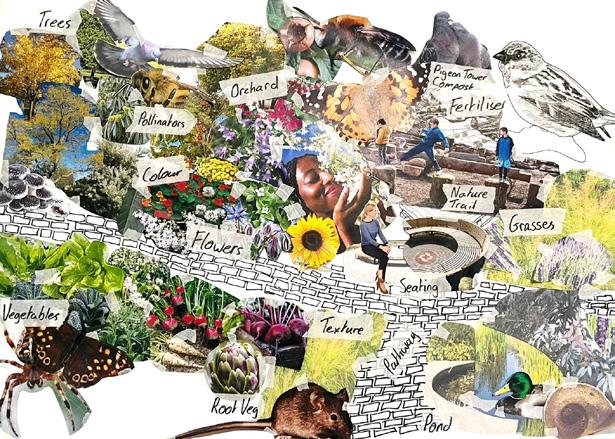
How an LI member captured the essence of our landscape-led briefing to make people see the unseen.
Claire Hunt CMLI
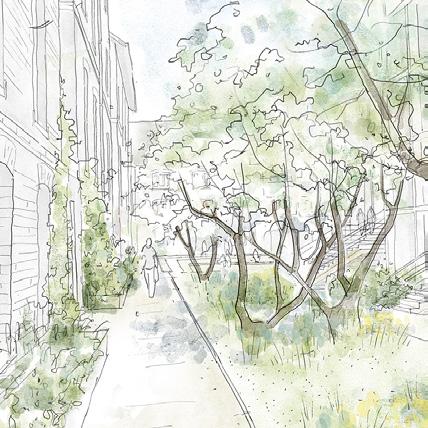
My sketches are a collage, connecting the many strands of landscape architecture. At their heart is connection and, for me, that’s what landscape-led development is all about. This illustration has been a way of showing how even the smallest design choices ripple outward. These choices shape the physical, mental, financial and even spiritual health of our place and communities.
My creative process is born out of observation and a lifelong love of being outdoors. I sketch to capture what I’ve seen, but also to translate
the unseen: the atmosphere, the possibilities, the layers of meaning that words and plans can’t always hold. My professional experience gives me the tools, but it’s my deep connection to the need to improve the world, project by project, that drives me.
What I’ve loved most is how this sketch has supported early engagement, giving people a way to visualise and join the dots. It has sparked conversations and stories of landscapes that have helped in difficult times or reminded people of cherished places. For me, that’s the real value of our work: landscapes that are playful, healing and profoundly human.
The benefits of a landscape-led approach
Bringing experienced landscape professionals in from the very start ensures developments are smarter and more adaptable, and that they deliver maximum benefit.
Over the coming pages, we present a series of five case studies from our members, many of which have been recognised as winners and finalists at the LI Awards, exemplifying each of the key benefits of a landscape-led approach, such as:
Economic growth and placemaking
Well-designed landscapeintegrated projects drive local economic growth, improve and sustain property values and increase levels of community satisfaction.
Long-term value
Well-designed landscapes add significant value to housing. The early consideration of landscape also streamlines development processes, secures planning permission more quickly, minimises maintenance costs and avoids the need for future ‘regeneration’ spending.
Environmental
Investment in designing and creating green landscape areas and natural habitats is essential to create places that are hospitable now and in a changing climate. A landscape-led approach enables effective water management, enhances climate resilience, restores nature while meeting Biodiversity Net Gain requirements, and reduces greenhouse gas emissions and air pollution.
Community cohesion and crime reduction
Well-designed public and open spaces encourage social interaction and use, creating safe places and driving down antisocial behaviour.
Wellbeing and health
There is overwhelming evidence of the links between health, both physical and mental, and the greenness of residential areas. The integration of safe and inviting green spaces into developments attracts and maximises its use, delivering healthier lives, exercise, socialising and play.
1 A public space that has been designed to foster community interaction and delight.
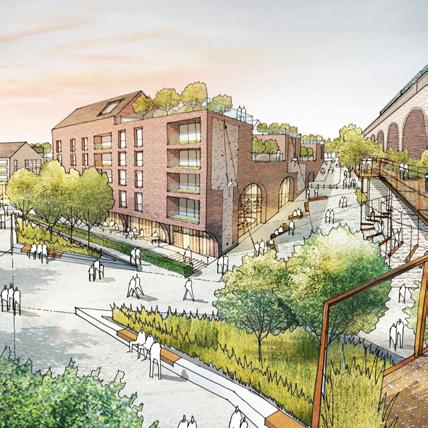
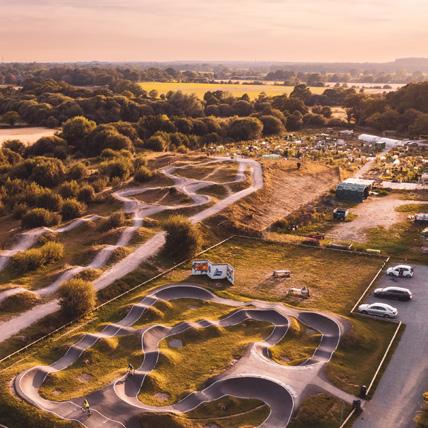
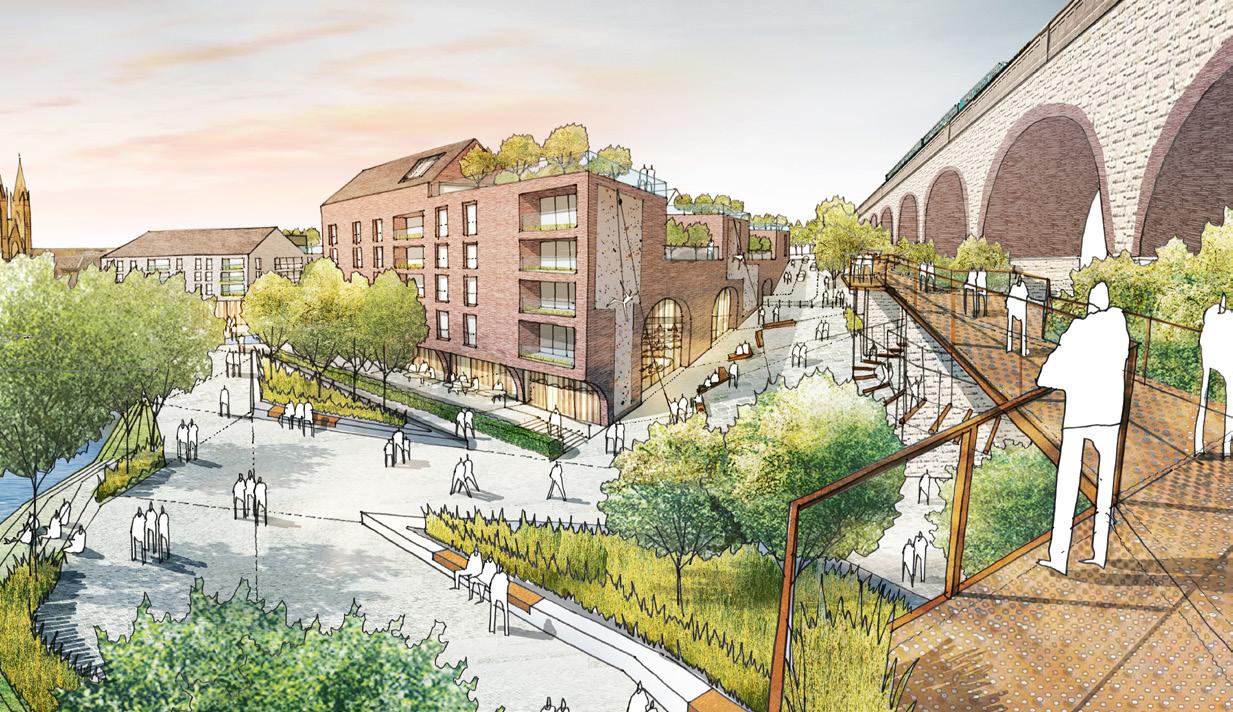
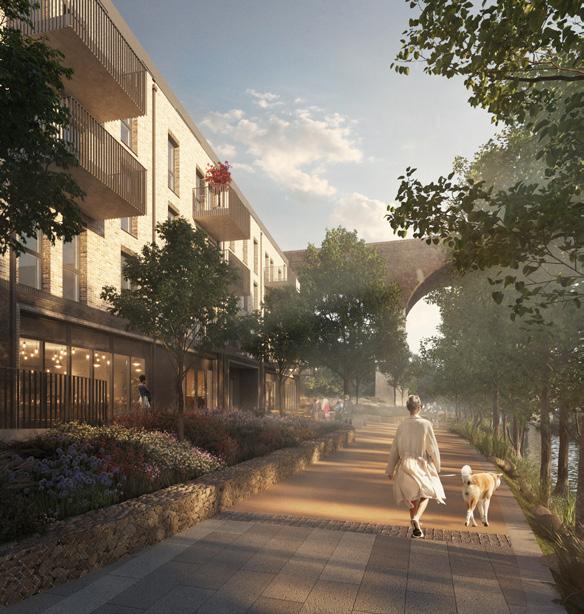
PRP is proud to have led the landscape strategy for the regeneration of Pydar, a £177 million masterplan that reimagines a neglected commercial area in Truro into a vibrant, inclusive and sustainable neighbourhood. Our landscapeled approach has been central to shaping the development’s identity, unlocking economic potential and fostering a strong sense of place.
Working closely with Cornwall Council, we’ve designed a masterplan to reconnect Truro’s historic core with the River Allen and the iconic Victorian viaduct. Over 64% of the 4.5 ha site is proposed as open space, including 1.4 ha of new green public realm, nature trails, play areas and a highline walk. With a Biodiversity Net Gain of over 50%, these spaces are not only envisioned as ecological assets, but also as social and economic drivers to encourage footfall, community interaction and local spending.
Landscape has shaped every aspect of Pydar’s strategic development. Incorporating terraced gardens, over 100 new trees and a new riverside walk, the design aims to enhance connectivity, wellbeing and climate resilience. The scheme promotes low-carbon living, with 60% of energy demand projected to be met by on-site renewables and a pedestrian-first layout that will reduce car dependency.
The landscape framework is designed to support a diverse mix of uses: 320 homes (35% affordable), 400 student beds and a digitally focused learning and living hub for Falmouth University. These elements will be woven into a rich public realm that will include collaborative workspaces, cultural venues, learning hubs and leisure facilities. This mix will generate over £150 million in local economic activity over the first decade through new residents moving into the area. With 623 long-term jobs and 1,554 short-term construction
roles expected to be created, the scheme is envisioned as a catalyst for growth. It celebrates Truro’s heritage while introducing new ways of living, learning, working and playing, thereby demonstrating how thoughtful landscape design can support resilient communities and deliver lasting social and economic value. Our collaborative and inclusive design process for the Pydar project earned PRP Landscape the Landscape Institute Award for Excellence in Collaboration, Engagement and Influence, the Building with Nature National Award and the Planning Award for Fostering a Healthy Town Centre. These accolades recognise the project’s commitment to sustainable placemaking, biodiversity enhancement and meaningful community engagement. Pydar sets a strong precedent that illustrates how landscape-led development can integrate nature, heritage and public realm to shape successful, future-facing neighbourhoods.
Benefit: Long-term value
Otterpool Park
Practice: Arcadis Location: Kent
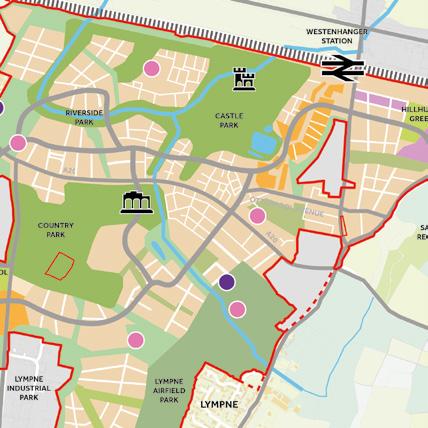
Otterpool Park is an emerging garden town of up to 10,000 homes between Folkestone and Ashford in Kent.
Arcadis, alongside a variety of project partners, prepared a landscape-led masterplan that will shape the detailed design of the town’s phases over the next few decades.
This was in response to the scale of development, the site’s location adjacent to the Kent Downs National Landscape, its rich tapestry of historic landscapes including a Roman farmstead, Tudor castle and WWII airfield and enhanced biodiversity opportunities. These places and topics were highly valued by the residents of the five surrounding villages.
Through a series of detailed landscape, spatial, morphological and visual sensitivity studies, locations for the town’s key open spaces and areas of built form were identified. Key to locating built form was striking a balance between areas which would have the least impact on sensitive landscape and visual receptors and recognising that the new settlement needed be legible as a town.
As well as charting existing watercourses and valued habitats, studies identified how people already use and track across the landscape and the locations of unique aspects of landscape character.
The resulting masterplan was rooted in a strong green-blue infrastructure strategy, including a
clear network of open spaces and routes between which the different quarters of the town could be planned. The green infrastructure amounts to over 50% of the masterplan area, comprising 160 ha of new and retained habitat, 63 ha of play and sport areas, 16 ha of strategic parks and 138 ha of other amenity space, for a Biodiversity Net Gain of 20%.
The iterative Landscape Visual Impact Assessment (LVIA) process embedded additional measures, notably, a plan to implement proposed structural planting in advance of development phases. This helped reassure stakeholders that the town would soon appear integrated into its setting, which in turn helped the masterplan gain outline planning approval without the need for any form of inquiry, appeal or hearing, in 2023.
Other measures to assist the long-term social and economic sustainability of the surrounding area were also proposed. One example is the use of wool and coppiced timber, sourced from the Kent Downs National Landscape, within the insulation and construction of the new homes, so helping conserve the designated landscape’s valued land-use pattern.
The LVIA, and the commitments made within it, sets key principles for the emerging landscape-led detailed designs for Otterpool Park’s future phases.
Benefit: Environmental
Balliemeanoch Pumped Storage Hydro Scheme
Practice: AECOM Location: Argyll and Bute
As landscape architects, we are all aware of the benefits of early project involvement to promote a landscape-led approach and maximise long-term value. This is particularly true when designing large-scale energy infrastructure in sensitive and often remote landscapes.
The push towards the government’s Clean Power 2030 Action Plan places even greater emphasis on landscape-led planning and design to achieve its ambitious goals. One such example is pumped storage hydropower (PSH), which is an important part of a net zero future in which homegrown energy, energy security, and grid storage and stability are key.
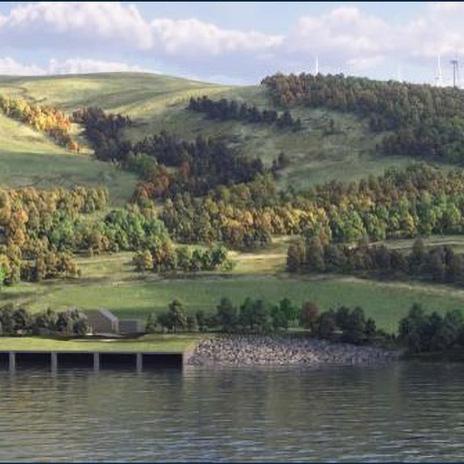
Balliemeanoch PSH project in Argyll and Bute, Scotland, if consented to by the Energy Consents Unit, seeks to do exactly this.
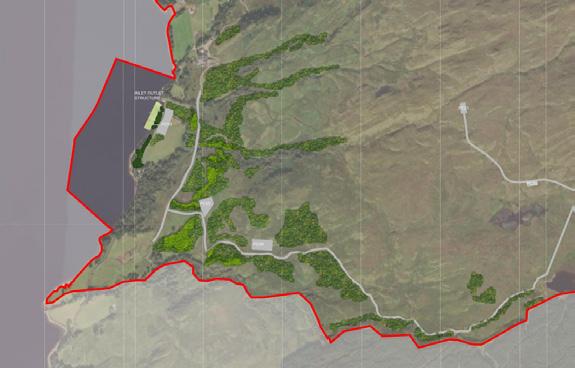
AECOM’s landscape team has been involved from the outset in shaping the Balliemeanoch project for Intelligent Land Investments Group. The landscape team’s involvement has ensured that a thorough understanding of
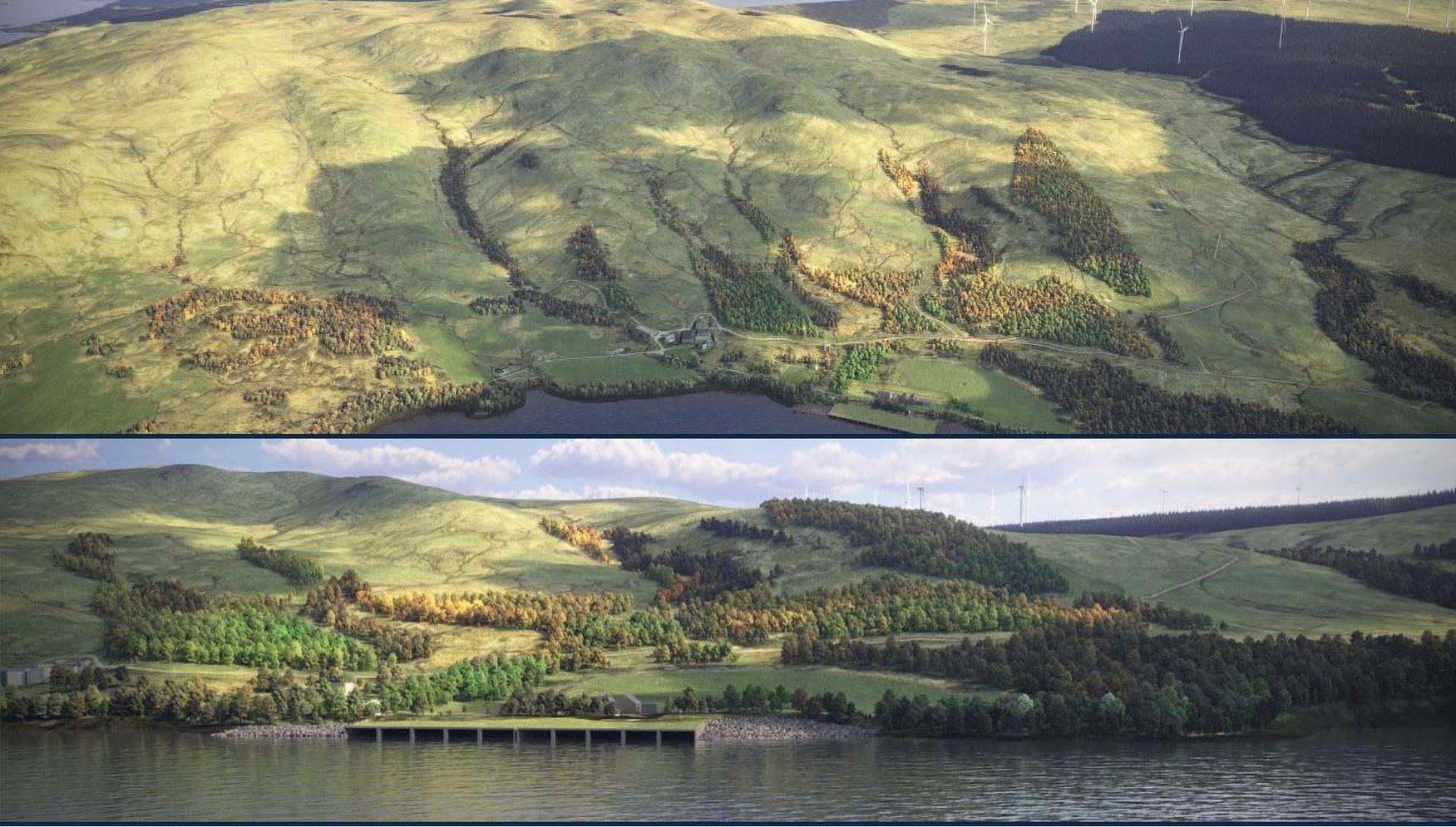
the local landscape character and visual amenity has underpinned the early design decisions. Carefully sited buildings and compounds, along with consideration of the profile of the reservoir embankments, have helped minimise the considerable impact that the project could otherwise have imposed on the upland landscape.
This landscape-led approach allowed for a comprehensive landscape strategy to be developed iteratively and collaboratively within the multidisciplinary design team. The embedded mitigation proposals include large-scale native and wet woodland planting, blanket bog and upland rehabilitation and heathland seeding, all of which contribute towards landscapescale restoration opportunities. Such interventions have benefits
for climate resilience and nature regeneration, while delivering essential energy generation and storage.
The proposed native woodland and wet woodland planting was designed to align with the natural contours of the landscape, weaving along watercourses and knitting together the fragments of existing woodland on the valley sides. The planting seeks to reinstate historically abundant woodland, enhancing the local landscape character while also allowing reconnection with the historic landscape pattern. The legacy of this project is not only about the role that Balliemeanoch can play in the UK’s net zero future – it also demonstrates the long-term value that landscape-led restoration at scale can achieve for future generations.
Benefit: Community cohesion
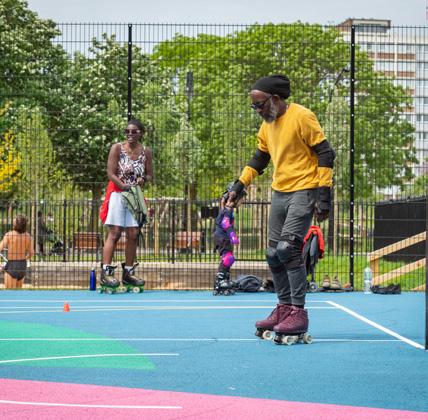
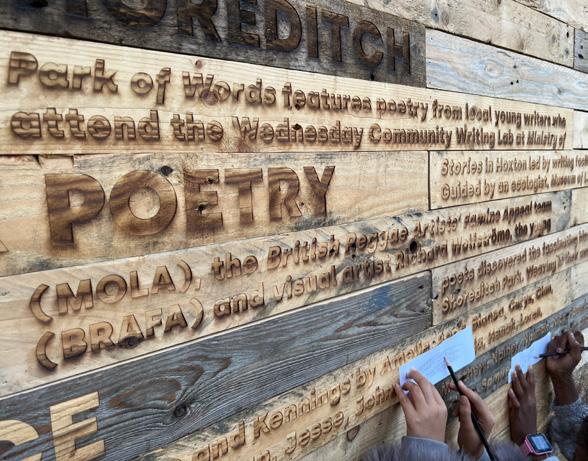
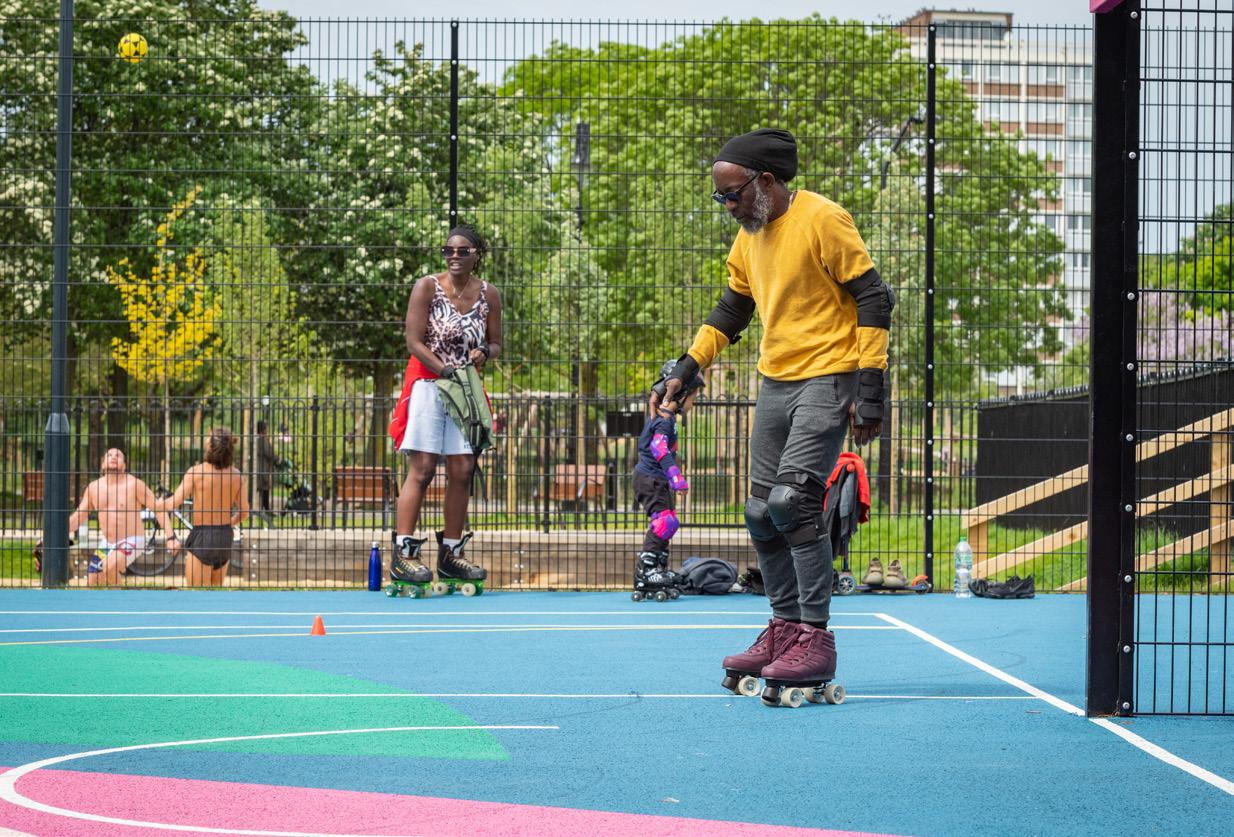
Shoreditch Park
Practice: LUC Location: London
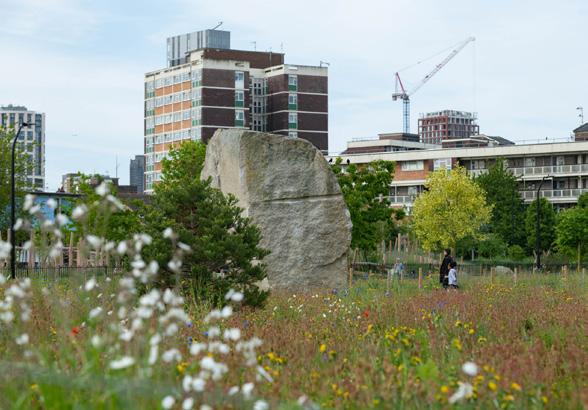
Shoreditch Park is one of the largest parks in the London Borough of Hackney, covering 7.1 hectares and serving the south of the borough. In 2019, as part of the wider Britannia Development Scheme, LUC was appointed to deliver a number of improvements to the park, with an allocated budget of £2m. The ambition was to identify what improvements should be made to the park, entirely through community engagement, with the purpose of delivering a park that works for local residents, both old and new.
Located in a busy residential area and heavily used by all ages, the park faces growing pressures from ongoing development and a rising population. A two-stage engagement process shaped the design. The first stage, in October 2019, used blank-page workshops, surveys, drop-ins, online tools
and focus groups to gather ideas from existing users, non-users and potential users. This generated over 1,600 responses that informed the masterplan. The second stage, delayed until October 2020 by COVID-19, sought feedback on the proposals. Despite lockdown restrictions, methods such as online and paper questionnaires, virtual focus groups and tailored school and college sessions went ahead. This ensured a broad crosssection of residents, including children and young people, were still able to contribute.
The community identified several priority areas for improvement which were adopted into the final design. These included increased sports and fitness facilities, enhanced ecology and biodiversity, refurbishment of the playground, safety considerations at night and from cyclists, improved signage and interpretation, additional seating and park furniture, gateways into the park enhancing identity, and improvements to the condition of the sports pitch grass sward. This collaborative approach not only ensured that diverse local interests and needs were embedded in the design but also fostered a sense of ownership and shared responsibility. Since completion, the response has been overwhelmingly positive, with residents and stakeholders praising the park’s transformation into a vibrant, welcoming space that has been secured for future generations.
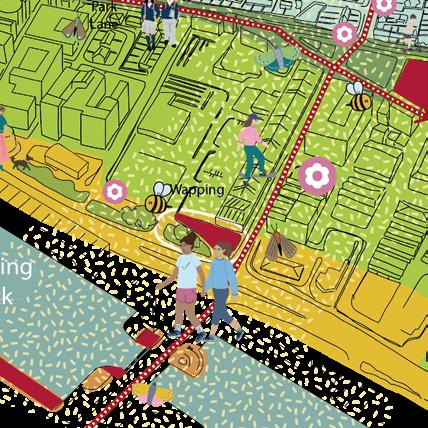
Urban GreenUP –The Pollinator Project Benefit: Wellbeing and health
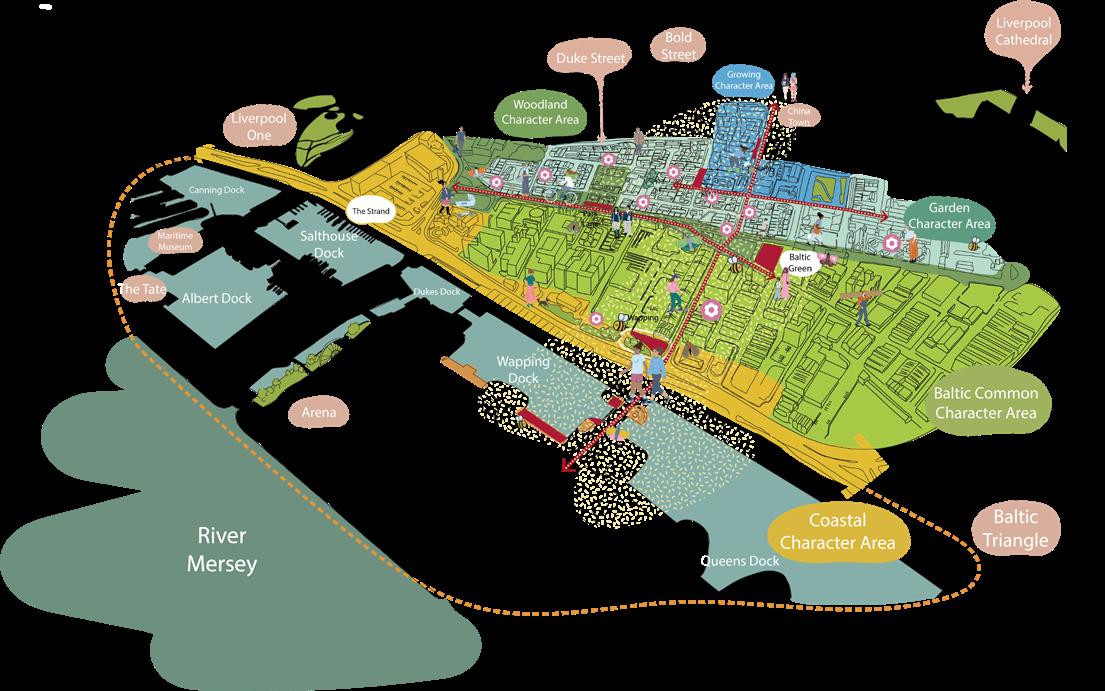
Practice: reShaped with Flavia Goldsworthy Location: Liverpool
The Pollinator Project in Liverpool, part of the European Union’s international Urban GreenUP programme, demonstrates how landscape can transform even the most challenging urban sites into thriving, biodiverse habitats with measurable social, environmental and economic value.
The project adopted a holistic whole-lifecycle approach, creating year-round resources for pollinators and other wildlife. The masterplan linked deprived and nature-depleted areas of Liverpool into a connected network of biodiverse spaces. Independent monitoring by Mersey Forest and the University of Liverpool recorded a 928% increase in pollinator biodiversity within the first year alone.
The project has been transformational for communities living in Liverpool’s highdeprivation Baltic Corridor. By situating the planting along active travel routes and creating pathways through the planting, residents encounter wildlife daily. Key to the success of the Pollinator Project was the inclusion of reShaped’s long-term engagement programmes throughout the design, delivery and in-use phases. Local businesses and social enterprises provide resources and volunteers to keep the planting healthy. There have been up to 25 people at maintenance sessions, including a diverse range of lived experience amongst the
attendees. This engagement teaches skills and fosters wellbeing, inclusion and a sense of ownership. The wider social, environmental and economic impact has been verified by Mersey Forest’s Green Infrastructure Valuation (GIVAL) calculator, which estimates:
▪ A 13.9% increase in walking levels, equivalent to 26 lives saved per year
▪ 23,500 residents with improved access to green space and 500,000 annual users of the new pollinator corridors
▪ Reduced workplace absenteeism, equating to £56,700 saved annually
▪ An estimated 100,000 visitor days, generating 60 full-time equivalent tourism jobs and two land management roles
▪ An 8.4% reduction in NO₂ pollution adjacent to Liverpool’s busy Strand corridor ▪ 6–8 degrees Celsius cooling of ground temperatures during heatwaves
Three years after completion, the Urban GreenUP project as a whole has acted as a catalyst and provided inspiration for environmental improvements internationally, nationally and throughout Liverpool. The impact of the original investment in landscape has grown further, with the project forming the basis of Liverpool City Council’s pollinator plan, influencing the emerging urban design strategy and local plan and generating £770,000 in successful funding applications to date. This has been facilitated through new partnerships and sponsorship by local businesses, who have not only funded the landscape maintenance but have also taken the learning and are improving their own estates.
Landscape-led planning and landscape thinkers from history: a legacy
Andrew Tempany FLI looks back at the ‘Greatest Generation’ of landscape thinkers and traces a lineage of landscape-led planning that resonates across a century to inform practice today.
The early and middle years of the last century were exciting times for developments in landscape planning and thinking. Visionary landscape thinkers Brenda Colvin, Geoffrey Jellicoe, Sylvia Crowe, Nan Fairbrother and Ian McHarg were all either proposing ways of, or writing about (often both), the creation of a better co-existence between us and nature. They used creative environmental design to integrate the enormous economic, social and infrastructural changes wrought by growth and development in the
20th century. They were thinking about outcome-orientated landscape planning at scale to guide the siting and design of infrastructure for power, roads and factories. This also included the new towns conceived as part of the controlled growth of London and other major cities along with our green belts.
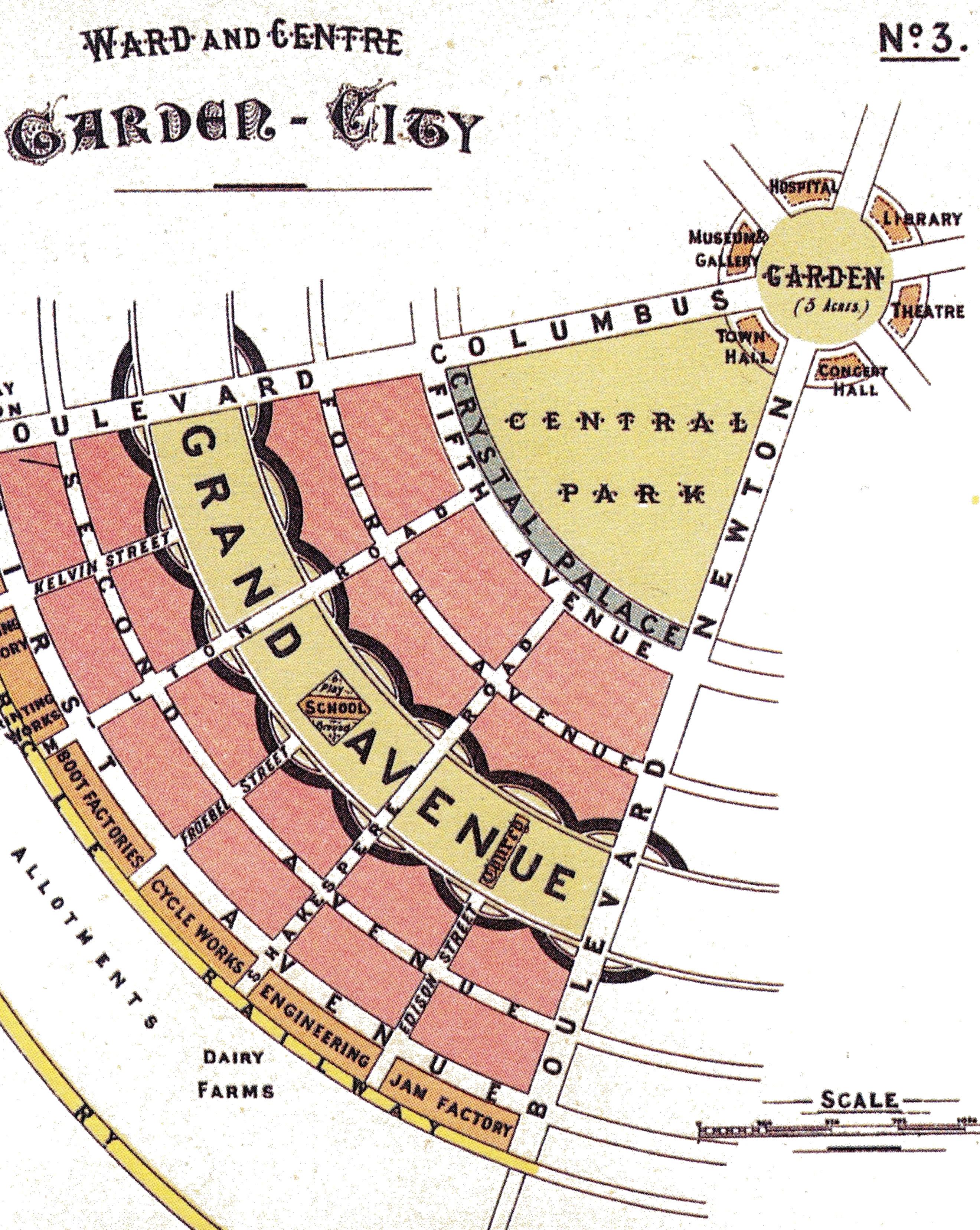
Where did this approach originate? Was it a continuation of the garden city principles and social engineering ideals of Ebenezer Howard earlier in the century? Partly. And certainly these played out in the new towns realised in the 1940s and 1950s. But other factors were also at play and a set of circumstances aligned to first bring this work about and then create a legacy that continues to shape the ways landscape architects think to this day.
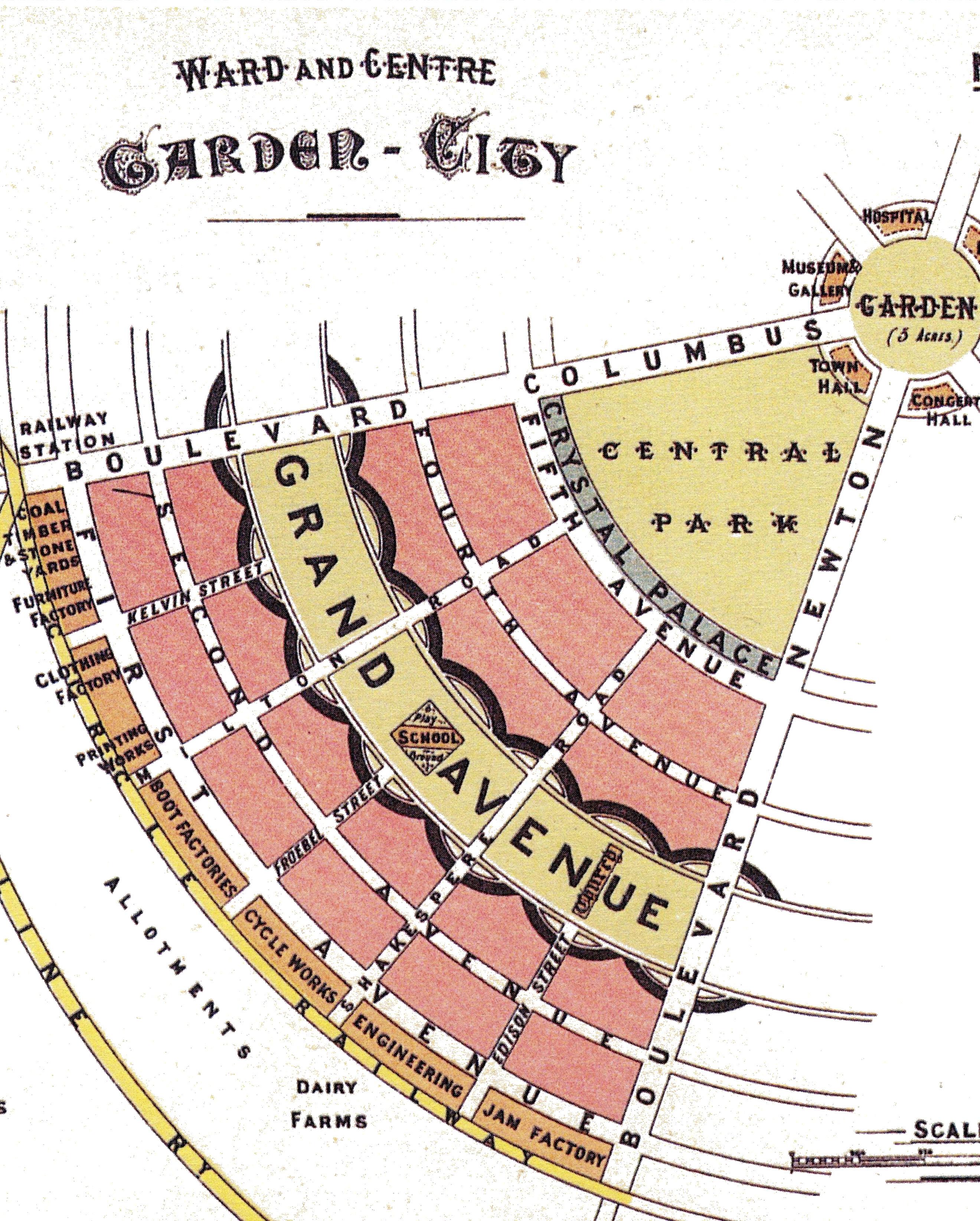
1 Diagram showing a segment of a garden city, from Tomorrow: A Peaceful Path to Social Reform (1898), later reissued as Garden Cities of Tomorrow (1902) by Ebenezer Howard.
Culture and background were one of these ways. These visionaries lived at a time when higher education and access to a professional career were generally only available to the privileged, and they reflected this, with some notable exceptions. While access to the profession remains an ongoing issue, at the time it meant that Colvin and Crowe benefited
from study under the pioneering female landscape designer Madeline Agar. Agar had trained in the USA, when landscape planning was evolving rapidly, through the recently built parkways and urban greenspace frameworks of Frederick Law Olmsted and Calvert Vaux.
The time in which they were all born was another factor. All were part of the ‘Greatest Generation’,1 who lived and worked through huge social and political change. This included geopolitical instability, two World Wars and the associated postwar legacy of rebuilding, rebalancing and the ‘Brave New World’2 thinking this entailed. In parallel, systems thinking was coming to the fore. That is, thinking about concepts in interlinked ways, with everything being a component of a system. Or to quote a much earlier thinker, John Muir: “When we try to pick out anything by itself, we find it hitched to everything else in the Universe”.3
This is certainly true of the remarkable planning and design
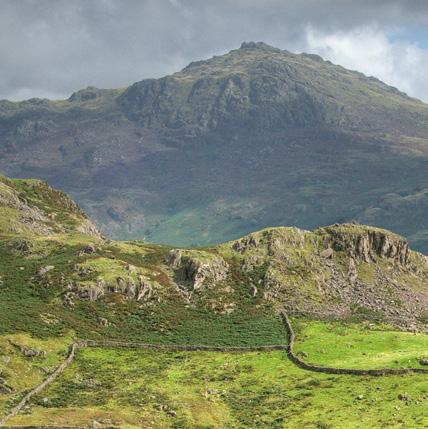
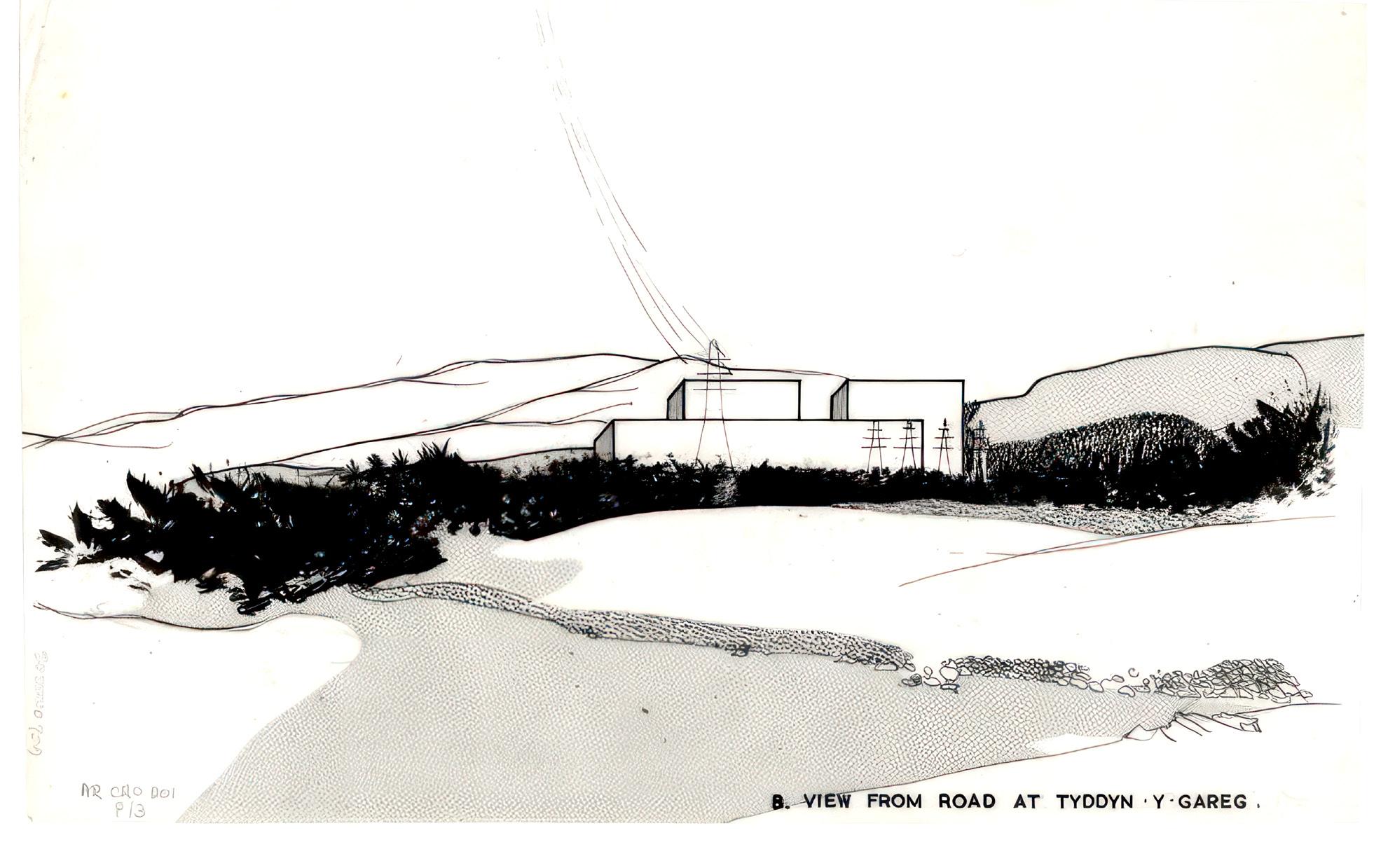
solutions realised by this group, whether the striking ecological environments developed by Colvin in her schemes for power stations, factories or reservoirs or the parallel work by Crowe at Trawsfynydd Nuclear Power Station. Landscapes were considered as systems, as context-informed microcosms of the
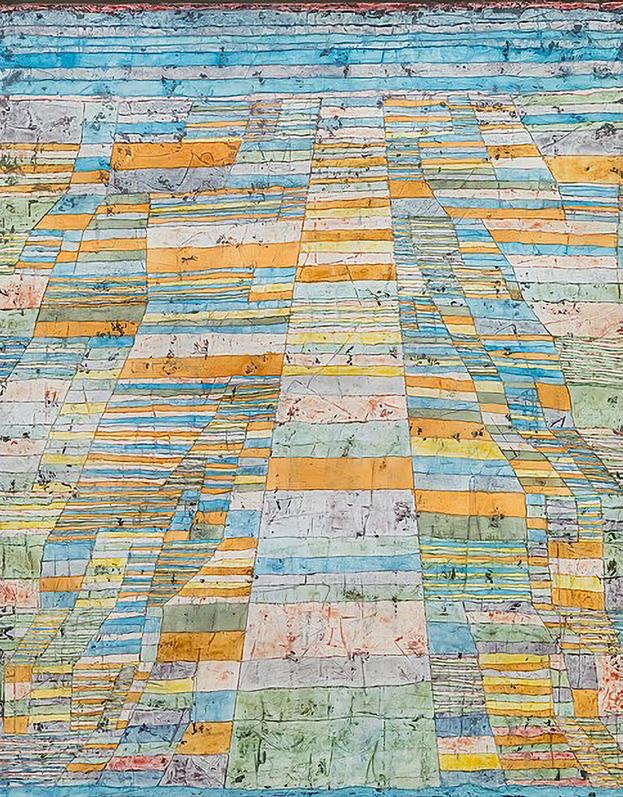
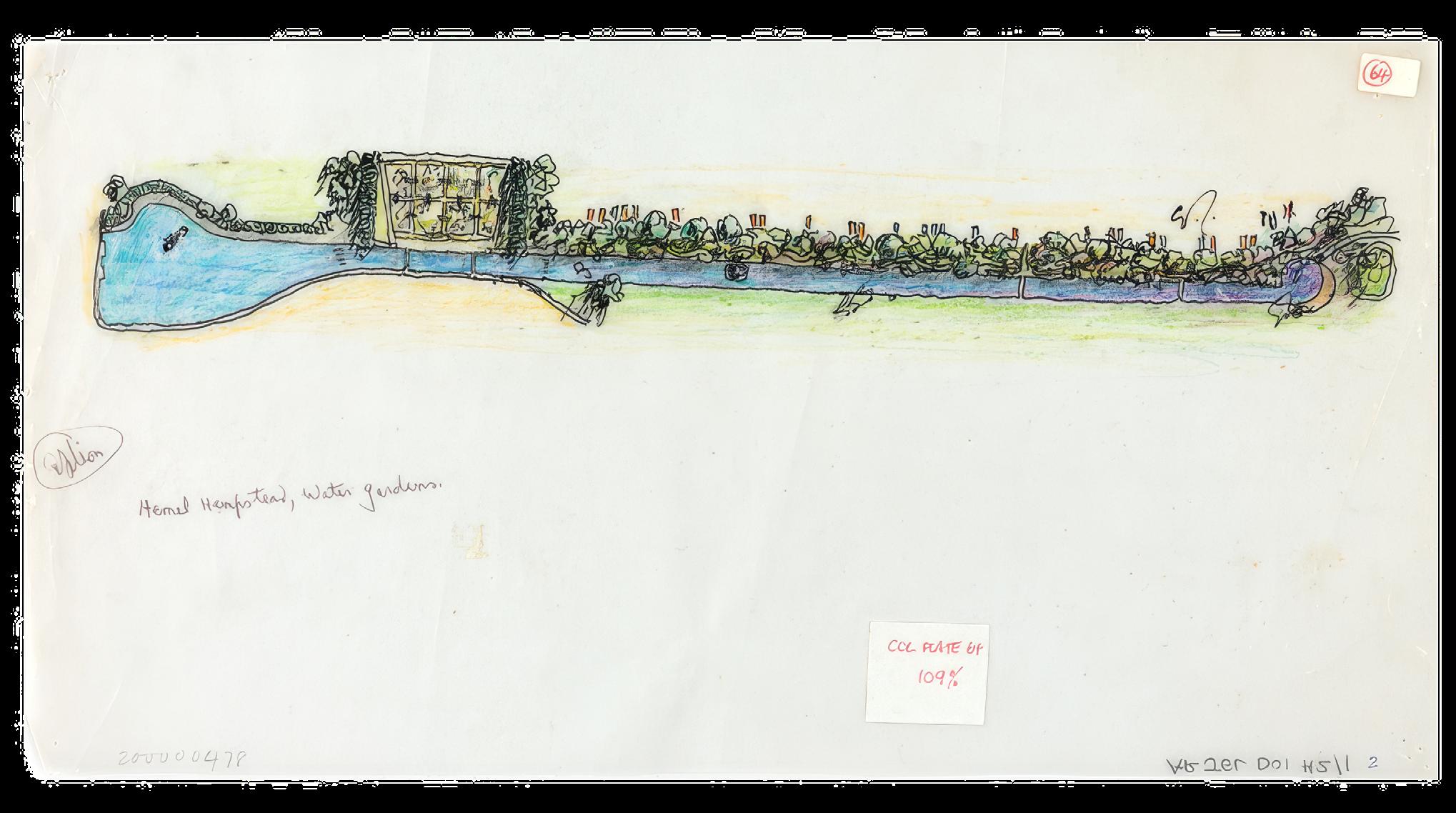
3 Jellicoe’s landscape planning process was informed by the modern art of the time. Highways and Byways by Paul Klee was part of Jellicoe’s inspiration for the original plan for Hemel New Town.
2 Originally an ironic Shakespearean phrase from Act V, Scene I of The Tempest (https:// www.folger. edu/explore/ shakespearesworks/the-tempest/ read/5/1/), Brave New World was also the title of Aldous Huxley’s novel of 1932, in which he presented a dystopian vision of a future society. It came to be applied colloquially the postwar Atomic Age andwas associated with times of great upheaval.
3 From Muir, J, 1911, My First Summer in the Sierra, Chapter 6: Mount Hoffman and Lake Tenaya (https:// vault.sierraclub.org/ john_muir_exhibit/ writings/ my_first_summer_in_ the_sierra/chapter_6. aspx)
4 Drawing showing view from road at Tyddn - y - Gareg of Trawsfynydd nuclear power station.
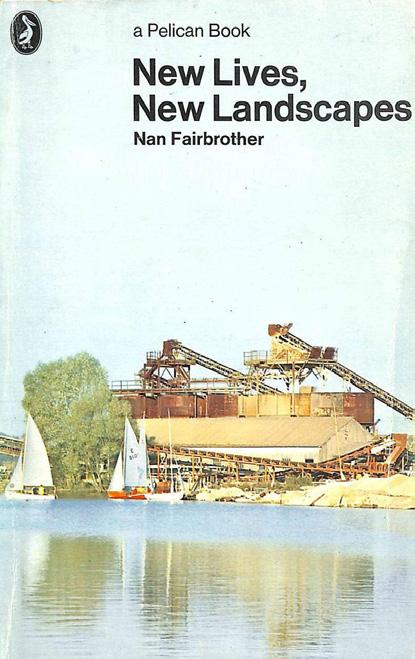
wider landscape, as a tool to boldly match the scale of the infrastructure they were both dealing with. In a similar vein, ecological approaches to planning were being developed in sophisticated ways by the Scottish landscape architect Ian McHarg and his colleagues at the University of Pennsylvania in the 1960s. This work became his seminal work Design with Nature, a landscape planning and design approach based on overlays of spatial and mapped data to note patterns and areas of opportunity. McHarg’s work was a forerunner to what later became Geographic Information Systems (GIS). Systems thinking, and systems-based landscape planning, is also about the intersections between environmental, sociocultural and economic systems. Certainly, the approach was well understood by this group. Fairbrother in particular had a keen interest in understanding the connections between landscape and human nature, which she articulated beautifully and with a sharp wit in New Lives, New Landscapes (1970). This was her framework for landscapeled planning to deal with the great changes being wrought in post-war
Britain. She put forward an approach based on landscape regions and four guiding landscape principles – of organisation, pattern, material and texture. Her thinking was clear, relatable and engaging. This meant that New Lives, New Landscapes enjoyed a wide, mainstream audience, far beyond our profession.4
Jellicoe took the relationship of landscape to society, civilisation and culture to another dimension. He drew upon references from history, mythology, psychology, visual arts and the subconscious in a rich, allegorical design approach to landscapes of power and the new towns.
So, what of their legacy, and of the future? As with Jellicoe’s storytelling, Fairbrother’s writing has, consciously and unconsciously, influenced generations of landscape architects and their thinking since her untimely passing in 1971. It also inspired applied landscape planning concepts such as green infrastructure for resilient places. Crowe and Colvin continue to influence how landscape architects tackle large-scale infrastructure. McHarg’s ecological design process is still used daily by landscape
architects and many other environmental professionals. Much has changed since their day but, in many ways, nothing has. We are now dealing again with great challenges, this time, complex ‘wicked problems’. Integrated, collaborative landscape planning has a part to play in all of this, and in the creation of resilient and well-sited new settlements and infrastructure. Colvin passionately believed that landscape architects must be integral to design teams from the very beginning. Achieving this often requires patience, clarity of thought, articulation and true collaboration. Equally important are narratives to bring people along with us, given that our work involves the fourth dimension, time. All of this is just as true today as it was then.
Andrew Tempany FLI FRSA has been in practice for over 20 years and is Technical Director of Landscape Design at Stephenson Halliday, an RSK company.
A global mandate: how landscape is shaping a global sustainable future
Dr Bruno Marques
In an era defined by the intersecting crises of climate change, biodiversity collapse and rapid urbanisation, the role of the landscape architect is undergoing a profound transformation. We are moving from the periphery to the very centre of global decisionmaking. No longer confined to the aesthetics of place, our profession is now being recognised as a critical driver of social equity, ecological resilience and, crucially, commercial viability.
This is not a future ambition; it is happening now, spearheaded globally by IFLA and championed recently by the Landscape Institute’s (LI) own transformative landscapeled briefing.1 Through strategic alliances with the world’s most influential bodies, IFLA is positioning
The president of the International Federation of Landscape Architects (IFLA World) sets out the importance of a landscape-led approach in the context of international development, and the vital role of the profession around the world.
this approach as the fundamental organising principle for a sustainable and prosperous planet, giving a powerful, unified voice to landscape on the global political stage.
A unified front: aligning with the global agenda
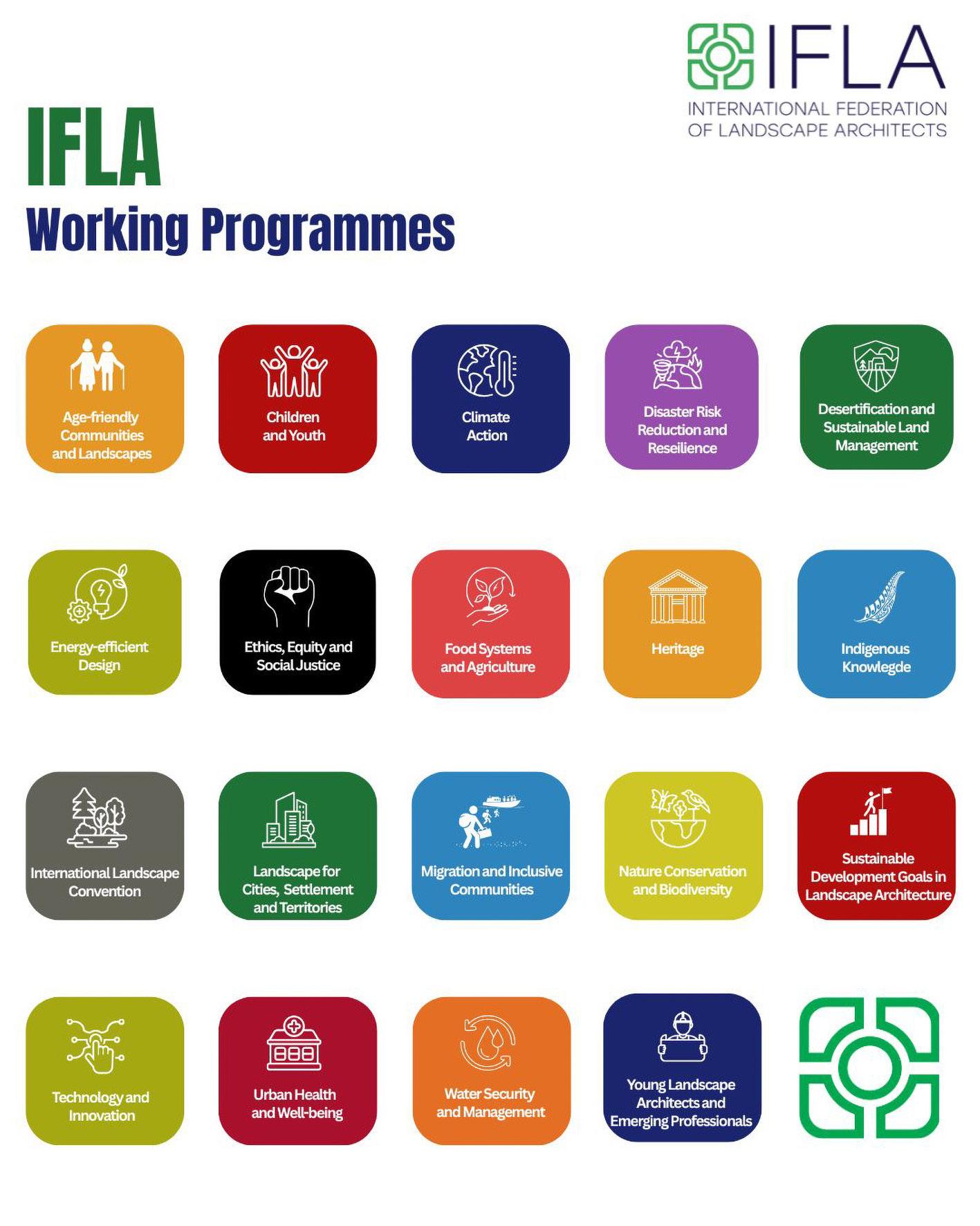
The world has a shared blueprint for a better future through the 17 United Nations (UN) Sustainable Development Goals. For landscape architecture to exert its full potential, its work must align directly with this universal framework. Recognising this, IFLA has embarked on a strategic restructuring, launching 19 new and dynamic work programmes designed to tackle our planet’s most pressing challenges.
These programmes are not simply internal committees; they are a direct and deliberate mapping of our profession’s expertise onto the mandates of key UN agencies and global conventions. Programmes such as Climate Action, Nature Conservation and Biodiversity, Urban Health and Well-being and Disaster Risk Reduction and Resilience mirror the urgent priorities of partners like the UN Environment Programme (UNEP), the World Health Organization (WHO) and the UN Office for Disaster Risk Reduction. This strategic alignment ensures that when global bodies seek solutions, the expertise of over 100,000 global landscape architects is accessible, relevant and ready to be deployed through IFLA.
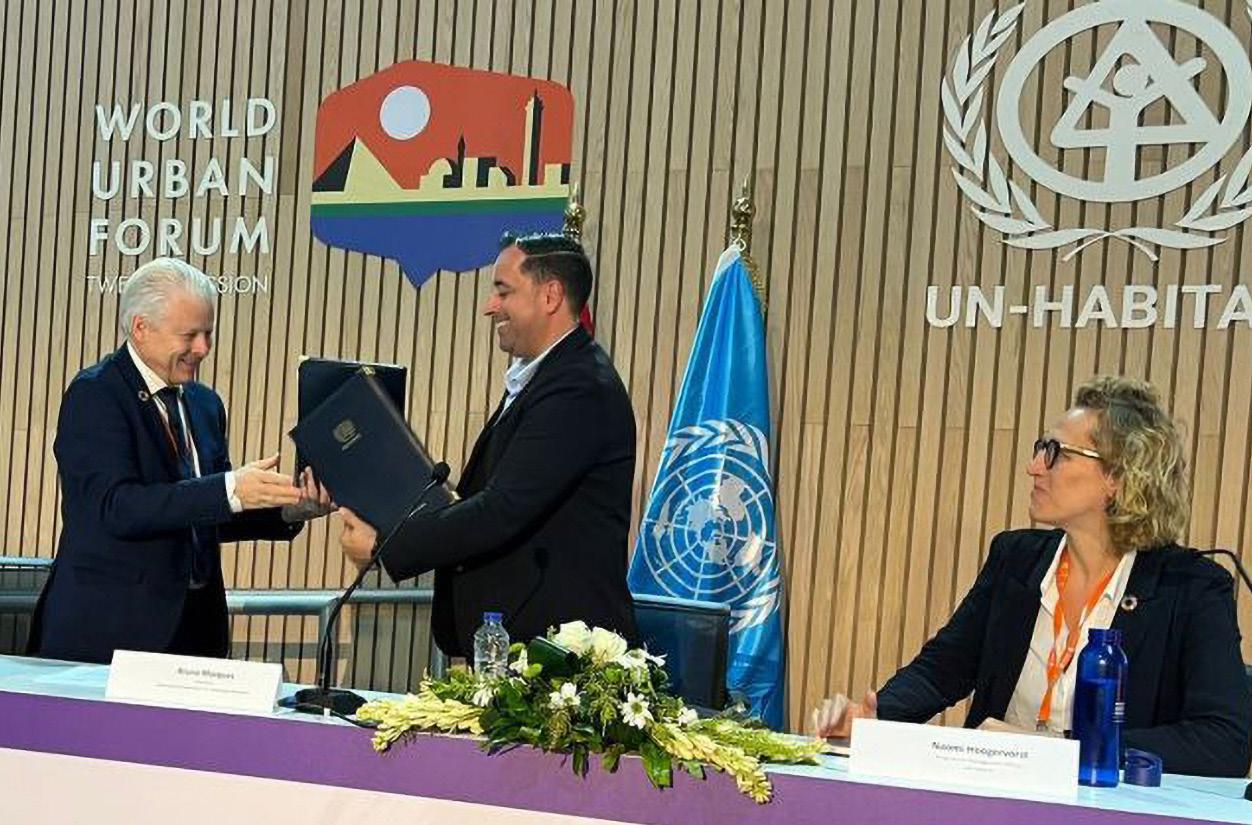
This synergy was formalised in a landmark moment for our profession. At the 12th World Urban Forum in Cairo last November, IFLA signed a Memorandum of Understanding (MoU) with UN-Habitat. This agreement institutionalises our role in shaping sustainable urban development globally. As I said at the signing, our expertise as landscape architects extends far beyond aesthetics. We are at the forefront of addressing critical challenges such as climate change, biodiversity loss, and social inequity.
IFLA–UN-Habitat MoU
The IFLA-UN-Habitat MoU focuses on five key areas: capacity development, research, policy advocacy, pilot projects and joint events. Each of these pillars are conduits for delivering value:
▪ Nature value: pilot projects will demonstrate the power of landscape architecture to regenerate biodiversity and implement nature-based solutions.
▪ Social value: capacity development initiatives will empower professionals, particularly in developing nations, to create inclusive, equitable and healthy cities for all.
▪ Commercial value: crucially, the policy advocacy component embeds landscape principles into urban planning frameworks. This makes well-designed, resilient landscapes a prerequisite for sustainable investment, signalling to financial institutions such as the World Bank that green infrastructure is not a cost, but a foundational, creditenhancing asset.
Leading the charge: The landscape-led approach
To truly influence the global agenda, we need more than just a seat at the table; we need a unifying philosophy. The LI’s landscape-led approach provides this. It reframes landscape not as a component of a project, but as the primary infrastructure upon which all social, ecological and economic systems depend. This philosophy was powerfully articulated and launched by the LI in May 2025. This vital
initiative champions the principle of ‘landscape first’, advocating for the early engagement of a chartered landscape architect in every project to enable fully informed decision-making. As the briefing outlines, our profession is uniquely trained to understand the complex, interconnected factors bearing on land: from heritage, geology and soil to habitats, water management, community needs and public health. By considering these elements together from the outset, we can deliver maximum benefits, both
immediately and for generations to come. This approach finds its voice through landscape architectsupported co-creation workshops, ensuring that places are developed with communities at their very heart.
The IFLA-spearheaded campaign for an International Landscape Convention (ILC) is the global-scale manifestation of this philosophy. This decade-long initiative is now a key project of the UN-Habitat Professionals Forum and it aims to establish a global framework that recognises the everyday landscape as our most vital asset. The momentum behind this was palpable at the Urban Thinkers Campus 9.0 in Birmingham last October, which was co-organised by IFLA and UN-Habitat and led by Professor Kathryn Moore FLI. The event brought together high-level representatives from UNEP and the UK’s Department for Environment, Food and Rural Affairs, resulting in an extraordinary degree of consensus on the need for this new approach.
The LI’s initiative provides a clear, actionable methodology to
deliver the ILC’s global ambition. It is a powerful demonstration of how a national professional body can lead, providing the tools and frameworks that build a groundswell of support for a global paradigm shift.
The triple bottom line: social, natural and commercial value
The ultimate success of the landscape-led approach lies in its ability to deliver tangible, measurable value across a triple bottom line. By thinking ‘landscape first’, we move beyond simple mitigation to active value creation.
Social value
Landscape architecture is a powerful tool for social justice. By designing accessible public spaces, promoting active living and creating inclusive communities through co-creation, we directly contribute to improved public health and wellbeing. This aligns perfectly with the work we are doing with the WHO, which
identifies poor urban planning and public spaces as a primary driver of non-communicable diseases. Every park that encourages exercise, every green street that cools a neighbourhood and every community garden that fosters social connection is a direct investment in a healthier, more equitable society.
Nature value
This is the heartland of our profession. In partnership with bodies such as UNEP, we design solutions that restore ecosystems, enhance biodiversity and combat climate change. Finding a balanced approach to maximise the quality of places for both people and nature is central to the landscapeled approach. From large-scale green infrastructure networks that manage stormwater to micro-forests that sequester carbon in dense urban cores, our work provides the essential ecosystem services that are the foundation of all life.
This is where our advocacy must be sharpest. For too long, the landscape has been viewed as a cost to be minimised. The landscapeled approach reframes it as a strategic investment that generates significant returns, both initially and longer term. The World Bank’s Global Platform for Sustainable Cities highlights three pillars for success: Sustainability Indicators, Integrated Urban Planning and Municipal Finance. Landscape architecture is the thread that weaves all three together, and we are working actively with the World Bank to focus on:
1. De-risking investment: a city with a robust green infrastructure plan is more resilient to climate shocks. This resilience translates directly into lower risk for insurers and investors, making the city more creditworthy.
2. Reducing long-term costs: nature-based solutions are often more cost-effective than traditional grey infrastructure. A restored wetland provides flood control and water filtration for a fraction of the cost of building and maintaining a concrete treatment plant.
3. Creating a landscape legacy: critically, as the LI points out, the landscape-led approach creates a lasting legacy that future-proofs development. Well-designed, resilient and community-loved places minimise the need for future regeneration funding, delivering a clear and substantial long-term commercial return.
Articulating this comprehensive, evidence-backed value is not merely a professional exercise; it is our passport to global influence. When we can demonstrate a clear return on investment that benefits economies,
communities and ecosystems simultaneously, we speak a language that resonates with the UN, the World Bank, treasury departments, allied professions and organisations, as well as private investors. This is precisely the leverage that empowers IFLA to secure a meaningful voice with global agencies and makes our presence at critical UN summits such as the climate change, biodiversity and desertification COPs not only symbolic, but indispensable. It transforms our role from advocates to essential partners in shaping a resilient and prosperous global future.
A call to action
The era of landscape architecture as a decorative afterthought is over.
We are now recognised as central players in crafting a sustainable, equitable and prosperous world. IFLA, through its global partnerships, has opened the door to the highest levels of policymaking. The LI, with its timely and essential landscape-led development briefing, has provided us with the clear mandate and methodology to lead in the UK. It is now up to all of us to champion this approach, to advocate for ‘landscape first’ in every meeting and on every project and to demonstrate the incontestable value of our profession in delivering a better future for people, nature and the economy.
Dr Bruno Marques is President of the International Federation of Landscape Architects (IFLA) World.
25 years of the European Landscape Convention
The Council of Europe (CoE) is an institution that is poorly understood in the UK. It is seen, certainly by some, as an external European organisation that imposes on British freedoms, while in fact it was the dreamchild of Churchill, conceived during the war years as a means of creating an enduring peace in Europe. It was established by the Treaty of London in 1949 and was largely constructed by British lawyers. The CoE precedes the establishment of the European Union by nearly a decade and is a much larger organisation that represents many more countries (46 member states, including the UK, where the EU comprises 27 member states, excluding the UK). It is concerned with three basic principles: human rights, democracy and rule of law, whereas the EU is more concerned with commerce and creating an even playing field with conditions in which commerce can thrive.
2025 marks the 25th anniversary of the signing of the European Landscape Convention, which was ratified by the UK in 2006 and remains relevant today. Here, Michael Oldham FLI outlines the opportunities and challenges for its future.
The CoE regulates through treaties, known as Conventions, to which member states sign up, whereas the EU issues directives that member states are obliged to follow as a body of law. Member states of the CoE are required to be signatories of the European Convention of Human Rights and may, or may not, sign up to its other Conventions.
The European Landscape Convention (ELC), 1 also known as the Florence Convention, was adopted by the CoE Committee of Ministers in July 2000 and opened for signatures on 20 October 2000. It declared that:
“Landscape has an important public interest role in the cultural, ecological, environmental and social fields, and constitutes a resource favourable to economic activity and whose protection, management and planning... contribute to human well-being... and entail rights and responsibilities for everyone.”
The CoE ELC, as it is currently known, is now also open to signatories outside its jurisdiction. However, it is important to note that each signatory to the Convention undertakes to:
a. Recognise landscape in law as an essential component of people’s surroundings, an expression of the diversity of their shared cultural and natural heritage, and a foundation of their identity;
b. Establish and implement landscape policies aimed at landscape protection, management and planning through the adoption of specific measures;
c. Establish procedures for the participation of the general public, local and regional authorities, and other parties with an interest in the definition and implementation of landscape policies mentioned in para b above;
d. Integrate landscape into its regional and town planning policies and in its cultural, environmental, agricultural, social and economic policies, as well as any other policies with a possible direct or indirect impact on landscape.
The ELC has been signed by 41 of the 46 members of the CoE and 25 of the 27 members of the EU. Germany and Austria are the only EU states that remain outside the Convention. The Convention covers many aspects of international policy and programming, encouraging mutual assistance and exchange of information, and it promotes for example the exchange of landscape specialists, particularly for training and information purposes. As is often said, landscape has no frontiers!
Communication breakdown
The ELC introduced a means of monitoring its implementation through workshops and conferences. However, communications within the CoE are often at diplomatic level, working down to member state governments and then selected departments. This means that in the UK, and across many member states, people with no interest in and/or understanding of landscape issues are selected to represent their country.
For example, the CoE Committee responsible for the ELC is the CDCPP (Culture, Patrimoine et Paysage), the Steering Committee for Culture, Heritage and Landscape. Attendees typically include a government representative from a ministry for arts, culture, the civil service or sport; the Head of the International Cultural Cooperation Division; the Special Government Advisor; an archaeologist; an art historian; or an archivist. Few are actively involved in landscape, strategic landscape planning, landscape management or urban or rural development. Representatives
from the UK government at the 12th Plenary Session of the CDCPP were the Head of Cultural Diplomacy, Department for Digital, Culture, Media and Sport and the Head of International Strategy from Historic England. Landscape is a poorly neglected partner on the committee and this urgently needs to change.
The consequences are made evident through CoE programmes such as the biennial Landscape Award of the Council of Europe, which is awarded by an international jury of representatives. The criteria used to judge the competition are those of sustainable territorial
development, exemplary value, public participation, and awarenessraising. However, although there are professional associations of landscape architects in 34 of the 41 states party to the Convention, these bodies are often not engaged by government. Consequently, few of the entries for competitions meet the criteria and there is a parade of relatively inconsequential projects that have little chance of winning or promoting the value of landscape.
Following the withdrawal of Russia and Belarus from the CoE in 2022 (the only two countries that have ever left), the finances of the
2 https://edoc.coe. int/en/the-councilof-europe-inbrief/11619-unitedaround-our-valuesreykjavik-declaration. html
3 Council of Europe Adopts Comprehensive Environment Strategy Highlighting Human RightsReykjavík process and the Environment
CoE became stretched. This resulted in the future of the Convention being in doubt as the Executive Secretary, Maguelonne Déjeant-Pons (who had been in post since its inception), retired and was not replaced.
In May 2023, the 4th Summit of the CoE took place in Iceland and focused on the future of the Convention. Representations were made by the International Federation of Landscape Architects Europe (IFLA EU) to the then President of the CoE, Marija Pejčinović Burić. The Reykjavik Declaration2 that the Summit resulted in reaffirmed and renewed the core values of the CoE, its democratic foundations and its commitment to human rights and the rule of law. IFLA EU welcomed the Declaration, which supported increased efforts to protect the environment and counter the impact of the triple planetary crisis of pollution, climate change and biodiversity loss. The strengthening of work on human rights aspects in relation to the environment was of particular importance.
The ELC has subsequently moved from DG2 (Democracy) to DG1 (Human Rights), neighbouring the Bern Convention (the CoE Convention on the Conservation of European Wildlife and Natural Habitats, 1979). It now sits in the Department for the Reykjavík Process and Environment. On 14 May 2025, the CoE Committee of Ministers adopted the CoE Strategy on the Environment,3 and made the Convention on the protection of the environment subject to criminal law. The strategy fulfils the mandate of the 4th Summit to elevate the environment as a visible priority of the CoE, presenting a forward-looking and comprehensive vision to align human rights, democracy and the rule of law with environmental protection. This vision is grounded in the belief that a clean, healthy and sustainable environment is not a luxury – it is essential to the full enjoyment of human rights for present and future generations.
In principle this is all good news. The ELC will possibly have more gravitas, with landscape and the environment better protected, and damage to either being recognised as a criminal act.
So, what of the future? It is important that Germany and Austria sign the Convention. Could the European Union (EU) sign the Convention and is there scope to incorporate some of the Convention’s aims and objectives into EU Directives? ‘Landscape’ is a term that hardly appears in any EU documents, yet it is the stage upon which all Europeans live, work and play.
In terms of nature and the natural environment, there is some commonality between the work of the CoE and the EU. However, one area that would greatly benefit from closer cooperation is planning law and the need to integrate landscape policies into all sectoral policies that have territorial impacts. Although there is an EU Directive demanding Environmental Impact Assessments of major infrastructure projects, there is no such directive instructing the need for landscape character assessment, or the development of comprehensive landscape strategies at local, regional and national level. Without this essential base, broad strategies covering many
other aspects of planning can be fundamentally flawed. More detailed collaboration between the EU and the CoE, providing mutual support for important legislation, could be more effective.
Detailed landscape policies are key; not simply to safeguard human rights and respect for democracy and to ensure a regard for the quality of the environment. They play a vital role in planning to mitigate climate change by countering the effects of extreme climatic events, reducing biodiversity loss and dealing with pollution.
National and local governments often seem to prefer to invest in expensive grey infrastructure projects that sometimes compound these problems, when more costeffective, sustainable and resilient nature-based solutions are available.
Progress is being made, but slowly!
Michael Oldham FLI is an honorary member and founding President of IFLA EU (formerly the European Foundation for Landscape Architecture). He is also the IFLA EU Head of Delegation to the Council of Europe, President of the International Jury for the European Landscape Awards, and a former LI Vice President and Committee Chair.
Scotland’s Landscape Charter
Rachel Tennant FLI
In June 2025 Scotland’s Landscape Charter was launched by Scotland’s Landscape Alliance (SLA). It highlights the vital contribution of Scotland’s landscapes to our lives in terms of our health and wellbeing, climate resilience, and nature and biodiversity, as well as our economy. It has been endorsed by the Scottish government and its agencies NatureScot, Heritage Environment Scotland, the Scottish Land Commission and Architecture and Design Scotland.
A pioneering landscape charter demonstrates the ongoing importance of the European Landscape Convention
This is also the 25th anniversary of the European Landscape Convention (ELC), the international treaty that provides the basis for Scotland’s approach to landscape, recognising that all landscapes matter and provide an essential shared resource from which everyone should benefit.
The ELC emphasises the dynamic nature of all landscapes and the central role of people in recognising their value and securing their good stewardship. The Charter is a mechanism to demonstrate Scotland’s significant value and distinctiveness within the UK’s commitment.
The Charter sets out a vision: that all our landscapes are cherished as a vital local and national resource,
being recognised as fundamental to our prosperity and wellbeing; that everyone can play an active part in decisions that affect them; and that those responsible for owning, using and managing land are committed to – and supported in – delivering their many benefits now and for future generations. Principles of collaboration, dynamic management and diversity underpin this vision.
The ELC provides a useful framework and, with the supporting mechanisms of the Council of Europe, ensures Scotland can benefit from – and share with others – best practice and innovation. The SLA aims to deliver and reinvigorate Scotland’s commitment to the ELC through the promotion of and adherence to the Charter in everyday landscape action.
A collaborative stakeholder event held on 30 October 2025 in Edinburgh shaped an annually updated action plan to support the implementation of the Charter’s vision and principles and augment the good policy and tools that exist around land and landscape, as well as provide a positive influence on the development of future policy and legislation.
See the Charter at scotlandslandscapealliance.org
Rachel Tennant FLI is Co-Chair of Scotland’s Landscape Alliance
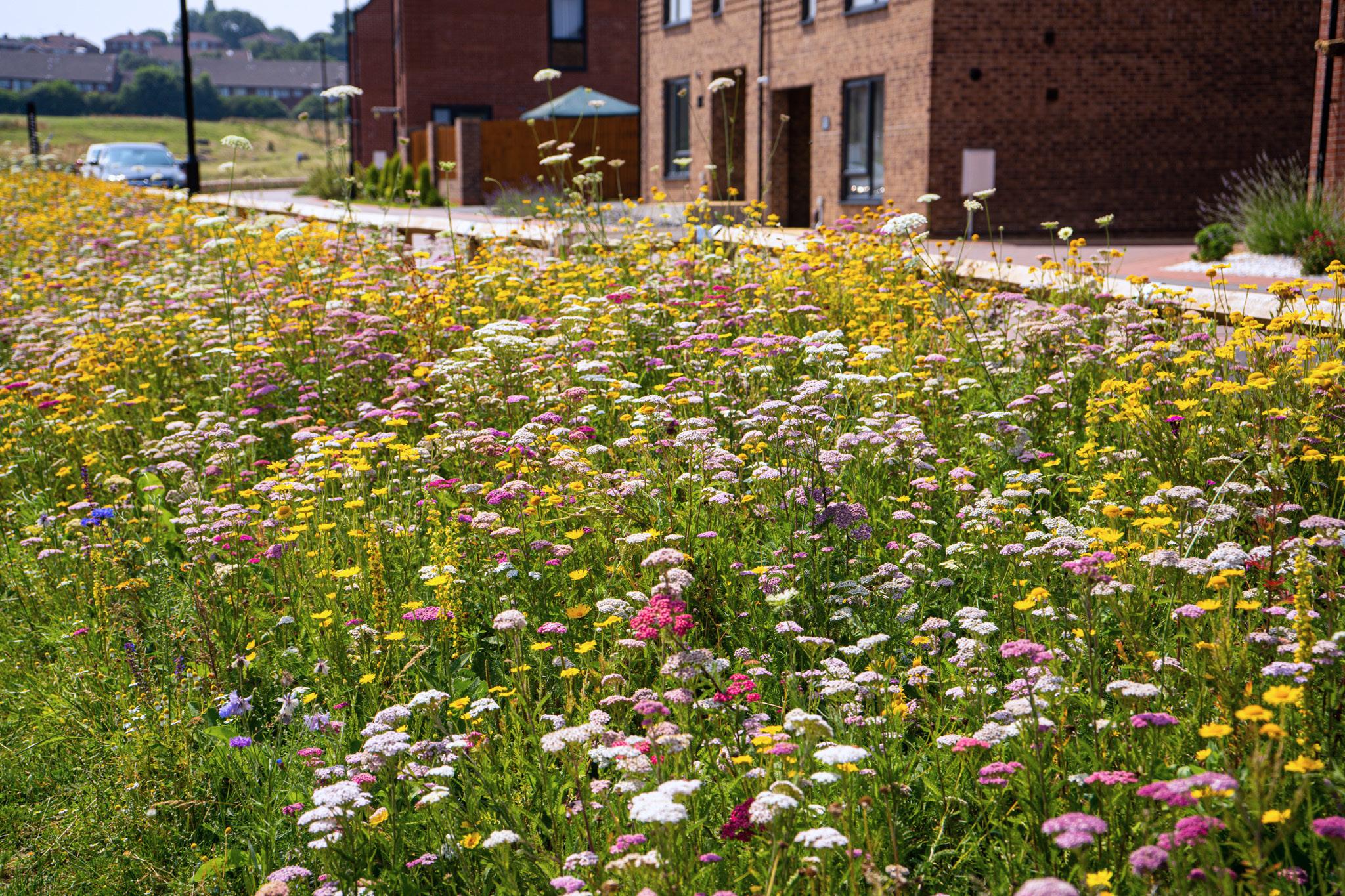
Tried and tested, robust species able to tolerate climate challenges
Stunning Visual Impact
100% flowers, upwards of 150 plants per square metre
& Plastic-Free
peat-free product with no plastic
Landscape value and the emerging planning and development system
Andrew Smith CMLI
It is right that a landscape-led approach will address matters of value: both the retention and creation of it in the face of the wave of emerging planning reform – a reform seemingly tilted towards housing delivery to the detriment of the environment.
We are acutely aware just how much change is coming. In its launch of the landscapeled approach, the Landscape Institute’s (LI) introduction is as follows: “The coming years will see the transformation of large areas of UK land and the creation of many new landscapes, through the building of homes – 1.5m in England alone – and new infrastructure... Using this land well and getting the landscape right is the difference between mediocrity and the creation of healthy and thriving places to live. We must create new places that deliver all aspects of what society needs – that generate healthy, resilient environments and communities – and that work for the long- term.”1
Landscape professionals are well placed to ensure value is balanced with the potentially conflicting demands of a changing development process.
The planning system is in a constant state of flux and has the incredibly difficult task of “reconciling the needs of development and conservation, securing economy, efficiency and amenity in the use of land, ensuring the sustainable management of natural resources and protecting, promoting, conserving and enhancing the built and historic environment”.2
Within the changes, while there may have been a move away from the seemingly complex matter of ‘beauty’, value has remained a constant thread through plan making.
The landscape-led approach will be a strong tool in meeting the challenges of the retention and creation of value throughout the development process. It is an approach that is able to advance through considered integration.
Our profession understands everything that lies behind this value: how to influence the policy environment that guides change, how to interpret such
policy to elicit change and how to perpetuate change through proactive stewardship.
The first required construct is to clearly understand what landscape is. Quite simply, it is all that is perceived. The European Landscape Convention adopts the following:
“Landscape is an area, as perceived by people, whose character is the result of the action and interaction of natural and/or human factors.”3
The definition is expanded upon in the South Downs National Park Local Plan:4
“This means landscapes are not just green areas of countryside, they include everything shaped by people and nature together. Roads and lanes, towns, villages, farms and buildings, industrial areas, rivers and beaches are all part of our landscape.
People are at the heart of landscape. The landscape we see today has been shaped by people, so we can think of it as a
2 https://www. gov.wales/sites/ default/files/publications/2024-07/ planning-policy-wales-edition-12. pdf
3 Guidelines for Landscape and Visual Impact Assessment, Third Ed (2013), Landscape Institute and Institute of Environmental Management and Assessment, Routledge
Within this landscape, landscape professionals are well placed to understand and articulate value.
living record of thousands of years of history. The different patterns of fields and woods, distinctive villages and valleys all contribute to character, each telling a story about the landscape. Planning guides new changes that retain and enhance this character, whilst preserving a landscape’s history, so people can continue to experience it and uncover stories about places.”
The landscape-led approach places these broad definitions at the heart of the planning and development process. Building on these definitions of landscape, it is very apparent that associated value is far wider ranging than natural and scenic beauty. Landscapes possess a social value: they improve quality of life, enhance health and wellbeing, community cohesion and integration, support a sense of place and cultural/artistic identity and increase a sense of safety. They have an economic value: through an efficient planning process, increased land and property values, faster sales, reduced maintenance costs, job creation, tourism and recreation. And, of course, they have an environmental value: in terms of biodiversity conservation, climate resilience, natural resource protection, and the restoration of natural processes.
The landscape-led approach reveals that the remit of our profession exists far beyond the creation of aesthetically pleasing spaces. Rather it is at the heart of the
delivery of comprehensive value that benefits individuals, communities and the environment in the long term. An environment that will continue to evolve through human interaction.
Our profession embraces a breadth of specialisms through design, planning, management and science. All bring knowledge that influences value outcomes: at times aligned, at times critical friend, at times at odds, importantly always drawn back to a robust baseline.
Such knowledge and professional input influences value throughout the development process. It can be applied at varying scales and stages but may sometimes get lost in reconciling complex needs.
Policy making
The LI’s members can both directly and indirectly influence centralised policy progression, through engaging with parliamentarians, joining with organisations across the built and natural environment, writing to ministers and meeting government or civil service officials in order to advocate a collaborative approach around matters of value. However, we are one of many voices.
It is right that our landscapeled endeavours should start here as it is these centralised policy documents that guide us on the achievement of sustainable development; the delivery of homes; ensuring the vitality of town centres; promoting healthy and safe communities; promoting sustainable transport; making efficient use of land; achieving well-designed places; protecting green belt land (where right to do so); meeting the challenge of climate change, including flooding and coastal changes; conserving and enhancing our natural and historic environment; and facilitating sustainable use of minerals. The detail within such policies guides subsequent plan making and determination of the planning process.
Greater influence at this stage is required to negate a distinct fear that the advancement of bills and their progression into law and policy may see the balance tilted. The feared outcome is that more weight may be applied to the value associated with the delivery of homes or infrastructure, and correspondingly less weight attributed to other landscape-related values. The fresh wave of planning reform and potential value pitfalls was well articulated by Ian Phillips in the summer 2025 edition of Landscape, Planning beyond growth.5
We need to hold our position in this central policy environment, retaining the preservation and creation of value through our influence on the emerging planning system, be this centralised or more localised policy. It is very evident from Belinda Gordon’s article, again in the summer 2025 edition of Landscape, that the LI’s members are well placed to influence emerging policy and guidance and to reiterate why a landscape-led approach to development is essential.6
There is the potential for further dilution of value through the changing geography of planning. It is early days for the current move to more strategic planning, as advocated in the 2024 Devolution
5 Landscape Summer 2025, Landscape Institute, https:// issuu.com/landscape-institute/ docs/planning_beyond_growth_restoring_our_environment_
6 Landscape Summer 2025, Landscape Institute, https:// issuu.com/landscape-institute/ docs/planning_beyond_growth_restoring_our_environment_
White Paper: a transition clearly articulated by Richard Hebditch in his recent LI article, ‘Footing the Bill’.7
It is important that the landscape-led approach influences the nascent Spatial Development Strategies, the potential Environmental Delivery Plans, the shape of new policy instruments, and guidance such as the Environmental Outcome Reports, Local Nature Recovery Strategies and Land Use Frameworks. We must ensure that intrinsic value is understood and value creation is captured in the right way and in the right location. A negative outcome could otherwise lead to social, environmental and economic value degradation.
Beyond the strategic level, the National Planning Policy Frameworks provide “a framework within which locally prepared plans can provide for housing and other development in a sustainable manner. Preparing and maintaining up to date plans should be seen as a priority in meeting this objective.”8 Again, the landscape-led approach is well placed to address matters of value at this level.
A key component is the preparation of a robust baseline, a defensible evidence base that aids effective progression in the plan process, through Local Plan Regulations 18 and 19,9 and subsequent Examination in Public. Criteria-based data can facilitate local plan making, guide development management, support site allocation, and shape and enhance management strategies that enable clear and effective local decision-making, guiding applicants, stakeholders and officers alike.
In essence, such data captures existing value and guides value creation and might include: strategic land availability assessment, settlement evidence, town centre studies, playing pitch and outdoor sports strategies, outdoor space reports and strategies, local-level landscape character assessments, landscape capacity studies, landscape gap
assessments, sensitivity studies, environmental design guides, landscape management plans, green infrastructure strategies, strategic wildlife corridors, green network and waterways strategies, biodiversity action plans and supplementary planning documents.
Development management
During development management, the same robust baseline is available for interpretation and progression by applicants and review by officers and stakeholders. Such data, refined from a contextual to a local level, informs value at the site level and allows a landscape-led journey from spatial arrangement into more refined planning documentation. Development progression can be articulated, collaborated upon and progressed through engagement to ensure effects upon value are objectively captured. Examples at this stage include Vision documents, Landscape and Visual Impact Assessment, Design and Access Statements, Design Commitment Statements, Design Codes and Landscape and Environmental Management Plans. While this guidance is widely available and the process is robust, as with the front end of the process, the tail end can be tilted towards housing delivery and its associated social and economic value. Housing
numbers, advanced through the standard method of measurement, are translated into a local level fiveyear required housing land supply.10 Meeting these policy requirements attracts significant weight and can lead to an imbalance with other environmental and economic values. The landscape-led approach must continue through to the tail end of the development process and into stewardship. Sadly, inconsistency often continues around the delivery of a vision, the progression of an approved outline scheme into its reserved matters, the progression of detailed schemes through clearance of conditions and into the delivery and perpetuation of proposed value.
Summary
There is a clear central mandate for development, predicated on housing delivery. This change will occur. In response we must ensure that the landscape-led approach is integral to the planning and development system and that landscapes are clearly understood and valued. When advanced more fully, it will be an approach that rightly protects both existing value and facilitates future value creation.
Andrew Smith is a landscape architect, planner and expert witness. He is Managing Director of fabrik Ltd.
Landscapecentred high street regeneration
The regeneration of high streets is a complex undertaking where landscape architects have much to contribute. But we must ensure that other stakeholders recognise the value of a landscape-centred approach.
It is almost a year since an event in Manchester that marked the winding-up of the Ministry of Housing, Communities and Local Government (MHCLG)-funded High Streets Task Force (HSTF). The Landscape Institute (LI) played a central role in that event, which was testament to four years of patient and confident communication around the relevance and value of landscape architects’ contribution to the initiative.
Led by the Institute of Place Management (IPM), the HSTF was established in 2019. Throughout the following five years, it worked with 149 local authorities, providing advice in relation to towns and cities across England. The project was delivered through the work of over 150 Expert Advisors, appointed through several professional organisations, including the IPM, Design Council and LI.
Landscape architects have played a key role in the High Streets Task Force, and their legacy is the creation of many more thriving, peoplecentred high streets.
During the first couple of years, the utilisation of LI Expert Advisors was limited. Through concerted representation by the LI, and a cohort of landscape architect Expert Advisors, that changed. By the end, landscape architects were not only strongly represented but had become central to conversations and, in many instances, were the focus of the advice that was being
provided. The HSTF drew on the expertise of advisors from across the UK and it was that breadth of experience, and the tangible evidence from regenerated places, that was so compelling.
In providing advice through the HSTF, I used wide-ranging projects to highlight principles. There were three in particular with enduring resonance:
At Kirkham in Lancashire, the character of the town centre, with its Roman origins, had been compromised by years of unsympathetic works to the streetscape and buildings. This included overwhelming vehicle dominance, particularly use of the historic market square for parking.
Working collaboratively with the community, Lancashire County Council and Fylde Borough Council as client, it was agreed to restore the square as a focus for the activities of the town. This entailed removing parking and reducing the carriageway width of adjacent streets with the overt objective of slowing speeds and encouraging drivers to instead use the bypass.
The resultant streetscape, with safer and more enjoyable footways, put people first. Significant investment in green infrastructure has, through the use of tree cells, seen over 20 trees planted in heavily utility-congested areas. Biodiverse planting beds provide attenuation and, along with green-roof bus shelters, have transformed the environment.
Since the programme of work started, the level of confidence in the
town centre has grown significantly through both strength of civic pride and investment from the private sector.
Lisburn Public Realm in Northern Ireland was intended to contribute to a positive, distinctive identity for the city centre: as a place to live, visit and invest, and in particular to address the poor evening economy.
The public realm, focusing on Market Square, was designed to become an increasingly usable space both by day and after dark, with elements that would attract people and encourage them to stay longer. Lisburn & Castlereagh City Council embraced the role of lighting, including festive programming, and worked closely with traders to increase levels of business.
Emily Square, in the Irish town of Athy, became a valuable case study to explain the process of change through a collaboratively developed strategy and detailed design. Images of workshops and sketches have now been supplemented with photographs and videos of the regenerated town centre in use.
Both Kildare County Council and the local community recognised the impact of vehicular dominance and decisions were taken to remove parking from the square and reduce through traffic. The ‘new’ square in this historic town provided a setting for the restored Market House as a
museum focused on the life of the polar explorer, Ernest Shackleton, who was born in the nearby village of Kilkea. Properties around the square were encouraged to ‘spill out’ and a broader range of visitors now enjoy using it. This is already encouraging more people into the town, with visitors remaining longer and contributing more to the economy and social life of Athy.
These are complex projects. Alongside communities, statutory parties, other consultants and contractors, landscape architects are at the forefront of these landscapecentred projects, doing what we do best: working collaboratively.
It is nearly 100 years since the founding of the LI. Experience through the HSTF highlights that much work still needs to be done to convey the value and expertise of what landscape architects can contribute. As we know, actions speak louder than words and we need to consistently highlight relevant examples of places that are better because of the contribution of landscape architects.
Andrew Haley CMLI is a Director with The Paul Hogarth Company, Chair of the Northern Ireland Ministerial Advisory Group for Architecture and the Built Environment, a Design Council Expert Advisor and a High Street Task Force Expert Advisor.
Small projects, big ideas
Mark Rogers CMLI
A landscape-led approach is on the tip of everyone’s tongue: but is this not what chartered landscape architects have inherently offered all along? From Alexander Pope’s call to English landscape designers to “Consult the genius of the place in all”,1 to Ian McHarg’s Design with Nature,2 and Julia Watson’s Lo–TEK: Design by Radical Indigenism3, there has long been an evolving landscape-led dialogue. This creatively brings together different elements and expertise from across the profession to deliver successful context-led designs. It is both the seeds from these pioneering minds and the work of the profession to date that have laid the roots for landscape not merely as an aesthetic whim to beautify development, but as critical infrastructure.
Today, through society’s collective awareness of anthropogenic climate change, biodiversity loss and land use pressure, this role has become urgent and is now reinforced by the government’s responsive
Landscape architects bring a strategic vision to smaller private gardens to ensure clients are linking with broader environmental and community outcomes.
legislation. The recent Landscape Institute (LI) briefing on a landscapeled approach to development highlights the critical role of landscape architects in collaboratively educating stakeholders and guiding projects from the earliest stages.
Chartered landscape architects are essential agents, creatively supporting the delivery of their clients’ statutory obligations. Examples are the Climate Change Act 2008 through carbon-conscious planning and circular economy strategies, the Flood and Water Management Act 2010 via resilient water management and sustainable drainage and the Environment Act 2021 by embedding Biodiversity Net Gain, ecosystem services and nature recovery into development. This expertise ensures that environmental features are sensitively integrated to enhance climate resilience, improve air quality, reduce greenhouse gas emissions and efficiently deliver broader environmental benefits.
A landscape-led approach provides the fundamental framework
for shaping sustainable, liveable and climate-resilient places. Even without regulatory drivers like BNG, smaller residential and commercial projects are valuable opportunities to embed this thinking. Landscape architects can help clients see landscape not as an afterthought, but as critical infrastructure that delivers lasting value.
Through landscape narratives and the spirit of place, clients are encouraged to view their schemes as part of a wider ecological, cultural and social system. Landscape architects can bring a strategic vision to smaller sites, improving connectivity and ensuring clients are linking with broader environmental and community outcomes. The results are sustainable, enduring new places that meet the needs of both people and nature, creating longterm value through community cohesion, wellbeing, nature restoration and climate resilience.
At Hortus Collective, we design at a detailed scale, using a
2 McHarg, IL (1969). Design with nature [1st ed]. Published for the American Museum of Natural History [by] the Natural History Press.
3 Watson, J & Davis, W (2019). Lo-TEK: Design by Radical indigenism. Taschen.
Pope, A (1731) Consult the genius of the place in all. Epistles to Several Persons ‘To Lord Burlington’ 1.57.
landscape-led approach to reveal a site’s inherent qualities and reframe beauty with consideration for ecological connectivity, placemaking and wider landscape benefits. One such project that embodies this ethos is Wraxall Yard: fully accessible holiday accommodation in Devon and winner of the 2024 Stephen Lawrence Prize and Civic Trust Award. Working closely with Clementine Blakemore Architects, Hortus Collective explored the derelict farm’s materiality, ecology and cultural narratives to create a design rooted in place.
Driven by the client’s belief that everyone should have the opportunity to engage with nature and land stewardship, the brief called for an ambitious renovation of the site to support rural accessibility. This vision resulted in a design that supports visitors’ wellbeing and access to nature, while retaining the farm’s agricultural vernacular and enhancing the site’s biodiversity.
At the heart of Wraxall Yard, the former fold yard was transformed into a restorative courtyard garden, creating an immersive refuge designed for visitors with varying
mobility needs. Since opening in July 2022 as a not-for-profit Community Interest Company, approximately 60% of bookings have included families with a variety of mobility needs. In partnership with the Green Island Trust, Wraxall Yard also provides supported holidays for local people living with disability, reinforcing its role as both a community asset and a place of respite.
As outlined in the LI’s briefing, research shows that access to well-designed landscape and natural green spaces improves health and wellbeing, reducing demand on healthcare services and delivering measurable societal benefits. Wraxall Yard demonstrates how a landscapeled approach can embed inclusivity and wellbeing, enriching lives while restoring a site with a strong sense of place and ecological conviction. Creating and restoring gardens in urban contexts is equally critical as developers strive to meet housing targets while delivering lasting social, environmental and economic benefits. Government statistics4 report 521,872 ha of residential gardens in urban areas, representing 29.5% of the total urban footprint and highlighting their potential as a resource for biodiversity, climate resilience and community wellbeing.
Hortus Collective is collaborating with a multidisciplinary
design team led by Assemble Architects to restore the landscape setting of St Anne’s College student accommodation in Oxford. In 2020, we provided landscape expertise in site analysis and creative observation to shape landscape-led principles and design proposals that aligned with the Local Plan and received positive pre-application feedback from the local authority. This led to a commission to develop full designs for the restoration of the gardens associated with the North Oxford Conservation Area, including the frontages of ten Victorian villas and the student-accessible rear gardens.
Although originally designed as ornamental status gardens, Jennifer Owen’s Thirty-Year Study into the Wildlife of a Garden5 demonstrates that gardens of this scale, with their varied mosaic of habitats, also provide significant biodiversity value within suburban contexts. Inspired by this ecological potential, our design restores the horticultural domesticity of the villas, reintroducing traditional vernacular materials and planting to enhance biodiversity and wider ecological connectivity. The proposals offer a collegiate frontage that contributes positively to the North Oxford Conservation Area streetscape.
At least 50% of the front gardens are reinstated as naturalistic plant communities, complemented by a blossom orchard and wildflower
meadow to the rear. Biodiversity interventions and sustainable drainage planters ensure the gardens function as ecological and climate-resilient infrastructure. Our early engagement in this process provided the opportunity to embed landscape-led design solutions to provide the client with a development that will deliver a positive legacy for generations to come.
4 Office for national statistics: UK natural capital: urban accounts 2019 release https://www. ons.gov.uk/economy/ environmentalaccounts/bulletins/ uknaturalcapital/ urbanaccounts
5 Owen, J. (2010) Wildlife of a Garden: A Thirty Year Study. RHS, London 7
Across all scales, landscape architects must proactively demonstrate the value of a landscape-led approach to clients. By sharing tangible examples and evidence, they can show how well-designed landscapes deliver interconnected benefits, including improved wellbeing, climate resilience, and ecological restoration. Framing these outcomes in terms of long-term value such as increased marketability, higher property values, and strong community satisfaction positions clients as active proponents of landscape-led design. This helps clients see their project as part of a wider ecological, cultural, and social context, creating designs rooted in place. Smaller garden and courtyard projects offer an advantage since their quicker turnaround allows benefits to be realised and showcased sooner. Early, visible successes such as integrated sustainable urban drainage systems (SuDS), enriched biodiversity, and access to nature cumulatively build client confidence and encourage future investment in larger landscape-led projects.
Far from being an optional embellishment, the LI’s briefing demonstrates that putting landscape at the heart of development is central to the creation of new places. A landscape-led approach will deliver societal needs, generate healthy, resilient environments and communities and provide long-term value in line with the UK’s environmental and climate commitments.
Mark Rogers CMLI is the founder of Hortus Collective
Open space management
Open spaces in new housing are becoming increasingly multifunctional but without strong stewardship their benefits risk collapse, leaving residents burdened with liabilities and unfulfilled aspirations.
Robin Waddell CMLI
Over the last 30 years, open spaces on new residential sites have been radically transformed from what they used to be.
Initially comprising simple close-mown grass and ornamental planting, these spaces in the early 1990s benefited from the introduction of young woodland ‘buffers’ around the margins of new developments, quickly followed by specific play areas for children. By the early 2000s the incorporation of sustainable urban drainage systems (SuDS) had become ubiquitous and by the 2010s ecological habitat became as much of a priority as amenity open space. Now, another layer of responsibility has arrived with mandatory Biodiversity Net Gain (BNG).
This has all arisen from an evolving planning system, a better understanding of the environmental impact of development, a changing climate and, more recently, the
link made between human health and proximity to open space. The end result is that open space on new developments is now highly optimised and multifunctional. Working alongside engineers, ecologists and master planners, the landscape profession has adapted and provides guidance to the development industry around the provision of appropriate design solutions for all these new requirements of public open space. None of this excellent predevelopment work should be undone by long-term management models that fail these green spaces. But the flip side to this fantastic resource outside the front doors of most newbuild properties is that it places more liability on whoever is being asked to own it. A lasting legacy isn’t the preserve of an egocentric designer: it’s incumbent on the landscape profession to ensure their aspirations for public open space are fulfilled in perpetuity. Otherwise, what’s the point?
This liability has in the past been overlooked in consultancy forums, in favour of showcasing design merit. However, there now appears to be more of an appetite
within the industry to discuss stewardship in its many forms.
Towards adoption
It is no coincidence that as public open space has started to become more complex and costly to manage on new residential sites, local authorities have stopped adopting it. Council adoption used to be facilitated with large, commuted sums, but unfortunately these monies couldn’t be ringfenced and budgets to manage the council’s open spaces were quickly cut. Beyond maintenance, fixed budgets are quickly eroded by regular health and safety inspections of play equipment, mature trees, drainage ponds and retaining structures. Even if invested wisely, the returns on
1 Stewardship frameworks should facilitate placemaking initiatives such as the MidSummer Festival at Northstowe, Cambridge.
commuted sums or endowments have been poor in recent years. Reliance on lump sum payments to pay for maintenance in perpetuity is risky- and local authorities realise this.
With local authority adoption no longer an option, private management companies have had to fill the void. These companies come in various ownership forms but they mostly rely on regular annual contributions from residents, who in turn benefit directly from welldesigned, multifunctional open space that is virtually on their doorstep.
would throttle the supply of land for housing, making housing less affordable.
There are many senior politicians currently echoing the Competition and Market Authority’s report on UK housing.1 This states that residents shouldn’t pay service charges and that local authorities should again adopt public open space on new developments. However, other than raising council tax to pay for this, local authorities would again need to rely on commuted sums from developers to make this work. An unintended consequence is that either developers will need to recover this loss by raising house prices or landowners won’t sell land at drastically reduced levels. Either
Private management of public open space is now widely accepted, but what form this takes in relation to the scale and complexity of a new development is still not well understood by developers or local authorities. Currently, a lot of complex open space is transferred by developers to unwitting and inexperienced residents, often with little handover information about their management. Left to manage them on their own, and often making ill-informed decisions, homeowners can find themselves liable for claims of negligence. Long-term management objectives, such as wildlife habitat and BNG, could be jeopardised.
Towards the future
The Garden Community Village movement has, in the last few years, raised the profile of stewardship within the industry, especially the importance of creating identity and a sense of place for new communities. On these larger sites, the governance body overseeing
stewardship is often made up of personnel who have professional experience in matters such as planning, engineering and ecology. They make objective decisions based on professional experience and residents help inform decisionmaking but are shielded from the aforementioned liabilities. What we are now beginning to see is that these Garden Village Governance bodies can also take responsibility for public open space on sites within their locale, providing a novel alternative to traditional methods.
The landscape profession has an important role to play in the governance of stewardship, and there is no other profession with such a thorough knowledge of all the component parts of green and blue infrastructure. Rather than walking away after the design is complete, we of all people should be actively involved in ensuring our aspiration to create and sustain fantastic open spaces is secured for future generations.
Robin Waddell CMLI is a landscape architect and Business Development Director with Greenbelt Group Ltd
Past and future heritage
LI President Carolin Göhler introduces the vital role that heritage landscapes play in shaping local places, reminding us of the importance of prioritising landscape today for the benefit of future generations. With contributions from Historic England, National Trust, Gardens Trust and English Heritage.
Carolin Göhler FLI, Landscape Institute President
With increasing pressure from the UK government to release land for housing, heritage environments face growing demands to support development while safeguarding their intrinsic value.
The following contributors emphasise the importance of heritage landscapes – whether as core historic assets or as settings that enhance the visibility and appreciation of historic features –and their ongoing need to adapt to contemporary challenges, including sustainability and climate change.
Heritage landscapes connect past, present and future, enriching developments through an understanding of physical context, history and culture. Such sensitivity
enhances local character and community acceptance, creating cohesive environments and creating uplift in land value.
Currently, in the UK, developers must assess the impact of proposals on heritage assets and demonstrate how conservation and enhancement will contribute to local character and quality of life. But increasing development pressures and attempts by successive governments to weaken the more robust landscape protections will see our heritage landscapes being further eroded or lost.
A landscape-led approach, integrating landscape architects’ expertise from the outset, is essential to ensure resilient, culturally sensitive planning. This global commitment to stewardship will preserve and enrich our shared historic and cultural landscapes for future generations.
Carolin Göhler FLI, President, Landscape Institute
Historic England: Caring for historic landscapes
Historic England is the government’s statutory adviser on all matters relating to the historic environment in England. We champion and protect England’s historic places, providing expert advice to local planning authorities, developers, owners and communities to help ensure our historic environment is properly understood, enjoyed and cared for.
Heritage is all around us, woven into the fabric of the landscape of our urban and rural environments. The integral nature of historic and natural environments in a landscape context is captured in the European Landscape Convention (ELC), which promotes the highest quality landscape for future generations through protection, management and enhancement. The ELC defines landscape as “an area, as perceived by people, whose character is the result of the action and interaction of natural and/or human factors.”
Offering constructive advice on historic landscapes in the context of sustainable development and land management is a key element of Historic England’s work. Advice is offered on proposals for change that will affect designed landscapes such as parks and gardens, particularly those that are nationally designated or registered. Historic landscapes of every scale, from protected landscapes to urban parks, are included, and landscape is also integral to the setting of other designated heritage assets such as listed buildings and scheduled monuments. In addition, undesignated sites of importance to local communities
are increasingly included. How we understand, experience and enjoy these precious landscapes is at the centre of our work.
Landscape architects are embedded in our national and regional interdisciplinary advice teams. We work closely with planners, archaeologists, historic building specialists, project officers, policy specialists and our legal team. We offer feedback and advice to government and other stakeholders at a national level, and to local authorities, owners and managers at both regional and local levels. We also publish advice to support professionals, owners, managers and decision-makers and encourage them to consider the historic environment in planning and the management of historic places. Heritage and historic landscapes have a key role to play in landscape-led approaches, contributing to local character, pride, sense of place and health and wellbeing. Heritage features and the historic environment are recognised as one of the building blocks of green infrastructure in the Green Infrastructure Framework and have an important role to play in supporting nature recovery. When developing landscape-led approaches for the future, there is much we can learn from the design of successful historic green infrastructure, from public parks to garden cities, which continues to deliver benefits to communities and the natural environment.
Erika Diaz Petersen CMLI, Principal National Landscape Adviser, Historic England
Gardens Trust: Sustaining significance in historic landscape design
As well as designing for the future, we need to manage our existing parks and green spaces. Our aim is to maximise their potential to deliver the resilient environments and communities that are at the heart of the Landscape Institute’s (LI) landscape-led advocacy.
Across the UK, our planning systems aim to balance development with society’s needs, including our culture and heritage. In 1995 the Gardens Trust was appointed as a statutory consultee to ensure local planning authorities can
access expert advice in making decisions about change. Unlike listed buildings, scheduled monuments or Sites of Special Scientific Interest, there is no consent regime, so critical planning decisions are supported by such advice. LI members should also be alert to historic designs being undermined by other types of work and activities that do not require consent. Where change is planned, the goal is always to find ways to sustain and enhance the significance of a historically important landscape design.
National Trust: Managing change for public benefit
The National Trust manages over 250 gardens across England, Wales and Northern Ireland. Their varied histories, designs, locations, significance, resources and public benefit all inform their management plans.
Climate extremes impact a garden’s infrastructure, such as path surfaces, drainage and water body management, more so than the planting palette, since most garden design styles allow flexibility in the planting in terms of their design intent. This has always been the case in UK garden history and we will continue to see varying impacts of climate extremes on different garden design styles. For instance, Arts and Crafts gardens offer flexibility in their planting palette and tend to be less reliant on water as a key design feature, whereas Capability Brown landscapes, celebrated for manipulation of water, could
see the design intent and visual trickery change.
Our greatest challenges as we start to consider how we will deliver the National Trust’s new strategy goals of growth, restoring nature, ending unequal access and inspiring millions, may not come as a surprise. What are the skills needed to maximise sustainability, conservation needs and public benefit? How do we attract more diverse professional gardeners and garden visitors? How will we define current and future public benefit? What will a more sustainable horticultural approach be for the future?
As the largest owner of historic gardens and plant collections in Europe, we are in a unique position to introduce changes to both horticultural processes and aesthetics in our gardens. We will challenge our sector colleagues and stakeholders to consider the
Conservation is about managing change rather than preservation. The key is understanding designs – their attributes and character, their views and settings – and letting these aspects shine. Through conservation, historic landscapes offer design ideas and solutions for today’s needs, including visitor access, nature conservation, climate change issues and more.
Jenifer White CMLI and Deborah Evans CMLI, Gardens Trust
future of horticulture and heritage garden management with us.
There are opportunities for horticulture and nature, not horticulture versus nature. This does not imply a universal ‘wilder’ appearance: garden styles that rely on intensive curation and intervention will continue, where determined by significance and as long as sustainable choices can be made. Of course, any change is simply a continuum of what has been happening in gardens for centuries and, at 130 years old, the National Trust is preparing to be relevant to more people than ever before. Our gardens and urban programmes will be key to these ambitions.
Pam Smith, Senior National Specialist for Gardens and Parks, National Trust
3 Monument session at Peckover House and Garden, Cambridgeshire. Dementiafriendly sessions for people with dementia and their carers.
National Trust Images/ Trevor Ray Hart
4 Osborne House Terrace.
5 Witley Court & Gardens Fountain.
English Heritage: Engagement is key to landscape appreciation
English Heritage cares for over 400 sites of heritage significance, including over 40 landscapes on the Register of Parks and Gardens of Special Historic Interest. Inclusion on this list recognises that these are nationally significant landscapes, each with their own special character and unique values. Caring for these sites means staying true to their design intent and, where possible, presenting each landscape in the manner it was originally laid out.
Within the collection we have gardens representing a wide range of periods and design styles; from the formal Elizabethan gardens at Kenilworth to the grandeur of Wrest Park’s sweeping 18thcentury vistas and lakes; the spectacular Victorian gardens of Queen Victoria’s summer residence at Osborne and the 20th-century gardens laid out by the Courtaulds at Eltham Palace.
This variety gives us the opportunity to share with our visitors the changing fashions that have shaped these landscapes. These trends come and go, each layer leaving behind an imprint of the styles and aesthetics of their age, each a product of the social
and political circumstances of the time.
Designed landscapes are living works of art that can be easily lost. They are constantly growing, changing, or being remodelled. Over time it becomes increasingly difficult to resist this change, and so those that survive become increasingly special. Charities like English Heritage work constantly to ensure these landscapes are conserved so their special qualities do not slip away.
If we don’t invest in these landscapes, we lose so much: we miss the opportunity to marvel at a fabulous fountain; we don’t realise we’re standing beneath the boughs of a Champion tree; we never experience the riotous colour of a summer bedding display. By enabling visitors to immerse themselves in these landscapes, we are helping people to engage with this rich history. And if we engage people, we can ensure they appreciate the special qualities of these places. By doing this we inspire future generations to care for these landscapes too.
Louise
Hudspith BA(Hons), MLA, CMLI, Head of Gardens & Landscape, English Heritage
Landscape-led masterplanning at Beckton Riverside:
reconnecting with the Thames through green infrastructure
A student project demonstrates the value of collaboration between academia and practice, providing real-world experience and encouraging innovative design responses
Oliver Rock CMLI
Clare Penny CMLI
4
3
2
1
Beckton Riverside, situated in East London alongside the River Thames, is undergoing a profound transformation. Originally lowlying marshland, the site became home to the Beckton Gasworks in the late 19th century – at its height, the largest gasworks in the UK. For more than a century, the area served London’s energy needs through heavy industry but, following the decline of coal gas and the decommissioning of the works in the 1970s, the site was largely left derelict.
Renewal through landscape
Today, Beckton Riverside is the focus of a major regeneration programme. Commissioned by Berkeley Group, HTA Design LLP and JTP have collaborated to develop a masterplan that reimagines the site as a new residential neighbourhood, integrated with the wider green infrastructure network via active travel routes and parkland destinations. The masterplan’s landscape-led philosophy is grounded in a layered approach that combines public space provision, flood and climate resilience and ecological enhancement. The neighbourhood is organised around a network of biodiverse open spaces linked by tree-lined streets and rain gardens. A new Thameside park will transform the previously inaccessible waterfront into a vibrant, soft riverfront destination that reconnects people with nature.
Co-creation and community engagement
At the outset of the masterplanning process, a community co-creation weekend was held to engage local residents, stakeholders and community groups. Through workshops, walking tours and interactive design sessions, participants contributed ideas, priorities and concerns. These insights shaped key elements of the masterplan and ensured the proposals respond to local needs and aspirations; celebrating the Victorian piers, improving access to green space and providing community amenities such as event spaces, growing areas and orchards. Parallel to the planning process, Beckton became a collaborative focus for the University of East London’s (UEL) postgraduate landscape architecture programmes.
Delivering a vision
On this complex brownfield site, the masterplan embeds landscape as a guiding principle. Phased regeneration will deliver homes, schools, community facilities and open spaces, demonstrating how landscape-led design can meet housing demand while building resilient, connected and sustainable communities.
University of East London collaboration: integrating education with practice
UEL offers three landscape architecture postgraduate programmes accredited by the Landscape Institute. These courses equip students with essential skills for professional practice, including design, assessment, planning, urban design and landscape management. Students also develop a broad set of representational skills, from sketching and model-making to digital 2D/3D and generative AI tools. UEL’s programmes have a strong emphasis on landscape-led and community-led design, reinforced by engagement with real-world projects.
In the 2024–25 academic year, postgraduate students collaborated with HTA, Berkeley Group and JTP on the Beckton Gasworks regeneration site, which is located adjacent to UEL’s campus in Newham. The project exemplified a successful partnership between community, landowners, academia and professional practice.
UEL’s studio theme, Cultivating Neighbourhoods, explored mental and physical wellbeing, food security and social equity: ideals closely aligned with the Beckton Riverside vision. Students developed innovative and sustainable proposals consistent with Berkeley Group’s and HTA’s development objectives and presented their final concepts to the client team in May 2025.
Student brief and projects
At UEL, design briefs are crafted to closely resemble real-world client projects. The Beckton Gasworks site was chosen to provide continuity across the academic year, enabling students to develop a deep understanding of the place, its communities and its landscape.
Group food forest project
The first project, commencing in September 2024, challenged students to design a food forest within the Beckton Gasworks site boundary. This was developed in collaboration with HTA and drew on research from the University of South Florida (USF), whose students had investigated food forests for sustainable food systems. UEL students used this research to inform site-specific designs and presented their final proposals at an international symposium co-hosted with USF.
Individual linear park design
Following the group work, first-year MA conversion and Post-Graduate Diploma students developed design strategies for a linear park along the Armada Way at Beckton. The project emphasised small-site design, conceptual thinking, manual and digital representation and principles of sustainable, inclusive design.
Group assessment project
In the second semester, students assessed the suitability of Beckton and other sites for mixed-use development through teaching on landscape assessment, planning and management. Using Natural England’s guidance (Tudor, 2019), students identified site sensitivities and development suitability, gaining insight into the rationale behind Beckton’s masterplan.
Individual Thames Park design
Concluding the year, students designed Thames Park, on Beckton’s riverside edge. Under the Cultivating Neighbourhoods theme, this project addressed environmental, social and governance challenges, advancing students’ conceptual and detailed design skills.
Students carried out site analysis, stakeholder engagement and iterative design development, culminating in conceptual and detailed proposals for a climateresilient, landscape-led urban park. This collaboration between UEL, HTA Design, JTP and Berkeley Group highlights the value of partnerships between academia and practice. It provided students with vital hands-on experience while enriching the regeneration project with innovative ideas grounded in contemporary landscape-led design principles.
Food forest collage – group design by Sonia Antwi, Anna Branthwaite, Jake Forrest, Kamyla Lemos, Elis Mutlu, Disha Patwa and Ciro Quintero Guttierez.
Student perspectives
Chinelo Anyanwu, Poppy Brooks and Ollie Lenthall share their experiences designing for the Beckton Riverside Project
What did you enjoy most about the collaborative experience with HTA Design on the Beckton Riverside Project?
CA: I enjoyed working on a real project with actual documents and files from practice. It offered valuable insight into the professional world and helped bridge the gap between study and practice.
PB: I valued the open exchange of ideas with professionals facing real-world challenges. Hearing HTA’s design reasoning helped shape our own work and encouraged more critical thinking.
OL: I most enjoyed the fact that it was a real project. Viewing real documents and files utilised in practice allows for a greater insight into the working world. I believe there can often be a detachment from studying and practising but a project like this helps in closing the gap.
In what ways can landscape professionals make a difference in new communities?
CA: They can play a major role by combining community consultation with inclusive design. When people enjoy their local spaces, they spend more time there, forming stronger community bonds.
PB: They help turn developments into social, connected places. Through well-designed public spaces and green corridors, landscape architects create identity and encourage community interaction.
OL: I believe they can make a huge difference; community consultation alongside thoughtful and inclusive design can allow communities to unite through new connections.
What does ‘landscape-led’ mean to you?
CA: It places emphasis on the outdoor environment. While buildings affect those inside, landscape impacts everyone –shaping biodiversity, air quality, community life and safety.
PB: It means designing around the landscape first. Natural features and movement patterns shape building placement, ensuring ecology, wellbeing and place identity guide the overall design
OL: I think it’s a powerful and important emphasis. I believe that the landscape of a new site has the greatest impact on its surrounding environment. The landscape influences inhabitants, biodiversity, air quality, local community and safety within the area.
What key skills did you learn from the Beckton Riverside Project?
CA: I learned to design from community input. Analysing varied feedback helped me identify common goals and develop inclusive solutions –for example, recognising different requests as shared desires for communal space.
PB: I learned to design spaces that balance ecological and social needs, from quiet nature trails to social hubs. I also improved communication, critical thinking, and storytelling – linking past, present and future into meaningful spaces.
OL: A key skill I learned from this project was designing from community input. Having access to this information allowed for a more ‘3-dimensional’ brief and critical analysis. Two different groups may have requested different individual features, meaning a common ground had to be established within the design.
Rethinking the Thames Path
Greenwich Council’s review of the Thames Path, in collaboration with the University of Greenwich, explores how this vital riverside route can adapt to population growth, climate change and community needs.
The Royal Borough of Greenwich (RBG) is home to the largest river frontage in London, with much of it publicly accessible via the Thames Path, which runs along the River Thames. The Thames Path is a 185.2 mile (298 km) National Trail along which many people walk, cycle, run, play and visit. The RBG decided to undertake a review of the path; of how it is used now and how the council can support it into the future. The review included engaging with and gathering evidence from multiple stakeholders.
Situated on the River Thames in London, with the path traversing its campus, the University of Greenwich (UoG) is an important stakeholder. Furthermore, as the UoG is home to one of the oldest landscape architecture departments in the UK, a collaboration with the university held significant potential
for the review that began in September 2024 and is expected to conclude in autumn 2025.
The review is being led by Councillor Maisie Richards Cottell, Chair of the Transport and Place Scrutiny Committee at the RBG. The committee can choose to carry out in-depth reviews on issues of its choice and, although it does not have decision-making powers, it can make recommendations to the executive of the council.
The decision to focus on the path was motivated by several considerations. The river frontage in the borough will see significant population growth over the coming decade as housing is built alongside it. The path is an asset for the local community, with the potential to be both an active travel route and a place for new and existing communities to use and enjoy. The challenge was to consider the
council’s role in preserving and enhancing the path as the city evolves around it.
The partnership between RBG and the UoG began with an email conversation. Cllr Maisie Richards Cottell was keen to include landscape architects in the review process and was aware of the UoG’s landscape architecture department by reputation. Professor Ed Wall’s work focuses on transformations of public space and estuarial coastal landscapes, so there were clear areas around which to discuss the path
beyond the shared geography of the Greenwich riverfront.
The university collaboration extended from workshops with students, who were developing designs for the Thames waterfront in Greenwich, to a workshop with professional landscape architects. Each started with walking along the path to experience the different characters of the waterfront. From the ongoing redevelopment on Greenwich Peninsula to the UNESCO World Heritage Site of Maritime Greenwich, participants navigated residential neighbourhoods, industrial districts, historic settings, university campuses and recreational areas. Discussions continued at the UoG, with landscape architects and Greenwich councillors offering different perspectives and experiences and exploring a range of opinions about how to envision the trail for the future.
These conversations rapidly expanded into discussions about the trail being reconsidered as a linear park, the challenges of climate impacted flooding, relationships with new developments and the need to accommodate more people on foot and by bike. Such a range of ecological, planning and social concerns requires the knowledge of landscape architects who are adept at conceiving of landscapes across many scales.
The professional workshop defined the need for a bold vision for the path. Pragmatic responses to flooding, path width, biodiversity and connectivity combined with the need for the path to be considered for its thickness and volume. Currently, the path is more than a one-dimensional line mapped along the edge of the River Thames; it is already experienced differently, from narrow pinch points to wider promenades where the range of the tide can be felt. The three dimensions of the path, as it meets the dynamic tidal range of the river and its many beaches, was thought to be as important as how new development sites make space for the path, including the planning of new floodable public spaces.
The path was also discussed in comparison to waterfront parks and promenades in other large global cities. In this context, investment in its design, planning and management stands in contrast to that of parks along New York City’s Hudson River and East River.
Two main lessons were learned from the workshops. First, through the process of the review and discussions with landscape architects, the potential of the path as a world-class public space is clearer than ever. Second, the collaborative work across local government, university departments and professional landscape architects has proven exceptionally fruitful.
Once all the evidence has been collected for review, the committee will make recommendations to the RBG executive about the path. Hopefully these will be put into practice and other London boroughs along the path will recognise the success of collaboration between local government, academic research and professional practices.
Maisie Richards Cottell is Labour Councillor for East Greenwich
Ed Wall is Professor of Cities and Landscapes at the University of Greenwich
3 The Thames Path Review landscape architecture workshop.
Four University of Greenwich students share design work
The Emerald City
More than season to season, this year we designed for a landscape along the Thames River frontage that changed from hour to hour. Landscape-led design has the dynamic ability to turn this challenge into an opportunity. Much of my design focused on the issues of anti-social behaviour and violent crime in my own community. By creating varied routes, soothing lighting schemes, and opportunities for expression within the local community, the goal was to provide a proof of concept that dynamic care works.
Sydney N. Olszewski is a BA Hons landscape architecture student
Tides of Time
My design has engaged with the Thames Path by taking underutilised and disconnected space and redesigning it with a route that
enhances recreation and biodiversity through introduced habitats and interventions that reconnect the fragmented riverfront. This project has shown a landscapeled approach, allowing the site’s natural topography, hydrology and ecology to influence and shape the design of the space. Blue and green infrastructure is integrated to support flood resilience, enhance biodiversity and encourage recreation, while the planting strategy restores native habitats and enhances ecological connectivity.
Imogen Dunn is a BA Hons landscape architecture student
Follow the Petals
This project reimagines the Greenwich waterfront through a landscape-led approach inspired by the form and movement of cherry blossom petals. During early site visits, a cherry blossom tree became a starting point for exploring how natural, fleeting moments could shape lasting interventions. Small water experiments tested how petals drifted, gathered and dispersed with currents, directly informing a design language of curved, petal-like forms. These observations translated into floating wetlands and nature-based systems along the
Thames, improving water quality, enhancing biodiversity and fostering ecological connections between river and land.
Asma Abdelouahab is a BA Hons landscape architecture student
Frognia
My project reimagines the waterfront at Deptford Creek through a landscape-led development approach that strengthens its relationship with the Thames. Biodiversity is prioritised by reintroducing oysters to naturally improve water quality and creating habitats that support the return and movement of frogs, demonstrating how design can work with natural river processes. The design engages with the Thames Path by improving pedestrian and cycle access, creating spaces that integrate seamlessly with the route and encourage people to pause and interact with the river.
Iva Aleksandrova is a BA Hons landscape architecture student
Integrated landscapes
Integrated Landscapes celebrates a new agenda for landscape, first explored at the Landscape and Infrastructure conference that marked the formal launch of the West Midlands National Park (WMNP) project at Birmingham City University. A highly significant event, nationally and globally,
The authors of a new book, grounded in research at Birmingham City University, argue that an integrated, landscape-led approach can transform the relationship between people and the land.
the conference brought together practitioners, academics, activists and policymakers. Together, they deepened knowledge of the conceptual foundations, policy and practice implications of its integrated landscapeled perspective for regional transformation and change. As we move towards an understanding of landscape as the material matrix which our cultures simultaneously shape and are shaped by, we can begin to adopt a holistic vision that avoids splintering the environment into separate facets, each competing for resources and control. An integrated landscape approach, echoing that of the European Landscape Convention, is glimpsed in the UNESCO Cultural Landscape designation, and runs through each of the chapters contained in the volume. The approach is not limited to territorial boundaries but instead allows the
possibility of collaborative strategies to be envisioned and enacted at scales beneficial for the sustained flourishing of life.
The creation of the WMNP is contextualised and informed by the radical redefinition of theories of perception presented in Overlooking The Visual.1 A paradigm shift, when applied beyond the academy in conduct, expression and methodology, results in a highly creative and substantive body of work that is providing a mechanism through the WMNP Lab. This encourages collective and strategic action and ensures that landscape is no longer what Nefs calls a ‘blind spot’ in regional and city economic strategies.2 By reimagining landscape from different perspectives, it is possible to extend and investigate the implications of this fresh, holistic approach to the land; to realise it is vital social, cultural, environmental
and economic resources that can address spatial and social justice across all 17 UN Sustainable Development Goals and the New Urban agenda.3 Adding to the growing debate about the value of landscape, not just as the green, grey and blue stuff, we can make the relationship between communities and their territory vivid and tangible. The WMNP approach, emerging as a significant engine of integrated social, economic and environmental action within dense urban areas, can lead to an improved quality of life for everyone.
on traditional knowledge, while others embrace cutting-edge thinking. An integrated landscapeled vision can underpin and shape governance, policy, economics, culture, identity, health, transport and development so that the relationship between people and the land nudges towards one of mutual benefit and nurture.
Integrated Landscapes in Policy, Practice and Everyday Life (2025) is published by Routledge.
Professor Kathryn Moore is Director of the West Midlands National Park Lab and Past President of the International Federation of Landscape Architects and Landscape Institute.
3 https://habitat3.org/
The climate emergency, rising inequality, soil degradation, hyperconsumerism, habitat destruction, and pollution of waterways and oceans are symptoms of a strained landscape relationship. We must move away from remote idealism and build examples of successful and sustainable alliances, collaboration and ideas, some of which are based
We are tremendously grateful to the contributing authors for their expertise and generosity in demonstrating the many ways in which this new conception of land can intersect with a wide range of disciplines, sectors and professions. Their contributions extend awareness and knowledge beyond the usual narrowly defined silos and traditional remits. It takes courage and determination to do this, yet it is precisely what is needed if we are to help meet the global challenges faced by society. We all owe it to future generations.
Dr Anastasia Nikologianni is Director of Young Landscape Architects and Emerging Professionals of IFLA and a Research Fellow at Birmingham City University.
We connect people, place and nature
The Landscape Institute’s new refreshed brand identity will strengthen our visibility and evolve with us.
Neelam Sheemar
In July 2025, the Landscape Institute (LI) unveiled its new refreshed brand identity, which is stronger, more accessible and clearer.
Landscape professionals play an essential role in shaping the environments where we live, study, work and socialise, ensuring that landscapes are beautiful, functional and resilient. There has never been a greater need for landscapes that support people and nature, and thus for the services of our members.
To help others understand the essential nature of this role and support landscapes and our members, we have a new Corporate Strategy (published in June) setting
out our Strategic Outcomes of being Expert, Essential and Inclusive. And we now have a clear LI brand to support this.
We have created a brand which strengthens our visibility, and in time can evolve, thus further future-proofing our identity and taking us to our centenary year in 2029 and beyond.
The updated logo with a new marque and tagline reflects the value of the landscape profession and our purpose – we connect and deliver long-term value for people, place and nature, unlocking multiple benefits, including:
▪ Economic growth and placemaking
▪ Long-term value
▪ Environmental benefits
▪ Wellbeing and health
▪ Community cohesion and crime reduction.
New Branding Guidelines and Tone of Voice, not just for staff
but for the whole membership, will ensure consistency in the use of the LI’s brand assets across all communications channels and materials.
We listened and delivered following a two-year consultation with our members and staff through surveys and focus groups. Five primary brand values were repeatedly expressed, which are reflected in the brand identity:
▪ A refreshed brand that can elevate the reputation of the LI.
▪ A simple and impactful brand across our digital channels and printed materials which reflects our core values.
▪ A brand that is easily recognisable and robust to ensure longevity.
▪ A consistent brand across multiple platforms and to be used effectively and consistently.
▪ An inclusive and accessible brand.
Marque
The LI marque is a bold, versatile short-form expression of our brand. It plays a key role in helping us elevate the reputation of the LI. Rooted in simplicity, the marque is designed to be adaptable and effective across both the digital and analogue world. It ensures the brand is instantly recognisable and built to last, keeping the LI relevant and distinctive into the future. The marque is made up of building blocks of the LI, connecting people, place and nature, and putting members at the heart of everything we do.
Strapline
A strapline is a concise expression of purpose, a memorable phrase that captures the heart of who we are and what we stand for. People, place and nature reflects the core values that guide what we do. It unites our work across policy, education, advocacy and design and helps to clearly communicate the LI’s mission: to create a better world through landscape, for the benefit of all.
Colour palette
Landscape architecture is far more than just ‘green’. Our colour palette reflects the diversity and richness of people, place and nature and captures the full spectrum of colours found across our members’ work. From natural earth tones to vibrant materials, urban textures, and seasonal shifts, the palette is designed to be flexible and expressive – representing the wideranging environments, communities and innovations at the heart of landscape practice.
Tone of Voice
Our Tone of Voice reflects the values and aspirations of our diverse professional community. Following extensive member consultation as part of our brand refresh, our tone has been carefully shaped to support the refreshed identity and the priorities of our membership. It is designed to elevate our reputation, maintain professional parity, and ensure consistency across all platforms and communications.
Neelam Sheemar is Head of Marketing, Communications and Events, Landscape Institute
Saira Ali FLI set to become next President of the Landscape Institute, with Ruth Lin Wong Holmes FLI as Vice President
A successful Elections process and voting turnout of over 20% sees a total of 12 newly elected members of the LI Board and Council
The Landscape Institute (LI) is delighted to announce that Saira Ali FLI will be the next President of the Landscape Institute, after a successful Elections process that saw an extremely high calibre of applicants, competitive campaigns, and a voting turnout of over 20%.
Saira commenced work with the LI as President-Elect from 1 July 2025, with incumbent President Carolin Göhler FLI continuing in her role as part of a two-year leadership
transition. Saira will assume the presidency in July 2026, with Carolin becoming Immediate Past President. Saira currently leads the Landscape Design and Conservation Team at Bradford Metropolitan District Council, and will be joined on both the Board of Trustees and Council by new Vice President, Ruth Lin Wong Holmes FLI, currently Head of Landscape and Public Realm at London Legacy Development Corporation.
Full list of successful candidates at the 2025 LI Elections
President-Elect
Vice President
Honorary Secretary
Honorary Treasurer
Non-Chartered Trustee
Council
Saira Ali FLI
Ruth Lin Wong Holmes FLI
Mark Smeeden CMLI
Matthew Bradbury FLI
Tamanna Parwani
Nicola Phillips CMLI
Clare Brockhurst FLI
Kathryn Ward CMLI
Allison Walters CMLI
Robert Sewell CMLI
Adam Barker FLI
Dilip Lakhani CMLI
My priority is to ensure our members are empowered, celebrated and heard, and that we step forward as mentors, inspiring both the next generation of landscape professionals and the next generation of children to choose landscape. Together, we will lead with creativity, courage and care, protecting the beauty of our heritage while shaping hopeful, inclusive landscapes for the future.”
Saira Ali FLI, President-Elect, Landscape Institute
There are so many opportunities to bring people together to tackle the complex challenges that face us. It is an important time for the LI and landscape professionals – I am committed to playing my part to advocate, promote, support, nurture, innovate and progress.”
Ruth Lin Wong Holmes FLI, Vice President, Landscape Institute
Charitable aims, professional objectives
CEO Rob Hughes writes about balancing the priorities of a dual-purpose organisation
Rob
Constituted under Royal Charter, the Landscape Institute (LI) is the chartered membership body for all landscape professionals. Importantly, it is also a charity which must operate and adhere to charity law and associated requirements while at the same time operating as a company that employs staff and must comply with company law and generate sufficient income to deliver our programmes.
There are many challenges that come with leading a dualpurpose organisation. Balancing member priorities with our wider charitable mission, responding to changes in professional practice, evolving expectations, and financial pressures. In order to meet such challenges, I prefer to see them as opportunities to innovate, build partnerships and maximise impact.
Ensuring strong governance and legal compliance underpins everything. As with all businesses,
anticipating and responding to statutory and legal requirements is a constant challenge. The consequences of any change can have significant implications for both financial and staffing resources. On top of this the governance framework of the LI is very complex. It has been constructed over many years and doesn’t always afford the flexibility that is needed to respond to a rapidly changing modern world. It is vital that I work closely with our Trustees to ensure the LI operates in line with charity and company law and adheres to our governance framework in decisionmaking. I also need to, with the staff team to understand the implications of change and the limitations of our structure to comply to determine how to minimise the risks to the LI. Compliance is not a constraint – it is the foundation on which we can lead with confidence and integrity and a key part of building the trust and credibility with members, regulators,
funders and the wider public.
Developing and empowering our staff is a key part of my role. The goal is to create a culture of professionalism, collaboration and continuous learning, ensuring our team has the skills, confidence and motivation to deliver excellence and innovate in a rapidly changing world.
Leading through change is about charting new paths, helping our members, our team and the organisation adapt, grow and thrive. My role as CEO is about stewardship – upholding the reputation of the landscape profession, amplifying the voice of our members, and ensuring we continue to serve our community and society with distinction. By embracing challenges as opportunities, nurturing our people, and keeping members at the heart of everything we do, our organisation will not only endure but flourish, making a lasting difference for members, the profession and the public.
1 Rob with Mike Reeder MP, a champion of sustainable construction, at a Chartered Institute of Building parliamentary reception.
Landscape Institute
Members of the LI staff team with the President, President Elect, and Vice President at a planning meeting.
Hughes
Meet the team
Get
to know the people at the LI working with members to make our organisation essential, expert and inclusive.
Rob Hughes CEO
My role
In my role as CEO I am directly accountable to the Board of trustees and Council. I work closely with our Trustees to ensure the LI operates in line with charity and company law and our governance framework; with the Council to ensure members’ voices are heard; and with staff to understand the implications of change and to empower the team.
How I work with members
Meeting with members and Registered Practices is a key part of my role. It helps me understand the complexity of the profession, the challenges and opportunities faced, and to anticipate the future. My goal is to strengthen the bond and relationship with the LI now and into the future.
My experience
I have spent my career working in commercial roles in the technology and education sectors, often in high growth, digital or hybrid environments where communication, creativity and energy are paramount. I am a strong collaborator whose people-first leadership has consistently reinvigorated the commercial and digital service structures of organisations.
My favourite landscape
I live with my family close to the Dark Peak in the Peak District National park. We have a smallholding of 3.5 acres, including low fertility upland meadow which we are slowly restoring. A keen apiarist and runner, I find the unforgiving yet beautiful fringe of the Dark peak can produce some stunning honey flavours.
My role
My role involves ensuring that our entry standards are rigorous; that we deliver a positive experience for members; supporting our education partners; and championing landscape as a career of choice. I also oversee the Institute’s sponsorship to ensure we can deliver the programmes that matter most to our community.
Jonathan Ellis Director of Membership & Professional Standards
How I work with members
I’m passionate about putting members at the heart of everything we do. I work closely with members through Council, Branches, standing committees, working groups and our professional assessment processes. The Institute simply couldn’t exist without the dedication, expertise and participation of our members.
1 People in Kinder Scout, Rob Hughes’ favourite landscape.
After graduating with a degree in political science, I’ve spent most of my career in the charity sector, working in membership organisations of various kinds. This has given me a deep appreciation for the power of members in driving meaningful change. I also serve as a Trustee for a palliative care charity based in Surrey.
My interests and favourite landscape
Having grown up in Cornwall, its breathtaking landscapes – rugged coastlines, rich biodiversity, and industrial heritage – hold a special place in my heart, and I return whenever I can. Now based in London, I find being near water especially grounding and restorative.
Belinda Gordon,
Director of Policy & Public Affairs
My role
I lead the team in our policy, technical, communications and events work to deliver the objectives set out in our Corporate Strategy of ensuring the LI and our members are Essential, Expert and Inclusive.
How I work with members
My work includes working with expert LI members both informally, through the Board and Council, and through a number of LI Committees. These include the Policy and Public Affairs Committee, the Knowledge and Practice Committee and the Journal’s Editorial Advisory Panel.
My experience
Following a degree in Geography at Cambridge and Master’s in Countryside Management from
Birkbeck College, I have worked on environmental policy issues for almost 30 years. I have worked both within government, which included a stint being Private Secretary for the Environment Minister, and in NGOs – most recently as Strategy Director for the think tank Green Alliance. I am also a trustee of a foundation which funds work to address modern slavery and the climate crisis.
My favourite landscape
I am lucky enough to live in the South Downs National Park and love walking and running in this fantastic landscape. I am passionate about addressing the climate and nature crisis and see landscape professionals as vital to doing this.
Rowena Lovell Board Secretary
My role
I joined the LI in February 2024 and lead the team responsible for ensuring the effective governance of the LI, which includes the Board and Council and associated committees, ensuring statutory and regulatory
compliance and correct processes are implemented and followed, and delivering the bi-annual elections and trustee recruitment.
How I work with members
Members play a pivotal role in the governance of the LI. Trustees and all members of Council come from the membership and make the decisions to drive the LI forward. Robust policies and governance procedures mean staff, volunteers and members can collaborate and innovate effectively.
My experience
I have a degree in Environmental Science and a career of nearly 30 years within the voluntary sector and in membership bodies. Past roles include Director of Strategy, Governance and Member Engagement as well as Company Secretary. I have a strong background and experience in the strategic planning and governance of membership bodies and leading effective teams.
My favourite landscape
The beautiful landscape of Lincolnshire is on my doorstep, and I love walking my dog and exploring both the rural and coastal paths. I am passionate about the role landscape plays in our health and wellbeing and believe in our right to access and enjoy it.
2 Charming fishing boats in St Ives Harbour, Jonathan Ellis’ favourite landscape.
As we go to press, the Landscape Institute is delighted to announce the winners of the 2025 Landscape Institute Awards.
The Awards showcase the very best in landscape planning, design, management and research in the UK and internationally, demonstrating the vital contribution that landscape professionals make to address societal challenges in climate, nature and health and
Thank you to our Awards sponsors
wellbeing around the world. Congratulations to all finalists and winners and thank you to our sponsors, who make these celebrations possible.
Look out for full coverage of the Awards in the next edition!
Landscape and Parks Management Awards
Excellence in Masterplanning and Urban Design
Excellence in Public Health and Wellbeing
Dame Sylvia Crowe International Award for Small to Medium Scale Projects (up to 10ha)
Dame Sylvia Crowe International Award for Large Scale Projects (10ha and above)
Excellence in Climate, Environment, and Social outcomes
Excellence in Place Regeneration
Excellence in Collaboration, Engagement & Influence
Excellence in Biodiversity Conservation and Enhancement
Excellence in Landscape Planning and Assessment
A Landscape Vision for Bedgebury The Environment Partnership (TEP) Ltd
AELTC Wimbledon Park Project LUC
Appleby Blue Almshouse Grant Associates
Aranya Stream Park Z’scape
Jiaxing Station Park Z’scape
Beckenham Place Park East BDP
Bradford Transforming Cities Fund City of Bradford Metropolitan District Council
Down Lane Park Levitt Bernstein and Haringey Council
Eden Dock HTA Design
Good Practice Guidance Planning for Dark Skies Gweithgor Awyr Dywyll Cymru / Dark Skies Working Group Wales
Excellence in Heritage and Culture Greenwich Park Revealed The Royal Parks
Student Dissertation
Landscape Legacy
Landscape Research and Digital Innovation Award
Student Portfolio
Excellence in Small Landscape and Garden Design
Excellence in Landscape Design
President’s Award
LIVING WITH THE WILD: Navigating the Human-Leopard Dynamics in Mumbai
Aditi Nair, The Bartlett, University College London
Reviving NAN TOU: A Place Caught in the Pitfall of Gentrification Lab D+H SH
Seeking Resilience and Equity in Transforming Cultural Landscapes
Tides of Heritage: A Journey through the Scilly Landscape
South China Agricultural University
Aditi Nair, The Bartlett, University College London
Turing Locke Hotel, Cambridge Robert Myers Associates
Urban Nature Project, Natural History Museum J&L Gibbons
Good Practice Guidance Planning for Dark Skies - Gweithgor Awyr Dywyll Cymru
Dark Skies Working Group Wales
Edinburgh Thursday, 29 January 2026
Cardiff
Thursday, 26 March 2026
Find out more and reserve your place at landscapeinstitute.org
National Housing and Regeneration Conference Tour
How a landscape-led approach is essential for people, place and nature
▪ Connect with decision-makers
▪ Gain insight into policy, legislation and best practice
▪ Contribute to panel discussions
▪ Strengthen your understanding
▪ Network with other built and natural environment professionals