Ensuring Progress for All 2025/26

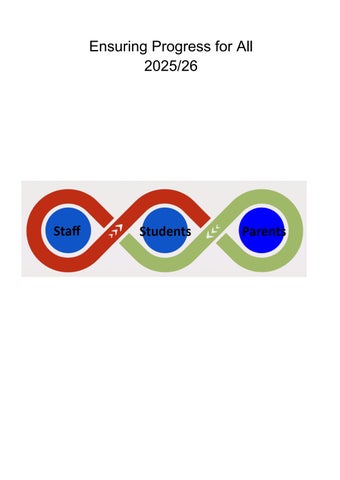
Progress is when our students know more, remember more and are able to do more Progress is seen when students are learning what is intended in the curriculum, which must be both well-constructed and well-taught. Progress will be further evidenced by our disadvantaged and students with SEND acquiring the knowledge and cultural capital they need to succeed in life
We have put a system in place to ensure that our assessment processes test the necessary knowledge and skills and that our feedback supports further progress and closing the gaps. Everyone plays a key part in the process The process is only as robust as the weakest link It is therefore essential that every person have a clear understanding of the process and the role that they play in ensuring that students reach their potential
It is built on a few fundamental principles that underpin everything we do They are:
1. We leave no one behind. We must ensure that we have done everything in our power to assist every student to make the expected progress
2. We have high expectations of ALL students including our disadvantaged and SEND students.
3 Our curriculum adapts to the needs of our students We critically evaluate the gaps after every assessment and adapt what we teach to ensure we close any gaps.
4 The most effective intervention is done by the classroom teacher No one has a better understanding of the gaps in students' learning than their own teacher
5 Every lesson is based on the ACED framework and is aimed at the most able in a class,‘Teach to the Top and scaffold down’, effective scaffolding will ensure that every student can access the content
6 We make every minute of lesson time count- ACED- our DIN task in every lesson promotes this.
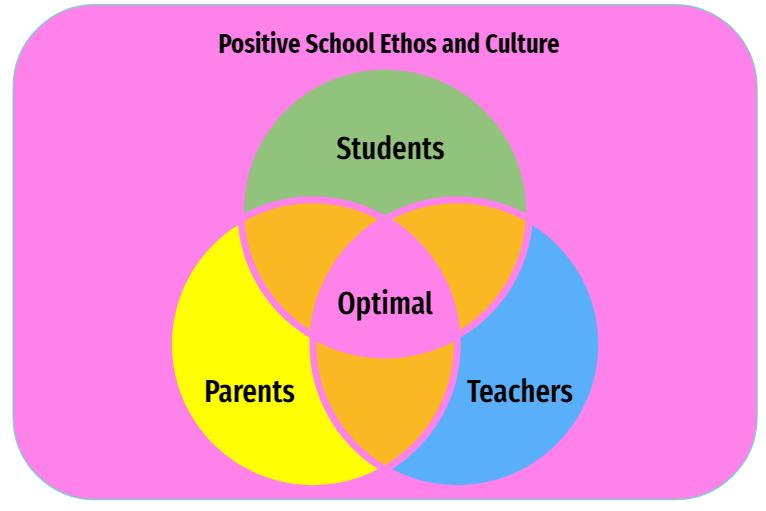
The partnership between Teachers, Students and Parents are the key ingredients for success It is however built on a Positive School Ethos and Culture
● Staff need to hold and model HIGH EXPECTATIONS of learning behaviours and aspirations
● There are specific groups that need to be considered when planning for lessons to ensure that they can access the learning They also need to be monitored closely in every lesson They are
○ Pupil Premium students
○ SEND students
○ EAL students
○ Progress 3 students
○ ATL 4 students
It is essential that thoughts are given to where these students are placed on your seating plan to ensure they receive the expected support They should also be clearly highlighted on seating plans
● Staff need to foster the relationship with parents Parents need to be aware of student’s weaknesses and successes.
● Students that are on a Progress Grade 4 should be actively managed with a detailed intervention plan There needs to be an active conversation with parents on a regular basis Parents need to clearly understand what their role is in closing any learning gaps The plan needs to be updated on Sims on a regular basis and reviewed at every data collection. Subject leads need to take a leading role to monitor intervention and develop alternative intervention strategies
● Parents Evenings: this is an opportunity to engage with parents and develop their understanding of the role that they play in ensuring students reach their potential Discussion needs to be to the point and provide clear direction of what a student needs to do to improve Focus on the data( home learning, test results and engagement in class) Make sure every parent leaves with a clear understanding of what you want them to do to support their child.
● Parents need to take an active role in their child’s progress. Conversations with parents need to provide specific details of what is expected They can only act if they fully understand what needs to be done and when it needs to be done by
● We ensure that they are aware of what their role is by communicating with them on a regular basis. It is essential that we communicate clearly what their child needs to do to improve, but also share success and improvements
● A telephone call is the first choice of communication However, if one needs to document what is expected from a student and the support required from a parent, it is better to use Edulink; our parental communication tool, and to tick the ‘Upload to Communication Log’ button
● Any email to parents of students on a Progress of 4 should be uploaded onto SIMS
● Students need to take responsibility for their progress They can do that if they are fully informed about what they need to do The way we ensure that they are informed is via
○ Active use of the PLC’s & The RVHS Revision/Study techniques
○ Closing the Gap Tasks & use of teacher feedback
○ Regular recall of facts- use of learning checks & retrieval quizzes
○ Skills based Assessments & Examinations
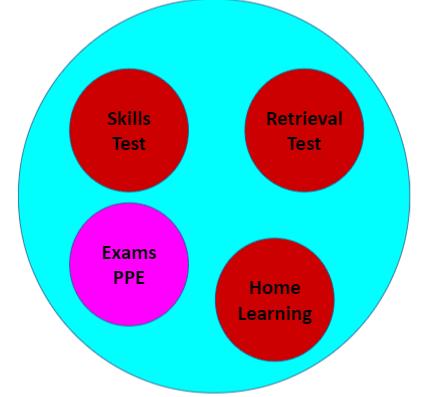
Measuring progress is done via two distinct routes
Subjects have the freedom to structure assessments throughout the period leading up to the data collection.
● Assessments could take the form of:
○ Quizzes (self-marking can assist in reducing workload)
○ Questioning
○ Knowledge tests
○ Retrieval tests
○ Whiteboards
○ Extended writing Tasks
○ Skills tests
○ Learning checks
○ PLCs - student assessment
● Each year group will do at least one Exam that will mimic actual public exams The aim is to ensure that students understand the structure of exams, the compact time frame with exams in close succession and the discipline of being silent and focussed for an extended period of time. The KS3 exam papers will be bespoke and test the appropriate skills that they have been taught The papers are unique to RVHS and contain appropriate elements from GCSE papers
● In Y10 they are examined via actual GCSE Exam style questions.
● In Y11 and Y13 they will be examined via 2 PPE’s that closely resemble the actual exam format
● Y12 will do a Progression Exam at the end of Y12 that will resemble the AS-Level Exams
● We teach them well, ensure that they can access the work and feel challenged and motivated to succeed
● We share their minimum expected target with them and ensure that detail is on the Target Sticker on their exercise book
● We discuss their progress with them after every data collection .
● We get students to actively use their PLC’s to identify their strengths and weaknesses & at which stage in their curriculum they are presently learning
● Targets are shown as G4+/G5+ etc When sharing with students, focus on the fact that we would expect them to reach at least a Grade 4 if their target is a G4+. It is good to get them to understand you will be surprised if they only achieve their target. These targets refer to their minimum expectation in Year 11 We always aspire to achieve highly and should teach to the top to motivate students to achieve above expected
Every student is set a target based on KS2 scores The targets are set using the Fisher Family Trust Methodology
FFT benchmarks are based on how similar pupils nationally performed in the subject last year (similar pupils are defined as similar prior attainment, gender and month of birth) Targets are set for each subject individually
There are three options available:
1 Average – schools that made the average progress last year (FFT50 – 50th percentile progress)
2. High – schools that made greater than average progress (FFT20 – 20th percentile progress)
3 Very High – schools that made much greater than average progress (FFT5 – 5th percentile progress)
Students at Roding Valley make progress that is far above the national average. We therefore set targets that are aspirational and provide a clear indication of what our expectations are for our students
● Targets are set using the FFT model and based on the outcome of the top 5% of schools nationally
● Students that do not have KS2 data will have targets set based on the Baseline tests in Maths and Reading
Students Targets are set as End of Year 11 Targets and student progress is measured against these targets
All midterm admission will sit a baseline test that will allow us to set a provisional target until such time as the target becomes available in FFT
● Assessment Percentage: Percentage that student achieved based on an Assessment or a range of assessments
● Progress Grade: Indication if a student is on track to achieve their EOY11 target
● Creative and Practical Subjects : Report on fluency in the required skills for that subject
● Current Grade: Grade that the student is currently working at. This grade is not reported to parents This grade is collected at every data collection
● Predicted Grade:
○ KS4 - Grade that the student is expected to attend achieve at the end of Y11
○ KS5 - Grade that the student is expected to achieve at the end of Y13
This grade is an indicator of a student’s ability to demonstrate the expected learning behaviour. It is essential that staff understand the meaning of each grade and allocate the correct grade This grade is not based on behaviour but learning behaviour. The descriptors are
Outstanding
Good
Requires Improvement
Concern
I am highly motivated and able to work effectively in a wide variety of situations I take responsibility for my own learning, often doing more than is expected
I am usually well motivated and able to work effectively with support and guidance in a wide variety of situations. I generally do what is expected of me. I am doing everything I can to try and achieve or exceed my target grade.
I am not highly motivated and need considerable support and guidance in order to work effectively I do less than what is expected of me and as a result, I am not likely to achieve my target grade
I am not motivated and need considerable teacher input and control in order to work effectively. As a result, I am unlikely to achieve my target grades. I can be disruptive to the learning of others.
The guidance is that an ATL should be no more than 1 grade above or below their Progress Grade There are however times when that is not a true reflection of their Attitude to Learning. It is expected that you will have a discussion with your Subject Lead and motivate why you believe that should be outside the guidance.
● Progress Grade: The progress grade is a calculated grade that gives an indication whether a student is making the expected progress
○ Progress 1 (Mastered) : a student will exceed their target grade by at least a full grade
○ Progress 2 (Secured) : a student will achieve their target grade.
○ Progress 3 (Insecure) : a student will be less than a grade below their target grade
○ Progress 4 (Concern) : a student will be at least a grade below their target grade
● Any students with a Concern must have an intervention plan in place
● Any student that can not be awarded a grade due to lack of evidence must be given a ‘NA’ for their Current and Predicted Grade and an ATL of 5
● Students are tracked on their progress grade. After every data drop, students get ranked based on their progress grade and ATL across all subjects. Every subject will identify its priority students The Progress Leader will focus on the lowest-ranked students and take a more holistic view
● Students are tracked on their Subject Progress Index(SPI) The SPI do a direct comparison of the outcome of a student compared to similar ability students across the country. It is an excellent indicator of how well a student/class/subject is performing Not all students will have a positive SPI in every subject or overall However, the majority of students should have a positive SPI
● Students are tracked on their Value Added(VA) The VA is how we get measured in performance tables and are similar to the SPI. The expected VA is based on their best 8 GCSE grades It is an excellent indicator of how well a student/class/subject are performing
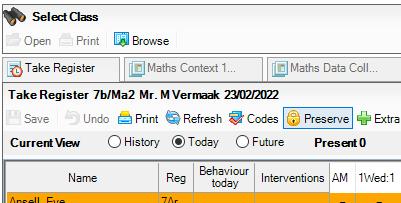
● In KS3 you will find all the data you need in Sims There are 2 main Markbooks, the Data Collection Sheet and the Context Sheet that will be on a tab on your register For more help with using Sims, visit our Sims Microsite
● In KS4 you will find the day to day information on Sims The performance data however will be on Sisra. Our main piece of tracking information is the Subject Progress Index(SPI) which provides a clear indication of how well a student is performing against similar students nationwide For more help with using Sisra, visit our Sisra Microsite
● In KS5 you will find the day to day information on Sims The performance data however will be on Sisra. Our main piece of tracking information is the Value Add (VA) That provides a clear indication of how well a student is performing against similar students nationwide and is how we are measured in the performance tables
● Parents will receive a Progress Grade, indicating whether their child is working at a standard that will allow them to achieve their KS4 target grade. They will also receive an ATL grade. We do not share grades with parents or students. We only share wether we believe that they are on track to reach their End-of-Year 11 Target
In Keystage 4:
● Parents will receive an EOY11 predicted grade, indicating whether their child is working at a standard that will allow them to achieve their KS4 target grade. They will also receive an ATL grade
In Keystage 5:
● Parents will receive an EOY13 predicted grade, indicating whether their child is working at a standard that will allow them to achieve their KS5 target grade They will also receive an ATL grade
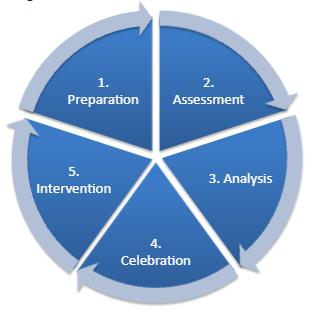
There is a clear Data Collection cycle where every role player will have an essential role
1. Know your students - CPD staff briefing All the key information you should know about your class is available on the Context Sheet It can be accessed as a tab on your register
The key columns that you must use to inform your planning are highlighted in Yellow
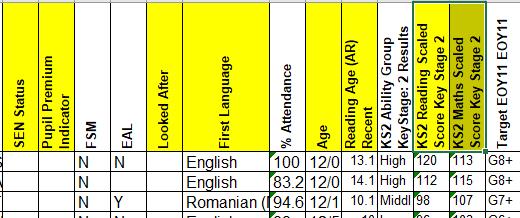
The greatest barrier to accessing the curriculum is a low reading age Students with a reading age that are more than 2 years below their actual age will struggle to access the content A
KS2 Reading scaled score of 100 or above is also an indicator that they are at the expected level of literacy. Any student with a baseline score below 90 will receive additional intervention to close that gap. They should be specifically monitored in Bedrock sessions to ensure that they engage fully. Any student with a baseline score below 85 will be enrolled in the Thinking Reading Program to ensure that they can access the curriculum.
2. Preparation: Students will be clear about the format and content of every assessment. They will understand the criteria for success. For examinations, students will be shown how to incorporate the RVHS Revision Techniques into their own study & make use of our RVHS microsites. Exams Microsite 2022
3. Assessment: The assessment will be accessible for all yet offer challenge for the more able. Any assessment will be followed by a Closing the Gap task that allows students to clearly understand how to improve. It is essential that every student understands how they are progressing towards their end goal. It is essential that teachers create an opportunity for teachers to engage every student in a discussion about progress.
4. Analysis: Subject areas will analyse the performance of key groups and classes to identify changes to the curriculum. The Raising Standards Lead and Progress Leader will analyse the overall performance of key groups and students overall to identify students of concern. A clear plan will be formulated to have the maximum impact.
5. Celebration: Celebrating success helps develop a sense of achievement. Every teacher can celebrate success in their class by awarding ARE points to students that are making or exceeding the expected progress, or if they have shown significant improvement.
6. Intervention All students on Progress of 4 will be given a clear intervention plan by their class teacher The lowest Progress overall and lowest Disadvantaged students will be monitored by the Progress Leader. Exams groups will be allocated to targeted intervention groups to ensure the best possible outcome for students
All students that are in danger of being at least a grade below their target grade must have a detailed intervention plan that clearly addresses the gaps in their knowledge This needs to be clearly communicated to parents and they need to have an understanding of what is expected from them
No parents should receive a red progress grade on a report without first receiving a phone call clearly explaining the reasons for their underperformance
These students should be the ones that get prioritised for marking and review of their books.
Some practical intervention strategies for classroom intervention
These students will be monitored closely They should clearly understand what they need to do to improve. They should be the second priority for marking and reviewing their books. Most of these students will close the gap with the heightened level of scrutiny
The Academic mentor has a crucial role in ensuring students make progress. The key elements of the role are
1. Bedrock: Monitoring and following up on the time spent and progress on Bedrock This is our main intervention and catchup strategy to ensure that students can access the curriculum
2. Setting the tone for the day:
a Ensuring that students have the correct equipment allows teachers to focus on teaching and any barriers to engaging fully in every lesson are eliminated by every student being fully equipped
b Ensuring that students in KS3 have a reading book and following up on their progress with the book
c Ensuring students are dressed appropriately in the correct school uniform and supporting students who need support to wear the correct uniform so all students appear equal
d Foster positive relationships with the students so they know you have high expectations of their progress and conduct, but they can approach you if they have any concerns that they need support with.
3. Targeting support for disadvantaged, SEND & EAL students.
a Ensure that these students have access to all the resources they need
b. Take an interest in their progress and make time to talk to them after every data collection to set appropriate targets and agree interventions
c. Ensure positive relationships are established with these students (as above) but also with their parents and carers to further support their needs and work together to eliminate any barriers to learning
How do we ensure our students can access the Curriculum?
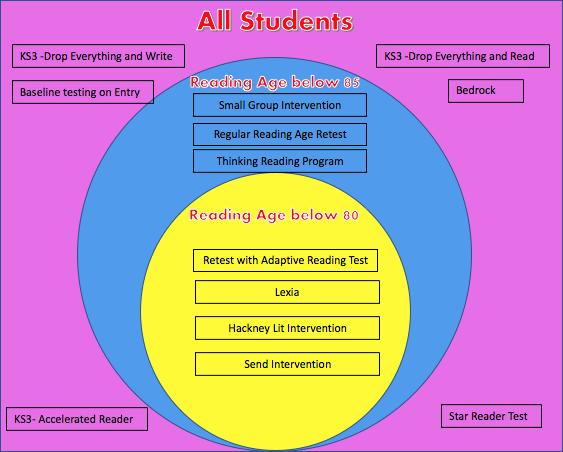
Literacy is the key to accessing the curriculum. We have a structured approach to ensure that students gain the required literacy skills to be able to access the curriculum by the end of KS3
The bulk of Interventions flows from the baseline test for year 7 The interventions in place are
1. All students do Bedrock. Bedrock is our main catchup intervention to ensure students can access the curriculum It supports the development of essential tier 2 and tier 3 vocabulary
2 All KS3 students do DEAR/DEAW time
3. Year 7
a all students do accelerated reader and the star reading assessments
b Students with a reading age below 85 do small group intervention in English
c Students with a reading age below 80
i. Lexia
ii Hackney Lit
iii SEND interventions
iv. Adaptive Reading Test 3 times a year
4 All students with a Standardised Reading Score below 85 will be enrolled in the Thinking Reading program to ensure they can access the curriculum
Tier 3 vocabulary is broken down using word etymology as a deliberate whole school practice
Vocabulary is deliberately promoted via word of the week The enthusiasm of all staff in promoting this in every subject is key to the success of the initiative
Upon entry, bilingual students are assessed for English Competency using baseline testing.
To be set up with a peer buddy
● A bilingual welcome pack
● A bilingual interview and language acquisition assessment
● Sourcing of bilingual curriculum materials
Then: a short language profile report to teachers to be written with strategies.
Descriptors for Codes of Competency and Steps (DfES, 2015)
● Codes A to B need some intervention and a bilingual learners’ toolkit
● Code C needs vocabulary (similar to the whole cohort) and extra time to mentally translate.
● Codes D to E will need help on some words, but are competent to a good standard; they can also be entered into home language GCSEs and used to help others in their language.
New to English (Code A)
Acquisition (Code B)
Afterwards:
● ESOL input (10 lessons on basic vocabulary and grammar) – extracurricular (to be further developed)
● ESOL Google classroom and on-line resources to be developed
● A fortnightly check-in to see how they are
● The offer of a home language GCSE where possible
● Liaison with the YPLS on whether translators are needed for parental meetings
Further:
● Assessing English-language acquisition progress
● Noting code of proficiency on SIMS
● Ensuring SIMS is up-to-date on EAL cohort
● Applying for EAL access arrangements
● Subject areas will utilise subject-specific tools to aid translation in home language - ie visual glossaries
● Flash Academy will be used as an intervention tool to support the development of English Language
Descriptors for Codes of Competency and Steps (DfES, 2015)
● Codes A to B need some intervention and a bilingual learners’ toolkit
● Code C needs vocabulary (similar to the whole cohort) and extra time to mentally translate.
● Codes D to E will need help on some words, but are competent to a good standard; they can also be entered into home language GCSEs and used to help others in their language.
. Preparation
2. Assessment
3. Analysis
5. Intervention
4. Celebration