
Upcoming CLE Guide
WRAP UP YOUR 2025 CLE REQUIREMENTS WITH THESE DECEMBER
PROGRAMS
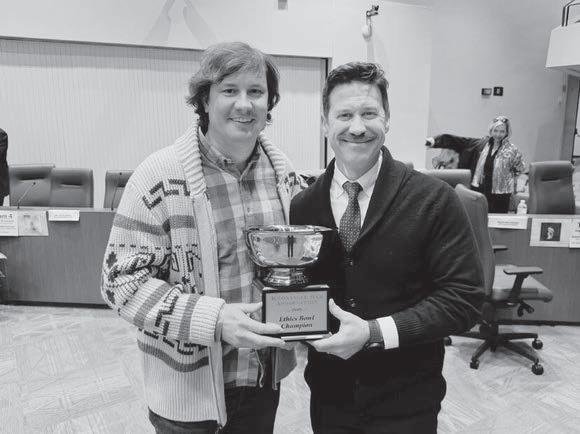
Ethics Bowl XIX: Redemption Year - A Second Bite of the Apple
Friday, December 5, 1-4:15 p.m. | City County Building, Main Assembly Room
Who will take home the Trophy this year? See this year's team participants on the event page. 3 hours of Dual CLE
Sponsored by Thomson Reuters





Tennessee Family Law Update 2025
Tuesday, December 9, 12-1 p.m. | Webinar via Zoom
K.O. Herston, Herston Law Group, PLC
Presented by the KBA Family Law Section 1 hour of General CLE
Sponsored by SmartBank
Mediation: Practice & Ethics Update 2025
Tuesday, December 16, 4 - 5 p.m. | Webinar via Zoom
Chad Hatmaker, Woolf, McClane, Bright, Allen & Carpenter, PLLC
Presented by the KBA ADR Section
1 hour of Dual CLE & 1 hour of Ethics CME Sponsored by First Horizon Still short on CLE credit? Finish your hours before the holiday season!! KBA On-Demand Programs:

Bankruptcy Case Law Update 2025
Wednesday, December 17, 12 - 2 p.m. | City County Building, Small Assembly Room | Soccer Taco buffet lunch included
Gregory C. Logue, Woolf, McClane, Bright, Allen & Carpenter, PLLC
Kevin S. Newton, Law Offices of Mayer & Newton Shanna Fuller Veach, U.S. Bankruptcy Court Presented by the KBA Bankrupcty Section 2 hours of CLE
2025 Updates in Legal Malpractice (Navigating Shark Infested Waters)

9.5 Ways to Torpedo a Mediation - A Practical Guide for Mediators and Attorneys
Current Order of Protection Issues
Vital Security Practices Every Law Firm Should Adopt Today
Residential Landlord-Tenant Update in a Post-COVID World Mediating Employment Matters, Settlement Offers, Attorney’s Fees, Tax Status
Ensure Your Mediation ThrivesAdvice from Seasoned Experts
Legislative Update: A New Look for the Tennessee Expungement Statute Conservatorship Refresh with Clerk & Master
AI in Legal Practice: Unlocking Microsoft 365 Copilot and LLMs for Secure Use
Modernization of Tennessee’s Foreclosure Law
Wrestling with Ethics
Employment Law Update 2025 And many more!
Register for any of these programs by visiting knoxbar.org/CLE or by scanning the QR Code below (865) 522-6522
Recieve 15 hours at a discounted rate with the CLE Easy Pass! Visit knoxbar.org/easypass
Contact Us cle@knoxbar.org



Courteney M. Barnes-Anderson
R. Kim Burnette
Melissa B. Carrasco
Meagan Collver


Samuel K. Lee
T. Mitchell Panter
M. Samantha Parris
Courtney Epps Read


Charles S.J. Sharrett
James R. Stovall
C. Scott Taylor
Alicia J. Teubert

The Pulpit Is No Place for a Scared Preacher 7 Appealing
I Won’t Back Down . . . Oh Well, Whatever, Never Mind
8 Legal Update
Humphrey’s to the Slaughter
19 Schooled in Ethics
Ethical Duties of Lawyers Acting as Mediators
21 Management Counsel
Avoiding “One of Those Questions” During an Interview 9 Around the
Rewiring the Legal Mind: How Positive Thinking Transforms Performance Under Pressure
21st Century Lawyer Relationships Matter
Hello My Name Is Emily Threatt
Three Stars
The Steady Star
Of Local Lore and Lawyers ‘Tis the Season for Holiday Stress: Mindful Tips to De-Stress Over the Holidays
Legally Weird
What’s In a Name?
Well Read
Dicta
DICTA is published monthly (except July) by the Knoxville Bar Association. It is designed to offer information of value to members of the local bar association. The news and features should illustrate the issues affecting the bar and its members. The opinions expressed do not necessarily represent those of the Knoxville Bar Association.
All articles submitted for publication in DICTA must be submitted in writing and in electronic format (via e-mail attachment). Exceptions to this policy must be cleared by KBA Executive Director Tasha Blakney (522-6522).
Publications Committee
Executive Editor Sarah Booher
Executive Editor Wade H. Boswell, II
Executive Editor Melissa B. Carrasco
Executive Editor Summer McMillan
Sherri Alley
Parker Bohne
Elizabeth B. Ford
Joseph G. Jarret
F. Regina Koho
Matthew R. Lyon
Robin McMillan
Angelia Morie Nystrom
Katheryn Murray Ogle
Bridget Pyman
Cathy Shuck
Jimmy Snodgrass
Eddy Smith
Grant Williamson
Managing Editor Tasha C. Blakney
KBA Executive Director
A New Orleans Classic: The Moviegoer, by Walker Percy
Privileged to Be in the Law
I Hear You
Foodie Finds
Smoked Pickle Barbecue
KBA Volunteerism
Volunteerism: Stories of Service
Top Ten Stress Inducers of the Holiday Season
Outside My Office Window Thankful for this Lumpy Life
Tasha C. Blakney Executive Director
Tracy Chain LRIS Administrator
Tammy Sharpe Director of CLE & Section Programming
Bridgette Fly Membership Coordinator
Jason Galvas Programs & Communications Coordinator


By: Jonathan D. Cooper Knox Defense

THE PULPIT IS NO PLACE FOR A SCARED PREACHER
I spent every summer, beginning at age 12, working on my grandfather’s cotton farm in the Mississippi Delta. It was hot work and long hours, but $20 a day seemed like a fortune! Over the years, the farm introduced soybeans as a crop, and so I have followed with interest and concern the news about American soybean farmers this year.
As you likely have read, China stopped buying U.S. soybeans earlier this year in response to tariffs imposed by the U.S. Last year, China purchased 985 million bushels of soybeans, or about half of all U.S. exports.1 Since May, China has purchased virtually no soybeans from the U.S., causing severe economic hardship to farmers who already struggle to survive2 amidst a sharp drop in soybean prices.3
The soybean farmers’ true and lasting threat comes from the fact that China has developed other suppliers to fill their demand for this crop. China has invested in Brazilian agriculture for the past two decades and this year purchased 2.5 billion bushels of soybeans from the country.4 With a little help from Argentina and other countries, Brazil could fulfill all of China’s import needs, and at a cheaper price than U.S. soybeans.5
I cite soybean farming as an example of a governmental policy that creates a systemic disruption which may fundamentally, and permanently, change that system. My concern is that, like an economic policy from which we cannot fully recover, this administration’s challenge to historic norms, democratic principles, and the rule of law stands to profoundly change our institutional standards and erode our society’s confidence in those standards.
The current administration’s disregard for our country’s rule of law is well documented, and I have focused on many of these issues in my columns this year. Whether it has been passive defiance of court rulings, direct attacks on law firms and individual attorneys within those firms, dangerous political rhetoric, deployment of the military in civilian life, use of criminal prosecutions to punish political foes and settle grievances, pardoning allies, or many other examples, the President appears “determined to push the bounds of legal and constitutional norms.”6
More specifically, through the use of executive orders and administration policy, the President has targeted law firms whose attorneys investigated him, stripping security clearances, barring them from federal buildings, and threatening to terminate government contracts. He has called judges who have ruled against him or his policies “radical left lunatics” and “deranged,” and has called for their impeachment.7 Very recently, the Justice Department, sought to impose federal sanctions on a California lawyer who attempted to block the deportation of his client.8
Some may celebrate these political initiatives because they further the President’s agenda. As lawyers, though, we cannot tolerate endsjustifies-the-means policies if they weaken our justice system and imperil the public’s view of our legal institutions. We are bound to defend the process, not just the outcome.
This is true regardless of which person holds the office of the
President. My concern is that any weakening by this administration or any other of our democracy, and the legal principles which support it, will simply pave the way for further erosion by the next administration. Could we be facing the plight of the soybean farmer, where circumstances develop to the point where there can be no return to a vibrant and healthy democratic equilibrium? Time will surely tell.
In the meantime, as I wrote in my February column, lawyers have a responsibility to (1) speak against misinformation, (2) educate the public, (3) build respect for our legal institutions through charitable service, and (4) speak truth to power. The ABA Task Force for American Democracy urges that “state and local bar associations continue efforts to address threats to democracy, the rule of law, and the independence and legitimacy of the courts,”9 and notes that lawyers have a “special obligation” to respect and promote the rule of law, our democracy, the courts, and court orders.10
It’s not always easy or pleasant to speak against principalities and powers, and sometimes there are consequences for doing so. It will not necessarily make you popular. However, we have the “special obligation,” the education, the training, and the experience to speak articulately when called upon to do so. We all have a “pulpit” by virtue of our position and profession, and the pulpit is no place for a scared preacher.11
So, in the concluding words of my final column as KBA President, I urge you to take courage, stand up for what is right, and accept your special obligation to respect and promote the rule of law and our democracy.
1 Faith Parum, Agricultural Trade: China Steps Back from U.S. Soybeans, Farm Bureau MarketIntel (Oct. 2, 2025), https://www.fb.org/market-intel/agricultural-tradechina-steps-back-from-u-s-soybeans.
2 Cecilia Vega, For Some Hurting U.S. Soybean Farmers, A Trade Deal with China May Not Be Enough to Save the Farm, CBS News (Nov. 9, 2025), https://www.cbsnews. com/news/for-some-us-soybean-farmers-china-trade-deal-may-not-be-enoughto-save-farm-60-minutes-transcript.
3 Faith Parum, Agricultural Trade: China Steps Back from U.S. Soybeans, supra
4 Myra P. Saefong, Here’s What the U.S.-China Trade Truce Really Means for the Soybean Market — And American Farmers, Wall Street Journal Market Watch (Nov. 8, 2025) https://www.marketwatch.com/story/heres-what-the-u-s-china-tradetruce-really-means-for-the-u-s-soybean-market.
5 Id.
6 American Bar Association, Report of the ABA Task Force for American Democracy, p. 1 (Sept. 10, 2025).
7 Deirdre Schifeling, How Trump’s Attacks on Democracy Put the Constitution at Risk, ACLU.org, https://www. aclu.org/news/civil-liberties/how-trumps-attacks-ondemocracy-put-the-constitution-at-risk, September 17, 2025.
8 Josh Gerstein, ‘This is sending a message’: DOJ moves to sanction lawyer who took pro bono deportation case, Politico, https://www.politico.com/ news/2025/08/06/justice-department-sanctions-immigration-lawyer-00496886, August 6, 2025.
9 American Bar Association, Report Of The Aba Task Force For American Democracy, supra at p. 11.
10 Id.
11 Credit for this phrase goes to Dr. Ernest Brothers, Associate Dean of the University of Tennessee Graduate School.

JUDICIAL PROFILE
By: Katie Ogle Burks & Ogle
JUDGE HECTOR SANCHEZ: HONOR, INTEGRITY, AND SERVICE
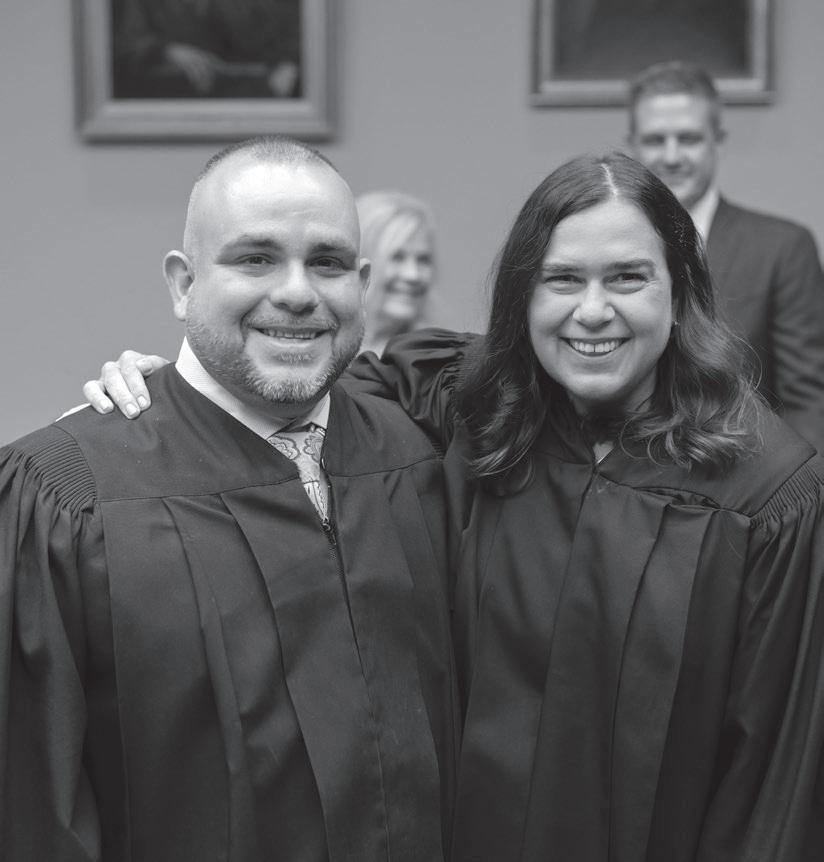
For Knox County Division II Criminal Court Judge Hector Sanchez, coming to work each day is an honor. “I absolutely love what I do,” notes the jurist. “I love being in trials, hearing attorneys make interesting arguments, and advocate for their clients. It’s an honor to serve the citizens of Knox County in this role.” Judge Sanchez’s path to this role, though, has had many twists, turns, and even highly classified military experiences.

Born in Texas, he moved to Boston, Massachusetts, as a child and considers this the place where he really spent most of his childhood. In 2003, he and his family moved to the Knoxville area, and he began working at a local furniture store. Following this, he joined the United States Marine Corps and proudly served for four years. During his time in the Marines, Judge Sanchez not only served our country, but requested an individual augmentation deployment in which he relieved a Marine, Soldier, Airman, or Sailor who had been in combat theatre for a considerable amount of time. In this assignment, Judge Sanchez was deployed to Afghanistan where he remained for much of his military service.
Upon returning stateside, he enrolled in an undergraduate program at Old Dominion University in Norfolk, Virginia, and began studies in criminal justice. After graduating, he had an interest in law school but didn’t really know much about the operations of the court system. “I took that opportunity to work full-time in the Knox County District Attorney’s Office and really see how our courts function,” says the judge. “Initially, I worked in the felony sessions unit where I built the physical file from the indictment forward, and then I worked in what is now major crimes. My primary role was to assist attorneys in trial preparation for capital cases that were being retried. After this experience, I knew I was going to apply to law school.” During his law school tenure, Judge Sanchez interned in the Knox County District Attorney’s Office, and following graduation, began work as an Assistant District Attorney General.
Appointed to the bench by Governor Bill Lee in September of 2022, many of the skills Judge Sanchez uses in his day-to-day work were honed during his time working for Charme Allen in the Attorney General’s Office for the Sixth Judicial District. “Trial experience as an assistant DA was huge for me. I was appointed by the Governor, sworn in the next day, and began hearing cases immediately. I would have been at a huge disadvantage if I hadn’t had such significant experience as an Assistant District Attorney.”
When asked about the most surprising aspect of his role, Judge Sanchez notes that many don’t realize the volume of cases that Knox County Criminal Courts hear. “In 2024, Knox County’s criminal courts held nearly 100 jury trials in a span of 217 days. In Division II alone, there were well over 6,000 cases that were heard.” Judge Sanchez is also especially proud of the work completed through other unique court programs like Veteran’s Court and Drug Court. “ To give somebody the tools they need to be successful and to see them utilize those tools and take it seriously, that’s incredibly rewarding for a criminal court judge.”

LRIS is NOT pro bono. Since January 2025, panel members have earned over $2.58 million from LRIS-referred cases. LRIS membership just may be the best ROI for your marketing dollar.

For more information, contact Tracy Chain, LRIS Administrator (865)522-6522 tchain@knoxbar.org www.knoxbar.org/joinLRIS
APPEALING
By: Robin McMillan Attorney at Law

I WON’T BACK DOWN . . . OH WELL, WHATEVER, NEVER MIND
Imagine that you represent an appellant in a pending civil appeal who decides not to pursue the appeal. Perhaps the parties have reached an agreement. Or, upon further reflection, your client has decided to accept the trial court judgment. What do you do? Tennessee Rule of Appellate Procedure 15 sets out the procedures to follow.
If your client was granted leave to appeal to the Tennessee Supreme Court pursuant to Tenn. R. App. P. 11 and all parties agree to dismissal of the appeal, file a motion and a proposed order of dismissal with the Court Clerk.1
If the appeal is pending before the Tennessee Court of Appeals, there are three possible approaches toward dismissal. One applies to cases that require trial court approval of a settlement agreement. In these situations, the parties should file a joint motion in the appellate court seeking a remand for the limited purpose of approving the settlement agreement.2 This step, however, does not end the parties’ obligations in the appellate court. If upon remand the trial court approves the settlement,3 then within thirty days “the parties jointly shall file in the appellate court a motion to dismiss the appeal,” accompanied by the settlement agreement and the trial court’s approval thereof.4 Additionally, that joint motion “shall provide for the assessment of costs on appeal.”5 When trial court approval of settlement is required, ensure that all steps of the process are completed to obtain an order of dismissal.
If trial court approval of a settlement is not required, the parties may file a stipulation of dismissal, which must be signed by all parties.6 If all parties agree, this is generally the fastest route toward entry of an order. 7
Alternatively, if trial court approval is not required, appellant may file a motion to dismiss the appeal.8 This method does not require the agreement of other parties. It will, however, take a bit longer to obtain the order of dismissal. Why? Because the other parties have ten days within which to file a response to appellant’s motion to dismiss.9 Absent the clear indication of an agreement, as signified by the signatures of all parties, the Court will wait the response time prior to entering an order.
Why will the Court wait if the appellant wants to dismiss the appeal? The answer lies within Rules 3 and 13 of the Rules of Appellate Procedure. They make it clear that in civil cases, “[c]ross-appeals, separate appeals, and separate applications for permission to appeal are not required.”10 Once an appeal has been filed any party can raise issues for consideration. Even if appellant decides not to pursue the appeal, appellee retains the right to do so.
How does this play out in practice? Let’s say that appellant files a motion to dismiss. Appellee decides to pursue the appeal. Within ten days of the filing of appellant’s motion to dismiss, appellee will file a notice of intent “to litigate appellate issues.”11 The contents of that notice will differ slightly given the posture of the appeal.
If the appeal is in the pre-briefing-stage, the appellee should timely file a notice similar to one an appellant would file to initiate an appeal simply stating an intent to pursue issues. Appellee will not need to designate the judgment or list the parties upon whom service is required because the Court Clerk already has this information.12 Rule 3(f) and the Advisory Commission Comments thereto make clear that the timely filing of a notice of intent to appeal is all that is required in order to raise any issue of law.13 No formality of notice is required, and issues need not formally be declared prior to briefing.
The contents of appellee’s notice will differ slightly if the appeal has already been briefed. In this situation, appellee should file a notice of intent pointing out the separate issues appellee intends to pursue, which were properly raised in appellee’s brief. Remember, the failure to raise issues in a brief results in waiver of those issues.14 Thus, appellee should already have raised and fully briefed the issues. If an appellee timely files a notice of intent, the Court likely will enter an order re-designating the parties such that the appellee will become the appellant and vice versa. The Court may also clarify deadlines given the change in posture of the parties. The appeal will then proceed.
Tangentially, an appellee may decide not to participate in an appeal for one reason or another. So, what do you do when you represent an appellee who will not participate? Please, notify the Court. If your client was a named party to the suit, your client is considered a party to the appeal. The Court will not assume that a named party will not participate. Such an assumption might result in prejudice. Filing a notice of non-participation will forestall the Court having to issue a show cause order to address your failure to file a brief. Avoid causing the Court this unnecessary work.
1 Tenn. R. App. P. 15(b).
2 Tenn. R. App. P. 15(c).
3 If the trial court does not approve the settlement, the appellant must notify the appellate court so that the appeal may proceed. Tenn. R. App. P. 15(c).
4 Tenn. R. App. P. 15(c) (emphasis added).
5 Id.
6 Tenn. R. App. P. 15(a).
7 The appeal is not dismissed until the Court enters an order of dismissal.
8 Tenn. R. App. P. 15(a).
9 Tenn. R. App. P. 22(a).
10 Tenn. R. App. P. 13(a); see also Tenn. R. App. P. 3(h) (“Cross Appeals and Separate Appeals Not Required in Civil Cases.”).
11 Tenn. R. App. P. 15(a).
12 Tenn. R. App. P. 3(f).
13 Id., Adv. Comm’n Cmts.
14 See, e.g., Hodge v. Craig, 382 S.W.3d 325, 335 (Tenn. 2012) (“Parties [other than the appellant] may present [separate] issues. . .. To do so, however, Tenn. R. App. P. 27(b) requires a party to include in its brief ‘the issues and arguments involved in [its] request for relief . . .’ ”) (quoting Tenn. R. App. P. 27(b)).

LEGAL UPDATE
By: Maria Gillen1 Tennessee Valley Authority Office of the General Counsel
HUMPHREY’S TO THE SLAUGHTER
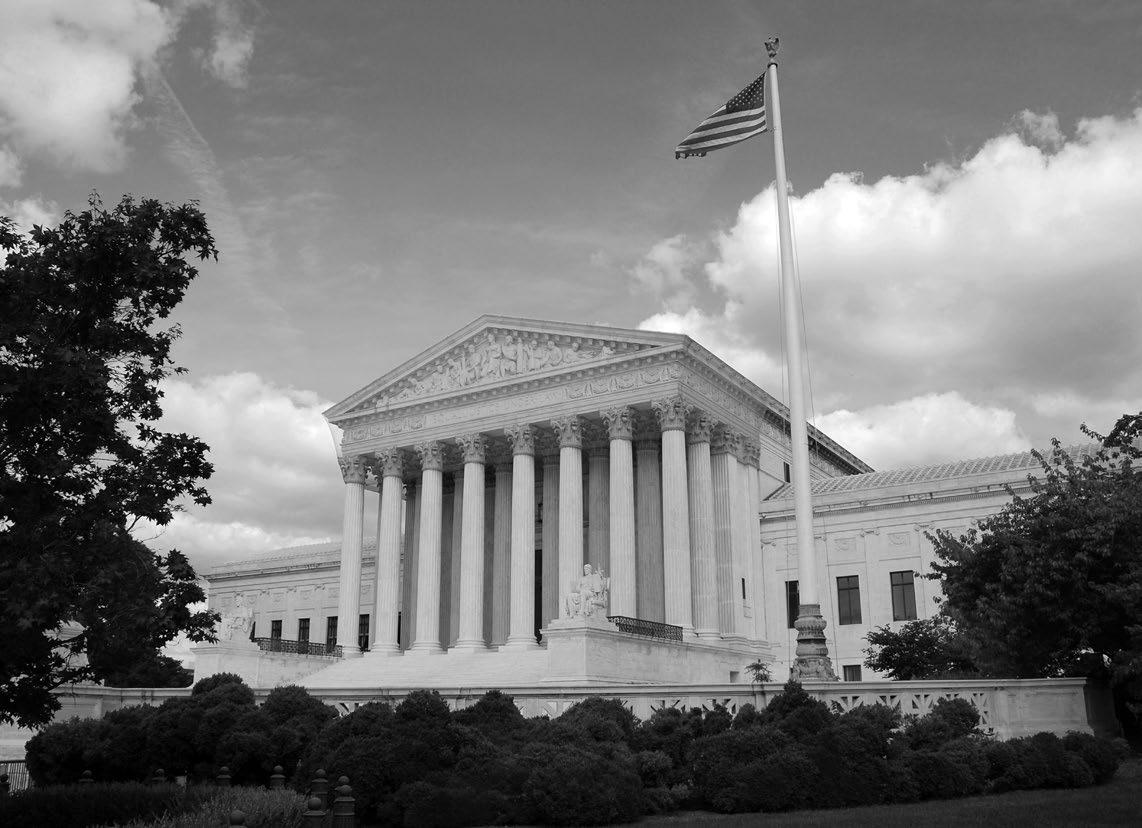
1Trump v. Slaughter,2 scheduled for oral argument before the Supreme Court on December 8, 2025, promises a separation of powers showdown and the potential overturning of a 1936 precedent, Humphrey’s Executor v. United States. 3 Humphrey’s Executor shields certain agency heads from full presidential control. Slaughter, ironically, involves an agency head from the very agency that gave rise to Humphrey’s Executor in 1936— the Federal Trade Commission. In Slaughter, the Supreme Court is addressing: (1) whether the statutory removal protections for members of the FTC violates separation of powers, and, if so, whether Humphrey’s should be overruled; and (2) whether a federal court may prevent a person’s removal from public office, either through relief at equity or at law.4
The Federal Trade Commission was established in 1914 by President Wilson to protect consumers and competition.5 It is composed of five commissioners, appointed by the President, “by and with the advice of the Senate.”6 Not more than three of the commissioners shall of be members of the same political party.7 The president can remove any commissioner for “inefficiency, neglect of duty or malfeasance in office.”8
In March 2025, President Trump removed two Democratic commissioners—Rebecca Kelly Slaughter and Alvaro Bedoya.9 The dismissal letters did not say that Slaughter or Bedoya were being dismissed for any of the statutory reasons, merely that their continued tenure did not comport with the administration’s priorities. The firings drew criticism from Democratic senators and antimonopoly groups concerned that the move was designed to eliminate opposition within the agency to big corporations.10
In July, Judge Loren AliKhan (D.D.C.) denied Trump’s application for a stay of her order enjoining defendants from removing Slaughter, relying principally on Humphrey’s Executor: (“[U]nless the Supreme Court expressly overrules Humphrey’s Executor, which speaks directly to removal protections for FTC commissioners, this court will not usurp the Supreme Court’s ‘prerogative . . . to overrule one of its [own] precedents.’”).11 The judgment of the district court was appealed to the U.S. Court of Appeals for the District of Columbia Circuit. In a per curiam decision, the appellate court kept the ruling in place, denied a stay pending appeal, and dissolved the administrative stay. The appellate court relied on Humphrey’s Executor: “[T]he Supreme Court has repeatedly and expressly left Humphrey’s Executor in place, and so precluded Presidents from removing Commissioners at will.” Then just four months ago, the Supreme Court stated that adherence to extant precedent like Humphrey’s Executor controls in resolving stay motions. “To grant a stay would be to defy the Supreme Court’s decisions that bind our judgments. That we will not do.”12 Judge Rao filed a dissent finding that recent rulings from the Supreme Court in analogous cases required the circuit court to exercise its equitable discretion to stay the district court judgment.13
The Administration argues that Humphrey’s was wrong when it was
enacted and has become more so as the FTC’s powers have expanded since 1936. The argument continues that as the “modern” FTC exercises broad investigatory, adjudicatory, judicial, and rulemaking powers, it is not the same commission that the Court examined in 1936. The principles in Humphrey’s have eroded over time, and that subsequent precedent, namely Seila Law, LLC v. Consumer Financial Protection Bureau14 and Collins v. Yellen,15 control. Those cases, dealing with different “independent agencies,” held that the President has the power to remove, at will, any principal officer who exercises “substantial” or “important” executive power. It is fair to assume that Slaughter’s brief, not yet filed at press time, will emphasize Humphrey’s Executor arguing it dealt with exactly the issue here.
The consensus among court watchers is that the Court will distinguish Humphrey’s and limit it. One pundit predicts a “mend it, don’t end it” approach.16
1 Any views expressed here are those of Ms. Gillen and not of the Tennessee Valley Authority.
2 Dkt. No. 25A264
3 Humphrey’s Executor v. United States, 295 U.S. 602 (1935).
4 See Grant of Application for Stay, 606 U.S. ___ (2025). The order also provided that “the application is also treated as a petition for certiorari before judgment is granted.” This is a rare procedure under S. Ct. R. 11 that has been invoked 3 times between 1988 and 2004 and zero times from 2004 to February 2019. Since Feb. 2019, it has been granted 25 times. Stephen Vladeck cast doubt on: “[u]sing a tool that was meant to expedite merits review of cases of national importance to summarily wipe away lower-court rulings of more modest significance without any of the benefits of plenary review.” Stephen Vladeck, The rise of certiorari before judgment, SCOTUSblog.com (Jan. 25, 2022).
5 15 U.S.C. § 41.
6 Id.
7 Id.
8 Id. Cf. FTC. v. Am. Nat. Cellular, Inc., 810 F.2d 1511, 1513 (9th Cir. 1987) (in case challenging the FTC’s institution of preliminary and injunctive relief against cellular phone carrier affirming the constitutionality of the FTC and agreeing with the district court’s finding that the statute’s limitation on the President’s power to remove an FTC commissions except for cause was only meant to limit the President’s removal power not eliminate his appointment function).
9 David McCabe and Cecilia Kang, Trump Fires Democrats on Federal Trade Commission, The New York Times, (Mar. 20, 2025), last accessed Nov. 11, 2025. Bedoya later resigned after the complaint was filed.
10 Supreme court lets Trump fire FTC commissioner for now and will hear arguments later, The Guardian, Donald Trump | The Guardian (Sept. 22, 2025), last accessed Nov. 11, 2025.
11 Order, Slaughter v. Trump, Civ. A. No. 25-909 (LLA), Doc. 58 (July 24, 2025).
12 Order, Slaughter v. Trump, No. 25-5261, Doc. 2133109 (September 2, 2025).
13 Id., Rao dissent.
14 Seila Law, LLC v. Consumer Fin. Protection Bureau, 591 U.S. 197 (2020) (for-cause restriction of President’s executive power to remove CFPB’s single Director violated constitutional separation of powers).
15 Collins v. Yellen, 594 U.S. 220 (2021) (Housing and Economic Recovery Act’s forcause removal restriction violated constitutional separation of powers).
16 Adam White, Is Humphrey’s Executor headed for Slaughter?, SCOTUSblog (Oct. 2, 2025, 9:15 AM), https://www.scotusblog.com/2025/10/is-humphreys-executorheaded-for-slaughter/, last accessed Nov. 11, 2025.
AROUND THE BAR
By: Tasha C. Blakney Knoxville Bar Association Executive Director

THE KNOXVILLE BAR ASSOCIATION WELCOMES NEW FELLOWS AND AWARDS GRANTS
Since its inception in 1997, the Knoxville Bar Foundation has awarded grants totaling nearly $600,000! In keeping with that tradition, the Foundation awarded grants to these worthwhile organizations in 2025:
• CASA of East Tennessee-to expand advocacy services for abused and neglected children in Knox County Juvenile Court
• Knox County Juvenile Court—in support of the ASIST program for juvenile status offenders
• Knoxville Bar Association Barristers Mock Trial Committee—to support the annual high school mock trial competition, one of the largest undertakings of the Barristers each year, and one which directly impacts the public’s knowledge and understanding of the legal system

Project--to help fund law student interns and externs as they undertake efforts to promote justice by exonerating those who have been wrongly convicted
• Justice for All—This program collaborates with our Federal Bar Association and the Eastern District of Tennessee to support and encourage underserved students in Knox County to pursue career goals in the legal field
• Full Circle Reentry Program— to support individuals who are transitioning from the federal prison system into society
• Community Mediation Center— to support the organization’s efforts to train and provide mediation services to underserved communities
• Free Hearts—to support the efforts of this organization as they undertake to restore voter rights for the formerly incarcerated and to expand voting access in our communities


• Legal Aid of East Tennessee--to continue funding the Knoxville Bar Foundation Fellowship, so that a law student may have an opportunity to hold a public-interest law clerkship and thereby provide support to Legal Aid’s Pro Bono Project
• SEEED Inc.--to administer the Career Readiness Program and expose students to the justice system
• Tennessee Innocence
• Adelante—to recruit and train lawyers to assist noncitizens who are detained in the Knox County Jail
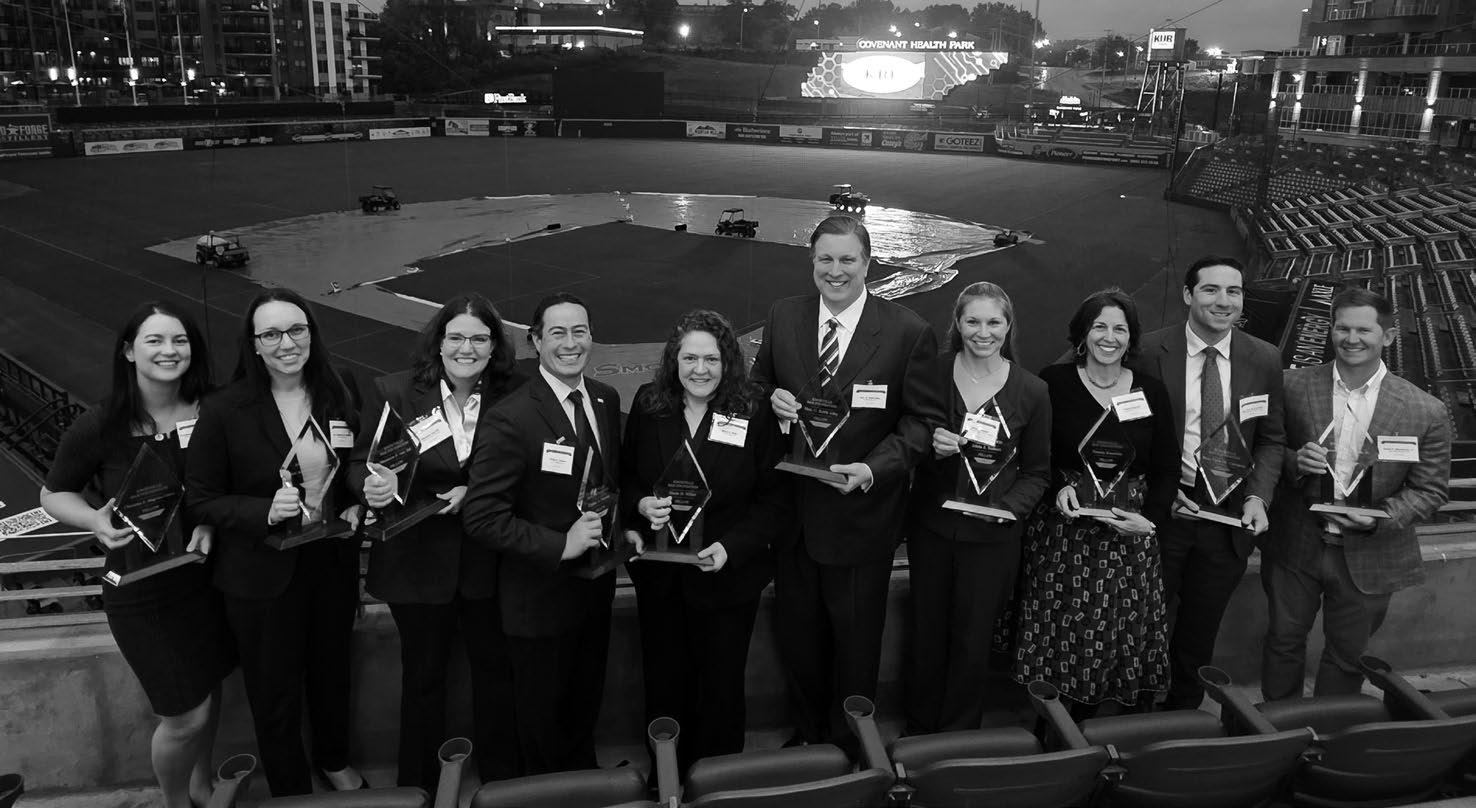
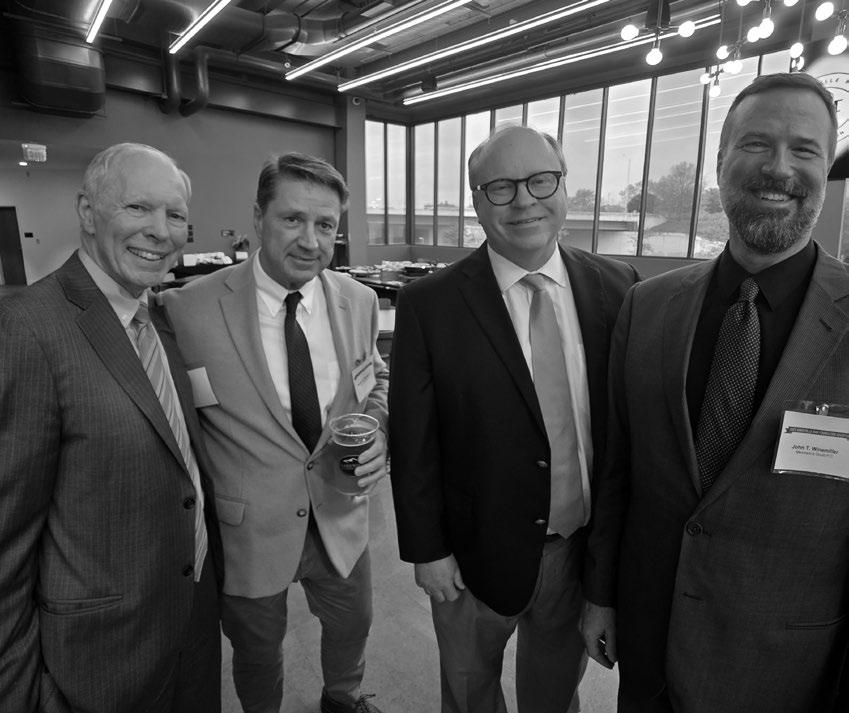
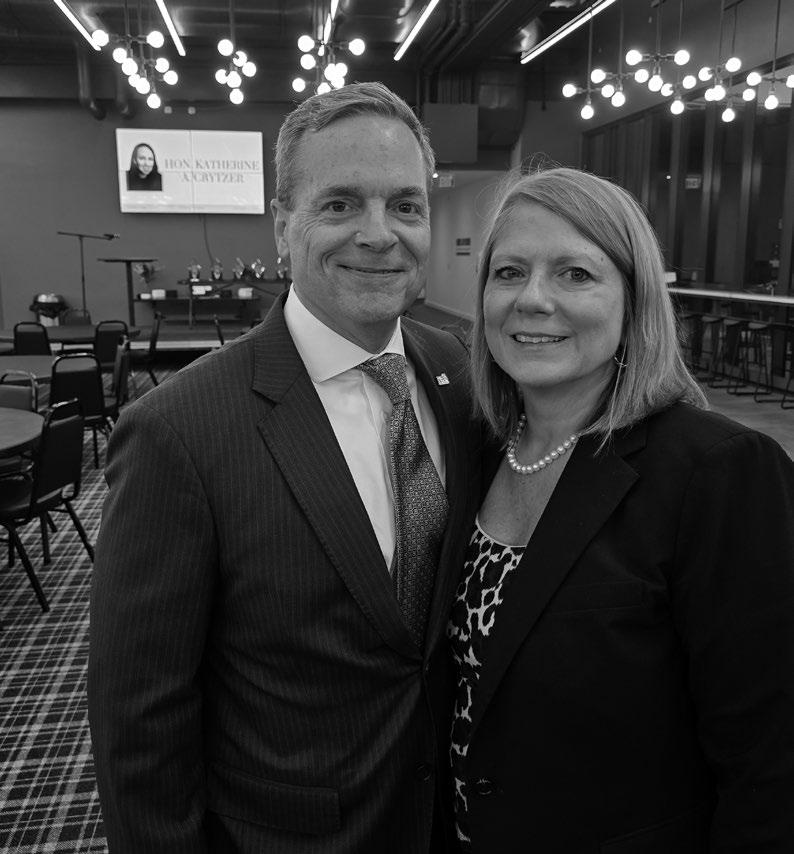
The Foundation also inducted its class of 2025 Fellows at a reception at Covenant Health Park in October. Congratulations to these new Fellows:
Hon. G. Keith Alley
Melissa B. Carrasco
Stacie D. Miller
James P. Moneyhun Jr. Hon. Tyler M. Caviness
Hon. Katherine A. Crytzer
Tammy Kaousias
Christina F. Magrans-Tillery

Alicia J. Teubert
Kate E. Tucker
Shannon F. van Tol
Carlos A. Yunsan

HOW TO THRIVE
By: Emily Heird, LPC/MHSP Vantage View Coaching
REWIRING THE LEGAL MIND: HOW POSITIVE THINKING TRANSFORMS PERFORMANCE UNDER PRESSURE
The legal profession trains you to anticipate problems, identify risks, and prepare for worst-case scenarios. This defensive mindset, while valuable in protecting clients, comes at a neurological cost that undermines the very performance excellence you seek. Understanding the brain science behind negative thinking patterns reveals why so many legal professionals struggle with chronic stress, decision fatigue, and burnout. More importantly, science shows us how to rewire these patterns for sustained peak performance.
When you engage in negative thinking, your amygdala, the brain’s alarm system, triggers a cascade of stress hormones including cortisol and adrenaline. This response evolved to help our ancestors survive immediate physical threats, but in modern legal practice, it fires repeatedly throughout the day during contentious negotiations, before oral arguments, when reviewing opposing counsel’s motions, or simply when anticipating client reactions.
Each activation creates what neuroscientists call “allostatic load,” the cumulative wear on your nervous system. Unlike athletes who experience acute stress during competition followed by recovery, legal professionals often maintain elevated cortisol levels throughout entire workdays, weeks, or months-long periods of intense work. This chronic activation shrinks the hippocampus, impairing memory formation, reduces prefrontal cortex activity, weakening executive function, and strengthens negative neural pathways through repetition.
The result is that your brain becomes increasingly efficient at generating negative thoughts, a phenomenon called negative neuroplasticity. Legal training actually accelerates this process by rewarding hypervigilance and risk-spotting. You’re essentially training your neural networks to default to threat detection (even when you’re not working), creating what performance psychologists call “cognitive rigidity,” the inability to shift mental states when circumstances change.
This manifests professionally as procrastination on complex briefs or work tasks (your brain is avoiding perceived threats), analysis paralysis during strategic decisions, heightened reactivity to opposing counsel’s tactics, and difficulty disconnecting from work mentally. You might notice yourself catastrophizing about case outcomes, ruminating over past mistakes, or feeling physically tense even during routine tasks.
Elite athletes understand what most lawyers don’t: negative thinking actually impairs the performance it’s meant to protect. Research from sports psychology demonstrates that athletes who engage in negative self-talk show decreased motor coordination, slower reaction times, and impaired decision-making under pressure. These are the exact capabilities lawyers need most during high-stakes moments.
Consider a tennis player serving at match point. Those who think “don’t double fault” are statistically more likely to do exactly that, demonstrating ironic process theory. Their brain, in trying to avoid the negative outcome, inadvertently increases focus on it. Similarly, when you think “I can’t lose this case” or “don’t mess up this deposition,” you’re priming your nervous system for the very outcome you fear.
Positive thinking isn’t about denying reality or ignoring risks, which would be malpractice. Instead, it’s about what neuroscientist Dr. Rick Hanson calls “taking in the good,” deliberately encoding positive neural pathways that balance your brain’s negativity bias. Athletes use this principle through visualization, seeing themselves executing their best performance rather than avoiding failure. This approach activates the same neural networks used during actual performance, essentially rehearsing success at a neurological level.
Legal practice requires high levels of resilience, which isn’t a fixed trait. It’s a dynamic capacity determined by your cognitive patterns. Constant negative thinking diminishes resilience. But the concept of neuroplasticity, your brain’s ability to form new neural connections throughout life, means you can literally rewire your cognitive patterns. However, because negative pathways are often stronger due to years of reinforcement, creating positive neural networks requires deliberate, consistent practice. Think of it like rehabilitating an injury. Athletes don’t simply stop using damaged muscle; they actively strengthen surrounding areas while gradually rebuilding optimal movement patterns. Similarly, you can’t just suppress negative thinking. You must actively construct alternative neural pathways while gradually weakening the dominance of threat-detection circuits.
Several evidence-based techniques can facilitate this rewiring.
1. Implementation Intentions with Positive Framing Instead of “if-then” planning focused on problems (“If opposing counsel objects, then I’ll...”), create implementation intentions with approach-oriented language: “When I enter the courtroom, I will take three deep breaths and remind myself of my preparation.” This subtle shift activates approach motivation systems rather than avoidance systems, improving cognitive flexibility and reducing cortisol production.
2. The Champion’s Debrief Borrow from Olympic training protocols by reviewing performance through three specific lenses: what went well, which activates reward circuits; what to adjust, which maintains growth mindset; and what you’re excited to try next, which generates positive anticipation. Apply this after depositions, client meetings, or court appearances, always starting with successes to prime positive neural activation.
3. Cognitive Reappraisal Training When you notice catastrophic thinking such as “This case is a disaster,” consciously reframe using factual, neutral language: “This case has challenging elements that require strategic problem-solving.” This activates your prefrontal cortex, dampening amygdala reactivity and maintaining access to higher-order thinking skills.
4. Future-Self Visualization Spend two minutes each morning visualizing yourself successfully navigating the day’s challenges, not avoiding problems but handling them with competence and composure. Include sensory details like the confidence in your voice during arguments and clarity while writing briefs. This primes positive expectancy and reduces anticipatory anxiety.
continued on page 12
TENNESSEE CHAPTER

Knoxville Area Members recognized for Excellence in the field of Mediation or Arbitration

Adrienne ANDERSON (865) 249-8011

James LONDON (865) 637-0203
Scott TAYLOR (865) 546-8030

Bob ARRINGTON (423) 723-0402
Richard MARCUS (423) 756-0414
Mark TRAVIS (931) 252-9123

Gail ASHWORTH (615) 254-1877

David NOBLIT (423) 265-0214
William VINES (865) 637-3531

Paul HOGAN Jr. (865) 546-2200

Robert NOELL (865) 215-1023
Howard VOGEL (865) 546-7190

Dana HOLLOWAY (865) 643-8720

Sarah SHEPPEARD (865) 546-4646

Jeffrey WARD (423) 639-6811
Check preferred available dates or schedule appointments online directly with the state’s top neutrals
Check preferred available dates or schedule appointments online directly with the state’s top neutrals
TennesseeMediators.org is free, funded by members
TennesseeMediators.org is free, funded by members

HELLO MY NAME IS
By: Bridget J. Pyman Arnett | Baker
EMILY THREATT
This month’s Hello My Name Is column features Emily Threatt, an Associate at Merchant & Gould, P.C., where she practices intellectual property law. A 2025 graduate of the University of Tennessee College of Law, Emily brings both technical precision and creative problem-solving to her work, drawing on her electrical engineering degree from Western Carolina University. She is a member of the Knoxville Bar Association and the Tennessee Bar Association, and she serves on the KBA Volunteer Breakfast Committee.
Before beginning her legal career, Emily worked as a product design engineer at Denso, focusing on hybrid and electric vehicle projects. That experience, shaped by fast-paced innovation and global challenges, gave her a lasting appreciation for collaboration and forward thinking, qualities she now brings to her work in intellectual property law, where she enjoys learning about emerging technologies and helping clients protect what makes their ideas unique.
What do you enjoy most about your job?

I enjoy learning about new technologies and capturing what is novel and valuable to a client within a patent. It is exciting to learn how the devices we use day in and day out function and also get a glimpse of what is to come, as I get an opportunity to learn about technological developments that have not yet hit consumer shelves.
Did you have any significant or interesting work experiences before you became a lawyer that impacted your current career?
Prior to going to law school, I was a product design engineer at Denso, an automotive manufacturing plant, where I worked on hybrid and electric vehicle projects. Joining the company in 2020, it was an
interesting time to be in the manufacturing field, as supply chain shortages and shutdowns resulting from the pandemic threw a heavy wrench into daily business. In addition to gaining technical knowledge, I learned the impact that good leadership and positivity can have during difficult times.
I had the opportunity to work for great managers who were genuinely invested in their teams. They took the time to connect with their reports, regardless of where they stood in company hierarchy. I also learned that effective collaboration within a working relationship starts with an understanding of what matters to the other person. If you do not know what your colleague or client cares about, what their goal or underlying goals are, it is much harder to work together productively.

The experience also showed me how powerful attitude can be in a high-pressure environment. Positivity led to flexibility, allowing teams to pull together and find creative solutions. As I begin my legal career, I hope and plan to carry these lessons forward, leading with empathy, staying curious about what motivates others, and maintaining a positive and constructive outlook.
What’s your favorite restaurant in Knoxville?
Tuk Tuk. They have the best thai red curry.
What do you enjoy doing in your spare time?
I enjoy spending time outside, staying active, and being with family and friends, including my dog, Charlie. I also enjoy traveling when I can. This summer I was able to visit Paris, Bruges, and Copenhagen, and I am already planning my next trip for whenever I may be able to fit that in.
5. Systematic Gratitude Practice with Professional Focus Rather than generic gratitude, target professional experiences: a well-crafted argument, a colleague’s insight, a client’s trust. Research shows gratitude practice increases dopamine and serotonin production while reducing inflammatory markers associated with chronic stress. The key is specificity and consistency, as vague or sporadic practice won’t create lasting neural change.
Legal excellence requires the same mental conditioning that defines athletic champions: the ability to maintain clarity under pressure, recover quickly from setbacks, and access peak cognitive performance on demand. By understanding and deliberately training your neural patterns, you transform your brain from a liability constantly scanning for threats into
your greatest professional asset: a finely tuned instrument capable of both rigorous analysis and resilient optimism. The choice isn’t between being a shrewd pessimist or naive optimist. It’s between remaining neurologically stuck in defensive patterns or developing the cognitive flexibility that forms the foundation of professional mastery and sustained wellbeing.
HOW TO THRIVE, continued from page 10
THE STEADY STAR
The S.S. Dorchester wasn’t made for war. On March 20, 1926, the day she was launched by the Newport News Shipbuilding and Dry Dock Company, she and her two sister ships were “designed for the Florida traveling public.”1 And that’s what she did for 16 years. She had a dance pavilion, library, tearoom, barber shop, and even a place for religious services. Her 314 passengers were able to enjoy modern luxuries such as electric fans and telephones in their rooms . . . and ice cream.2
The S.S. Dorchester wasn’t made for war, but warriors almost never are. Everything changed with the attack on Pearl Harbor on December 7, 1941. By February 1942, the S.S. Dorchester underwent a metamorphosis with the addition of four 20 mm guns, a 3-inch, 50 caliber gun fore, and a 4-inch, 50 caliber gun aft. Her beautiful picture windows were covered with steel plates, and the luxury ship that once carried 314 passengers and 90 crew members joined the U.S. Army as the U.S.A.T.3 Dorchester, carrying 906 soldiers and crewmembers.4
Most remarkably, although the U.S. Navy did provide personnel to man the ship’s weapons and communications systems, the majority of the S.S. Dorchester’s civilian crew remained with the ship, including Captain L.B. Kendrick.5 For the next year, Captain Kendrick carefully navigated the icy waters of the north Atlantic, transporting soldiers and supplies to Greenland for deployment to Europe and then back again.6 Then, at the end of 1942, Captain Kendrick transferred command to Captain Preston S. Krecker, Jr. It did not last long.
Captain Krecker was only thirty-seven years old when he took command.7 On January 23, 1942, the Dorchester sailed out of New York harbor as part of a 64-ship convoy bound for Greenland.8 It carried 904 individuals—a mix of crew members, the Navy Armed Guard, and various military personnel—plus about a ton of supplies and 60 bags of mail for the soldiers who were stationed on the European front.9
The afternoon of February 2, Lieutenant William H. Arpaia, the officer in command of the Navy Armed Guard assigned to the Dorchester, received word that an enemy submarine had been spotted in the area.10 Lieutenant Arpaia immediately ordered the gun crew to battle stations, all of the ready boxes were opened, the guns at the fore and aft were cocked, and the magazine tension increased.11 The Captain of the Army unit aboard the ship ordered additional lookouts on deck, and the men watched and waited in the bitter cold. Nothing happened.12
Captain Krecker advised that “if we were not torpedoed by 2400 that we had nothing to fear by reason of the fact that we would be in iceberg area where submarines cannot operate.”13 So, Lieutenant Arpaia retired to his quarters at 0015 hours (12:15 a.m.). At 0055 hours (12:55 a.m.), the Dorchester was torpedoed.14
What happened next should have been chaos. The ship was hit near the engine room, so it stopped abruptly, began listing sharply to the starboard, and started to flood. Doors were jammed, multiple lifeboats were rendered completely unusable or could not be lowered into the water. Some of the lifeboats were cut loose and fell on top of the people who were already in the water. Captain Krecker attempted to blow the whistle to abandon ship, but there wasn’t enough steam to sound the signal.15 The ship sunk in less than 30 minutes.
Still, no chaos. Navy Lieutenant H.V. Stebbins reported, “There was apparently no panic during the abandoning ship operations.”16 Instead, “[s]urvivors spoke of the calm attitude of the Army Chaplains who were
THREE STARS
By: Melissa B. Carrasco Carrasco Trump, PLLC

passengers aboard, all of whom were missing. It was reported that the Army Catholic Chaplain gave his life jacket to one of the men, and that the Army Jewish Rabbi supplied one survivor with a pair of gloves.”17
If you have heard the story of the Dorchester, it was probably because you were hearing the story of the four Army Chaplains: John P. Washington, Alexander D. Goode, George L. Fox, and Clarke V. Poling, who, along with Captain Krecker, stood on the deck of the Dorchester in the midst of the ship being abandoned, singing, praying, and offering peace and calm resolve to the soldiers and sailors aboard.18 They all gave up their life jackets and went down with the soldiers and sailors on ship.19 That is what Chaplains do. They are not the only ones.
Since Rev. John Hurt joined General Washington and the Continental Army during the brutal winter at Valley Forge,20 the Chaplain Corps of every branch of the military have spent long winters and many holidays away from home bringing comfort and spiritual guidance to armed forces. There is Army Chaplain Garland White. Born into slavery in Henrico County, Virginia, he fled to Washington, D.C. and then Canada, where he became a minister. As soon as AfricanAmericans were allowed to enlist in the Army, he did so.21 His unit was the first into Richmond after it surrendered, and it was there that he found his formerly enslaved mother who never forgot the boy that was sold away from her. He is buried in Arlington National Cemetery.22
There is Navy Chaplain Joseph T. O’Callahan who was stationed on the U.S.S. Franklin when it was struck repeatedly by Japanese bombers during World War II. He could have headed to the infirmary to give comfort to the wounded and dying, but instead he stayed on deck, carrying the wounded away from active fire, leading firefighting crews into the inferno that was on the flight deck, manning the hose to cool armed bombs that threatened to explode in the heat.23 Chaplain O’Callahan earned a Medal of Honor, and in fact, the Franklin’s crew became the most decorated in U.S. Naval history.24
Then, there were the Chaplains who were with my brother in Fallujah, Iraq, during the final minutes of his life. They made sure he was not alone. There are just so many stories. And so, as we celebrate holidays in whatever way we do, we must remember those who are far from home, keeping us safe, and the Chaplains who are also far from home, keeping watch with them.
1 Stanley Brewer, S.S. Dorchester, https://greatships.net/dorchester, last visited Nov. 8, 2025.
2 Id.
3 United States Army Transport
4 Brewer, supra n. 1.
5 Id.
6 Id.
7 Find a Grave, Capt. Preston Stewart Krecker, Jr., https://www.findagrave.com/ memorial/102555898/preston-stewart-krecker, last visited Nov. 8, 2025; see also Crew List of Ships Hit by U-Boats, Preston S. Krecker, Jr., https://uboat.net/allies/ merchants/crews/person/82352.html, last visited Nov. 8, 2025.
8 Excerpt of transcription of the files of Lt. H.V. Stebbins, USNR, U.S..A.T. Dorchester, available at https://sites.rootsweb.com/~havaland/lloyd-dorchester.html.
9 Id.
10 Excerpt of transcription of the files of Lt. William H. Arpaia, USNR, U.S..A.T. Dorchester, available at https://sites.rootsweb.com/~havaland/lloyd-dorchester. html.
11 Id.
12 Id.
continued on page 22
OF LOCAL LORE AND LAWYERS
By: Joe Jarret, J.D., Ph.D. University of Tennessee
‘TIS THE SEASON FOR HOLIDAY STRESS: MINDFUL TIPS TO DE-STRESS OVER THE HOLIDAYS
Introduction:
Like people from other walks of life, lawyers experience stress which, according to the Center for Disease Control, is your body’s physical and emotional response to new or challenging situations. According to the National Institute of Mental Health, stress often leads to anxiety, which is your body’s reaction to stress. If that anxiety doesn’t go away and begins to interfere with your life, it could affect your health. You could experience problems with sleeping, or with your immune, digestive, cardiovascular, and reproductive systems. You also may be at higher risk for developing an anxiety disorder or depression. Further, both stress and anxiety can affect your mind and body, which can lead you to experiencing symptoms such as:
• Excessive worry
• Uneasiness
• Tension
• Headaches or body pain
• High blood pressure, and
• Loss of sleep
So what’s a lawyer to do?
Stress: An Occupational Hazard:
The day-to-day practice of law is stressful enough at the best of times but is often more so during the holiday season. Often, a time of year that we’d like to associate with joy and celebration can quickly add an extra layer of stress to our already stressful lives as we juggle caseloads, client expectations, end-of-year deadlines, and personal responsibilities. This time of year can involve pressure to schedule final hearings, close files, finalize billings, and appease clients who want matters settled so they can concentrate on their own social obligations, family gatherings, and seasonal travel.
Clients & Stress:
According the National Institute of Health, the key to dealing with stressful client situations is to be prepared, both practically speaking and emotionally. This means that you should expect the types of situations that cause clients to be emotional and have solutions and responses ready. Another important aspect of dealing with this type of stress concerns your attitude. When you understand that the client is upset, you can bring empathy to his or her point of view, no matter what they say to you. This will help you deal with the heat of the moment in a calmer way. Look at each situation as a chance to accomplish something, both for the client and for yourself.1
Attorney Jamie Spannhake notes that attorneys are well-advised to set boundaries as a means by which to manage holiday season stress. The lawyer’s craft usually demands long hours and sustained availability, and as the year ends, demands by clients for quick responses and last-minute, or spur of the moment meetings increase. She suggests that the best response to such client demands is to set clear boundaries, both at work and home, thus protecting your time and energy, and ultimately allowing
you to enjoy the holiday season without suffering from burnout.2
Speaking of Burnout:
Research shows that lawyers who work in environments that value professionalism, skill, and humanity over productivity and availability are in better health and experience lower levels of stress than their counterparts. Whether you’re a public or private sector lawyer, you play a vital role in creating an environment that promotes personal and colleague/employee well-being. Among the steps you can take are:
Set realistic expectations. Be realistic when assigning tasks and setting deadlines. Support your staff in responding to unrealistic client deadlines. Encourage open communication about workloads and seek adjustments when needed. Delegate tasks effectively by distributing work fairly. Consider individual strengths and capacities when assigning projects.
Champion work-life balance. Lead by example. Disconnect after work hours and encourage your staff to do the same. Promote the use of vacation time. Normalize taking breaks and encourage staff members to prioritize personal well-being.
Be flexible and supportive. Be understanding when staff members need to adjust their schedules for personal reasons. Go beyond understanding and explore flexible scheduling options, which could include compressed work weeks, remote work arrangements on specific days, or offering flex time to accommodate personal needs.
Open communication. Create a safe space and culture of open communication where staff members feel comfortable discussing their stress levels and well-being without fear of judgment or retribution. Implement regular check-ins to discuss workloads, identify potential problems, and offer support.
Provide access to resources. Equip yourself and others with basic mental health awareness training. This will enable you to identify early signs of burnout and provide appropriate support to those in need.
By taking these steps, you can create a more supportive work environment that helps your staff and law practice thrive and avoid burnout, especially during the holiday season.3
Summary:
We live in a busy world where time isn’t always our friend. What’s attainable for one person could be nearly impossible for another. Do what works for you, keeping your mental wellness in mind as you likewise look out for others. What good are the holidays if you don’t have the energy to enjoy them? Make a list, check it twice, and decide what’s really important. Happy Holidays!
1 “Dealing with Customer Service Stress,” National Institute of Health, advisory memorandum 301-496-3164.
2 Spannhake, J. (September 19, 2025). Managing Holiday Stress: A Guide for Lawyers. Attorney At Work. https://www.attorneyatwork.com/author/jamiespannhake/.
3 National Task Force on Lawyer Well-Being, The Path to Lawyer Well-Being: Practical Recommendations for Positive Change. [https://perma.cc/EY2V-YFW7] (posted August 14, 2017).
Purpose-built for your path forward
Designed specifically for legal, accounting, and client-focused professionals
Optimized for clarity and control
Smarter workflows that drive efficiency and deliver the insights you need to succeed
Supported by experts you can trust
From onboarding to live support, our team is here to help you—every step of the way
One platform, many possibilities
Powerful solutions built to support every part of your business and simplify your day

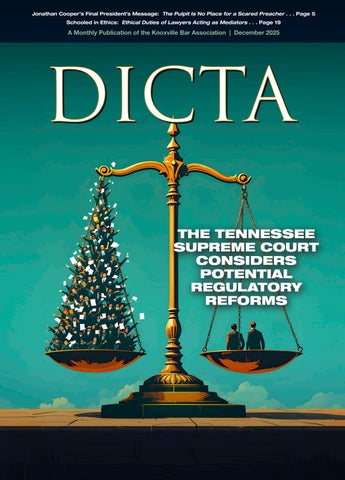
THE TENNESSEE SUPREME COURT CONSIDERS POTENTIAL REGULATORY REFORMS TO INCREASE ACCESS TO QUALITY LEGAL REPRESENTATION
This is the first of a three-part series.
In September, the Tennessee Supreme Court released a per curiam order announcing its interest in revisiting how it regulates the legal profession to remove barriers in accessing legal services.1
The Order observes that “[t]here is a growing recognition that the current supply of legal services in the United States is insufficient to meet the needs of many Americans.” At the same time, the Order explains that “[t]he requirements for admission to practice law established by the Court, in combination with rules prohibiting the unauthorized practice of law, restrict the pool of individuals who may provide legal services in Tennessee.”2 Thus, the Order explains, the Court is interested “in reassessing its approach to regulation of the legal profession to ensure that all Tennesseans have access to affordable quality legal services.”3
The Order solicits written comments from the Tennessee Board of Law Examiners, the Tennessee Access to Justice Commission, law schools and other educational institutions, the academic community, professional organizations, members of the Bar, and the public concerning seven specific issues related to improving access to quality legal representation:
(1) Whether the Court should modify, reduce, or eliminate its reliance on ABA accreditation in setting minimum educational requirements for applicants to the Tennessee Bar;
(2) Whether there are any practicable alternatives to ABA accreditation that the Court should consider;
Back to the Future?
The Tennessee Supreme Court Considers “Alternative Pathways for Admission to the Tennessee Bar”
The fourth potential reform identified by the Tennessee Supreme Court asks, “[w]hether the Court should consider adopting alternative pathways for admission to the Tennessee Bar—for example, by allowing applicants to satisfy the minimum educational requirements and/or examination requirement in part by completing an apprenticeship or serving with a legal aid organization.”
The Existing Model and Past Models
The vast majority of today’s American lawyers entered the profession through what I call the “ABA model,” which consists of a four-year
(3) Whether there are less costly alternatives to the traditional three-year law school curriculum that would adequately prepare individuals for the practice of law;
(4) Whether the Court should consider adopting alternative pathways for admission to the Tennessee Bar—for example, by allowing applicants to satisfy the minimum educational requirements and/or examination requirement in part by completing an apprenticeship or serving with a legal aid organization;
(5) Whether the Court should consider modifying requirements for admission to the Tennessee Bar for those licensed in other States to promote interstate practice and mobility;
(6) Whether any legal services currently provided by lawyers could be competently provided by paraprofessionals and, if so, what qualifications, limitations, or subject matter restrictions the Court should consider imposing; and
(7) Whether the Court should modify, reduce, or eliminate regulations prohibiting non-lawyer ownership of law firms or fee sharing with non-lawyers.
This article is the first in a series that addresses three of the issues identified in the Court’s order. Additionally, DICTA readers are encouraged to contact KBA Executive Director Tasha Blakney (tblakney@knoxbar.org) with feedback as the KBA considers a potential comment on behalf of the Association.
– Foreword by Alex Long University of Tennessee Winston College of Law
undergraduate degree, followed by three years at an ABA accredited law school, and then a difficult two-day bar examination (plus a character and fitness process and the MPRE). Because this model is so dominant today, we naturally assume it has always been thus.
The opposite is actually the case. Today’s alternative pathway was once by far the most dominant pathway. For the first 100 or so years of our Republic, almost all lawyers served in an apprenticeship. Consider the Justices of the U.S. Supreme Court. 55 of the 57 Justices appointed before 1900 served a year or more in an apprenticeship before they joined the Court. The first year that every Justice on the Supreme Court had four years of undergraduate education and three years of law school was 1986, less than a half century ago.
Longstanding Exceptions – Non-ABA Law Schools, Apprenticeship, and the Diploma Privilege
There have, of course, been exceptions to the dominant model. Some
states, including Tennessee and California, have long separately accredited non-ABA law schools and allowed graduates of those schools to take the state bar. The Nashville School of Law is the only non-ABA law school in Tennessee. Massachusetts and Alabama also have state accredited non-ABA law schools. California has by far the most non-ABA accredited law schools and a different (and harder) series of bar examinations for those schools. The disadvantage to these schools is that many states will only allow graduates of an ABA accredited law school to sit for the bar, so attending a state accredited law school may limit a graduate’s ability to leave the state.
Similarly, apprenticeship stayed a viable route in a handful of states, even as the ABA model became dominant nationally (and in those states). California, Vermont, Virginia, and Washington maintained an apprenticeship path, although California’s route involves extra examinations and rigorous reporting requirements, and Virginia’s requires the apprenticeship to be unpaid. California can also boast the most famous lawyer apprentice since Abraham Lincoln: Kim Kardashian started her apprenticeship in 2018 and finished in 2025 but did not pass her first attempt of the bar examination. In all these states apprentices are required to pass the state bar before entering the practice of law.
COVER STORY
By: Benjamin H. Barton Helen and Charles Lockett Professor of Law Winston College of Law, University of Tennessee

Wisconsin has long had a diploma privilege for graduates of the University of Wisconsin Law School and Marquette University Law School, which means those graduates do not need to take the Wisconsin bar to become licensed lawyers. Utah instituted a temporary diploma privilege in 2020 for its law schools as a response to the COVID-19 pandemic.
Alternative Pathways
Recently several states have created (or are considering) new pathways into the profession outside of the ABA model. Some of these paths allow applicants to skip the bar examination through some kind of apprenticeship or experiential experience. For example, New Hampshire launched the Daniel Webster Scholar Honors Program at the University of New Hampshire Franklin Pierce School of Law. Students take an experiential heavy second and third year of law school and then collect a portfolio of their work, which is then reviewed by the New Hampshire Board of Bar Examiners. If the work passes muster, they need not take the written bar exam and are admitted to practice in the State. Utah has created a similar option where apprentices must complete all required skills coursework from a Utah law school and serve 240 hours of apprenticeship, followed by a written Utah only bar exam. In 2023, a Georgia task force recommended the state follow New Hampshire’s lead, and Massachusetts and Minnesota are also considering similar programs. Oregon offers two portfolio options – The Supervised Practice

Portfolio Examination, which allows law school graduates to work in a supervised apprenticeship setting after graduation and develop a portfolio to be graded by the State’s bar examiners. The Oregon Experiential Portfolio Pathway offers the same portfolio examination following an experiential heavy second and third year at one of Oregon’s three law schools. Washington has adopted similar programs. Arizona has created a lawyer apprentice program for graduates of ABAaccredited law schools who just missed passing the bar exam. The Uniform Bar Exam cut score in Arizona is 270, so graduates who scored 260-269 on the UBE can sign up for the program. Participants work as lawyers in public law or in a rural setting under the supervision of a licensed lawyer for two years and can then become lawyers without retaking the bar, assuming their supervisory attorney and a local judge recommend them. New York State and South Dakota are considering similar public interest practice programs.
A Nevada task force recommended two new exams to replace the existing bar exam, as well as a requirement of 40-60 hours of supervised practice for every applicant before joining the bar. California, New York, and Indiana are also considering alternative bar examinations outside of the Uniform Bar Exam or the NextGen Bar Exam, but the Kaplanrun California only bar exam in February 2025 experienced significant difficulties, possibly cooling this route.
Recommendation: Focus on Rural Areas and Public Interest Work for the Poor
Given the sheer volume of options, the Supreme Court may have a hard time settling on which approach is wisest. Here we have actual examples of states being the laboratories of democracy, trying lots of different approaches to a national problem. To this author, the approach that seems most clearly aimed at the concerns raised in the Supreme Court’s order is a program aimed squarely at increasing rural and public interest work for the poor. The Arizona approach seems smart (harnessing very able individuals who have graduated law school and just barely failed the bar), but regardless of the underlying specifics, any program should be focused on serving rural counties and the poor.
1 IN RE: PUBLIC COMMENTS ON POTENTIAL REGULATORY REFORMS TO INCREASE ACCESS TO QUALITY LEGAL REPRESENTATION, No. ADM2025-01403, Sept. 16, 2025, https://tncourts.gov/sites/default/files/ProposedRulesPdf/ ORDER%20SOLICITING%20PUBLIC%20COMMENTS%20ON%20POTENTIAL%20 REGULATORY%20REFORMS%20TO%20INCREASE%20ACCESS%20TO%20 QUALITY%20LEGAL%20REPRESENTATION.pdf
2 Id. at 2.
3 Id. at 4.
LEGALLY WEIRD
By: Wade H. Boswell II Tennessee Department of Human Services
WHAT’S IN A NAME?
A person’s name is their ultimate identifier. Names can be given to honor a family member or friend. My family is not immune from doing so. In the late 1800’s my great-great-grandfather was the bailiff for Anderson County Judge David King “D. K.” Young.1 He held Judge Young in great esteem, and my great-grandfather was given the name Young as his middle name: Walton Young “W. Y.” Boswell. And having looked up Judge Young for this article, it appears that my great-greatgrandparents further honored him by calling my great-grandfather by his first two initials, like Judge Young.2 That was a cool connection to make.
My family continues with the name-honoring custom to this day. I was named after my grandfather, not my father. When my father and I practiced together, clients needed to know our middle initials to know who to ask for when calling. My sister and brother’s names are from our mother’s side of the family. My brother nearly strayed from the namehonoring convention with his youngest son. My brother and sister-inlaw asked my two nephews to help decide on their brother’s name. They came up with Jedi. It was a close call, but Jedi was not chosen for his middle name. When he learned of this years later, he thought it was great and wished he had been given the Jedi name. When he turns 18 next year, it will be his call whether to change it. I’ve already prepared the paperwork. The Force will guide him in his decision.
Whether it’s Jedi or another unconventional name, current society has embraced such titles as names. From 2015-2019, Admiral Schofield played basketball for UT.3 From 1998-2001, the Texas Longhorns were led by quarterback Major Applewhite. Unconventional names, however, are not limited to military rank, and even the legal system is represented. There’s former NFL safety Lawyer Milloy.4 There’s also actor Judge Reinhold. Though now his stage name, Judge is technically a nickname given to him in childhood because he looked stern and judge-like as a baby.5
During fall semester of my 2L year, my dad took me as his plus one to the then-annual Tennessee Supreme Court dinner. The cocktail hour was a blur of introductions. Dad was about to introduce me to another group of three couples when we were directed to find a seat. We joined this group, filling in the 8-top table next to us, and the three gentlemen continued the conversation they had just started when my dad and I had walked up. The conversation was about the tradition of calling former judges “Judge,” the infrequency of judges returning to practice, and being mindful of not calling a former judge “Judge” in the courtroom. Not keeping up with current events, I nearly asked how this was even an issue, but the emcee, having finished introducing the Justices, then requested all other judges stand and be recognized. All three of them stood up: Chancellor McDonald, Chancellor Cate, and Judge Emery. So glad I kept my mouth shut! I then realized the context of the conversation. They were talking about Randy Nichols, who had just stepped down from the criminal court bench to become District Attorney General upon the death of DA Ed Dossett.6 What was clear from their conversation is that “Judge” is no longer a title but an honorific upon departure from the bench.
That table conversation resurfaced in my mind after coming across the saga of John Dehen, former district court judge in Anoka County, Minnesota. In 2021, then-Judge Dehen purchased used Old Hickory chairs off Facebook Marketplace, and a few of them were obviously missing the front cross-piece. Dehen had the opportunity to inspect them and knew they were used and from a closed restaurant. In subsequent litigation over the purchase, the court found that a cursory inspection would’ve shown that some chairs were missing the front cross-
piece between the front legs, with holes where the missing piece would’ve gone, and there were no hidden defects. Further, the court ruled he had not met his burden of proof to support his claims of intentional fraud, negligent misrepresentation, and breach of contract.7 Prior to filing the lawsuit, Dehen wrote to one of the Defendants a letter which contained the following: “Being a District Court Judge and presiding over matters similar to this.” This reference to the judicial title came immediately after a threat to sue the defendants. It was made in a way to show that the judge had special knowledge of the court’s procedures and the court referee’s expectations. The defendants genuinely found this intimidating, harming the defendants’ confidence in the integrity of the judiciary. This led to a private admonition for violating the Minnesota Code of Judicial Conduct.8
Nonetheless, the private admonition did not deter Dehen from further malfeasance. Dehen wrongly held a remote juvenile docket involving confidential juvenile matters from a moving vehicle while riding to a family member’s swim meet.9 He also improperly ordered an administrator to give his court reporter a raise despite a clear conflict of interest.10 He did this twice, issuing the second writ of mandamus after the first was struck down by the court of appeals.11 The Minnesota Supreme Court censured Dehen for judicial misconduct and suspended him from judicial office, without pay, for nine months. Assuming Dehen would resign from the bench to avoid punishment, the court also suspended him from the practice of law and publicly reprimanded him as an attorney.12
Before the disciplinary ruling was handed out and realizing he would not be a judge much longer, Dehen made the unusual move of filing a petition to change his legal name from “John Peter Dehen” to “Judge John Peter Dehen.” The judge hearing the petition took umbrage at Dehen’s arrogance, criticizing Dehen for filing his petition “in bad faith and with intent to mislead.” He also stated that, “To permit a former district court judge, who has been suspended for abusing his position of authority, to regain the title he was stripped of, would make the administration of justice a practical mockery.” Further writing, “By using the name ‘Judge,’ the Applicant would be holding himself out as a judge, a position he held for 15 years, but no longer holds.”13
As this shows, titles are earned. And no amount of chicanery can garner a title once lost.
1 https://www.findagrave.com/memorial/46366972/david_king-young, Last visited Nov. 11, 2025.
2 Id. at photos 1 and 3.
3 https://en.wikipedia.org/wiki/Admiral_Schofield, Last visited Nov. 11, 2025.
4 https://en.wikipedia.org/wiki/Lawyer_Milloy, Last visited Nov. 11, 2025.
5 https://en.wikipedia.org/wiki/Judge_Reinhold, Last visited Nov. 11, 2025.
6 https://dag.knoxcountytn.gov/news/longtime-district-attorney-general-randalle-nichols-retires-leaving-behind-an-era-of-justice-and-service/, Last visited November 10, 2025.
7 See also, Dehen v. Wade, No. 70-CV-21-12337 (Minn. Dist. Ct. March 3, 2022) https://publicaccess.courts.state.mn.us/CaseSearch, Last visited Nov. 12, 2025.
8 https://www.bjs.state.mn.us/file/private-discipline-summaries%20-%20 07.11.2025.pdf, Last visited Nov. 11, 2025.
9 Inquiry into the Conduct of the Honorable John P. Dehen, A24-0694, *4 (Minn. Sept. 22, 2025) https://mncourts.gov/_media/migration/appellate/supreme-court/ special-releases/22sep25/OPA240694-092225.pdf, Last visited Nov. 11, 2025
10 Id.
11 Id. at 10.
12 Id. at 72.
13 “Judge denies ex-judge’s bid to change name to ‘Judge’,” MPR News, October 17, 2025, 2:06 p.m. https://www.mprnews.org/story/2025/10/17/ramsey-judgedenies-judges-bid-to-change-name, Last visited Nov. 12, 2025.
SCHOOLED IN ETHICS
By: Paula Schaefer
Art Stolnitz Distinguished Professor of Law
University of Tennessee Winston College of
Law
ETHICAL DUTIES OF LAWYERS ACTING AS MEDIATORS
The ABA recently issued Formal Ethics Opinion 518, which addresses a lawyer’s ethical obligations when acting as a mediator.1 Among other things, the opinion addresses a lawyer’s obligations under Model Rule 2.4 “Lawyer Serving as a Third-Party Neutral” and Model Rule 1.12 “Former Judge, Arbitrator, Mediator or Other Third-Party Neutral.”
Because Tennessee’s RPCs 2.4 and 1.12 differ significantly from the Model Rules, this column will address the relevance of Formal Opinion 518 for Tennessee attorneys as it relates to these rules. This discussion focuses on two topics: (1) the lawyer-mediator’s duty to explain (and act consistently with) the mediator’s role; and (2) the lawyer-mediator’s duties regarding conflicts of interest. This column will close with a discussion of Formal Opinion 518’s guidance regarding a lawyermediator’s obligation to avoid dishonesty in the mediation.
The Duty to Explain (and Act Consistently with) the Lawyer-Mediator’s Role
Formal Opinion 518 stresses that the lawyer-mediator must inform unrepresented parties that the lawyer-mediator does not represent them. This obligation is found in Model Rule 2.4(b). Model Rule 2.4(b) also requires the lawyer-mediator to explain the difference between a neutral mediator and a partisan lawyer representing a client when a party appears not to understand the lawyer-mediator’s role.
Formal Opinion 518 emphasizes the need to protect individuals who are not “sophisticated consumers of mediation services” by explaining the differences between attorney and mediator—including the inapplicability of the attorney-client privilege. The Opinion suggests that a prudent lawyer-mediator should not only provide information but should also discuss with an unrepresented party what it means that the lawyer does not represent them.2
The Opinion also emphasizes the need for a lawyer to act as a neutral. The Opinion addresses the importance of a mediator not suggesting they are acting in the party’s best interests or that a proposed settlement is in the party’s best interests. Also consistent with acting as a neutral, the Opinion explains the need for the lawyer-mediator to avoid providing legal advice.3
In contrast to Model Rule 2.4(b), Tennessee’s RPC 2.4(b) contains nine subsections detailing a lawyer’s duties when serving as a dispute resolution neutral. Among these, a lawyer-neutral must “communicate[] with each of the parties to the dispute, or their attorneys, about the lawyer’s qualifications and experience [as a mediator], the rules and procedures that will be followed in the proceeding, and the lawyer’s responsibilities as a dispute resolution neutral.” When the lawyerneutral’s services are not provided pursuant to Supreme Court Rule 31, TRPC 2.4(b) also requires that each party provide informed consent,

confirmed in writing, to the lawyer’s services as a neutral in the matter. When services are provided pursuant to Rule 31, Subpart (6)(b)(6) of that rule provides, “A Neutral shall explain to the parties to the ADR Proceeding that the Neutral is not the advocate for either party nor is the Neutral the advocate for both parties.”
Accordingly, TRPC 2.4(b) requires a more detailed discussion—and in some cases, written informed consent—that is not required by Model Rule 2.4. Nonetheless, a Tennessee lawyer-mediator may find the Formal Opinion’s guidance about disclosures to unrepresented parties and unsophisticated users of mediation services to be helpful in fulfilling the TRPC 2.4(b) obligation. Additionally, the Opinion’s explanation of actions that are inconsistent with the mediator’s proper role (like providing legal advice or suggesting that the mediator is acting in the party’s best interests) is important guidance for Tennessee lawyermediators.
The
Lawyer-Mediator’s
Conflicts of Interest
Formal Opinion 518 opens by explaining that most professional conduct rules do not apply to lawyer-mediators because most rules focus on the attorney-client relationship or obligations of a lawyer while representing a client in interactions with courts, counsel, and thirdparties.4 The Formal Opinion then notes that Model Rules 1.12 and 2.4 are the only Model Rules that specifically govern lawyers serving as neutrals5 and that Rules 8.1-8.4 apply to all lawyers, regardless of whether they are acting in a representational role.6
Model Rule 1.12 addresses conflicts of interest related to a lawyer’s prior (or current) work as a judge, arbitrator, mediator, or third-party neutral. In contrast, TRPC 1.12 only addresses conflicts for former judges (and their law clerks) and arbitrators, but not for lawyers serving as mediators. Accordingly, Tennessee lawyer-mediators should not look to TRPC 1.12 for conflict-of-interest guidance despite this reference in Formal Opinion 518.
For a Tennessee lawyer-mediator—regardless of their acting under Rule 317—TRPC 2.4 details the applicable conflict of interest rules. Rule 2.4(b) provides that the lawyer-mediator must:
• be capable of acting impartially;
• must not represent any of the parties in other matters;
• must not have responsibilities to another client, former client, third person, or personal interests that will interfere with the mediator’s duties; and
• must disclose conflicts of the lawyer or another lawyer in the lawyer’s firm that present a significant risk of materially
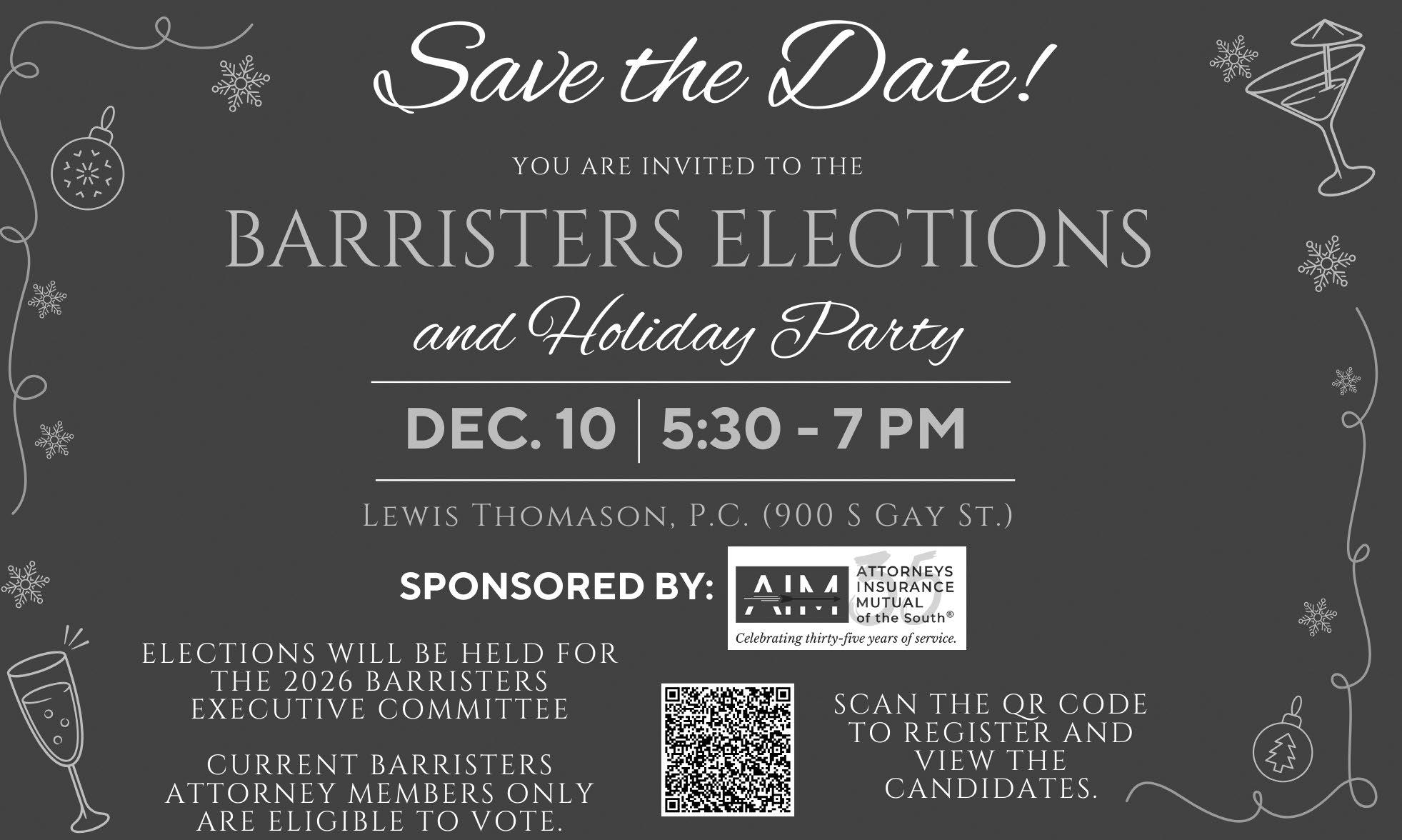
MANAGEMENT COUNSEL: LAW PRACTICE 101
By: Jimmy Snodgrass Bass, Berry & Sims
AVOIDING “ONE OF THOSE QUESTIONS” DURING AN INTERVIEW
There is an obvious answer to what questions cannot be asked during an interview—clearly an interviewee cannot and should not be asked about any protected class, such as their age, race, religion, disability, sexual orientation, etc. But an interviewer can often get themselves and the company into trouble with related questions that may be wellintentioned and part of normal conversation, especially in East Tennessee. These seemingly innocuous questions, such as, “What years did you go to Bearden High School?” or “When did you graduate from UT?” could potentially be seen as discriminatory to the extent that they reveal an applicant’s age. This is a question that would regularly come up in everyday conversation if, for example, the interviewer knew someone who also went to the school at that time.1 A better structured interview question would only be if the essential duties of the position require a certain age (such as a bartender), asking if the applicant is at least 18 years of age. On the other hand, especially for internal promotions, it is important to refrain from asking candidates how long they want to continue working or when they are thinking of retiring.
Another issue to avoid is questions that would be cited as discriminatory based on race or national origin if the applicant does not get the position. A well-meaning interviewer could easily get themselves into trouble by asking questions such as, “That’s an interesting name – where are you from?” Similar lines of questioning to avoid would be, “What language do you speak at home?” or “Where were you born?” Conversely, an employer can ask if an employee is authorized to work in the United States.
Lastly, any questions relating to an applicant’s pregnancy or childcare are particularly sensitive, even though this topic is another example of a question that would regularly come up in a non-interview setting. Interviewers should be sure to avoid questions like, “Are you planning to have children within the next year?” or “What are your plans for childcare?” Another example would be if the applicant naturally mentions their children or recent marriage, avoid asking later in the interview if there is anything that may impact their ability to help deal with [x].
While companies want to hire the best candidates for each position, from an employment perspective, a hiring process gone awry is likely the first evidence cited in support of a discrimination claim. Therefore, it is important to have a standard interview process for all applicants that can be cited by the company as evidence of why one candidate was selected over another. Topics to consider in making sure there is a uniform interview process for a position would be how many rounds of interviews there are or having a standard evaluation form in place. For example, if one candidate receives a screener interview from an HR employee, it is important to ensure that another candidate who is family friends with a senior employee does not automatically proceed to the second round.

While the same employees do not have to conduct the interviews for all candidates, it is important to ensure that they are similar (such as both applicants being interviewed by a senior partner or member of the hiring committee).
However, no matter how well structured an interview process, this hard work is worthless unless the employees conducting the interviews are well-trained on both what they should ask during the interview and the company’s official policies.
Consider FedEx, obviously a large international corporation that is well-versed in conducting interviews. When attempting to hire a senior manager, the company utilized a uniform Senior Manager Selection System to create a preferred qualifications grid to screen a pool of applicants. The hiring director then selected nine core interview questions that all candidates would be asked and presented with in advance.
A three-person panel conducted all interviews, and the panel would independently rate the candidate’s responses to the interview questions. The panel would then compare their notes in an attempt to agree on a consensus score for all applicants.2
After not being selected for the position following her interview in 2013, Cheri Hutson, who had been employed by FedEx since 1982, claimed that she was discriminated against based on her gender. FedEx filed a motion for summary judgment, claiming that it had a legitimate, nondiscriminatory reason for not hiring Ms. Hutson, as she did not interview well. FedEx pointed to the fact that Ms. Hutson “was asked the same questions and evaluated under the same criteria as the male candidates for the position” and received a lower score.
However, the Western District of Tennessee found that Ms. Hutson met her burden at the summary judgment stage to establish that FedEx had treated the male candidate more favorably than her. The Court relied upon the subjective nature of the interview, as well as inconsistencies in the scoring of Ms. Hutson’s responses to the interview questions. As an example, when compiling a consensus grade for the interview, Ms. Hutson’s scores were rounded down, whereas the male candidate’s scores were rounded up. Additionally, the panel counted certain answers as incorrect when Ms. Hutson’s answer “did not precisely match the answer key but did not do so when [the male candidate’s] did not provide precisely the same answer found on the answer key.”
Put simply, proper training of those who conduct interviews is another important tool that is often neglected in the hiring process.
1 If you were wondering what years I went to UT, I was privileged enough to witness Derek Dooley, Butch Jones, and Jeremy Pruitt-led football teams, along with Cuonzo Martin and Donnie Tyndall-helmed basketball teams. I still believe that the charge call on Jarnell Stokes in the Sweet 16 should have resulted in a federal investigation.
2 Hutson v. Fed. Express Corp., No. 2:15-CV-02411-STA-CGC, 2017 WL 325986 (W.D. Tenn. Jan. 23, 2017).
About this column: “The cobbler’s children have no shoes.” This old expression refers to the fact that a busy cobbler will be so busy making shoes for his customers that he has no time to make some for his own children. This syndrome can also apply to lawyers who are so busy providing good service to their clients that they neglect management issues in their own offices. The goal of this column is to provide timely information on management issues. If you have an idea for a future column, please contact Jimmy Snodgrass at jimmy.snodgrass@bassberry.com.
WELL
READ
By: Paul Noel Chief of Police Knoxville Police Department
A NEW ORLEANS CLASSIC: THE MOVIEGOER, BY WALKER PERCY
Reading Walker Percy’s The Moviegoer1 after leaving New Orleans felt like stepping back into a place that exists as much in memory as it does on the map. Percy’s 1961 National Book Award–winning novel2 is often described as philosophical or existential, but for me, it read like a quiet homecoming. His portrayal of New Orleans is not the tourist’s city of jazz clubs and Mardi Gras parades, but the lived-in, everyday New Orleans that only locals really understand. Through Binx Bolling’s meandering life, Percy evokes the rhythms, moods, and subtle beauty of a place that still lingers in me even though I no longer live there.
Binx is a stockbroker living in Gentilly, a part of the city that rarely gets attention in fiction, but Percy makes it central. The neighborhoods he describes, unremarkable unless you are a New Orleanian, carry an understated familiarity. I could see the quiet streets, the modest houses, the streetcars that seemed to move more slowly than time itself. Percy paints them without embellishment, yet in his restraint, the city comes alive with remarkable clarity. Reading those passages made me nostalgic for the ordinary corners of New Orleans, the ones that never make it into guidebooks but form the heartbeat of life there.
The novel’s themes of detachment and longing resonated with me in an unexpectedly personal way. Binx’s habit of finding comfort in movie theaters and his sense of disconnection from daily life reminded me of the way New Orleans itself often feels—a blend of joy and melancholy, rooted in tradition yet always aware of transiency. There is a weight of history in the city, something Percy captures when he places Binx’s wandering against the backdrop of familiar streets and landscapes. That blend of searching and staying, of never quite arriving but never really leaving, mirrored my own complicated feelings about moving away.

events or dramatic gestures but in the smallest of encounters: the view of Lake Pontchartrain at dusk, the quiet of a front porch, the conversations that hang heavy in the humid air. Reading those passages made me realize how much I miss the unassuming details of New Orleans life, such as going to Fiorella’s to get red beans and fried chicken, live oaks arching over a street, and the unhurried pace that makes you feel as though time bends differently there. Percy’s novel is, at its heart, about paying attention to such moments, and in doing so, it gave me back a part of home I hadn’t fully realized I’d lost.
Binx’s endless search for purpose feels like a meditation on place and belonging. Percy demonstrates that our identity is inseparable from where we come from, and even when we leave, it continues to shape us. I left New Orleans years ago, but in Binx’s wandering through Gentilly and Uptown, I found echoes of my own past steps. The book reminded me that leaving does not mean forgetting, and sometimes it takes literature to remind us of the depth of our connections.
Ultimately, reading The Moviegoer was like walking the streets of New Orleans again in memory. It reminded me that the city’s greatest gift is not spectacle or celebration, but the quiet assurance that life’s meaning can be found in the ordinary. Percy gave me a way to revisit New Orleans not as it appears on postcards, but as it feels when you live there day after day. In the end, his novel left me not only with nostalgia but also with gratitude: for the city that shaped me, for the memories that endure, and for a writer who understood that sometimes the truest search is simply for a place to belong.
1 Percy, Walker. The Moviegoer. New York: Vintage Books, 1998
One of the most powerful aspects of The Moviegoer is how it elevates the mundane. Percy shows that meaning is not only found in grand
2 Time Magazine declared The Moviegoer one of the 100 Best English Language novels of all time. https://entertainment.time.com/2005/10/16/all-time-100novels/slide/the-moviegoer-1961-by-walker-percy/ THREE STARS, continued from page 13
13 Id.
14 Id.
15 Stebbins, supra n.8.
16 Id.
17 Id
18 Command Sergeant Major James H. Clifford, USA-Ret., No Greater Glory: the Four Chaplains and the Sinking of the USAT Dorchester, Army Historical Found., https:// armyhistory.org/no-greater-glory-the-four-chaplains-and-the-sinking-of-the-usatdorchester/, last visited Nov. 8, 2025.
19 Id.
20 Brandon Elrod, 250 Years of Spiritual Support: The Legacy of the Chaplain Corps, Baptist Press (Jul. 29, 2025), https://www.baptistpress.com/resource-library/ news/250-years-of-spiritual-support-the-legacy-of-the-chaplain-corps/.
21 American Civil War Museum, Annual Legacies: Chaplain Garland H. White (Dec. 18, 2019), https://acwm.org/blog/annual-legacies-chaplain-garland-h-white/, last visited Nov. 9, 2025.
22 Id.
23 Congressional Medal of Honor Society, Joseph Timothy O’Callahan, (Dec. 25, 2023) https://www.cmohs.org/recipients/joseph-t-ocallahan, last visited Nov. 9, 2025.
24 Chuck Lyons, Survival: The Story of the USS Franklin, Warfare History Network (June 2015), https://warfarehistorynetwork.com/article/survival-the-story-of-theuss-franklin/, last visited Nov. 9, 2025.
PRO BONO SPOTLIGHT
By: Mary Frances DeVoe Director of Pro Bono Legal Aid of East Tennessee
PRO BONO PROJECT YEAR IN REVIEW
As we wrap up another year, I want to take a moment to celebrate the incredible impact of Knoxville’s legal community through the Pro Bono Project here at Legal Aid of East Tennessee (LAET). The numbers tell a compelling story, one of generosity, collaboration, and the ripple effect that happens when attorneys, firms, and law students step forward to serve. But behind every statistic is a human story— neighbors, families, and individuals whose lives are transformed by your time and expertise.
This article features a lot of numbers (scary, I know). But as you read, I want you to remember that behind every one of those numbers is a person and their loved ones. The expungement cases we handled this year represent people who can finally pass background checks and access stable employment and housing. Conservatorship cases reflect families finding peace of mind knowing their loved ones are protected and cared for. Debt relief and bankruptcy work mean families can breathe again after months, sometimes years, of anxiety and uncertainty that come with financial crisis. Over and over, volunteers tell us that pro bono work, whether staffing clinics or taking full case representation, reminds them why they went to law school in the first place. Pro bono work not only changes clients’ lives, but it also renews attorneys’ connection to the profession and to the ideals of justice that the profession was built upon.
Even with shifting program leadership and staff, LAET’s Pro Bono Project has had a busy year. Across East Tennessee, 563 new cases were opened, 320 remain active, and 515 cases have been closed. Each of these represents a neighbor who has received meaningful legal help because someone stepped forward to serve.
In Knoxville and the surrounding counties, attorneys donated $112,039 worth of legal services this year alone. According to a 2015 study by economist Kenneth Smith and Kelly Thayer, Economic Impact of Civil Legal Aid Organizations in Tennessee: Civil Justice for Low-Income People Produces Ripple Effects that benefit Every Segment of the Community, 1 every dollar donated to legal aid produces a ripple effect that benefits the entire community. Adjusted for inflation, that return is now $15.36 for every $1 invested. That means Knoxville’s volunteer attorneys generated an estimated $1.7 million in community impact this year. Across East Tennessee as a whole, the total value of donated services reached $437,395.37, creating a staggering $6.7 million impact. These figures demonstrate the power of collective effort and the enormous value of our volunteers’ time and expertise.
When we look closer at the types of cases handled, the diversity of volunteer work stands out:
• 54% of pro bono cases were expungements, helping clients clear old records and access jobs and housing.
• 27% were family law matters, including adoptions,

conservatorships, and custody cases that safeguard stability and dignity.
• 10% involved debt relief, consumer finance, and bankruptcy, often preventing further financial crisis or homelessness.
• The remaining cases—nearly 100—fell into other urgent areas, from eviction prevention to public benefits.
Locally, volunteers and law students contributed 242.5 hours this year. In Knoxville-area cases specifically, 31% involved consumer finance or bankruptcy, 16% were family law or conservatorships, and 12.5% were expungements. These figures reflect a community of attorneys who aren’t afraid to roll up their sleeves and tackle legal issues that directly affect the lives of their neighbors.
It’s been a year of growth and transition for our Knoxville Pro Bono Project leadership, but one constant remains: the generosity and professionalism of the Knoxville Bar. Whether you staffed a clinic, took a case, mentored a new attorney, or encouraged others to volunteer, you made a tangible difference.
As we move into 2026, LAET’s Pro Bono Project will continue to build new partnerships and create more accessible opportunities for attorneys and law students to serve. We are committed to the Knoxville Bar’s storied tradition of exceptional pro bono service. Even as federal funding remains uncertain and the number of neighbors needing help continues to grow— 17.3% of Knox County residents are eligible for Legal Aid—our small team of 12 case-handling Knoxville attorneys faces an enormous demand: over 7,300 eligible clients per attorney in our area alone. Pro bono work continues to be an essential tool in helping us bridge this justice gap, allowing attorneys to extend our reach and ensure that more community members receive the legal support they desperately need.
The work is urgent, but it is also rewarding. Each hour donated, each case accepted, and each client served strengthens the justice system and the fabric of our community. Pro bono isn’t just an obligation—it is an opportunity to change lives and to inspire others to do the same.
None of this impact would be possible without the support of our community partners and the Knoxville Bar Association, whose commitment to Access to Justice continues to inspire. Students from LMU and UT Law bring energy and talent, while firms of all sizes provide essential volunteer capacity and mentorship. Together, they form the backbone of LAET’s pro bono efforts.
Thank you for another year of partnership, purpose, and impact. As we celebrate 60 years of Legal Aid in East Tennessee, we invite every attorney—whether you’ve taken a case before or are just getting started— to join us in 2026. Together, we can ensure that justice is not a privilege, but a guarantee.
1 https://www.tba.org/docDownload/1486130, last visited Nov. 11, 2025








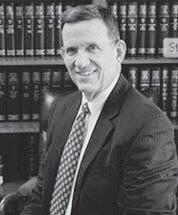


IN ETHICS, continued from page 19
affecting the lawyer’s impartiality or materially limiting the services the lawyer will provide as a neutral to the parties.8
Also addressing conflicts, TRPC 2.4(c) requires that a lawyer acting as a neutral not provide legal advice to a party during the proceeding and not take anything of value (other than compensation for the services provided) from a party, a party’s attorney, or any other interested person.9 Returning to Formal Opinion 518, it notes that mediation is generally conducted subject to other rules such as statutes, court rules, or rules of an organization conducting a mediation, and that such rules may also address conflicts of interest.10 Consistent with this guidance, for Tennessee attorneys acting as Rule 31 mediators, Subpart(6)(b) of Rule 31 addresses possible conflicts of interest that must be disclosed and prohibits lawyers (serving as a neutral) from representing a party during the dispute resolution proceeding.11
The Obligation of the Lawyer-Mediator to Avoid Dishonest Statements to Parties
Finally, Formal Opinion 518 addresses an obligation found in both Model Rule 8.4(c) and TRPC 8.4(c)—the prohibition against conduct involving dishonesty, fraud, deceit, or misrepresentation.12 The Opinion explains that exaggeration, puffery, or false statements that may be ethically utilized by an attorney negotiating on behalf of a client (when such statements would not be considered statements of material fact) are likely to be a violation of Rule 8.4(c) if utilized by a lawyer-mediator. This is so because statements communicated by a trusted, neutral mediator are likely to be taken at face value.13 In short, “Given the lawyer-mediator’s neutrality, parties are likely to trust the lawyer-mediator to play it straight and to not exaggerate or make false statements designed to lead
the parties to an agreement.”14 The opinion explains that it is for this reason that the lawyer-mediator must be “thoughtful and cautious” when answering questions during the mediation, such as regarding the lawyermediator’s views of information communicated by the other party.15
Conclusion
Despite some significant differences between Tennessee RPCs and the Model Rules relied upon in Formal Opinion 518, the Opinion contains valuable information for Tennessee lawyers serving as mediators.
1 ABA Formal Ethics Opinion 518, A Lawyer’s Duties to Avoid Misleading Communications When Acting as a Third-Party Neutral Mediator (Oct. 15, 2025).
2 Id. at 2.
3 Id. at 3-4.
4 Id. at 1.
5 Id
6 Id. at 1-2.
7 Tenn. Sup. Ct. R. 31, Subpart (2)(b) (stating that Rule 31 standards do not replace, eliminate, or render inapplicable attorney professional conduct rules that do not conflict with Rule 31).
8 TRPC 2.4(b)(3), (4), (5), (7). Relatedly, TRPC 2.4(d)(3) provides that a lawyermediator must withdraw if any of the conducts in 2.4(b) are no longer satisfied.
9 TRPC 2.4(c)(6), (7).
10 ABA Formal Ethics Opinion 518, at 1.
11 Tenn. Sup. Ct. R. 31, Subpart (6)(b).
12 ABA Formal Ethics Opinion 518, at 4-5.
13 Id. at 5.
14 Id
15 Id

PRIVILEGED TO BE IN THE LAW
By: Jason M. Galvas KBA Lawyer Referral & Information Service (LRIS) Assistant
I HEAR YOU
When I first started at the LRIS many moons ago, my knowledge of the law consisted of Jack Nicholson yelling at Tom Cruise that he could not handle the truth. I was also good friends with a practicing family law attorney—such a good friend—that she drove one of the U-Haul trucks to Knoxville when we moved here from Michigan. We were close, and we discussed everything but her work. She is a judge now, and I hear a fantastic one.
That was my experience when I walked into the KBA to interview for the assistant LRIS position. I was upfront and honest. I do not know much about the law; I had never even darkened the doorway of a courtroom. What I possessed was empathy, a smidge of common sense, calmness, and a voice like tinted glass. Luckily for me, those were the qualities that they were looking for, because before I knew it, I was training to screen people for a referral to an attorney.
The training was intensive and extensive. At the LRIS, we serve two masters. One is the people who call and write in for help with a myriad of legal (and sometimes not-so-legal) problems. The others are the attorneys who are part of the service, relying on and/or supplementing their income with the referrals they receive from us. After I gained enough experience with referrals, which is an ongoing process, I began engaging with clients and worked to connect them with the right attorney for their particular legal needs.
A pattern quickly emerged: people need help. I knew I was in the right place.
Broadly speaking, the people who contact the LRIS fall into a few categories. One of those is people who are looking for a payday. They have subsumed the barrage of advertising about slip and fall, car accidents, and workplace injuries. They have a vision about the way the law operates, not just from commercials, but also from multiple media sources, books, movies, and social media. The protagonist is a crusading attorney tirelessly working for justice for their victim. The key phrase that this group clings to is that the attorney doesn’t get paid unless their client gets paid. The bad people/corporation/government entity must pay. Justice prevails.
Another group is the quick and easy. These are individuals who know what they need. It is a revocable trust. A will. A divorce. A business contract. This group knows it costs money and is ready to make that investment. As I said, it’s quick, easy, and straight to a referral to an attorney who can help them.
There is yet another group. It is with these individuals that I feel privileged to be in the law. This group is exhausted, they are scared, they do not know what to do or where to turn. Usually, they contact different organizations after experiencing a tragedy themselves or with someone close to them, only to be turned down. They were informed, “Apologies, that’s not something we offer.” “You or they don’t qualify for that program.” They are told to reach out to this agency or that one, only to hear yet again that nobody can assist.
In the end, whether by luck or assistance, they manage to find or receive the LRIS number. They dial, the phone rings at my desk, and I pick up.
After years of answering the phone, I can identify this group within the first 10 or 15 seconds of our conversation. Their voices are weary, they shake with anger, frustration, and desperation. They launch into an explanation of what is transpiring. They have repeated this so many times that it is now rote; it sounds like a prayer recited every week at church.
I listen. I hear them. The caller’s voice hesitates. It falters. They are simply waiting for me to step in and say there is little I can offer. Rather, they receive empathy and compassion. The sense that their voices are truly acknowledged, rather than simply heard.
Few experiences are as painful as feeling ignored or unheard. Feeling misunderstood and disregarded by others. When my next words are “tell me more about that” or even a simple, “oh my goodness,” the relief felt through the phone is palpable. Finally, a glimmer of hope begins to shine through for them. They can take a breath. And within that breath is a hand grasping theirs and pulling them back from the edge. Often, that is enough. That breath provides perspective. It shifts the world back underneath their feet. They can approach their problem with calmness and rationality.
We cannot help everyone. No one can. However, we can help some, sometimes even just one. It makes every call answered at the LRIS worthwhile. That is what makes me feel privileged to be in the law. Helping people is a fundamental cornerstone of the LRIS. One that I am very enthusiastic about in both my professional and personal life. Yes, we want to connect paying clients with attorneys—it is always top of mind. It is another cornerstone. Providing this service to the public addresses a growing and significant need. It is so very fulfilling that I can help in this much-needed service area.

FOODIE FINDS: THE BEST OF KNOXVILLE FOOD TRUCKS
By: Parker Bohne
LMU Duncan School of Law
J.D. Candidate, 2026
SMOKED PICKLE BARBECUE
For nearly a decade, Eric Pickle worked in the corporate world. His job required frequent travel, and Eric made it a mission to find good barbecue in every city he visited. What he didn’t know then was that all his “research” would eventually lay the groundwork for Knoxville’s own Smoked Pickle Barbecue.
When COVID-19 brought the world to a halt in 2020, Eric—like many others—was furloughed from his corporate position. Rather than sit idle, he bought a cheap smoker, restored it, and began experimenting. What started as a hobby quickly turned into a passion. He began cooking for family and friends, and soon, word spread. Backyard cookouts turned into small events, and people kept coming back for more.
By late 2020, with restaurants shuttered, Eric saw an opportunity. He purchased a larger smoker and began selling barbecue through Facebook and Instagram. The response was immediate. Encouraged by the demand, he decided to take the next step.
In April 2021, Smoked Pickle Barbecue rolled out its first food truck appearance at Creekside in Knoxville. With a consistent line of people for three straight hours, Smoked Pickle sold out of everything they had made for that day. That debut made it clear that the backyard operation had evolved into something much bigger.
Since then, Smoked Pickle Barbecue has grown steadily and deliberately. In 2023, Eric expanded operations into a commissary kitchen, allowing for larger-scale production and the ability to take on catering. Today, catering makes up nearly 70% of their business, serving everything from weddings and corporate events to The Volunteer Tailgate at Tennessee football games.

One key decision helped solidify Smoked Pickle’s loyal following: finding a permanent home base. In the early days, Eric and his team spent much of their time chasing gigs across East Tennessee, parking wherever they could. Eventually, he realized that customers wanted consistency. Now, Smoked Pickle Barbecue is a permanent fixture at 920 Ebenezer Road.
Smoked Pickle operates on what Eric calls a “sell-out model.” Each day’s menu is prepared in limited quantities based on forecasts, previous sales, and even the day of the week. When they’re out, they’re out. It’s a business approach that builds anticipation and ensures quality. On most days that they’re open, the truck starts at 11 a.m. and stays open until 6 p.m. or until they run out of food. The truck is open on Thursdays, Fridays, and Saturdays—except during the football season, during which the truck is closed on Saturdays.
When Eric started smoking meats in his backyard, he didn’t think
he’d end up owning a food truck. He has never received any culinary training. But he knew that people loved the barbecue he was making.
Today, the business is thriving thanks in large part to a small but dedicated team. Having such an incredible team has made all the difference to Eric. According to him, they’ve truly helped drive the rapid success of Smoked Pickle Barbecue.


The best way to find out more about Smoked Pickle Barbecue—or to book them for catering—is through social media, like Facebook or Instagram, or their website (www. smokedpicklebarbecue.com).

Rusty Harmon NMLS #673950 Senior Vice President, Private Banker M: 865.719.9677 rusty.harmon@smartbank.com

Address Changes
Please note the following changes in your KBA Attorneys’ Directory and other office records:
M. Alan Moore, Jr.
BPR #: 029315
Tennessee Tax Law, PLLC 2095 Lakeside Centre Way, Suite 131 Knoxville, TN 37922-6647
Ph: (865) 500-3258 amoore@tntaxlaw.com
Tonya R. Willis
BPR #: 018275
Attorney Tonya Willis P.O. Box 113 Louisville, TN 37777-0113 Ph: (865) 254-9445 twheatwillis@gmail.com
Our dedicated private banking team offers exclusive services to attorneys and their practices, providing a deep understanding of your financial ambitions and a collaborative partnership.
We invite you to experience banking redefined.
THE KNOXVILLE BAR ASSOCIATION IS PLEASED TO WELCOME THE FOLLOWING NEW MEMBERS:
Sara Berry Attorney-at-law
Tim E. Shaw Attorney-at-law
Tiffany C. Black
Riley Cumberland
Kaitlyn Forrest
Madeline G. Macrae
Sydney E. Ross
Zachary R. Schmidt
Mariah Smith
Peyton G. Stanley
Madelyn A. Torres NEW LAW STUDENT MEMBERS

KBA VOLUNTEERISM
By: Mariel Bough VeraSafe
VOLUNTEERISM: STORIES OF SERVICE
From my perspective, the KBA membership is second to none when it comes to the level of effort made to have a meaningful impact in our community. This column highlights not only the ongoing contributions of our members through the KBA Barristers’ Volunteer Breakfast Committee, but also expanded opportunities to engage with community programs, such as CareCuts and Grow Free Tennessee.
Butler, Vines, and Babb Makes a Difference Through Meal Preparation
Once a month, by preparing a hot meal with the help of the Volunteer Ministry Center the KBA continues to support individuals who are working hard to overcome homelessness and attain housing. The KBA’s ability to consistently support this program is only possible through our community’s generosity with both their time and resources. Recently, Edward U. Babb, Managing Partner at Butler, Vines and Babb, PLLC, reflected on how serving others became a part of the firm’s culture.
Butler, Vines and Babb, PLLC is always happy to partner with the KBA Barristers’ Volunteer Breakfast Committee each year. We value making a positive impact on our community.
Our firm has always had a heart to help and serve in the community, from building houses to adopting families or ministries during the holidays. However, our corporate cooking really began years ago with a prior employee who had a ministry she wanted to support. The question, of course, was how could Butler, Vines and Babb come alongside her efforts and assist? We knew from past experiences that we loved to cook together and had a habit of sharing a “potluck” meal together several times a year. It was decided that the staff and attorneys should be given the opportunity to “Eat for the Cure.” This event would be held every month. Everyone was given the opportunity to sign up on one of four teams to cook/serve/cleanup a meal. Each team cooked three times a year. At the end of the year, the monies raised were donated to the ministry supported that year. Over the years, we’ve been able to financially support many different community outreaches.
It was John Butler, however, who saw the potential and decided it was time to take the volunteer spirit “on the road.” He heard of the KBA ministry opportunity and knew it would fit us perfectly. The day before the event at Volunteer Ministries, those who want to cook gather in our kitchen at work to pre-cook items. Those who have a desire to serve meet at VM the morning of and finish cooking, then serve the meal, having an opportunity to speak in person with those at Volunteer Ministries. Those who can’t cook or serve are quick to donate
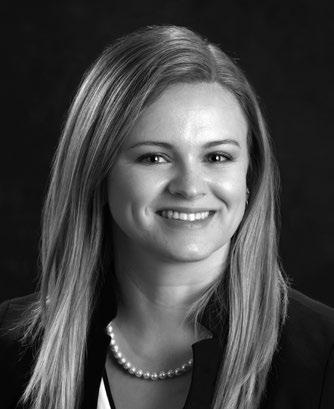
toward the expense of the groceries needed. It’s a group effort of caring and sharing with a heart to help others.
It’s been a wonderful opportunity to pour back into the community, and it’s a firm outreach that we look forward to each year!
We are deeply grateful to local Knoxville area law firms—like Butler, Vines and Babb— that demonstrate an enduring commitment to service and give back to our community year after year, making a positive impact one day at a time.
Looking for other ways to serve?
The Volunteer Breakfast Committee now offers more ways for KBA members to serve, including through the CareCuts organization and the Family Table Program provided through Grow Free Tennessee.

CareCuts of Knoxville, volunteer-driven non-profit, not only provides haircuts, but also food, clothes, and essential life supporting services to individuals experiencing homelessness. CareCuts events are typically well attended by those in need, and the organization’s donation needs might change as we enter the colder Winter months. KBA members who would like to support this cause should reach out to the Volunteer Breakfast Committee co-chairs for more information about CareCuts’ donation needs.
The Family Table Program provided by Grow Free Tennessee is part of the Community Coalition Against Human Trafficking. This program aims to end human trafficking, raise awareness, offer training, and provide support for survivors. Through this program, volunteers can provide a warm meal to individuals staying at the organization’s safe house. Volunteering with Grow Free Tennessee helps empower those on the path to healing and restoration, supporting survivors as they rebuild their lives.
We encourage you to get involved and help make our community stronger. To learn more, please reach out to KBA Membership Coordinator, Bridgette Fly, or contact the Volunteer Breakfast Committee co-chairs, Bridget Pyman at bpyman@arnettbaker.com and Miranda Goodwin at mirandaegoodwin@gmail.com.

TOP TEN
By: Jason Long Lewis Thomason
TOP TEN STRESS INDUCERS OF THE HOLIDAY SEASON
‘Tis the season. The overwhelming season of stress-inducing events guaranteed to keep my blood pressure high and my doctor on speed dial for a refill of Benazepril (it’s not a HIPAA violation if I choose to share my own medical information). As we race toward the finish line of 2025, the final Top Ten List of the year recounts my Top Ten Stress Inducers During the Holiday Season. To clarify, I love the holidays, and it is totally worth shaving years off my life to go through these December rituals, right?
10. Time Flies. I put this one first because it impacts every other item on this list. They say as you grow older time seems to move faster. I wholeheartedly believe that, but the month of December takes it to a whole other level. Maybe it is the fact that the days are actually shorter or that we seem to live in perpetual darkness at this time of year, but time just feels more fleeting during the holiday season which inevitably brings on the stress.
9. Family Interactions. Let me be clear. I’m not talking about the nuclear family I live with 365 days out of the year. Those loved ones don’t cause me stress (or at least no additional stress during the holidays). I’m talking about the visiting parents or in-laws who want to talk politics, sharing meals with the siblings who know all of your deep dark secrets and aren’t afraid to share them, or even just that weird second cousin named Melvin who always wants free legal advice. Family is important, but sometimes less can be more.
8. Cold/Sickness. As I type this, I am home (3 out of the last 4 days) with a brutal cold that won’t go away. COVID and flu are rampant this time of year. Get your vaccines. Nothing increases your stress level like laying around thinking about how much work you have to do and being unable to do it.
7. Holiday Movie Selection. This one may sound silly to most of you, but it is a real struggle in the Long household. Our is a family of cinephiles. Some of our closest family moments are bonding over good movies. A Long family tradition is compiling the list of movies we will watch during the holiday season. Surprisingly, this can be a stressful and contentious process. Some of us (I won’t name names) insist on movies we have seen a hundred times (Elf, A Christmas Story), while others offer more risky, bizarre offerings (The Christmas That Almost Wasn’t). There is the annual debate over what constitutes a Christmas Movie (Die Hard?). We inevitably end up with a list of forty movies and three days to watch them.
6. Holiday Travel. I think travel is a nightmare even during regular times (economy air travel is not built for the 6’5”). Travel during the holidays is ten times worse. Crowded airports, increased security, pushy fellow passengers desperate to get home. As for holiday travel coming off a 40+ day government shutdown? Well, we are about to see how bad that can be.
5. Holiday Parties. For sure, these can be fun, but for those of us who have become more and more introverted in our senior years, holiday parties present yet another opportunity to stand awkwardly in a room
full of people, trying to remember names, and hoping to come up with enough small talk to get through the next round of cocktails. Quite frankly, it’s exhausting.
4. Gift Ideas. I’m terrible at coming up with gift ideas. This problem is inevitably compounded by the fact that I wait until the last minute to try to find something, anything, acceptable. Routinely, I end up frantically running through the mall or scanning online websites to overpay for a bunch of stuff my family doesn’t really want. It’s either that or my family ends up getting individually curated packages of beef jerky and Buc-ee’s t-shirts.
3. End of Year Finances. For those of you who manage or run your law firms, I don’t even want to think about the level of stress the end of the year brings. I get worked up just trying to collect and close the few client accounts I originate in a given year. I just want to practice law and get a check. You people who want to wrestle with payroll, bonuses, overhead, collections and the bottom line, in addition to practicing law, are either saints or certifiably insane, I haven’t decided yet.
2. CLE Compliance. I know. For some of you, this is no big deal. You have all of your CLE hours. Congratulations . . . you are a bunch of heroes. For the rest of us, the week between Christmas and New Years involves frantically taking online seminars, inevitably overpaying for them, to assure we can continue to do this all over again next year.
1. Billable Hours. The bane of a lawyer’s existence (for those of you employed in a legal job that does not require you to track your life in six-minute increments . . . God, I admire you). I’ll spend the last two weeks of December trying to bill as many hours as I can to meet year end goals, come home exhausted on the 31st from my efforts, only to turn the calendar on January 1 to see a big fat zero staring me in the face. I’ve made some great choices in life.
Regardless of your stressors during this season, I hope you all enjoy the holidays and find some time to relax. Happy Holidays.

OUTSIDE MY OFFICE WINDOW
By: Sarah M. Booher Tennessee Department of Human Services

THANKFUL FOR THIS LUMPY LIFE
One of the first things my therapist Jean had me do in 2018, that I still do to this day, is keep a gratitude journal. I’m not talking about pages and pages of words each and every day. I mean more like 3-5 items jotted down in a swag bag, legal conference mini notebook two minutes before I go to bed.
This process did not come easy for me. I am not a natural Pollyanna. For years, that glass wasn’t just half empty, it was probably also full of liquid waste filtered from a feline kidney. When our religion teacher asked us who we wanted to be in our senior year of high school, I looked him dead in this eye, without even a single iota of humor in my heart, and said, “Ouiser Boudreaux.”1 Without missing a beat, he quipped back at me, “Well, you better come up with a new goal, because you’ve already achieved that one.”
So it may come as a surprise to you that I’ve always considered Thanksgiving to be the best holiday. Sure, some folks want to dismiss it because of its rather auspicious beginnings, and that’s worth some reflection, but I adore it. 1. No gifts are necessary. 2. Church attendance is not required but stretchy pants are accepted and expected. 3. You don’t have to stay up late. 4. Turkey skin. Thank you, Sarah Josepha Hale, for championing the Thanksgiving cause for years. Thank you, Abraham Lincoln, for making it an annual event. Thank you, Congress of 1941, for making it a national holiday. I am forever in your collective, gluttonous, culinary debts.
oblivion.
Sometimes I still see how many ridiculously wonderful things I can show gratitude for in 60 seconds. Or I, in the moment, realize how marvelous something is and show appreciation for it right there on the spot. Sometimes I even appreciate an inanimate object out loud, but we don’t need to go into that at this time.
Thankfulness, gratitude, appreciation – it doesn’t matter what you want to call it – changes things. The experts pretty much all agree on the highlights. It improves sleep quality. It improves emotional and social well-being. It lowers depression risks.2 And newer data out of Harvard Medical School even shows that it may even extend lives.

Participants with gratitude scores in the highest third at the study’s start had a 9% lower risk of dying over the following four years than participants who scored in the bottom third. This did not change after controlling for physical health, economic circumstances, and other aspects of mental health and wellbeing. Gratitude seemed to help protect participants from every cause of death studied — including cardiovascular disease.3
But back to my journaling for a moment. I began my gratitude journal with low-hanging fruits, the things we always say, what polite society expects us to say, because I didn’t know what to say. Family. A job. A roof over my head. Some days, when I was running on fumes or fuming mad, I let the sarcasm lead me, with enumerations like expletives, Tums because people were giving me ulcers, or relief that I didn’t commit any felonies that day.
Eventually, I got good at gratitude. I’ve heard before that it takes at least 21 days to form a habit. It was probably more like 221 days for me – I’m stubborn and not very bright. Yet even still, I accepted it was okay to be grateful for the Ocean Spray diet cranberry juice I drink by the gallons, 20-year-old Birkenstocks, a good meme, a great song, Christmas lights, Ferrero Rochers, setting up bills on autopay, butt warmers in my car, warm grass between my toes, the barks my dog makes in his sleep, mailing an envelope across the country for whatever a Forever Stamp costs these days, streaming services, good shaving cream, the girl who does my nails, the guy who lets me merge into his lane, the food content creators on social media, that one Will Ferrell skit with his daughter, that letter from my godmother years ago, and on and on and on toward
I’m going to shoot you straight. I’m not a health nut. At best, I’m a reasonably prudent person when it comes to that sort of thing. I don’t necessarily care if gratitude makes me live longer. Sure, I’m obsessed with eating vegetables and I *will* make my daily step count, but I can’t stand sweating and that candy wall at Buc-ee’s better watch out because I’m gonna come at it like a spider monkey.4 In other words, longer life, schmonger life.
What I love about gratitude, though, and what keeps me coming back for more and more appreciation of my own life, is sort of akin to an old Robert Fulghum quote I heard years ago: “Life is lumpy. And a lump in the oatmeal, a lump in the throat, and a lump in the breast are not the same lump. One needs to learn the difference.” Gratitude is free. Anyone, anywhere, anytime can use it to provide meaning and context. It respects connection. It gives me a moment to be present in my own life to think about other people and broader implications. It gives me peace for the little things to fortify me for the big things. It lets me love the lumps.
Happy Belated Thanksgiving and Happy Holidays to you and yours.
1 See Shirley MacLaine in the 1989 cinematic classic, Steel Magnolias
2 The power of gratitude: 6 benefits of a gratitude practice, Calm.com (April 16, 2025), https://www.calm.com/blog/power-of-gratitude
3 Maureen Salamon, Gratitude enhances health, brings happiness – and may even lengthen lives, Harvard Women’s Health Watch (September 11, 2024), https://www. health.harvard.edu/blog/gratitude-enhances-health-brings-happiness-and-mayeven-lengthen-lives-202409113071.
4 It’s another Will Ferrell thing.