December 2025/January 2026 | Kentucky Monthly Magazine
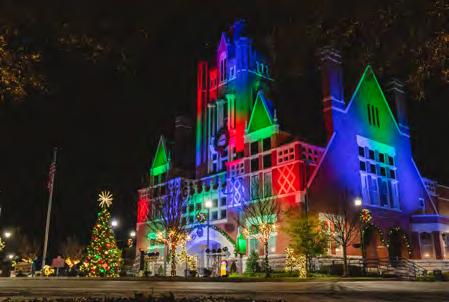
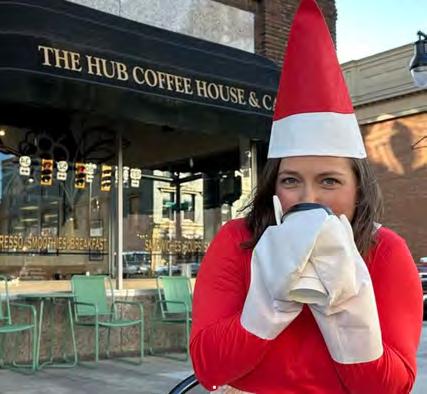
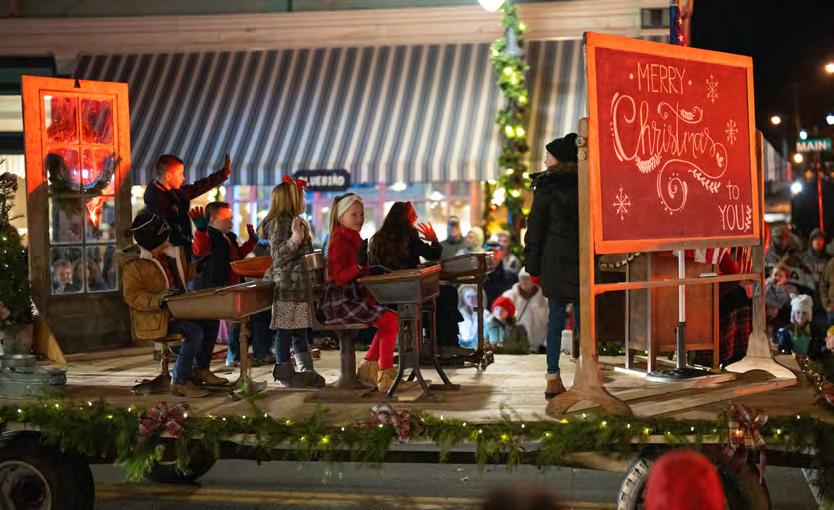
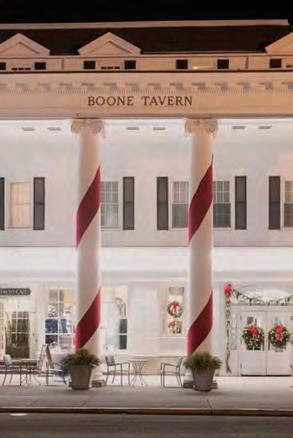
by Mason Warren/ShelbyKY Tourism
Test your knowledge of our beloved Commonwealth. To find out how you fared, see page 8.
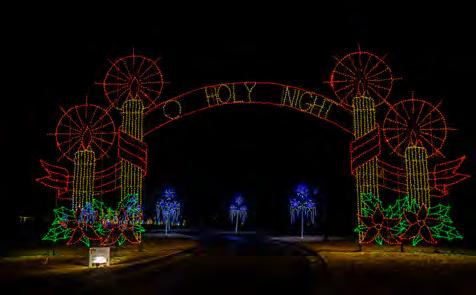
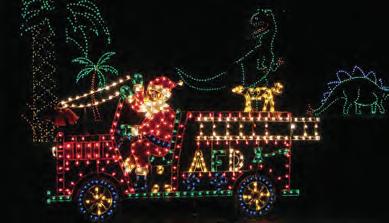
1. How many lights illuminate The Festival of Lights at Patti’s 1880’s Settlement in Grand Rivers?
A. 32,000
B. 72,000
C. 1.5 million
2. The late Martha Layne Collins, once the highest-ranking Democratic woman in the nation, won the race for governor of Kentucky in 1983 without the support of her former boss, John Y. Brown Jr., who instead endorsed whom?
A. Harvey Sloane
B. Grady Stumbo
C. Phyllis George Brown
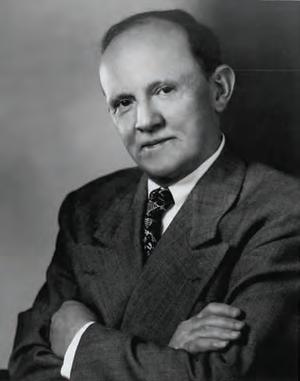
3. As a University of Kentucky basketball player, Basil Hayden was the first to do what?
A. Play football, too
B. Be named an All-American
C. Ser ve in the military
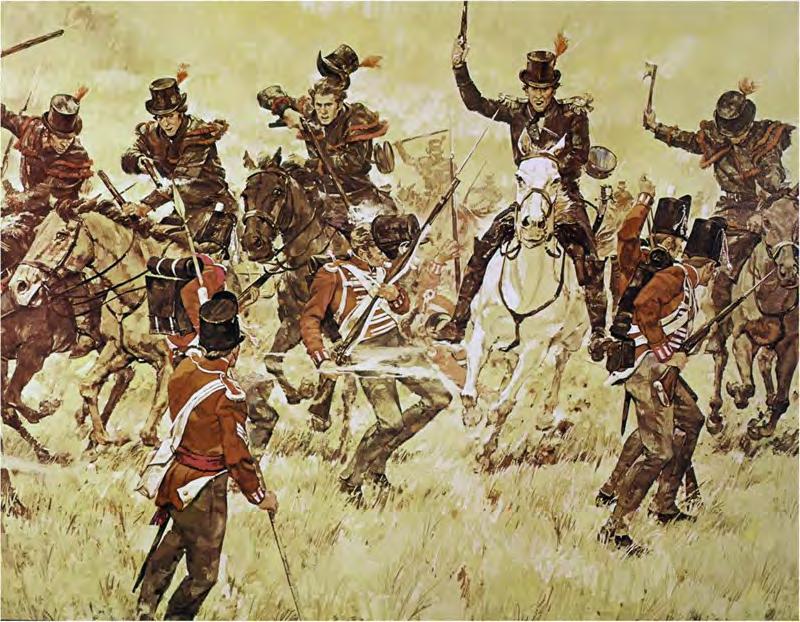
4. The last military battle in Kentucky, which also has been called an ambush or a massacre, took place in which town on Jan. 23, 1865?
A. Simpsonville
B. Shelbyville
C. Franklin
5. Henry C. Magruder, the Confederate leader of the Jan. 23, 1865, ambush, later was captured alongside Marcellus Jerome Clarke, who was known by which fictionalized moniker?
A. “Bloody Jerry”
B. “Sue Mundy”
C. “Three Fingers Clarke”
6. Lawrenceburg’s Anna Mac Clarke, a graduate of Kentucky State University, was the first Black woman to do what?
A. Run for public office
B. Register to vote
C. Ser ve as a commanding officer of an otherwise all-white regiment
7. Morganfield native Thomas Lyle Williams Sr. founded which cosmetics company?
A. Maybelline
B. Max Factor
C. L’Oréal
8. Paul McCartney said when he and John Lennon started writing songs, they pretended to be brothers Phil and Don from which Western Kentucky county?
A. McLean
B. Muhlenberg
C. Caldwell
9. Will Smith hit the winning home run for the Los Angeles Dodgers in Game 7 of the 2025 World Series. Smith graduated from which Kentucky high school?
A. duPont Manual
B. Saint Xavier
C. Kentucky Country Day School
10. Which Gilligan’s Island character was played by an actor who attended the Kentucky Military Institute?
VOLUME TWENTY-EIGHT, ISSUE 10, DECEMBER 2025 / JANUARY 2026
Stephen M. Vest Publisher + Editor-in-Chief
EDITORIAL
Patricia Ranft Associate Editor
Rebecca Redding Creative Director
Deborah Kohl Kremer Assistant Editor
Ted Sloan Contributing Editor
Cait A. Smith Copy Editor
SENIOR KENTRIBUTORS
Jackie Hollenkamp Bentley, Jack Brammer, Bill Ellis, Steve Flairty, Gary Garth, Kim Kobersmith, Brigitte Prather, Walt Reichert, Tracey Teo, Janine Washle and Gary P. West
BUSINESS AND CIRCULATION
Barbara Kay Vest Business Manager
Katherine King Circulation Assistant
ADVERTISING
Lindsey Collins Senior Account Executive and Coordinator
Kelley Burchell Account Executive
Laura Ray Account Executive
Teresa Revlett Account Executive
For advertising information, call 888.329.0053 or 502.227.0053
KENTUCKY MONTHLY (ISSN 1542-0507) is published 10 times per year (monthly with combined December/January and June/ July issues) for $25 per year by Vested Interest Publications, Inc., 102 Consumer Lane, Frankfort, KY 40601. Periodicals Postage Paid at Frankfort, KY and at additional mailing offices.
POSTMASTER: Send address changes to KENTUCKY MONTHLY, P.O. Box 559, Frankfort, KY 40602-0559. Vested Interest Publications: Stephen M. Vest, president; Patricia Ranft, vice president; Barbara Kay Vest, secretary/ treasurer. Board of directors: James W. Adams Jr., Dr. Gene Burch, Gregory N. Carnes, Barbara and Pete Chiericozzi, Kellee Dicks, Maj. Jack E. Dixon, Mary and Michael Embry, Judy M. Harris, Jan and John Higginbotham, Frank Martin, Bill Noel, Walter B. Norris, Kasia Pater, Dr. Mary Jo Ratliff, Randy and Rebecca Sandell, Kendall Carr Shelton and Ted M. Sloan.
Kentucky Monthly invites queries but accepts no responsibility for unsolicited material; submissions will not be returned.
KENTUCKYMONTHLY.COM
Readers Write
The Influence of Mentors
I enjoy reading Bill Ellis’ articles in Kentucky Monthly. Not only are they “down to earth,” but there is really a great message in them and one open to various interpretations, I suppose.
My interpretation is one of mentorship. When I look at my life and his through his writings, it is obvious we did not get to our place in life alone. We are standing on the shoulders of people who loved us, cared for us, and certainly wanted to see us succeed. I started a list of all the people who had an impact on my life, no matter how large or small, and I am well over 150 in number. It is amazing when you start thinking back over your life and how we got to where we are now.
I also think about those mentors in our lives whom we know only through writings, history books and stories that have been passed down. When I think of those people, I sometimes like to think of them and their actions as being either trail blazers and or trail markers. I think of trail blazers as those brave individuals who, without any ulterior motive, took a stand on what they believed in and were willing to fight for it, either physically or, many times, verbally in written or spoken word. Trail markers, on the other hand, seem to have had a vision and could “see the other
side of the mountain” and who said in so many words, “Come follow me.” Both types have had an impact on my life.
I want to wish Bill all the best, and I am looking forward to his next article.
Lewis P. Bradley, Hopkinsville
Snow Hill Memories
Bill Ellis’ column in the September issue really brought back memories.
Growing up, we lived on Snow Hill on Bland Avenue, in one house with three “apartments.” (We lived in two of them at one time or another.)
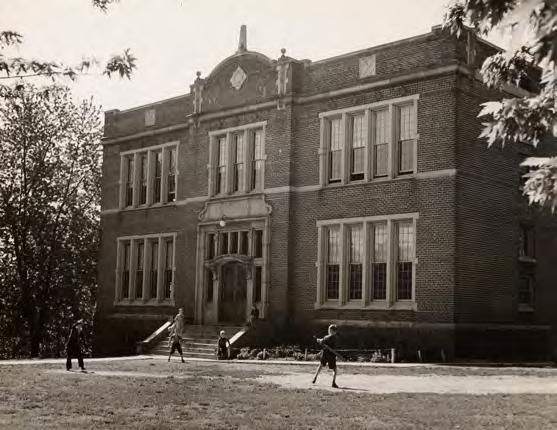
I think my first and second grades were in a little building behind the elementary school, which held the third through sixth.
I attended seventh and eighth grades at Henry Clay. Then on to Waddy for ninth through elenth. We were the first graduating class at the new Shelby County High School in 1961. We had boxed lunches for a while, as the lunchroom was not finished. We moved to Frankfort after that.
I still see Bill’s dad’s welding sign when I go through. So many memories. Thank you!
Connie
Oldham, La Grange
We Love to Hear from You! Kentucky Monthly welcomes letters from all readers. Email us your comments at editor@kentuckymonthly.com, send a letter through our website at kentuckymonthly.com, or message us on Facebook. Letters may be edited for clarification and brevity.
MAG ON THE MOVE
Even when you’re far away, you can take the spirit of your Kentucky home with you. And when you do, we want to see it!
turkey
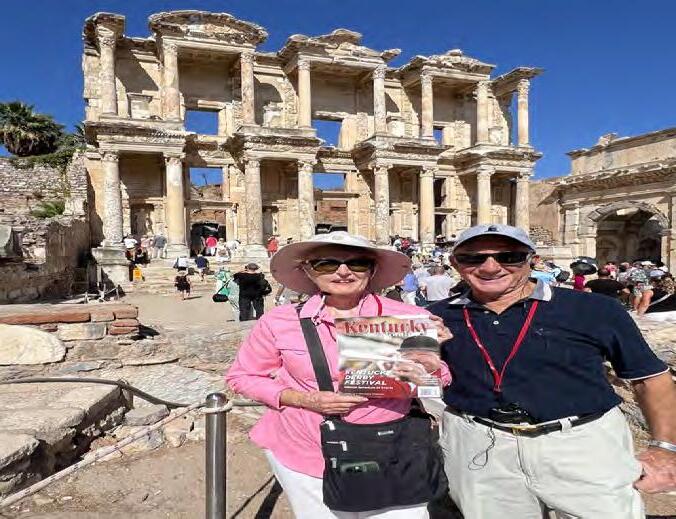
Barbara and Pete Chiericozzi of Tega Cay, South Carolina—formerly of Salvisa—visited the remains of the Library of Celsus, built in 110 CE, in Ephesus (modern Turkey). At one time, the library held 12,000 scrolls, with holdings that were surpassed only by libraries in Rome and Alexandria, Egypt.
submit your photo
Take a copy of the magazine with you and get snapping! Send your high-resolution photos (usually 1 MB or higher) to editor@kentuckymonthly.com or visit kentuckymonthly.com to submit your photo.
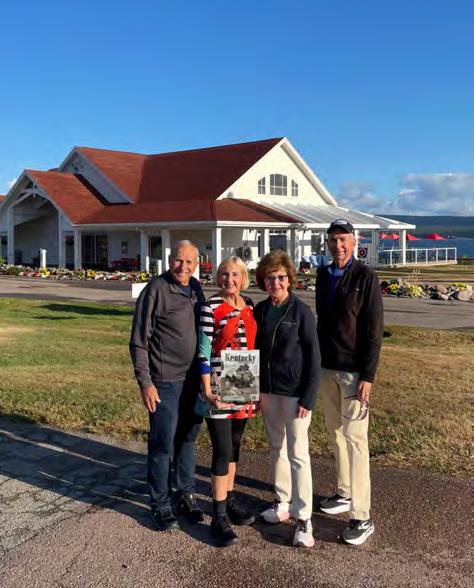
Paul and Ann Brinkopf of Benton and Martha and Mark Birdwhistell of Richmond ventured to Nova Scotia, where they are pictured at the Keltic Lodge at the Highlands at the Cape Breton Highlands National Park.
nova scotia
Tim and Betsey McDonald, center, of Louisville enjoyed a beautiful day at Lake Como in Northern Italy with their daughter, Kassie Fiumicelli, and her husband, Fabrizio. They were on a 10-day trip that started at the annual Luminara in Pisa festival in Pisa, Italy, before they departed for this beautiful spot.
greece
Jeff and
from
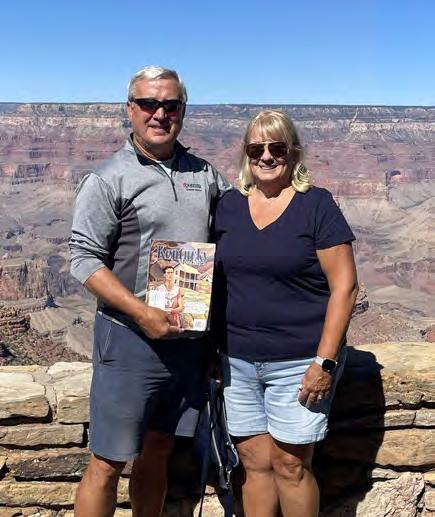
celebrated their 50th anniversary with a trip out west that included a stop in the Grand Canyon.
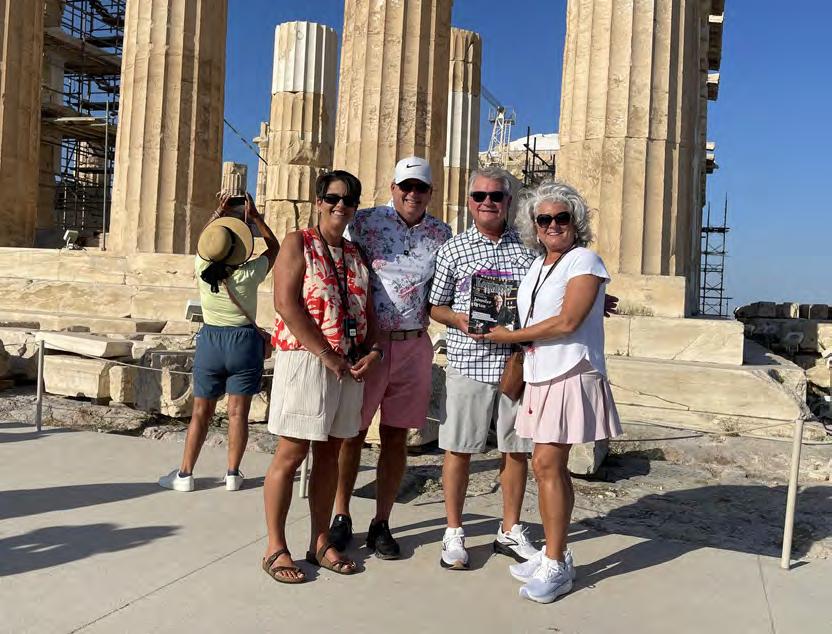
From left, Julie and Kris Beickman and Greg and Kim Hoodenpyle—all of Henderson— took in the ancient ruins at The Acropolis and the legendary Parthenon in Athens.
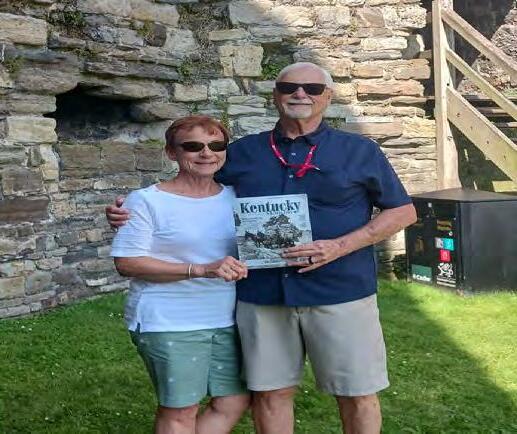
Patricia Dorton Whitaker and Morris Hunter of Maysville visited Beaumaris Castle in Anglesey, Wales. wales
Vicki Jehn
Taylor Mill
grand canyon
VISIT KENTUCKY’S NATIONAL QUILT MUSEUM
Charles Cameron: A Curious Modern Quilter Through March 24, 2026
School Block Challenge 2026 Through March 3, 2026
New Quilts From An Old Favorite: Food March 6 – July 28, 2026
Latifah Saafir: Quilts March 6 – July 28, 2026
Janet Stone: And Now I Know My ABCs! March 27 - September 22, 2026
Tula Pink: Twenty Years of Tula Pink April 3 - September 15, 2026
Sudoku by Charles Cameron
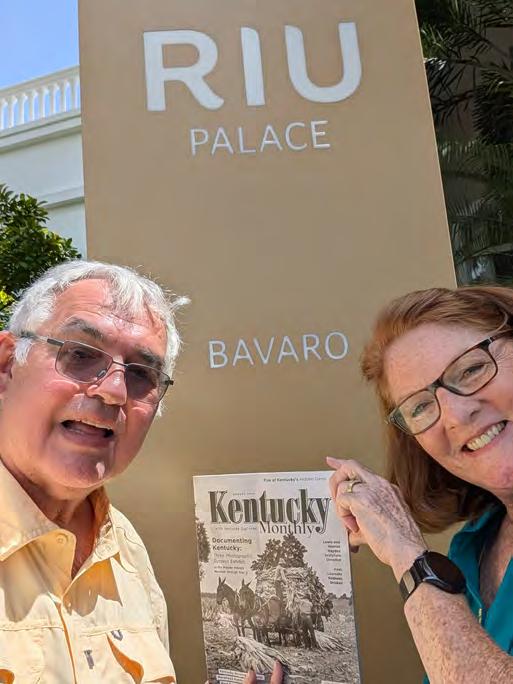
dominican republic
Madisonville residents J.R. and Sonda Bone vacationed at Punta Cana, Dominican Republic. “Kentucky Monthly is the best airport layover read!” they wrote.
new york
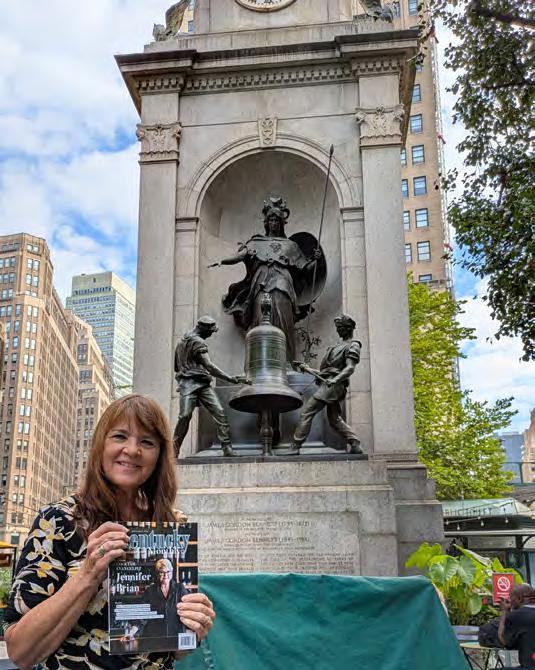
Jill Heink of Lexington visited the Big Apple, where she is pictured in Herald Square in front of the James Gordon Bennett Memorial (also known as The Bellringers). The clock rings on the hour, with the two workmen swinging at the bell as Minerva looks on!
KWIZ ANSWERS
1. C. Vintage horse-drawn carriages take visitors through Patti’s Settlement, where you can enjoy lunch with Santa and Mrs. Claus; 2. B. Grady Stumbo finished third in the voting behind Collins and Sloane; 3. B. Basil Hayden, “The Blond Adonis,” was an All-American in 1921; 4. A. Confederate guerrillas, led by Henry C. Magruder, killed more than 40 U.S. Colored Troops near Simpsonville; 5. B. Many war crimes were attributed to “Sue Mundy,” a female guerrilla created by Louisville Journal publisher George D. Prentice to mock Union Gen. Stephen G. Burbridge. With his long dark hair and smooth facial skin, Clarke was thought to be “Sue Mundy”; 6. C. Clarke was a first lieutenant in the Women’s Army Corps during World War II; 7. A. Inspired by his sister’s use of Vaseline combined with coal dust to darken her eyelashes, Williams created a mascara/eyebrow enhancer, Maybelline’s first product; 8. B. Paul was Phil and John was Don Everly of Everly Brothers fame; 9. C. Smith was a shortstop and pitcher for the KCD Bearcats; 10. C. A young Jim Backus, also known for “Mr. Magoo,” attended KMI in 1932 alongside actor and Louisville native Victor Mature.
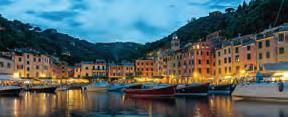
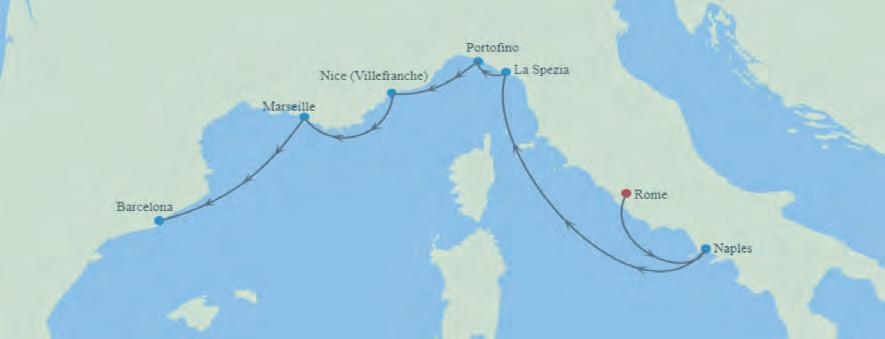
9 Night Cruise | 7 Ports | 2 Sea Days
Departing from Rome, June 2nd, 2026. Arriving in Barcelona on June 11th. More info and links to come!
BY LAURA YOUNKIN
A Matter of Time
During a recent interview, Carl Broemel referred to the lyrics of an old Jim Croce song: “There never seems to be enough time to do the things you want to do once you find them.” He felt it was a good explanation of why it’s taken so long for him and his friend Tyler Ramsey to record an album.
Broemel plays guitar, pedal steel guitar and saxophone and sings backup vocals for the Louisville band My Morning Jacket. Ramsey is based in Asheville, North Carolina, and is also a guitarist. While both have band connections, they also do solo work. Now, they’ve put enough songs together for a mostly instrumental record called Celestun.
Ramsey said. He went to Broemel’s house for a few days and rehearsed before their first show. “Right away, it felt really natural … Our voices blend well. It’s like he’s my brother in a way.”
primarily instrumental. “I’m way into finger-style instrumental guitar and composition,” Ramsey said. “He [Broemel] studied a little bit of classical guitar, so he’s into that stuff, too.”
“The goal of this is not to be popular,” Broemel said. He and Ramsey love old records and finding forgotten music. He wants to find them and share them with listeners, hoping they’ll appreciate them, too.
Although neither musician is originally from Kentucky, both feel an affinity to the state. “I’m a Hoosier, and I moved to LA, and I met My Morning Jacket in LA. Louisville is a bit of a second home for me at this point,” Broemel said.
They first met when their bands toured together in 2012. Ramsey was playing with Band of Horses, which was opening for My Morning Jacket. Ramsey has fond memories of that tour. “There is a little Kentucky in this relationship,” he recalled. “One of the first times I really connected with Carl and the rest of his band was at the Forecastle Festival. Afterward, there was a party at La La Land [Studios]. That was a special night.”
After listening to Ramsey’s solo work and Band of Horses, Broemel said he was interested in creating music with him.
In 2019, they began their Duo Quest tour. “We went out and toured together. We didn’t have any albums,” Broemel said.
“So when we booked our first tour, we had booked it before we really had sat down and played together,”
One of the things Broemel appreciates about playing with Ramsey is Ramsey’s complexity. “I think playing with Tyler is the perfect level of challenge and fun,” he said. He referred to Ramsey’s style as a mystery in which he has to figure out what’s going on and what he can add.
The duo has booked another tour across the country for 2026, which includes a stop at the Whirling Tiger in Louisville on Feb. 12.
This time, they’ll have their new release Celestun to share with fans. They wanted to make an album earlier, but it was hard for two working musicians to find the time. The pandemic lockdown gave them that time. Ramsey would send Broemel a piece of music, and Broemel would add his part and send it back. “It was magical,” Ramsey said.
The release has a few vocals but is
Ramsey has a strong affection for Kentucky music. “I love S.G. Goodman, Bendigo Fletcher, Joan Shelly, Maggie Halfman [and] Nathan Salsburg,” he said.
Broemel agreed and added Bill Monroe and VHS or Beta to the list.
“I feel free and challenged when we’re working together. It feels magical to us,” Broemel said of their camaraderie. “And if it does for other people, it’s not for me to say.”
“It always makes me smile,” Ramsey agreed. “There are little subtle shifts every time we play these songs.”
Will they continue making music together? “This is what our band is like. Both hands on the Ouija board and see where it’s going,” Broemel said.
Ramsey was more concrete. “We already have plans,” he said. “We’re already moving forward. We’ll do it again.”
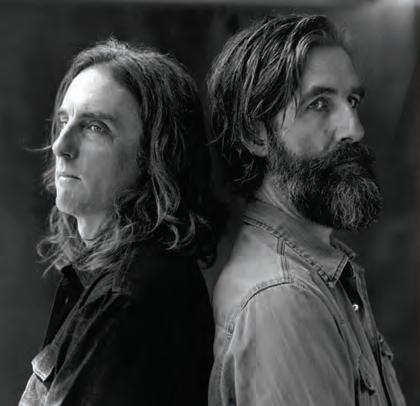
Carl Broemel, left, and Tyler Ramsey
Holiday Treats
T his time of year, family and friends get together to celebrate the season with special desserts and savory spreads that may not be on the menu the rest of the year. Contributor Merritt Bates-Thomas shares a few of her favorites that you can offer at your seasonal get-togethers.
1. In a mixing bowl, stir together the crumbled feta cheese, chopped green olives, cream cheese and Greek yogurt. Add in the fresh lemon juice and olive oil. Stir together to blend well.
2. Add garlic powder, ground black pepper and red pepper flakes, if using. Blend remaining ingredients with a hand mixer, leaving chunks of olive in the mixture.
3. Place in a serving bowl, garnish with parsley, and serve with assorted crackers.
Recipes and photos by Henderson resident Merritt Bates-Thomas, a registered dietitian nutritionist (RDN) who has been sharing recipes with a healthier twist on WBKR-FM
92.5’s What’s Cooking since 2017. In May 2023, she joined ABC-25’s Local Lifestyles to share recipes and tips for flavorful cooking. She also appears on CW7’s Daybreak Extra’s Joe’s Kitchen Follow her on Instagram @thekitchentransition and on Facebook at The Kitchen Transition.
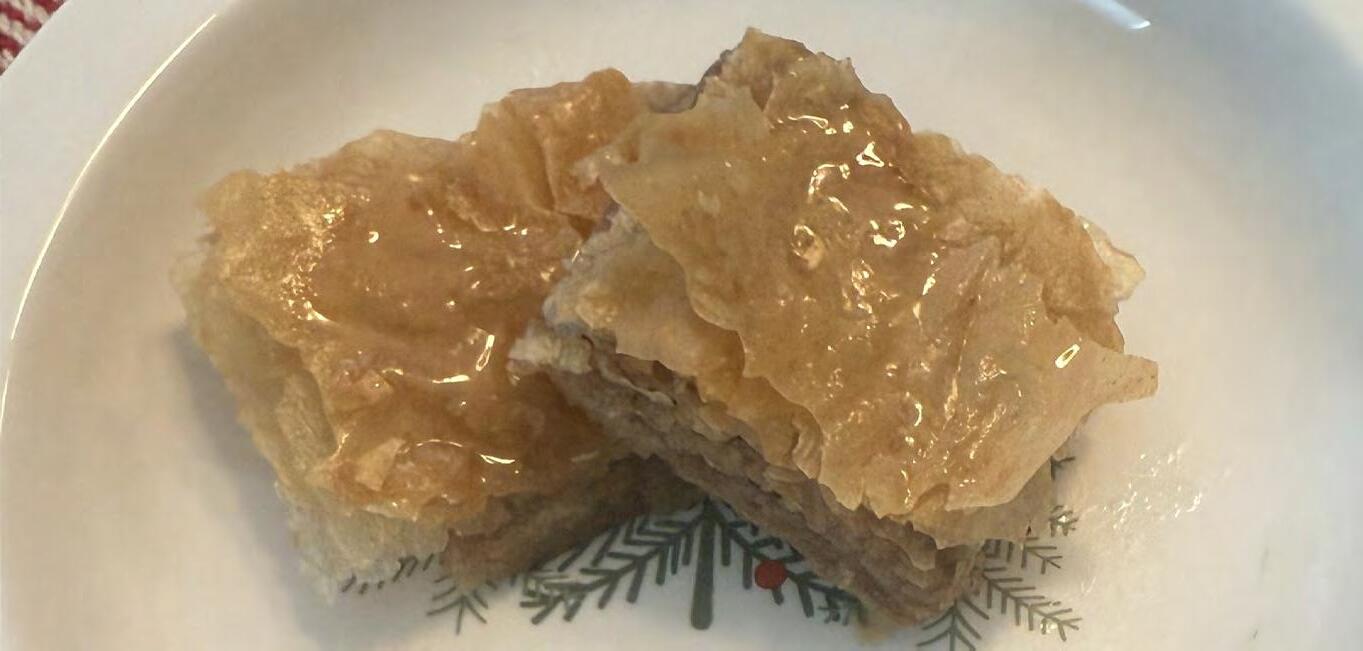
Apple Baklava
YIELDS 24 PIECES
16 ounces phyllo dough, thawed according to package instructions
1 cup granulated sugar
½ cup honey
2 tablespoons lemon juice
¾ cup water
1. Preheat oven to 325 degrees.
1 pound walnuts, finely chopped (about 4 cups)
1 teaspoon ground cinnamon
1¼ cups unsalted butter, melted
1½ cups apple butter
Melted chocolate chips and chopped walnuts for garnish (optional)
2. Place thawed phyllo dough on the counter for 1 hour before starting your recipe to bring it to room temperature. Trim phyllo dough to fit a 13- by 9-inch baking dish. You can trim one stack at a time, then cover with a damp towel to keep from drying out.
3. Butter the bottom and sides of the 13- by 9-inch baking dish and set aside.
4. In a medium saucepan, combine sugar, honey, lemon juice and water. Bring mixture to a boil over medium-high heat, stirring until sugar has dissolved. Reduce heat to medium-low and boil an additional 4 minutes without stirring. Remove from heat and let syrup cool while preparing baklava.
5. Pulse walnuts in a food processor until finely chopped. In a medium bowl, stir together walnuts and cinnamon.
6. Place 10 phyllo sheets into baking pan one at a time, brushing each sheet with melted butter once it’s in the pan before adding the next sheet (i.e., place phyllo sheet into pan, brush the top with butter, place next phyllo sheet in pan, butter the top, etc.). Keep remaining phyllo covered with a damp towel at all times.
7. Spread about 1/5 of the apple butter and then sprinkle 1/5 of the nut mixture (about ¾ cup) over phyllo dough.
8. Add five buttered sheets of phyllo, then another layer of apple butter and nuts. Repeat four times. Finish off with 10 layers of buttered phyllo sheets. Brush the top with butter.
9. Cut pastry into 1½-inch wide strips, then cut diagonally to form diamond shapes. Bake for 1 hour and 15 minutes or until tops are golden brown.
10. Remove from oven and immediately spoon cooled syrup evenly over the hot baklava (you’ll hear it sizzle). This will ensure that it stays crisp rather than soggy. Let baklava cool completely, uncovered and at room temperature, before serving.
1 cup finely chopped pecans, almonds, walnuts or hazelnuts (or a mixture)
1 cup cocoa
¼ cup bourbon
½ teaspoon pure vanilla extract
3 tablespoons honey
1-2 tablespoons water
1. Combine sugar and lemon zest in a food processor. Pulse to incorporate. Pour onto a large sheet of wax paper or parchment paper. Set aside.
2. Place crushed ginger snaps, nuts and cocoa in the bowl of a food processor and pulse to combine.
3. Whisk together the bourbon, vanilla extract, honey and water, and drizzle over the ginger snap crumb mixture. Mix until everything is well combined.
4. Shape mixture into ½ tablespoonsized balls. Roll in the lemon sugar. Store in an airtight container.
Cinnamon Pecan Cake
YIELDS 8-12 SLICES
Butter and flour for preparing pan
¾ cup all-purpose flour
¾ cup super-fine almond flour
1 teaspoon baking powder
½ teaspoon salt
1 stick (¼ pound) butter, softened
1/3 cup granulated sugar
1/3 cup packed light brown sugar
2 large eggs, room temperature
½ cup Greek yogurt
1 teaspoon vanilla extract
1 teaspoon almond extract
¼ cup light brown sugar
2 teaspoons ground cinnamon
¼ cup chopped pecans
½ cup honey
½ cup water
¼ cup pecan pieces, toasted
Powdered sugar (optional)
1. Preheat oven to 350 degrees. Grease an 8-inch round cake pan lightly with butter (bottom and sides), then dust with flour to keep the cake from sticking.
2. In a medium bowl, combine flours, baking powder and salt. Whisk to combine the dry ingredients.
3. In a mixing bowl, add the softened butter, granulated sugar and 1/3 cup packed light brown sugar. Cream butter and sugars together for 2-3 minutes until light and fluffy. Scrape down the sides of the bowl. Beat in the eggs, one at a time. Mix in the Greek yogurt and the extracts until smooth.
4. Add the dry ingredients to the mix and combine to remove any lumps. Scrape down the sides of the bowl as needed.
5. In a small bowl, combine ¼ cup light brown sugar, cinnamon and pecans and set aside.
6. Transfer half the batter to the cake pan and spread it into an even layer. Sprinkle cinnamon-sugar-pecan mixture over the cake batter. Add the remaining batter to the pan and spread evenly over the first layer.
7. Bake on the middle rack of the oven for 30-35 minutes, until the top is golden brown and the middle of the cake is set. Cool the cake in the pan 10 minutes.
8. Place a cutting board or dinner plate over the top of the cake pan and flip the cake over so that it releases from the pan. The cake will be upside down. Place a cake stand or serving tray on top of the cake and flip over the cake. Allow the cake to continue cooling.
9. Combine the honey and water in a saucepan over medium-high heat. Bring the mixture to a boil. Reduce heat to medium and simmer for about 5 minutes until reduced. Turn off the heat and allow the honey mixture to cool for 10 minutes.
10. Spoon the honey mixture over the cake. Sprinkle with powdered sugar, if desired, and top with toasted pecans.
Note: I toast the pecan pieces that will top the cake during the last few minutes of the cake cooking.
Kentucky’s Festive Spirit
It’s beginning to look a lot like a Hallmark holiday movie set in a town near you
BY JACKIE HOLLENKAMP BENTLEY
The story is familiar: It’s Christmastime, and girl meets boy. They fall in love. Some kind of drama ensues and resolves, and they live happily ever after. The movie setting for this story typically is a small town with shop windows and streets all decked out for the holidays. While we may never find ourselves in this kind of Hallmark-esque movie plot, visiting a festive and glittering small town during the holidays is entirely possible in Kentucky. Many of the Commonwealth’s cities pull out all the stops when it comes to celebrating the holidays. We highlighted a few to visit to get you into the holiday spirit.
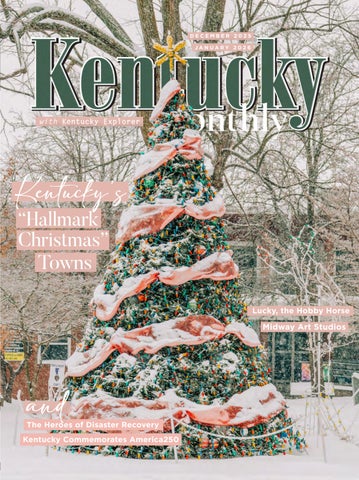
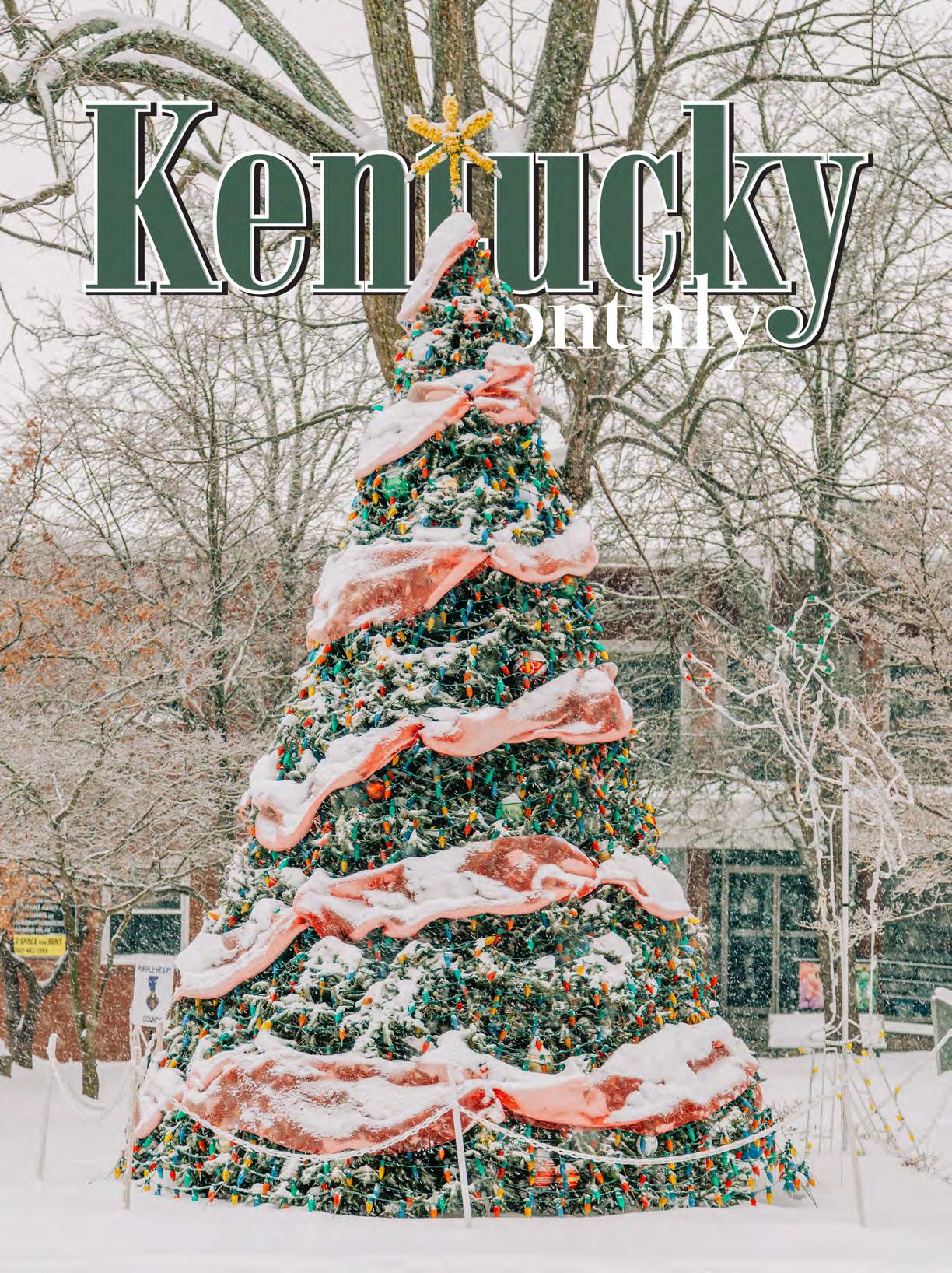
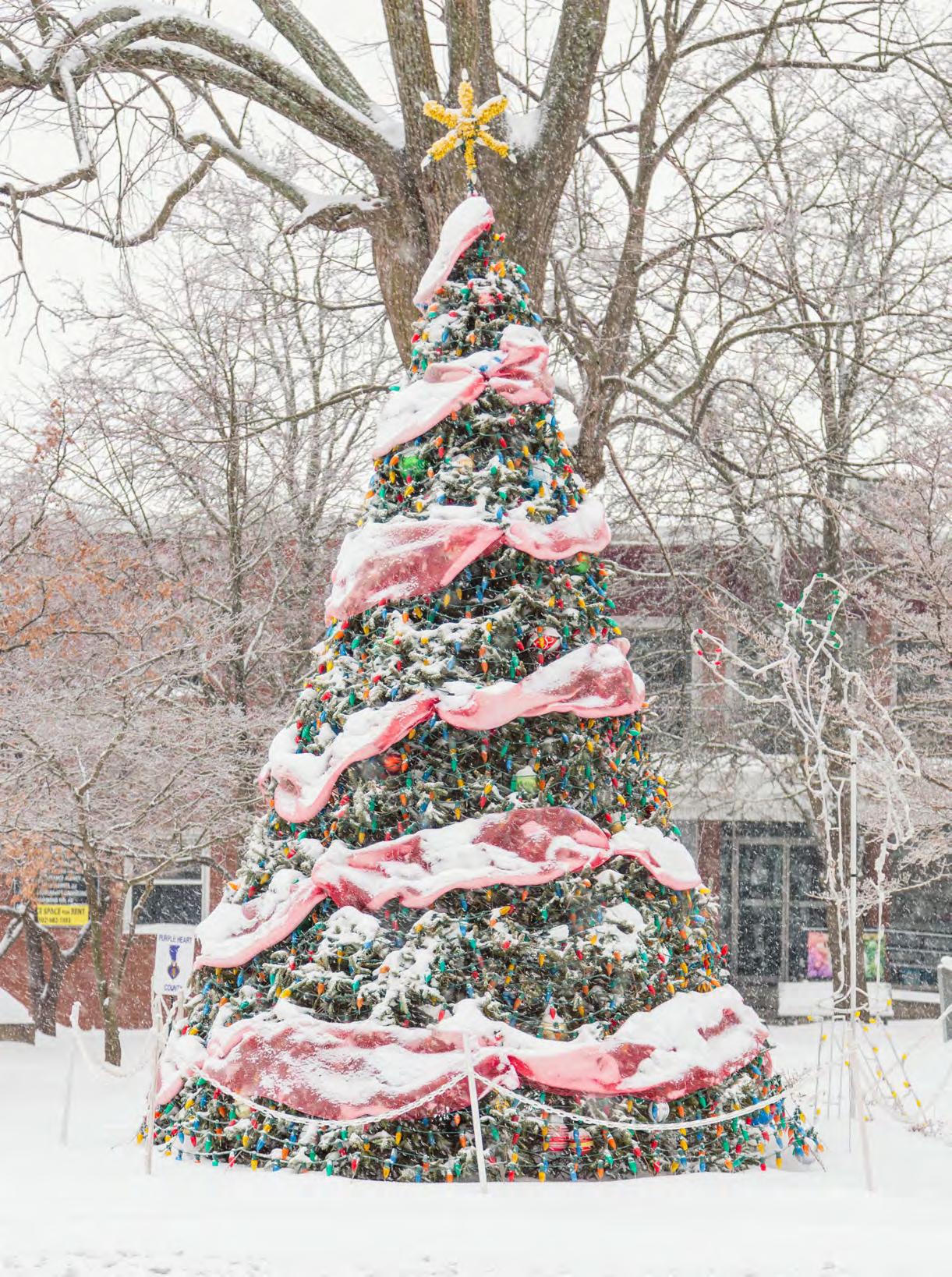
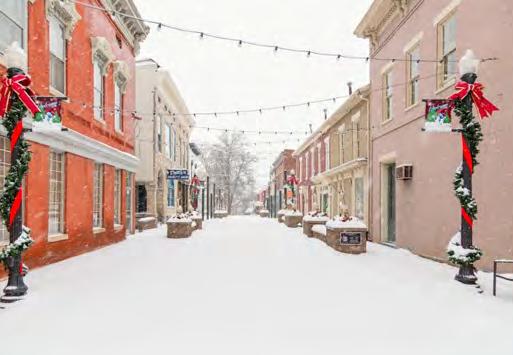
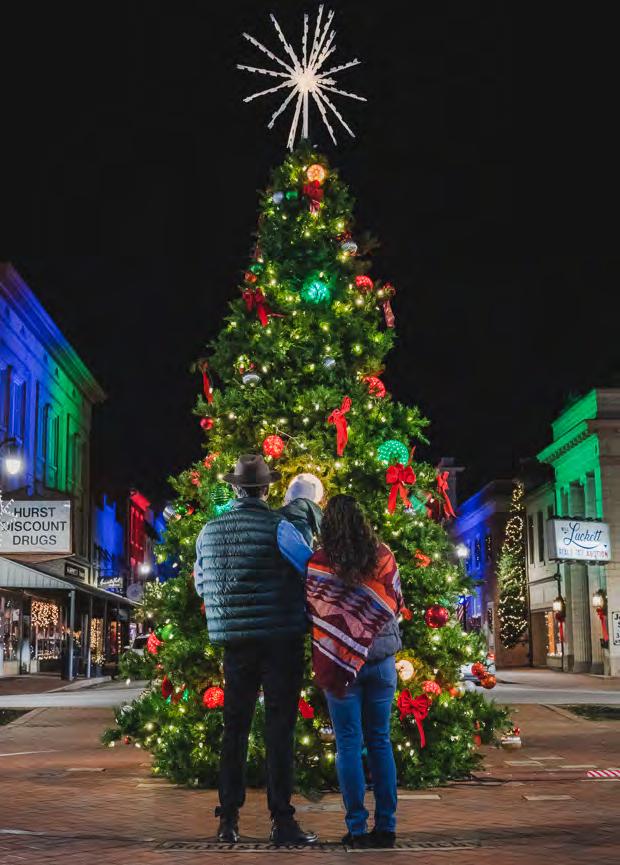
A snowy, showy Shelbyville Christmas tree.
PADUCAH
AChristmas parade, carriage rides, decorated storefronts, a drivethrough Christmas light display, and a pajama cocktail party are a few of the ways Paducah celebrates the holidays.
“Yes, we do get all decked out,” said Alyssa Phares, president and CEO of the Paducah Convention & Visitors Bureau.
The town had to get an earlier-
For more information and a schedule of holiday events, check out www.paducah.travel.
merchants, nearby businesses and local homeowners also decorate to complement the street greenery and holiday lighting.
Nearby Noble Park already had transformed into Christmas in the Park, with more than 500,000 lights shaped into different holiday scenes throughout.
“It’s a drive-through light display, so you can pack your kids in the car, put some Christmas music on, roll down the windows and drive through,” Phares said. “People come from all over to this event.”
than-usual start to welcome the U.S. Capitol Christmas Tree Whistlestop Tour visit on Nov. 14. On the tour, the tree destined to decorate the west lawn of the nation’s Capitol is transported 3,000 miles, from the Humboldt-Toiyable National Forest in Nevada to Washington, D.C. In addition to festooning the Paducah Homegrown Farmers’ Market pavilion—where the “People’s Tree” was displayed—downtown
Horse-drawn carriage rides will be available Dec. 13 and Dec. 20 to give residents a nostalgic way to enjoy the holiday atmosphere in the downtown area and surrounding streets.
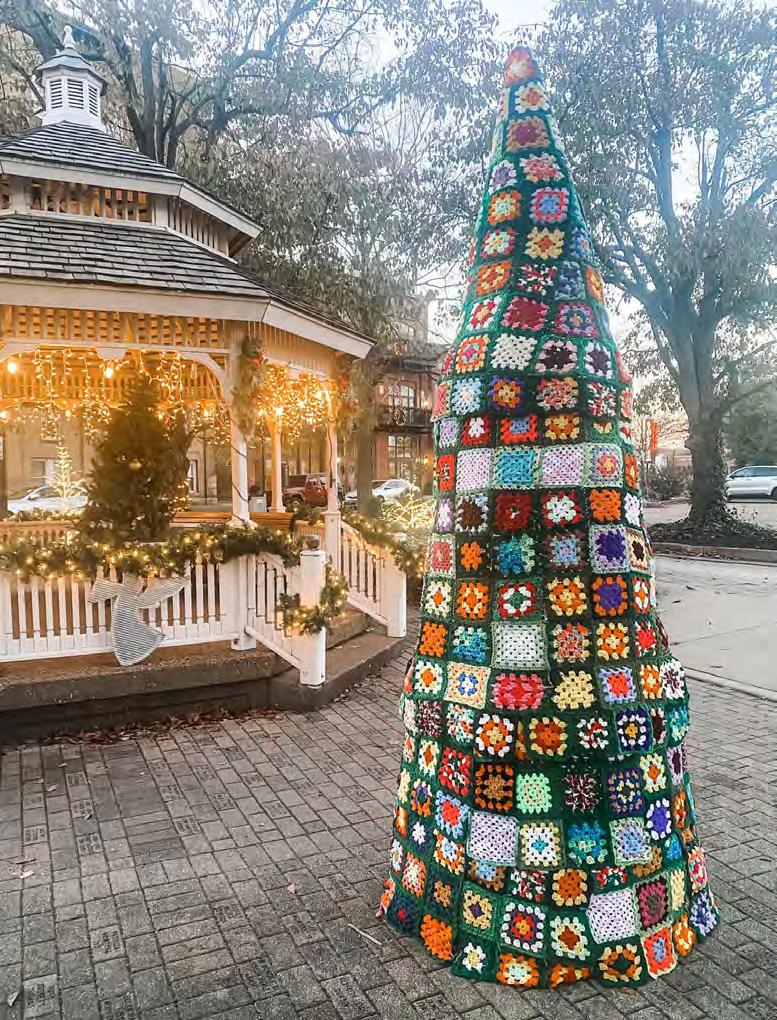
“Lower Town, which has many residential homes, tends to go all out for the holiday season as well, so even the residents get in on the festivities,” Phares said. “We also have a gazebo … that gets decorated and glowing. It just feels really homey and comforting and like a place you really want to be during the holidays.”
SHELBYVILLE
For a complete list of activities and events to get into the holiday spirit, see visitshelbyky.com.
To call the city of Shelbyville the “epicenter of Christmas” might be considered hyperbole, but not to Janette Marson, the president and CEO of ShelbyKY Tourism.
“With so many things going on all the time throughout December, it feels truly like the epicenter,” Marson said. “It’s just absolutely magical, and you’d have trouble doing everything in a weekend. You’d have to come back time and time again to pack everything in.”
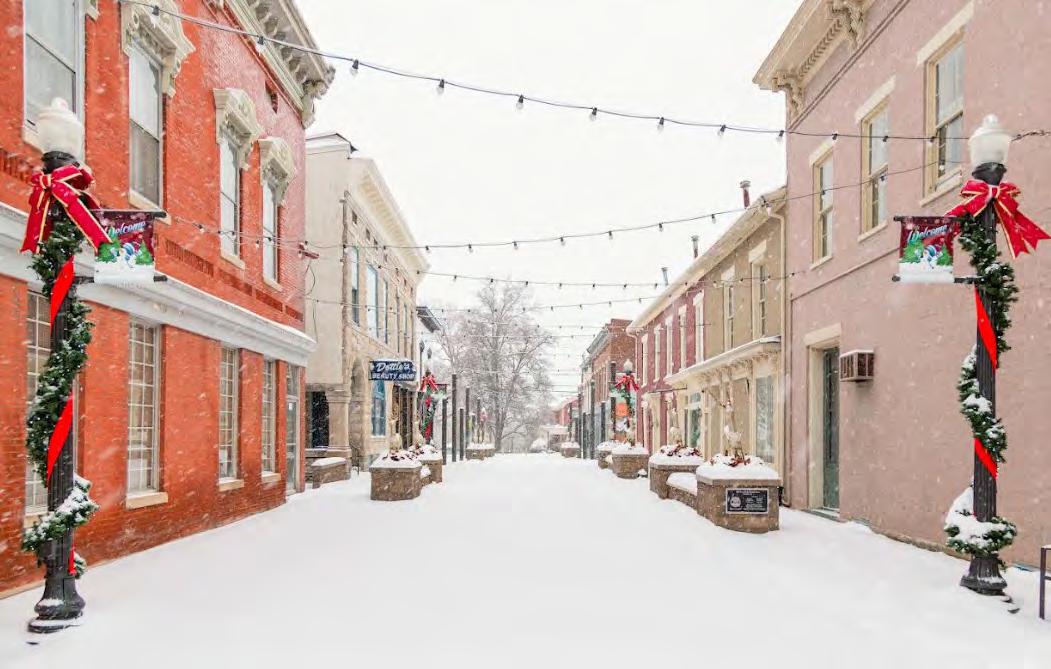
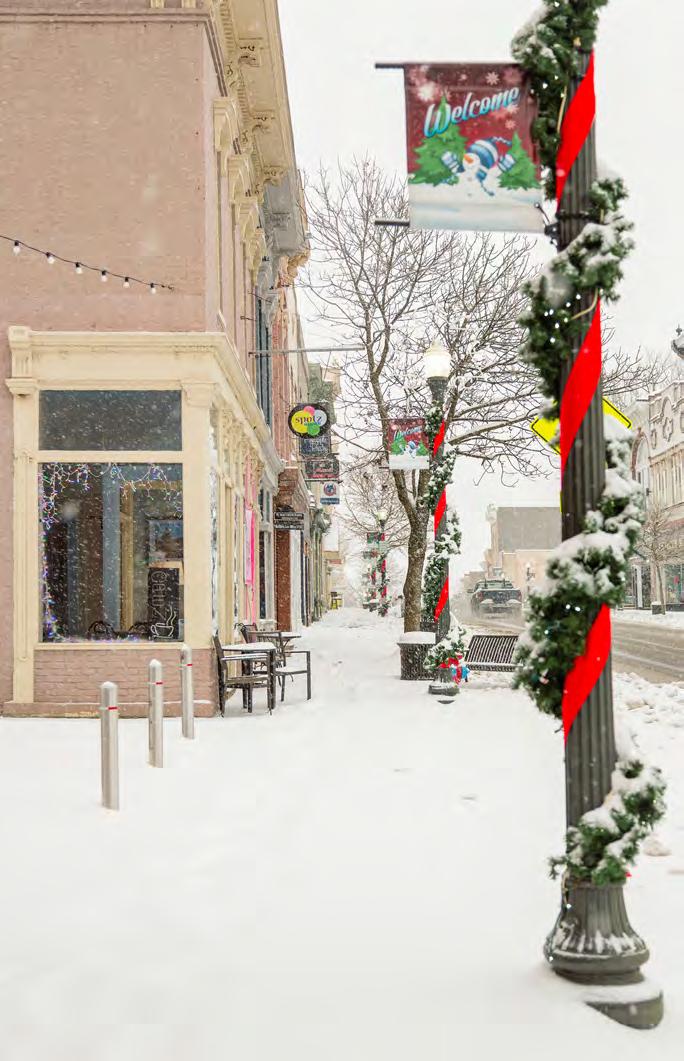
Many holiday activities are scheduled throughout Shelby County, but the holiday magic can be found simply strolling the streets of downtown Shelbyville.
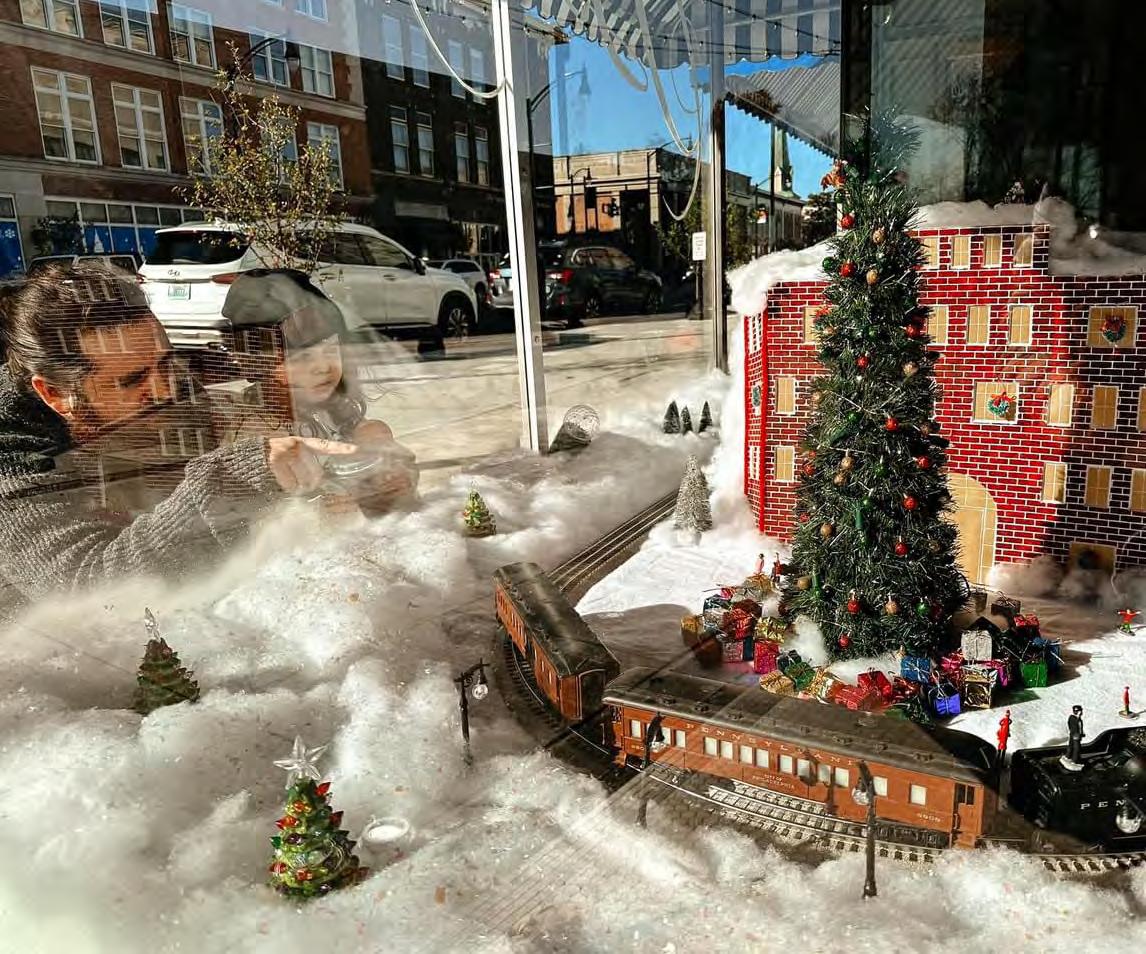
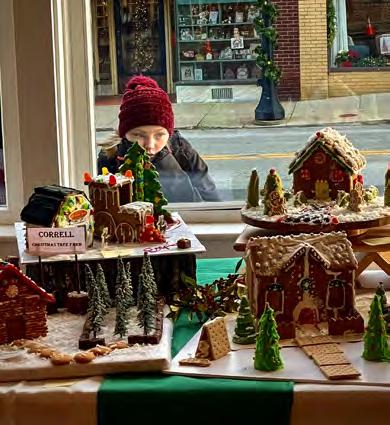
“Oh, my heaven, the lights, the sounds. There are boutiques, and every one of them will have some sort of a Christmas display in the windows,” Marson said. “It’s like you’ve stepped back in time. It’s absolutely magical.”
In addition to storefront decorations and window displays, lights, banners and greenery bedeck the downtown proper.
“You’ll hear Christmas music,” she said. “You’ll always see lots of people with bags from shopping. You will see the displays in the windows and just the twinkling lights everywhere if you just want to walk.”
BARDSTOWN
The city of Bardstown puts on such a display for the holidays that visitors describe it as the North Pole of Kentucky.
“We went ahead and trademarked the title so we could use it all the time,” said Stacey Phelps, the president of Visit Bardstown. “It’s so special when you start pulling into our downtown. It’s like a winter wonderland, with all the lights, the greenery—just everything.”
Phelps said the town also has been referred to as a Norman Rockwell painting at Christmastime.
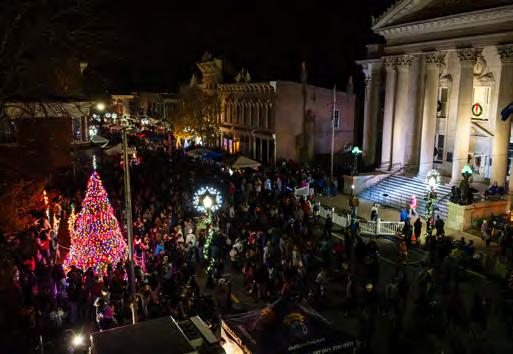
“I mean, that’s exactly what it looks like,” she said. “All of our downtown businesses light up. We have a massive Christmas tree that sits in front of our courthouse right at Court Square. There will be lights at least three blocks down side streets. Everything will be lit up.”
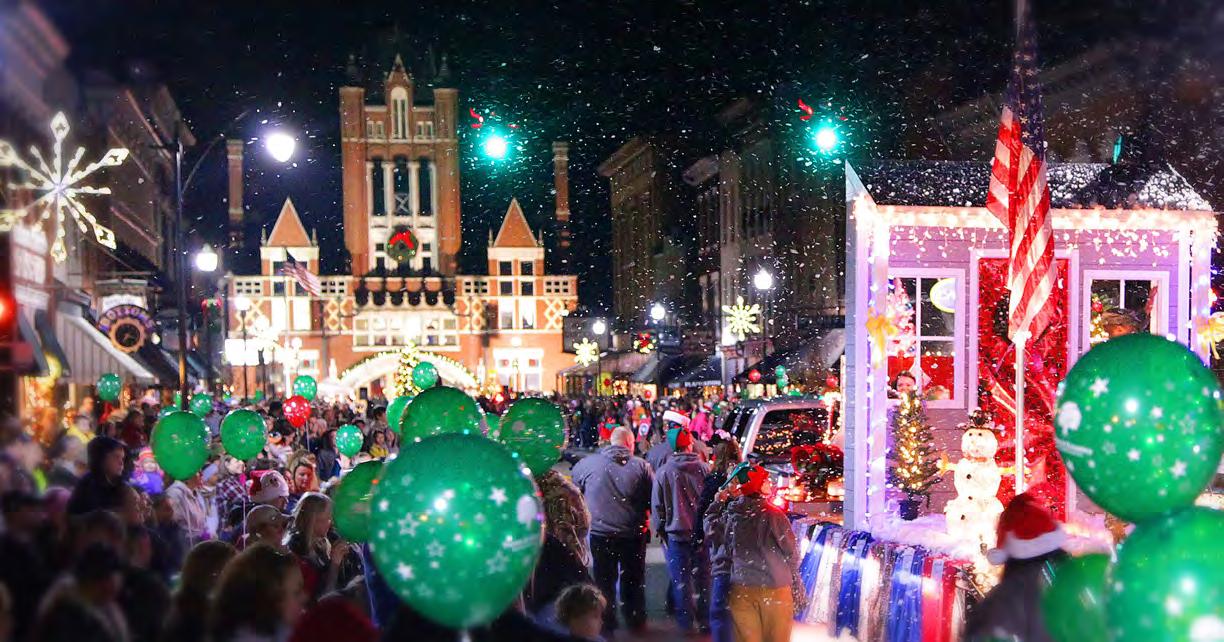
The Bardstown Christmas parade takes to the streets on Dec. 4, with
more than 200 floats bedecked in holiday themes.
On Dec. 6-7, visitors can travel less than a mile away to visit My Old Kentucky Home’s Christmas Carnival in the Park for even more holiday festivities, including bounce houses, games, miniature golf and ice skating.
“Pretty much the whole entire park is transformed into a magical wonderland,” Phelps said.
DANVILLE
For those wanting to experience that Hallmark movie small-town atmosphere, Danville promises to deliver just that this holiday season.
Danville’s annual Small Town Christmas on Dec. 6 will feature a visit from Santa Claus, vendors, kids’ games, food trucks, live music, a Christmas parade and much more to get everyone in the holiday spirit.
That spirit continues throughout December by walking through downtown Danville and experiencing the holiday ambiance. In addition to the traditional large decorated evergreen tree in front of the courthouse, there are decorated lampposts and plenty of
twinkling lights.
In 2022, the city began purchasing authentic horse-drawn sleighs to display along Main Street.
“Individual businesses and organizations adopt the sleighs and then decorate them, and they serve as a great backdrop for Christmas photos. They just add to the overall festive environment, and it’s a unique thing that Danville does on Main Street,” said Kendall Clinton, the executive director of the Danville-Boyle County Convention and Visitors Bureau. “We’re now up to 19 sleighs, so you can walk from the entrance to the Centre College campus down to Constitution Square.”
The Square’s historic cabins and buildings are adorned with
holiday trappings.
“We light up all of the buildings in Constitution Square, and every one of the cabins and buildings has a candlelight in the window,” Clinton said.
Danville businesses come together and pick a theme for decorating their storefronts. This year’s theme is Christmas movies.
“Some of them do displays inside of their windows. Some of them will have things painted on them,” Clinton said. “We’ve got a gorgeous little downtown on a normal day, so just add all the lights and decorations, and that just makes it all that more attractive for people to come and have a nice Christmas experience.”
For details about the Christmas parade and other holiday happenings, check out Stanford City Hall’s Facebook page.
’TIS THE SEASON
STANFORD
When it comes to the holidays, Stanford (population 3,662) takes a back seat to no one.
“We decorate all of our lamps downtown,” said Mayor Dalton Miller. “We’ve got a giant Christmas tree that we put on the front porch of the Lincoln County Courthouse.”
The annual Christmas parade is set for Dec. 6, and Miller expects it’ll draw its usual large crowds.
In 2022, the show Great American Christmas in Kentucky, featuring actors Jen Lilley and Jesse Hutch, was filmed at the parade, drawing more than 14,000 people to Stanford’s streets.
“You couldn’t move,” Miller said. “I loved it because I go all out for the Christmas parade as the mayor, and I wear some very flashy suits that are Christmas themed.”
It’s common over the years to have parade-goers capture a pic with Miller as The Grinch or in a flashy blue suit with snowmen or bright green with Santa Clauses—nothing holiday-themed is off the table.
“Why not just have fun?” Miller said.
Even when a movie isn’t being filmed, thousands visit Stanford to enjoy the parade and take in the holiday festivities, Miller said.
While the parade is just one day, visitors can experience the city’s smalltown Christmas charm anytime during December. In addition to the city lights and decorated trees, downtown merchants do their part and outfit their storefronts to reflect the holiday cheer.
“It’s a joint effort to get it all decorated,” Miller said.
Downtown areas aren’t the only locations to enjoy viewing festive lights and décor this time of year. Take a drive through local neighborhoods to get a glimpse at homeowners’ creative displays.
At Kentucky Monthly, we would like to see our readers’ merry-and-brightly decorated homes. This year, we request that you send in high-resolution photos (1 MB or higher) of your holiday home décor— indoors, outdoors or both. Please email the images to editor@kentuckymonthly. com. Next Christmas season, we’ll share them in the magazine.
Happy Holidays to our readers!
Historic Locust Grove
Built around 1790, Historic Locust Grove is a National Historic Landmark and Louisville Metro Park with 55 acres of public land. It was once home to Louisville’s founder George Rogers Clark. Locust Grove shares the history of early Kentucky and its role in the development of the United States after the American Revolution, as well as the history of Louisville and how the city came to be.
Considering this rich history, it’s fitting Locust Grove will play a big part in next year’s 250th birthday of America. “Historic Locust Grove is a cultural generator that connects authentic experiences over place and time. The upcoming 250th anniversary of the United States presents a need to renew our commitment to self-government and the civic education that sustains it. This is why we created an initiative known as LouiVirtue, which will be funded by our new ’250for250’ campaign.” says Jessica Dawkins, Historic Locust Grove’s President & CEO.
LouiVirtue is a collective of local teenagers who will participate in a year-long cohort that combines history education, personal wellness, and community building into a comprehensive program centered on virtue. The program, which will be free for the students, will rely on deep mentorship, community connection, and service.
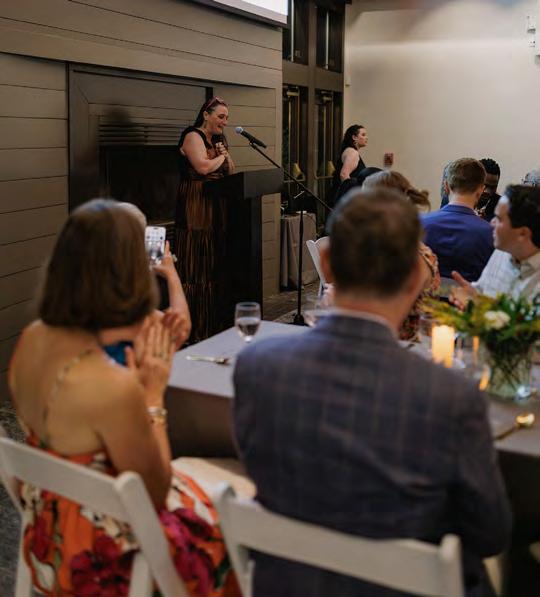
CEO and President Jessica Dawkins announces the 250for250 campaign to guests of the Soiree held in October.
Dawkins - a museum professional and local historian for two decades - came up with the idea for the program when she realized children can rarely define the word ‘honor’.
“Our primary goal is to cultivate a new generation of civicminded youth prepared to participate and strengthen democracy. Our modern world directly contradicts with
the American founding ideal that individual virtue is vital to a successful democratic republic. By promoting selfawareness and emotional intelligence, we hope to empower young people to understand, value, and improve their civil society at every level: individual, family, neighborhood, city, state, and nation.”
Each lesson in LouiVirtue will scaffold from learning the meaning of the cardinal virtues into how these virtues
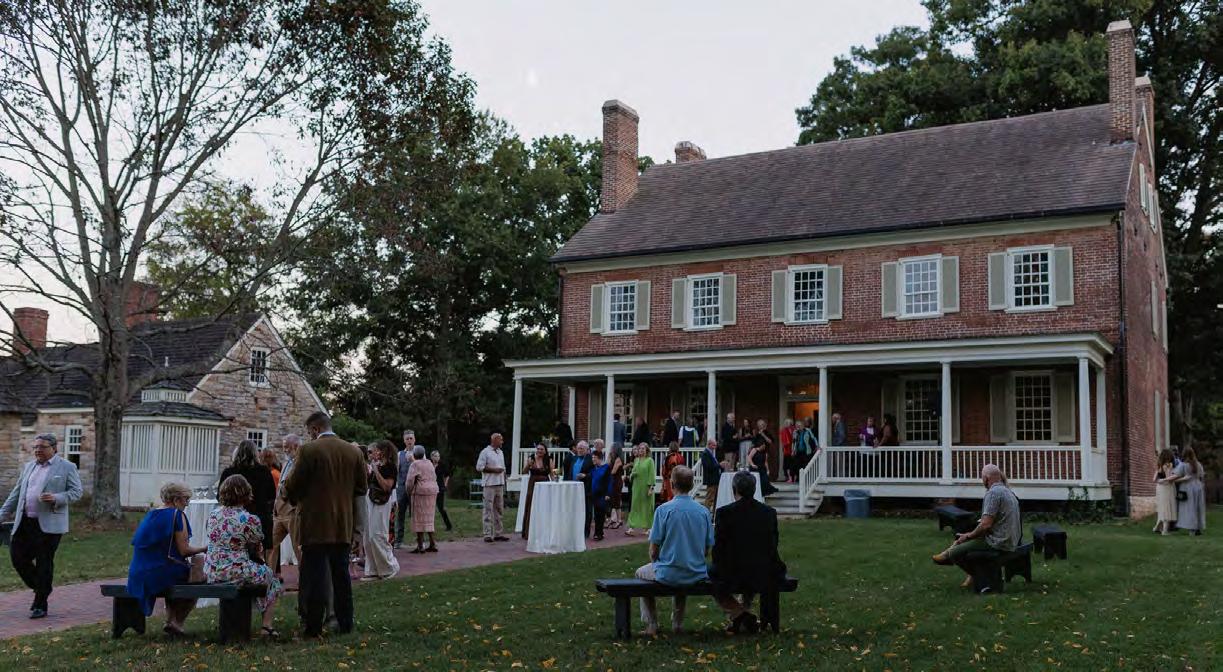
Photos of the October Soiree held at Historic Locust Grove, by Krista Prak
are exemplified, or not, within each person’s life and surroundings. Students will explore the virtues’ historical roots, philosophical foundations, and practical applications, as well as their placement within America’s founding documents. “The hard part will be practicing their virtue in this modern world of vice. We so often reward Hustle over Humble, so these kids will need help navigating those pressures along the way,” Dawkins said.
Each student will be paired with mentors, along with access to guest speakers and high-level partnerships that offer connections to immersive, interactive experiences. A portion of each lesson will include immersion within Locust Grove’s environment, ensuring nature’s healing therapy as part of the curriculum.
Students will identify a meaningful capstone project that aligns with Locust Grove’s pillars of history, arts, civics, and land, providing them with opportunities to apply their virtue in service to the community. Students will design projects that incorporate a particular set of virtues. As they work to implement their capstone projects, they will also define their goals as citizens so they may embody the basic tenets of productive citizenship (*see side bar).
Founding Father Samuel Adams said, “Neither the wisest constitution nor the wisest laws will secure the liberty and happiness of a people whose manners are universally corrupt.” This statement suggests that even with the best government in place, it is the citizenry’s’ ethical and moral foundation that leads to democratic action. Dawkins adds. “We need to go back to the basics, and help individuals become ‘one’ again. An offering like this demonstrates Historic Locust Grove remains to be an innovative leader in community development, just as we were 250 years ago.”
Learn more about Historic Locust Grove’s 250for250 campaign online at LOCUSTGROVE.ORG .
Five Basic Tenets of Productive Citizenship
(Yale University)
These tenets are interconnected and create a framework for citizenship that encourages individuals to contribute positively to their communities and society as a whole.
RIGHTS
Understanding and respecting the rights of all individuals within the community.
ROLES
Recognizing and fulfilling the roles one plays within the community.
RESOURCES
Accessing and utilizing the resources available to support community needs.
RESPONSIBILITIES
Acknowledging and fulfilling one’s responsibilities to the community.
RELATIONSHIPS
Building and maintaining relationships with community members and stakeholders
Happy Birthday, America
Kentucky will mark the 250th anniversary of the nation’s birth with statewide commemorations and local events
BY JACK BRAMMER
As a girl growing up in Carroll County, Ashley SpennebergPerkins participated with her parents in historic re-enactments. In her elementary school days, she was a proud member of the Kentucky Junior Historical Society.
“I love Carroll County, and that’s where I fell in love with history. And here I am now working on this wonderful history project, in which
we want everyone in the state to participate,” she said in a recent interview in the Thomas D. Clark Center for Kentucky History in downtown Frankfort.
Armed with bachelor of science degrees in history and anthropology from Northern Kentucky University and a master’s degree in public history from NKU, SpennebergPerkins has been a staff member of the Kentucky Historical Society in Frankfort since November 2023. She
The Kentucky Historical Society is an agency of the Kentucky Tourism, Arts and Heritage Cabinet, an affiliate of the Smithsonian, has full accreditation from the American Alliance of Museums, and is a founding member of the History Relevance Campaign.
To stay current with America250KY celebrations and events, visit history.ky.gov
now has the important title of America250KY commission administrator.
In that role, she’s helping coordinate the various birthday bashes Kentucky is holding in 2026 to celebrate 250 years since the signing of the Declaration of Independence. The celebrations have been ongoing since 2024, but they will reach a rapid pace in the new year, culminating in milestone events in Frankfort on the Fourth of July
and in early December 2026, when the celebrations end.
The official title of the monumental project is America250KY. It is a part of America250, a nonpartisan initiative working to engage every American in the 250th anniversary of the United States. The Kentucky effort features a nifty logo showing 250 in large numbers with the word “America” written over it and a small
banner across part of the number reading “Kentucky.” In 2026, you will see it a lot in the Commonwealth.
Collectors of historic memorabilia will want to grab the free large coins—bigger than a silver dollar— the Historical Society will distribute featuring the America 250KY logo and an inscription around the edge that reads “Highlighting Achievements— Embracing Responsibility.” The back
of the coin shows a map of the United States with the years 1776, 2026 and 1836—the year a group of prominent Kentuckians organized the Kentucky Historical Society to “collect and preserve authentic information and facts connected with the early history of the State.”
Also available as free souvenirs will be a lapel pin and a writing pen with the America250KY logo.
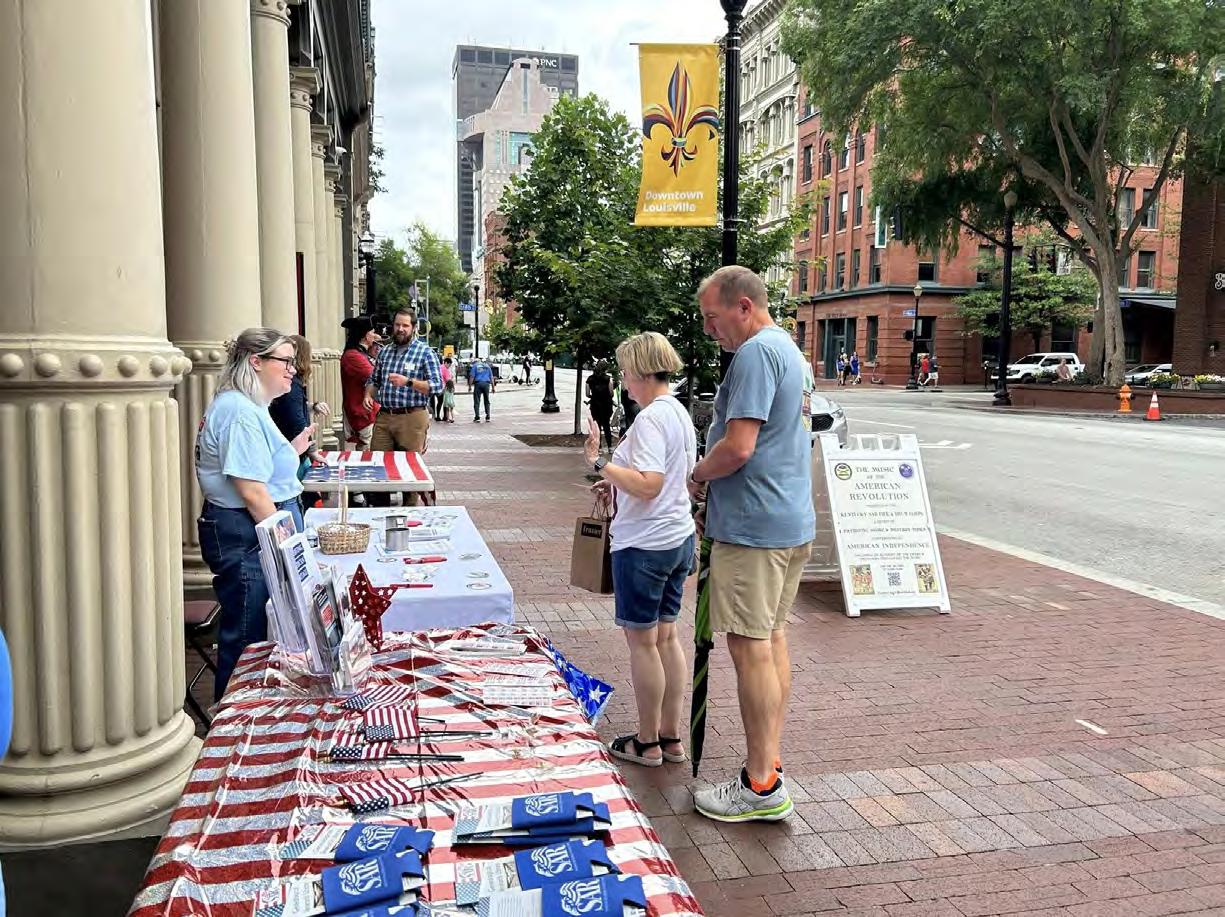
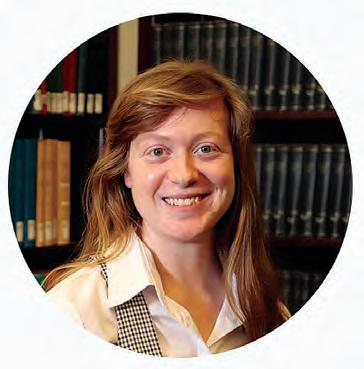
Carroll County native Ashley Spenneberg-Perkins, left, is the America250KY commission administrator; above, the National Sons of the American Revolution Headquarters in Louisville celebrated Flag Day on June 14.
Cost for the State’s Celebrations
In 2021, the Kentucky General Assembly appropriated $4 million for the state’s program to celebrate the milestone birthday.
“Kentucky was one of the earliest states to start this program,” Spenneberg-Perkins said. “Every state is doing this, and we in Kentucky have three people on staff [to oversee the progam].” These are Spenneberg-Perkins, education specialist Maddie Menz and research specialist Molly Shaddix The team started its work in 2024. It works with a 250th anniversary commission set up by Gov. Andy Beshear.
In September 2024, Beshear offered funding of up to $10,000 for museums, historic sites and other nonprofits to improve programming
and celebrate the anniversary. The Kentucky Arts Council offered grants for exploring the theme of 250 years through the arts, and in August 2025, the Kentucky Heritage Council closed its application for grants to preserve historic properties.
In February 2025, Boyle County became the first county to form a committee to lead its birthday celebrations with the Kentucky Historical Society. Louisville/ Jefferson County has its own planning committee. SpennebergPerkins noted that Lexington’s festivities align with the city’s 2025 celebration of the 250th anniversary of its founding.
Lexington was founded in 1775 by William McConnell and frontier explorers who set up camp near a natural spring, now known as McConnell Springs. In honor of the
American Revolution battles in Lexington and Concord, Massachusetts, the frontiersman named their site Lexington.
Additional Kentucky counties are coming up with interesting plans to celebrate the nation’s 250th anniversary, said Spenneberg-Perkins.
Some Counties’ Plans
Maysville city commissioner and former mayor David Cartmell said the committee he is on is planning a revival of the Broadway musical 1776 .
“In the first performance of it in Maysville years ago, I played Richard Henry Lee,” Cartmell said. “I don’t know if I could do that again with all the jumping around required. We’ll see.”
Helen McKinney, executive director of the Shelby County
Historical Society, said the society will continue a series with speakers focusing on the Revolutionary War. It also will develop a trolley tour that will take passengers to burial sites of Revolutionary War patriots, where visitors at each site will “meet” two veterans of the war and hear their stories. All veterans will be honored.
The society also will provide “Revolutionary Minutes,” 60 seconds of facts related to the war and focusing on the history of the nation, Kentucky and Shelby County.
Big plans are in store for next Fourth of July, including participation in the community’s annual Independence Day parade.
The county is researching and expanding its list of Revolutionary War soldiers buried in the county.
The society’s annual public exhibit will be 250 years of clothing in Shelby County. It will feature a variety of items from its collections. And the society’s 2026 annual publication is expected to focus on 250 years of Shelby County history.
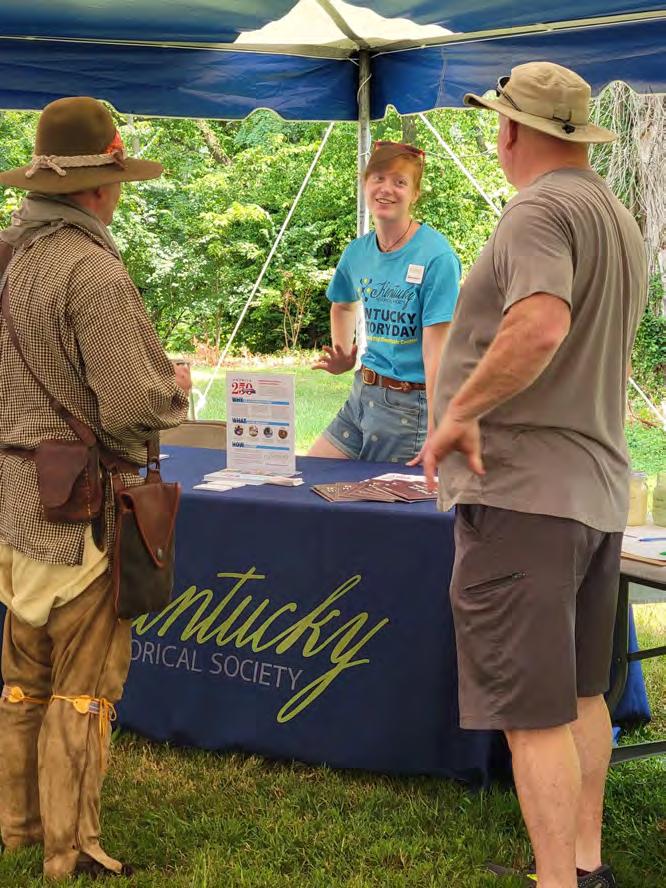
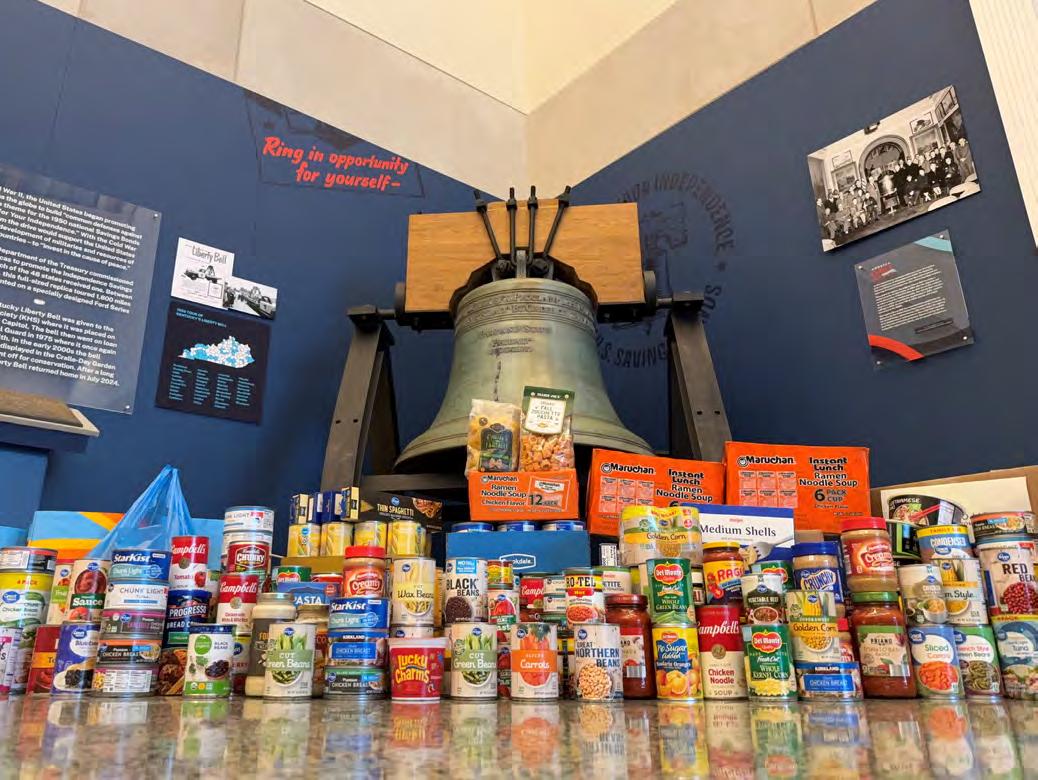
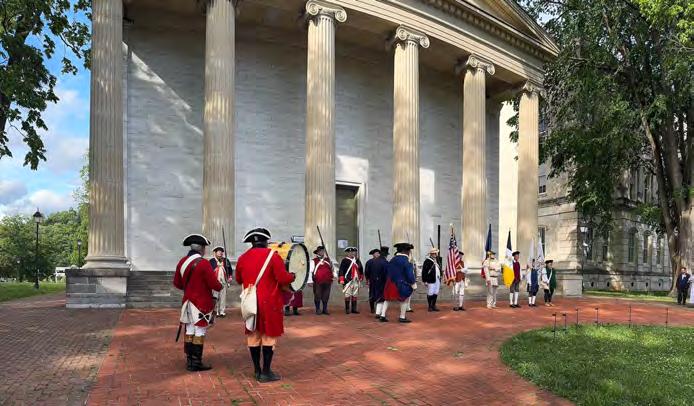
Above, canned food donations at the Kentucky History Center at a kickoff of the America250 commemoration; left, Revolutionary War reenactors, pictured at the Old State Capitol in Frankfort, will be seen throughout Kentucky’s celebration of the nation’s anniversary.
Kentucky Historical Society Plans
The state Historical Society uses various venues to raise awareness about the anniversary. One is a free speakers’ bureau at the history center. Tentatively scheduled for March 21 is Brian McKnight, who teaches Appalachian history at the University of Virginia’s College at Wise. He will talk about his upcoming book on the two explosions at the Scotia mine at Oven Fork in 1976 that killed 26 coal miners and mine inspectors and led to the Federal Mine Safety and Health Amendments Act of 1977.
When asked what the Scotia mine disaster has to do with the American Revolution, Spenneberg-Perkins said the program wants to include major stories in the nation’s history over its 250 years.
Other efforts to spread the word about the upcoming birthday are “tabling events.” These are community engagement activities and “road shows” that feature various activity stations, such as informational tables. The main events involve local history talks, hands-on activities, and the display of historical artifacts.
heritage tree in 1994.
The state society is planning “something big” for the Fourth of July celebration in Frankfort, Spenneberg-Perkins said without elaboration.
The official celebrations are to end in December 2026, possibly Dec. 7. Why that date? That’s when Kentucky became a territory of Virginia. Kentucky did not become a state until June 1792.
Spenneberg-Perkins said that birthday bashes for the state will be added and are subject to change. She suggested searching the historical society’s website at America250KY or its Facebook page for updates.
“Our job is to spread the word about the big birthday,” she said. “This important anniversary will showcase our past, and the ideals of the American Revolution can help us understand who we are today.” Q
“Throughout the entire 250th celebrations, we want people to look at the entirety of Kentucky’s history,” Spenneberg-Perkins said. “We are exploring the state’s history from the nation’s founding to today.”
Another way for the state society to spread the word about the birthday is the Liberty Tree Project with the Daughters of the American Revolution and the Kentucky Division of Forestry. It involves planting 120 tulip poplar trees—one in each county. The tulip poplar was designated the state tree in 1956, and the Kentucky coffeetree was designated the state
My ‘Lucky’ Experience
The magical transformation of a tobacco stick in a young boy’s mind led to hours of farm fun
BY GARY P. WEST
Ireadily confess to enjoying modern-day conveniences, while at the same time considering myself a bit old-fashioned. There are moments when I get carried away and think of myself as a throwback, maybe living a lifestyle my greatgrandparents did. But notice I said moments, not days. Those thoughts quickly pass.
The fact is, I’m not sure how good of a back-in-theold-days guy I would have been. My exposure to farm life as a little kid didn’t do much for résumé building in that type of lifestyle, although my roots were in the rural town of Smiths Grove (Warren County). I guess I was counted among the 700 people the sign at the edge of town proclaimed lived there. My family was composed of “town folks.” It seemed like that sign was there for years, even after my family moved to Elizabethtown. I guess whoever was in charge of the sign figured others took our place when we left, so there was little need to go to the cost and effort of changing the sign.
My granddad tried to make a farmer of me, but it just didn’t take. Of course, I have total respect now for everything that happens on a farm. I envy those who had that experience.
As an 8-year-old, the only farm-related thing I enjoyed was my favorite tobacco stick horse named Lucky. I tied a grass string around the big end of the stick, so when I rode it, Lucky would follow my command. I made a “click-click” sound with my tongue on the roof of my mouth, followed by a loud “giddy-up” that let Lucky know it was time to go. Upon hearing my command, my grandmother knew I was on the move. It worked for me and seemed to work for Lucky, and at the end of each summer visit to my grandparents’ farm, I would “stable” Lucky in the smokehouse until my return.
Now I see that riding a stick horse—or a hobby horse, as they now call it—has become a competitive sport and may be under consideration for the 2028 Olympics. You’ve got to be joking.
Lucky wasn’t one of those fancy, city-slicker horses. You know the ones I’m talking about— those with the padded, stuffed heads that seemed to smile all the time. No, sir, Lucky was a farm horse, and if I wanted to get somewhere in a hurry, I rode Lucky. Those hobby horses would have been no match for my Lucky.
I’ve never baled hay, hung tobacco or plowed a field, but I’ve watched others. And I’ve got to confess: I’ve never milked a cow. I love horses, though, as long as they’re on the other side of the fence, where I’m in control and pet them. Horses are such majestic animals, all powerful in their graceful gallop that seems to make the ground beneath them shake. Just thinking about them makes me want to find a $2 window. Looking back, I realize that Lucky was my cowboy stick horse, never a racehorse. Mind you, he could have been. He was always fast enough to get me where I needed to go.
every command, never complained about not getting enough oats or water, and was always ready for whatever adventure I had in store for the two of us at my grandparents’ house out on Little Knob Road.
Lucky was just as real to me as the horses Roy Rogers and Gene Autry rode. Trigger and Champion had nothing on Lucky. Like those cowboys, I rode with a couple of sixshooter pistols (cap pistols, that is) belted around my waist. When I dismounted to get a drink of water out of a nearby garden hose, my loyal horse waited right there by my feet.
I’m sure my memories are no different from those of thousands of other now-grown stick-horse riders. Lucky may not have been a just-perfect tobacco stick with a just-right grass string, but he was something. He may not have answered to the name of Lucky, but whoever or whatever he was, he could be counted on. He could be depended on. He was there when needed.
Many people probably have a Lucky in the echoes of their minds. But my horse was perfect—followed my
On one summer visit, I forgot about Lucky, who was faithfully waiting for me, standing patiently in one corner of the smokehouse. Suddenly, I had outgrown Lucky. It just happened. I never went back for him, never even thought about him again until years later. The progression of life separated us physically. But lately, I’ve begun thinking about the little things, the things that were so important to a little kid of 7, 8 or 9 years old who wanted to get only as close to farm activities as riding a stick horse.
When is the last time any of us saw a kid riding a stick horse in the front yard? Maybe it’s the pull of an Xbox or cable TV that has sent the Luckys of days gone by to the barn.
But some older kids are riding stick horses in competition. I wouldn’t have believed it had Inside Edition not aired a segment on cable TV about it. Maybe one of the horses will be named Lucky. Q
A Joyful Space
Midway Art Studios provides a haven for local artists to create and a gallery for art lovers to shop
BY DEBORAH KOHL KREMER PHOTOS BY REBECCA REDDING
Midway, the small town located midway between Lexington and Frankfort, is chock full of eclectic shops and memorable eateries. Railroad tracks carry freight trains directly through the center of Main Street, a scenic route lined primarily with 19th century buildings.
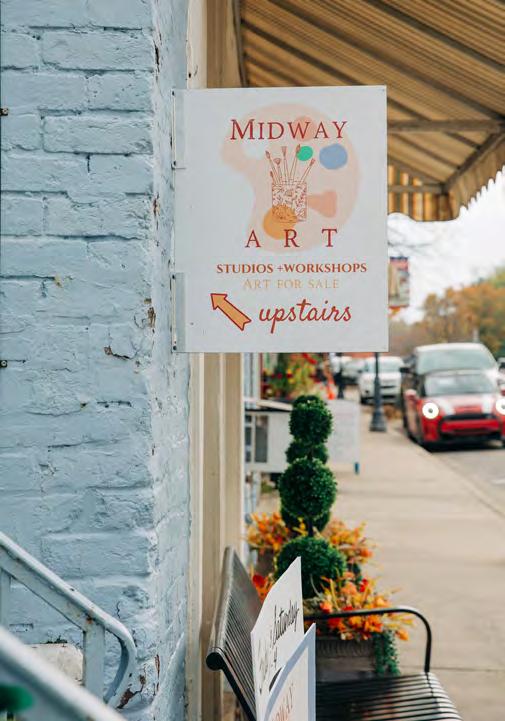
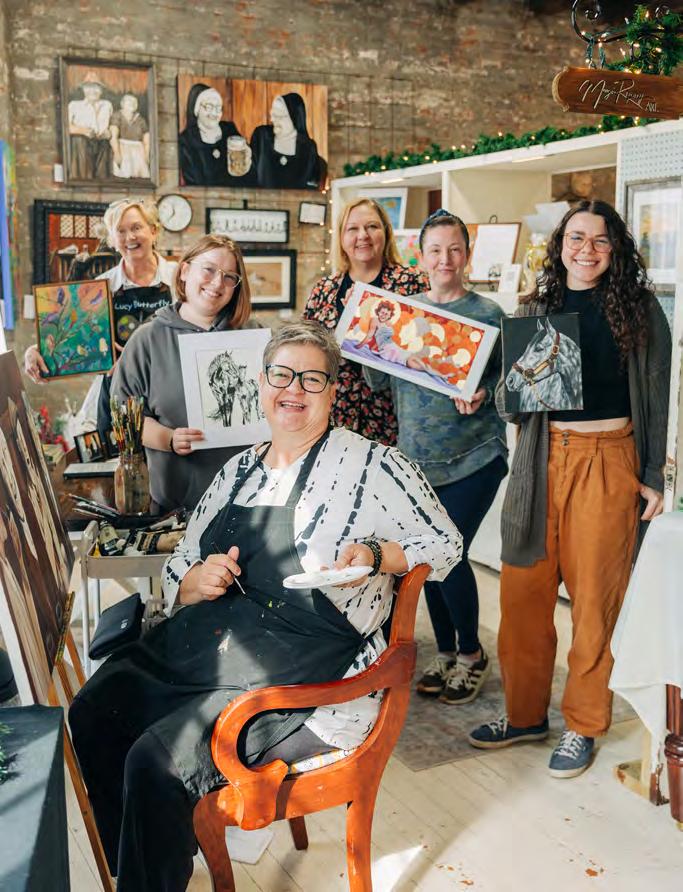
The second floor of one of the historical buildings, just above the Midway Boutique, is the home of Midway Art Studios, a multipurpose space that combines a gallery, working studios for artists, and a venue for workshops and classes.
Marie McLamb opened the studios in March. Nine working artists rent space where they can create their artworks. McLamb explained that at this time, all the artists are women. Some have full-time jobs; for others, creating art is their full-time job.
“Everyone gets along so well, and it is a very supportive and uplifting group,” McLamb said. “I like to refer to it as joyful. Some are just getting into art, and some have been in the business for a while. So, everyone can share things with each other. That is a special part of it.”
The art gallery is open to shoppers on Fridays and Saturdays. The walls are full of the works of the studio artists, and all the pieces are for sale.
Sierra Morgan of Versailles is one of the working artists with a studio there. Her art, Arreis Artwork, is available at the gallery and at arreisartwork.com. Morgan specializes in ink-and-water painting, genuine 24-carat gold leafing, and watercolors. Her subject matter leans to locally found plant species, birds and horses. She also paints commissioned pet portraits.
Morgan’s space at Midway Art Studios is her first dedicated studio. She enjoys it because it is a great way to sell her works and enables collaboration with other artists.
According to Morgan, each artist has two or three walls
to establish their workspace, but one side is open. She said the eclectic, charming wall dividers help maintain the character of the building. The open space enables the artists to share and encourage each other.
“It feels like a community versus a competitive workplace,” Morgan said. •
Participants in the workshops offered at Midway Art Studios can learn something new or just have an enjoyable night out with friends. The classes usually are a one-time event in which folks can learn to make a mosaic, arrange a charcuterie, paint a portrait of their pet, and more.
McLamb said the classes are fun and reasonably priced. She has partnered with Bluegrass Distillers and local chef
Ouita Michel, owner and founder of Holly Hill Inn in Midway and its sister restaurants throughout the Bluegrass, on events and workshops. McLamb hopes to add more collaborations in the future.
Two of the popular workshops partner with Midway Bakery, another Holly Hill business. One is making Garden Art Focaccia, where the bakery provides the dough, and the participants create a scene on their focaccia dough using vegetables, olives, herbs and spices. Another workshop is the Bourbon Ball Swirl, which is described as a cinnamon roll without cinnamon, with chocolate in the middle and bourbon in the icing.
“Both the focaccia and the swirl are take-and-bake, so [participants] can bake it in their own oven and fill their home with these smells,” McLamb said. “If you take this to
“My goal has always been to try to get Kentuckians to explore their own backyard,”
Owner Marie McLamb stands in front of one of the gallery walls at Midway Art Studios. The historical upstairs space is full of stunning original works for sale.
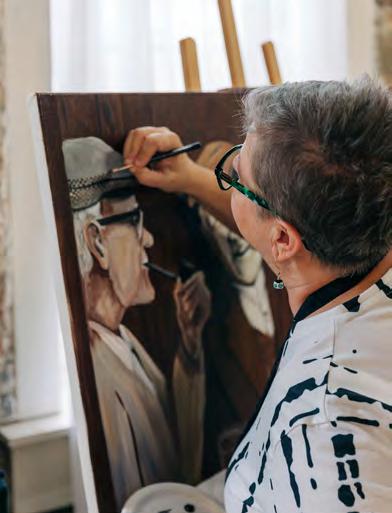
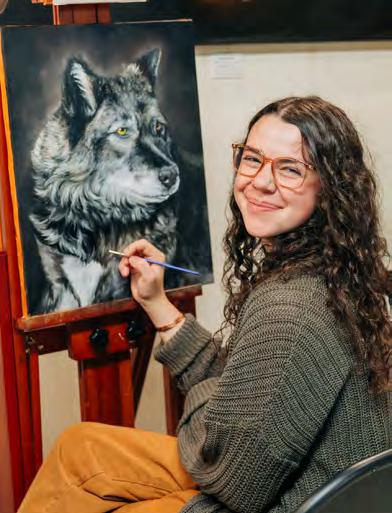
Visiting Midway Art Studios is more than just a shopping trip— it’s an experience! You’ll find artists working in real time. Far left, Margie Rigney works on one of her era-inspired pieces. Left, Karly Loparco paints one of her wildlife portraits. All pieces are for sale.
the artists
Devan Ryan Carrier Oils, Metal Leaf
Veronica Feth Printmaking, Watercolors
Stephanie Gemperline
Digital, Traditional Watercolors, Mixed Media—Mostly Fiber, Wood Engravings
a party, I’ll guarantee you will get invited back.”
The workshops are popular, and McLamb said the variety ensures that there is something for artists of all levels.
“Many people say they are not an artist, but for our workshops, they don’t have to be. Our classes are designed for all skill levels,” said McLamb. “Visit our website at www.MidwayArtStudios.com to join us for our upcoming workshops and events.”
• • •
McLamb is an artist, but she also is passionate about local businesses and small towns. She is a Kentucky arts and travel blogger (backroadbluegrass.com and Bluegrass
Blog on Facebook and Instagram), where she presents best-of lists, including brunch spots, patio dining, hiking trails, dog-friendly places, rooftop cocktails and dining, coffee shops and more. She also features special giveaways on her blog.
For the last five years, McLamb has orchestrated the Bluegrass Creative Market, a quarterly pop-up market at the Lexington Green shopping center. McLamb said the Kentucky-made market has a festival feel with live music, food and drink trucks, free samples and giveaways.
“My goal has always been to try to get Kentuckians to explore their own backyard,” she said. “We need to support these locally owned businesses.” Q
A few members of Midway Art Studios show off their favorite pieces. From left, Sarah Vandergrift, Sierra Morgan, Margie Rigney, Marie McLamb (owner), Devan Ryan and Karly Loparco.
Midway Art Studios
100 East Main Street
2nd Floor (above Midway Boutique)
Midway
Fridays and Saturdays, 11AM–4PM
DECEMBER 6 • 10AM-12PM
Santa Mug Candle Pour
Led by Leisa Sumner of Honey Bee Candles & Soaps, in this festive workshop, you’ll learn to hand pour your own candle.
DECEMBER 6 • 2-4PM
Pasta-Making with NoodleCraft
The best pasta you’ll ever have is handmade—by YOU! Chef Rick of NoodleCraft will provide all the supplies, tools and knowledge to create your own meat or cheese ravioli!
DECEMBER 11 • 6-8PM
Gingerbread House Decorating
Grab your friends and head to the festive city of Midway to kick off the holiday season! Join the Art Studios for a delightful event led by Robin Hammond of Southern Hospitality, where you can decorate a take-home gingerbread house.
DECEMBER 13 • 10AM-5PM Winter Market
Shop the Studios during the festive Midway European Christmas Market.
Mayfield Strong
Everyday heroes provided much-needed assistance following a tornado disaster
BY TAD MYRE
Who we are can be tested in the worst of times. In recent years, Kentucky has had its share of those. Once-in-a-lifetime disasters now seem to come in waves, wrecking communities, unhousing folks, obliterating life savings, costing jobs and ending lives. Those not directly in the path of destruction may have loved ones who were, but most all of us know the shock of that first bulletin, then the drone-filmed wreckage, and then the individual stories of trauma and loss, and finally, the rush of first responders, those brothers and sisters of mercy who drop all at a moment’s notice. After that, there’s the slow, uneven communal trudge toward some level of a normality that was snuffed out in an instant, as those left relatively unaffected might turn their weary eyes elsewhere.
Since 2020, the Federal Emergency Management Agency (FEMA) has issued 13(!) disaster declarations in our state. One of the most horrific events was the tornado of Dec. 10, 2021. An EF4 twister with up to 190-mile-per-hour winds cut across
165.7 miles, the longest path for a tornado in U.S. history. It left 57 dead and up to 533 injured. The Graves County seat of Mayfield lost more than 60 businesses, eight historic churches, and more than 1,760 housing and rental units, along with its courthouse, fire department, police station, power grid and water treatment plant.
That same evening, four EF3 tornadoes bombed Dawson Springs and Bowling Green, killing 18 more and injuring another 133. That night marked the deadliest December tornado outbreak ever recorded in the United States.
If this article was a book, it would profile hundreds of heroes and their stories, but it isn’t a book. Space limits us to a small sampling of stories, and they cannot do the justice that’s deserved—the consolation being that none of these folks seeks the limelight. Recognition is not what they ask, but the stories aren’t for them. They’re for us.
Camp Graves
Micah Seavers, the son of an itinerant preacher, is one of the extroverted characters for which
Kentucky is so famous. Before the storm, Seavers ran a kids’ camp in Graves County and owned (and still owns) Southern Red’s Barbecue (named when Seavers had a full head of red hair that’s now retreated to a beard only), a down-home restaurant in the Graves County community of Water Valley, Kentucky (population 235). The tornado sidestepped Seavers and his family, but he didn’t stop to count his blessings. Instead, he rushed to Mayfield to lend a hand and was met there by an emergency manager who informed Seavers that he could best help by using his restaurant to feed the hungry. This he did, opening his restaurant to the flood of victims, volunteers and emergency responders. By 4 a.m. Saturday morning, he’d prepared some 500 meals and kept feeding folks for weeks at no charge. He also led a team that delivered fuel to homes cut off as a result of damaged lines (remember, it was December). Next, Walking Humbly Outdoor Adventures (WHOA) opened their 45-bed kids’ camp, welcoming the disaster displaced.
With vacant farmland and no lack of ingenuity, he, friend Buck and sister Christina quickly formed a
charity they named Camp Graves and used it as temporary housing for those who’d lost their living quarters (some 65 percent of whom were renters). Seemingly overnight, Camp Graves became a sanctuary. People who’d been displaced into jam-packed lodges, consigned to the floor or couch in someone’s home, or thrown out into the street moved from oftunwelcome circumstances into safe and secure lodging in an environment that gave hope in the face of trauma. Seavers knows about temporary living quarters and crowded houses. His dad took the family all over the
map, and Seavers can’t remember a time in those days when his family didn’t host strangers in their home because they had no place else to go. His generous spirit materializes in many ways, including spontaneously. He once gave his boots and socks to an elderly man and continued his errands barefoot in 4 inches of snow.
Mayfield Graves LTRG
Few of us had heard of Long-Term Recovery Groups (LTRGs) before the Mayfield tornado. These are countywide organizations that sprout up after a disaster. Some groups work better than others, and the one that arose after the Mayfield disaster, the Mayfield Graves LTRG, has been one of the best. The mission of these
entities is to organize, coordinate, direct traffic, take in and direct (“leverage”) donations, support case managers, organize volunteers, and oversee the massive and multiple efforts devoted to recovery. To work, such organizations require good and selfless leaders as well as deference by local elected leaders, who may be inclined to rush in and control the narrative and the gush of donated money.
The LTRG started as an idea proposed by FEMA, the Red Cross and Jim Garrett. The Community Foundation of West Kentucky, with particular credit to Chris Dockins, embraced the concept, gave it life, and supported it until it was ready to take off on its own in May 2022. Leadership came about organically from the
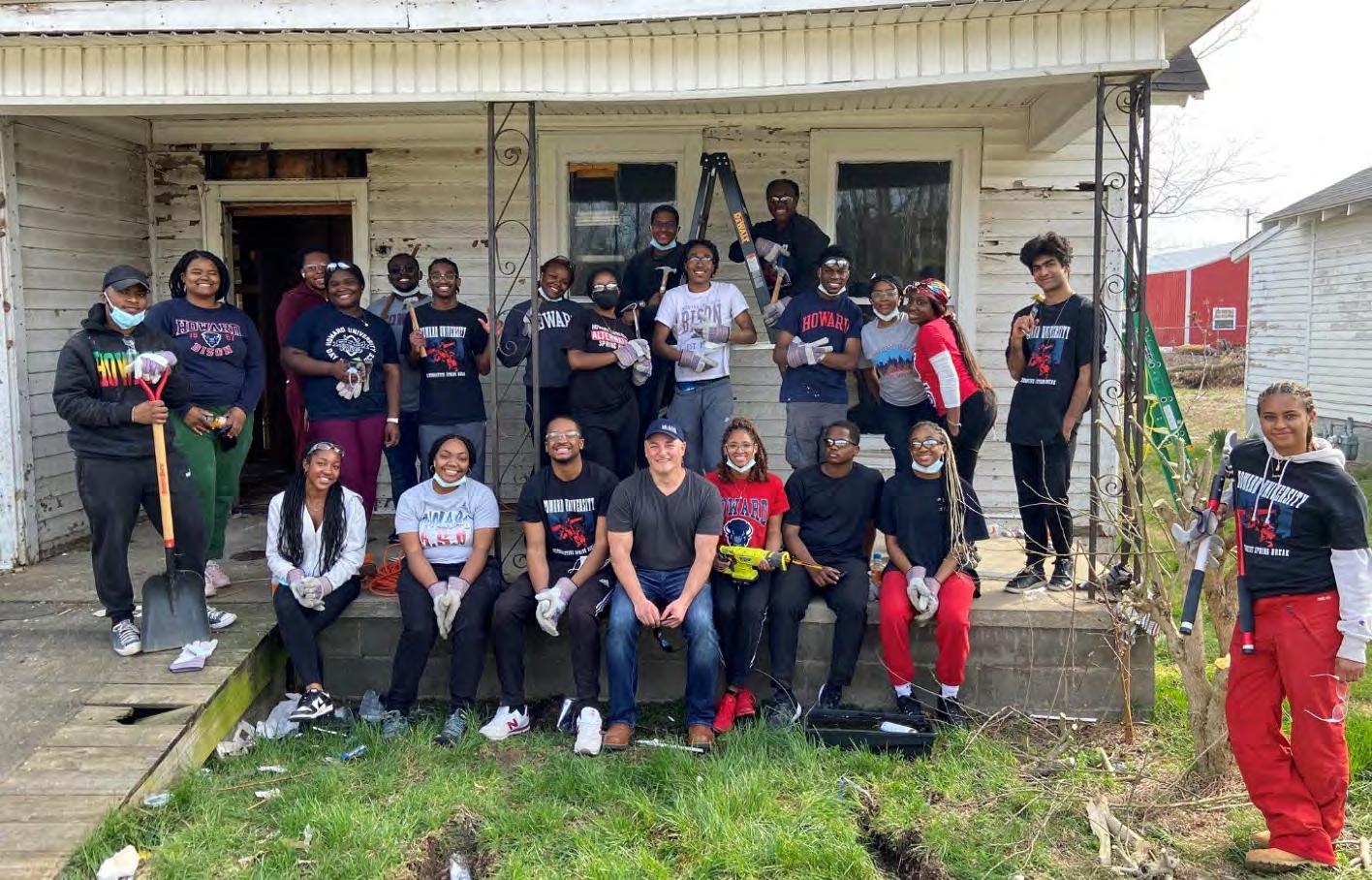
Above, college students from Howard University in Washington, D.C., showed up to help with the rebuilding effort; left, Mayfield Graves LTRG Executive Director Amy Chicoine (left) with Jaye Herrick.
meetings of some 60 charities and other well-wishers and do-gooders with the appointment of Ryan Drane as executive director and the selection of the board of the organization.
Drane was an active member of Mayfield First United Methodist Church, one of the churches that was demolished and was already knee-deep in recovery efforts. He shuttered his consulting business (temporarily, he believed at the time) and committed to a six-month term that ended up lasting five times that. At some point, he came to realize that he could never go back to his former life.
Help came from all corners. The Honorable Order of Kentucky Colonels, the James Graham Brown Foundation, the Thoroughbred Society, the Red Cross, the United Way, the Dollar General Foundation and the Community Foundation of West Kentucky were some of the larger donors, but there were others and a volume of smaller gifts of time and treasure that added up. In addition to standing up the warehouses at the fairgrounds, the LTRG and these donors devised and started a program called New Lease on Life, which involved salvaging damaged or blighted homes, fitting them up, and leasing them to families, creating an easy pathway to home ownership. Among other things, each of the homes had tornado shelters. The program grew so large that it’s now its own charitable organization.
Leadership: Kathy O’Nan and Jesse Perry
City and county government had their hands full rebuilding government infrastructure. City Hall was obliterated, along with the judicial center and other government offices. I first met Mayfield’s top official in a 24/7 gym, where she had located her makeshift office. Mayor
Kathy O’Nan combines an infectious larger-than-life personality with a deeply gentle spirit, and her unstated goal of being everywhere at once didn’t keep her from being on time with us. O’Nan led what she called Sticky Note Sessions, to which all residents were invited and were encouraged to offer input on priorities. This they did by placing their “sticky votes” on posterboards.
Graves County Judge Executive Jesse Perry gets similar high marks for working collaboratively at all levels, including personally handing out items, helping with donation management, and kickstarting the critical need for storage and warehousing at the county fairgrounds. Both respected the need for LTRG autonomy, but both gave support and collaboration that has made for such a great recovery story.
People Helping People
Assistance came from all over Kentucky and from all over the map. The Amish and the Mennonites brought their tradition of working together in disaster recovery and of collaborating with other relief organizations. Their work ethic and extraordinary skills were focused on the physical repair and rebuilding of homes. They also provided emotional and spiritual support to survivors. Out of nowhere, a busload of college students showed up from Howard University in Washington, D.C., to help in the rebuilding effort.
The wonderful Lawrence Leahy, disaster recovery officer and philanthropic advisor for FEMA, dropped into town from forest fires out West and helped tie together the charitable sector. Jaye Herrick showed up with her own trailer and tirelessly assisted in the effort for six months, then left to help out at some other disaster. Six months later, she
was back for another six-month stint.
Drane told me how invaluable Herrick’s expertise was, that she knew her stuff and could even run a construction crew. Volunteers and charities from my hometown of Paducah jumped in and lent valuable assistance.
The Most Honorable Order
My entrée into this arena came from my position as a member of the Board of Trustees of the Honorable Order of Kentucky Colonels. HOKC board and staff immerse themselves in disaster recovery, and each of us tries to emulate the spirit and generosity we always witness in these sad settings. Kentucky Colonels from all over the globe show their generosity, making individual contributions to HOKC and entrusting us to apply them where they have the most beneficial impact. It’s a mission we all learn through direct involvement in our Good Works Program, reapplied and reengineered here, and one that is sacred to each of us.
All the political divides and hostility on social media become irrelevant when our fellow Kentuckians need food and shelter, and it’s nothing less than life-affirming to have a front-row seat to the true and timeless nature of our Commonwealth and its citizens. The tornados and storms always start small, with a little wind and a bit of rain, and grow and darken to inflict their devastation. On the side of relief, HOKC does something similar in response, starting small and growing into a source of light and hope. We are part of a vast circulatory system that receives and then returns in the form of time and money, that gives and saves and enriches the lives of our sisters and brothers, our children and our elders. It doesn’t take much at all to join us. Please do. Q
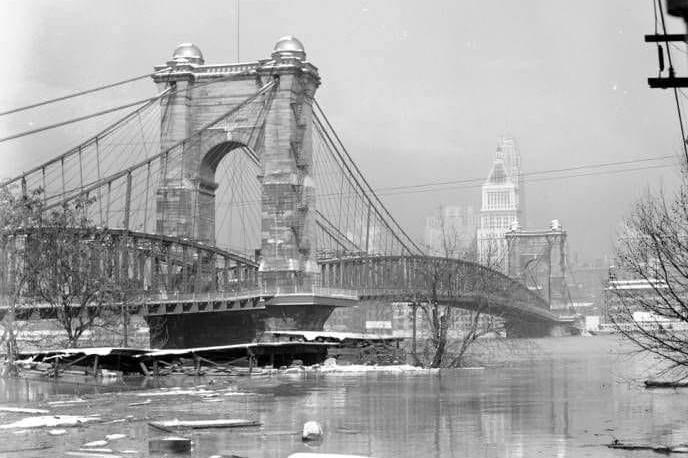
The Roebling Suspension Bridge During the 1937 Flood
As the water levels crested at 79.9 feet (26 feet above flood stage) on Jan. 26, 1937, the John A. Roebling Suspension Bridge that connects Covington and Cincinnati remained open and fully operational throughout the crisis. Kentucky’s river cities were devastated. More than 380 people died, and more than 1 million people were displaced. The flood remains one of the worst natural disasters in Kentucky’s history.
Kentucky Explorer
Charles Hayes Jr. • Founder
Stephen M. Vest • Publisher
Deborah Kohl Kremer • Editor
Rebecca Redding • Typographist
One-Year Subscription to Kentucky Monthly: $25
Letter to the Kentucky Explorer
Letters may be edited for clarification and brevity.
My Family’s Ride on the Black Brothers Line
Re: ‘Early Bus Service Connected Southeastern Towns,” October issue, page 44.
Being raised in a military family, we never knew where we would be living, though mostly, we lived at Fort Knox. At the time my story begins, we lived in a tenant house on my grandfather’s farm in Lee County, near Heidelberg and Lock 14, the last lock on the Kentucky River. We had lived there since Dad had been deployed to the Korean War. (We always called it a “war” and not a “conflict.”) Though wounded in the leg while there, Dad healed completely and returned to the war. He was never wounded during his service in World War II.
After the Korean War, the Army deployed Dad to England to help remove military equipment from a Royal Air Base that had been stocked there prior to the Normandy invasion. He was sent ahead of our family, so that left Mother with six children to pack and head out of the foothills to England. The Army planned the entire trip and sent her the itinerary and bus, train and airplane tickets. As with all military orders, we immediately began to comply. My sister was the oldest; I was next in line and then four boys.
Our first leg of the trip was on the Black Brothers Bus Line. Not sure how they got all our baggage loaded— luggage for seven people, plus the few household items Mother packed because she felt they were necessary, since we’d be living in a town and not on a military base. The driver was kind and managed to get all of us and the luggage situated before we drove away. At this point, everything was familiar. As a 9-year-old, I felt like we had gotten a ride back to the tenant house. However, as we passed the familiar and then continued, things began to concern me. In Richmond, we transferred to another
FOUNDED 1986, VOLUME 40, NO. 10
company’s vehicle and headed to Lexington. Until we landed in England and met my father, I was on alert, making sure none of us curious kids wandered away from Mother and got lost. It was a big adventure with so many people everywhere that I felt justified in staying alert.
In Lexington, there were two train terminals. Our first stop was at the station off South Broadway; our driver was informed that the train we needed was at the downtown terminal. The station had been notified that we were at the wrong terminal and on military travel orders, so the downtown station held the train for us. We got there and immediately boarded a Pullman car headed to a military base near an airport in the New York area. We stayed in Army housing until an Army bus arrived and took us and several other military families to the airport. We all boarded an Eastern Seaboard flight to Shannon Airport in Ireland and then on to London. Dad met us there, and our family stayed a year in England. He completed his work there, but he needed to finish his two-year deployment. The Army sent him and our family to Germany. At the end of his deployment, I looked forward to returning to the U.S. and seeing family and friends. I wondered if we’d get to ride the Black Brothers Line back to the mountains, but Dad rented a car and drove us home before he headed west to Fort Ord, California.
Sherry Browne, Lexington
Sweetest of the Sweet
The vignettes in Kentucky Explorer are entertaining and fascinating glimpses into Kentucky’s past. After writing about the temptations in his story about sorghum (“Sweet Sorghum,” October issue, page 50), how can John Mitchell Johnson not share his recipe? Delty surely would like us to share her secret.
By the way, I invested online in sorghum as black strap molasses.
Elaine Landry, Lexington
Paul Hornung, who won the 1956 Heisman Trophy, was born in Louisville on Dec. 23, 1935.
Spirited Mystery in the Hay Loft
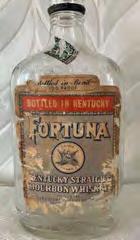
I found the “Memories of Glencoe Distillery” story interesting (September issue, page 52), especially the photos of the Fiddle and Fortuna Bourbon bottles. The latter held special interest, as the photo suggests.
This bottle’s link to our family began about 1960, when my father bought a neighboring piece of property in western Shelby County that contained an old house and a barn with a dirt floor, three stalls and a hayloft. Dad tore down the house to build a modern new house, and after we moved in, he nailed a basketball goal on the front of the barn for my brother and me.
My brother, Jerry, and I lived in the house until we finished college, and our mother lived there until her death in 2002.
After our father died in 2006, Jerry and I sold the property. Before the sale, we cleaned up the barn, and in the loft behind an old wooden chest, we found a vintage Falls City Beer poster. Next to the chest in a pile of straw, Jerry found the empty Fortuna bottle. None of us drank alcohol during our years in the house that Dad built, so it’s an enduring mystery who left the bottle in the loft. The old barn is gone now, but the Fortuna bottle sits in a curio cabinet in my home as a valuable piece of our Kentucky heritage.
Live Nativity
Our little Methodist church in rural Calloway County was one of the center points of our family. In the 1960s and ’70s, I usually was part of the church Christmas pageant.
For the pageant, the pulpit and choir were moved to the side, so the altar area could be made into a stage. White sheets were strung up with safety pins, serving as curtains to be closed after each act. This formality was intended to add to the dramatic effect but likely became part of the show at times.
We worked for weeks before the event to create our costumes. Mothers made white angel frocks with tinseledged wings, while boys and dads searched for the perfect substance to create big, bushy beards.
If memory serves, there were some incredibly audacious fabrics back in the 1960s that led to some colorful bathrobes. Those fabulous finds were used for the royalty making their way from the East. All three were appointed with paper mâché crowns of gold, studded with plastic rubies and emeralds.
The shepherds were outfitted with a rope tied at the waist of their modest brown clothing. Mary always wore some kind of blue wrap—perhaps from a curtain or a wellworn tablecloth. Joseph and the shepherds wore towels tied around their heads. If there was a newborn in the congregation that year, baby Jesus was real. We did our best to honor the pictures of the memorable scene found in our Bibles.
I don’t know whose idea it was, but there were a few years when the congregation decided it would be fun to produce a live nativity for those who did not attend our church. It was to be held outside, in front of the church. Parents were just as enthusiastic as we youngsters were, and the entire church got behind the idea.
For the stable, the men came together and used varioussized boards for a frame, which was overlayed with hickory
slabs left over from firing tobacco. Those slabs were flat from the saw cut on one side with bark on the other. The bark provided the perfect rustic look we imagined might be found in Bethlehem.
In deciding who would play which characters, I guess we probably swapped roles so everyone got a chance to stand inside the stable for a little while. There might be a female king one year, and occasionally, one of the fellows was an angel. I don’t recall any live animals, but we had life-size wooden cutouts of sheep and a donkey placed in our midst. Someone even had the presence of mind to illuminate the scene with spotlights.
Typically, the live events were held on the Friday and Saturday evenings the weekend before the big day. There were shifts for each night, so Sunday School class members signed up for a specific time. As teenagers, we didn’t stand perfectly still and quiet, but when someone saw car lights, they said, “car from afar,” so we could straighten up and get back in character. Many cars sped right on by, but some slowed down, and a few even parked and walked out to us.
It was a fun time to be with our friends, except for one thing. Apparently, no one had thought about how cold it might be in the weeks leading up to Christmas. When the weekend arrived, the temperature always took a decided dip into teeth-chattering territory.
Fortunately, the parents who had to drive their children, along with several church elders, provided a warming station in the fellowship hall. The laughter and discussion during those breaks indicated they had as much fun as those who were manning the manger scene out front. There were warm cups of hot chocolate for what felt like frostbit hands, along with snacks and a few baked goodies for special treats.
Bobbie Bryant, Jefferson County Previously published in the Murray Ledger & Times
Latonia Race Track (now Turfway Park) was the first track in Kentucky to offer Sunday races.
Jim Miller, Diamondhead, Mississippi
Send memories to Deborah Kohl Kremer at deb@kentuckymonthly.com or mail to Kentucky Monthly, Attn: Deb Kremer, P.O. Box 559, Frankfort, KY 40602.
“I Remember”
Send in your memory today!
The Giving Spirit
By Shelby Roy Hopkins, Stanford
One early December day back in the 1970s, my mother and I were tending the country store my parents owned in Broughtontown in Lincoln County. Each year around the end of November or early December, we ordered and received large boxes of chocolate-covered peanuts. We bought other types of chocolate candy, but the chocolate-covered peanuts were, by far, the bestseller. I do not remember how big the boxes of candy were, but they were quite heavy. The inside of the box was wrapped with cellophane to keep the candy fresh.
After the delivery truck driver left our store, we began to put up the groceries that had been delivered. Once we had put most of the items away, we opened one large box of candy. We placed enough candy into plastic bags to weigh 1 pound each. Mom and I, who both loved sweets more than any other type of food, sometimes seemed to eat more chocolate than we were bagging up. The still-chilled, fresh candy seemed irresistible to us. Those bags of candy sold quickly, and in just a few days, we repeated our routine. If a customer came in when we were bagging up the candy, we offered them a sample. They never turned it down, and they never failed to buy a bag or two to take home with them.
By Our Readers
We asked what brought him to Broughtontown that particular day. He replied, “Well, I sold a new television set to Mr. and Mrs. ___________, and I came over to try and get some money for it. It was a console television set, and it sold for a little over $600. I made them a really good deal on it, and I told them they could make monthly payments. Now, it has been six months, and I haven’t received the first dime.”
We knew the family Ed spoke of well and were a little surprised they hadn’t paid anything at all for the set. He was surprised, too. He said, “I knew they were poor, but I thought they were honest.”
He realized he had sold them a much more expensive television than he should have, but it seemed too late now.
Anyone who has ever been in some type of business realizes you can’t afford to get cheated often. If you do, you won’t be in business for long. My mother, who had been raised in that little country store in Broughtontown, knew it as well as anyone.
She asked Ed what he planned to do. Ed said, “I came to pick it up and take it back to the store unless he paid me something on it. He told me he couldn’t afford to pay anything at the time because it was nearly Christmas, and he had spent his money on presents.”
One day while we were bagging the candy, Ed Buis pulled up to the store and came in. We knew Ed well, as did most everybody. Ed ran a successful furniture store in Eubank (Pulaski County), and his family-owned business continues to thrive today. Ed was a nice man, and it was good to see him. He sampled some of the candy as we stood there and talked. He bought a bottle of pop, along with three or four bags of candy to take back home.
Ed, disenchanted as could be, then said to Mom, “I stood there at the door looking through the screen. There, those poor little kids were sitting around the room watching cartoons on the new color television. I just didn’t have the heart to take it back from them, you know, with Christmas coming on. I guess I just lost out.”
Ed took another sip of his pop and, as he headed out the door, said to us, “I sure am glad I came to Broughtontown today. This candy is the best I have ever had. I think I’ll stop on my way back and give them kids a bag of this candy.”
Louisville’s William Clark, of Lewis & Clark fame, was governor of the Missouri Territory from 1813-1821.
Console televisions were large and heavy pieces of furniture found in living rooms of the 1970s.
Thumbing a Ride on Christmas
By Walker Williamson, Middletown, Ohio, transplanted Pike County Kentuckian wwilliamson@cinci.rr.com
Anyone who has ever had teenage children, especially boys, knows that teenagers can do some pretty dumb things when they really set their heads to it. My dumb story happened at Christmastime in 1958. I was a junior in my first year at Berea Foundation School, then a laboratory high school that was a part of Berea College. I was feeling pretty good about myself because I had made the basketball team, and Coach Massey told us that we had been invited to be a part of a Christmas tournament and would play a game on Dec. 26. I elected to stay in Berea until after the tournament and then go home after we either won the tournament (not likely) or got defeated (most likely).
We practiced on the day before Christmas, and Coach Massey announced we would not practice on Christmas Day. A teammate, Tommy Williams, and I began to discuss what we would do Christmas Day, and we decided to hitchhike to Tommy’s home near Corbin, about two hours down U.S. 25. We would spend the day with his parents and hitchhike back on the day after Christmas, in time to catch the bus to our basketball game.
Hitchhiking was a fairly common practice in the 1950s. From the time I was a teenager, it was my main means of transportation until I bought my first car at 21. Hitchhiking was how I got back and forth from Berea to Pike County. I never felt unsafe or threatened, but it would frighten me today if I thought my son or one of my nieces or nephews tried hitchhiking.
Tommy and I were fortunate that we quickly caught a ride with a gentleman who, as it turned out, was driving all the way to Florida. It occurred to me that my Aunt Mae lived in Asheville, North Carolina, and this gentleman would be passing through Asheville on U.S. 25. Tommy and I decided to just stay in the car with our benefactor and visit my Aunt Mae and her husband, Noble, in Asheville. Aunt Mae was not only a dear aunt, but Noble was one of my favorite in-laws, as he always brought us baseballs and other sports equipment when he came to visit.
Today, the journey from Berea to Asheville takes about four hours. I would guess that we got out of the car in downtown Asheville about 7 or 8 p.m. after about six hours of driving. We needed the use of a public telephone to call Aunt Mae, and the only place open was what we called, in that era, a supper club. The doorman of the establishment informed us there was a cover charge to
enter. We had never heard of a cover charge and didn’t have the money to pay one, but the doorman took pity on us and let us go inyo the club to use the pay phone. He probably gave us the dime to make the call.
When Aunt Mae answered her phone, she not only was surprised to hear from her favorite nephew, but she was exceedingly surprised to hear that he and a friend were in her town and were going to come and visit her on Christmas Eve. Aunt Mae quickly recovered, though, and sent her husband to pick us up. They fed us a late-night dinner, gave us a bed to sleep in, and woke us up Christmas morning to a good Southern breakfast of sausage, eggs, biscuits and gravy. Aunt Mae was so gracious and kind, I am surprised she hadn’t gotten up early and gone out to get us each a Christmas present. She probably tried but couldn’t find an open store.
After breakfast, Noble loaded us in his car and took us about 25 miles north on U.S. 25 to give us a good head start on our hitchhiking trip back north. I’m sure he carefully calculated how far he needed to drive us out of Ashville in order to ensure we wouldn’t turn around and come back to his house.
The problem with hitchhiking on Christmas Day is that there is sparse traffic. Rides were few and far between. I remember that we walked a good part of the way through Knoxville. I am sure it was 9 or 10 p.m. before we arrived back in Berea, tired and weary. Why did we think that trip was a good idea?
The next day, we traveled on the bus to our basketball game. We lost, and to add insult to injury, I didn’t even get to play.
The next day, Dec. 2, I hitchhiked to Pikeville and gratefully spent the rest of the Christmas holidays with my family.
Berea Foundation School. Photo courtesy of Berea College.
The Louisville Water Company’s Early Days
By Hayley Robb Price, Louisville Water Company Communications Strategist
On March 6, 1854, the Kentucky legislature voted to create the Louisville Water Works, now known as Louisville Water Company—Kentucky’s first public drinking-water provider. That vote laid the foundation to improve public health for the citizens of Louisville and, eventually, around the world.
The Louisville Water Works was a private company, but on Tuesday, Sept. 9, 1856, shares of stock went on sale for $100 each. Only 51 shares were sold. In 1906, the city of Louisville eventually bought the rest of the shares and the original 51 that were owned by private investors. The city of Louisville became the sole shareholder of a private entity, and it’s a governance model that stands today.
In 1860, Louisville Water began production on the banks of the Ohio River, where Louisville Water Tower and the original pumping station still stand. The original goal was to turn on the water on July 4, 1860, but work wasn’t completed until October.
Newspaper accounts provided a colorful review when Louisville Water started moving water through the pipes.
On Oct. 16, 1860, the Louisville Daily Journal reported, “It was generally understood that the water would be introduced in the main pipe through the city yesterday,
Louisville Water Pump Station No. 1 and Water Tower, circa 1861.
and there was a large attendance of ladies and gentlemen at the Works during the day. The water was actually turned on late in the day for the purpose of trying the pipes. Some trifling leaks were discovered on Main Street, but the experiment was said to be altogether satisfactory.”
October 2025 marked 165 years of the company delivering highquality drinking water to Louisville and beyond. From steam engines to advanced meters, Louisville Water has a long history of innovation and reliability.
As one of the oldest water utilities in the country, Louisville Water is credited for many things, but most of all, it’s known for its centuryand-a-half commitment to public health and safety.
Early Uses of Water
It was actually a fire—and not public health—that sparked the decision to create the Water Works.
After many failed votes to create a water company, it wasn’t until the fire of 1840 nearly destroyed downtown Louisville that the city finally gave in. After all, most people had a well in their backyard and could get water for free. Why would they want to pay for it?
Residents insisted a public water service was needed to protect the homes and businesses from fires. The only defense they had at the time was a bucket brigade, which involved passing buckets of water down an assembly line of people to fight a fire. It was a law that anyone who made more than $40 per year had to keep two buckets of water readily available at all times.
Once founded, Louisville Water installed “plugs” into cisterns so the fire department could easily access water for a fire.
By 1868, Louisville Water’s 11th annual report noted there were 180 cistern plugs, now considered fire hydrants. Today, Louisville Water manages more than 25,000 public fire hydrants.
Muhammad Ali, World Heavyweight Champion boxer from 1964-67 and 1974-78, was born in Louisville on Jan. 17, 1942.
Ironically, early uses of Louisville’s water often had little to do with drinking. Besides fighting fires, Louisville Water also was used in “beautifying streets.”
In 1861, the city council directed Louisville Water to place “hose plugs upon the sidewalk at the intersections of such streets and alleys as may be necessary to supply water for carts to sprinkle the streets.” This practice continued into the 1920s.
Hydraulic elevators were another popular water user. By 1896, 149 establishments (mostly stores) had attachments for hydraulic elevators, using water power to move goods and people up and down.
Applying for Water Service
Many of us take running water for granted, but it was a luxury in 1860. Applying for water service was a big deal, and not everyone was approved.
In 1861, the city council requested Louisville Water provide water service to a hospital.
In 1863, the Board of Water Works rejected applications for water plugs for fish vendors but approved a butcher shop’s request, as long as the butchers paid for the water.
In 1889, Louisville Water received a request from W.H. Dillingham, who lived on Broadway. Dillingham asked for his meter to be moved, as he claimed it restricted water flow to a water-powered organ.
Decades later, water service remains a big deal to the Louisville Water Company, which has expanded its reach from 512 customers to more than 300,000 customer accounts and serves far beyond Jefferson County. Nearly 1 million people rely on Louisville Water today—that’s 20 percent of Kentucky’s population. Every time we break ground on a new water main or deliver water to a new county, it’s another milestone worth celebrating.
Follow along at louisvillewater.com for more Louisville Water history as the company celebrates 165 years of delivering high-quality water.
Top, street sprinklers, introduced in the 1850s, controlled dust from unpaved roads tainted by horse manure and urine; above, a certificate for one share of Louisville Water Company stock, dated 1858; right, diagram of a cistern hydrant, 1879.
Kentucky in the War of 1812
By Douglas T. Collins, Prospect
During the War of 1812, Kentucky provided more troops and supplies to the war effort than any other state. Since Kentucky had no fortifications in need of defense, its forces actively participated in out-ofstate campaigns, resulting in heavy battle casualties. Before hostilities began, William Henry Harrison, then governor of the Indiana Territory and later President of the United States, requested military support from Kentucky. After being appointed brigadier general of the Kentucky militia on Aug. 22, 1811, Harrison organized forces to defend the Indiana territorial government at Vincennes, Indiana. Although he resigned his commission in December 1811, with assistance from Kentucky Gov. Charles Scott, he continued recruiting Kentuckians to help defend Indiana. Consequently, much of Kentucky’s militia during the war operated in what was then the Northwest Territory.
Kentucky Militia
Isaac Shelby, Kentucky’s first and fifth governor and a Revolutionary War hero, led the militia to recapture Fort Detroit in the War of 1812, which was then renamed Fort Shelby.
Most American soldiers at the Battle of Wild Cat Creek were from Hopkinsville, which was named after their commander, Maj. Gen. Samuel Hopkins (1753-1819), a state representative who is buried in Henderson.
John Allen, a former Kentucky legislator and gubernatorial candidate, became colonel of the 1st Kentucky Rifle Regiment in 1812. He was killed at the Battle of the River Raisin, where about 400 Kentuckians died and 80 wounded prisoners were executed after the battle. Allen and eight other fallen officers had counties named after them in Kentucky, Indiana and Ohio. “Remember the River Raisin!” became a rallying cry for Kentuckians during the War.
Many Kentuckians also took part in Andrew Jackson’s defeat of the British regulars at the Battle of New Orleans, which took place (unknown to the participants) after the peace treaty had been signed.
About 25,010 Kentuckians—nearly five out of six men of military age—served in the war. Kentucky contributed 36 regiments, four battalions and 12 independent companies against the British and their Native American allies, a notable feat for its small population. As the seventh-most populous state in 1810, Kentucky had approximately 407,000 residents (roughly the current population of Kentucky’s three northern counties—Boone, Kenton and Campbell).
Kentucky militia participated in U.S. Army campaigns in Indiana, Illinois, Ohio, Michigan, Louisiana and Ontario, Canada.
Shelby, who helped lead the Kentucky militia in the liberation of Fort Detroit when he was in his 60s, joined Harrison in pursuing the retreating British troops led by Maj. Gen. Sir Isaac Brock and Native American leader Tecumseh into Canada, defeating them and killing Tecumseh at the Battle of Moraviantown, called the Battle of the Thames by the Americans.
Homefront
Kentucky played a key role in supplying the war, with Newport Barracks acting as a major depot. Saltpeter mining was prominent in Carter Caves, Great Saltpeter
Ken Riley’’s painting, “Remember the River Raisin.” Used with permission from the Kentucky National Guard.
Cave in Rockcastle County, and especially Mammoth Cave in Edmonson County, which produced 570,000 pounds of high-quality saltpeter during the war.
The war harmed the state’s economy by disrupting trade with Britain, leading to basic manufacturing. An excise tax on distilled spirits was introduced to fund the war effort and lasted until 1817. A similar tax would not reappear until the Civil War in 1862.
Future Kentucky Governors
The War of 1812 had a lasting effect on Kentucky. One consequence was that the Shawnee never again challenged white control of the state. Also, many of Kentucky’s future leaders served in the war. Counting Shelby’s second term, which began just after the outbreak of hostilities, six consecutive governors of Kentucky were veterans of the war. Later governors, Charles A. Wickliffe and John J. Crittenden, also served as aides-de-camp in the war. Twenty-two of Kentucky’s 120 counties are named for War of 1812 participants, including nine that were named after soldiers killed at the Battle of the River Raisin.
The Battle of Frenchtown, aka the Battle of the River Raisin
The Battle of Frenchtown was a significant engagement during the War of 1812 in which 397 American forces were killed and 547 taken prisoner after surrendering to the British Army and its Native American allies. The hostilities occurred between Jan. 18-23, 1813. The initial conflict, sometimes referred to as the First Battle of the River Raisin, was an American victory.
Four days later, on Jan. 22, British and Native American forces launched a counterattack, compelling the Americans—many of whom lacked combat experience and preparation—to surrender.
Brig. Gen. James Winchester later reported that of an estimated force of 1,000 soldiers, approximately 33 escaped, while 397 were killed and 547 were taken prisoner. This battle represents the deadliest confrontation on Michigan soil and is considered the most severe single defeat for American forces in the War of 1812. Following the battle, numerous wounded, captured Americans unable to walk were killed by Native American forces, predominantly Potawatomi, reportedly in retaliation for prior actions by Kentuckian soldiers. This event has become known as the River Raisin Massacre. Those prisoners who could walk were taken toward Detroit.
Kentucky Counties Named for War of 1812 Veterans
Adair County – John Adair
Allen County – Col. John Allen •
Ballard County – Maj. Bland Ballard
Clay County – Green Clay
Crittenden County – John Jordan Crittenden
Daviess County – Joseph Hamilton Daveiss Edmonson County – John Edmonson •
Graves County – Maj. Benjamin Franklin Graves • Hart County – Nathaniel Hart •
Hickman County – Paschal Hickman • Hopkins County – Samuel Hopkins
Jackson County – President Andrew Jackson
Johnson County – Richard M. Johnson
Kenton County – Simon Kenton
Lawrence County – Capt. James Lawrence
Letcher County – Gov. Robert P. Letcher
Madison County – President James Madison
McCracken County – Virgil McCracken
McLean County – Abney McLean
Meade County – James M. Meade •
Metcalfe County – Gov Thomas Metcalfe
Owen County – Col. Abraham Owen
Pike County – Zebulon Pike
Russell County – William Russell
Shelby County – Gov. Isaac Shelby
Simpson County – John Simpson •
Spencer County – Capt. Spear Spencer
Taylor County – President Zachary Taylor
Whitley County – Col. William Whitley
Wickliffe County – Gov. Charles A. Wickliffe
• Denotes fallen River Raisin officer
River Raisin National Battlefield Park
Established on March 30, 2009, the River Raisin National Battlefield Park, located in the Monroe, Michigan, preserves the site of the Battle of Frenchtown as the only national battlefield marking a site of the War of 1812. The park was designated as a Michigan Historic Site on Feb. 18, 1956, and was added to the National Register of Historic Places on Dec. 10, 1982.
Membership Information
Descendants of the Kentuckians who rendered civil, military or naval service between 1784-1815 are eligible to join the General Society of the War of 1812 (gswar1812.org) or the National Society United States Daughters of 1812 (daughters1812.org).
The charter proposed connecting Lexington and Louisville via Frankfort, and the railroad was completed in 1934.
Ha ven Gillespie
Covington Native Penned Christmas Classic
By Amanda Dunn
Reprinted with permission from the Frazier History Museum fraziermuseum.org
“If you don’t wash behind your ears, Haven, Santa Claus will know. You better be good.”
This childhood memory of his mother’s warning floated to the surface of Haven Gillespie’s memories as he rode the New York subway in the fall of 1934 looking for inspiration for a children’s Christmas song.
Haven had left for New York following the funeral of his beloved brother, Irwin, to take a new batch of songs to his publisher. Upon Haven’s arrival, Edgar Bittner, the manager at music publisher Leo Feist Inc. in New York’s famous Tin Pan Alley, asked Haven to write a children’s song for Christmas. Still in the midst of grief, Haven reluctantly agreed and left with his friend and collaborator, J. Fred Coots. Haven and Coots boarded a subway train on Eighth Avenue and went to opposite ends of the car to wait for inspiration to strike. As the subway traveled through the city, Haven let his grief take him on a journey through memories of his childhood in Covington.
Born Feb. 6, 1888, Haven was one of nine children born to William and Anna Gillespie. The family was hit hard by poverty and lived in the basement of a house on Third Street between Washington Street and Madison Avenue in the Northern Kentucky city.
When he was 14 years old, Haven made his way to America’s printing hub, Chicago, to work as a “printer’s devil,” cleaning the printing presses and running errands for $1.50 per day. Over the next five years, Haven worked his way up the ladder—and along the way, he was exposed to new words and the complexities of the English language.
Although he had no formal musical training, Haven discovered he had a talent for writing
lyrics. While Haven never completely gave up his work as a printer because he “had ink in his blood,” his songwriting picked up steam.
Throughout the 1910s, ’20s and ’30s, he produced a number of hits, including “Drifting and Dreaming,” “Breezin’ Along with the Breeze” and “You’re in Kentucky Sure as You’re Born.” Haven often found himself writing lyrics while taking a ride on public transportation.
Grief can be a funny thing. It’s often in moments of quiet solitude that memories can surface, bringing inspiration from unexpected places. Haven’s memory of his mother’s Christmas warning was exactly what he needed at the moment.
By the time the train reached 49th Street, Haven had written the lyrics to “Santa Claus Is Comin’ to Town” on the back of an envelope he had pulled from his pocket. Despite Bittner’s excitement over the song, reception to it was mostly lukewarm when Leo Feist Inc. tried to find someone to play it. Coots called in a favor to his friend, comedian and radio host Eddie Cantor
After making its debut on Cantor’s 1934 Thanksgiving show, “Santa Claus is Comin’ to Town” became an “overnight” success.
Throughout his career, Haven wrote more than 1,000 songs, but none came close to the success of “Santa Claus Is Comin’ to Town,” a song he didn’t want to write. The song has been covered by Frank Sinatra, the Jackson Five, Mariah Carey, Pentatonix, Bruce Springsteen, Michael Buble and countless others.
As we navigate the holiday season, remember to take joy in the little moments. And be good, because Santa Claus is comin’ to town!
Trigg County was formed on Jan. 27, 1820, from portions of Christian County and Caldwell County.
Upcoming History Events Across Kentucky
Notes on Paducah Musical History: Early Jazz at the McCracken County Public Library in Paducah, Jan. 22. Free. For more information, call 270.442.2510 or visit mclib.net
Celebrating the Black Experience Exhibit at Kentucky State University in Frankfort. through Dec.15. For more information call 502.892.3115 or visit artscouncil.ky.gov/exhibits/ celebrating-black-experience
Theodore Sedgwick Distinguished Lecture Series – Supreme Court Justice Louis D. Brandeis of Louisville at The Filson Historical Society in Louisville. Dec. 16. For more information call 502.635.5083 or visit filsonhistorical.org
The Smithsonian’s Museum on Main Street Exhibit at the Henderson County Public Library in Henderson. Jan. 10-Feb. 21. This traveling exhibit will be in several Kentucky museums through July 5, 2026. For more information, call 859.257.5932 or visit kyhumanities.org
Perfect for Holiday Gatherings?
Introduced by the Kraft Food Company in 1930. Kraft Mayonnaise was featured in many ads to help housewives with interesting recipe ideas.
Although the condiment was invented in the 1700s, the word “mayonnaise” first used was around 1805.
In the United States. Hellmann’s Blue Ribbon Mayonnaise was the first mass-produced mayo, hitting store shelves in 1926.
Try this recipe: “Just mix 1 cup of Kraft Mayonnaise with 1/4 cup of apricot nectar, and you have a grand new salad dressing.” 1950s ad for Kraft Mayonnaise.
CLASSIFIED ADS
Reach 120,000 readers wotj a classified ad in Kentucky Explorer! Classified ads are only $50 per issue (up to 25 words). Contact Deborah Kohl Kremer at deb@kentuckymonthly.com or call 888.329.0053.
KENTUCKY ANTIQUE TRAIL — Trail brochure/maps are in Kentucky state welcome centers and member stores. Visit KentuckyAntiqueTrail.com. Contact info@AntiqueTrail.com or call 256.797.5640.
BOOK FOR SALE —
George Graham Vest: The Life and Times of Dog’s Best Friend chronicles the life and career of Frankfort native, jurist and legislator George Graham Vest. The book is by Stephen M. Vest, a cousin, who is known for his command of the English language. $26.95 plus shipping. To purchase, call 888.329.0053 or visit shopkentuckymonthly.com
BOOK FOR SALE — This rich book is both a history and military history. The former reveals how and why we came to revere, retrieve and identify and return our military fallen. The latter discloses how we do it.
The author, William H. Jordan, cites his most difficult recovery and identification as Commander of the Army’s Recovery and Forensic laboratory. Published by Texas A&M University Press.
BOOK FOR SALE —
Boys of the Burg is not just a tale about growing up; it’s a tribute to camaraderie, a homage to personal growth, and a reflection on the unique beauty of rural Kentucky. Available at The Kentucky Bookstore in Lawrenceburg, or online from Barnes & Noble, Bookshop and Walmart.
BOOK FOR SALE —
Highlighting rural Kentucky events from 1865, this adventurous story by C.W. Shumate waited 160 years to be shared. The Butler Books novel is available at www. cwshumate.com. (M-D)
WANTED Paying cash for large diamonds; collections of vintage wrist and pocket watches; gold and silver coins; sterling flatware and serving pieces; gold and silver jewelry; collections of arts and crafts and pottery; antique advertising signs; antique walking canes; pocket knives; collections of antique guns and swords; military collections; early hand-crafted crocks and jugs; musical instruments; call Clarence, buyer for more than 35 years; 606.531 0467. (F-D)
Trigg County was named in honor of Lt. Col. Stephen Trigg, a soldier killed at the Battle of Blue Licks in 1782.
Rediscovering the Details
Navigating modern-day life often leaves us stressed, fatigued and disconnected or “wired and tired,” as Dr. Pam Stephens Lehenbauer emphasizes in Wonder and Joy for the Wired and Tired. She writes that she is a fan of “breaking down complex, theoretical research into practical information useful in everyday life.”
That’s what Stephens Lehenbauer, an adjunct professor at Northern Kentucky University, aims to do in the book, which she divides into six “wonder” elements of inspiration: the universe, nature, the human body, the spirit, creativity and “gifts of the extraordinary.” She adds a section of questions to provoke discussion.
The author considers the book a success if it “can convince even a few overwhelmed and weary souls to see with fresh eyes the many miraculous, everyday wonders and joys our world can offer.”
Stephens Lehenbauer, an epidemiologist, nurse practitioner, researcher, educator and “science junkie,” lives with her husband in Northern Kentucky.
By Steve Flairty
Wonder and Joy for the Wired and Tired: A Guide to Finding Inspiration and Well-Being in a Wonder-Filled World, by Dr. Pam Stephens Lehenbauer, Bear Paw Press, $15.99 (P)
A Comprehensive Tribute
It’s not often that a deep, heartfelt appreciation for visual art can be presented so descriptively in words and images in 224 pages, but that’s the case in the illuminating coffee-table book Rounding the Circle: The Legacy of Mary and Al Shands
The title connects to an earlier book of essays by the same Rev. Al Shands published in 2013 and is the title of an art exhibit of the Shands collection presented at Louisville’s Speed Art Museum in 2023.
This comprehensive account of the legacy of the now-deceased Shands couple, movers and shakers in the art world who lived in Oldham County, shares their inspiring bios, colorful photos of the visual artwork in their collection, and testimonials from noted artists.
Rounding the Circle was published by the Great Meadows Foundation, an organization launched by Al Shands in 2016 to “critically strengthen and support visual art in Kentucky by empowering our community’s artists and other arts professionals to research, connect, and participate more actively in the broader contemporary art world.”
By Steve Flairty
Multifaceted Ancestor
Tanner Levi Hunter Willis heard many stories of his greatgreat-grandfather, Levi Morton Osborne. Called “Ol’ Mort,” he was, noted Willis, “a soldier, a family man, and a quiet legend the hills never forgot.” An inspired Willis shares those stories in Smoke and Silence: The Lives of Ol’ Mort
Willis took what he heard, along with taking some admitted “creative liberties,” to craft 99 pages of easy reading that captures the voices and culture of Kentucky mountain people in the early 1900s, while focusing on Mort.
The accounts start with Mort’s childhood in Tygarts Valley (Greenup County), where he patiently nurtured Ruth, the family mule, and fought off a feisty mountain lion. Willis tells of Mort’s brave actions in World War I, his life as a family man, and his stint as a bootlegger during the Depression.
Willis, part of the 10th generation who grew up on the same Greenup County farm, works in global development and diplomacy initiatives and lives in Northern Virginia.
By Steve Flairty
Smoke and Silence: The Lives of Ol’ Mort, A Folk Epic from the Hills of Kentucky, by
Rounding the Circle: The Legacy of Mary and Al Shands edited by Julien Robson, Great Meadows Foundation, $50 (H)
Tanner Levi Hunter Willis, Jesse Stuart Foundation, $20 (P)
BY BILL ELLIS
Words to Live By
For some reason, certain words, sayings, quotations and axioms seem to stick in my 85-yearold brain. Maybe the same happens to you.
I recall my father giving me instructions about how to do a job. “I’ll show you once, and you’ll always know how,” Pop said. He taught me to build houses, weld, braze and solder. But mostly, he taught me to work hard, whatever the task. I sure miss him.
“Life is too short and too sweet to be spent in the company of fools,” said Easy Rawlins in Bad Boy Brawly Brown, a novel by Walter Mosley. I try to follow that advice, although it is impossible at times to avoid the fools we meet, including some public officials.
I still recall the words of John Donaldson, a riverman I interviewed for my book The Kentucky River. “Don’t step in a shadow” was a warning given to towboat crews during a night venture on the rivers, because that shadow might hide a step into the water. “Don’t step in a shadow” is still good advice for us landlubbers, especially us old folks.
“Lord, Lord, how this world is given to lying,” said Sir John Falstaff in William Shakespeare’s Henry IV, Part 1. We are inundated with words from politicians, advertisements, road signs, television and radio, every day. And now we have to worry about Artificial Intelligence (AI).
In The Road, a dystopian novel by Cormac McCarthy, the protagonist said, “You forget what you want to remember, and you remember what you want to forget.” Ain’t it the truth.
“Man is the only one to whom torture and death of his fellow creatures is amusing of itself,” wrote author and historian James Anthony Froude. I recently heard this charge against Russian captors of Ukrainian troops.
I read a quote on a stone marker at York Harbor Inn in Maine some years ago. On a memorial for Bonnie Britton, who had passed away at age 11, was written: “I run, run so fast, I had to find my destiny. Help me God, I ride the wind.”
• • •
Nations, as well as individuals, are chided.
Many years ago, German Chancellor Otto von Bismarck thought the United States got away with mistakes that a continental nation could ill afford. “God looks after fools, drunkards and the United States of America,” he said. We hope and pray for our survival, don’t we? What perilous times we liv in.
“The Americans can always be trusted to do the right thing, once all other possibilities have been exhausted.” This quote from British Prime Minister Winston Churchill was a sarcastic remark about an ally.
From the popular BBC series Call the Midwife came the following words of wisdom: “And even when the heart falls silent, we do not cease to be, because in the end, we all become memories.” Right now, before you read the rest of this article, remember loved ones or even unloved folks from your life. What are the words of that old country song? “Precious memories, how they linger. How they flood my soul.”
• • •
The above sayings all come from non-religious sources. And now for the religious side of old Bill.
Rev. Jack Snell, a Baptist pastor, declared: “I believe in the miraculous but don’t have to have a miracle to sustain my faith.” I believe the same. I don’t expect God to intervene in our lives, protecting us from the stupid mistakes we make. I am sure miracles take place without us even knowing.
Remember that old hymn that declared: “They will know we are Christians by our love.” I try to love all people, but it is hard sometimes.
Bill with a replica of the leg lamp from A Christmas Story
Politicians, famous people, even the guy down the block are oftentimes hard to love, so at least I try to “like” them. OK, at least I don’t really hate them. I try to keep my mouth shut. Being raised a Baptist boy, I could not help but absorb Biblical verses. My Baptist faith has evolved over the years.
I try hard to follow Luke 6:31 (NIV): “Do to others as you would have them do to you.”
The Bible tells us to sometimes just shut up: “The tongue has the power of life and death … and those who love it will eat its fruits.” (Proverbs 18:21).
Well, as Pop used to say, “It’s all over but the shouting.”
• • •
Gosh! This is the December/ January issue, and what about Christmas? My wife, Lottie, and I— along with our family—will get together sometime over the holiday. We will probably make a trip to see our daughter, Eva, and her family in Texas before heading for Daytona Beach, Florida.
With all the hoopla over the holiday, it’s easy to forget that Dec. 25 is a celebration of our Savior’s birth. I really believe that and hope to see him someday.
I will, sometime over the holiday, celebrate another tradition, one that is frivolous, I know. Alone, because no one else in the family understands, I will watch A Christmas Story and, once again alone, dream about Christmas when I was a kid in the old days—you know, the 1940s and early ’50s. Some of you recall those days also.
MERRY CHRISTMAS AND HAPPY NEW YEAR!
We are seeking submissions for the literary section in our February 2026 issue.
Readers may contact Bill Ellis at editor@kentuckymonthly.com.
SUBMISSION DEADLINE: December 5, 2025
BY GARY GARTH
The Woods in Winter
“The woods are lovely, dark and deep…” from “Stopping by Woods on a Snowy Evening” by Robert Frost
This is one of two double issues (meaning one issue covers two months) of Kentucky Monthly that are published annually. The other is the June/July issue. This is probably welcomed by my editor, as it means I won’t be tardy filing my January column since there is none.
From now until February, when, hopefully, you will next hear from me, I plan to be in the woods as much as possible.
There will be Christmas and other holiday and family happenings, which will demand considerable in-house time. But, when possible, I’m an outside-in-winter kind of guy. There are practical reasons for this:
1. Kentucky winter weather, which occasionally can be frigid, is generally cool and pleasant.
2. The humidity, while surprisingly high (resulting in what is oft termed “bone-chilling” cold), is also crisp and pleasant.
3. There are no mosquitoes or ticks.
4. There are no crowds.
5. As Mr. Frost noted more than a century ago, the woods are “lovely, dark and deep.” And they are but also can be, or can quickly become, hypothermic, icy, dangerous and dark. Probing the woods in winter requires care and caution.
I am not an avid hiker, although— for the reasons stated—I’m generally on the trail more in winter than in summer. The woods are generally open in winter (no foliage). Take a look around. Study the landscape and
the flow of the woods. You won’t be alone. Wildlife are surprisingly active in winter. If you like to watch critters, as I do, be outside on a stark wintry day. Move slowly. Watch carefully. And prepare. The winter woods might be lovely, dark and deep, but they also are unforgiving.
It’s best not to hike alone. But if you do (as I still sometimes do), tell someone where you are going and when you plan to return.
Carry a cell phone, but don’t depend on it. In some areas, cell service is spotty; in a few spots, it’s nonexistent. Carry a map and the skill to use it.
Stay on marked trails.
Dress warmly. Layering is best, as garments can be shed easily or added as needed. I like wool (my wife, Katy, is a skilled spinner and knitter, so I’m well-garbed in knitted woolens).
Fleece, down and synthetics such as polyester/nylon blends work well together for layering. Top them with a wind/waterproof shell. Avoid cotton.
Carry a flashlight and a whistle.
You need as much or more water in winter as in summer. Hydrate well before venturing into the winter woods. Carry water with you. One general rule: Drink one quart for every two hours on the winter trail. Another general rule: However much you’re drinking, it’s not enough. Drink more.
Winter sunshine is a precious commodity. Be off the trail and out of the woods before dark.
And don’t forget to listen to the winter woods. Write me at editor@
kentuckymonthly.com and let me know what you hear.
Have a wonderful Christmas and holiday season and a joyous and safe new year. See you in February.
In late October, officials for the Kentucky Department of Fish and Wildlife Resources announced that chronic wasting disease (CWD) had been confirmed in a 2½-year-old male deer taken by a hunter in Pulaski County earlier in the season.
CWD is a neurologic disease that affects deer, elk and other cervids. It is always fatal. There is no known cure.
The Pulaski County deer was the second wild deer confirmed in Kentucky with CWD. A wild whitetail from Ballard County was confirmed in late 2023. A total of nine deer from a captive facility in Breckinridge County were confirmed in October 2024 and August 2025.
The disease has not been found in any deer or elk from Kentucky’s 16-county elk zone. Pulaski County is not in the elk zone, but it borders McCreary County, which is.
After the CWD-infected deer in Ballard County—the first confirmed case in Kentucky—was discovered two years ago, authorities established a 14-county CWD surveillance zone that carries some restrictions and includes Ballard, Breckinridge, Calloway, Carlisle, Fulton, Graves, Hardin, Henderson, Hickman, Marshall, McCracken, Meade, Union and Webster counties.
Whether restrictions would be
imposed in Pulaski County and the surrounding area was undetermined at press time. But some changes are almost certainly coming. Game officials are keenly aware of the threat CWD poses. Since 2002, wildlife officials have tested more than 70,000 deer and elk for CWD, including many in the 16-county elk zone.
Following the Pulaski County discovery, wildlife officials tried to put a positive spin on keeping the elk herd CWD free.
“The recent CWD detection in a white-tailed deer from Pulaski County does not directly impact the Kentucky elk zone as Pulaski County is adjacent to the western-most elk zone county,” John Hast, State Elk Program
Coordinator, said through a statement released by the KDFWR. “We continue to sample hunter-harvested deer and elk from across the state to help keep the elk population safe.
“For the past several years,” Hast added, “biologists have worked with elk hunters to collect CWD tissue samples from roughly one-half of all the elk harvested during the fall elk seasons, and the agency continues to investigate and sample roadkill elk and other elk that might have died suspiciously.”
Agency officials said a general CWD public meeting would likely be held in November, but details had not been announced at press time. When
time and location details at theoutdoornotebook.net
The Kentucky Fish and Wildlife Commission is scheduled to meet in Frankfort Dec. 5 for its regular quarterly meeting. Any additional CWD-related hunting or other restrictions will likely be announced at that time. That meeting will be livestreamed on the KDFWR’s YouTube channel at youtube.com/ FishandWildlifeKY
For more CWD information, contact the state game agency at 800.858.1549 or go to fw.ky.gov/cwd
DECEMBER 2025
Wedded Memories
This is the time of year when those beautiful “family update” letters begin arriving in our mailboxes—or at least they did before COVID. Post-COVID, I’m not sure I’ve seen one.
Those are the letters that tell you about how great your second cousin’s third wife is doing in her new million-dollar job and how each of their medicalschool-bound children is competing for a Fulbright scholarship.
I always planned to spend my Beatle Birthday—the one where you ask, “Will you still need me, will you still feed me, when I’m 64?”—in Liverpool, roaming through the monuments to John, Paul, George and Ringo. Instead, I was in Ninevah, an Anderson County hamlet that is home to Lovers Leap Winery.
Lovers Leap was the spectacular location of the wedding of my youngest daughter, Sydney, to Zach, her college sweetheart, whom she met at Western Kentucky University, where they were student leaders and where she briefly was considered for a Fulbright.
Three of my children have now tied the knot, and each of the nuptials is etched in my memory in different ways. For Christopher, who was married on the porch of my fourth-greatgrandfather’s house in Verona, the memory is covertly walking bride-tobe Gera across the Verona Vineyards property so he wouldn’t see her in her wedding dress. For Molly, who was married here in Frankfort to “My Mitchell,” as she calls him, it is the prayer she asked me to give during
the ceremony. I blubbered through most of it. The only clearly pronounced words I recall were, “Molly” and “Amen.” Oh, and who could forget Katy’s flower-girl performance?
That brings us to Syd, who is a tad bit like me. She’s a planner. When I say she’s a planner, she had multiple spreadsheets dedicated to how she wanted her special day to proceed. It started on Thursday and cascaded until their Sunday afternoon honeymoon flight.
I was not asked to do a prayer or a welcome. “I don’t want any blubbering at my wedding,” she might have said. “All I want is for you to be ready at 1:30 p.m. in the driveway to drive me to Lovers Leap [for the 4:30 p.m. wedding]. You’ll need to walk me down the aisle, and you’ll need to do the daughter-daddy dance. Then, you can help put away the tables and chairs in the reception hall, but that’s up to you.”
I was ready at 1:30, but on the way out of the house, there was a phone call (not for me), and then someone (not me) forgot something, and we had to wait a second or two.
When we pulled out of the driveway, it was 1:36. Tension started to build. We turned onto U.S. 420 at 1:38 and onto the curvy Ninevah Road at 1:41. By 1:45, we found ourselves behind a farm truck, where we
remained for several angst-filled moments.
We reached Little Benson Creek around 1:50, which is when the kettle blew! “I TOLD YOU WE HAD TO LEAVE AT 1:30!”
“But, honey …” I stammered. “EVERYTHING IS OFF SCHEDULE NOW. EVERYTHING IS IN RUINS!”
“We can make up time. You’re not supposed to arrive at the vineyard until 2. We can still make it.”
“NO, WE CAN’T. I HAD BUILT IN AN UNWRITTEN STOP AT McDONALD’S FOR A HAMBURGER, FRIES AND A SPRITE.”
“Nobody told me about McDonald’s. We would have gone the other way.”
“THE ONLY WAY THIS CAN BE FIXED IS FOR YOU TO GO.”
“To McDonald’s?”
“Yes, Dad. Please, get me a HAMBURGER, large FRIES and a SPRITE. When you get back, I don’t care where I am or what I’m doing, YOU need to bring me MY HAMBURGER, FRIES and a SPRITE.”
I did as I was told. When I returned, I asked Ashley, the matron of honor, where I might find Sydney. “Oh, she’s busy. They’ve gone up into the vineyard for first-glance photos and a minute or two alone,” she said.
“Which way?” I said, as I caught a glimpse of her billowy white dress through the grape arbor. “Oh, I see her.”
“You can’t go up there, Mr. Vest,” Ashley said.
“Ashley, I can’t not go up there,” I said.
Vest can be contacted at steve@kentuckymonthly.com