ORCAS, SHIPS, AND TAR SANDS:
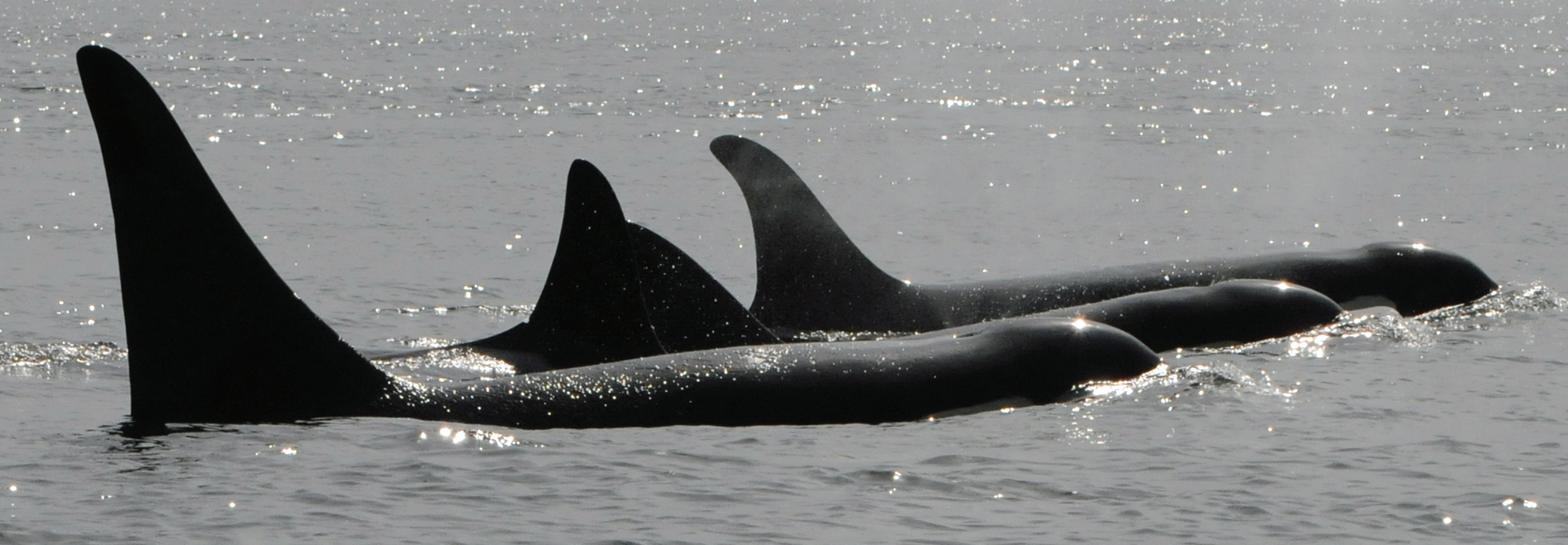

ORCA-WATCHING IN THE SAN JUAN ISLANDS IS USUALLY QUITE A SUNNY SCENE, but last summer there were some clouds gathering over one of the Pacific Northwest’s biggest tourism draws: The Salish Sea’s resident killer whales were simply absent for much of the summer – an unusual event probably related to declining salmon runs.

f similar concern is that the population’s numbers showed another slight decline in 2013, with yet another of the orca pods’ young, prime-reproduction-age males disappearing and dying. The Southern Residents, as the orca population is known, is down to about eighty whales. If those numbers dip much farther, the long-term prospects for this population to survive becomes increasingly doubtful. However, those are potentially short-term problems that a few years of increasing salmon stocks and newborn calves can solve. And they look nothing like the deep dark cloud of a real and very serious existential threat to the whales that is now gathering on the horizon. That threat lies in the form of the black, sticky goo known as tar-sands oil. And it is about to start heading straight down the same path these whales take in the summertime: an endless parade of noisy oil tankers, which will be negotiating the frequently treacherous currents and hard-right angles of the San Juan/ Gulf Islands archipelago alongside threatened orca pods.
“Because the whales tend to group up, a catastrophic event such as a spill or a disease outbreak or something like that has the single
largest potential to extirpate the population,” says Fred Felleman of Seattle, a longtime whale activist and a marine traffic consultant. “We’re looking at putting at risk every primary resource that keeps resident whales resident. One significant spill in any one of those areas is more than enough to break the back on a very, very delicate camel.”
The placid Salish Sea waters, occupied at least half of the year by the resident killer whales are a long way from the Alberta plains where these tar sands are being mined. But there are no refineries in Canada capable of handling the tar sands oil—known, in its crude form, as a tarry, sludge-like substance called bitumen. When it is thinned out with a concoction of chemicals into a more fluid form called dilbit, it can be transported by pipeline and then by ship to refineries elsewhere. At least, that’s the plan in Vancouver.
Unlike Keystone XL—the more notorious project to transport the dilbit from Alberta by pipeline straight to refineries in Texas, and the center of an ongoing environmental controversy in Washington, D.C.—the Vancouver plan does not cross American soil at all. Rather, the owners of the already-existing Transmountain Pipeline want to rebuild it and expand its capacity so that dilbit can be transported from Alberta to Vancouver, then pumped into waiting ships and transported to various refineries in the United States and elsewhere.
It may surprise most people in the Northwest to learn that Vancouver has become an oil port—and is now about to become a major transit center for tar-sands oil. The change occurred in 2006 with very little fanfare, when Kinder Morgan – the American company that bought the Transmountain pipeline the year before—began offloading oil products at the Westridge Marine Terminal in Vancouver , where the pipeline terminates. Up until then, the pipeline had only carried petroleum products headed for use in Vancouver; but in 2006, Kinder Morgan began loading dilbit into ships at the port and sending them out to market.
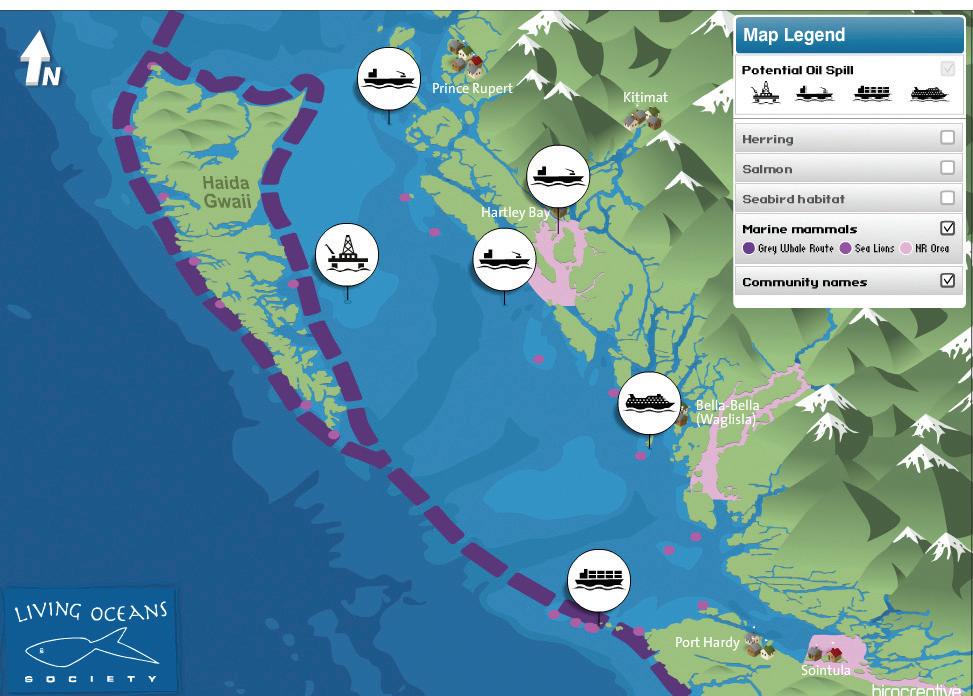
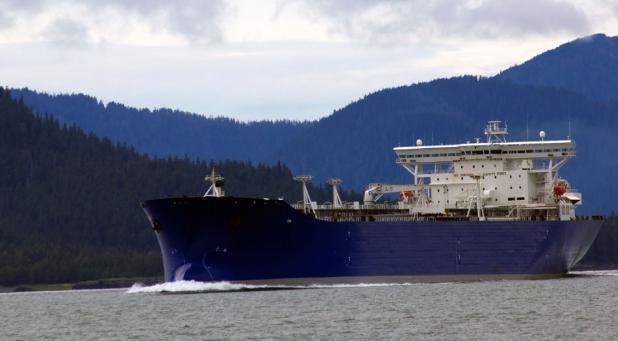
Kinder Morgan’s long-term expansion plans, call for a massive increase in both the amount of dilbit flowing out of the terminal at Westridge and the number of ships carrying it. If the company’s plans are approved by the Canadian Cabinet (and the likely legal challenges fail), Vancouver will see a leap from 60 crude-carrying ships a year to 420 of them.
All of these ships can only pass one way en route to the open sea: through Haro Strait, along the American border, and right through the hunting grounds populated in the summertime by the endangered Southern Residents.
NOR IS THAT THE ENTIRE PICTURE. Overall, the increase in oil-bearing ships only about a 15 percent overall increase in shipping through Haro Strait. But The expansion at the oil terminal is only one part of a much larger and more ambitious plan to increase shipping in and out of Vancouver, including a major increase in container ships and in coal-bearing ships.
Then there are the American plans to turn Cherry Point, near Bellingham, into a major PORT coal-FOR exporting COALport, brought there by train. The ships coming in and out of that port will not travel through Haro Strait, but rather in through Rosario Strait, a narrower and even more convoluted path that also happens to be a regular part of the ORCAS’ circuitlike path the Southern Residents travel in the summertime.
In Prince William Sound, for example, Nearly a third of the resident orcas in Prince William Sound, for example, who were exposed to the oil spilled by the Exxon Valdez in 1989 wound up dying within the year. One pod of transients was doomed to extinction by the event, but the Alaskan resident whales’ numbers were strong enough to eventually rebound from the losses, as they appear to be doing now.
The Southern Residents, however, would not be so fortunate if they lost a third of their population. “The effects would be devastating,” says Ken Balcomb of the Center Whale Research on San Juan Island. “It would depend, of course, on whether the whales were in the vicinity when the spill occurred. Probably it would happen in the winter here, when the whales aren’t around as much. But even then the toxins would be in the ecosystem for a long, long time, and that would be the coup de grace. And if they were present, it would pretty much doom whatever pods were in the vicinity.”

A spill from a tanker carrying tar-sands oil would be especially lethal. The black goo they will be carrying—the dilbit, the toxic mix of bitumen and dilutants—does not behave like ordinary crude oil. The dilutants, which are highly toxic and extremely explosive, tend to separate very quickly from the bitumen, which means that the air surrounding the spill will be filled with a cloud of highly toxic and flammable gases. Any air-breathing mammals—including oil-response personnel, nearby residents, and of course killer whales—in the vicinity who are exposed to those gases will almost certainly incur serious lung damage if not death.

COMPOUNDING THE FEARS OF A SPILL is the reality that government officials in the Northwest on both sides of the border are ill prepared for an oil spill if one were to occur—particularly one involving dilbit, for which the current oil-response units simply don’t have the equipment to properly respond. (Among its many characteristics, dilbit is likely to sink to the bottom of the sea immediately, while most oil-boom and response equipment is geared toward floating crude petroleum.)
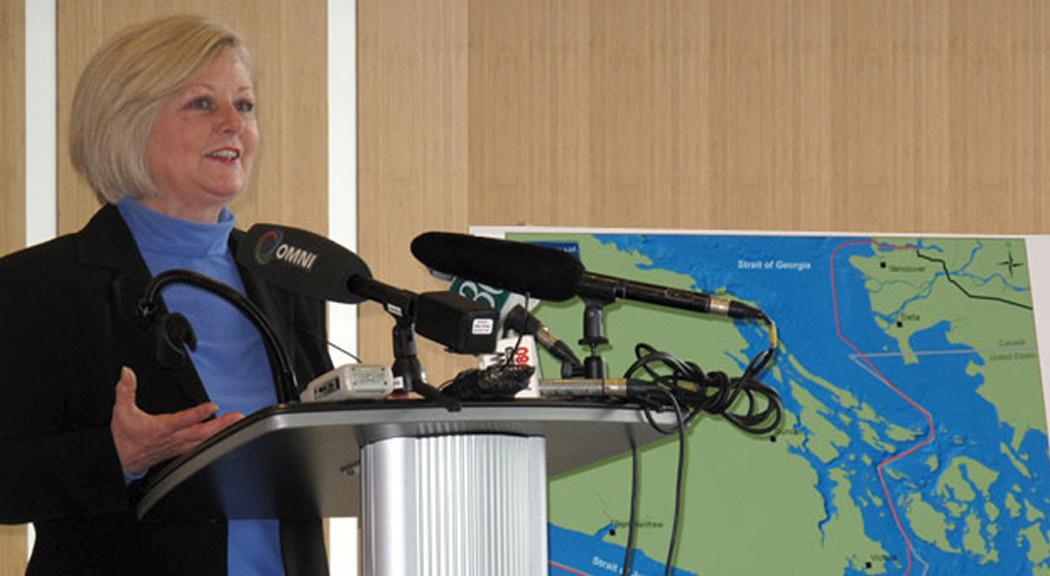
“It’s always been a question, if there were a really serious spill out here, would the federal government be in any sense equipped to deal with the protection of critical resources,” says Karen Wristen, executive director of the Living Oceans Foundation in Vancouver, which is organizing to combat the oil-facility expansion. “And the answer to that is no, they never were.”
Making the picture especially gloomy is that the likelihood of a spill increases dramatically in the waters of the Salish Sea as the numbers of total ships starts to climb. One study, by a George Washington University professor who specializes in shipping-traffic risk assessment, found that if all of the pro-
MORE SHIPS MEAN MORE NOISE AND MORE TROUBLE
The view that most people observe across Haro Strait, along the western shore of San Juan Island, when the killer whales are present is generally a placid one. The only noise to be heard is the sounds of the currents rushing, the “koosh” sound of the whales as they surface and blow plumes into the air – though at times, the calm is broken by the engines of the boats that come crowding around the whales to get a close look at them, sometimes thirty at a time. If there are large ships in view, they are mostly distant and seem almost silent as they glide past.
But drop a hydrophone into those same waters to listen to the sounds in which those same whales swim, socialize, and hunt, and the picture changes dramatically. There will be the whales, all talking in their distinct Southern Resident dialect to each, echolocating for fish; and there will be the whale-watch boats, whose engines are mostly short-lived whines and low-level thrums.
And then there will be the large cargo ships en route to or from Vancouver. Because sound travels so well in water, even the quietest of these will throw up 100 decibels of noise across miles of seawater, and that noise dominates everything within the soundscape. The loudest of them—often older ships with rusty or warped screws—will make noise as loud as 130 decibels, worse than a chainsaw or a turbo-fan aircraft at takeoff.
Val Veirs is a semi-retired physics professor who listens to all this racket, and monitors and records it, with an array of hydrophones he has set up off his waterfront home on the western side of San Juan Island.
According to Veirs, it’s inevitable that these noise levels are going to affect orcas—particularly in their abilities to communicate and hunt, both of which are closely connected to sound.
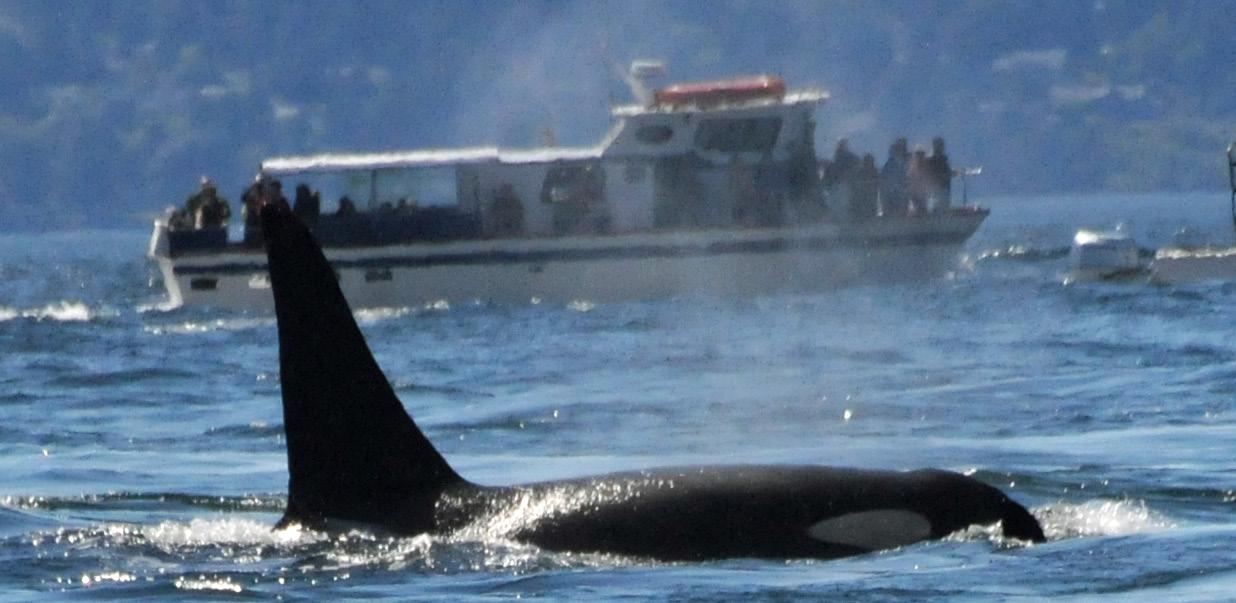
What Veirs and his fellow scientists have found is that killer whales often respond to increased ship noise by vocalizing more loudly, depending on how loud the passing ships are. Moreover, the presence of the noise reduceSd the distance of their communications: “So if we say that the average background is about 100 dB,” Veirs say, “then around 1 or 2 kilometers is the kind of maximum range you could imagine orcas could communicate.” It’s also not uncommon for whales to fall completely silent when the ships are passing by and throwing up that overwhelming thrum in the water.

posed projects for increasing ship traffic through Haro and Rosario straits come to pass, the likelihood of a collision-induced spill becomes about 97 percent.
In other words, if all these plans are put into action, it is a matter when, not if, there will be an oil spill in these waters.
Wristen fears the broad impact on the planned stream of oil-laden ships, especially given the likelihood of a spill. “It hugely increases the risk to the whales, and we are so completely unprepared to deal with it,” she says. “It would devastate the whole ecosystem, and it would take a pretty hard toll on the people at the top of it, as well, the human beings and their economy. There’s so much to be lost in the Salish Sea.”
Washington state wildlife officials are aware of the possibility of an oil spill in the interim. Don Noviello of the Washington Department of Fish and Wildlife says state officials have prepared plans to deal with the whales in the event of a spill emergency. Those plans include using underwater bells to drive the whales away, as well as other measures such as seal bombs—though he acknowledges that none of these measures has been tested.
Kinder Morgan and Transmountain officials submitted their final proposal for the expansion in December (after press deadline), after which it will spend the better part of the next year being considered by the Canadian Cabinet. The political pressure to approve the expansion will be intense, especially as the fight over the Keystone pipeline drags on and the pressure builds for a means to bring the tar sands oil to market. However, the opposition is also likely to be intense, especially in British Columbia, where First Nations communities and environmentalists are already up in arms.
For its part, the U.S. government in the form of the National Marine Fisheries Service—which listed the Southern Residents as endangered in 2005, noting at the time that a catastrophic oil spill could doom them—says it is prepared to respond to such an emergency, but it is remaining mum on the issue of the prospect of increased vessel noise and spill risk from the new Canadian projects as well as the Bellingham coal port.
Pipeline and port officials insist that improvements in navigation and spill response will keep wildlife in the shipping lanes safe. But environmentalists are deeply skeptical.
“We’ve already got a lot of environmental problems that are slowly driving these whales to extinction,” says Ken Balcomb, who has studied the Southern Residents for over forty years. “I look at those 400 or so ships that they plan to run through here, and it’s just another 400 of the thousand cuts that the resident whales suffer. Eventually, they add up.”