Ear tip
(custom designed per patient)
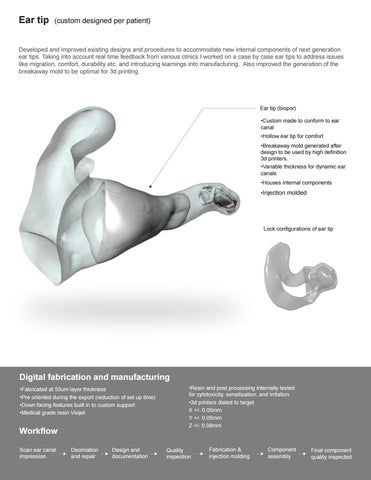
Developed and improved existing designs and procedures to accommodate new internal components of next generation ear tips. Taking into account real time feedback from various clinics I worked on a case by case ear tips to address issues like migration, comfort, durability etc. and introducing learnings into manufacturing. Also improved the generation of the breakaway mold to be optimal for 3d printing.
Ear tip (biopor) •Custom made to conform to ear canal •Hollow ear tip for comfort •Breakaway mold generated after design to be used by high definition 3d printers. •Variable thickness for dynamic ear canals •Houses internal components •Injection molded
Lock configurations of ear tip
Digital fabrication and manufacturing •Fabricated at 50um layer thickness •Pre oriented during the export (reduction of set up time) •Down facing features built in to custom support •Medical grade resin Visijet
Workflow Scan ear canal impression
Decimation and repair
Design and documentation
•Resin and post processing internally tested for cytotoxicity, sensitization, and irritation •3d printers dialed to target X +/- 0.05mm Y +/- 0.05mm Z +/- 0.08mm
Quality inspection
Fabrication & injection molding
Component assembly
Final component quality inspected
Tympanic lens (digital fabricated tympanic chassis) I created a flexible digital infrastructure and workflow to tackle the fast demand of a custom product. The tympanic chassis are dialed to be 3d printed with accuracy of 50um or lower. It accommodates standard components and reduces assembly time by 40%. It eliminates the need for other assembly molds and at the same time it increases manufacturing capacity. Perimeter sulcus (elastomer)
Receiver (dropped in component)
Digital fabricated tympanic chassis •Custom design to conform to patient’s anatomy •Flexible organic design •Designed for printability / additive manufacturing •Optimized to reduce stress points while maintaining minimal material •Quick turnaround part for fast iterations •All other components are standard and can be dropped in for minimal assembly time
Standard sub assembly components
Evolution and configurations of device
Full encasement of receiver component
Minimization of material around receiver
Integration of a tab for ease of ETN usability
Digital fabrication and manufacturing •Fabricated at 50um layer thickness •All features designed to be self-supporting •Print style parameters developed for optimal detail
•3d print runs dialed to target X +/- 0.05mm Y +/- 0.05mm Z +/- 0.08mm
•Every print run verified with a dimensional test piece
Workflow Scan ear canal impression
digital data used to drive physical assembly Decimation and repair
Design and digital alignment of sub components
Quality inspection
Fabrication & post processing
Component assembly
Final component quality inspected
Shipping case (custom tympanic lens case) Developed a custom part that would house the final tympanic lens. The case protects the lens and it allows the lens to naturally sit in a cavity that is the exact shape of the lens. Designed with a removable lid to prevent damage being done while it’s being extracted from the case. Ergonomically designed to allow for a better grip while the device is being handled at the clinic by the ENT. Every device shipped was accompanied by a graphic instruction card that I also developed and illustrated
•Case lid •Case base •Tactile indentions and texture for grip
•Cavity for tympanic lens •Raised lip for lens protection •Space for the forceps to approach lens
•Tympanic lens •Grasping tab •Alligator forceps
Digital fabrication and manufacturing •Fabricated at 50um layer thickness •Pre oriented during export •Dialed clearances so the two parts would fit together
•Batch printed and post processed •Fabricated with clear resin for aesthetics
Workflow Design and digital alignment of sub components
Automated generation of driven by lens design
Quality inspection
Fabrication & post processing
Final component quality inspected