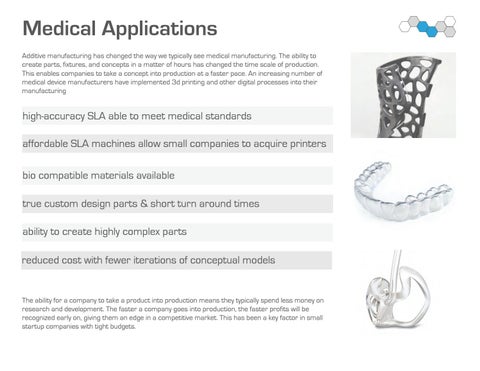
Medical Applications Additive manufacturing has changed the way we typically see medical manufacturing. The ability to create parts, fixtures, and concepts in a matter of hours has changed the time scale of production. This enables companies to take a concept into production at a faster pace. An increasing number of medical device manufacturers have implemented 3d printing and other digital processes into their manufacturing
high-accuracy SLA able to meet medical standards affordable SLA machines allow small companies to acquire printers bio compatible materials available true custom design parts & short turn around times ability to create highly complex parts reduced cost with fewer iterations of conceptual models
The ability for a company to take a product into production means they typically spend less money on research and development. The faster a company goes into production, the faster profits will be recognized early on, giving them an edge in a competitive market. This has been a key factor in small startup companies with tight budgets.
Dental Applications The dental industry has rapidly embraced the digital era. With 3d scans to 3d modeling to 3d printing workflows, the industry has quickly expanded in the last 10 years. Align Technologies embraced additive manufacturing in the early 2000s, giving them an advantage over other competitors. Using 3d printing enabled them to create clear aligners at a fraction of the cost and time. Nowadays, even a small dental practice can have the same quality product due to the availability of highly accurate 3d printers at a low cost
5.9
expected growth
digital workflow scan, model, print
Europe and North America own more than 2/3 of the market.
3.4
main growth is in companies with <500 employees
billions
avg wait time for products decreased from 10 to 6 days with additive
Asia Pacific is the largest growing market 2016
2023
Dental Applications Oportunities and digital process work flow
Impression scan -high definition digital representation of impression
1
Model preparation
2 -repairing, decimation, and orientation of geometries for printing
Print setup
3d print of mold
-simplied set up -orientation for optimal print time -easy support customazition
4
3
-SLA high accurate 3d printing -repeatable production -fast turn around time
Vacum forming -using high accurate 3d printed parts to form aligners and lingual braces
5
QA inspection
6 Deliver product -inpection according to the QC QA standarts company specific
7 -delivery of product and patient fitting
Hearing Aid Applications Companies are taking full advantage of digital workflows and can fit patients with custom products according to their own anatomy. While the workflow is similar to that of the dental industry, hearing aids are typically assembled with electronics and other components to complete the product. We are now seeing a boom in companies fully utilizing additive manufacturing. In a matter of hours from when an impression is taken, it can be scanned, modeled, and 3d printed. The most popular process is printing a shell to be silicone casted. The direct printing of elastomer materials is a great opportunity for this specific market.
9.8
expected growth
6.9
hearing aid market growth is 6.9 billion 2017 to 9.8 billion by 2022
billions
digital workflow scan, model, print
Europe has the greatest expected growth, due to the aging population combination of typical hearing aid that doubles as of biomedical tracker
2017
2022
Hearing Aid Applications Oportunities and digital process work flow
Impression scan -high definition digital representation of teeth impression
1
Model sculpting
2 -repairing, decimation, and modeling patient specific tip
Print setup
3d print of shell
-simplied set up -orientation for optimal print time -easy support customazition
4
3
-SLA high accurate 3d printing -repeatable production -fast turn around time
Injection molding -using high accurate 3d printed parts to form aligners and lingual braces
5 Direct print of mold
QA inspection -part inpection according to the QC QA standarts company specific
6
Deliver product
4
7
-DLP 3d printing -repeatable production -fast turn around time
-delivery of product and patient fitting
Alternate opportunity
Medical wearables Applications This category encompasses an array of devices. There is a distinction between a fitness wearable and a medical application wearable, but the line is continuously being blurred. Consumer fitness trackers help one stay in shape but a medical wearable can point out and potentially detect life threatening conditions. Wearables collect biometric data and can help a physician perform a proper diagnosis – in some cases it can even administer medicine. Similar opportunities for additive manufacturing are present in these industries.
ADAMM (wearable technology that monitors asthma)
Re.flex (helps rehabilitatio by monitoring various movement)
Sunu (sonar band that improves the navigation of visually impaired)
ADAMM (wearable technology that monitors asthma)
-repeatable non customized parts
-real time data about quality of movements
-generic sizes
-generic sizes
-repeatable production prints
-in clinical studies getting ready to be released
-300 million world wide people could benefit
-data assessable for therapist
-need for flexible parts and durable -fit of device is key for quality data housing for the electronics to be collected
-shell printing and injection molding process to create flexible wristband
The key is identifying the best workflow for their manufacturing processes. Most of the work in this category can use a workflow similar to the hearing and dental industries. This narrows down the technical aspects of 3d printing such as identifying the correct material, identifying the fastest and accurate method of 3d printing, or implementing a quality standard used by all medical companies.
-hard plastics housing of the electronics
Elastomers in Medical Devices
soft feel and flexible biocompatible can be combined with other polymers able to compress and return to original shape replace many workflows for casting and injection molding
The challenge is proving to companies that a complete digital workflow can accommodate their needs and is not just about providing an accurate 3d model to the customer or manufacturing company. Identifying a complete and robust workflow is the key to selling the technology and subsequently, building trust in the technology. Once the technology is implemented, the training and documentation within manufacturing become secondary battles.