
New hope for osteoarthritis: Upstate offers gentle radiation therapy
Upstate Medical University now offers low-dose radiotherapy to treat osteoarthritis.
Osteoarthritis is a degenerative joint disease that can affect the many tissues of the joint. It is by far the most common form of arthritis, affecting more than 32.5 million adults in the United States, according to the Centers for Disease Control and Prevention. Low-dose radiotherapy is a safe, effective, and non-invasive treatment for inflammatory and degenerative conditions of the tendons, joints, and other soft tissues of the body. It can significantly improve pain and stiffness, helping avoid the need for surgery.
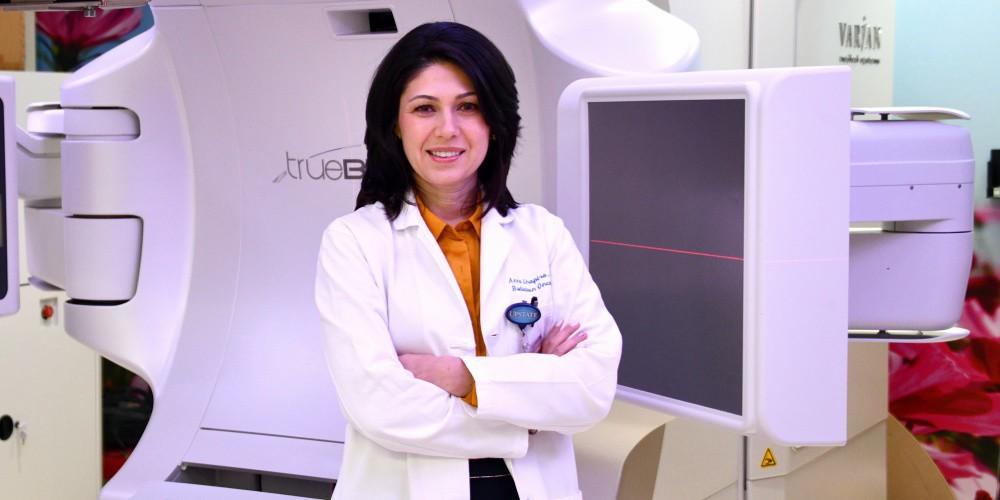
Anna Shapiro, MD, vice chair for clinical affairs for Upstate’s Department of Radiation
Oncology, said that this type of therapy was used in the United States up until the 1980s but was then replaced by other pain management options. However, it has long been used in Europe for benign conditions. When Shapiro decided to offer the treatment at Upstate, she traveled to Germany for training with one of the top professors in the field. She said thousands of patients a year are treated in Germany with low dose radiotherapy for several inflammatory conditions of the musculoskeletal system such as bursitis, tendonitis and plantar fasciitis.
Treatment for osteoarthritis is aimed at pain relief, as the condition can’t be reversed. Typical treatments include NSAIDs, cortisone injections and physical therapy. NSAIDS can cause stomach upset, liver and kidney damage and long-term use of cortisone injections can worsen joint damage over time. A last resort is joint replacement surgery. Enter low-dose radiation therapy, which Shapiro said has minimum to no side effects. LDRT is believed to have antiinflammatory properties.
“The duration of relief is variable, but some people get long term relief for a number of years,” Shapiro said. “It is definitely longer than patients typically get with steroid injections which they can receive every three months or so.”
Shapiro said most people are more familiar with higher dose radiation therapy used for cancer treatments. However, the radiation doses used to treat inflammatory conditions is less than 10 percent of that used for cancer treatments.
Shapiro said she has treated more than a dozen patients to date for osteoarthritis and none have experienced side effects.
Interested patients will first have a consultation with an Upstate physician who will ask about symptoms and conduct a physical examination to see if radiotherapy is a suitable option. The next step is a planning computed tomography (CT) scan, which helps healthcare professionals visualize the treatment area so they can plan how to precisely target the X-rays. Patients are treated in one of Upstate’s four satellite offices of the Cancer Center. Treatments last up to 15 minutes and are covered by insurance.
Patients get a course of six treatments over two weeks. Treatment uses precisely targeted X-rays to trigger an anti-inflammatory response. They return in three months for a follow up. If they have no pain, they don’t need any more treatment. If they have some pain, they can do one or two more courses.
“This is for patients who have tried other options,” Shapiro said. “They have done physical therapy, and they have done injections, and they are not yet ready for surgery. It’s a really great noninvasive option.”
Deborah Burgett, an administrative assistant at Upstate Medical University, switched from treating her arthritis pain with injections to low-dose radiation therapy and found relief.
“For four years, I used steroid injections to manage the pain caused by an arthritic knee. Despite the treatments, I continued to have some discomfort and inflammation. I was still taking pain medications regularly and alternating between ice and heat packs to calm the pain.
“Then, Dr. Shapiro suggested I consider low-dose radiation therapy as an alternative. Shortly after my first session, which specifically targeted my knee, the pain began to subside. Not only was I finally pain-free, but the inflammation also significantly decreased. Today, I’m back to doing the things I love, like boating and swimming, without knee pain. I would recommend low-dose radiation therapy to anyone struggling with chronic joint pain. It has made a big difference in my quality of life.”
Shapiro adds that the use of low-dose radiation therapy for treatment of osteoarthritis pain is gaining popularity in the United States. She said the American Society for Radiation Oncology 2025 meeting theme is “Rediscovering Radiation Medicine and Exploring New Indications.”
“Every society meeting has had sessions on benign applications,” she said, “so radiation for benign conditions is really gaining popularity quite quickly. It’s very exciting.”
Caption: Anna Shapiro, MD, now offers patients low-dose radiotherapy to treat pain from osteoarthritis.
Written by Jean Albanese
Published on Thursday, August 7, 2025


FacebookXShare
Upstate Medical University
Upstate Leadership
Mission, Vision, Values
College of Medicine
College of Nursing
College of Health Professions
College of Graduate Studies
Health Sciences Library
Alumni & Friends
Visitor's Guide
Patient Care
Upstate University Hospital
Upstate Golisano Children's Hospital
Upstate Community Hospital
Upstate Cancer Center
Women's Health
Find a Doctor
MyChart
More Links
Upstate News
About Upstate
Maps & Directions
Upstate Calendars
Search Upstate
Jobs
Volunteer
Give to Upstate
Contact
iPage
Social Media
Upstate Social Media


All contents copyright © 1988-2025, SUNY Upstate Medical University, Syracuse, NY
Privacy Policy | Notice of Privacy Practices | Emergency Information | Freedom of Information | Accessibility Statement | Non-discrimination Statement | Price Transparency
Contact Kathleen Froio with questions about the content of this page.