13 minute read
Spine Trauma in DISH/AS Patients

Management Principles
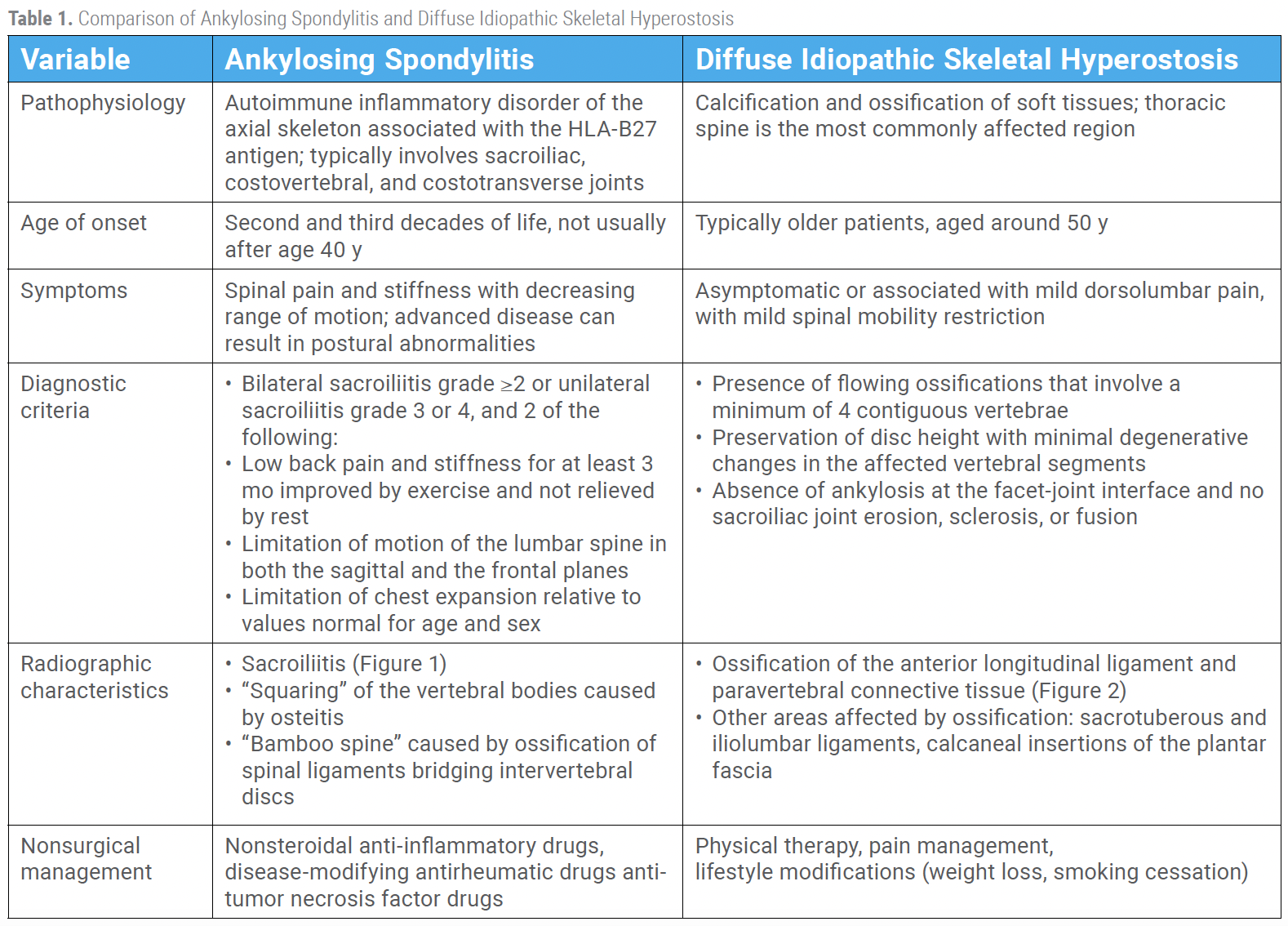
Ankylosing spondylitis (AS) and diffuse idiopathic skeletal hyperostosis (DISH) are distinct conditions that both lead to reduced spinal mobility, abnormal biomechanics, and a rigid, fracture-prone spine.[1–3] Despite differing etiologies (Table 1), advanced stages of both conditions confer a 4-fold higher risk of vertebral fracture compared to unaffected individuals, often after low-energy trauma, with significantly greater complication and mortality rates.[4]
Biomechanical alterations drive the distinct fracture patterns observed in these patients. Spinal fusion creates a long lever arm that is unable to dissipate impact, producing high stress concentrations even after minor trauma.[4] In AS, paravertebral ossification spanning zygapophyseal and costotransverse joints frequently leads to kyphosis and unstable fractures involving posterior elements, strongly linked to neurological deterioration. In contrast, DISH patients more frequently sustain isolated vertebral body fractures. These injuries still carry similar risks of delayed diagnosis and neurologic decline.[5,6] In addition, osteoporosis and decreased bone min- eral density are prevalent in AS, likely driven by systemic inflammation and reduced activity.[7,8] Although DISH is not directly linked to osteoporosis, its older patient population often exhibits compromised bone quality. Moreover, ligamentous ossification can artifactually elevate bone mineral density readings, masking underlying fragility.[9] Thus, impaired bone quality further compounds fracture risk in both conditions. With the rising prevalence of DISH in aging, obese, and diabetic populations, and with a steady incidence of AS, it is critical to understand the unique fracture mechanisms, instability patterns, and bone quality considerations in these patients. These factors underscore the importance of tailored management strategies for trauma in patients with an ankylosed spine.
Radiographic Evaluation
Patients with suspected fractures should be managed with advanced complete spinal imaging and full spine precautions until definitive treatment. Studies demonstrate high rates of missed or incorrect initial fracture diagnosis in patients with AS and DISH, which may result in progressive neurologic injury.[5] Advanced imaging such as computed tomography (CT) should be used in fracture identification for any patient with AS or DISH, as nondisplaced fractures are easily missed using only x-ray imaging. Magnetic resonance imaging (MRI) is mandatory in cases with neurologic involvement, but literature suggests CT alone may be sufficient in DISH patients without suspicion for neurologic involvement.[10] Shah et al found that additional MRI findings did not change management of isolated vertebral body fractures in DISH patients, but all AS patients with the same fracture pattern on CT had additional MRI findings that were clinically significant and warranted conversion to operative management.[10]
Management and Outcomes
Operative treatment is recommended in vertebral fractures in patients with AS and DISH owing to the severity and incidence of complications, namely pseudarthrosis and progression of neurologic deficits.[11] Westerfeld et al found that overall complications and mortality rates were lower in patients managed operatively.[5] Medical comorbidities are the most common reason for nonoperative treatment.[1]
Nonoperative Management
Nonoperative management typically consists of rigid external immobilization with orthoses such as cervical collars and thoracolumbosacral orthoses, depending on the level of injury. Patients with advanced disease may have postural deformities that require additional molding or adjustment for external bracing. Taher et al demonstrated successful outcomes using bracing without surgical intervention in 3 patients with extension-type injuries, no significant dislocation, and normal facet orientation.[12] Several case series suggest that nonoperative management can achieve good outcomes in well-selected patients, but further investigation into patient selection is needed.[13] However, nonoperative management is not without risk of complications. Besides the risks inherent to fracture instability, healing fractures without fixation requires extended bed rest, which can lead to deconditioning, skin ulceration, and pulmonary complications.[14]
Operative Management
Positioning
The ligaments and paraspinal muscles are crucial mechanical supports for the ankylosed spine. Surgeons must be careful when positioning patients for surgery to prevent additional fractures or displacement, especially after the loss of muscular tone with general anesthesia. For patients with cervical injuries, fiberoptic intubation is recommended to reduce the risk of worsening neurological deficits.[11]
Approach
In AS and DISH patients, fusion can be performed through an anterior, posterior, or combined approach using allograft, autograft, or other synthetic graft materials. The posterior approach is preferred in trauma patients, as it allows for multiple points of fixation and provides good exposure to the spinal cord if decompression is needed. Current recommendations for thoracolumbar spine fracture in DISH utilize an open posterior fixation with instrumentation at 3 levels above and below the site of the fracture. Caron et al found that of 58 patients (77% of the surgical treatment group) who received posterior segmental fixation with instrumentation 3 levels above and below the injury, no patients required reoperation for fixation failure.[15] However, multilevel fixation may not be necessary in the cervical spine. Cervical fractures are more frequently encountered than thoracolumbar fractures in AS patients.[16] Although posterior fixation is preferred in the thoracic spine, cervical fracture management is not standardized and varies with patient factors. Evidence suggests there is no significant difference in neurological improvement between the posterior and combined approaches.[17] While the combined approach leads to longer operation times, greater stability can be achieved than with the posterior approach alone.[18] Patients with unstable B- and C-type cervical fractures may benefit from this increased stabilization. Generally, standalone anterior fixation is at a higher risk of failure without posterior fixation due to a lack of structural support.[16] Studies show the anterior approach has been associated with fewer degrees of neurological improvement, but it may also result in fewer complications and may be a suitable option for patients who cannot tolerate prone positioning due to cardiac comorbidities or fracture instability.[19,20]
Surgical Techniques
The standard for operative management uses pedicle screw and rod constructs. Monoaxial pedicle screw systems are preferred because they are inherently more stable than polyaxial screw systems and are better able to counteract mechanical stresses that are increased with the ankylosed spine.[21] Besides percutaneous pedicle screw (PPS) fixation, there is also emerging evidence that interdiscal penetrating endplate screws may provide stronger fixation with significantly decreased screw loosening.[22]
Poor bone quality is highly associated with AS and DISH, and increased screw quantity or augmentation with polymethylmethacrylate can be effective. Surgeons should be aware of possible pulmonary cement embolization in patients with long instrumentation.[10]
Minimally Invasive Surgery
Minimally invasive surgery (MIS) approaches are increasingly utilized in spinal fixation for traumatic fractures in patients with ankylosing spinal diseases.[23] Lower complication rates, decreased blood loss, and decreased hospital stay when compared to open surgery are highly desired benefits for AS and DISH patients given their high rates of medical comorbidities.[11] Furthermore, many studies have demonstrated the efficacy of PPS in DISH and AS patients.[24,25] Okada et al found similar fusion length and neurological improvement and lower complication rates in PPS fixation compared to traditional open posterior fixation.[25]
The decision to use MIS depends on various factors, including surgeon experience, fracture type, and stability. Current studies indicate that good outcomes can be achieved in AS and DISH patients using a minimally invasive approach for hyperextension fractures and minimally displaced neurologically intact injuries.[18]
Complications
Complication rates for patients with AS and DISH are known to be higher than those of control populations.[5,26] Westerveld et al found that complications occurred more frequently in patients with ankylosing disorders regardless of treatment strategy, and respiratory failure and pneumonia were most frequently reported.[5] Patients with DISH have been shown to have decreased pulmonary function compared to control patients, contributing to their susceptibility to pulmonary complications.[27] Deconditioning due to stiffness and pain, as well as high rates of medical comorbidities, are other factors that affect postoperative recovery. The systemic inflammatory nature of AS also predisposes patients to complications such as increased intraoperative bleeding and surgical site infections.[28] Epidural hematoma and cardiac abnormalities have also been documented in the AS population postoperatively.[26,29]
Patient Cases
Case 1
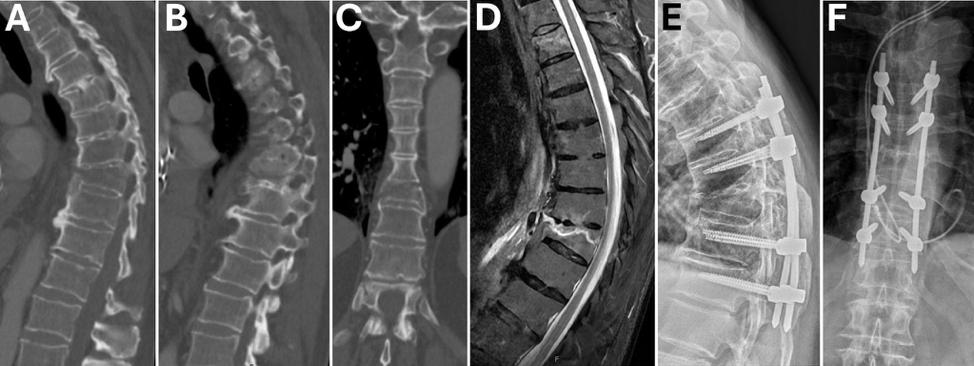
A 71-year-old man with ankylosing spondylitis sustained a mechanical ground-level fall that resulting in an extension injury involving the anterior and middle columns of T9, as seen on CT and MRI (Figure 1AD). He underwent percutaneous T7-T11 instrumentation to stabilize the injury (Figure 1E and F).
Case 2
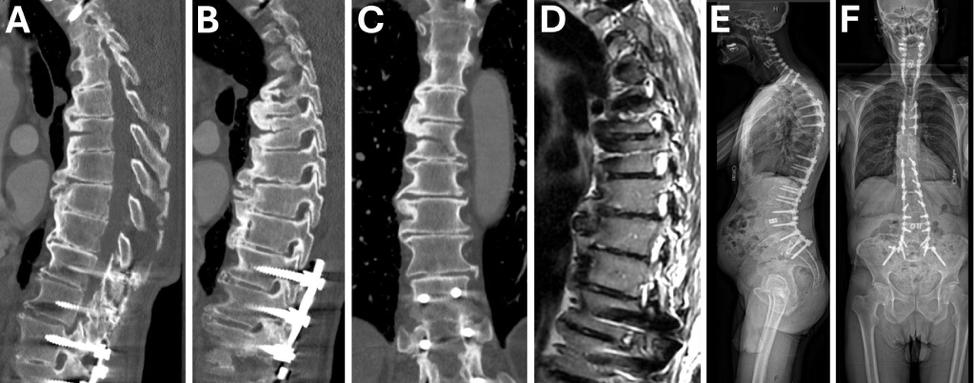
An 85-year-old man with DISH and a remote history of C1-T2 and T10-pelvis fusion sustained a syncopal ground-level fall, resulting in an extension injury involving the anterior and middle columns of T6, as seen on CT (Figure 2A-C) and MRI (Figure 2D). He underwent percutaneous T5-7 instrumentation to stabilize the injury (Figure 2E and F).
Conclusion
Management of spinal fractures in patients with AS and DISH presents unique challenges due to altered spinal biomechanics, difficulty of radiographic evaluation, and risk of neurologic deficit progression. Treatment can be operative or nonoperative, but nonoperative management is typically only used for patients with factors that preclude them from surgery. A posterior approach is typically preferred for traumatic thoracic fractures in cases where spinal decompression is also indicated. Surgical approaches for cervical fractures can vary based on fracture stability and patient comorbidities. Patients with AS and DISH require special consideration during management, from fracture identification to patient transport and positioning to surgical technique. In understanding the factors that affect management of vertebral fractures in this patient population, surgeons will be equipped to provide the care that patients need and improve long-term outcomes.
References
1. Westerveld LA, Verlaan JJ, Oner FC. Spinal fractures in patients with ankylosing spinal disorders: a systematic review of the literature on treatment, neurological status and complications. Eur Spine J. 2009;18(2):145-156.
2. Kim SH, Lee SH. Updates on ankylosing spondylitis: pathogenesis and therapeutic agents. J Rheum Dis. 2023;30(4):220-233.
3. Luo TD, Varacallo MA. Diffuse Idiopathic Skeletal Hyperostosis . In: StatPearls. StatPearls Publishing; 2025. Accessed September 11, 2025. http://www.ncbi. nlm.nih.gov/books/NBK538204/
4. Harlianto NI, Ezzafzafi S, Foppen W, et al. The prevalence of vertebral fractures in diffuse idiopathic skeletal hyperostosis and ankylosing spondylitis: a systematic review and meta-analysis. North Am Spine Soc J. 2024;17:100312.
5. Westerveld LA, van Bemmel JC, Dhert WJA, Oner FC, Verlaan JJ. Clinical outcome after traumatic spinal fractures in patients with ankylosing spinal disorders compared with control patients. Spine J. 2014;14(5):729-740.
6. Kobayashi K, Okada E, Yoshii T, et al. Risk factors for delayed diagnosis of spinal fracture associated with diffuse idiopathic skeletal hyperostosis: a nationwide multiinstitution survey. J Orthop Sci. 2021;26(6):968-973.
7. Briot K, Roux C. Inflammation, bone loss and fracture risk in spondyloarthritis. RMD Open. 2015;1(1).
8. Ramírez J, Nieto-González JC, Curbelo Rodríguez R, Castañeda S, Carmona L. Prevalence and risk factors for osteoporosis and fractures in axial spondyloarthritis: a systematic review and meta-analysis. Semin Arthritis Rheum. 2018;48(1):44-52.
9. Donnelly S, Doyle DV, Denton A, Rolfe I, McCloskey EV, Spector TD. Bone mineral density and vertebral compression fracture rates in ankylosing spondylitis. Ann Rheum Dis. 1994;53(2):117-121.
10. Shah NG, Keraliya A, Harris MB, Bono CM, Khurana B. Spinal trauma in DISH and AS: is MRI essential following the detection of vertebral fractures on CT? Spine J. 2021;21(4):618-626.
11. Daher M, Rezk A, Baroudi M, et al. Management of thoracolumbar vertebral fractures and dislocations in patients with ankylosing conditions of the spine. Orthop Rev. 2024;16:94279.
12. Taher AW, Page PS, Greeneway GP, et al. Spinal fractures in the setting of diffuse idiopathic skeletal hyperostosis conservatively treated via orthosis: illustrative cases. J Neurosurg Case Lessons. 2022;3(20):CASE21689.
13. Barkay G, Fernandes J, Strong D, Suttor S, Hartin N, Gray R. Non-operative management for patients with spinal ankylosing disorders presenting with extension type (AOSpine B3) fractures—our experience with a cohort of 40 patients. Global Spine J. 2025;15(7):3323-3331.
14. Werner BC, Samartzis D, Shen FH. Spinal fractures in patients with ankylosing spondylitis: etiology, diagnosis, and management. J Am Acad Orthop Surg. 2016;24(4):241-249.
15. Caron T, Bransford R, Nguyen Q, Agel J, Chapman J, Bellabarba C. Spine fractures in patients with ankylosing spinal disorders. Spine. 2010;35(11):E458-E464.
16. Kurucan E, Bernstein DN, Mesfin A. Surgical management of spinal fractures in ankylosing spondylitis. J Spine Surg. 2018;4(3):501-508.
17. Peng C, Luan H, Liu K, Song X. Comparison of posterior approach and combined anterior-posterior approach in the treatment of ankylosing spondylitis combined with cervical spine fracture: a systematic review and meta-analysis. Global Spine J. 2024;14(5):1650-1663.
18. Harlianto NI, Kuperus JS, Verlaan JJ. Perioperative management, operative techniques, and pitfalls in the surgical treatment of patients with diffuse idiopathic skeletal hyperostosis: a narrative review. Explor Musculoskelet Dis. 2023;1(4):84-96.
19. Shetty AP, Murugan C, Karuppannan Sukumaran SVA, et al. Surgical approach to cervical fractures in ankylosing spondylitis patients: rationale and surgical strategy. World Neurosurg. 2023;173:e321-e328.
20. Chen HJ, Chen DY, Zhou SZ, Sang LL, Wu JZ, Huang FL. Combined anterior and posterior approach in treatment of ankylosing spondylitis-associated cervical fractures: a systematic review and meta-analysis. Eur Spine J. 2023;32(1):27-37.
21. Reinhold M, Knop C, Kneitz C, Disch A. Spine fractures in ankylosing diseases: recommendations of the spine section of the German Society for Orthopaedics and Trauma (DGOU). Global Spine J. 2018;8(2S):56S-68S.
22. Ishikawa T, Ota M, Umimura T, et al. Penetrating endplate screw fixation for thoracolumbar pathological fracture of diffuse idiopathic skeletal hyperostosis. Case Rep Orthop. 2022;2022:5584397.
23. Nayak NR, Pisapia JM, Abdullah KG, Schuster JM. Minimally invasive surgery for traumatic fractures in ankylosing spinal diseases. Global Spine J. 2015;5(4):266-273.
24. Ye J, Jiang P, Guan H, et al. Surgical treatment of thoracolumbar fracture in ankylosing spondylitis: a comparison of percutaneous and open techniques. J Orthop Surg Res. 2022;17(1):504.
25. Okada E, Shiono Y, Nishida M, et al. Spinal fractures in diffuse idiopathic skeletal hyperostosis: advantages of percutaneous pedicle screw fixation. J Orthop Surg. 2019;27(2):2309499019843407.
26. Schwendner M, Seule M, Meyer B, Krieg SM. Management of spine fractures in ankylosing spondylitis and diffuse idiopathic skeletal hyperostosis: a challenge. Neurosurg Focus. 2021;51(4):E2.
27. Shimizu T, Suda K, Harmon SM, et al. The impact of diffuse idiopathic skeletal hyperostosis on nutritional status, neurological outcome, and perioperative complications in patients with cervical spinal cord injury. J Clin Med. 2023;12(17):5714.
28. Chehrassan M, Shakeri M, Nikouei F, et al. Understanding the pros and cons of spine surgery for ankylosing spondylitis: experience from a single institution study. BMC Rheumatol. 2025;9(1):11.
29. Hanna G, Uddin SA, Trontis A, et al. Epidural hematoma in patients with ankylosing spondylitis requiring surgical stabilization: a single-institution retrospective review with literature analysis. Neurosurg Focus. 2021;51(4):E5.
Contributors:
Audrey Zhao, BS
Hania Shahzad, MD
Safdar Khan, MD
Yashar Javidan, MD
Wyatt Vander Voort, MD
Hai Le, MD
From the Department of Orthopaedic Surgery at the University of California, Davis, in Sacramento, California.