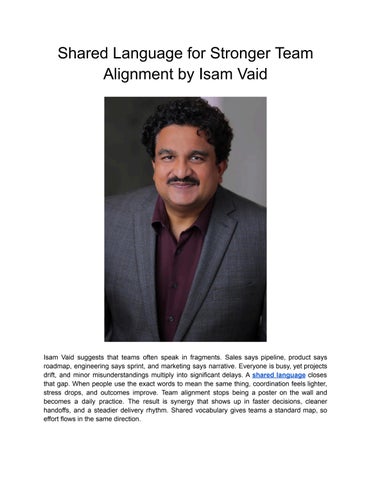
Shared Language for Stronger Team Alignment by Isam Vaid

Isam Vaid suggests that teams often speak in fragments Sales says pipeline, product says roadmap, engineering says sprint, and marketing says narrative. Everyone is busy, yet projects drift, and minor misunderstandings multiply into significant delays A shared language closes that gap. When people use the exact words to mean the same thing, coordination feels lighter, stress drops, and outcomes improve. Team alignment stops being a poster on the wall and becomes a daily practice The result is synergy that shows up in faster decisions, cleaner handoffs, and a steadier delivery rhythm. Shared vocabulary gives teams a standard map, so effort flows in the same direction
Shared language is not about jargon It is about clarity that travels If a designer says 'discovery,' the analyst, manager, and customer success lead should picture the same milestone and artifacts That consistency builds trust because expectations match reality Leaders gain a more accurate view of progress, contributors feel heard, and customers receive a steadier experience. The human payoff matters as much as the tactical one. People relax when words are reliable Meetings shorten, debate sharpens, and decisions arrive with less friction Alignment becomes visible through the words teams choose every day. Shared clarity also protects focus when priorities shift, as teams can consistently rename work and adopt new terms without confusion

Creating that harmony starts with a simple glossary Write short definitions for the terms your team uses every week Include examples that show the difference between similar words like issue, risk, and incident. Add unambiguous status labels, such as proposed, approved, in progress, blocked, and complete Keep the list visible where work happens, inside docs, tickets, and chat Use it in onboarding so new hires absorb how the organization communicates Update it during retrospectives when miscommunications surface. The glossary is a living artifact that distills how your team describes goals, work, and outcomes
Rituals reinforce vocabulary Kickoffs should start with a quick review of terms, scope, and success metrics so everyone starts on the same page. Weekly reviews should standardize how progress is reported, using shared templates and a standard scale for confidence. Demos should capture decisions in a visible log that teammates can reference later. Async channels should pin definitions to guide discussions that span time zones. These habits create a cadence that reduces friction The rituals do not slow you down They build speed by removing confusion before it grows. Clear rituals also create teachable moments for new teammates, who learn how to talk about work with context and care
Feedback loops are the glue. Encourage teammates to ask what we mean by that whenever a phrase feels fuzzy, reward clarification, not bravado Document ambiguous moments and convert them into sharper definitions Translate customer language into plain internal language, and vice versa, so insights do not get lost between departments. Use brief playback statements at the end of meetings to confirm decisions and next steps A culture that prizes clarification converts uncertainty into shared understanding Leaders can model this by asking purposeful, naive questions.
Technology should serve the language, not replace it Choose tools that spotlight definitions within the workflow. Build lightweight playbooks with screenshots and real examples, not heavy manuals that collect dust Tag assets with the same terms people use in meetings so search works intuitively. Track metrics that mirror everyday words, such as lead time, cycle time, adoption, and quality, rather than vanity numbers that confuse. When dashboards reflect the glossary, leaders steer smarter, and contributors see how daily actions move the numbers that matter. Simple cues inside tools, like hover definitions, reduce cognitive load and keep attention on the work itself

The business case for a shared language is persuasive Estimates improve because scoping terms are consistent. Hiring improves because interview rubrics map to the same vocabulary used on the job Customer experience improves because handoffs preserve meaning from the first demo to renewal Most of all, people feel connected They see how their work links to the strategy and how their words shape outcomes. Speaking the same language is not a soft skill. It is the operating system of team alignment and synergy, and it can be installed today with a clear glossary, intentional rituals, and steady feedback loops that keep the whole organization in tune