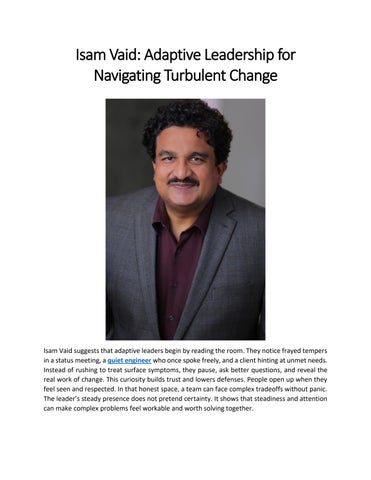
Isam Vaid: Adaptive Leadership for Navigating Turbulent Change

Isam Vaid suggests that adaptive leaders begin by reading the room. They notice frayed tempers in a status meeting, a quiet engineer who once spoke freely, and a client hinting at unmet needs. Instead of rushing to treat surface symptoms, they pause, ask better questions, and reveal the real work of change. This curiosity builds trust and lowers defenses. People open up when they feel seen and respected. In that honest space, a team can face complex tradeoffs without panic. The leader’s steady presence does not pretend certainty. It shows that steadiness and attention can make complex problems feel workable and worth solving together.
Clarity follows close behind. In times of disruption, rumors will race to fill any gap. Adaptive leadership keeps messages repeatable and straightforward, framing the challenge, naming what is known, and admitting what is still unclear. The story stays consistent across channels, from an all-hands to a one-on-one. Goals are described as experiments with tight learning loops, not as promises carved in stone. Teams hear why a constraint matters, how success will be measured, and when the next update will arrive. This reliable cadence steadies morale, reduces rework, and helps people see how their daily efforts connect to the mission.

Psychological safety turns insight into action. People think best when they can disagree without punishment. Adaptive leaders invite dissent, thank colleagues who challenge assumptions, and separate ideas from identities. Meetings use simple norms to draw out every voice, like round robins, time-boxed debates, and short written briefs that spotlight reasoning. Technical arguments stay anchored to evidence rather than volume. Mistakes become data points instead of career verdicts. Over time, the group learns to surface risks early, recover quickly from missteps, and treat learning as a shared asset. The result is faster, more informed decisions with fewer blind spots.
Structure must flex as conditions shift. Processes built for calm waters often snap under stress. Adaptive leadership favors light, visible, and reversible frameworks. Teams work in short cycles with frequent demos that show reality, not slides. Cross-functional groups assemble quickly around a problem and dissolve when the work is complete. Incentives are tuned so collaboration is rewarded, not treated as charity. Tools are chosen for transparency and speed, from shared dashboards to open decision logs. People can see what changed, why it changed, and how to contribute. The system breathes without losing coherence.

Empathy fuels stamina during long transformations. When the stakes rise, exhaustion and cynicism creep in. Adaptive leaders protect capacity with clear priorities, sane pacing, and time for recovery. They acknowledge losses that come with change, like a beloved product sunset or a shift in roles. They share progress through specific stories that honor contributors by name. Managers receive coaching on how to hold career conversations with candor and kindness. The goal is not constant positivity. It is a grounded hope that recognizes grief, celebrates small wins, and treats each person as more than a resource.
Decision quality improves when perspectives widen. Adaptive leaders cultivate diverse voices and connect teams to outside signals. They invite customers to usability sessions, rotate who leads postmortems, and sponsor communities of practice that spread craft knowledge. Data and narrative travel together so insights feel credible and human. When a bet must be placed, the leader explains the logic and the risks and states what would trigger a change in course. This transparency reduces blame, speeds corrections, and builds the humility needed to adapt again tomorrow.

Resilience is practiced, not proclaimed. Teams rehearse for disruption through tabletop drills and role-play. People practice incident communication, triage, and clean handoffs. Leaders keep a short list of guiding principles that travel well in a crisis, such as fix customers first, protect the team, and document while you go. Afterward, they close the loop with honest retrospectives and minor, visible improvements. Stress becomes shared practice rather than private strain. In the end, adaptive leadership is disciplined care for people and outcomes, a daily habit of listening, learning, and choosing well when the path ahead keeps shifting.