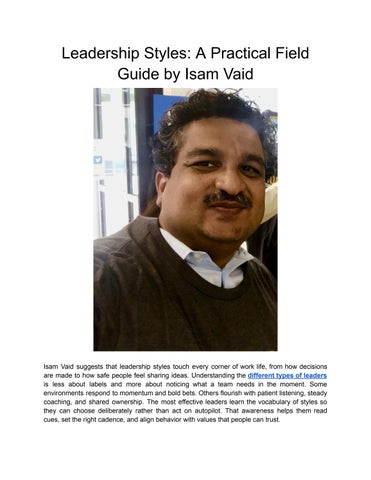
Leadership Styles: A Practical Field Guide by Isam Vaid

Isam Vaid suggests that leadership styles touch every corner of work life, from how decisions are made to how safe people feel sharing ideas Understanding the different types of leaders is less about labels and more about noticing what a team needs in the moment. Some environments respond to momentum and bold bets Others flourish with patient listening, steady coaching, and shared ownership The most effective leaders learn the vocabulary of styles so they can choose deliberately rather than act on autopilot. That awareness helps them read cues, set the right cadence, and align behavior with values that people can trust
Transformational leadership often gets the spotlight because it sparks change that people can feel. These leaders paint a vivid picture of the future, connect daily work to a larger purpose, and celebrate progress in ways that energize teams Picture a manager who reframes a backlog as a runway to launch an innovative service, then clears obstacles so talent can take off. They communicate with clarity, invite stretch goals, and build momentum with visible wins. The risk is burnout or strategy drift if vision outpaces systems, so transformational leaders ground ambition in data, pacing, and simple rituals that protect energy.

Servant leadership centers on empathy, service, and empowerment. A servant leader asks what people need to do their best work and then hustles to provide it, whether that means clearer priorities, flexible schedules, or better tools. They listen closely, coach often, and share credit freely For teams wrestling with ambiguity, this style builds psychological safety and loyalty that outlasts a single project Results emerge from trust and consistency rather than pressure The shadow side emerges when urgency demands quick decisions, and the leader hesitates to decide Servant leaders counter that risk by setting explicit decision rules and time boxes
Autocratic and democratic styles sit at opposite points of a decision spectrum Autocratic leadership centralizes authority, which can be helpful in crises, safety-sensitive settings, or early turnarounds where speed and consistency matter It reduces confusion, yet can choke initiative if used too long. Democratic leadership invites participation, voting, and consensus seeking. It improves buy-in and surfaces risks, especially in creative or cross-functional work. Overuse can slow momentum or blur accountability Leaders who favor either pole keep balance by naming the decision method up front and clarifying who owns the final call.

Laissez-faire leadership grants broad autonomy to capable people In high-skills teams, it feels like trust, and it often boosts innovation because individuals have room to tinker and own their outcomes. Without shared goals and feedback loops, though, it can dissolve into silos and uneven quality Clear expectations keep freedom productive Set goals, define interfaces, and schedule lightweight reviews to catch drift early. These small guardrails protect autonomy while maintaining coordination When autonomy meets transparency, teams move faster with fewer collisions, and leaders can focus on removing systemic barriers rather than micromanaging tasks.
Situational leadership threads through all these approaches by asking leaders to diagnose before they act. Skill, motivation, and context vary, so guidance should differ too. A new hire may need structured steps and close coaching A seasoned contributor may only need a goal and a deadline. A sudden outage calls for decisive commands, while a long-range strategy benefits from broad consultation. Situational leaders stay curious, watch signals, and adjust their stance as conditions change This flexibility prevents style ruts, preserves morale, and aligns effort with evolving realities inside and outside the team.
For readers refining their own style, small practices compound Start meetings by naming the decision method to reduce ambiguity. Pair vision with a single metric that demonstrates progress, and review it at a steady cadence Ask one more question before advising to strengthen coaching muscles. Share a concise lessons-learned note after each launch to normalize reflection. Invite dissent early to widen the solution space, then decide and document why Most of all, treat style as a toolkit, not a title People remember how leaders make them feel, whether seen, stretched, or safe to speak up. When leaders match style to moment with care, performance improves, and cultures grow more resilient, creative, and humane