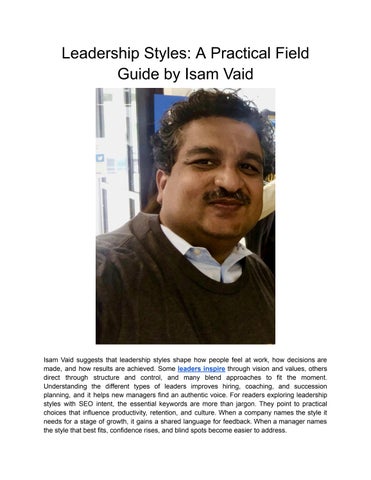
Leadership Styles: A Practical Field Guide by Isam Vaid

Isam Vaid suggests that leadership styles shape how people feel at work, how decisions are made, and how results are achieved Some leaders inspire through vision and values, others direct through structure and control, and many blend approaches to fit the moment Understanding the different types of leaders improves hiring, coaching, and succession planning, and it helps new managers find an authentic voice For readers exploring leadership styles with SEO intent, the essential keywords are more than jargon. They point to practical choices that influence productivity, retention, and culture When a company names the style it needs for a stage of growth, it gains a shared language for feedback When a manager names the style that best fits, confidence rises, and blind spots become easier to address.
Transformational leadership gains power from purpose. These leaders paint a compelling picture of the future, connect daily tasks to meaningful outcomes, and encourage people to stretch beyond current limits. Think of a startup founder who links engineering work to healthier patients or cleaner streets, then celebrates experiments that teach as much as launches that succeed The reward is energy, innovation, and loyalty built on shared meaning The risk of overreach is when inspiration is not matched with pacing, recovery, and clear priorities. Great transformational leaders schedule rest, establish milestones, and invite dissent early They keep vision vivid without letting it eclipse the discipline required to deliver dependable results
Servant leadership centers on empathy and service. The servant leader asks what people need to do their best work, then clears roadblocks with quiet consistency Picture a product director spending Monday mornings listening to support calls, translating those insights into fixes that reduce customer friction, then crediting the team that made it happen They coach more than they command, creating psychological safety that helps ideas surface Morale improves because people feel seen and respected. Decisions can slow if consensus becomes endless, so effective servant leaders define when debate ends and which decisions are reversible The style fits values-driven organizations, customer-centric teams, and any environment where trust is the first ingredient for speed.
Democratic leadership invites participation to strengthen decisions These leaders design forums where diverse voices shape options before a final choice is made. In a distributed company, this might include short surveys, rotating facilitators, and transparent notes documenting tradeoffs. Teams gain stronger buy-in and better ideas when quiet experts have a place to contribute. The tradeoff appears when deadlines loom, because extensive input can stretch timelines and blur accountability Seasoned democratic leaders prevent drift by clarifying decision rights, setting time boxes, and publishing criteria in advance. They listen widely, choose decisively, and then review outcomes to improve the next decision cycle Participation remains a means to quality, not an end in itself
Transactional leadership emphasizes clear goals, measurable outcomes, and fair rewards. Sales leaders often thrive with this approach, using quotas, leading indicators, and consistent coaching to keep performance visible The strength is predictability People know what success looks like, how it will be measured, and what they will receive for meeting the mark. The limitation arises in ambiguous problems where creativity matters, because teams can become fixated on the letter of the target rather than its spirit Balanced transactional leaders still recognize initiative, reward cross-team collaboration, and adjust metrics when they distort behavior They treat scorecards as signals, not shackles, and pair them with space for curiosity
Autocratic leadership centralizes authority for speed and control In emergencies, regulated contexts, or environments with severe safety constraints, this focus is essential. A hospital incident commander or a flight director cannot pause critical action for a round of opinions Problems arise when the same intensity persists after the crisis. People withdraw, information gets filtered, and promising ideas fade before they reach the top. Healthy autocratic leaders explain the why, communicate intent, and reopen participation once stability returns They establish safe channels for dissent and reward early risk escalation. Used skillfully, this style provides clarity when confusion would be dangerous, then gives way to more inclusive modes when learning and growth are the goals

Coaching leadership blends clarity with growth. These leaders give frequent, specific feedback and design work as a ladder of stretch assignments. One-to-one conversations include open questions, career maps, and agreements that turn insights into experiments Over time, teams gain capability and resilience, and the organization benefits from a stronger bench. The challenge is consistency, since coaching requires scheduled time and a genuine curiosity about how people learn The payoff is a culture that retains top talent while raising the capacity of everyone else. Most leaders benefit from situational range, moving between transformational, servant, democratic, transactional, autocratic, and coaching styles as context changes The skill is choosing the right style on purpose, not by habit