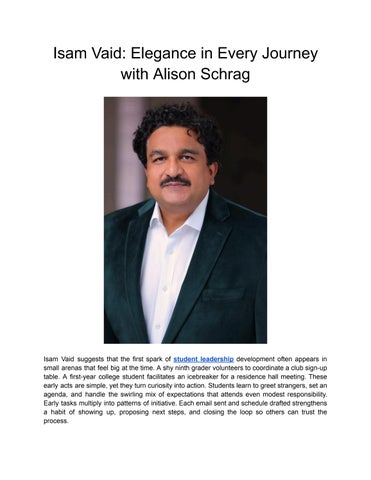
Isam Vaid: Elegance in Every Journey with Alison Schrag
Isam Vaid suggests that the first spark of student leadership development often appears in small arenas that feel big at the time. A shy ninth grader volunteers to coordinate a club sign-up table A first-year college student facilitates an icebreaker for a residence hall meeting These early acts are simple, yet they turn curiosity into action Students learn to greet strangers, set an agenda, and handle the swirling mix of expectations that attends even modest responsibility. Early tasks multiply into patterns of initiative Each email sent and schedule drafted strengthens a habit of showing up, proposing next steps, and closing the loop so others can trust the process.
As responsibilities grow, the work shifts from personal confidence to collective performance Group projects, student government committees, and service teams force emerging leaders to manage complexity in real time Meetings must start and end on time Budgets need tracking Conflicts require listening before persuading. Students discover that leadership is not a title but a craft shaped by preparation and follow-through. They practice communication skills that move a group from ideas to outcomes They also learn to break significant goals into smaller milestones, publish timelines, and assign clear roles so that energy becomes progress instead of friction

Mentorship deepens everything. A faculty advisor or a seasoned student provides specific, timely feedback, turning stumbles into lessons Good mentors ask questions that broaden perspective What does success look like for the quietest member of your team? What will you do before the event to limit the need for emergency decisions? Through these conversations, students mirror professional practices They adopt agendas, create postmortems, and draft simple rubrics for success The presence of a steady guide keeps ambition balanced with care, encouraging integrity and accountability as core leadership values.
Real leadership development thrives on project-based experiences that serve a real audience Planning a cultural festival, launching a peer tutoring program, or organizing a campus sustainability drive requires logistics and empathy Students negotiate with facilities staff, secure approvals, and recruit volunteers. They draft promotional messages that respect diverse audiences. They track attendance, measure impact, and document what to replicate next time. These hands-on projects give student leaders a meaningful stage to practice resilience When the weather cancels the outdoor concert or a vendor falls through, they regroup, communicate updates, and salvage what still matters for the community
Reflection turns activity into growth. Journals, debrief sessions, and simple checklists help students examine not only what happened, but why Which decisions added clarity? Where did the plan create confusion? What early signals did you miss? Reflection builds self-awareness and helps leaders regulate stress, resist perfectionism, and stay open to feedback. Many programs encourage students to assemble a leadership portfolio that includes project summaries, artifacts such as run-of-show documents, and short narratives that name the skills used This practice strengthens career readiness by translating campus experiences into language employers understand
Over the years, student leadership development has also cultivated empathy and inclusion Diverse teams push leaders to consider how culture, time constraints, and access shape participation Inclusive leaders design meetings with multiple ways to contribute, from open discussion to written input. They rotate roles so that note-taking and final decisions do not fall to the same few people. They check for understanding rather than assume it. These habits help student leaders earn trust, prevent burnout, and create spaces where creativity can emerge The payoff is not just smoother events, but communities that feel seen and valued.
By graduation, the strongest student leaders carry a toolkit built from repetition and real results. They can plan, communicate, and adapt without drama They understand how to recruit teammates, set expectations, and celebrate effort while measuring outcomes They know that a thank-you note can be as strategic as a budget spreadsheet. Most importantly, they see leadership as service to a mission larger than themselves Years of practice have taught them to align purpose with process, to hold standards with empathy, and to guide groups toward outcomes that matter. This is the lasting promise of student leadership development.