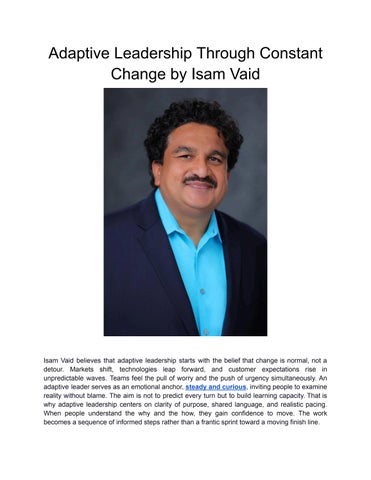
Adaptive Leadership Through Constant Change by Isam Vaid

Isam Vaid believes that adaptive leadership starts with the belief that change is normal, not a detour Markets shift, technologies leap forward, and customer expectations rise in unpredictable waves. Teams feel the pull of worry and the push of urgency simultaneously. An adaptive leader serves as an emotional anchor, steady and curious, inviting people to examine reality without blame. The aim is not to predict every turn but to build learning capacity. That is why adaptive leadership centers on clarity of purpose, shared language, and realistic pacing. When people understand the why and the how, they gain confidence to move The work becomes a sequence of informed steps rather than a frantic sprint toward a moving finish line.
Practitioners begin by widening their field of view They look for weak signals hiding in customer stories, frontline metrics, and hallway conversations where candor surfaces first. They study patterns rather than chase isolated events Listening is treated as analysis, not courtesy Questions like What surprised you this week invite context before conclusions harden. Adaptive leaders frame issues as tensions to navigate rather than problems to fix once and for all. This stance reduces false certainty and invites experimentation It also helps people separate technical tasks from adaptive challenges that require shifts in beliefs, habits, and relationships. By naming the difference, leaders set more honest expectations about pace, risk, and support

Healthy adaptation depends on learning loops that move quickly but thoughtfully A team sets a clear outcome, chooses the smallest test that could prove or disprove an idea, and defines the evidence that will count as progress Pilots run in short cycles, so adjustments happen before costs grow Retrospectives are structured to surface insights without shaming anyone for trying When experiments succeed, they scale with discipline. When they fail, the learning is harvested and archived so others do not repeat the same path This rhythm of test, reflect, decide builds confidence. Over time, it becomes a muscle that keeps the organization responsive without losing its sense of direction
Communication gives this approach its heartbeat People can carry uncertainty if the narrative is honest and the cadence is reliable. Adaptive leaders speak in plain language that explains why a shift matters and how it will be measured They repeat key messages across channels, so meaning does not depend on a single meeting. They invite dissent early and reward it when it sharpens the plan. Updates include what is known, what remains unknown, and what happens next This simple structure converts anxiety into movement It also protects attention When priorities are stated clearly and often, teams can say no to noise and yes to the work that advances outcomes

Decision quality improves when authority sits closer to the work. Adaptive leadership decentralizes within clear guardrails Teams receive a shared purpose, measurable outcomes, and boundaries on risk. Inside that frame, they choose tactics and timing. Leaders scan for interdependencies, unblock resources, and keep standards visible This model honors expertise and accelerates response time It also raises accountability because choices belong to the people who make them. Over time, the organization shifts from permission-seeking to principle-guided action Momentum increases, not through pressure, but through ownership The signal to the market is speed with judgment, a combination that builds trust with customers and partners.
Adaptive leaders invest in the human side with intention Change can feel like loss, even when the outcome is positive. People need space to name what they are letting go of, and they need proof that the future is worth it Coaching, peer support, and visible recognition reduce fatigue Leaders model self-care, ask for feedback, and share what they are learning. They celebrate progress in ways that feel genuine, not performative. These practices preserve trust, which is the essential currency when the stakes are high With trust in place, teams take smarter risks and recover faster. Without it, even good strategies stumble because fear steals attention and energy

The result is a culture that treats disruption as a prompt for curiosity Teams become skilled at scanning horizons, testing ideas, and aligning around outcomes Customers notice responsiveness and reward it with loyalty. Investors notice steadiness of execution and reward it with patience Most of all, employees see that their voices matter and that their work creates visible value. Adaptive leadership turns change from a chronic threat into a renewable source of advantage It guides teams through uncertainty with strength and insight, translating vision into practical steps that people can follow In a world defined by motion, that steady, human clarity is the strongest strategy of all.