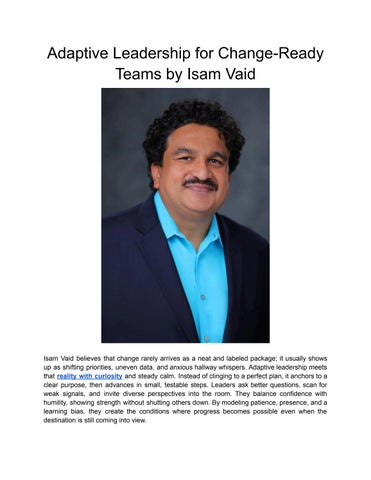
Adaptive Leadership for Change-Ready Teams by Isam Vaid

Isam Vaid believes that change rarely arrives as a neat and labeled package; it usually shows up as shifting priorities, uneven data, and anxious hallway whispers Adaptive leadership meets that reality with curiosity and steady calm. Instead of clinging to a perfect plan, it anchors to a clear purpose, then advances in small, testable steps Leaders ask better questions, scan for weak signals, and invite diverse perspectives into the room They balance confidence with humility, showing strength without shutting others down. By modeling patience, presence, and a learning bias, they create the conditions where progress becomes possible even when the destination is still coming into view
Trust is the first job, and it starts with everyday behavior People follow leaders who listen, keep promises, and make space for honest talk. Adaptive leadership builds psychological safety through visible habits Managers open meetings with quick check-ins, explain decision paths, and thank colleagues who surface risks early. They separate people from problems, so feedback feels like a shared search for truth rather than a personal attack. When trust grows, teams speak sooner, share cleaner data, and rally around shared goals This safe climate turns tension into a clear signal rather than a threat that sends everyone backward.
Clarity is the next pillar. Adaptive leaders translate strategy into plain language and outcomes anyone can recognize They design simple metrics that track learning and results, because insight today becomes momentum tomorrow A weekly review that lists what to keep, what to change, and what to stop creates a living feedback loop. Teams see patterns sooner and waste less energy debating old assumptions Clear roles reduce confusion about who decides and who executes. When complex trade-offs arise, leaders explain their reasoning so that even disappointed stakeholders understand the path.
Speed matters, but only when paired with reflection. Adaptive leadership favors short cycles, pilot projects, and fast feedback, yet speed without pauses creates noise The best teams schedule brief retrospectives, write crisp notes, and share what they learn with the broader group. This rhythm of act, review, and adjust keeps talent engaged. People see that their input changes the plan, which builds ownership and pride Leaders also protect time for deep work as carefully as they celebrate quick wins. By pacing change, the group stays focused enough to move fast and grounded enough to avoid reckless churn

Communication makes or breaks change Adaptive leaders are visible and human They repeat the purpose, restate constraints, and admit when their view has shifted They use stories that connect data to daily life, so numbers feel real and actionable. Updates arrive on a steady drumbeat through channels people already use, and they include the why as well as the what Questions are invited in public forums, not only in side conversations When rumors surface, leaders address them openly and return the group to facts. This reliable cadence reduces drama and keeps attention on the next practical step
Resilience grows when people practice it together. Adaptive leadership invests in cross-training, mentorship, and simple playbooks for anticipated disruptions Teams run tabletop exercises that test response skills before a crisis hits, then refine procedures based on what they discover. Managers check workloads, encourage time off, and model healthy boundaries. They also celebrate effort that leads to learning, not only effort that leads to wins Over time, the group becomes less fragile. People gain confidence that they can handle surprises because they have rehearsed, reflected, and improved as a unit

Finally, adaptive leadership honors values while pursuing results. It treats dignity as nonnegotiable, even during reorganizations or tight deadlines. Leaders offer context, explain criteria, and provide support, including coaching for those absorbing new responsibilities They recognize that people carry private challenges into public work and respond with patience. Kindness is not a luxury; it is a competitive advantage that keeps expertise on the team and strengthens long-term trust When the dust settles and a new normal emerges, the culture remains intact, and the organization is ready for the next chapter of change.