2. MATERIAL AND METHODS
*** Abstract
nutritionaltheirresilienttotransformagricultureanditsalliedsectorsintoclimateandvibrantproductionsystemswhiledevelopingfullpotentialandensuringsustainedfoodandsecurity.
Climatechangethreatens
Investigation of Decadal Changes of Temperature Bihar Region (India) Dr. Shraddha Yadav Dr. Manohar Lal Assistant Professor, Amity University, Noida, U.P. (India) Associate Professor, KSKGRL, Indian Institute of Geomagnetism (Govt. Of India), Prayagraj, U. P. (India) Climate change has influenced rainfall and temperature patterns in specific areas. As a result, it's vital to look into the trend of meteorological variables like temperature in Bihar. Other hydrological processes, such as rainfall, may be influenced by temperature variations, contributing to temperature variability.
To perform a Mann Kendall test, compute the difference betweenthelater measuredvalueandallearlier measured values,(yj yi),wherej>i,andassigntheintegervalueof1,0, or 1 to positive differences, no differences, and negative differences, respectively. The test statistic S, is then computedasthesumoftheintegers: n 1 n Σ Σsign(yi yj)i=1 j=i+1
TheMann Kendall test, isa non parametricapproach,has beenwidelyusedfordetectionoftrendindifferentfieldsof researchincludinghydrologyandclimatology.Itisusedfor identifying trends in time series data. If the data do not confirmtoanormaldistribution,the[15]testcanbeapplied.
1,
2 1
In this study, the observed annual/seasonal January February(J F),March April May(MAM),June July August September (JJAS), October November December (OND) Centre,0.25°,temperatureareused.Dailygriddedrainfalldataset(0.25°×latitude×longitude)procuredfromNationalDataIndianMeteorologicalDepartment(IMD),Pune.
2
The objective for the present analysis was to identifytrends in long and short term change amount of temperature in Bihar region at various spatial scales. It examines the impact of variousshort(1954annualhistoricalspatiotemporalvariabilityofTemperatureonBiharandseasonaltimeseriesstateovera60yearperiod2013).ThegoalofthisstudywastodeterminelongandtermchangesinrainfallamountsintheBiharregionatspatialscales. Rainfall, Mann Kendall Test, Standardized Anomaly Index, ENSO, Cyclone, Climate Change.
change will affect agricultural production in India [12]. Because of the large spatial and temporal variability in weatherfactorsinIndia,theanalysisofchangesinclimatic variables at a local level represents an important task in detecting the magnitude of climate change, identifying current and future climate risks, and designing risk management interventions. Since decisions about climate changearecomplex,costlyandhavelong termimplications, itisvitalthatsuchdecisionsarebasedonthebestavailable evidence [13]. Bihar is one of the most climate sensitive states in India due to its geographical setting, hydro meteorological uncertainties, dense rural population and high level of poverty [14]. The State Government of Bihar acknowledges that climate change is one of the major challengesofagricultureinthestate,anditsoverallstrategy is
International Research Journal of Engineering and Technology (IRJET) e ISSN: 2395 0056 Volume: 09 Issue: 01 | Jan 2022 www.irjet.net p ISSN: 2395 0072 © 2022, IRJET | Impact Factor value: 7.529 | ISO 9001:2008 Certified Journal | Page284
2.1 Mann Kendall Trend Analysis
sustainabledevelopmentinSouth Asiagiventhepotentialvulnerabilityassociatedwithhigh population density, poverty, and limited resources for adaptation. Climate change is, thereby, set to cause huge economic, social, and environmental damage across the region, compromising growth potential and poverty reductionefforts[1].Agricultureisextremelyvulnerable,as any change in climate influences crop growth and yield, hydrologic balances, supplies of inputs and other management practices [2]. Climate change effects on agriculturearemanifold:changesinaveragetemperatures, rainfall, and weather extremes; changes in pests and diseases conditions; changes in the nutritional quality of foods;andchangesinsealevel,amongothers[3,4].Higher temperatures shorten crop cycles by inducing early flowering and shortening the grain filling period, thereby reducing yield per unit area [5]. High day and night time temperaturesaresettobecomemorecommoninthenear futureandrepresentatremendousenvironmentalhurdleto global food production and food security [6 8]. Future climaticvariabilitywillalsoleadtomorefrequentextremes ofweatherintheformof erraticmonsoonsandincreased uncertaintieslocationimpactsAlthoughaffectingfrequencyandintensityofdroughtandflooding[9],therebybothrainfedandirrigatedproductionssystems.climatechangehasoccurredonaglobalscale,itsoftenvaryfromregiontoregion[10]andevenfromtolocation[11].Moreover,considerableremainastowhen,whereandhowclimate
Keywords:
over
1. INTRODUCTION

Thepresenceofastatisticallysignificanttrendisevaluated usingthe Z value.Apositive(negative)valueof Z indicates anupward(downward)trend.Thestatistic Z hasanormal distribution. To test for either an upward or a downward monotonetrend(atwo tailedtest)atαlevelofsignificance, H0 isrejectediftheabsolutevalueof Z isgreaterthanZ1 α/2, where Z1 α/2 is obtained from the standard normal cumulativedistributiontables. 2.2 Sen’s slope estimator test
TheSen’sestimatorpredictsthemagnitudeoftrend.Here, the slope (Ti) of all data pairs is computed as [16] The estimate for the magnitude of the slope of trend b is calculatedusingnon parametricSen’smethod,whichisthe medianofslopesofalldatavaluepairs. b=median[Xj Xi/j i]foralli<j..… Eqn(2) where b istheslopebetweendatapointsXjandXimeasured attimesjandirespectively.
3. RESULTS AND DISCUSSIONS 3.1 Mann Kendall Trend Analysis of Temperature over Bihar Region For the state of Bihar, minimum temperature showed decreasing( 0.006)trendinwinterseasonfortheperiodof 1954 2013(SeeTable1).Fortheperiodof1954 2013, Table 1: Mann Kendall Trend analysis of temperature data Bihar (1954 2013) 1954 2013 Min Temp. Max Temp. Annual/Seasonal ZTest Significance Q ZTest Significance Q JF 1.10 0.006 1.42 0.008 MAM 1.71 + 0.009 1.83 + 0.013 JJAS 2.08 * 0.008 1.97 * 0.008 OND 0.64 0.004 1.44 0.006 ANNUAL 1.38 0.005 0.19 0.0006
International Research Journal of Engineering and Technology (IRJET) e ISSN: 2395 0056 Volume: 09 Issue: 01 | Jan 2022 www.irjet.net p ISSN: 2395 0072 © 2022, IRJET | Impact Factor value: 7.529 | ISO 9001:2008 Certified Journal | Page285 Where sign (yi yj), is equal to +1, 0, or 1 as indicated above.When S is a large positive number, later measured valuestendtobelargerthanearliervaluesandanupward trendisindicated.WhenSisalargenegativenumber,later values tend to be smaller than earlier values and a downward trend is indicated. Where xi and xj the annual valuesinyears i and j,i>j,respectively,and 1 ifxi xj>0 sign(yi yj)={0 ifxi xj=0 1 ifxi xj<0 It has been documented that when n ≥ 8, the statistic S is approximatelynormallydistributedwiththemean. TheE(s)=0variancestatisticisgivenas Var(s)=[n(nq 1)(2n+5) Σtp(tp 1)(2tp+5)] P=1 /18…….Eqn(1) Here q isthenumberoftiedgroupsand tp isthenumberof datavaluesinthe Pth group. The values of S and VAR(S) are used to compute the test statistic Z asfollows S 1/[Var(s)]1/2 ifS>0 Z={0 ifS=0 S+1/[Var(s)]1/2 ifS<0
International Research Journal of Engineering and Technology (IRJET) e ISSN: 2395 0056 Volume: 09 Issue: 01 | Jan 2022 www.irjet.net p ISSN: 2395 0072 © 2022, IRJET | Impact Factor value: 7.529 | ISO 9001:2008 Certified Journal | Page286 * Statistically significant at 0.05 level. + Statistically significant 0.1 level significantincreasingminimumandmaximumtemperatureshowsdecreasingand(0.008and+0.008)trendandstatistically(0.05level)formonsoonseason(Subhash et.al, 2010). 3.2 Results of decadal Variation in Temperature of Bihar
hotter than usual. The average water temperature in that area is typically between 1 and 3°C (approximately 2 and 5°F)warmerthannormalduringthisevent.Thiswarming adds huge amounts of heat and moisture into the
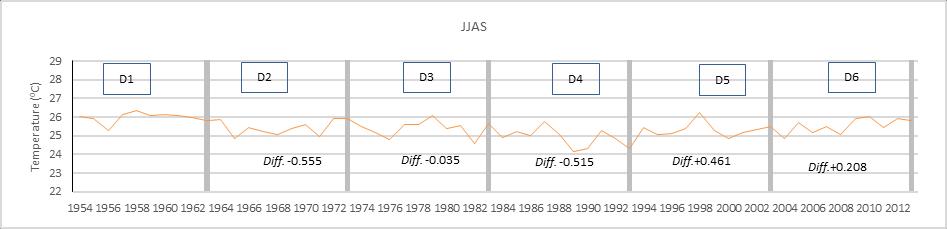
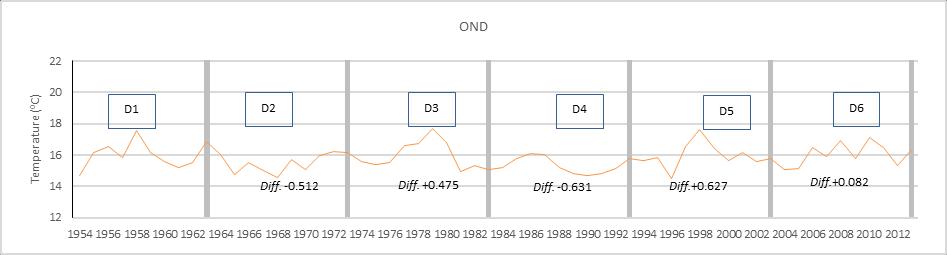
In the recent decade, seasonal and annual values of maximumtemperatureincreasedfortheStateofBihar.In monsoonseason,maximumtemperatureincreasedat0.6°C /decadeindecadeVI,incomparisontodecadeV(shownin figure 1). Temperature increase may be due to El Niño events[17]observed13droughtyearsintheperiod1901 2009, for ISMR region during monsoon season. Due to changes in the ocean climate and temperatures, there is warmwateracrossthePacificOcean;boththeseasurface seaandthethermoclineflattenthroughout,andparticularlythesurfaceinthecentralandeasternPacificOceanbecomes
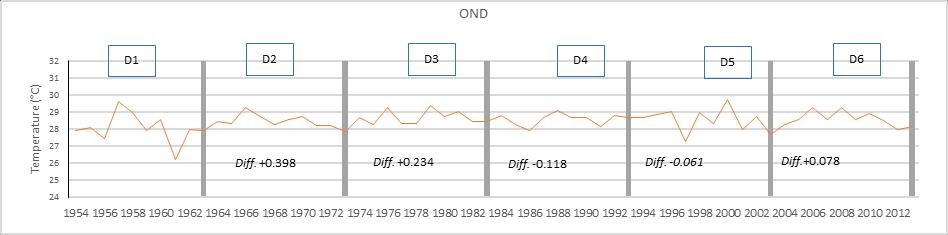
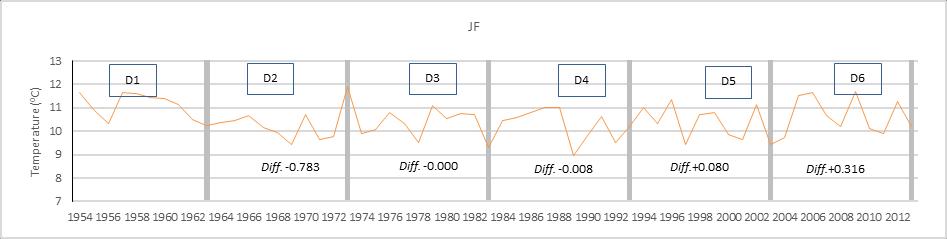
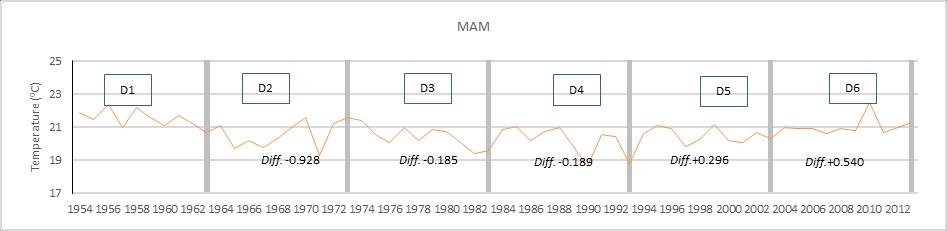
(showntemperature,decadecontrast,excessshouldenergyproportionaldecreased(1984temperatureminimumsometiwhileglobally.andatmosphere,ultimatelyaffectingthepatternsofairpressurerainfallacrossthePacificandeventuallyspreadingAsaresult,thewesternPacificexperiencedroughts,theeastexperienceheavyresultantprecipitationandmesevenfloodsconditionobserved[18].Theannualtemperaturedatashowedmaximumdecreaseinofapproximately3°C/decadeindecadeIV1993),incomparisontodecadeIII.ItmaybeduetoSSNinthisdecade(IV),asSSNisdirectlytotemperature.Moresunspotsdelivermoretotheatmosphere,sothatglobaltemperaturesrise[19].Thisindicatescoolerwinterseasonduetorainfalleventobservedinyear1984and1994.InrelativelylesscoolwinterseasonwasobservedinV(19942003)withamajorincreaseintheminimumapproximatelyattherateof0.008°C/decadeinfigure2).
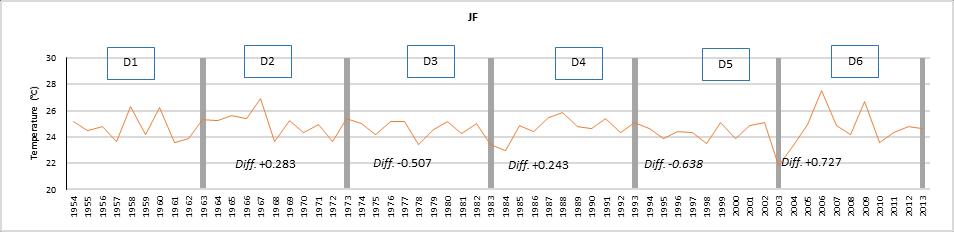
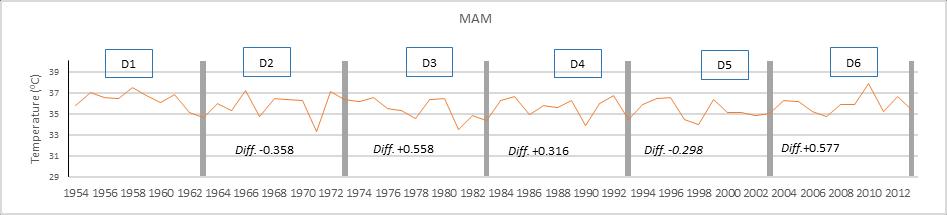
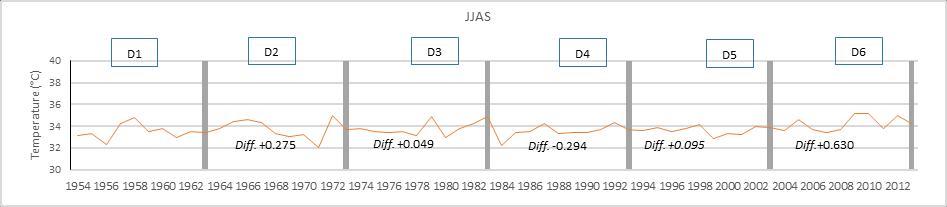
International Research Journal of Engineering and Technology (IRJET) e ISSN: 2395 0056 Volume: 09 Issue: 01 | Jan 2022 www.irjet.net p ISSN: 2395 0072 © 2022, IRJET | Impact Factor value: 7.529 | ISO 9001:2008 Certified Journal | Page287 Fig 1: Decadal variation (JF, AM, JJAS, OND) of maximum temperature in Bihar Fig 2: Decadal variation (JF, MAM, JJAS, OND) of minimum temperature in Bihar
[6] D.B. Lobell, W. Schlenker, J. Costa Roberts, “Climate trendsandglobalcropproductionsince1980”.Science 2011,333,616 620. [7] J.E.Cairns,K.Sonder,P.H.Zaidi,N.Verhulst,G.Mahuku, R. Babu, S.K. Nair, B. Das, B. Govaerts, M.T. Vinayan, “Maize production in a changing climate: Impacts, adaptation,andmitigationstrategies”.Adv.Agron.2012, 114,1 57.
[9] R.K. Randhawa, H. Singh, M.S. Kang, “Global warming and its possible impact on agriculture in India”. Adv. Agron.123,65 121,2014.
Januclimatehttp://blogs.worldbank.org/climatechange/whyonline:aredataandevidenceimportant(accessedon14ary)2016.
[15] M.G. Kendall,“Rank Correlation Methods”, 4th edition, London:CharlesGriffin,1975. [16] P.K.Sen,“Estimatesoftheregressioncoefficientbased on Kendall’s tau”, Journal of American Statistical Association39,pp.1379 1389,1968.
International Research Journal of Engineering and Technology (IRJET) e ISSN: 2395 0056 Volume: 09 Issue: 01 | Jan 2022 www.irjet.net p ISSN: 2395 0072 © 2022, IRJET | Impact Factor value: 7.529 | ISO 9001:2008 Certified Journal | Page288 4. CONCLUSION
REFERENCES
[8] Y. Hijioka, E. Lin, J.J. Pereira, R. T. Corlett, X. Cui, G. Insarov, R. Lasco, E.Lindgren, S. Akhilesh, “In Climate Change: Impacts, Adaptation, and Vulnerability”. Fifth Assessment Report of the Intergovernmental Panel .Eds.;CambridgeUniversityPress:Cambridge,UK;New York,NY,USA;pp.1327 1370,2014.
[12] M. Lal, “Implications of climate change in sustained agricultural productivity in South Asia”. Reg. Environ. Change.11,79 94,2011
[13] V. Pope, “Why Are Climate Data and Evidence Important”? Available
JanuaryStateActionPlanonClimateChange(2).pdfhttp://www.moef.gov.in/sites/default/files/Biharonline:(accessedon7)2016.
[11] G. Hadgu, K. Tesfaye, G. Mamo, “Analysis of climate change in Northern Ethiopia: Implications for agricultural production”. Theor. Appl. Climatol. 2014, 117,733 747,2014.
[3] I.Niang,O.C.Ruppel,M.A. Abdrabo,A.Essel,C.Lennard, J.Padgham,P.Urquhart,P.Africa,“InClimateChange: Impacts,Adaptation,andVulnerability”.PartB:Regional Aspects;ContributionofWorkingGroupIItotheFifth AssessmentReportoftheIntergovernmentalPanelon ClimateChange,2014. [4] J.R. Porter, L. Xie, A.J. Challinor, K. Cochrane, S.M. Howden, M.M. Iqbal, D.B. Lobell, M.I. Travasso, “Food Security and Food Production Systems’’ Fifth AssessmentReportoftheIntergovernmentalPanelon ClimateChange,2014. [5] N.Chattopadhyay,“Climatechangeandfoodsecurityin India”. In Climate Change and Food Security in South Eds.;Springe:Berlin,Germany,2011;pp.129 251.
[18] F.Fiondella,“TopMisconceptionsaboutElNiñoandLa Niña”,TheEarthInstitute,ColumbiaUniversity,2009 [19] V.Reddy,P.R.Reddy,“Impactduetosunspotactivityon climate change: some salient results”, Article in InternationalJournalofEarthSciencesandEngineering. Vol.09.No.1,pp.1 5,2016
[10] S.Trajkovic,S.Kolakovic,”Wind adjustedTurcequation for estimating reference evapotranspiration at humid Europeanlocations”.Hydrol.Res.,40,45 52,2009
[14] GOB State Action Plan on Climate Change: Building Resilience through Development. Available
In the recent decade, seasonal and annual values of maximumtemperatureforStateofBiharwereobservedto increase. In monsoon season, maximum temperature increased at 0.6°C/decade in decade VI in comparison to decadeV.Theannualminimumtemperaturedatashowed maximum decrease in temperature of approximately 3°C/decade in decade IV (1984 1993), in comparison to decadeIII.Thisindicatescoolerwinterseasonduetoexcess rainfalleventobservedinyear1984and1990.Incontrast, relativelylesscoolwinterseasonwasobservedindecadeV (1994 2003) with a major increase in the minimum temperature,approximatelyattherateof0.008°C/decade. Inpost dueyearanomalycomparisonmaximummonsoonseason,theminimumtemperatureshoweddecrease(0.6°C/decade)indecadeIV,intodecadeIII.Inmonsoonseason,maximumwasseentobepositiveinyear2009(+2.0°C)andin2010(+2.1°C).MaximumtemperaturewasincreasedtoElNiñoevent(2009,2010).
[1] M. Ahmed, S. Suphachalasai, “Assessing the Costs of Climate Change and Adaptation in South Asia; Asian DevelopmentBank:Mandaluyong,Philippines,2014. [2] J. Knox, T. Hess, A. Daccache, T. Wheeler, “Climate changeimpactsoncropproductivityinAfricaandSouth Asia”.Environ.Res.Lett.2012,7,034032.[CrossRef].
[17] H. Varikoden, J.V. Revadekar, Y. Choudhary,and B. Preethi, “Droughts of Indian summer monsoon associated with El Niño and Non El Niño years”, Int.ernationalJournalofClimatology,35,pp.1916 1925, 2014