IRJET- Health Emergency System with Smart Traffic Management

Page 1

International Research Journal of Engineering and Technology (IRJET)

e-ISSN: 2395-0056

Volume: 08 Issue: 03 | Mar 2021

p-ISSN: 2395-0072

www.irjet.net

Health Emergency System with Smart Traffic Management Akash Samtani1, Dhanraj Nimbalkar2, Hrithik Bagane3, Manan Shah4, Niyati Khandelwal5, Sanjesh Pawale6 1-5Student,

Dept. of Computer Engineering, Vishwakarma University, Maharashtra, India Professor, Dept. of Computer Engineering, Vishwakarma University, Maharashtra, India ---------------------------------------------------------------------***--------------------------------------------------------------------2. SYSTEM OVERVIEW Abstract - Often, there is loss of lives due to delayed arrival 6Asst.

of ambulances to either the place of emergency or the hospital. The purpose of our Internet of Things (IoT) and cloud-based project is to create a system that will enable any smartphone user who faces a medical emergency to quickly get to a nearby hospital by way of signal manipulation on the path. The user would not be required to wait for the ambulance. In our proposed system, the patient or the user with the patient would have to send an emergency request using our mobile application to a respective hospital. An authorized person will accept or reject the patient's request based on the hospital's current situation on the hospital end. On acceptance of a request, the system would use the user's real-time GPS to track the user's vehicle's location and this would be constantly updated to the cloud, which will, in turn, manipulate the signals that are on the way of the patient to the hospital.

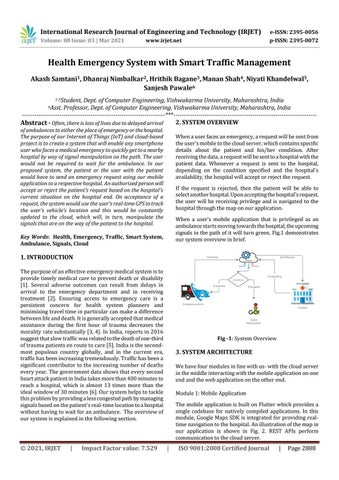
When a user faces an emergency, a request will be sent from the user's mobile to the cloud server, which contains specific details about the patient and his/her condition. After receiving the data, a request will be sent to a hospital with the patient data. Whenever a request is sent to the hospital, depending on the condition specified and the hospital's availability, the hospital will accept or reject the request. If the request is rejected, then the patient will be able to select another hospital. Upon accepting the hospital's request, the user will be receiving privilege and is navigated to the hospital through the map on our application. When a user’s mobile application that is privileged as an ambulance starts moving towards the hospital, the upcoming signals in the path of it will turn green. Fig.1 demonstrates our system overview in brief.

Key Words: Health, Emergency, Traffic, Smart System, Ambulance, Signals, Cloud

1. INTRODUCTION The purpose of an effective emergency medical system is to provide timely medical care to prevent death or disability [1]. Several adverse outcomes can result from delays in arrival to the emergency department and in receiving treatment [2]. Ensuring access to emergency care is a persistent concern for health system planners and minimizing travel time in particular can make a difference between life and death. It is generally accepted that medical assistance during the first hour of trauma decreases the morality rate substantially [3, 4]. In India, reports in 2016 suggest that slow traffic was related to the death of one-third of trauma patients en route to care [5]. India is the secondmost populous country globally, and in the current era, traffic has been increasing tremendously. Traffic has been a significant contributor to the increasing number of deaths every year. The government data shows that every second heart attack patient in India takes more than 400 minutes to reach a hospital, which is almost 13 times more than the ideal window of 30 minutes [6]. Our system helps to tackle this problem by providing a less congested path by managing signals based on the patient's real-time location to a hospital without having to wait for an ambulance. The overview of our system is explained in the following section.

© 2021, IRJET

|

Impact Factor value: 7.529

Fig -1: System Overview

3. SYSTEM ARCHITECTURE We have four modules in line with us- with the cloud server in the middle interacting with the mobile application on one end and the web application on the other end. Module 1: Mobile Application The mobile application is built on Flutter which provides a single codebase for natively compiled applications. In this module, Google Maps SDK is integrated for providing realtime navigation to the hospital. An illustration of the map in our application is shown in Fig. 2. REST APIs perform communication to the cloud server.

|

ISO 9001:2008 Certified Journal

|

Page 2888


Turn static files into dynamic content formats.
Create a flipbook
Issuu converts static files into: digital portfolios, online yearbooks, online catalogs, digital photo albums and more. Sign up and create your flipbook.