International Research Journal of Engineering and Technology (IRJET)
e-ISSN: 2395-0056
Volume: 08 Issue: 03 | Mar 2021
p-ISSN: 2395-0072
www.irjet.net
AN ANALYSIS OF BRAKING ENERGY REGENERATION IN VEHICLE PROF. S. L. BANKAR1, TEJAS THAKARE2, SARANG SOMANI3, UTSAV BORSARE4 1Associate
Professor, Department of Mechanical Engineering, Yeshwantrao Chavan College of Engineering, Nagpur, 441110 2,3,4Student, Department of Mechanical Engineering, Yeshwantrao Chavan College of Engineering, Nagpur, 441110 ---------------------------------------------------------------------***---------------------------------------------------------------------The energy so produced can then be stored as Abstract - Climate change is the severe concerns for our mechanical energy in flywheels or as electrical energy generation and for upcoming generation. We are heading towards more polluted, unhealthy environment. The use of in the automobile battery which can be used again. This vehicle is drastically increasing day by day but the storage of system helps to improve overall performance of natural resources is drastically decreasing. It is need of a time vehicle. There are multiple methods of energy to save these natural resources as much as possible. In conversion in RBSs including electric motor, flywheel, automobiles, energy is lost due friction in breaks in form of electromagnetic and hydraulic. heat. As the first law of thermodynamics states that “Energy is always conserved, it cannot be created or destroyed, it can be converted from one form to another”. We are going to discuss the Regenerative Braking System (RBS) in this paper. Regenerative braking is an energy recovery mechanism that slows a vehicle or object by converting its Kinetic Energy (K.E) into a form which will be either used immediately or stored until needed.
2. REGENERATIVE BRAKING SYSTEM (RBS) The main aim is to study existing regenerative braking system and to discover best system that is efficient, less bulky so as to increase performance and efficiency of vehicle. System used in vehicle is known as hybrid vehicle or electric vehicle. The use of hybrid vehicle is widely available since 1997 in Japan and vehicle was Toyota Prius followed by Honda Insight in 1999. But the Baku-Tbilisi-Batumi started applying RBS in railways in early 1930s. In 1967 American Motor Car company (AMC) created an electrical energy regeneration brake for their concept electric car, the AMC Amitron. Toyota was the first car manufacturer to commercialize RBS technology in their Prius series hybrid car. Since then, RBSs have to be used in almost all electric and hybrid cars as well as some gas-powered vehicles.
Key Words: Regenerative Braking, Hybrid vehicles, Kinetic energy recovery system (K.E.R.S.), Flywheel, Motor, Hydraulic Power Assist.
1. INTRODUCTION A ‘brake’ is a mechanical device that inhibits motion by absorbing energy from a moving system. It is used for slowing or stopping a moving vehicle, wheel, axle, or to prevent its motion, most often accomplished by means of friction. In conventional braking systems, friction is used to counteract the forward momentum of a moving vehicle. When the brake applies pads rub against the wheels or a disc that is connected to the axles, excessive heat energy is created. Due to friction this energy dissipates into the air in the form of heat, wasting as much as 30 percent of the vehicle's generated power. Over the time, this cycle of friction and wasted heat energy reduces the vehicle's fuel efficiency.
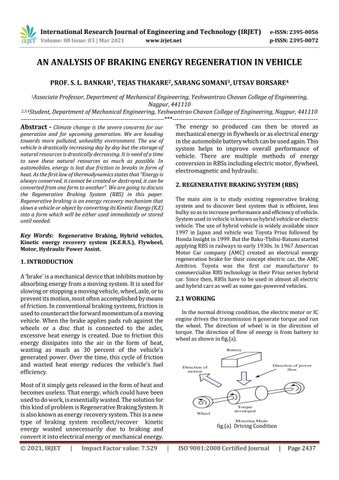
2.1 WORKING In the normal driving condition, the electric motor or IC engine drives the transmission it generate torque and run the wheel. The direction of wheel is in the direction of torque. The direction of flow of energy is from battery to wheel as shown in fig.(a).
Most of it simply gets released in the form of heat and becomes useless. That energy, which could have been used to do work, is essentially wasted. The solution for this kind of problem is Regenerative Braking System. It is also known as energy recovery system. This is a new type of braking system recollect/recover kinetic energy wasted unnecessarily due to braking and convert it into electrical energy or mechanical energy. © 2021, IRJET
|
Impact Factor value: 7.529
fig.(a) Driving Condition
|
ISO 9001:2008 Certified Journal
|
Page 2437