International Research Journal of Engineering and Technology (IRJET) e ISSN: 2395 0056 Volume: 08 Issue: 12 | Dec 2021 www.irjet.net p ISSN: 2395 0072 © 2021, IRJET | Impact Factor value: 7.529 | ISO 9001:2008 Certified Journal | Page1684 Sentiment Analysis of Code Mixed Text Ritu Pawar1, Swapna Salunkhe2 , Shilpa Dhongdi3 , Vaibhav Waghamare4, Prof. Tushar A. Rane5 1,2,3,4Dept. Information Technology, SCTR'S Pune Institute of Computer Technology, Pune, Maharashtra, India, 5Assistant Professor, Dept. Information Technology, SCTR'S Pune Institute of Computer Technology, Pune, Maharashtra, India *** Abstract In this covid 19 pandemic there is the huge categories.normalizingtechniquesvariouswithreviewsmultiplewhichtorequirednewlyopinionsuchbecomecommunicationpeopleinclinationtowardsnetworkingsitesandsocialmediaasnowcannotgatherthereforetheonlymodeofisviadigitaltechnology.Duetothisithasloteasierforgovernmentaswellasvariousindustriesastelemarketing,commercialetctoanalyzetheofpeopletowardsanysocialissuesorreviewsforanylaunchedproducts,onwhichtheycanfurthertaketheactions.However,todoso,therespectivebodyneededdecryptthecontentwhichisbeingpostedbythepeopleisusuallyinformofmixedcomplicatedcombinationoflanguage.NowadayspeopleposttheiropinionsandgenerallyinthecombinationofRomanizedEnglishtheirownmothertongue.InthispaperwestudiedMachineLearningapproachesandproposedefficienttoidentifythesentimentofthetextafterandpredictedthosesentimentsinvarious Key Words: Machine learning, Sentiments, Romanized English, Reviews, Code-mixed 1.INTRODUCTION With the progression of innovation and less expensive correspondenceCodewhile2002).intolikeCodeframeworksdiscoursejuxtapositionexchangingcomposingThisfeelingsthesecoAssociationsbuildingOnlinetheoverview,isaccessibilityofelectronicdevices,prettymucheveryhumancarefullyassociatedthroughSocialmedia.Also,asperthethecompletetimespentviawebbasedmediainworldacrossPCandcellphonesexpandedby83%Mediahasgonepastbasicallyfriendlysharingtonotorietyandacquiringvocationopenings.areutilizingwebbasedmediaasadevicetomprehendtheirclients,itemsandadministrationsandauditsarenotjustrestrictedinonelanguage.Thesearebestowedinacombinationofdialects.patternofblendingtwodialectsintalkingandhaspromptedinstitutingoftwoterms:codeandcodemixingwhereCodeSwitchingis"theinsidethesamediscoursetradeofsectionsofhavingaplacewithtwouniquelinguisticorsubframeworks"(Gumperz1982),andMixingalludestotheinsertingofetymologicalunitsexpressions,wordsandmorphemesofonelanguageanexpressionofanotherdialect(MyersScotton1993,Hence,CodeSwitchingisnormallybetweensentencesCodeMixing(CM)isanintrasententialpeculiarity.exchangingisgenerallyfoundduringcasuallikewebsites,tweetsandposts. In Indian Online media, we found blending of Hindi and English language. Language variety triggers Indians to habituallychangealso,blenddialects.Thispeculiarity of code blending has been seen by bilingual speakers from metropolitan urban areas where the individual talks in English at the work spot and Hindi or other Indian qualilikewiselanguagethistheWordsCodethis:basedinwouldSentimentofrepresentarticulationfindareTheetymolClients(forafindwordslanguagewordsblendextremelyHinglishToday,exchangesbetweenadditionalatheyarewLanguagesathishome.Furthermore,theotherexplanation,hyindividualsblendtwodialectswhiletalkingisthattheynotreallyfamiliarwiththeirnativelanguagedialectsorhaveagreatelyimprovedandlesscomplexsubstituteofwordintheEnglishlanguage.Presentlyadays,welytrackdownahighmeasureofcodeblendingHindiEnglishlanguageinBollywoodfilmandmelodyverses.practicallywellknownbollywoodmelodieshaveverses.Itmakesthemelodiesappealingandengagingandthecrowdslovethem.ThiscodescriptiswritteninRomanlettersinorder.Here,thefromonelanguagearephoneticallywritteninotherutilizingRomancontent.Thesephoneticallyspelleddon'thaveastandardspelling;soforeachwordweafewspellings.ThetextaccessibleonSocialmediahasgreatdealofdeviationsfromthestandardorthography,example,Wordplay,Creativespellingsandsoon)utilizenonstandardcontractionsandnonogicalsounds.attributesofthelanguageviewedasononlinemediaportrayedbyDanetandHerring,2007.Weadditionallyatonofutilizationof"smileys",whichpackanintooneorhardlyanysymbols.Theserealitiesasignificantchallengeinrecognizingthelanguagethetext,InformationExtraction,MachineTranslationandAnalysis.AnillustrationofanassertioninEnglishbe:"Sibling,youareincredible!"AsimilarassertionunadulteratedHindiwouldbe:","Nonetheless,viawebmedia,suchaproclamationwouldbecomposedlike"Bhai,tuextraordinaryhai!"Thisisanexampleofblend.Theassertionisacombinationoftwodialects.Bhai,tu,haihaveaplacewiththeHindilanguageandwordincrediblehasaplacewithEnglishlanguage.Inexaminationwehavezeroedinonrecognizingtheofcodeblendscript(EnglishandHindi)whichincludedtakingcareofthedifferentrelatedtiesofcodeblend.

International Research Journal of Engineering and Technology (IRJET) e ISSN: 2395 0056 Volume: 08 Issue: 12 | Dec 2021 www.irjet.net p ISSN: 2395 0072 © 2021, IRJET | Impact Factor value: 7.529 | ISO 9001:2008 Certified Journal | Page1685 2. LITERATURE SURVEY Shashank et al. (Dec,2015) in a paper sentiment analysis code mix script had done analysis of Hindi and English mixedlanguagesinceHindiismostlycombinedwithEnglish classify80%soSince(combinationlexicon,analysiscorpusdictionarysystemlanguage[8].Authorproposedapproachinwhichtheydividedinto2parts.FirstlanguageidentificationwithEnglishandtoidentifyHindiwordstheyusedtokenfromofHindilyrics.Insecondparttheydonesentimentofsentenceusing3sentimentresourcesOpinionAFINN(affectivelexicon)andlastlyWordNetofdictionaryandcontains155287words).WordNetwasgivingbetterresultscomparedtootherstheyusedWordNetAPI.Inthatapproachtheyobtainedaccuracy.However,inthisapproachtheyfailedtosomeofsentence.Fore.g. “Movieitneachchenailagi, bhai!!finehaibus.”Isnegativesentencebutthewords“fine” “achche”ispositivesotheresultgivenbysystemispositive. Sreelakshmi k, Premjith B, Soman K.P(April,2020), conducted research to detect hate speech text in Hindi English code mixed data using various machine learning models.The proposed methodology makes use of Facebook’swordembeddingpre trainedlibrary,fastTextto represent across 10000 samples of data collected from varioussourcesasnon hateandhate.Thestudyprovides aninsighttoresearchersworkinginthisfieldofcode mixed datathatthebestresultisbeingprovidedatthecharacter level.Theperformanceof theproposedsystemiscompared withdoc2vecandword2vecanditisbeingobservedthat fastTextfeaturesgivesbetterrepresentationwithSVM RBF classifier.Thusthestudyconfirmsthatproposedapproach hasperformedwellcompared to allexistingworkdonein this area but in future it could be extended to finer classification according to the percent of hate speech detectedandthisapproachcouldbeusedinclassificationof sentimentsdependsonthehate speech,ifitcontains itmoreoffensivewordthatcouldbeclassifiedasnegativeelsecouldbepositivesentiment.
Abinash Tripathy et al. (May,2015) proposed that sentiment analysis is the most well known branch of criticismsentimentalmethodsNaiveproposedofauthornaturallanguageprocessing.Toidentifytheintentionoftheitdealswiththetextclassificationoftext.Theaimisappreciation(positive)orcriticism(Negative)type.TheworkalsoshownaevolutionanalysisofresultsgainingthroughclassificationmethodsBayesandSupportVectorMachine.Theseclassificationwereusedforclassificationintensioninareviewhavingeitheraappreciation(positive)or(Negative)review.
Machine learning approach uses supervised, semi supervisedorunsupervisedlearningtoconstructamodel from a large training corpus. As for this approaches, supervisedlearningtechniques havebeenthemostwidely used in manysentiment analysis tasks.It makes use of a trainingcorpustolearnacertainclassifierfunction.Using supervisedalgorithmstheefficiencyofsentimentanalysis systems depends on the combination of appropriate algorithmstogetherwithasetofappropriatefeatures.
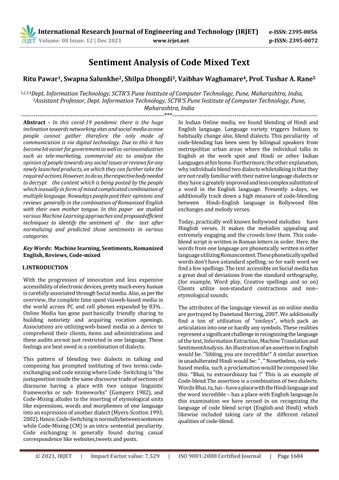
worthwhilesuitable.aregardingmaydaimplement,approachesthoughtreatdatasettotrainaclassifier.Mostmachinelearningmethodssentimentanalysisasasupervisedlearningproblem,recentmethodshaveexploredsemisupervisedaswell.Unsupervisedapproachesaredifficulttobecausetheyrequireahugeamountoftrainingtatobeforaccuracy.Furthermore,unsupervisedmethodsnotalwaysmatchupwithhumanconclusionsthegiventext.Consideringsentimentanalysisasclassificationproblem,supervisedtechniquesaremoreButavailabilityofplentyofunlabeleddatamakesittoperuseunsupervisedmethodsaswell.Fig1:Architecturediagram
usingtwitterdatasetthatwerealreadylabelled.Furtherthe andinaccuracywascalculatedandtherewasimprovementof1.7%thatwhenthesemanticanalysisWorldNetwasfolloweduptakingitto89.9%from88.2%.
Machine Learning techniques uses a labelled training
Kaur, Harpreet, Veenu Mangat, and Nidhi Krail (May,2017) conducted a on Sentiment analysis of the “Hinglish”textusingthedictionarybased techniquewhich wasproposedin[3].Moviereviewdatasetin“Hinglish”was collected for analyzing sentiment. The authors here prepared two dictionaries: one is for English data, and anotherisforHindidatawhichhastheabilityofhandling word variations and also are case insensitive. Tf idf technique was used along with unigram, bigram and trigram for feature extraction, For sentiment classification, Naïve Bayes, SVM, Logistic regression and NeuralNetworkalgorithms were used foridentification ofbestsfeaturesetandalsotheclassifierfor“Hinglish”text. GeetikaGautametal.(sept,2014) Intheresearchworkof a set of techniques with semantic analysis of machine workwaslearningtoclassifythesentenceandreviewsofproductthatbasedontwitterdata[4].Themainaimoftheresearchwastoanalyzeabigamountofreviews(Twitters)by
3. 1]TECHNIQUESMACHINELEARNING APPROACH
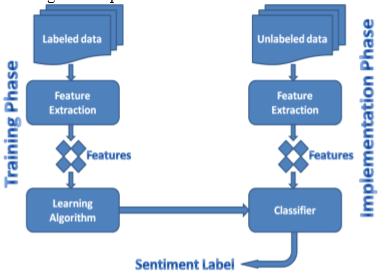
The working of the system is broadly divided into followingsections:
(KNN),
Tolearnthetransformationmatrixfollowedbyrefinement using Procrustes algorithm it uses adversarial learning. Therefore, this approach is independent of any kind supervisedsignalsbetweentwolanguages.
FastTextispopularmethodforlearningwordembeddings.It can create word vector for words absentfromthetrained embedding space, by summingup the character n grams vectors. Therefore, it offer advantages similar to that of subwords.
2]
results.regularrequiresonlyconsiderationThebothnegatives,thenumberwordsDevanagariWordnet.ForHindiwords,theyarefirstconvertedtoHindiandthensentimentpolarityofthoseisdeterminedusingHindiWordnet.Itcountsthetotalofpositiveandnegativelettersinthegiventext.Ifnumberofpositivewordsismorethanthatoftheitwillreturnananswersaspositivesentiment.Ifareequal,itwillthenreturnaneutralsentiment.drawbackofthismethodisthatitdoesnottakeintohowthewordsareblendedinasentence,itlooksatincidents.Itisfasttoimplementbutthemodelalongtermcostoutlayasitusuallyrequiresmaintenancesothatyougetsteadyandenhanced
4. PROPOSED METHODOLOGY
Inthisapproach,weobtainwordrepresentationbytraining word embedding model, like fastText or Glove,on single corpus containing text from both the languages usually formedbyconcatenationofmonolingualcorpus.Withthis formationofasharedvocabularyandallwordsvectorsare in a common vector space is done. Words from the two languages may or maybe not be aligned. Here subword based word embedding models are chosen. To guess the meaningofout of vocabularywords,whichhelpsustohandle obtainedthemisspellingsubwordscausedthelargevocabularyandlargeamountunseenconstructionsbycombininglexiconandsyntaxoftwolanguagesareused.Thereisahugevariationsofspellingandbecausemostofthecodemixedtextbelongstocategoryoftextinglanguage.Properwordvectorsareforevenmisspelledwordsusingsubwords.
3] PSEUDO MULTI LINGUAL
Among the many machine learning algorithms Nearest Neighbors Random Forest Support Vector classification techniques have been applied to classify the sentiment and evaluate the performanceoftheclassifiers.
andMachine(SVM),DecisionTree(DT),MaximumEntropy(ME)NaiveByes(NB)
2.1Tokenization: Itistheprocedureofseparatingastring,textintoalistof 2.2tokens.SpellingVariant: Itisveryessentialtohandlespellingalternativesbecause there might be some characters in the wordswhich are otherwierroneouslyrepeated.Supplementarylettersneedtorunoff,setheymayaddfalseinfoForeg: ‘gooooooooooood’ needs to be converted to ‘good’.For this purpose spell correctionalgorithmisusedwhichusespattern.enlibrary tohandlespellingvariations.
4] RULE OR LEXICON BASED APPROACH MODEL
Inthisapproach,firstindependentlylearnmonolingualword representations,L1andL2,fromlargemonolingualcorpus and then learn a transformation matrix W to map representationfromonelanguageto therepresentationof the other language. Vector space of embedding of one language, L1 to that of the other language, L2 can be transformedusingprojectionmatrix.Inbothsupervisedand unsupervisedsettings,theprojectionmatrixcanbelearnt In anunsupervised setting themappinglearntcanperform bettertothose learnt in supervised settings. MUSE can be usedtoobtainthismapping.Thistoolreturnsawordaligned embedding space for each language such that similar words in either language have similar representation.By taking an average of word vectors of common words and simplyappendingtheotherstwodifferentembeddingspaces aremerged.Asingleembeddingspace,L,andvocabularyfor boththelanguagesisobtainedasaresultofthis. MUSEprovidesbothsupervisedandunsupervisedvariant.
2. Text Pre processing: Ittransformstextintoamoredigestibleformsothatdeep learningalgorithmscanperformbetter
Incodemixtext(English+Hinglish),theveryfirststepisto figureoutlanguageoftheword.IfitsEnglishthenitisbeing tagged as /E and if it is Hindi then as /H. There after sentimentpolarityofEnglishlettersiscalculatedwiththe helpof
(RF),
K
International Research Journal of Engineering and Technology (IRJET) e ISSN: 2395 0056 Volume: 08 Issue: 12 | Dec 2021 www.irjet.net p ISSN: 2395 0072 © 2021, IRJET | Impact Factor value: 7.529 | ISO 9001:2008 Certified Journal | Page1686
1)MUSE Unsupervised
MAPPING BASED MODEL
2)MUSE Supervised Itmakesuseofbilingualdictionarytolearnamappingfrom isthesourcetothetargetspaceusingProcrustesalignment.Itsupervisedapproachasitrequiresbilingualdictionary.
1. Data Collection Phase: There is not much Hinglish dataset available readily since analysis of Hinglish text isn’t that popular thuswe have collected most of sentences related to moviedomainfrom numerousofblogsandsocialmediasiteslike Twitter, Facebook,Youtube,bookmyshow,newspaperetc.
International Research Journal of Engineering and Technology (IRJET) e ISSN: 2395 0056 Volume: 08 Issue: 12 | Dec 2021 www.irjet.net p ISSN: 2395 0072 © 2021, IRJET | Impact Factor value: 7.529 | ISO 9001:2008 Certified Journal | Page1687 2.3RemovingPunctuation: It is essential to get rid of punctuations so we don’t have distinct forms of the same word. If we don’t cut off the punctuation, been and then been, and been! Will be consideredsafely. 2.4HandlingPhoneticTyping: ArenderedHindiwordcanhavenumerousspellings and example,thesespellingsfluctuateduetothemothertongueeffect.For श (sha)ismarkedas स (sa)byanOdiyaperson. Andthephraseभीतरcouldbewrittenasbhetar,betar,bitar, vitar, bhitar. To handle these variants in the spelling, we haveplottedafewuniformitiestothesamewords. 2.5WrongSpellingRemoval: Ifwemustclassifytheword'reccomend',whichhas been mistakenly spelt, and the genuine spellings are 'recommend'.Sowefirstofallbeconcernedaboutthisword andcalculateit'sLevenshteindistance. 2.6RemovingRepetitionsofWord It andsinglewordsisnecessarytoeliminatedescribedwordsasuserusethoseconstantlytoemphasizeonitbutwhilemanagingwordwillconveytheadequateknowledgetotheuserwillbesimpletoprocess. 3. Translation: Aftertextpreprocessing,thewholesentenceisconverted intoEnglishviagoogleapitranslator. 4. Sentiment classification using Deep learning algorithm Deeplearningisastudywithinmachinelearningthat uses “artificialneuralnetworks”toprocess informationmuchlike thehumanbraindoes. Deep learning is hierarchical machine learning that uses multiplealgorithmsinaprogressivechainofeventstosolve encompassingperformanceRecently,ofcomplexproblemsandallowsyoutotacklemassiveamountsdata,accuratelyandwithverylittlehumaninteraction.deeplearningalgorithmdeliveredspectacularininformationscienceapplicationsSAacrossvariousdatasets.Suchmodels wouldn’t like any pre defined options, however they may learnsophisticatedoptionsasofthedataset bythemselves. alsofeatureexceedinglyextremelyanother,bythougheachsingleunitintheseNeuralNetworks(NN)iseasy,suggeststhatofstackinglayersofNLunitsatthebackof1thosemodelsareaunitcompetenttolearnrefinedcallboundaries.Wordsaresignifiedinanhighdimensionvectorarea,andthereforetheextortionislefttotheNN.ArchitectureslikeRNNsarecompetenttoeffectivelycomprehendthesentences structure. These build deep models the simplest work for taskslikesentimentanalysis. 5. SYSTEM ARCHITECTURE/WORKFLOW Fig 2:Workflowofsystem 6. UML DIAGRAMS Fig 3:Usecasediagram

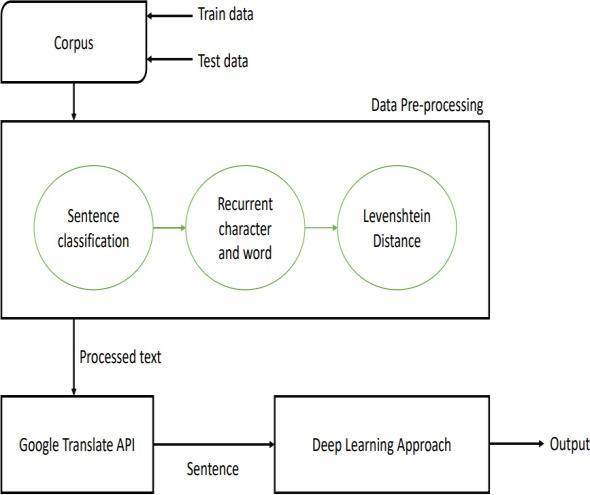
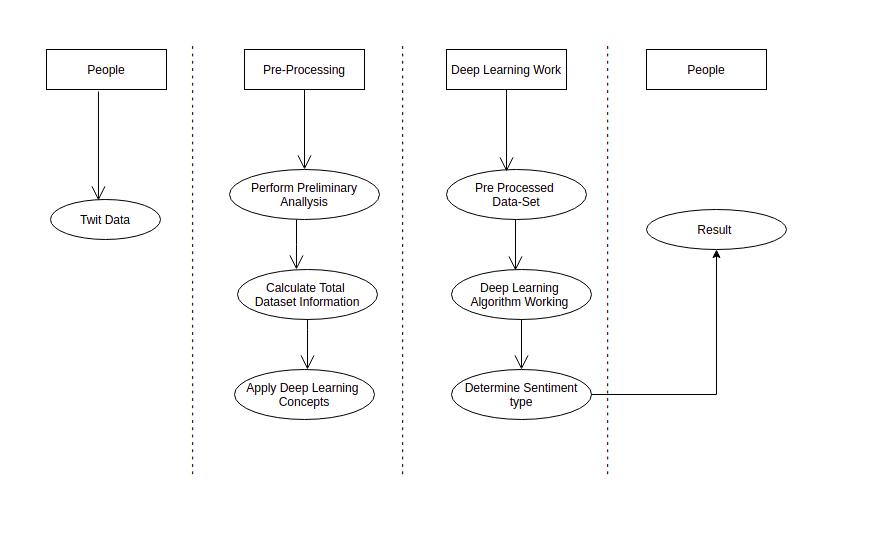
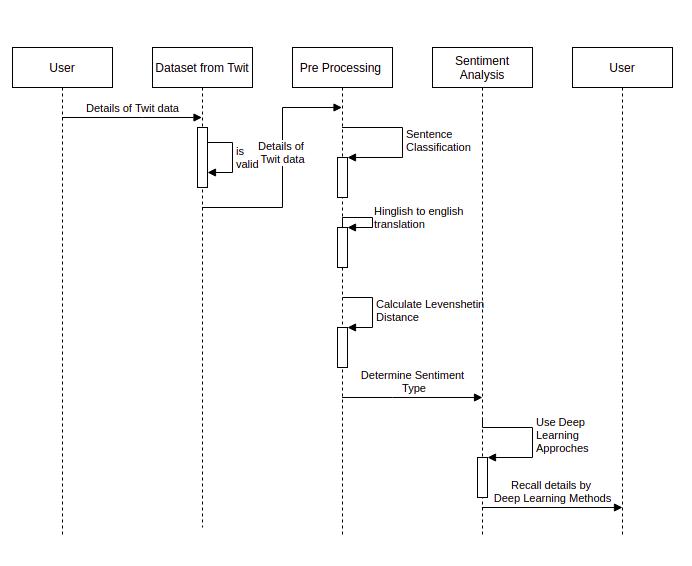
International Research Journal of Engineering and Technology (IRJET) e ISSN: 2395 0056 Volume: 08 Issue: 12 | Dec 2021 www.irjet.net p ISSN: 2395 0072 © 2021, IRJET | Impact Factor value: 7.529 | ISO 9001:2008 Certified Journal | Page1688 Fig 4:Classdiagram Fig 5:ActivityDiagram Fig 6:SequenceDiagram 7. CONCLUSION In our work, we had the option to arrange a code blend explanation into positive or negative. This undertaking includedrecognizingthedialects(HindiorEnglish)inacode blendarticulation,transcribingtheHindiRomanizedscript intoDevanagaricontent,andafterwardpassingjudgmenton the feeling of the explanation. We expect this work will empower a superior comprehension and investigation of SocialMediaopinioninclientdiscussionsacrosstheworld and particularly in Social Organizations in India. We are intending to stretch out our work to find anddistinguish feelings in discussions on friendlyorganizing locales and applications. 8. FUTURE SCOPE identifyingutilizelanguageAlso,accuracyspamandFuturescopesthatneedtobesolvedlikeambiguityproblemsaspectbasedsentimentanalysisintext.DetectFakeandreviewfurtherresearchisexpectedtoimproveinsentimentanalysisofcodemixedlanguage.wewouldliketoextendourworktoseveralotherpairsofcodemixeddata.Itwouldbeinterestingtotherichfeaturesofindividuallanguagestohelpsentimentsintheircodemixedversion. REFERENCES [1] Kaur, Harpreet, Veenu Mangat, and Nidhi Krail. "DictionarybasedSentimentAnalysisofHinglishtext." ScienceInternationalJournalofAdvancedResearchinComputer8,no.5(2017). [2] Detection of hate speech text in hindi English code mixeddata,thirdinternationalconferenceoncomputing andnetworkcommunicationpublishedbyElsevierB.V

International Research Journal of Engineering and Technology (IRJET) e ISSN: 2395 0056 Volume: 08 Issue: 12 | Dec 2021 www.irjet.net p ISSN: 2395 0072 © 2021, IRJET | Impact Factor value: 7.529 | ISO 9001:2008 Certified Journal | Page1689 [3] Harpreetkaur,DictionarybasedSentimentAnalysisof Hinglish text International Journal of Advanced ResearchinComputerScience [4] Geetika Gautam Sentiment Analysis of Twitter Data Using Machine Learning Approaches and Semantic Analysis Computing,,7thInternationalConferenceonContemporaryAt:Noida(India)Volume:IEEEXplore [5] Hitesh Parmar, Glory Shah and Sanjay Bhanderi, “Sentiment mining of Movie reviews using random forestwithtunedhyperparameters” [6] DeepakSinghTomarandPankajSharma,”Atextpolarity analysisusingsentiwordnet”,Vol.7(1),2016,190 193. [7] Mohammed Arshad Ansari and Sharvari Govilkar, “Sentimental Analysis of codemixed data for transliteratedHindiandMarathitexts”,Volume7,No.2, April2018. [8] AbinashTripathy,AnkitAgrawal,SantanuKumarRath, “Classification of Sentimental Reviews Using Machine LearningTechniques”ProcediaComputerScience [9] Sreelakshmik,premjithB,somanK,”DetectionofHate speech text in hindi english code mixed data”. Conference on Computing and Network Communications(CoCoNet'15). [10] Shashank Sharma, Sentiment Analysis of Code Mix Script2015Intl.ConferenceonComputingandNetwork Communications (CoCoNet'15), Dec. 16 19, 2015, Trivandrum,India