IRJET- Vehicle Accident Detection System

Page 1

International Research Journal of Engineering and Technology (IRJET)

e-ISSN: 2395-0056

Volume: 07 Issue: 07 | July 2020

p-ISSN: 2395-0072

www.irjet.net

Vehicle Accident Detection System Dr. Deepa Deshpande1, Sarjil Tikki2, Sagar Aglawe3, Rutuja Joshi4, Minal Darakh5 1Dr.

Deepa Deshpande, Associate Professor, CSE Dept., JNEC Aurangabad Tikki, Jawaharlal Nehru Engineering College, Aurangabad 3Sagar Aglawe, Jawaharlal Nehru Engineering College, Aurangabad 4Rutuja Joshi, Jawaharlal Nehru Engineering College, Aurangabad 5Minal Darakh, Jawaharlal Nehru Engineering College, Aurangabad ---------------------------------------------------------------------***---------------------------------------------------------------------2Sarjil

Abstract - To ensure the safety of the road commuters in such a network, it is imperative to enhance the performance of Advanced Driver Assistance Systems (ADAS). Real-time driving risk prediction is a fundamental part of an ADAS. Many driving risk prediction systems have been proposed. However, most of them are based only on vehicle’s velocity. But in most of the accident scenarios, other factors are also involved, such as weather conditions or driver fatigue. In this paper we propose a system for vehicle accident detection using raspberry pi considering various factors.

To ensure the safety of the road commuters in such a network, it is imperative to enhance the performance of Advanced Driver Assistance Systems (ADAS). Real-time driving risk prediction is a fundamental part of an ADAS. Many driving risk prediction systems have been proposed. However, most of them are based only on vehicle’s velocity. But in most of the accident scenarios, other factors are also involved, such as weather conditions or driver fatigue. In this paper we propose a system for vehicle accident detection using raspberry pi considering various factors. 2. LITERATURE SURVEY Every year the lives of approximately 1.35 million people are cut short as a result of a road traffic crash. Between 20 and 50 million more people suffer non-fatal injuries, with many incurring a disability as a result of their injury. Many of these accidents have common causes such as distracted driving, speeding, driver drowsiness, weather conditions, improper turns, etc. More than 97k people died due to accidents caused by over speeding in 2018. According to NHTSA Distracted driving is dangerous, claiming 2,841 lives in 2018 alone. Among those killed: 1,730 drivers, 605 passengers, 400 pedestrians and 77 bicyclists. In a paper named “Driver Fatigue Detection Based Intelligent Vehicle Control” by Zutao Zhang, Jiashu Zhang they presented an intelligent vehicle control based on driver fatigue detection and eyetracking using haar algorithm. In this paper, driver fatigue can be detected when the eyes close over 5 consecutive frames and system will warn fatigue to driver. We have included this factor in our system. Similarly, In a paper named “Traffic Accident Prediction Using Vehicle Tracking and Trajectory Analysis” by Weiming Hy Xuejuan |

3. METHODOLOGY The four input factor and its implementations is as

1. INTRODUCTION

© 2020, IRJET

Xiao, Dan Xie, and Tieniu Tan they presented a probability model for traffic accident prediction. We have also considered this factor for our system Many organizations are trying to develop a system which detects and warns about an accident. Considering this scenario we are developing a system with various input factors that are object detection, driver drowsiness, mutual object detection and weather conditions.

Impact Factor value: 7.529

|

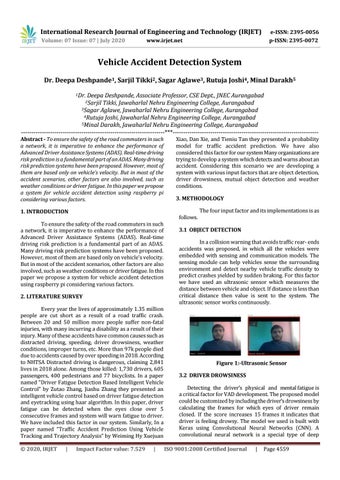
follows. 3.1 OBJECT DETECTION In a collision warning that avoids traffic rear- ends accidents was proposed, in which all the vehicles were embedded with sensing and communication models. The sensing module can help vehicles sense the surrounding environment and detect nearby vehicle traffic density to predict crashes yielded by sudden braking. For this factor we have used an ultrasonic sensor which measures the distance between vehicle and object. If distance is less than critical distance then value is sent to the system. The ultrasonic sensor works continuously.

Figure 1:-Ultrasonic Sensor 3.2 DRIVER DROWSINESS Detecting the driver‟s physical and mental fatigue is a critical factor for VAD development. The proposed model could be customized by including the driver‟s drowsiness by calculating the frames for which eyes of driver remain closed. If the score increases 15 frames it indicates that driver is feeling drowsy. The model we used is built with Keras using Convolutional Neural Networks (CNN). A convolutional neural network is a special type of deep ISO 9001:2008 Certified Journal

|

Page 4559


Turn static files into dynamic content formats.
Create a flipbook
Issuu converts static files into: digital portfolios, online yearbooks, online catalogs, digital photo albums and more. Sign up and create your flipbook.
IRJET- Vehicle Accident Detection System by IRJET Journal - Issuu