
International Research Journal of Engineering and Technology (IRJET) e-ISSN: 2395-0056
Volume: 12 Issue: 06 | Jun 2025 www.irjet.net p-ISSN: 2395-0072
International Research Journal of Engineering and Technology (IRJET) e-ISSN: 2395-0056
Volume: 12 Issue: 06 | Jun 2025 www.irjet.net p-ISSN: 2395-0072
Vaishnavi Subhash Pawar1
1UG Student, Department of Electronics and Telecommunication Engineering, K.K. Wagh Institute of Engineering Education and Research, Nashik, Maharashtra, India
Abstract - Fireflies are sensitive to artificial light, particularly powerful white headlights and floodlights used during light festivals and for firefly tourism. These lights interrupt fireflies' natural bioluminescent communication, causing mating failure, disorientation, and population reduction. This study presents a firefly-friendly road lighting system that uses filtered amber or redlights, motion sensors, and automatic dimming to illuminate eco-sensitive roads during firefly festivals, while avoiding upsetting fireflies. The proposed approach ensures automobile safety while maintaining biological balance infirefly zones.
Key Words: Fireflies, light pollution, eco-tourism, red LED, smart streetlight, insect conservation, solar power
1.INTRODUCTION
Firefliesarebioluminescentinsectsthatcommunicateand attractmatesbylightsignals.Duringseasonalfireflyfestivals and eco-tourism events, large numbers of tourists visit forestedandhillyregionswherefirefliescanbefound.The useofvehicleheadlightsandartificiallightingduringsuch eventssubstantiallydisruptsfireflymatinghabits.According to studies, excessive light pollution causes stress and disorientationinfireflies,eventuallyleadingtoadeclinein population.Thereisaneedtoprovideroadilluminationthat promotestourismwhilesafeguardingfireflies.
1.1
Conventional headlights and white streetlights produce a broad light spectrum that interferes with firefly communication.Theunexpectedinfluxoftouristsduringthe fireflyseasonbringsmanyautomobilesintothesesensitive areas, and turning off headlights completely is dangerous. Current awareness initiatives are useful, but they do not provide a solid technical solution that balances environmentalandhumanneeds.
1.2 Literature Review
According to Owens and Lewis' (2022) research and International Dark-Sky Association standards, artificial illumination,particularlywhiteandbluelight,affectsfirefly behavior by interfering with their bioluminescent
communication.Amber orredspectrumlighting hasbeen found to be less harmful to firefly and other nocturnal insects.
Some lighting techniques for wildlife areas have been proposed, including shielded fixtures and motion sensors. However,themostofthesearegeneral recommendations for nature reserves and parks, not for usage on roadways duringfireflytourismevents.
This article fills that gap by presenting a feasible, smart lighting system designed specifically for firefly tourism highways,whichcombinesfilteredlights,sensors,andsolar power to balance road safety and environmental conservation.
Thegoalofthisresearchistodevelopasmart,firefly-friendly roadlightingsystemthat:
a). Preservesfireflyhabitat.
b).Improvevehiclevisibilityontheroad.
c).Reduceslightpollutionatfireflytourismevents.
Toreduceenvironmentalimpact,thesystememploysfiltered lights,sensors,solarenergy,andautomation.
Component Purpose Description
Amber/Red LED Lights
Full-Cutoff Fixtures
Motion Sensors (PIR/IR)
Reduce impact onfireflies
These lights emit longer wavelengths (>590 nm), which cause minimal disruption to insectvisualsignals.
Control light direction
Reduce unnecessary lighting
Fixtures are designed to direct light only downward to avoid sidewaysorupwardscatter.
Sensorsdetectmovingvehicles and activate lights only when needed.
International Research Journal of Engineering and Technology (IRJET) e-ISSN: 2395-0056
Volume: 12 Issue: 06 | Jun 2025 www.irjet.net p-ISSN: 2395-0072
Component Purpose Description
Dimming Circuit Lower light intensity Lightsautomaticallydimaftera fewsecondsorwhennomotion isdetected.
Solar Panel + Battery Powersource Makes the system sustainable and usable in forest zones withoutgridpower.
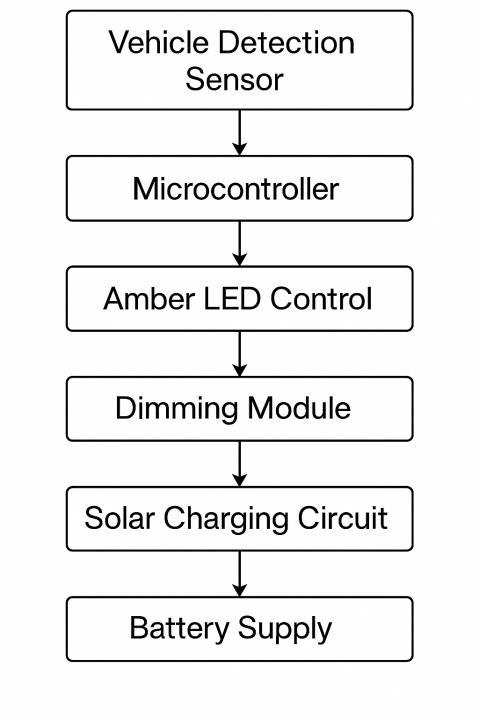
1. A vehicle enters a firefly-sensitive area (ecotourismroad).
2. Amotionsensordetectsthevehicle.
3. The LED light goes on automatically and provides amber lighting to help the driver see theroad.
4. The fixture covers the light, directing it only downward.
5. After 15-20 seconds, or as the car passes, the systemdimsorturnsoff.
6. A solar panel powers the lights, making them environmentallyfriendlyandself-sufficient.
Thismethodguaranteesthatfirefliesarenotdisturbedby intensewhiteheadlights,andcarsarenotrequiredtouse fullbeamlightsincertainareas.
BlockDiagramoftheSystem
WavelengthSelection:Firefliesaresensitivetolight intheblue-greenspectrum(450-550nanometers). Amber (>590 nm) and red light (>620 nm) are outsideofthisrange,causingminimalinterruption totheirvisualandcommunicationsystems.
Directionallighting:Accordingtoecologicallighting principles,full-cutofflightslimitlighttrespassand skyglowbyprovidingilluminationonlywhereitis required.
Intermittent lighting: Constant light produces chronic stress in insects. Intermittent, sensoractivated lighting allows the space to return to darknessinbetweenvehicles.
The proposed lighting system is intended to reduce firefly disturbance by replacing harming whitelights withamber LEDsandusemotionsensorstolimitunwantedillumination. It increases car safety while conserving firefly' natural behavior. The system promotes energy efficiency and environmental sustainability by using solar power and directionalfixtures,particularlyineco-tourismareas.
Preserves firefly populations. Prevents mating disruption and stress by avoiding damaging light spectrum.
Supports eco-tourism by allowing people to experiencefireflyzoneswithoutdamagingthem.
Improvesroadsafetybyusingamberlightsinstead ofhigh-beamheadlightstoincreasevisibility.
Energy-efficientandsustainable,usingsolarpanels andmotionsensors,reducingenergywaste.
Scalable and little maintenance. Canbeinstalledonforesttrails,hillstations,orecotourismroads.
International Research Journal of Engineering and Technology (IRJET) e-ISSN: 2395-0056
Volume: 12 Issue: 06 | Jun 2025 www.irjet.net p-ISSN: 2395-0072
Artificiallightinghasaconsiderableeffectontheecological behavior of nocturnal insects such as fireflies. In firefly tourism areas, the usage of high-beam lighting and continuouswhitestreetlightsnotonlydegradesthevisual experience but alsoaddsto theloss of firefly populations. Thisstudypresentsafirefly-safesmartlightingsystemthat incorporates amber LED lights, sensor automation, directional shielding, and solar power to protect the environment while also ensuring road safety.
Thismethodprovidesapracticalanduniquealternativefor localgovernments,forestagencies,andecotourismplanners. Future work may include prototype development, pilot installationinafireflyzone,anddatacollectiontoassessthe system'sperformanceinreal-worldcontexts.
[1] Owens, A. C. S., & Lewis, S. M. (2022). The impact of artificiallightatnightonnocturnalinsects.*Frontiersin EcologyandEvolution*.
[2] Longcore,T.,&Rich,C.(2004).Ecologicallightpollution. *FrontiersinEcologyandtheEnvironment*.
[3] International Dark-Sky Association. (2023). Light Pollution and Wildlife. Available at: https://www.darksky.org/light-pollution/wildlife/
[4] National Geographic. (2020). Why fireflies are disappearing and what we can do. Available at: https://www.nationalgeographic.com
[5] Xerces Society. (2023). Firefly Conservation and Outdoor Lighting Guidelines. Available at: https://xerces.org/firefly-conservation
[6] Gaston, K. J., et al. (2013). The ecological effects of nighttime light pollution: a mechanistic appraisal. *BiologicalReviews*,88(4),912–927.
[7] Horváth,G.,&Kriska,G.(2008).Lightpollutionandthe visualecologyofaquaticinsects:Areviewandsynthesis. *ConservationBiology*,22(5),1208–1218.