International Research Journal of Engineering and Technology (IRJET)
e-ISSN: 2395-0056
Volume: 05 Issue: 03 | Mar-2018
p-ISSN: 2395-0072
www.irjet.net
PYTHON BASED MACHINE LEARNING FOR PROFILE MATCHING Arpitha D1, Shrilakshmi Prasad2 Prakruthi S3, Raghuram A S4 1,2,3,4 Assistant
Professor, ATME College of Engineering, Mysuru, arpithad86@gmail.com ---------------------------------------------------------------------***--------------------------------------------------------------------Abstract - Information retrieval from different social sites has to be done for various Inter-social activities & functionalities for that matching user profiles has to be done. User creates same profiles under different sites.(for personal use, for work etc.,). The current work explores the different algorithms foe similarity measures for classifications, presenting new analysis. Different data sets are used to check the value and also classification. A model is built using Decision tree algorithm in order to check the similarity measures between two profiles. Experiments on real data sets are used to compare methods and their changes to the similarity-based learning.
Key Words:
Machine Learning; Similarity Measures; Decision tree Algorithm;
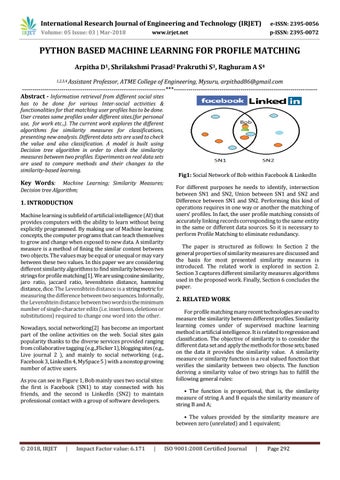
1. INTRODUCTION Machine learning is subfield of artificial intelligence (AI) that provides computers with the ability to learn without being explicitly programmed. By making use of Machine learning concepts, the computer programs that can teach themselves to grow and change when exposed to new data. A similarity measure is a method of fining the similar content between two objects. The values may be equal or unequal or may vary between these two values. In this paper we are considering different similarity algorithms to find similarity between two strings for profile matching[1]. We are using cosine similarity, jaro ratio, jaccard ratio, levenshtein distance, hamming distance, dice. The Levenshtein distance is a string metric for measuring the difference between two sequences. Informally, the Levenshtein distance between two words is the minimum number of single-character edits (i.e. insertions, deletions or substitutions) required to change one word into the other. Nowadays, social networking[2] has become an important part of the online activities on the web. Social sites gain popularity thanks to the diverse services provided ranging from collaborative tagging (e.g.,Flicker 1), blogging sites (e.g., Live journal 2 ), and mainly to social networking (e.g., Facebook 3, LinkedIn 4, MySpace 5 ) with a nonstop growing number of active users. As you can see in Figure 1, Bob mainly uses two social sites: the first is Facebook (SN1) to stay connected with his friends, and the second is LinkedIn (SN2) to maintain professional contact with a group of software developers.
Fig1: Social Network of Bob within Facebook & LinkedIn For different purposes he needs to identify, intersection between SN1 and SN2, Union between SN1 and SN2 and Difference between SN1 and SN2. Performing this kind of operations requires in one way or another the matching of users’ profiles. In fact, the user profile matching consists of accurately linking records corresponding to the same entity in the same or different data sources. So it is necessary to perform Profile Matching to eliminate redundancy. The paper is structured as follows: In Section 2 the general properties of similarity measures are discussed and the basis for most presented similarity measures is introduced. The related work is explored in section 2. Section 3 captures different similarity measures algorithms used in the proposed work. Finally, Section 6 concludes the paper.
2. RELATED WORK For profile matching many recent technologies are used to measure the similarity between different profiles. Similarity learning comes under of supervised machine learning method in artificial intelligence. It is related to regression and classification. The objective of similarity is to consider the different data set and apply the methods for those sets; based on the data it provides the similarity value. A similarity measure or similarity function is a real valued function that verifies the similarity between two objects. The function deriving a similarity value of two strings has to fulfill the following general rules: • The function is proportional, that is, the similarity measure of string A and B equals the similarity measure of string B and A; • The values provided by the similarity measure are between zero (unrelated) and 1 equivalent;
© 2018, IRJET
|
Impact Factor value: 6.171
|
ISO 9001:2008 Certified Journal
|
Page 292