International Research Journal of Engineering and Technology (IRJET)
e-ISSN: 2395-0056
Volume: 05 Issue: 03 | Mar-2018
p-ISSN: 2395-0072
www.irjet.net
Static Analysis of Pile Foundation on Slope Terrain K. Prakash1, B.Kavitha2, S.Srijan3, S.Suresh kumar4 1Assistant
professor, Department of Civil Engineering, Sona College of Technology, Salem, Tamilnadu Student, Department of Civil Engineering, Sona College of Technology, Salem, Tamilnadu ---------------------------------------------------------------------***--------------------------------------------------------------------Abstract - A good soil should possess high bearing capacity, 1.1 Objective 2, 3, 4 UG
avoid settlement, prevent lateral displacement and should absorb less water to withstand the structure. Buildings constructed on good soil will have less chance of settlement and deformation. But when soil stratum loses its strength due to structural load, there is a high chance of structure to collapse. Thus the soil stratum should be studied through model for geotechnical properties before the construction. In this study, new software called PLAXIS is used to analyze the load bearing capacity and other finite elements of soil. The case study is proposed for Shri Saibaba temple at Yedapalli, Coonoor, The Nilgiris. The temple is analyzed in PLAXIS software by applying ultimate load and failure patterns of the soil stratum are studied. Key Words: Landslide, Geotechnical properties, Finite element, Deformation, Pile, Modelling
1. INTRODUCTION
In the study soil stabilization of a Shri Saibaba temple and the height difference between 30 feet on a slope terrain analysis by PLAXIS software. The main objectives of the study are as follows:
To analyze the soil investigation report and slope of site where the building is proposed to be constructed. To analyze the structural load using STAAD pro. To determine the load carrying capacity of pile and design the structures. To estimate the soil deformation surrounding the implanted piles using finite element analysis. To run a model of pile in plaxis for static analysis of pile in slope. The soil-pile system is modeled.
1.2 Scope
The analysis of geotechnical structures and their static behaviour in a slope has a particular importance regarding the theoretical and empirical methods. The analyses were performed by plaxis software. In our site, height difference between ground level and building located area is found to be 30 feet. The result of test shows that the site has loose soil. Since our soil has rock at deeper depth, we are adopting end bearing pile. The soil-pile system is modelled using the Elasto-Plastic Mohr-Columb Model for the soil and the Elastic model for pile. Therefore pile foundation has been used. Deformation of a soil stabilized by reinforced concrete piles is studied using finite element modelling. Deformation and properties of soil was found using plaxis software. STAAD pro was used to analysis the building. Hence plaxis software was used for analyzing and allowed smooth workflow and proved to be cost efficient and time saving.
To carry out deformation of a soil stabilized by reinforced concrete piles is studied using finite element modelling. To ensure that the structure is safe against land sliding and geometric changes. (Unloading, reshaping and substitution). The deformation and stability of slope may be assessed for various pile arrangements and stiffness. Getting familiar with structural software’s Auto CAD, STAAD- pro and PLAXIS.
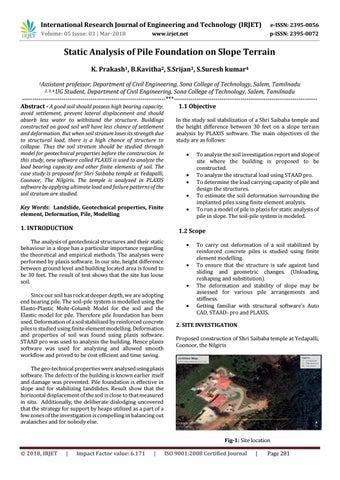
2. SITE INVESTIGATION Proposed construction of Shri Saibaba temple at Yedapalli, Coonoor, the Nilgiris
The geo-technical properties were analysed using plaxis software. The defects of the building is known earlier itself and damage was prevented. Pile foundation is effective in slope and for stabilizing landslides. Result show that the horizontal displacement of the soil is close to that measured in situ. Additionally, the deliberate dislodging uncovered that the strategy for support by heaps utilized as a part of a few zones of the investigation is compelling in balancing out avalanches and for nobody else. Fig-1: Site location © 2018, IRJET
|
Impact Factor value: 6.171
|
ISO 9001:2008 Certified Journal
|
Page 281