International Research Journal of Engineering and Technology (IRJET)
e-ISSN: 2395-0056
Volume: 05 Issue: 03 | Mar-2018
p-ISSN: 2395-0072
www.irjet.net
Tap Generator Rincy Joy1, Rashmitha Nair2, Sanket Makwana3, Shreyas Gawali4 1234B.E.
Department of Electronics engineering, Vidyalankar Institute Of Technology, Mumbai, Maharashtra, India ---------------------------------------------------------------------***---------------------------------------------------------------------
Abstract -
Since its conception electricity and its generation have been studied extensively. Electricity generation typically requires burning of fossil fuels. In recent years there has been a focus on generating energy using renewable sources. Tap Generator is one such initiative that utilizes kinetic energy produced by running tap water to generate electricity. Key Words: generator; electricity; non-conventional sources; energy.
1. INTRODUCTION
Turbine: The turbine is enclosed in a box which has two openings on opposite sides for water to enter and to exit. Motor: The shaft of the motor is attached to the rotating turbine as the shaft rotates voltage is produced across the two terminals of the motor. Boost Converter: It consists of LM2577 IC which is a step-up DC-DC voltage booster that boosts 3V to 12V. Voltage Regulator: IC 7812 regulates the output of the boost converter to 12V before applying it to the LEDs. LEDs: It is a parallel connection of 12V driven LED strips that takes output of regulator as input.
1.1 Theory behind the project concept If the shaft of a motor is made to rotate by external forces, it generates voltage proportional to the movement of the shaft. These external forces can be some unnoticed wasted energy that exists around us.
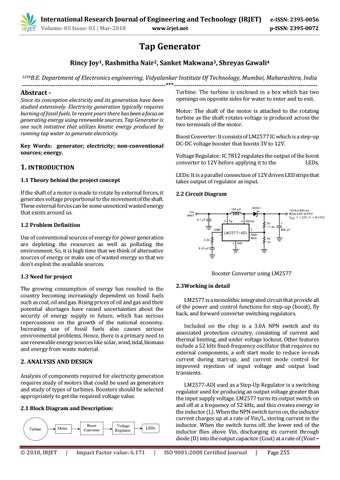
2.2 Circuit Diagram
1.2 Problem Definition Use of conventional sources of energy for power generation are depleting the resources as well as polluting the environment. So, it is high time that we think of alternative sources of energy or make use of wasted energy so that we don’t exploit the available sources. Booster Converter using LM2577
1.3 Need for project The growing consumption of energy has resulted in the country becoming increasingly dependent on fossil fuels such as coal, oil and gas. Rising prices of oil and gas and their potential shortages have raised uncertainties about the security of energy supply in future, which has serious repercussions on the growth of the national economy. Increasing use of fossil fuels also causes serious environmental problems. Hence, there is a primary need to use renewable energy sources like solar, wind, tidal, biomass and energy from waste material.
2. ANALYSIS AND DESIGN Analysis of components required for electricity generation requires study of motors that could be used as generators and study of types of turbines. Boosters should be selected appropriately to get the required voltage value. 2.1 Block Diagram and Description:
© 2018, IRJET
|
Impact Factor value: 6.171
|
2.3Working in detail LM2577 is a monolithic integrated circuit that provide all of the power and control functions for step-up (boost), fly back, and forward converter switching regulators. Included on the chip is a 3.0A NPN switch and its associated protection circuitry, consisting of current and thermal limiting, and under voltage lockout. Other features include a 52 kHz fixed-frequency oscillator that requires no external components, a soft start mode to reduce in-rush current during start-up, and current mode control for improved rejection of input voltage and output load transients. LM2577-ADJ used as a Step-Up Regulator is a switching regulator used for producing an output voltage greater than the input supply voltage. LM2577 turns its output switch on and off at a frequency of 52 kHz, and this creates energy in the inductor (L). When the NPN switch turns on, the inductor current charges up at a rate of Vin/L, storing current in the inductor. When the switch turns off, the lower end of the inductor flies above Vin, discharging its current through diode (D) into the output capacitor (Cout) at a rate of (Vout − ISO 9001:2008 Certified Journal
|
Page 255