International Research Journal of Engineering and Technology (IRJET)
e-ISSN: 2395-0056
Volume: 05 Issue: 03 | Mar-2018
p-ISSN: 2395-0072
www.irjet.net
A review on Design and construction of a one-axis sun-tracking system Mr. P. R. Mistri1, Mr. S. S. Patel2 1,2 Asst.
Prof, Dept of Smt. S. R. Patel engineering College, Gujarat, India ---------------------------------------------------------------------***--------------------------------------------------------------------cloud cover. The required accuracy of the tracking Abstract - This paper explains a tracking system which can be used with single-axis solar concentrating systems. The position and "status" of the Sun are detected by three lightdependent resistors (LDRs), one of which detects whether the collector is focused, whilst a second resistor determines if there is cloud cover, and the third senses whether it is day or night. The resultant signals are passed to an electronic control system which operates a low-speed 12-V d.c. motor which rotates the collector with the help of a speed-reduction gearbox. The tracking system accuracy depends on the magnitude of the solar radiation. The deviation from zero is 0.3 and 0.06 ° with solar radiation of 95and 550 W m-2, respectively. Both values instruct that the mechanism can be used comfortably for parabolic trough collectors of medium to high concentration ratios.
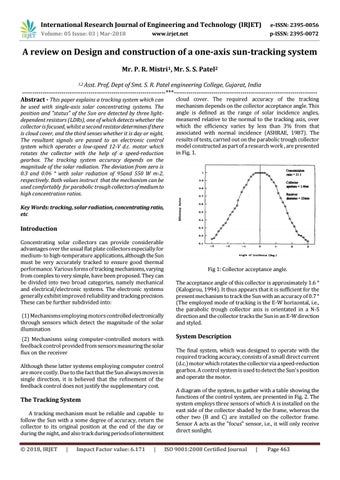
mechanism depends on the collector acceptance angle. This angle is defined as the range of solar incidence angles, measured relative to the normal to the tracking axis, over which the efficiency varies by less than 3% from that associated with normal incidence (ASHRAE, 1987). The results of tests, carried out on the parabolic trough collector model constructed as part of a research work , are presented in Fig. 1.
Key Words: tracking, solar radiation, concentrating ratio, etc
Introduction Concentrating solar collectors can provide considerable advantages over the usual flat plate collectors especially for medium- to high-temperature applications, although the Sun must be very accurately tracked to ensure good thermal performance. Various forms of tracking mechanisms, varying from complex to very simple, have been proposed. They can be divided into two broad categories, namely mechanical and electrical/electronic systems. The electronic systems generally exhibit improved reliability and tracking precision. These can be further subdivided into: (1) Mechanisms employing motors controlled electronically through sensors which detect the magnitude of the solar illumination (2) Mechanisms using computer-controlled motors with feedback control provided from sensors measuring the solar flux on the receiver Although these latter systems employing computer control are more costly. Due to the fact that the Sun always moves in single direction, it is believed that the refinement of the feedback control does not justify the supplementary cost.
The Tracking System A tracking mechanism must be reliable and capable to follow the Sun with a some degree of accuracy, return the collector to its original position at the end of the day or during the night, and also track during periods of intermittent © 2018, IRJET
|
Impact Factor value: 6.171
|
Fig 1: Collector acceptance angle. The acceptance angle of this collector is approximately 1.6 ° (Kalogirou, 1994). It thus appears that it is sufficient for the present mechanism to track the Sun with an accuracy of 0.7 ° (The employed mode of tracking is the E-W horizontal, i.e., the parabolic trough collector axis is orientated in a N-S direction and the collector tracks the Sun in an E-W direction and styled.
System Description The final system, which was designed to operate with the required tracking accuracy, consists of a small direct current (d.c.) motor which rotates the collector via a speed-reduction gearbox. A control system is used to detect the Sun's position and operate the motor. A diagram of the system, to gather with a table showing the functions of the control system, are presented in Fig. 2. The system employs three sensors of which A is installed on the east side of the collector shaded by the frame, whereas the other two (B and C) are installed on the collector frame. Sensor A acts as the "focus" sensor, i.e., it will only receive direct sunlight. ISO 9001:2008 Certified Journal
|
Page 463