International Research Journal of Engineering and Technology (IRJET)
e-ISSN: 2395 -0056
Volume: 04 Issue: 05 | May -2017
p-ISSN: 2395-0072
www.irjet.net
Predicting Student's Performance System Ankita Kadambande1, Snehal Thakur2, Akshata Mohol3, Prof A.M.Ingole4 1,2,3Student, Computer Engineering, Bharati Vidyapeeth’s College Of Engineering Lavale, Pune, India
4Assistant Prof, Computer Engineering, Bharati Vidyapeeth’s College Of Engineering Lavale, Pune, India
---------------------------------------------------------------------***---------------------------------------------------------------------
Abstract – As the education is very important from the
modern era, we are developing an application for predicting the student’s performance by applying Data Mining Techniques as it is now widely used in educational field. In present the Educational Data Mining is rising with the branch of knowledge and obsessed with various approaches as kind of predicting student’s performance, analysis etc. This system analyses the students who are facing the problems in achieving the highest score in the academics with the aim of detecting the identifying patterns and then by implementing the actions to assist them using Support Vector Machine (SVM) algorithm. In our system we are utilizing Support Vector Machine (SVM) algorithm which is the supervised learning technique. Through Support Vector Machine (SVM) algorithm we are performing prediction and also analyzing data used for classification and regression. Eventually this system will help the student’s to know how much they have to improve themselves so that they can be applicable for placements. We are conducting online test for the student. The system will predict the performance by considering details such as attendance, SSC marks, HSC marks or Diploma marks, each subject mark, online test marks, etc. The result of our system will be displayed in the graphical manner through which we will come to know how much students are placed and how much of them are yet remaining for their placement.
more they can improve themselves for getting applicable for placements. We are also conducting the online test which will be considered while predicting the performance. This paper analyses the students who are facing the problems in achieving the highest score in the academics with the aim of detecting the identifying patterns and then by implementing the action to assist them using Support Vector Machine (SVM).
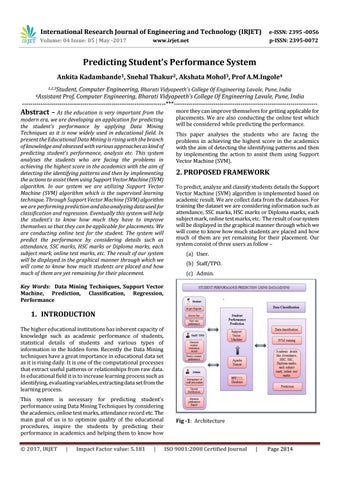
2. PROPOSED FRAMEWORK To predict, analyze and classify students details the Support Vector Machine (SVM) algorithm is implemented based on academic result. We are collect data from the databases. For training the dataset we are considering information such as attendance, SSC marks, HSC marks or Diploma marks, each subject mark, online test marks, etc. The result of our system will be displayed in the graphical manner through which we will come to know how much students are placed and how much of them are yet remaining for their placement. Our system consist of three users as follow – (a) User. (b) Staff/TPO. (c) Admin.
Key Words: Data Mining Techniques, Support Vector Machine, Prediction, Classification, Regression, Performance
1. INTRODUCTION The higher educational institutions has inherent capacity of knowledge such as academic performance of students, statistical details of students and various types of information in the hidden form. Recently the Data Mining techniques have a great importance in educational data set as it is rising daily. It is one of the computational processes that extract useful patterns or relationships from raw data. In educational field it is to increase learning process such as identifying, evaluating variables, extracting data set from the learning process. This system is necessary for predicting student’s performance using Data Mining Techniques by considering the academics, online test marks, attendance record etc. The main goal of us is to optimize quality of the educational procedures, inspire the students by predicting their performance in academics and helping them to know how © 2017, IRJET
|
Impact Factor value: 5.181
|
Fig -1: Architecture
ISO 9001:2008 Certified Journal
|
Page 2814
International Research Journal of Engineering and Technology (IRJET)
e-ISSN: 2395 -0056
Volume: 04 Issue: 05 | May -2017
p-ISSN: 2395-0072
www.irjet.net
3. IMPLEMENTATION METHOD Support Vector Machine is a supervised machine learning algorithm which is used for basically classification and regression. But it is mostly used for solving classification problems. In this algorithm we use point plotting to plot each data item as a point in n-dimensional space where n is number of features with the value particular coordinate. Then, we perform classification by finding the hyper-plane. We can differentiate two classes with the help of hyperplane.
Fig -3: Classified data according to height of individual student and hair length of student. Above figure 3 shows blow up plot of the sample. Pink circles in the figure show females and blue square shows the males. A graph shows some rules that are – 1. 2. Fig -2: Support Vector Machine The above figure shows that Support vectors are present to co-ordinates of each and every observation. Above dotted line shows the frontier for differentiates the two classes. Support vector machine is a borderline which used for segregates the two classes (hyper-plane/line).
Male have an average height up to 180cms. Female have long scalps hair.
If we see an object with 150cms height and hair length 45cms then we guess that this individual is a female. This is how SVM does the classification analysis.
3.1 Working of Support Vector Machine Now let’s understand the working of SVM using example below – Classify the student as per their gender female and male. In engineering college 50% - 50% boys and girls are there. Using this ratio we create some set of rules for classification. For simplicity two differentiating factors are identified as follow 1. Height of individual student.
Figure 4 shows many frontiers which can classify the problem. There are three frontiers are present. In this entire frontier we need to find best frontier for these particular problem.
2. Hair length of student.
© 2017, IRJET
|
Impact Factor value: 5.181
Fig -4: Frontiers are created
|
ISO 9001:2008 Certified Journal
|
Page 2815
International Research Journal of Engineering and Technology (IRJET)
e-ISSN: 2395 -0056
Volume: 04 Issue: 05 | May -2017
p-ISSN: 2395-0072
www.irjet.net
For this we need to interpret the object function in SVM to find the less distance of the frontier from support vector. Now consider the red frontier nearer to the pink circle which are 2unit far away from a red frontier and the another red frontier is near to the blue squares which are away by 1unit from the red frontier. We need to find distance from each frontier then we choose the maximum distance from nearer support vector. The blue frontier is furthest from nearest support vector which is considered as the margin.
3.2 Pros and cons of Support Vector Machine
Pros:
Cons:
It works really good with clear margin of separation. It is very effective in high dimensional spaces. It is effective in cases where number of dimensions is greater than the number of samples. It uses a subset of training points in the decision function its called as support vectors, so it is also memory efficient. Versatile: Different Kernel functions can be specified for the decision function. Common kernels are provided, but it is also possible to specify custom kernels. It doesn’t perform well, when we have large data set because the required training time is higher. If data set has noisy then system doesn’t perform very well. i.e. target classes are overlapping.
3.3 Application of Support Vector Machine Fig -5: Misclassified data In these figure 5 we need to map the vector to a high dimension plane so that we can differentiate observations from each other. We can see that such a transformation will result in following SVM.
1. 2. 3. 4. 5.
SVM for geo and environmental science:Content based image retrieval. Support vector machine for textual classification. SVM used in E-learning. Support vector classifiers for land cover classification.
4. CONCLUSIONS It focuses on analyzing the prediction accuracy of the student’s performance. By this system we can know the academic status of the students and can concentrate on students to improve their academic result and placements. It will also help to improve their standards, reputation and quality of education. This system is built by utilizing the Support Vector Machine (SVM) algorithm. In machine learning, Support Vector Machines are supervised learning models with associated learning algorithms that analyze and survey data used for classification and regression. It is simply a co-ordinate of individual observation. It’s very crucial for cases where very high predictive power is required. Such algorithms are smaller harder to visualize because of the more complexity in formulation.
Fig -6: Data is distributed with help of margin
© 2017, IRJET
|
Impact Factor value: 5.181
|
ISO 9001:2008 Certified Journal
|
Page 2816
International Research Journal of Engineering and Technology (IRJET)
e-ISSN: 2395 -0056
Volume: 04 Issue: 05 | May -2017
p-ISSN: 2395-0072
www.irjet.net
REFERENCES [1] [2]
[3]
[4]
[5]
[6]
J. Weston and C. Watkins,Multi-class Support Vector MaChines Royal Holloway, University of London, 1998. Pozdnukhov A., Kanevski M. Monitoring network optimisation using support vector machines. In: Geostatistics for Environmental applications. (Renard Ph., Demougeot-Renard H and Froidevaux, Eds.). Springer, 2005. pp. 39-50. Dacheng Tao, Xiaoou Tang, Xuelong Li, and Xindong Wu, Asymmetric Bagging and Random Subspacing for Support Vector Machines-based Relevance Feedback in Image Retrieval, IEEE Transactions on Pattern Analysis and Machine Intelligence, accepted, to appear. “An introduction to Support Vector Machines and other kernel-based learning methods” by Nello Cristianini & John Shawe-Taylor. (http://www.support http://www.supportvector. Mahesh Pal recently finished his PhD form the university of Nottingham, UK and presently working as a lecturer in department of civil enginnering NIT kurukshetra, haryana, India. Shaymaa E. Sorour, Tsunenori Mine, Kazumasa Goda and Sachio Hirokawa “Comments Data Mining for Evaluating Student’s Performance” in International Conference on Advanced Applied Informatics 2014 IIAI.
BIOGRAPHIES Ankita Kadambande. Student at Bharati Vidyapeeth’s College Of Engineering Lavale in Computer Engineering stream. Snehal Thakur Student at Bharati Vidyapeeth’s College Of Engineering Lavale in Computer Engineering stream. Akshata Mohol. Student at Bharati Vidyapeeth’s College Of Engineering Lavale in Computer Engineering stream. Prof A.M.Ingole. Professor at Bharati Vidyapeeth’s College Of Engineering Lavale in Computer Engineering stream
© 2017, IRJET
|
Impact Factor value: 5.181
|
ISO 9001:2008 Certified Journal
|
Page 2817