International Research Journal of Engineering and Technology (IRJET)
e-ISSN: 2395 -0056
Volume: 03 Issue: 11 | Nov -2016
p-ISSN: 2395-0072
www.irjet.net
A REVIEW ON MAXIMUM POWER POINT TRACKER FOR DFIG BASED WIND ENERGY CONVERSION SYSTEM V.SUDHA1, V.KAMATCHI KANNAN2 1Assistant Professor, Department of Electrical and Electronics Engineering, Maharaja Engineering College, 2Associate Professor, Department of Electrical and Electronics Engineering, Bannari Amman Institute of
Technology, Sathyamangalam. Erode (TN), India Email: sudhaeee2006@gmail.com, kannanped@gmail.com
---------------------------------------------------------------------***--------------------------------------------------------------------If the mechanical energy is converted into conversion system is aimed and proposed in this paper. This is electricity, then the motor is called a wind generator done by adapting a new method of fuzzy control for wind turbine or wind energy converter(WEC).The fluctuating wind velocities. The wind turbine is coupled with effective conversion system is called wind energy DFIG. This controlling method will track the maximum power conversion system(WEC'S). by the TSR (Tip speed ratio). According to optimum rotor
Abstract - A proper control technique to wind energy
speed the wind is calculated and the comparison is made with its TSR value. The inputs are given to fuzzy logic controller and the output from the controller will adjust the duty cycle of the power converters, so that the max power is obtained in WECS. The TSR value comparison is done by the New Intelligence and effecting algorithm called fruit fly optimization algorithm. The simulation and evaluation under different wind conditions with the proposed controller is done by using MATLAB/SIMULATION software.
There are two ways of Power generation in WECS, i.e., constant speed operation and variable speed operation. Even though the speed of the turbine is fixed or variable, only the variable speed wind turbines extract the maximum energy. The maximum output power is obtained at a particular operating point due to non-linear characteristics of the wind. This particular point is tracked by the maximum Power Point tracking (MPPT) controller.
Key Words: MPPT (Wind energy conversion system (WECS), Voltage source converter (VSC), Tip speed ratio (TSR), H-bridge converter, Neutral-Point Clamped (NPC).
1. INTRODUCTION
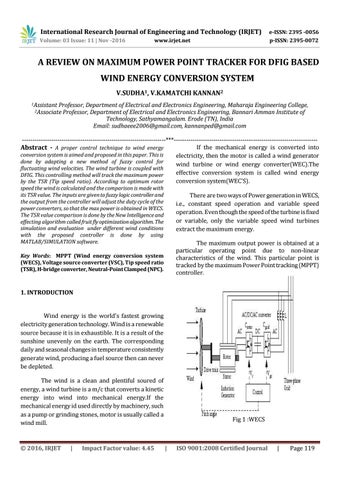
Wind energy is the world’s fastest growing electricity generation technology. Wind is a renewable source because it is in exhaustible. It is a result of the sunshine unevenly on the earth. The corresponding daily and seasonal changes in temperature consistently generate wind, producing a fuel source then can never be depleted. The wind is a clean and plentiful soured of energy, a wind turbine is a m/c that converts a kinetic energy into wind into mechanical energy.If the mechanical energy id used directly by machinery, such as a pump or grinding stones, motor is usually called a wind mill.
© 2016, IRJET
|
Impact Factor value: 4.45
Fig 1 :WECS
|
ISO 9001:2008 Certified Journal
|
Page 119
International Research Journal of Engineering and Technology (IRJET)
e-ISSN: 2395 -0056
Volume: 03 Issue: 11 | Nov -2016
p-ISSN: 2395-0072
www.irjet.net
The different types of MPPT control methods used are listed below: Tip speed ratio control (TSR), Optimum torque (OP) control, Fuzzy logic control (FLC), Search control method, Power signal feedback (PSF) control. Artificial neutral N/W (ANN) control etc.The efficient method to represent logistic information with uncertainty and imprecision is done by FLC control. The control methods in FLC is used in control methods and modeling problems.
In this method the turbine works with maximum efficiency and stresses in the blades are vary less when compared to other methods.
For the better design of (FLC), the determination of optimal rule bases input, output scaling factors, membership functions are effectively considered. In this paper for variable wind turbine, an effective and intelligent algorithm called (FOA) fruit fly optimum algorithm is used as FLC MPPT controller for better design. 2. BASIC PRINCIPLE OF DFIG DRIVEN BY WECS The stator of the induction motor is connected to the grid and if the speed of the rotor is above the synchronous speed then
Fig 2 : DFIG driven by WECS 3. MPPT CONTROL AND WIND TURBINE MODEL OF DFIG
Ns=120f/p
The MPPT controller is used to track the maximum power from the wind. The maximum power is obtained by using the rotor speed. The basic method used to deal with uncertainty imprecision is done by the control process is the fuzzy logic controller method to obtain efficient output from the maximum power.
The motor works as a generator to produce electrical output. The power to the grid is the constant line frequency power. f = Line frequency p = No.of poles in stator winding
Tm+
The induction generator output power determined in unique by its operating speed. The Tm (pull out) torque should not be exceeded from the operating unit. The efficiency obtained from the DFIG based WECS is high. It is easy to operate and maintain synchronization problems are reduced in this type.
-
Tem *=k. ωm 2
Wind turbine model
ωm
k
VSCF (variable speed constant variable) system uses simple wind turbines. In the wind turbine operates with variable speed to obtain constant frequency output.
© 2016, IRJET
|
Impact Factor value: 4.45
|
ISO 9001:2008 Certified Journal
|
Page 120
International Research Journal of Engineering and Technology (IRJET)
e-ISSN: 2395 -0056
Volume: 03 Issue: 11 | Nov -2016
p-ISSN: 2395-0072
www.irjet.net
Now a days the more developing designs are implemented in designing of WECS which is reliable compact, efficient, low maintenance cost and of less noise. This DFIG is used along with new designs because of high efficiency, high power density and use of energy material at low cost, for drive applications the turbine diameter is very small. For better designing of FLCs some of the basic factors are to be considered like the determination optimal rule bases. Membership functions and input/output scaling factors. By considering the ON-LINE MPPT control based on a FLC is proposed for the WECS for variable speed operation. The effective algorithm called FOA is used for better design. 4. FUZZY RULES For the specified wind speed the maximum optimal rotor speed is obtained to wavelength optimum estimated by FOA. The error obtained is considered and the error between the obtained speed and is given as input to the FLC system.
Fig 3 : Control Technique used in WECS. 6. FOOD FINDING TECNIQUES OF THE FRUIT FLY'S ARE GIVEN IN THE BELOW STEPS 1. Identify the initial location of the fruit fly randomly.
The output obtained is given as input to the pulse generates which produces signals for DC boost converter. Here the maximum power from the wind is obtained by adjusting the duty cycle of the boost converter, the rotor speed is controlled here and the
Init x-axis; Init y-axis. 2. Also randomly assign the direction and distance of energy fruit flies.
value of TSR obtained is maximum (optimum) for maximum power.
5. CONTROL SYSTEM
Xi = X-axis + Random value
Fruit fly optimization algorithm.
Yi = Y-axis + Random value
The maximum and the minimum value of the function is determined by a New Intelligent Algorithm called FOA for optimization problems. This is done by fruit fly's food searching behavior.
3. Calculate the distance of the assigned value from the origin (Dist i) and calculate Si (Small concentration judgment value). Dist p = (Xi2+Yi2)^1/2
The fruit fly will pick up various scents in the by its olfactory organs, They will fly towards the food directly by smelling the food sources in the air.
© 2016, IRJET
|
Impact Factor value: 4.45
Si = 1/ Dist i
The small concentration (Small(i) is calculated for the individual location by substituting Si (small concentration judgment value into fitness function (small concentration judgment function) 4.
|
ISO 9001:2008 Certified Journal
|
Page 121
International Research Journal of Engineering and Technology (IRJET)
e-ISSN: 2395 -0056
Volume: 03 Issue: 11 | Nov -2016
p-ISSN: 2395-0072
www.irjet.net
small i = Function(Si)
optimization algorithm. This algorithm will track the maximum speed of the rotor based on TSR (Tip speed ratio) according to wind speed. The error obtained between the maximum speed and the actual rotor speeds are given to FLC system.
5. Identification of the maximum small concentration among the fruit fly swarm is done and X,Y co-ordinates are found out. [best small best index]= max(small)
The maximum operating point is obtained by producing an adjustable duty cycle input which should be given to the boost converter. The results obtained during different conditions of wind speed will increases the efficiency and the benefits of proposed the maximum power point tracker controller.
6. Repeat the steps 2-4 to find out new maximal small concentration of the fruit fly and judge whether the value is greater to the value obtained before, if yes, Implement step 5. 7. RESULTS
REFERENCES
Using MATLAB/ SIMULINK Simulation the output performance of FOA based fuzzy MPPT controller is obtained. In the result, the wind speed changes by changing the wind speed at time t= 1s and t=2s. It changes from 7m/s to 9m/s. The FOA fuzzy MPPT controller is analyzed with the obtained speed. The maximum power is obtained for different wind speed variations optimum TSR ( Tip speed ratio) is considered along with wavelength optimum the maximum output power co-efficient cp,max as well.
[1] E. Muljadi and C.P. Butterfield, “Pitch-Controlled Variable-Speed Wind Turbine Generation”, IEEETransactions on Industry Applications, Vol.37, N°.1, pp: 240-246, January/February 2001 [2] R. W. Kates, “Climate change 1995: impacts, adaptations, and mitigation." Environment: Science and Policy for Sustainable Development 39.9 (1997): 29-33 [3] S. R. Bull, "Renewable energy today and tomorrow,” proc. IEEE, vol. 89, no. 8, pp. 1216-1226, Aug. 2001. [4] “Technology opportunities to reduce U.S. greenhouse gas emissions,” National Laboratory Directors, available: http://www.ornl.gov/climate_change/climate.htm, 1997 [5] T. Burton, N. Jenkins, D. Sharpe and E. Bossanyi, Wind energy handbook. Wiley, 2011. Survey," Industrial Electronics, IEEE Transactions on, vol. 53, pp. 1002-1016, 2006. [6] F. Iov and F. Blaabjerg, "Power electronics and control for wind power systems," in Power Electronics and Machines in Wind Applications, 2009. PEMWA 2009. IEEE, 2009, pp. 1-16. [7] B. Wu, Y. Lang, N. Zargari, and S. Kouro, Power Conversion and Control of Wind Energy Systems. Hoboken, NJ: Wiley, 2011 [8] F. Blaabjerg, M. Liserre, and K. Ma, "Power electronics converters for wind turbine systems," IEEE Transactions on Industry Applications, vol. 48, no. 2, pp708-719, 2012 [9] R. H. Baker, “Bridge converter circui.t,” U.S. Patent 4 ,270 163, May 26, 1981. 83.
8. CONCLUSION We have developed a new algorithm in this paper to extract maximum power for variable speed operations by fruit fly fuzzy logic MPPT controller © 2016, IRJET
|
Impact Factor value: 4.45
|
ISO 9001:2008 Certified Journal
|
Page 122