International Research Journal of Engineering and Technology (IRJET)
e-ISSN: 2395 -0056
Volume: 03 Issue: 11 | Nov -2016
p-ISSN: 2395-0072
www.irjet.net
Network Coding approach for Secure Cloud Storage Gauri Swapnil Bobade Pillai HOC College of Engineering, Rasayani, Dist Raigad, Maharashtra, India ---------------------------------------------------------------------***--------------------------------------------------------------------Abstract - This paper focuses the ingrained relationship
web service application programming interface application
between secure cloud storage and secure network coding.
programming interface (API) or by applications that utilize
The secure cloud storage protocol is that the user can check
the API, such as cloud desktop storage, a cloud storage
the data integrity without possessing the actual data. The
gateway or web-based content management systems.
secure network coding uses the concept of data
Network coding is a routing paradigm where a router in the
fragmentation. Though different and studied independently
network sends out encoded data packets, which are a
they can work together to give effective results. It shows
function of received data packets, instead of the traditional
systematic construction of secure cloud storage protocol
store-and-forward approach. Encoding can increase the
when secure network coding protocol is used with it.
network capacity for multicast tasks. Linear coding, in which
Further two specific secure cloud storage protocols based on
a router sends out a linear combination of received data
two recent secure network coding protocols are proposed.
packets, is proved to be sufficient to achieve the increased
First is security mediated anonymous cloud storage is
capacity. This is especially useful in cooperative networks.
proposed and second is third party auditable secure cloud storage. It will give us the effective and efficient mechanism
SYSTEM ARCHITECTURE
for secure cloud storage.
1.1 Secure Cloud Storage
Key Words: Cloud storage auditing, network coding, security, fragmentation, user anonymity, third-party public auditing
INTRODUCTION Cloud storage is a model of data storage in which the digital data is stored in logical pools, the physical storage spans multiple servers and the physical environment is typically
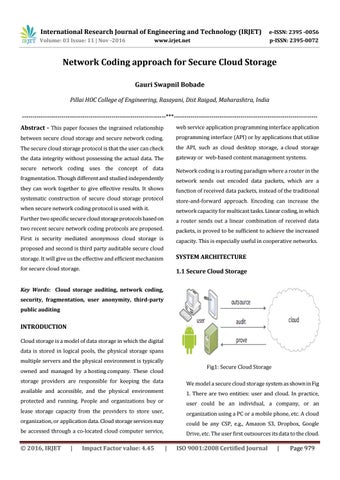
Fig1: Secure Cloud Storage
owned and managed by a hosting company. These cloud storage providers are responsible for keeping the data
We model a secure cloud storage system as shown in Fig
available and accessible, and the physical environment
1. There are two entities: user and cloud. In practice,
protected and running. People and organizations buy or
user could be an individual, a company, or an
lease storage capacity from the providers to store user,
organization using a PC or a mobile phone, etc. A cloud
organization, or application data. Cloud storage services may
could be any CSP, e.g., Amazon S3, Dropbox, Google
be accessed through a co-located cloud computer service,
Drive, etc. The user first outsources its data to the cloud.
© 2016, IRJET
|
Impact Factor value: 4.45
|
ISO 9001:2008 Certified Journal
|
Page 979
International Research Journal of Engineering and Technology (IRJET)
e-ISSN: 2395 -0056
Volume: 03 Issue: 11 | Nov -2016
p-ISSN: 2395-0072
www.irjet.net
Later, the user periodically performs an audit on the
Prove (q; F) Ѓ: On input an audit query q, the cloud
integrity of outsourced data. The user can then check
computes a proof Ѓ using the stored data F′.
whether the proof returned from the cloud is valid or
Verify(q; Ѓ;K) δ: On input an audit query q and the
not, meaning that the data remains intact, or obtaining
cloud’s proof Ѓ, the user checks if the cloud’s proof is
evidence that the data has been tampered which will
valid using the secret key K. The user outputs δ = 1 if the
possibly incur some further action, such as legal action
proof is valid, else outputs δ = 0.
or data recovery. Similar to previous work [3], [4] and as motivated earlier in this paper, we model the cloud as
1.2 Secure Network Coding
potentially malicious. We assume the communication between the user and the cloud is authenticated, which can be done by standard techniques. Thus, we can focus our attention on the user and the cloud but not communication. A secure cloud storage system that enables a user to check the integrity of the outsourced data is expected to be: Correct: If the cloud indeed stores the whole outsourced data, the cloud can always prove to the user that the data remains intact.
Fig 2: Secure Network Coding
Secure: If the user’s data is damaged, the user can
Fig 2 shows a typical system that employs the network
detect with high probability in the audit query, even if
coding technique. There are three types of entities: sender,
the cloud tries to cover the event.
router, and receiver. A sender wants to broadcast some data
Efficient: The computation, storage, and communication
to a group of receivers. The sender divides the data into
cost of both the user and the cloud should be as small as
packets and sends a linear combination of the packets via the
possible.
network. A router in the network also sends a linear
Secure cloud storage i.e. SCS protocol contains five
combination of the received data packets to its next hops.
efficient algorithms:
When a receiver obtains sufficient encoded data packets, it
SCS = KeyGen, Outsource, Audit, Prove, Verify as
can decode them to recover the original data by solving a
follows:
system of linear equations. To prevent a malicious router
KeyGen (λ) K: On input a security parameter λ, the user
from modifying a packet, the sender attaches some
runs this algorithm to generate a secret key K to enable
authentication information with each data packet. When a
auditing and verification. Outsource (F; K)
router receives a series of packets, the router first checks
F: On input the data F to be
their correctness, then combines the received correct
outsourced, the user runs this algorithm to get the
packets, and finally sends out the combined packet together
processed data F using the secret key K. The processed
with the combined authentication information. The
data contains some authentication information of the
combined authentication information is computed according
data F and is then sent to the cloud.
to the details of a specific protocol.
Audit (K) q: The user runs this algorithm to generate
A secure network coding (SNC) protocol contains four
an audit query q to be sent to the cloud.
© 2016, IRJET
|
Impact Factor value: 4.45
efficient algorithms:
|
ISO 9001:2008 Certified Journal
|
Page 980
International Research Journal of Engineering and Technology (IRJET)
e-ISSN: 2395 -0056
Volume: 03 Issue: 11 | Nov -2016
p-ISSN: 2395-0072
www.irjet.net
SNC = (KeyGen, Auth, Combine, Verify) as follows:
Audit(K) q: The user runs this algorithm to generate a
KeyGen (λ) (SK; PK): On input a security parameter λ, the
collection of uniformly random numbers {ij ; cj}j=1;:::;l
sender runs this algorithm to generate a secret key SK and a
where 1 ≤ ij ≤ m and cj Fp. The user sends the query q = {ij ;
public key PK to enable packet authentication.
cj}j=1;:::;l to the cloud. To achieve a good security level, the
Auth (xi; SK) (xi; ti): On input a packet xi p
to be sent
user sends multiple independent audit queries during one
out in the network, the sender computes an authentication
audit process.
information ti and then sends out (xi; ti).
Prove (q; F) Ѓ: On receiving an audit query q = {ij ; cj}j=1;:::;l
Combine ({ui; ti}i=1;:::;l; {c1; : : : ; cl}) → (w; t): On
where l is the length of the query, the cloud augments vij
receiving a group of packets ui
with the unit coefficient vector eij to get a codeword xij for
and their
all j. The cloud runs SNC. Combine({ui; ti}i=1;:::;l; {c1; : : : ;
authentication information ti’s, a router runs this algorithm to generate a combined packet w
cl}) (w; t) where ui = xij . The cloud extracts the first n
with coefficients {c1;
entries of w as a vector y
: : : ; cl} and the combined authentication information t. Verify (w; t)
_: On input a packet w
. The cloud sends back (y; t) as
a proof of the corresponding query. The equation y = Σl j=1 cj
and its
· vij holds.
authentication information t, a receiver or a router runs this
Verify(q; Ѓ;K) δ: On input an audit query q = {ij ; cj}j=1;:::;l,
algorithm to check whether a packet is modified maliciously.
the cloud’s proof Ѓ = (y; t), the user constructs a vector w
If the packet is correct, it outputs δ = 1, else outputs δ = 0.
such that the first n entries of w are the same as y, the (n + ij)- entry is cj , and all other entries are 0. The user runs
CONSTRUCTION
SNC. Verify (w; t) δ to get an answer δ. If δ = 1, the Construction of a secure cloud storage protocol SCS =
outsourced data remains intact and output 1, else the
(KeyGen, Outsource, Audit, Prove, Verify) given a well-
outsourced data is damaged and output 0.
designed secure network coding protocol
Anonymity via Security Mediator
SNC = (KeyGen, Auth, Combine, Verify) is done. Construction follows the following algorithm: SCS = (KeyGen, Outsource, Audit, Prove, Verify) KeyGen (λ) K: The user determines the finite field Fp where the network coding works over. The user also determines the packet size n and the total number of packets m. Then the user runs SNC. KeyGen (λ) (SK; PK). The key is K = (SK; PK). Outsource(F;K) F: On input the data F to be outsourced, the user takes F as a collection of vectors {vi}i=1;:::;m in
. Take
each vi as a codeword and then attach it with a coefficient vector ei to get xi = [vi ei]
Fig 3: Security mediator
. The user runs SNC.
Auth(xi; SK) → (xi; ti) to get the authentication information.
A group of users in an organization outsource their data to the
The user then outsources the processed data F′ = {vi; ti}
cloud through a gateway called security-mediator. The security-
i=1;:::;m together with the public key PK to the cloud. Only
mediator serves as a separate entity that can help generating
the vi’s are outsourced but not the xi’s.
authentication information of the data for the users. However, the
© 2016, IRJET
|
Impact Factor value: 4.45
|
ISO 9001:2008 Certified Journal
|
Page 981
International Research Journal of Engineering and Technology (IRJET)
e-ISSN: 2395 -0056
Volume: 03 Issue: 11 | Nov -2016
p-ISSN: 2395-0072
www.irjet.net
users desire to keep their data secret from the security-mediator.
Unblind ({wi; ti; ci}) t: The authentication information has
When one user wants to outsource some data to the cloud, the
some linear homomorphism as shown in SCS. Prove which is
user first blinds the data in some secret way, and then sends the
used by cloud to compute the authentication of some linearly
blinded data to the security-mediator. On receiving the blinded
combined data blocks. The user thus can also use this linear
data, the security-mediator authenticates the blinded data and
homomorphism to compute the authentication information
sends the authentication back, from which the data user recovers
for w in the same way as SCS. Prove. Thus, the authentication
the real authentication information. Since the authentication
information for the unmasked data block w = Σl i=1 ciwi can
information of the outsourced data for every user is generated
be obtained.
with the help of the same security-mediator, the cloud cannot
Outsource (F;K) F: The user first blinds the data to be
differentiate between different users from the outsourced data. In
outsourced as in the SM SCS. Blind algorithm and then
this way, the user anonymity is preserved. Later, the user sends
obtains the real authentication of the data as in SM-SCS.
the data and its authentication information to the cloud via an
Unblind. Later, the user sends the data and its authentication
anonymous channel. In case authentication is needed, this can be
information to the cloud.
done by existing mechanism. To ensure the integrity of the
Audit (K) q: The user runs this algorithm and the detailed
outsourced data, one user sends audit queries to the cloud. On
process is the same as SCS Audit.
receiving an audit query, the cloud answers the query according
Prove (q; F) Ѓ: The cloud runs this algorithm and the
to the protocol with a proof. Finally, the data user verifies the
detailed process is the same as SCS. Prove.
result returned from the cloud. We can extend our generic
Verify (q; Ѓ; K) δ: The user runs this algorithm as same as
construction using the idea of Wang et al into a security-mediated
SCS. Verify, i.e. the user only needs to check if the
secure cloud storage protocol. Again, we note that the only
authentication of the returned result is correct.
existing proposal only has a security proof in the random oracle
Third-party Public Auditing
model. We thus obtain an SM-SCS in the standard model if the underlying secure network coding protocol does not need it. It is worth noting that the construction shows a generic way to design anonymous secure cloud storage protocols for the first time. Security-mediated secure cloud storage protocol (SM-SCS) contains seven efficient algorithms (KeyGen, Blind, Unblind, Outsource, Audit, Prove, Verify). KeyGen(λ) K: The security-mediator runs this algorithm. SCS. KeyGen employs SNC KeyGen to generate the key. The security-mediator keeps the secret key only known by itself and shares the public key with both the users and cloud.
Fig 4: Third party public auditing
Blind(w) {wi}i=1;:::;l: To get the authentication information for a data block w in
, the user generates l random For a complete outsourcing solution, it is desirable to have
vectors wi such that w =Σl i=1 ciwi for some secret
the auditing also outsourced to a third-party. This
coefficients ci’s. The user asks the security-mediator to
enhancement can reduce the burden of the user by shifting
return the authentication information ti for wi using SNC
the auditing responsibility to the third-party public auditor.
.Auth.
© 2016, IRJET
This paradigm is reasonable since the third-party auditor
|
Impact Factor value: 4.45
|
ISO 9001:2008 Certified Journal
|
Page 982
International Research Journal of Engineering and Technology (IRJET)
e-ISSN: 2395 -0056
Volume: 03 Issue: 11 | Nov -2016
p-ISSN: 2395-0072
www.irjet.net
could have more experience and knowledge than the user,
authentication algorithm as in the original SCS. Prove. The
and thus the auditing is more convincing and neutral to both
randomization can mask the data and thus the third-party
parties. However, the fact that the auditing does not require
auditor cannot get non-trivial knowledge about the user’s
the original data does not mean that the auditing does not
data from cloud’s response. The returned proof still holds in
leak the original data. This problem is identified by Wang et
this case and thus the third-party auditor can indeed check
al. [5]. Their solution is a zero-knowledge secure cloud
the integrity of the user’s data.
storage protocol. The setup is shown in Fig. 5. The data user
Verify (q; Ѓ; K) → δ: The third-party auditor runs this
generates the key and then outsources the data to the cloud.
algorithm as same as SCS. Verify, i.e. the third-party auditor
Any third-party auditor can audit the data by only using the
only needs to check whether the authentication of the
public key. To check if the outsourced data remains intact in
returned result is correct.
the cloud, the auditor sends a series of audit queries to the
Advantages
cloud, and the cloud responds to the queries by returning the
The cloud storage system is more secure than a traditional system.
proofs. The auditor then can check the proof to see if the data is still intact.
Reliability of the data is more.
A third-party publicly auditable secure cloud storage protocol TP-SCS = (KeyGen, Outsource, Audit, Prove,
User identity is not disclosed to the outside world.
Verify) as follows:
Disadvantages
KeyGen(λ) K: Everything is the same as SCS. Besides, the
Storage cost is more as compared to the traditional system.
user shares the public key with both the third-party auditor
Communication cost has increased.
and the cloud. Outsource (F; K) F: The user first runs SCS. Later, the user also sends some random data blocks wi in
Computation cost is enhanced.
with
CONCLUSION
coefficients set to 0 together with their authentications using
Based on the relationship of secure cloud storage and secure
SNC.Auth.
network coding, a systematic way to construct a generic
Audit(K) → q: The third-party auditor runs this algorithm to
secure cloud storage protocol based on any secure network
generate a collection of uniformly random numbers {ij ;
coding protocol is proposed. We enhance our generic
cj}j=1;:::;l where 1 ≤ ij ≤ m and cj ∈ Fp. The third-party
construction to support user anonymity and third-party
auditor sends the query q = {ij ; cj}j=1;:::;l to the cloud. To
public auditing. It is also interesting to study the reverse
achieve a good security level, the third-party auditor sends
direction, i.e. under what conditions a secure network coding
multiple independent audit queries during one auditing process.
protocol can be constructed from a secure cloud storage
This process is the same as SCS Audit.
protocol.
Prove (q; F) Ѓ: When receiving a challenge query from the third-party auditor, the cloud computes the result and proof
REFERENCES
Ѓ in the same way as in SCS. Prove to obtain (y; t). Then the cloud uses the wi’s to randomize Ѓ by adding y with some
[1]
Secure Cloud Storage Meets with Secure Network Codin
random linear combination of wi’s. Since the authentication
g Chen, F.; Xiang, T.; Yang, Y.; Chow, S. Computers, IEEE
of y and wi’s are known to the cloud, this randomization step
Transactions on Year: 2015, Volume: PP, Issue: 99
is quite easy using the linear homomorphism property of the
Pages: 1 - 1, DOI: 10.1109/TC.2015.2456027
© 2016, IRJET
|
Impact Factor value: 4.45
|
ISO 9001:2008 Certified Journal
|
Page 983
[2]
International Research Journal of Engineering and Technology (IRJET)
e-ISSN: 2395 -0056
Volume: 03 Issue: 11 | Nov -2016
p-ISSN: 2395-0072
www.irjet.net
International Journal of Scientific & Engineering Research, Volume 4, Issue 8, August-2013 128 ISSN 2229-5518 IJSER © 2013 http://www.ijser.org “The impact of different MAC protocols for Network Coding in Adhoc Network”.
[3]
A. Juels and B. Kaliski Jr, “PORs: Proofs of retrievability for large files”, in ACM Conference on Computer and Communications Security (SP), 2007, pp. 584–597.
[4]
G. Ateniese, R. Burns, R. Curtmola, J. Herring, L. Kissner, Z. Peterson, and D. Song, “Provable data possession at untrusted stores”, in ACM Conference on Computer and Communications Security (CCS), 2007, pp. 598–609.
[5]
C. Wang, S. S. M. Chow, Q. Wang, K. Ren, and W. Lou, “Privacy preserving public auditing for secure cloud storage”, IEEE Transactions on Computers, vol. 62, no. 2, pp. 362–375, 2013.
[6]
K. Yang and X. Jia, “An efficient and secure dynamic auditing protocol for data storage in cloud computing”, IEEE Transactions on Parallel and Distributed Systems, vol. 24, no. 9, pp. 1717–1726, 2013.
[7]
R. Ahlswede, N. Cai, S.-Y. Li, and R. W. Yeung, “Network information flow”, IEEE Transactions on Information Theory, vol. 46, no. 4, pp. 1204–1216, 2000.
© 2016, IRJET
|
Impact Factor value: 4.45
|
ISO 9001:2008 Certified Journal
|
Page 984