International Research Journal of Engineering and Technology (IRJET)
e-ISSN: 2395 -0056
Volume: 03 Issue: 10 | Oct -2016
p-ISSN: 2395-0072
www.irjet.net
DESIGN OF GETSM BY VARYING SUSPENSION SYSTEM K. Sanjay Karthik1, M. Uttej2, H. Prashanth3, B.V.R.M. Kumar4 1, 2, 3B.Tech student, Department of Mechanical Engineering, SVCE, Nellore, A.P, India
4Associate professor, Department of Mechanical Engineering, SVCE, Nellore, A.P, India
-------------------------------------------------------------***--------------------------------------------------------------Abstract: We know that GETSM (Generation of suspension system we have used for this is the Electricity Through Speed Breaker Mechanism) is one of helical compression springs. But now, we are the upcoming technology to generate electricity. So, willing to change the suspension system in order to present work has been carried out on the analysis of increase the performance of GETSM technology. suspension system i.e. used in GETSM. Conventional designs use helical springs for suspension. But this paper The literature study has been done and we have demonstrates that laminated springs will provide a better come to know that the laminated springs can be cushioning effect than the helical ones. A literature study made better for this technology than the helical has also been done on both the suspension systems by compression springs [1]. using the values that are obtained from our prototype. Finally, laminated springs acts as a better option for GETSM in practical application as it can bear more amount of stress induced in it due to the application of load of the vehicle.
A spring is an elastic member whose function is to distort when loaded and to recover to its original shape when the load is removed. The springs absorb (or) control energy due to either shock (or) vibration and provide a cushioning effect. According to their shape, springs are classified into many types such as helical springs, conical springs, leaf springs, torsion springs, disc springs, etc. As of this paper, only helical and laminated springs are said to be studied in detail [2].
Keywords: GETSM, Helical compression springs, Laminated springs, Speed breaker, Electricity.
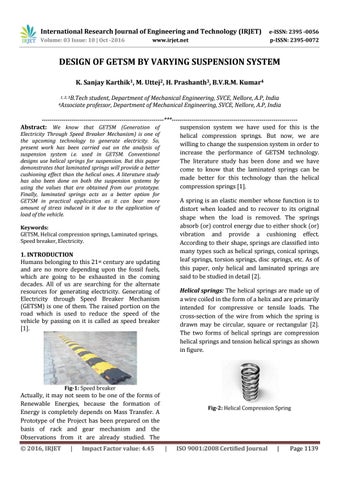
1. INTRODUCTION Humans belonging to this 21st century are updating and are no more depending upon the fossil fuels, which are going to be exhausted in the coming decades. All of us are searching for the alternate resources for generating electricity. Generating of Electricity through Speed Breaker Mechanism (GETSM) is one of them. The raised portion on the road which is used to reduce the speed of the vehicle by passing on it is called as speed breaker [1].
Helical springs: The helical springs are made up of a wire coiled in the form of a helix and are primarily intended for compressive or tensile loads. The cross-section of the wire from which the spring is drawn may be circular, square or rectangular [2]. The two forms of helical springs are compression helical springs and tension helical springs as shown in figure.
Fig-1: Speed breaker
Actually, it may not seem to be one of the forms of Renewable Energies, because the formation of Energy is completely depends on Mass Transfer. A Prototype of the Project has been prepared on the basis of rack and gear mechanism and the Observations from it are already studied. The © 2016, IRJET
|
Impact Factor value: 4.45
Fig-2: Helical Compression Spring
|
ISO 9001:2008 Certified Journal
|
Page 1139
International Research Journal of Engineering and Technology (IRJET)
e-ISSN: 2395 -0056
Volume: 03 Issue: 10 | Oct -2016
p-ISSN: 2395-0072
www.irjet.net
cold formed or hot formed depending upon the size of the wire. The material used for leaf springs is usually a plain carbon steel having 0.9 to 1.0% Carbon. The leaves are heat treated after the forming process. The heat treatment of spring steel produces greater strength and therefore greater load capacity, greater range of deflection and better fatigue properties. Laminated springs are hardened and then tempered [2].
Fig-3: Helical Torsion Spring
Laminated springs: They are also called as flat/carriage springs. Also they are commonly called as LEAF SPRINGS. They consists of a number of flat plates ,called as leaves of varying lengths held together by means clamps and bolts as shown in figure. The major stresses produced in leaf springs are Tensile and Compressive stresses. They are majorly employed in Automobiles [2].
4. CONSTRUCTION: The entire construction of the prototype is similar to that of the rack and gear mechanism which is used for the conventional GETSM concept. The change occurs for the arrangement of suspension system. So, it can be studied in detail. Apart from that, entire working of the project is same as that of the conventional. As of the helical spring suspension system, the speed breaker is supported by the GI pipes of smaller diameter at its four ends. The base wood is also of rectangular cross-section and is fastened with GI pipes of larger diameter corresponding to the previous ones. The helical compression springs are placed in those GI pipes of larger diameter and then the speed breaker with the GI pipes of smaller diameter is placed in it. Thus, the cushioning effect is produced for the speed breaker when the vehicle comes across it.
Fig-4: Laminated Spring
Up to now, many projects has been done on the GETSM technology and all of them are based on the helical compression springs. So, we have changed the type of suspension system and studied the results from it. 2. PRINCIPLE OF WORKING: This concept works on the major principle of converting mechanical energy into electrical energy. When a load is applied on the speed breaker, then it tends to deflect in the downward direction. This vertical motion is converted into rotational motion of the generator and thus the electricity is produced [1]. 3. SELECTION OF MATERIAL: The material for helical spring should have high fatigue strength, high ductility, high resilience and it should be creep resistant. It largely depends upon the service for which they are used i.e. severe, average or light. The springs are mostly made from oil-tempered carbon steel wires also called as spring steel containing 0.6 to 0.7% Carbon and 0.6 to 1.0% Manganese. The helical springs are either © 2016, IRJET
|
Impact Factor value: 4.45
Fig-5: Design using Helical Springs (1. Speed Breaker (metal plate) 2. Rack 3. Gear 4. Pipes of smaller diameter 5. Pipes of Larger diameter 6. Basewood 7. Support wood 8. Suspension springs 9. Belt drive 10. Generator 11. Battery)
|
ISO 9001:2008 Certified Journal
|
Page 1140
International Research Journal of Engineering and Technology (IRJET)
e-ISSN: 2395 -0056
Volume: 03 Issue: 10 | Oct -2016
p-ISSN: 2395-0072
www.irjet.net
As of the laminated spring suspension system, the speed breaker is made with four drills on the either sides of the raised portion. Four C-shaped shafts are fastened to the four edged ends of the speed breaker. The leaves are taken and are joined together by means of rebound clips and a centre bolt. The C-shaped shafts are placed in either of the spring eyes and are fixed tightly. The U-clips are placed from the top through the holes drilled on the speed breaker and are bolted at the bottom. This entire setup acts as the spring system and provides suspension for the speed breaker when the vehicle travels across it.
( (
) ) K = 1.3105 As there are various loads that are travelling on highways, we take an average weight of 30 tonnes. Applied axial load, P = 30 Tonnes = 294199.5N Area of the spring, A = 126.6769mm2 Maximum shear stress induced in the spring, = = = ( ) ( )
49089.55 N/mm2 For leaf springs: Let us consider that, Width of leaf, b = 90mm Half of effective length of leaf, l = 500mm Thickness of leaf, t = 10mm Load, P = 30Tonnes = 294199.5N Number of full length leaves, nf = 3 Number of graduated leaves, ng = 15 Bending stress in full length leaves, ( ) = = 7543.57 ( ) ( ( ) ( ) )
N/mm2 Bending stress in graduated leaves, ( ) = 5029.05 ( ) ( ( ) ( ) )
Fig-6: Design using Leaf Springs (1. speed breaker 2. Rack 3. Leaf Spring 4. Base for the entire Construction 5. U-clips 6. Rebound clip 7. Spring eye 8. C-shaped shaft 9. Centre bolt)
N/mm2 Maximum bending stress induced in the spring, ( ) ( ) = 12572 N/mm2
5. ANALYSIS OF THE MODEL: The performance of the project can be estimated by doing the analysis from the observations that are obtained during the working of the project. A literature study of the project is said to be done by using the values that are obtained from the working of the project. The formulas are taken from “The Design Data Handbook” by S. Md. Jalalaudeen. For helical compression spring: Let us consider that, Wire diameter of the circular spring, d = 10mm Mean coil diameter of the circular spring, D = 50mm Free length of the spring, Lf = 75mm Spring rate, k = 232 N/mm Number of Active coils, n = 5 Solid length of spring, Ls = 55mm Deflection produced in spring during loading, d = 20mm Spring index, = 50/10 = 5 Wahl’s shear stress factor,
© 2016, IRJET
|
Impact Factor value: 4.45
6. RESULTS AND DISCUSSION: It has been clearly observed from the literature study that the helical compression springs are about to induce a high amount of fatigue stress at which for the maximum load conditions this spring would be failed definitely. This is due to the design of the spring. This design is such that it cannot distribute the total amount of stress along its crosssection. So, the spring is said to be failed for the maximum load conditions. Coming to the laminated springs, the entire load of the vehicle is said to be distributed over the leaves. So, the stress distribution is also said to be even on variable load conditions. Hence, the suspension system does not fail even at the maximum load conditions and provides a perfect cushioning effect for the speed breaker on the application of load. 7. CONCLUSION: As we think of the present scenario, GETSM is an upcoming technology. But in future, this technology can be employed widely for the generation of power. This technology has the main advantage is |
ISO 9001:2008 Certified Journal
|
Page 1141
International Research Journal of Engineering and Technology (IRJET)
e-ISSN: 2395 -0056
Volume: 03 Issue: 10 | Oct -2016
p-ISSN: 2395-0072
www.irjet.net
that it can be constructed by using the components which are available in the market readily and no new part or process is required. Moreover, government is also planning to arrange this technology at toll gates and at some busy areas. So, by using laminated spring suspension system, the performance of the project would be somewhat better than the helical spring suspension system.
BIOGRAPHIES: K. Sanjay Karthik (Principle author) Studying B.Tech at Sree Venk ateswara College of Engineering.
ACKNOWLEDGEMENT: The authors are very thankful to Sree Venkateswara College of Engineering for providing the resources at the department of mechanical engineering to enable them to carry out this research work. We are also very grateful to K. Hema Harika pursuing 1st B.Tech, EEE in Visvodaya College of Engg. for using her drawing skills in drawing our design.
Studying B.Tech at Sree Venkateswara College of Engg..
M. Uttej (Co-author)
H. Prashanth (Co-author) Studying B.Tech at Sree Venkateswara College of Engg..
REFERENCES:
B.V.R.M. Kumar (Project Guide)
[1] K. Sanjay Karthik, Ch. Muni Sai, V. Gopala Krishna- “Generation of Electricity through Speed Breaker Mechanism” International Journal of Modern Trends in Engineering and Research, ISSN: 2393-8161 Volume 3, Issue 4; April 2016.
Working as an associate prof. at Sree Venkateswara College of Engineering, Nellore, A.P, India.
[2] “A Textbook of Machine Design” by R.S. Khurmi, S. Chand publishing. [3] Alok Kumar Singh, Deepak Singh, Madhawendra Kumar, Vijay Pandit, “Generation of Electricity through Speed Breaker Mechanism” International Journal of Innovations in Engineering and Technology (IJIET), 2(2), 2013, 20-24. [4] Miss. Shraddha Deshpande, Miss. Bhagyashri Kulkarni, Prof. Aashish Joshi “Electricity Generation Using Speed Breaker” International Research Journal of Engineering and Technology, ISSN: 23950072 Volume: 03 Issue: 02 | Feb-2016 [5] Jyoti Maurya , Pooja Gupta , Pooja Gupta, Tarannum Shahab , Amitabh Srivastava “Generation of Electricity through Speed Breaker Mechanism” ISSN: 2319 – 1805 Volume 5 Issue 4 2016 [6] “Design Data Handbook” by S. Md. Jalaludeen, Anuradha Publications.
© 2016, IRJET
|
Impact Factor value: 4.45
|
ISO 9001:2008 Certified Journal
|
Page 1142