
International Research Journal of Engineering and Technology (IRJET) e-ISSN:2395-0056
Volume: 12 Issue: 03 | Mar 2025 www.irjet.net p-ISSN:2395-0072
International Research Journal of Engineering and Technology (IRJET) e-ISSN:2395-0056
Volume: 12 Issue: 03 | Mar 2025 www.irjet.net p-ISSN:2395-0072
Asheel Ali A1 , Fayes K A2 , Unnikkuttan K S3 , Babitha Peter4
1Bachelor of Technology in Civil Engineering, Ilahia College of Engineering and Technology, Kerala, India
2Bachelor of Technology in Civil Engineering, Ilahia College of Engineering and Technology, Kerala, India
3Bachelor of Technology in Civil Engineering, Ilahia College of Engineering and Technology, Kerala, India
4Assistant Professor, Department of Civil Engineering, Ilahia College of Engineering and Technology, Kerala, India
Abstract - Water resource management is crucial as population growth, land-use changes, and climate variability increase pressure on water availability. This study assesses future water demand and surface water balance in the Muvattupuzha River Basin using GIS-based land classification and the WEAP (Water Evaluation and Planning) model. The results indicate a significant rise in water demand by 2050, with agricultural expansion and urbanization being key drivers. The findings highlight the necessity for sustainable water allocation strategies and conservationtechniques.
Key Words: WEAP Model, GIS, Water Demand, Climate Change, Water Balance
1.INTRODUCTION
Water scarcity is a critical global issue as only 2.5% of Earth’s water is freshwater. The Muvattupuzha River Basin is a lifeline for the region, supporting agriculture, industrialactivity,andurbansettlements.However,rising demand coupled with climate-induced variability poses severechallenges.ThisstudyemploystheWEAPmodelto forecast water demand and assess the surface water balance for the basin from 2022 to 2050. The objectives are to (i) analyze historical trends, (ii) simulate future water scenarios, and (iii) propose strategies to ensure sustainablewatermanagement.
2.
Urbanization & Water Demand: Studies predict that by 2050, over 2 billion people will experience urban water shortages.
WEAPModelApplications:UsedinIndia,SouthAfrica,and Iraqforpredictingwaterbalanceanddemand.
Climate Change & Water Scarcity: Rising temperatures affect rainfall patterns and river flow, altering water resourcesustainability.
TheMuvattupuzhaRiverBasinspansapproximately1,272 sq. km in Kerala, India, with elevation ranging from 0 to 1500 meters. Its diverse landscape includes fertile agricultural plains, forested highlands, urban centers, and wetlands.Theriverservesastheprimarysourceofwater fordomestic,industrial,andirrigationneeds.
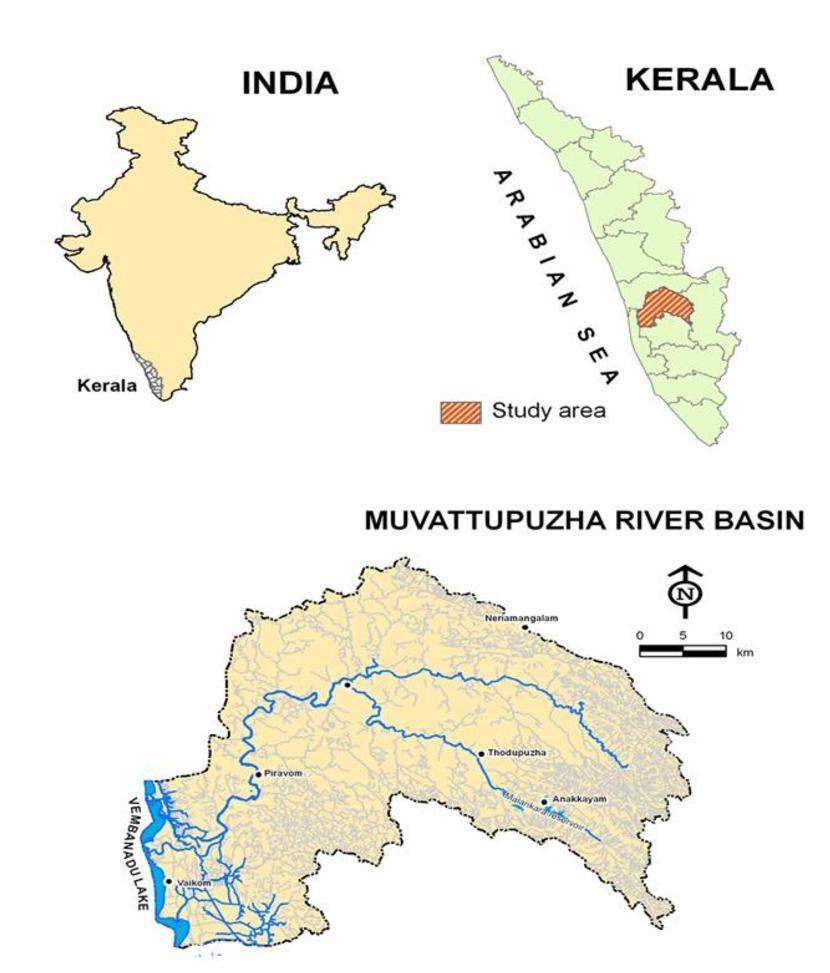
Fig -1: LocationofStudyArea
3.2 Data Collection
Datawerecollectedfrommultiplereliablesources:
ElevationData:ObtainedfromWEAPModel
LandUse:DerivedfromWEAPModel.
International Research Journal of Engineering and Technology (IRJET) e-ISSN:2395-0056
Volume: 12 Issue: 03 | Mar 2025 www.irjet.net p-ISSN:2395-0072
Hydro-climatic Data: Rainfall, evaporation, and river dischargerecordsfromtheIDRB(2010–2022).
Population Data: Sourced from the 2011 Census and projectedto2050.
Water Use Data: Collected from Kerala Water Authority andKeralaIrrigationDepartment
Table -1: SourcesofDataCollection
DataType Source Purpose
ElevationData (DEM) WEAPModel Classifylandby elevationzones
LandUse WEAPModel Identifyagriculture, urban,forest,and wetlands
ClimateData IDRB Recordrainfall, evaporation, temperature
Population Data Census2011 Estimatewater demand
4.1 GIS-Based Land Use Classification
Using ArcGIS and QGIS, land use data were overlaid with Digital Elevation Models (DEM) to classify the basinintothreeelevationzones:
0–500m: Predominantlyagricultural with significant urbansettlements.
500–1000m:Moderateagriculturalandforestcover.
1000–1500m: Limited agriculture with sparse vegetation.
TheWEAPmodelwasconfiguredtosimulatecurrent and future water demand. Four scenarios were developed:
Table -2: WEAPScenarioDevelopment
Scenario
4.3
Historical hydrological data (2010–2022) were used to calibrate the model. Calibration involved adjusting parameters (e.g., infiltration, evapotranspiration) to achieve a high R-squared value (0.9944), indicating that thesimulateddatacloselymatchedobservedrecords.
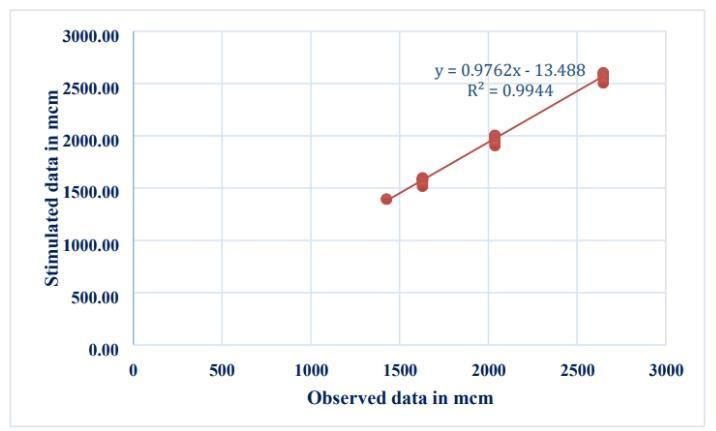
Fig -2: comparisonbetweenobservedandstimulateddata
5.1 Land Use Distribution by Elevation
Table -3: LandUseDistributionbyElevation
Agriculture is dominant at lower elevations, while forests declinewithelevation.
Urbanization is highest in lowlands, increasing water demand.
International Research Journal of Engineering and Technology (IRJET) e-ISSN:2395-0056
Volume: 12 Issue: 03 | Mar 2025 www.irjet.net p-ISSN:2395-0072
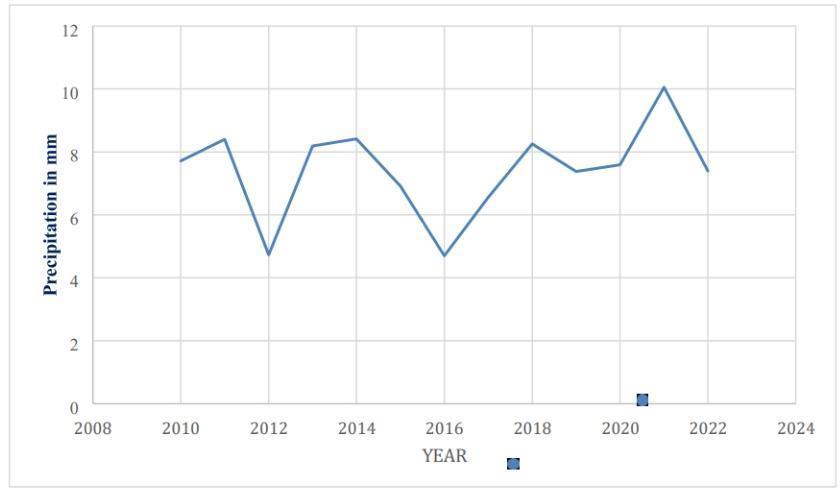
Fig -3: AnnualRainfallTrendsinMuvattupuzha RiverBasin(2010-2022)
The annual rainfall trends from 2010 to 2022 show significant seasonal variations in the Muvattupuzha River Basin. The monsoon months (June to September) contribute the highest rainfall, leading to increased river recharge and surface runoff. Conversely, the dry months (January to April) experience a substantial decline in precipitation, resulting in reduced streamflow and lower water availability. The variability in rainfall patterns highlights the importance of efficient water storage and managementstrategiestomitigateseasonalshortages.
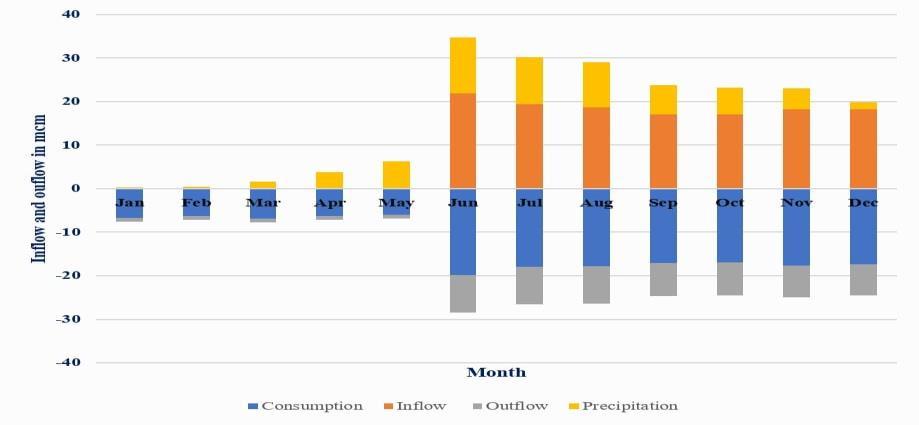
Fig -4: MonthlyVariationofRainfallandRiverFlow inMuvattupuzhaRiverBasin
Themonthlydistributionofrainfallandriverflowreveals distinct seasonal fluctuations, with the highest inflows recorded during the monsoon period (June-September). This period contributes the majority of the annual discharge, replenishing surface and groundwater resources. In contrast, the pre-monsoon and postmonsoon months (January-April) experience significantly lower precipitation, causing a decline in river flow and increased dependency on stored water. These findings
emphasize the need for sustainable water management practices, particularly in dry months, to ensure a stable watersupplythroughouttheyear.
5.3.1 Population Growth Scenario
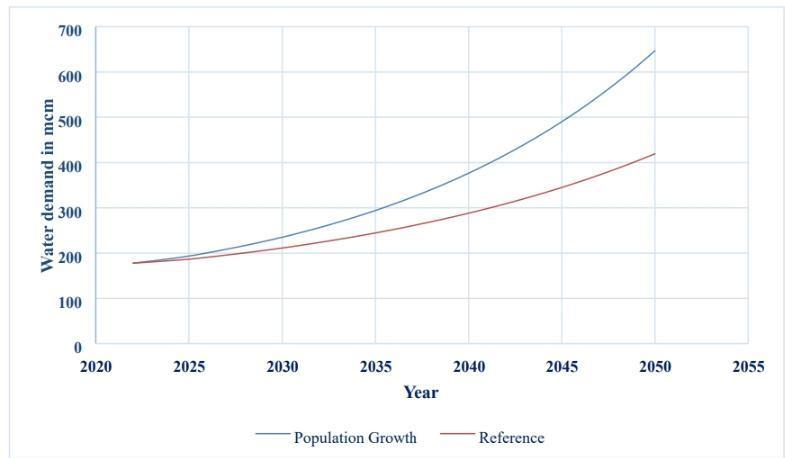
Fig -5: WaterDemandUnderPopulationGrowthScenario
The population growth rate is assumed to increase from 2.2 to 5 due to rapid-fire urbanization. As population expands, domestic water demand rises significantly from 108.6 MCM in 2022 to 4938.4 MCM by 2050. This sharp increaseindemandputsstressonavailablewatercoffers, leadingtoimplicitdearths.
Recrimination without structure expansion( e.g., budgets, water conservation programs), severe water failure is anticipated.
5.3.2 Agricultural Expansion Scenario
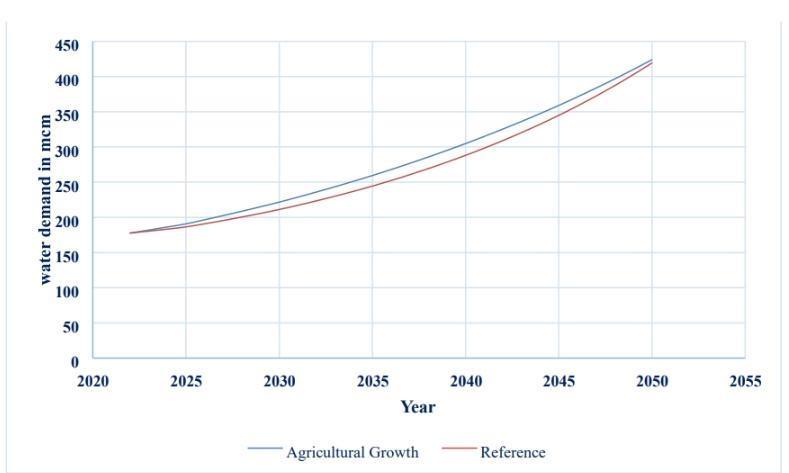
Fig -6: WaterDemandUnderAgriculturalExpansion Scenario
The irrigation water requirement increases annually by 1% due to expansion of cultivated land.As a result, water demand rises from 177.6 MCMin 2022 to 8097.9 MCM in 2050.The agricultural sector is the largest water
International Research Journal of Engineering and Technology (IRJET) e-ISSN:2395-0056
Volume: 12 Issue: 03 | Mar 2025 www.irjet.net p-ISSN:2395-0072
consumer, and increasing cultivated area intensifies pressureonwaterresources.
Implication: Improving irrigation efficiency (e.g., drip/sprinklerirrigation)isnecessarytoreduceexcessive waterconsumption.
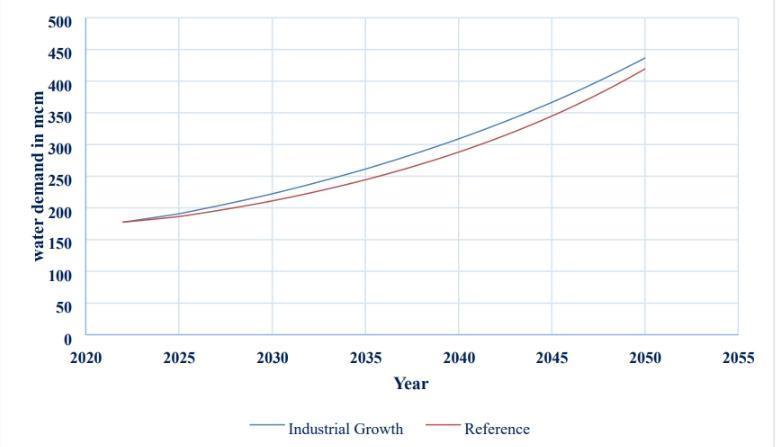
Fig -7: WaterDemandUnderIndustrialGrowthScenario
The industrial growth rate is projected to increase from 1.5% to 1.75% annually, driving up water demand in industrialsectors.
As industries expand, water demand will rise by approximately15%overthenext20years.
The industrial sector contributes significantly to water pollution, requiring better wastewater management to preventenvironmentaldegradation.
Implication: Sustainable industrial policies, water recycling,andpollutioncontrolmeasuresarenecessaryto balanceeconomicgrowthwithwatersustainability.
6.1
The WEAP model simulations reveal a significant rise in water demand across the Muvattupuzha River Basin by 2050, primarily driven by rapid urbanization, expanding agriculturalactivities,andincreasingindustrialgrowth.As population growth accelerates, the demand for domestic, agricultural, and industrial water supply is expected to outpace available resources. Additionally, seasonal fluctuations in rainfall further intensify the challenges of maintainingastablewaterbalance,withmonsoonseasons replenishingwatersourcesanddrymonthscausingsevere shortages.
The scenario analysis highlights that if current trends continue,theregionwillexperiencecriticalwaterdeficits, negatively impacting food security, industrial output, and
urban sustainability. Without strategic interventions, over-extraction of surface and groundwater resources could lead to aquifer depletion, reduced river flow, and ecosystem degradation. Therefore, integrated water resource management strategies must be prioritized to ensure long-term sustainability, equitable distribution, andclimateresilience.
Based on the findings, the following water management strategies are recommended to mitigate the predicted demandsurgeandenhancewatersecurityinthebasin:
1.AdoptEfficientIrrigationTechniques
Implement drip and sprinkler irrigation systems to minimize water wastage and enhance efficiency in agriculturalpractices.
Promote precision agriculture and smart irrigation technology to optimize water use based on real-time soil moisturelevels
2.Enhance Rainwater Harvesting & Groundwater Recharge
Construct rainwater harvesting structures in urban and rural areas to capture excess rainfall during monsoon months.
Promote check dams, percolation tanks, and artificial recharge wells to replenish groundwater reserves and improveaquifersustainability.
3.StrengthenUrbanWaterConservationPolicies
Implement water-saving regulations in residential, commercial, and industrial sectors, including efficient plumbingfixturesandwaterreusesystems.
Promotewastewatertreatmentandrecyclinginindustrial zonestoreducefreshwaterdependency
[1] Dlamini, N., Senzanje, A., & Mabhaudhi, T. (2023). Assessing climate change impacts on surface water availability using the WEAP model: A case study of the Buffalo River catchment, South Africa. European Journal of Remote Sensing and Hydrology. https://doi.org/10.1016/j.ejrh.2023.101330
[2] Hamdi, A. A., Abdulhameed, I. M., & Mawlood, I. A. (2023). “Application of WEAP Model for Managing Water Resources in Iraq: A Review.” IOP Conference Series: Earth and Environmental Science, Volume 1222,2nd InternationalScientificConferenceofWater (ISCW-2023), 15/03/2023 – 16/03/2023, Anbar,
International Research Journal of Engineering and Technology (IRJET) e-ISSN:2395-0056
Volume: 12 Issue: 03 | Mar 2025 www.irjet.net p-ISSN:2395-0072
Iraq. (https://doi.org/10.1088/171315/1222/1/012032)
[3] He,C.,Liu,Z.,Wu,J.,Pan,X.,Fang,Z.,Li,J.,&Bryan,B. A. (2021). Future global urban water scarcity and potential solutions. Nature Communications, 12(1), 6652.https://doi.org/10.1038/s41467-021-25026-3
© 2025, IRJET | Impact Factor value: 8.315 | ISO 9001:2008 Certified Journal | Page559