International Research Journal of Engineering and Technology (IRJET)
e-ISSN: 2395 -0056
Volume: 03 Issue: 10 | Oct -2016
p-ISSN: 2395-0072
www.irjet.net
A REVIEW ON “DESIGN, ANALYSIS & EXPERIMENTAL INVESTIGATION OF COMPOSITE LEAF SPRING” Prashant N. Pakale1, Prof. D. M. Patil2 1 Student of M. E. [Mechanical Engineering - General], Dept. of Mechanical Engineering,
PSGVPM's D. N. Patel College of Engineering, Shahada - 425409, Maharashtra, India. 2Associate Professor, Dept. of Mechanical Engineering, PSGVPM's D. N. Patel College of Engineering, Shahada - 425409, Maharashtra, India. ---------------------------------------------------------------------***---------------------------------------------------------------------
Abstract – Leaf spring is part of suspension system used in
most of vehicles and makes the vehicle heavier due to conventional steel material. The Automobile industry has focused and given prior interest to replace that conventional materials like steel in replace with other material due to several reasons like various mechanical properties. Lot of research has been going on to replace leaf spring with Composite materials. Composite materials are satisfying various demands of automobile researchers as it having good elastic properties, high strength to weight ratio, less weight compared to steel material. The aim of this paper is to focus on various issues like spring nature with other material behavior, fatigue life, weight, stresses while designing, modeling and experimental investigation of composite leaf spring. Also many researchers have been focused on safety, comfort durability about leaf spring.
elements and nodes. Analysis work includes certain limits of loads and forces. Also many researchers have applied this study on experimental basis to verify predictions made by them. Few researchers were discussed about developing and validating proceedings for predicting the deflections and stress developed in leaf spring. E-Glass/Epoxy, Graphite/Epoxy, Carbon/Epoxy were taken as a Composite material for leaf spring in most of research papers.
Key Words: Leaf spring, Composite material, Weight reduction.
1. INTRODUCTION
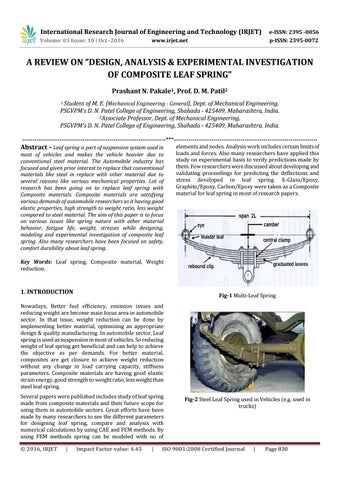
Fig-1 Multi-Leaf Spring
Nowadays, Better fuel efficiency, emission issues and reducing weight are become main focus area in automobile sector. In that issue, weight reduction can be done by implementing better material, optimizing an appropriate design & quality manufacturing. In automobile sector, Leaf spring is used as suspension in most of vehicles. So reducing weight of leaf spring get beneficial and can help to achieve the objective as per demands. For better material, composites are get closure to achieve weight reduction without any change in load carrying capacity, stiffness parameters. Composite materials are having good elastic strain energy, good strength to weight ratio, less weight than steel leaf spring. Several papers were published includes study of leaf spring made from composite materials and their future scope for using them in automobile sectors. Great efforts have been made by many researchers to see the different parameters for designing leaf spring, compare and analysis with numerical calculations by using CAE and FEM methods. By using FEM methods spring can be modeled with no of © 2016, IRJET
|
Impact Factor value: 4.45
|
Fig-2 Steel Leaf Spring used in Vehicles (e.g. used in trucks)
ISO 9001:2008 Certified Journal
|
Page 830
International Research Journal of Engineering and Technology (IRJET)
e-ISSN: 2395 -0056
Volume: 03 Issue: 10 | Oct -2016
p-ISSN: 2395-0072
www.irjet.net
3. LITERATURE REVIEW Erol Sancatkar, Mathieu Gratton [1] they have
discussed about manufacturing of a composite leaf spring for a light vehicle run on solar energy. This paper have objective to give brief information regarding designing, numerically analysis and physical testing for future use of composite material for leaf spring. They have suggested using unidirectional E-glass impregnated by an epoxy resin. Light vehicles running on solar power were selected for study. They have concluded after experimentations that small modifications can be employed such as placement rubber pads to enhance suspension capability of light vehicles. Their redesigns for front suspension of leaf springs for solar powered light vehicles were successful and meet all design requirements.
H.A. AL-QURESHI [2] they have studied automobile leaf
springs and designed it with composite materials. The aim of this paper is to design, analysis and experimental investigations of composite leaf spring. For this aim they have selected a spring of compact car i.e. Jeep. For physical testing a single leaf spring with varying thickness of spring have been selected which having glassfiber reinforced plastic material with similar mechanical geometrical properties. That leaf spring was designed, fabricated & tested compared with multileaf spring. These experiments were done in laboratory and have been performed road test. For these testing’s leaf spring material was replaced with GFRP. They have concluded that, GFRP leaf springs have more flexibility, hardness and stresses, noise parameters were get reduced than conventional steel leaf spring. Also Natural frequency and weight was reduced up to 80%.
I. Rajendran, S. Vijayarangan [3] they had applied
artificial genetic algorithms for design optimization of composite leaf spring. Hence it was helped to reduce weight of leaf spring along with good strength and stiffness property. They have taken thickness and width as design variables for design optimization. They have suggested that, for optimization of leaf spring mathematical programming can be good instead of using many conventional and global methods. By using this technique reduction in weight of steel leaf spring was achieved up to 23.4%. For this, they have replaced mono leaf spring by seven leaf springs under identical conditions.
Mahmood M. Shokrieh, Davood Rezaei [4] In their
work, they have selected four steel leaf springs used in rear suspension system of both light and heavy vehicles. For analysis they have used ANSYS V 5.4 software. Their main purpose is to minimize the weight and which will sustain external force without failure. For manufacturing of leaf spring they have opted fiberglass with epoxy resin material. By comparison they have found that, weight of composite leaf spring without eye end units reduced about 80% than steel leaf springs. Along with that, natural frequency was higher © 2016, IRJET
|
Impact Factor value: 4.45
|
than steel leaf spring. They have shown different joints design for attaching of eye ends to opposite leaf spring with vehicle body.
Gulur Siddaramanna SHIVA SHANKAR, Sambagam VIJAYARANGAN [5]Due to increase in interest of replacing
steel material of leaf spring with composites and reducing weight of vehicle Author has explained the procedure of design, analysis using ANSYS and manufacturing of mono composite leaf spring by using adhesive bonded end joints instead bolted joints. This was because of reducing stress concentration and delamination. They have concluded that scarf type of bonded joint will increase strength of spring in comparison with lap type bonded joint. Their work includes mono leaf spring manufactured with variable thickness with constant cross sectional area of unidirectional glass fibre reinforced plastic with similar mechanical and geometrical properties to multileaf spring. For design of constant cross section of leaf spring they have used computer algorithm using C-Language. They have concluded that thickness of spring increases and width of leaf spring decreases hyperbolically from spring eye towards the axle seat. They have given comparison results of load, deflection and stresses of steel for E-glass/Epoxy, Graphite/Epoxy, Carbon Epoxy material leaf springs. They have found after experimentation that, E-Glass/Epoxy leaf spring performance was good in between them. They have done harmonic analysis and found that. Natural frequency of composite leaf spring was higher than that of steel leaf spring. After last they have noticed that, chipping resistance was one of disadvantage with using composite leaf spring. In that, Matrix material of composites was likely to chip off when subject to poor road environment’s which may start break out some fibers in lower part spring.
Mouleeswaran SENTHIL KUMAR, Sabapathy VIJAYARANGAN [6] in this Paper, author have made
experimental and analytical investigation was made for fatigue life prediction of steel and composite multi leaf spring by using data analysis. Composites are those material made up of glass fibre reinforced polymer. Static analysis was done by considering dimensions of existing conventional leaf spring using ANSYS 7.1 and that software results are compared with experimental results. They have taken parameters like load carrying capacity, stiffness, and weight of leaf spring for experimental investigation. After their work they have predicted that, composite leaf spring having 67.35% lesser stress, 64.95% higher stiffness, 126.98% higher natural frequency and weight was reduced by 68.15% in comparison with steel leaf spring. Hence author has concluded that, fatigue life of composite leaf spring was more than that of conventional steel leaf springs.
M. M. Patunkar, D. R. Dolas [7], they have selected EGlass/Epoxy material for modeling and analysis of mono leaf spring (GFRP). Also, they have given a comparison results for various loading condition. A spring with constant width and thickness was manufactured by using hand layup technique.
ISO 9001:2008 Certified Journal
|
Page 831
International Research Journal of Engineering and Technology (IRJET)
e-ISSN: 2395 -0056
Volume: 03 Issue: 10 | Oct -2016
p-ISSN: 2395-0072
www.irjet.net
For experimentation, they have used load testing machine and for analysis part they have used ANSYS V 10 software at various loads. They have given constraint at two eye rolled ends. One was provided with translation for adjustment in deflection and other was made for free to travel with its longitudinal direction. That would be help for leaf spring being flattened when load was applied. They have concluded after results that, Composite leaf spring have more deflection and stresses than steel leaf spring. For smooth road, composite leaf spring has good performance. But, for rough road chipping resistance failure problem was observed. Their work approach was related to minimise weight of leaf springs.
M. VENKATESAN, D. HELMEN DEVARAJ [8] In this paper, they have Design and Experimental Analysis of composite leaf spring for comparing load carrying capacity, stiffness and reducing weight of steel leaf spring. EGlass/Epoxy with unidirectional laminates was selected for composite material. For design, they have considered Flexural rigidity as a parameter and tested to increase from both ends to the center. For designing three criterions was selected namely-1) Constant thickness, varying width design 2) Constant width, varying thickness design 3) Constant cross section selection design. In modeling part, 3 D brick element was done in Solid 45 and five node contact element was done in Cont 49 for representing Contact and sliding in between adjacent surface of leaves. For Analytical part spring was bonded with end joints. Different graphs were plotted for study and have concluded that 85% weight was reduced by using E-Glass Epoxy instead using conventional steel leaf spring.
M. Raghvendra, Sayed Altaf Hussain, V. Pandurangadu, K. PalaniKumar [9] Their paper gave
study about design and analysis of composite leaf spring, for weight reduction of leaf springs. For study they have selected three different composite materials and modeled as considering uniform cross section, with unidirectional fiber orientation angle for each lamina of a laminate. ANSYS 10.0 was used for static analysis of a 3 D model of leaf spring. After comparison between mono steel and laminated composite mono leaf spring, they have concluded that second one having 47% lesser stresses, 25%-65% higher stiffness, 27%-67% higher frequency and weight was reduced about 73%-80%.
Shishay Amare Gebremeskel [10] in present scenario, more attracting issue in automobile world is to reduce weight of vehicles. For achieve this issue, researcher has shown interest regarding reducing weight in spare parts of vehicles. So, they have selected leaf spring for their work. Their work consists of design, simulation and manufacturing of single composite leaf spring for light weight vehicles i.e. three wheeler vehicles. For manufacturing, E-Glass/Epoxy material was considered as a composite material for leaf spring. Maximum stress failure criterion was considered for © 2016, IRJET
|
Impact Factor value: 4.45
|
analysis and for manufacturing hand layup technique was considered. They have found that fatigue life of Eglass/Epoxy leaf spring of 221.16x10³ cycles.
B. Vijaya Laksmi, Satyanarayana [11] this paper represents modeling and analysis of composite leaf spring in heavy vehicle. Their work was for reducing weight of steel leaf spring. Modeling have completed by using Pro-E software. Three materials namely E-Glass/Epoxy, CGlass/Epoxy, S-Glass/Epoxy was selected as composite material. They have done both static and dynamic analysis for their work using cosmos software. They have concluded that, E-Glass/Epoxy was better than mild steel as stress, yield strength, manufacturing as weight parameters were considered. After static analysis, they have done frequency and harmonic analysis for different harmonic loads and concluded that S-Glass/Epoxy was best material to manufacture leaf spring due to less production cost and good efficiency.
Ghodake A. P., Patil K. N. [12] for automobile sector
choice, they have worked for replace the material of steel leaf. For it, they have selected Glass reinforced fiber Plastic (GFRP) & Polyester resin (NEPTOL 1011) against conventional material. Hand-layup technique was used to fabricate leaf spring by considering conventional leaf spring design considerations. Analysis was done by ANSYS software. For numerical results, stress, deflection & strain energy parameters are taken into consideration. They have compared both steel & composites found that, composites was lighter, less cost, reduced weight upto 84%-94% than steel.
Pankaj Saini, Ashish Goel, Dushyant Kumar [13] Due to demand of reducing weight along with increasing strength of vehicle, author have researched on composite materials for leaf spring. They did static analysis for composite leaf spring and selected GFRP (E-Glass/Epoxy, Carbon/Epoxy& Graphite/Epoxy) as a material instead steel material for leaf spring. Modeling was done in Auto-Cad 2012 & Analysis was in done by using ANSYS 9.0 Software. They have suggested after study to use E-Glass/Epoxy composite material for manufacturing of leaf spring. After using composite materials they have concluded that, leaf spring weight reduces upto 90.51% to 81.22% than steel leaf spring.
Mr. Anandkumar A. Satpute, Prof. S. S. Chavhan [14]
they have presented that, weight reducing of leaf spring material becomes big demanding issue in automobile sector. Hence, for that they have stated all methods of fabrication of steel leaf spring & selected hand-layup technique for their work. They have done analysis & experimental investigation on composite leaf spring. Thickness of composite leaf spring was taken up to 5 to 14 mm. After study they have found that, weight of leaf spring get reduced upto 88%. Also chipping resistance problem can be avoided by using carbon fibers.
ISO 9001:2008 Certified Journal
|
Page 832
International Research Journal of Engineering and Technology (IRJET)
e-ISSN: 2395 -0056
Volume: 03 Issue: 10 | Oct -2016
p-ISSN: 2395-0072
www.irjet.net
3. CONCLUSIONS A lot of research, work & study have been done by many researchers in the field of design, analysis & experimental investigation of leaf spring. Many of authors have given various methods of design, analysis & experimental investigation of leaf spring. But they have found need of weight reduction with leaf spring. Almost all of researchers have found that, Composite materials are best replacement against steel leaf spring. Because, Composite leaf having lesser stress, lesser weight, higher stiffness, higher deflection, greater strength. The future scope is regarding to minimise the problem of chip formation and also for reducing overall cost of vehicle by using different composites. Also comparative study can be done by changing various dimensions parameters with composite leaf springs.
REFERENCES Erol Sancaktar, Mathieu Gratton, “Design, Analysis, And Optimization Of Composite Leaf Springs For Light Vehicle Applications” ELSEVIER-Composite strucures (1999) 195-204. [2] H.A.Qureshi, ”Automobile leaf spring from composite material” ELSEVIER-Journal of material processing technology 118 (2001) 58-61. [3] Rajendran, I., Vijayarangan, S. “Optimal Design of a Composite Leaf Spring using Genetic Algorithms”, ELSEVIER-International Journal of Computer and Structures 79 2001: 1121 –1129. [4] Mahmood M. Shokrieh, Davood Rezaei, “Analysis and optimization of a composite leaf spring” ELSEVIERComposite Structures 60 (2003) 317–325. [5] Gulur Siddaramanna Shiva Shankar, Sambagam “Mono Composite Leaf Spring For Light Weight Vehicle – Design, End Joint Analysis And Testing” ISSN 1392– 1320 Materials Science (Medžiagotyra). Vol. 12, No. 3. 2006. [6] Mouleeswaran SENTHIL KUMAR, Sabapathy VIJAYARANGAN, “Analytical and Experimental studies on Fatigue Life Prediction of steel and composite Multileaf spring for Light Passenger Vehicles using Life Data Analysis” Materials science . vol.13.No.2.2007. [7] M. M. Patunkar, D. R. Dolas, “Modelling and Analysis of Composite Leaf Spring under the Static Load Condition by using FEA”, International Journal of Mechanical & Industrial Engineering, Volume 1, Issue 1-2011. [8] M. Venkatesan , D. helmen devaraj , “Design And Analysis Of Composite Leaf Spring In Light Vehicle “ international journal of modern engineering research Vol.2, Issuue 1, Jan-Feb 2012 pp: 213-218, ISSN: 22496645. [9] M. raghvendra, Sayed Altaf Hussain, V. Pandurangadu, K. PalaniKumar “Modelling and Analysis of Laminated composite Leaf Spring under the stati Load condition by using FEA.”, International Journal of Modern Engineering Research (IJMER), Vol 2, Issue 04, July-Aug 2012, pp: 1875-1879. [10] Shishay Amare Gebremeskel “Design, Simulation, and Prototyping of Single Composite Leaf Spring for Light Weight Vehicle” Global Journal of Resarches in [1]
© 2016, IRJET
|
Impact Factor value: 4.45
|
Engineering (Mechanical And Mechaics Engineering) Volume 12 Issue 7 Version 1.0 Year 2012. [11] B.Vijaya Lakshmi, Satyanarayana, “Static And Dynamic Analysis On Composite Leaf Spring In Heavy Vehicle” International Journal of Advanced Engineering Research and Studies IJAERS/Vol. II/ Issue I/Oct.-Dec.,2012/8084. [12] Ghodake A. P., Patil K.N. “Analysis of Steel and Composite Leaf Spring for Vehicle” IOSR Journal of Mechanical and Civil Engineering (IOSR-JMCE) e-ISSN: 2278-1684 Volume 5, Issue 4 (Jan. - Feb. 2013), PP 6876. [13] Pankaj saini, Ashish goel, Dushyant Kumar “Design and analysis of composite leaf spring for light vehicle” (IJIRSET) ISSN: 2319-8753 Vol. 2, Issue 5, May 2013. [14] Mr. Anandkumar A. Satpute, Prof. S.S.Chavhan, “Mono Composite Leaf Spring-Design and Testing” Indian Journal of Applied Research”, Volume:3, Issue7, July 2013, ISSN: 2249-555X. [15] Parkhe Ravindra and Sanjay Belkar “Performance Analysis of Carbon Fiber with Epoxy Resin Based Composite Leaf Spring” E-ISSN 2277 – 4106, P-ISSN 2347 – 5161 Vol.4, No.2 (April 2014), pgs 536-541. [16] R S KHURMI, J K GUPTA, A Text Book of Machine Design.
ISO 9001:2008 Certified Journal
|
Page 833