A CUSTOMER FACING CAREER
Paul Giamberardino talks customer connection, reinvention, and the future of supply chains





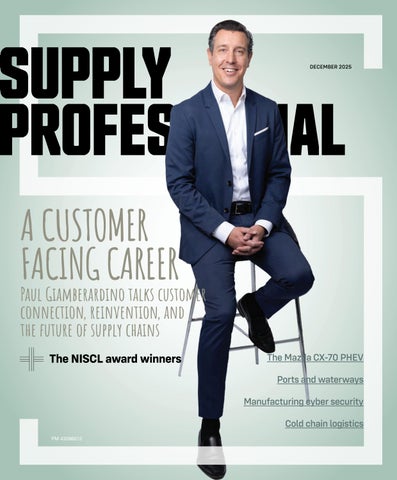
Paul Giamberardino talks customer connection, reinvention, and the future of supply chains
Successful intralogistics is all about building smart and staying agile throughout every stage of facilities management. With our engagement model that helps you ideate, activate and adapt innovative solutions, combined with the power of our family of companies, we can help you optimize your facilities for whatever tomorrow brings. Tackle the challenges of today and make the most of the opportunities of tomorrow.
ONE TRUSTED PARTNER THREE STAGES OF OPTIMIZATION ENDLESS OPERATIONAL ADVANTAGE



There’s little doubt that the past year has been transformative in many areas, with supply chain being no exception. In speaking with people in the field, a recurring comment has been that no two days are the same. We’ve seen that volatility accelerate over the past 12 months.
So, for Supply Professional’s last issue of the year, we’ll go through some of the major trends that we’ve seen in 2025 and how they will likely play out going into 2026.
Certainly, political and trade relations with the US have dominated any discussions of supply chains this year. With the old rules-based system seemingly out the window for now, we’ve instead seen the rise of protectionism and the use of tariffs.
As of this writing, the US has imposed a 35 per cent tariff on most non-CUSMA goods, along with 10 per cent on energy and potash products, and 50 per cent on steel and aluminum derivatives. This has fed uncertainty, disrupted trade, and contributed to a slowdown in economic growth.
Yet, it has forced us to re-evaluate trade not only with our southern neighbours, but several other countries and trading blocks. For example, the Canada-Indonesia CEPA, the first bilateral trade agreement with an ASEAN country, comes into force in 2026. Other trade deals are also in the works, as are new initiatives for manufacturing and infrastructure.
Another rapidly transforming area is the use in supply chain of advanced technologies, with artificial intelligence (AI) as the most hyped of these products. Adoption of these technologies has accelerated this year. According to MHI’s 2025 supply chain report, supply chain leaders are significantly ramping up their technology investments, with 55 per cent planning to spend more and 60 per cent planning to spend over $1 million. We’ll likely see more adoption of these technologies as the price point drops.
The rise of technology also means the need for better trained workers. Going forward, supply chain leaders must be data literate. At the same time, organizations must remember that technology’s best use is alongside humans, rather than as a replacement.
That means soft skills will be a differentiator, especially as workers spend more time engaged with technology. Those with people skills will become more valuable. Intelligent companies realize this and are upskilling their employees accordingly.
So, looking ahead to 2026, expect to see a rise in the use of advanced technologies such as AI for a range of supply chain functions. We’ll also see the expansion of Canada’s role in areas like critical minerals, clean tech, manufacturing, and others.
As the integration of those technologies deepens, our workforce must develop new skills while not losing sight of the value of soft skills.
This year has provided us with a lot to deal with. But as always, those who benefit in 2026 will be those who can turn this volatility into opportunity.

EDITOR
MICHAEL POWER 416-441-2085 x7 michael@supplypro.ca
PUBLISHER
FARIA AHMED 416-441-2085 x 5 faria@supplypro.ca
DESIGN
Art Direction ROY GAIOT Design Consultation BLVD AGENCY
iQ BUSINESS MEDIA INC.
Vice President STEVE WILSON 416-441-2085 x3 swilson@iqbusinessmedia.com
President & Executive Publisher ALEX PAPANOU
PUBLICATION MAIL AGREEMENT NO. 43096012 ISSN 1497-1569 (print); 1929-6479 (digital)
CIRCULATION Mail: 126 Old Sheppard Ave, Toronto ON M2J 3L9
SUBSCRIPTION RATES
Published six times per year
Canada: 1 Year $ 99.95 CDN Outside Canada: 1 Year $ 172.95 USD Single price per copy $18.00 CDN
Opinions expressed in this magazine are not necessarily those of the editor or the publisher. No liability is assumed for errors or omissions. All advertising is subject to the publisher’s approval. Such approval does not imply any endorsement of the products or services advertised.
Publisher reserves the right to refuse advertising that does not meet the standards of the publication.
No part of the editorial content of this publication may be reprinted without the publisher’s written permission. © 2021 iQ Business Media Inc. All rights reserved. Printed in Canada.
Supply Professional is the Official Magazine for NISCL

I have the privilege of working with an editor who gives me free reign. But there are times when he does funnel ideas, and several days ago I received an email suggesting that an interesting column could be a look ahead to 2026: what will it hold for the Canadian economy? And at the risk of looking as foolish as foolish can be, I’m going to give it a shot. I’ll make my fearless predictions, then let the chips fall where they may.
But first a look back at 2025. At the time of writing (mid-November), here are Canada’s key economic indicators: Inflation is 2.2 per cent annualized and seems to be heading down.
Unemployment hovers around seven per cent. The projected real GDP growth is a tad higher than one per cent. Let’s try to provide a bit of context around each of these numbers. The Bank of Canada targets an inflation rate of two per cent so we’re okay there. Seven per cent unemployment sounds high to me, but it’s around the 10-year average, which was skewed upward by the COVID-19 lockdown. GDP growth has averaged two per cent over the past decade, so we’re on the wrong side of that number.
It’s not surprising that the performance has been sub-par over the past year. It’s due in large part to the uncertainty caused by the erratic Donald Trump tariff policies. I have written about this issue at length. I am truly surprised that a comprehensive trade deal hasn’t already been reached. It makes me
wonder whether this is a conscious political decision by the US President. Mid-term elections will occur one year from now. Perhaps Trump wants to close a series of trade deals weeks or months before those elections because of the impact it would have on the stock market and the mood of the business community.
Trump’s decisions are beyond our control. What is under our control is fiscal and monetary policy, and 2025 has seen mismanagement in both realms. We’re projected to run a deficit this year of $78.3 billion which is almost $2,000 for every man, woman, and child. If we were living within our means – which is both good economics and a moral imperative –that’s how much our taxes would have to go up, or how much spending would have to go down. Deficits this size are unsustainable. No Canadian politician seems to have an idea how to bring taxation and spending into balance.
The Bank of Canada was slow to cut interest rates and at 2.5 per cent, the bank rate is too high by one-half of one percent, or 50 basis points. There is a broad consensus among economists that if you have an expansionary fiscal policy (running large deficits) and contractionary monetary policy (higher than justifiable interest rates), that the public sector will grow at the expense of the private sector; and as it turns out, the proof is in the pudding.
The monthly Labour Force Survey, put out by Statistics Canada, classifies workers as public sector employees, private sector
employees and the self-employed. Over the past 12 months, public sector employment grew by 3.7 per cent. Private sector employment grew by 2.4 per cent. The number of self-employed, year over year, is almost unchanged. These are troubling numbers and explain why we’ve seen tepid economic growth and productivity that has flatlined.
If you’re getting depressed about Canada’s economic future, I can’t blame you. But if it’s always darkest before the dawn, maybe you can buy into my thesis that we’ll see significant economic improvement over the next year.
Here’s how it will come about. The tariff spat with the US was a valuable wake-up call. I’ve noticed recently that the Ontario government is running ads to support rare earth mining. Canada should be making a concerted effort to monetize the natural resources we are blessed with, whether oil and gas or minerals. This will be a tremendous source of wealth for our country. Then it will be enlightened self-interest for the US to partner with us in exploiting this bounty.
And speaking of partnering, I have to believe that by the summer 2026 we will have reached a comprehensive trade deal with the US. The uncertainty is hamstringing private business and even if the eventual deal might not appear to be great, at least there will be a deal and the certainty it provides.
Bottom line, here’s what I think we’ll be looking at one year from

“GDP growth has averaged two per cent over the past decade, so we’re on the wrong side of that number.”
now: interest rates will be lower, even while inflation stays tame or recedes slightly. After the trade deal is struck, unemployment will start to come down and it will be closer to its normal historic average of six per cent by the end of 2026. Similarly, real GDP should return to its more normal longterm growth rate of two per cent. Call it a good but not great economy in 2026. SP
BY NISCL STAFF
The National Institute of Supply Chain Leaders (NISCL) Awards were more than a celebration – they were a reaffirmation of why supply chain leadership matters now more than ever. Amid global uncertainty, climate pressures, and economic volatility, Canada’s supply chain community continues to anchor national resilience and drive organizational agility. The Awards evening brought this truth to life, showcasing individuals and teams whose work not only delivers results but shapes the country’s strategic future.
In the months leading up to the Awards, we spoke about the importance of speaking the C-suite’s language – translating operational excellence into strategic influence. The idea is simple but transformative: when supply chain leaders articulate their impact in terms of profitability, resilience, and enterprise growth, their stories resonate in the rooms where critical decisions are made. The Awards night was a vivid expression of that philosophy. Every nominee demonstrated that supply chain and procurement are not transactional functions, but strategic imperatives that define organizational success.
The NISCL Awards were conceived to shine a spotlight on leadership that often operates behind the scenes – the people who anticipate disruption, safeguard continuity, and innovate under pressure. In today’s environment, this kind
of leadership is not optional; it is what keeps Canada moving, building, and thriving.
Recognition programs like NISCL’s are vital because they validate and amplify these contributions. They remind us – and the C-suite –that supply chain decisions are enterprise decisions. Every story told from the stage was a story of foresight, collaboration, and strategic growth.
The energy in the room was electric as peers, partners, and industry leaders gathered to celebrate a year of innovation and resilience. From public institutions to private enterprises, the stories shared reflected an extraordinary range of impact — from stabilizing essential services to building sustainable sourcing frameworks and reimagining logistics in a volatile global market.
Each of the four categories represented a distinct dimension of leadership:
Public Sector Supply Chain Team of the Year:
• P rocurement Services Team, The City of Vaughan
• Materials Management Team, University Health Network
• Strategic Sourcing (Consumables) & Purchasing, The Hospital for Sick Children (SickKids)
• Procurement & Supply Chain, Hamilton Health Sciences
WINNER: Materials Management Team, University Health Network
Private Sector Supply Chain Team of the Year:
NOMINEES:
• P rocurement Department, Give and Go Prepared Foods, A Division of Mondelez International
• Supply Chain Planning & Fulfillment, Maple Leaf Foods Inc
• BGIS Strategic Sourcing, BGIS
WINNER: BGIS Strategic Sourcing
Emerging Supply Chain Leader of the Year:
NOMINEES:
• Amanda Abbott – Category Manager, Construction, Toronto Community Housing Corporation
• Brunilda Gjini – Senior Manager, S&OP, Pernod Ricard
• Rajan Tyagi, CSP – Sourcing Specialist, BGIS
• Theora P. – Packaging Supervisor, DHL Supply Chain
• Victoria D’Astice – Senior Supply Chain Analyst, The Regional Municipality of Halton
WINNER: Brunilda Gjini – Senior Manager, S&OP, Pernod Ricard
Senior Supply Chain Leader of the Year:
NOMINEES:
• Barbara McDonald, NISCL-CSCL/ CSCMP, MCIPS – Director, Customer Supply Chain, Sofina Foods Inc.
• Dimitri Fleitman, MBA, CCLP, SCMP, CSCL, MCIPS – COO, Just Quality International | Previously: Head of Supply Chain, Dole Packaged Foods
• John Castelhano – Senior VP, Strategic Sourcing North America & UK, BGIS
• Nick Nanos – Chief Supply Chain Officer and Senior Vice President Wholesale, LCBO
• Nuria Defoe – VP, Procurement, Mattamy Homes
• Rosalia La Corte - NISCL-CSCL/ CSCMP, BFA, Prosci Change Practitioner – Director, Strategic Sourcing, Workplace Safety Insurance Board
• Sam Pringle – Director, Supply Chain Management, The Regional Municipality of Halton
• Sanja Cancar-Todorovic, DBA, eMBA, MM, BA(hons.) – Principal, Global Commercial Cloud and AI Datacenter Integration, Microsoft
• Taras Korec, P. Eng., P. Log., CSCMP, NISCL-CSCL – VP, Operations, Compugen Inc.
• Tharshini Markandaier – Head of Procurement and Category Management, Toronto Transit Commission
• Victoria G. – Director, Procurement and Enterprise Risk, City of Edmonton
WINNER: Nick Nanos – Chief Supply Chain Officer and Senior Vice President Wholesale, LCBO
The judging process was meticulous and rooted in fairness. Each submission was evaluated against 15 attributes within five sub-categories, with judges independently reviewing and scoring entries before results were collated. This rigorous approach ensured that every finalist was recognized for genuine impact, innovation, and leadership excellence. As one of the judges remarked, “I wish you could all win.” Indeed, every nominee is a winner in their own right –each having demonstrated a level of influence and creativity that elevates the profession as a whole.
COLLECTIVE PRIDE IN WHAT CANADA’S SUPPLY CHAIN LEADERS REPRESENT What made the evening most powerful was not just the announcement of
winners but the collective pride in what Canada’s supply chain community represents. Whether in the public or private sector, emerging or senior roles, these leaders are redefining what it means to lead with purpose –turning intelligence into innovation, resilience into strategy, and collaboration into national strength.
Their stories bring to life the message we’ve championed all year: supply chain leadership is strategic leadership. By communicating its impact in the language of value, performance, and growth, our profession not only earns a seat at the executive table – it helps shape the agenda.
As we celebrate this year’s winners and nominees, the NISCL Awards remind us that recognition fuels visibility – and visibility drives influence. The future of Canada’s competitiveness will be written by those who see the supply chain not as a function, but as a force for transformation.
Because you are not just managing supply chains. You are shaping how Canada moves, builds, and delivers. At the end of the evening, one thing was unmistakable: a deep appreciation for the profession and a renewed recognition of its significant impact on the Canadian economy. SP
“Every nominee demonstrated that supply chain and procurement are not transactional functions, but strategic imperatives that define organizational success.”



BY MARIA GREAVES-CACEVSKI
If life is a game, then business is a chessboard. The winners are the ones who are strategic in purpose and execution. Whereas mission and vision statements are organizational directives for achieving someone else’s goals, personal growth and development must be the epicenter for career resilience. There needs to be a shift from external validation to internal alignment. The focus for career development is on the “why” and the “how” of personal success.
In this era, job market stability is threatened by uncontrollable factors such as geopolitical instability, economic volatility, automation, and artificial intelligence. Traditional career strategies are eroding quickly. The old model of career stability was built on loyalty to one employer and mastery of one skillset. This model can no longer compete with the new paradigm where roles are fluid and not fixed, making long-term job security uncertain. The breaking point is the realization that adaptability and diversification are more valuable than loyalty. The new career rules are to play for resilience, build a multifaceted skills portfolio, and invest in your personal brand and network as your safety net.
Career development today is shaped by three major forces: High-impact courses and certifications: Practical, recognized credentials aligned with industry demands have become essential for boosting procurement expertise and staying competitive.
Resources and communities for continuous learning: Professional growth now thrives on networking, conferences, and knowledge-sharing platforms that enable real-time
learning and collaboration. Networking as the cornerstone: Building connections through industry events and online communities is no longer optional. It’s the foundation for career resilience and advancement.
Career pathways in today’s landscape have a combination of high-impact courses and certifications aligned with industry demands and resources
and communities that support continuous learning and growth. The shift of career focus to practical, recognized credentials that boost procurement expertise has been the result of the spotlight on procurement as the strategic backbone of organizational success. To meet the global demand for timely, high-impact training in supply chain, procurement, and sourcing, credible professional associations are curating specialized designations to deliver career resilience. Below are some examples.
National Institute of Supply Chain Leaders (NISCL): A Canadian association focused on developing supply chain professionals. It offers the Certified Supply Chain Leader (CSCL) designation and is the exclusive Canadian partner of the Chartered Institute of Procurement & Supply (CIPS). The partnership offers NISCL-CIPS dual membership and dual designation with an executive level fast track.
Association for Supply Chain Management (ASCM): The largest non-profit association for supply chain management globally with over 45,000 members in 100 countries. Formerly known as the American Production and Inventory Control Society (APICS), it offers a range of certifications, such as Certified in Planning and Inventory Management (CPIM), Certified Supply Chain Professional (CSCP), and Certified in Logistics, Transportation and Distribution (CLTD) and focuses on planning, inventory, logistics and manufacturing.
Institute for Supply Management (ISM): The world’s oldest non-profit association for supply management association with over 50,000 members in 90 countries. Certifications are focused on leadership within procurement and sourcing within the supply chain, such as Certified Professional in Supply Management (CPSM) and Certified Professional in Supplier Diversity (CPSD).
Professional development is not random, it is intentional. It follows a chronological structure designed for purpose and execution. Each step builds on the previous one to ensure clarity, capability, and measurable impact. This framework applies across industries and empowers individuals to become
S.T.A.R. performers by applying the purpose of “why” and the execution of “how” as a continuous career development review process.
Step one is to strategize, the purpose is to understand your environment and define your “why.” The execution involves auditing the current state, identify gaps, and benchmark performance metrics.
Step two is to transform, the purpose is to set strategic goals that are aligned with your values and career vision. The execution involves creating a roadmap with clear objectives and timelines.
Step three is to be accountable; the purpose is to build capabilities and execute with discipline. The execution involves upskilling, digitizing processes, collaborating, and standardizing best practices.
The final step is to resile, the purpose is to deliver measurable impact and reinforce adaptability. The execution involves tracking KPIs, sharing achievements, and recognizing wins to reinforce resilience.
“To meet the global demand for timely, high-impact training in supply chain, procurement, and sourcing, credible professional associations are curating specialized designations”
Procurement agility as a career development concept means applying the same principles that make sourcing agile – speed, adaptability, and data-driven decisions – to your own professional growth. Career development needs to be a strategic roadmap where skills are continuously evaluated by monitoring market trends and optimizing capabilities in data ana-
lytics, negotiation in volatile markets, and digital fluency. The outline of your level-up roadmap for career and personal growth is designed using gaming principles – invest in continuous learning and build both hard skills (technical expertise) and soft skills (communication, adaptability). The fundamentals of game-inspired strategies frame challenges as opportunities to learn and grow. These are universal strategies that work across any industry because the model outlines a strategic purpose and execution that is intentional and disciplined. Just like how the current procurement strategy has evolved from a transactional function into a critical competitive advantage to deliver value through innovation of goods and services. The application of gaming principles to procurement can reinforce strategy, engagement, and continuous improvement because the rules of business are changing constantly. To level up your procurement game, professionals need to improve tech-

nical skills, strategic thinking, and leadership capabilities with actionable steps and timelines. Your S.T.A.R. professional development model should be anchored to a strategic purpose and an agile strategic execution plan to level up. SP

BY MICHAEL POWER
Supply chain offers a variety of potential careers, whether in logistics, procurement, transportation, or other areas. For Paul Giamberardino, what has long drawn him to the field has been the opportunity for customer facing roles, in which he acts as the final touch point in the buying experience. From roles in sales or supply chain, that customer connection has been a compelling aspect of his decades-long supply chain career.
“Whether that customer is a patient in a hospital, a parent coming in to buy back-to-school supplies, or someone getting a new iPhone – it’s been a variety of different customers – but always the last step before that customer experience,” says Giamberardino, a Hamilton, Ontario native and now the chief supply chain officer at Staples Canada. “That helps identify what you need to do to excite and delight your customers. It helps me think in terms of the experience that we’re trying to drive for our customers. That’s ultimately what needs to be driving your decisions and how your strategies evolve.”
While Giamberardino’s supply chain career spans over 25 years, his education and first career path were in engineering. He received a mechanical engineering and management degree from Hamilton’s McMaster University. The five-year
program offered a combination of business and engineering. It also gives students an advanced standing into the second year of an MBA, which Giamberardino pursued after he began working.
An early position came when Giamberardino began working at Procter & Gamble in 1998, in the company’s Hamilton manufacturing plant. While the facility had produced soap for almost a century, the company announced the plant’s closure on Giamberardino’s sixth day on the job. Still, it kept operating its distribution centre across the street from the plant.
He was happy to be in his hometown and decided to stay on with the small team running the DC. The facility supplied all of P&G’s products in Canada. Giamberardino worked with the company’s big accounts, focusing on everything from order management to inventory management forecasting while managing the flow of goods from P&G’s facilities to clients’ facilities.
“That was my stumble into supply chain,” he says. “From there, I ran the distribution and the inbound and outbound logistics. I then moved to the head office with P&G and worked in what was called customer logistics.”
By this time, he had worked in manufacturing, distribution, and customer logistics. Yet
Giamberardino wanted a role with an even greater customer-focus. He also wanted to learn more about how customers interacted with the company’s products. He worked in different capacities within P&G’s sales division.
After about a decade, an opportunity arose at Johnson & Johnson. Giamberardino took the job. He saw it as a way to work in consumer packaged goods in a supply chain capacity for an entrepreneurial, evolving company.
“My role expanded to where I was leading some strategy for North America, and then into another role, which was leading all of customer logistics,” he says. “So, all the distribution and customer service for other products across all three of our segments in Canada – the consumer packaged goods, and then medical devices, things like orthopedics, sutures, heart stents, and then pharmaceuticals.”
Those segments represented distinct operating companies in Canada, and Giamberardino’s team was one of the few working across all three. He was on the executive team for both medical devices and consumer products. Johnson & Johnson was one of the few companies taking best practices from retail and applying them to healthcare. This practice improved patient outcomes, provided better availability, and ultimately improved the company’s working capital.
“I enjoyed the feeling that I had every day coming into work knowing that I’m going to improve someone’s life, either with a life-saving surgical product or maybe a cancer drug that would extend someone’s life, that you’re getting to Canadians who need it,” he says. “It was a pretty heartwarming role to be in.”
After almost nine years, Giamberardino’s next role was at Rogers Communications. The company was consolidating its fragmented supply chain to improve efficiency and effectiveness, and in 2019 he became its VP of supply chain.
The COVID-19 pandemic began soon after that. Suddenly, Canadians needed improved residential internet to work from home, yet the company’s stores, like most others, were shut down. Technicians couldn’t enter people’s houses to install internet, so supply chain kept the business running, Giamberardino says. Some creativity didn’t hurt either. Rogers created internet self-install kits, allowing customers to receive a kit that allowed them to install the internet themselves. The company provided support via an app that walked customers through the installation. That helped those working at home to stay connected.
“It was challenging and a lot of fun,” Giamberardino says. “We were proud of what we did – we consolidated our supply chain. We opened
state-of-the-art facilities. We moved from various providers into singular, consolidated entities, and ultimately provided a much better customer experience, such that we were delivering phones next day across the country. No matter what day you ordered it, even if you ordered on a Friday or Saturday, you’d get it on a Saturday or Sunday, which was new to the industry.”
After almost four years at Rogers, another opportunity arose, this time on the executive team at Staples Canada. Giamberardino joined that company in 2022, which was again looking to consolidate their supply chain. The supply chain was fragmented, with distribution reporting to one group, replenishment reporting to another, and so on. There were opportunities to orchestrate things more effectively under one leader, providing a strong voice at the executive table to champion supply chain initiatives.
Giamberardino’s new role as chief supply chain officer allowed him to be that voice, influencing not only the supply chain but also strate-
gy, go-to-market plans, and how the company addresses customers. He saw this as an opportunity to return to such a position and has been in the role for three years.
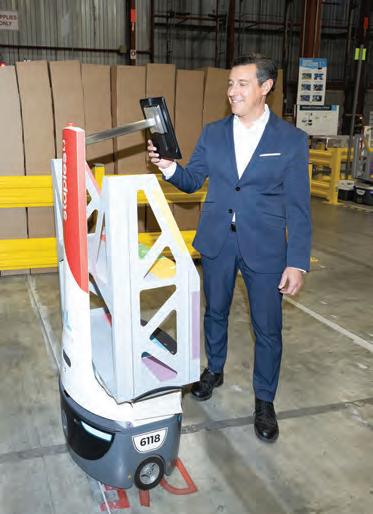
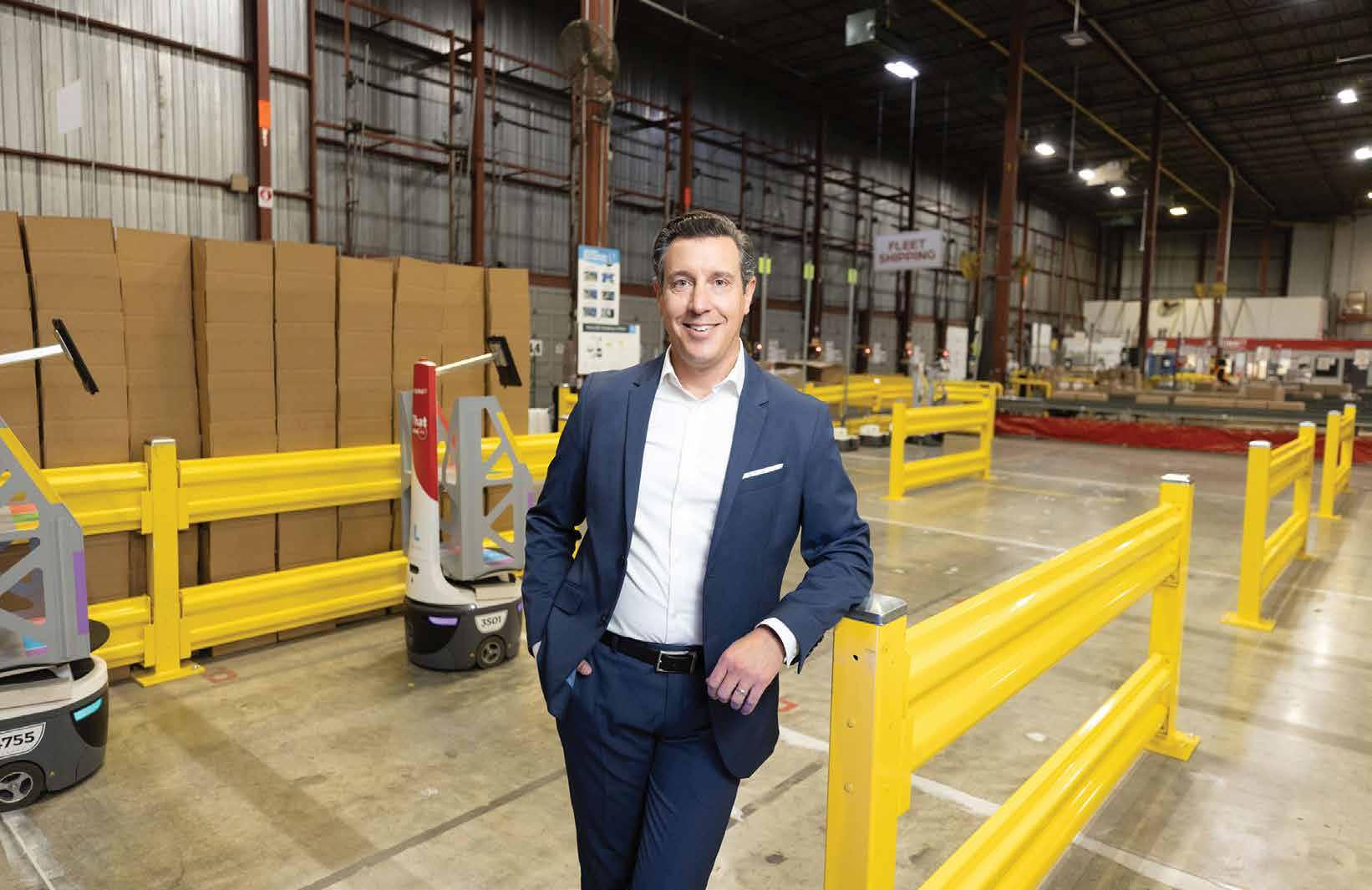
“I think we’ve changed every element of the supply chain already, and there’s still lots to do,” he says. “We’re putting in state-of-the-art warehouse management, transportation management, at all of our facilities across the country. We’re aggressively redesigning our real estate footprint and consolidating our operations. We’re introducing robotics and automation into our fulfillment centres, upgrading our planning, and forecasting infrastructure to better serve our customers. It’s a great team I get the opportunity to work with. We’re really seeing the fruits of our labour with our cost profile coming down and our service going up.”
Those efforts haven’t gone unnoticed. In June, the Retail Council of Canada awarded Staples Canada supply chain team the Supply Chain Innovation Award.
While each day is different, Giamberardino says the role is always interesting. His day usually starts with a review of the organization’s results, including the previous day’s performance, what store traffic was like, any pressing issues that need attention, and so on. Are there any service or systems outages within fulfillment centres across the country? What where the volumes like? From there, he shifts to a more forward-looking perspective. With several major transformation projects underway, Giamberardino spends time on updates regarding potential new technology, vendor meetings to understand new automation for facilities, new software applications to improve forecasting or operations management, and so on.
Most days include a finance meeting to discuss costs, performance, or how the organization is managing against its budget.
“And then often it’s collaborating with my peers, so that not a day goes by where I’m not talking to our CEO or CFO or our head of retail or head of marketing and merchandising on various projects that we have going on,” he says.
Over 25 years of experience has led to several career highlights for Giamberardino. While he worked at Johnson & Johnson, he participated in some executive development programs. For one, the company put leaders from around the world into groups, giving them challenging projects. One such project focused on the delivery of drugs – HIV drugs in particular – to Sub Saharan Africa. Some of those pharmaceuticals required cold chain and temperature protection during their journey. Giamberardino’s group –consisting of people from across the world who had never met – worked to pilot different ways to accomplish that, including drone deliveries and other transportation methods.
“That was definitely out of my comfort zone,” he says of the experience. “Having always worked in Canada and seeing the challenges when you don’t have infrastructure in certain markets and things that we take for granted. It gave me a real appreciation for where we live, and some of the support structure that’s in place as Canadians.”
Another project involved delivering healthcare into Brazil, which especially fascinated Giamberardino. The country was hosting the World Cup, building multi-million-dollar stadiums in the Amazon Rainforest, while putting on an international tournament. Yet, accessing basic healthcare was challenging for many Brazilians. Giamberardino and other leaders offered recommendations for improvement.
Another career highlight came from his alma mater, the engineering and management program at Hamilton’s McMaster University, which recently celebrated the 50th anniversary of the program. A total of 50 graduates were chosen over the past 50 years, with Giamberardino among those recognized as successful program graduates.
“It was an amazing event,” he says. “I was amongst peers from various decades of graduation that have gone on to do some pretty amazing things. It was a really nice recognition and great way to promote the program, which is still a premier engineering program today.”
Supply chain offers its professionals lots of challenges, Giamberardino says. From the Ever Given getting jammed in the Suez Canal in 2021, to multiple port strikes, Canada Post strikes, the COVID -19 pandemic, and so on, there are always new threats on the horizon.
“My advice to anyone who’s even contemplating supply chain is, it’s a super-exciting time to be getting into this field, and one that promises to be a lot different in even five or 10 years.”
Yet, that’s what makes the field interesting, Giamberardino stresses. No two days are the same, which is why there are so many smart people in the industry. There is so much innovation in the field that supply chains are being built differently than they were in the past. For example, warehouses are now designed for robotics and automation, rather than just forklifts moving pallets. This transformation is yielding benefits.
“There’s so much change happening in terms of how you can orchestrate the movement of goods such that you’re taking out a lot of costs, but also improving the customer experience,” he says. “My advice to anyone who’s even contemplating supply chain is, it’s a super-exciting time to be getting into this field, and one that promises to be a lot different in even five or 10 years than what it was over the last number of years. That’s all being enabled and underpinned by the data we have. You’ve got tools at your disposal that never existed in the past. It’s demanding a completely different skill set than what we had in the past.”
The industry’s profile is changing, and supply chain teams include data scientists, robotics engineers, network design analysts and others. As well, those in the field must now learn about artificial intelligence’s applications – something that Giamberardino is doing. Supply chain professionals must also ensure their underlying data is accurate so AI can make the best decisions possible.
“Those are the challenges that we’re facing, but they’re fun and exciting ones,” he says. “And I’m thrilled in terms of what we’ve been able to do here at Staples, even in a short period of time, but I’m more excited about what our roadmap has in front of us, and the variety of different vendors we’re yet to interact with, and some of the fascinating technology that’s coming online.”
Outside of work, Giamberardino has been an active runner, often starting his day with a run. He runs while listening to music, a podcast, or enjoying the uninterrupted time to contemplate the day ahead. Over the past decade, he has participated in several marathons and half-marathons.
He and his wife and three daughters now live in Toronto. Two of his children attend university, while the youngest still lives at home. She is a com-
petitive swimmer, similar to her eldest sibling, and the pastime means the family spends a lot of time at the pool. Giamberardino often acts as a lane timer or strokes-and-turns judge at swim meets, and he is involved with the swim club has served on the board of directors.
The family also has a cottage in Georgian Bay, where they enjoy spending time. He is also a sports fan and follows Toronto sports teams like the Maple Leafs and Blue Jays.
Giamberardino is involved with the NISCL Leaders and was a judge during the organization’s recent awards program. He sits on the advisory council for Toronto Metropolitan University, helping to build its supply chain program as one of the school’s post-graduate programs.
“Where we or other leaders can play a role to help raise the profile of our practice, it’s a great time to be doing it,” he says. “It’s something that our country and our economy need.”
Regarding advice for supply chain professionals, Giamberardino refers to the acronym “PIE.” Early in his career, Giamberardino thought that hard work was enough to unlock opportunities. A mentor then told him about to the acronym. The ‘P’ refers to ‘performance.’ You need to do a good job in whatever role you undertake. That’s the “price of entry” in terms of opportunities and advancement, he says. The ‘I’ is for ‘image’ and what people think of you. The ‘E’ stands for ‘exposure.’ Ensure you are meeting the right people, advocating for yourself and where you want your career to move. Reach out and make connections, whether it’s in supply chain or elsewhere.
“My guidance has always been to remember the PIE acronym,” Giamberardino says. “Have a strong performance, have a really great image, work well with others. And then ultimately make sure you’re getting exposure and build your network, because you never know when opportunities are going to open up.”
Finally, Giamberardino stresses that he’s excited about supply chain’s profile on the corporate and national levels, especially since the pandemic helped to raise that profile to where it is today. Winning companies are the ones that do supply chain well. There are opportunities to elevate the field’s profile, he notes. For those with established supply chain careers, there are now even greater opportunities, including advancing to chief executive officer.
“It’s something that the industry should be celebrating,” he says. “We should look for ways to help supply chain folks who bring a balance of delivering to the customer but also managing the bottom-line costs into organizations. That’s something many organizations need. It’s a fantastic time to be promoting that.” SP
BY CHRISTIAN SIVIÈRE
Trade is a vital part of Canada’s economy: it represented 65 per cent of our GDP in 2024 and exports alone support nearly 3.3 million Canadian jobs. Trade in services is growing faster than trade in goods, driven by digitalization. Yet, merchandise trade is still growing, despite tariffs and other geopolitical challenges. World Trade Organization economists recently raised the 2025 merchandise growth forecast to 2.4 per cent (up from 0.9 per cent in August) though they lowered the 2026 projection to 0.5 per cent (from 1.8 per cent).
Canada will therefore continue to trade. Challenges with our primary trading partner led our government to formulate a strategy of doubling our non-US exports within a decade, to net an extra $300 billion in trade. This ambitious goal requires adequate transport infrastructure to move our goods efficiently and economically, and our ports and waterways will play a key role in achieving it. Historically, ports and waterways have been at the centre of
Canada’s history. The Hudson Bay and its connecting rivers became a hub for the fur trade developed by the Hudson Bay Company, Canada’s oldest company, established in 1670. The Canadian Pacific Railway linked Canada’s Atlantic and Pacific coasts, symbolizing national unity and ambition.
The importance of ports and waterways was illustrated with the 1959 inauguration of the St. Lawrence Seaway: the system of rivers, locks, canals, and channels enables oceangoing vessels to travel from the Atlantic to the Great Lakes, as far inland as Duluth, Minnesota on Lake Superior. It’s jointly managed by Canada and the US and transports bulk commodities like grain, iron ore, coal, cement, steel, stone, chemicals, and forest products, between late March and late December.
Measured in container traffic, Vancouver is by far Canada’s main port and the fourth largest in North America (3.47 million TEUs handled in 2024), followed by Montréal (1.46 million TEUs), Prince Rupert (739,000 TEUs), Halifax (509,000 TEUs) and St John (184,000 TEUs). Taking overall tonnage into consideration, including bulk and breakbulk, the ranking is more diverse: Vancouver, Montréal, Sept-Iles, Saint John, Québec, Prince Rupert, Halifax, Thunder Bay, Hamilton, and Toronto. Doubling our non-US exports will require significant investments in port and rail infrastructure to handle the increased volume, putting pressure on the key ports of Vancouver and Montréal, creating opportunities for our smaller ports.
The Canadian Government’s last budget included significant funding for transportation, including ports, with a proposed $5-billion new Trade Diversification Corridors Fund over seven years. A major project under study in Montréal for several years and now coming to fruition, is the construction of the Contrecoeur Terminal about 40
kilometres down river, to increase the port’s capacity by 55 per cent. The project cost is estimated at $2.3 billion, and the federal government announced a $150 million commitment to it, part of its new funding for transportation infrastructure nationally. Independently, the port of Montréal recently rolled out several construction and overhaul projects to improve fluidity: the repair of Berth 28, the widening of the Pie-IX bridge and further construction of the overpass spanning Notre-Dame Street.
Recent projects initiated by the Vancouver Fraser Port Authority include the one-of-a-kind Roberts Bank Terminal 2 expansion, with procurement for the landmass and wharf components underway, and expected to be completed in the mid-2030s, plus significant rail corridor improvements in Burnaby, the Ridley Island Export Logistics Platform, and other road and rail upgrades. Dredging the Burrard Inlet and deepening the navigation channel underneath the Second Narrows bridge are ambitious projects in the preliminary stage, with no cost attached to them yet. The objective is to accommodate larger vessels to maximize oil shipments. With the Trans Mountain expanded pipeline and Westridge Marine Terminal coming into operation in May 2024, crude oil exports surged in 2025, with approximately 60 per cent of the volumes going to China, and the balance to the US, South Korea, Singapore, and Japan.
On the East Coast, the port of Halifax can boast of being the only port able to receive mega ships carrying 18,000 TEUs. Recent port infrastructure investments focused on green shipping by funding alternative fuel vessels, a hydrogen production facility, electrification of port equipment, and an electric locomotive.
At the port of Saint-John, the decade-long modernization plan allowing for larger vessels is nearly complete and it now boosts a capacity of 800,000 to one million TEUs,

with multiple rail lines running directly onto the port’s property.
In the meantime, Great Lakes ports called for CBSA to expand container inspection services to six inland ports along the Great LakesSt. Lawrence Seaway, in a report commissioned by the Chamber of Maritime Commerce. It examined the impact of upgrading CBSA services at marine facilities in Québec City, Hamilton, Valleyfield, Windsor, Goderich, and Picton. Currently, the CBSA only clears marine containers at five ports: Halifax, Saint John, Montréal, Prince Rupert and Vancouver. Designating the six additional ports as “ports of first arrival” would generate new income for those ports but also relieve pressure on existing gateways, cut truck emissions, align with our trade diversification priorities, and connect inland communities to global markets. Currently though, there are no direct ocean container services to and from any of these six ports.
Today, only 18 per cent of Canada’s exports and 24 per cent of our imports move via water, highlighting the importance of our US trade, which moves predominantly by truck. These percentages are expected to grow drastically in the next 10 years, and in various ways, our ports are getting ready for the challenge. This will help us achieve our goal of substantially increasing our non-US trade, and reduce our dependency on the US, both as an export market and as a source of supply. SP
In today’s complex public sector landscape, procurement professionals face mounting pressures to maximize value while navigating budget constraints, compliance requirements, and operational efficiency demands. At the same time, the procurement process for education, government, health care, and non-profit organizations often involves time-consuming procedures, limited supplier options, and limited real-time oversight of daily spending.
But as of this year, that reality is changing: Amazon Business Canada is now an awarded supplier partner under Ontario Education Collaborative Marketplace’s (OECM) new Online Marketplace Platform Services agreement. This creates new opportunities for public sector buyers to leverage the convenience, selection, and value of Amazon through a competitively-awarded contract vehicle.
OECM is a trusted not-for-profit collaborative sourcing partner for Ontario’s education, municipal and Broader Public Sector (BPS) organizations. With over 1,400 public sector entities across Ontario leveraging its agreements, OECM has always prioritized delivering cost-effective, high-quality solutions to its members. By awarding Amazon Business as a supplier partner under the Online Marketplace Platform Services agreement, OECM reinforces their commitment to innovation by providing a fast, practical solution to some of the key challenges faced by public sector procurement teams. Through the new Agreement, OECM members can leverage
Amazon Business’s vast store while maintaining compliance with procurement guidelines and optimizing organizational spending. The collaboration comes at a critical time when public sector organizations are being asked to demonstrate fiscal responsibility while continuing to meet the growing demands of their constituents.
What makes this Master Agreement especially valuable for public sector procurement professionals is how it addresses multiple pain points simultaneously:
Simplified Selection with Enhanced Visibility: With access to millions of products from a single source, buyers can easily compare options and prices while leveraging powerful analytics tools to track spending across departments. This empowers procurement teams to make data-driven decisions that align with budget constraints and organizational priorities.
Local Business Support:
Public sector organizations often have mandates to support local businesses. With over 200,000 Canadian suppliers on its store, Amazon Business enables buyers to highlight and prefer local sellers, making it easier to meet these objectives without sacrificing selection or convenience.
Streamlined Compliance:
The Guided Buying feature available through Business Prime

helps direct employees to approved products and suppliers, helping to prevent procurement violations before they happen—a critical advantage for organizations subject to strict purchasing regulations.
Administrative Efficiency:
Multi-user accounts with customizable approval workflows eliminate bottlenecks in the purchasing process while maintaining appropriate oversight. This means faster fulfillment times without sacrificing control.
Through this Master Agreement, valid through December 2027, OECM members receive value beyond what’s typically available with free access to Amazon Business Prime for the first year, followed by an exclusive 75% off discount on Amazon Business Prime Medium and Enterprise plans for the second and third years. Benefits include:
● Quantity discounts of up to 10% on over 12 million products
● Dedicated Amazon Business representative support
● Advanced analytics tools that track buying patterns to optimize savings.
These benefits address the core challenges faced by procurement professionals in the public sector—particularly
the need to demonstrate value, maintain compliance, and operate efficiently within budget constraints.
OECM members can quickly begin taking advantage of these benefits by signing up for a free Amazon Business account. The OECM-Amazon Business agreement is valid through December 17, 2027, pursuant to the Online Marketplace Platform Services Request for Proposals #2023-41.
For procurement professionals across Ontario’s public sector, this Master Agreement represents a valuable opportunity to modernize purchasing processes, increase efficiency, and stretch limited budgets further. By combining Amazon’s store scale with features specifically designed for institutional buyers, it addresses many of the unique challenges faced by public sector procurement teams.
As organizations continue to seek innovative ways to improve operations while controlling costs, collaborative approaches like OECM’s Master Agreement award to Amazon Business demonstrate how strategic procurement relationships can deliver significant value to Canada’s public sector organizations.
OECM’s dedicated Customer Support team is available to assist with questions related to this agreement.
Email: customersupport@oecm.ca Phone: 1-844-OECM-900 (1-844-632-6900)

As 2026 approaches, Canada’s public sector stands at a defining moment. Provincial and federal governments are thoughtfully safeguarding public funds and enhancing citizen confidence by responsibly managing the growth of administrative bodies.
These actions, aligned with the federal budget’s focus on fiscal discipline, workforce optimization, and a historic $51 billion infrastructure commitment, demonstrate a balanced approach: protecting resources today to enable stronger delivery tomorrow. Across departments and agencies, leaders are harmonizing efficiency with the core mission of public service.
This transition is not without its challenges. Administrative restructuring means that organizations must do more with less. Yet beneath the surface of these pressures lies a powerful opportunity – to modernize how the public sector operates, invests in people, and delivers value
to Canadians. The choices we make in 2026 will decide whether this era marks a setback, or ignites a bold, lasting change.
Periods of reform have always tested the resilience of public institutions. But they also create space for innovation. The shift toward a leaner government offers a chance to rethink how work is done: to strengthen accountability, streamline processes, and equip employees to make faster, better-informed decisions.
True modernization doesn’t come from technology alone. It comes from people – their skills, their professionalism, and their ability to apply judgment under pressure. As governments reallocate resources toward infrastructure and public outcomes, the success of these investments will depend on the readiness
clearly defines the skills, behaviours, and outcomes required for excellence, we create a common language of capability across departments, jurisdictions, and disciplines.
Certification programs provide both accountability and recognition. They assure citizens that public funds are managed by qualified professionals, and they give employees a clear sense of career progression and pride in their craft. But to be effective, these programs must be addressed through well-designed frameworks.
A standardized competency framework ensures continuity through change. As roles evolve and technologies advance, these frameworks provide a consistent foundation for training, recruitment, and performance evaluation. They help align individual development with organizational priorities, ensuring that upskilling isn’t just reactive, but strategic.
By embedding certification and competency standards at the heart of public sector change, we don’t just build individual expertise, we strengthen the entire system. It’s how we move from ad hoc learning to sustained professionalization, from fragmented skill development to a culture of shared excellence.
of the people delivering them. That’s why 2026 must be a year not just of fiscal discipline, but of strategic capability-building.
In a time when the public sector is being asked to deliver more with fewer resources, investing in people becomes the most strategic decision leaders can make. A leaner organization can only succeed if its workforce is equipped with the right capabilities – not just technical knowledge, but judgment, agility, and confidence built through consistent professional standards.
The path forward must focus on structured upskilling anchored in certification and a standardized competency framework. When public procurement follows a shared professional standard — one that
Some may question the relevance of professional designations in today’s fast-moving world, but that view misses a critical truth: the right designation is not merely relevant; it is an imperative. A complete designation must integrate real-world experience, mentorship, and applied learning that mirror the complexity of today’s public challenges – from infrastructure delivery to digital transformation.
Canada is increasingly a global player in trade and procurement. The federal government has actively pursued bilateral trade agreements with nations across Europe, Asia, Latin America, and beyond –including recent frameworks with Indonesia, the UK, and ongoing negotiations with India and ASEAN partners. These agreements don’t just open markets; they demand
world-class procurement practices that meet international benchmarks for transparency, fairness, and efficiency.
This is where professional designations become essential. The NISCL Dual Designation – the first-ever dual credential that combines the Canadian Certified NISCL-CSCL Designation with the globally recognized MCIPS Designation – sets professionals against the CIPS Global Standard of Excellence. It goes beyond micro-credentials or legacy driven content by validating advanced competencies in complex, cross-border procurement environments: risk management in international supply chains, sustainable sourcing under trade pacts, and ethical negotiation in multilingual, multicultural contexts.
For public servants managing multibillion-dollar infrastructure or supply contracts under CETA, CPTPP, or USMCA, the NISCL-CIPS Dual Designation signals readiness to operate at the highest international tier. It transforms applied learning into globally competitive expertise,
ensuring Canadian procurement not only complies with trade obligations but leads in best practice adoption. As trade volumes grow, so does the need for professionals whose skills are recognized – and respected –from Ottawa to Jakarta.
Professional standardization cannot be achieved in isolation. It requires collaboration among governments, professional associations, and private-sector partners. Shared frameworks for certification, designation, assessment, and continuing education can reduce duplication, promote mobility, and ensure that public procurement professionals – whether federal, provincial, or municipal –are held to the same high standards. Partnerships with industry also play a vital role in keeping public sector learning relevant. Exposure to innovation, project delivery models, and data-driven practices helps bridge the gap between theory and application. When professionals move fluidly between sectors – bring-
“A modern public sector is one that values learning as much as leadership, standards as much as strategy, and people as much as policy.”
ing best practices, tools, and insights with them – everyone benefits.
The next year will test the adaptability of our institutions, but it will also define the next generation of public procurement excellence. The fiscal measures of 2025 have set clear limits, but they’ve also created momentum for renewal and change. Standardization, certification, and globally aligned designations give us a framework for channeling that momentum productively.
A modern public sector is one that values learning as much as leader-
ship, standards as much as strategy, and people as much as policy. By investing in certification, designation, and/or consistent competency frameworks, we can ensure that every public sector professional – regardless of title, department, or region – has the tools to excel.
Ultimately, this is about more than efficiency. It’s about trust. Canadians expect their public institutions to deliver consistently, transparently, and competently. Standardization of the profession, supported by ongoing development and real-world experience, is how we sustain that trust in the years ahead, so that the public procurement community continues to deliver and thrive.
As we move into 2026, the question for public sector leaders is not whether change will continue, it’s how we will prepare our people to thrive within it. The answer lies in shared standards, skilled professionals, and a collective commitment to excellence. That’s the foundation of a futureready public procurement, one capable of meeting the challenges of tomorrow with confidence and purpose. SP

BY JACOB STOLLER
This year has been a tough year for cyber security. According to a report from cyber threat intelligence organization KELA, ransomware attacks increased by 34 per cent compared with the previous year. Manufacturing, alarmingly, was the hardest-hit sector with a 61 per cent increase. Canada also holds the dubious honour of being the second most attractive target next to the US.
Much of this flies under the radar, indicating that the true picture could be far worse. The Bitdefender 2025 Cybersecurity Assessment Report found that out of 1200 security professionals surveyed, 58 per cent have been told to keep quiet about a cybersecurity incident and have acknowledged that such pressure is on the rise.
Manufacturing has become increasingly vulnerable as senior leaders seek more data to guide their strategic decisions. “In the past, operations technology (OT) didn’t talk to IT, and they were fine with keeping each other separate,” says Paul DeJong, President of Cambridge, Ontario –based systems integrator Northern Dynamics. “But since Industry 4.0 really started to proliferate, everybody wants access to that OT data through IT networks, the cloud, and so on. So, all of a sudden, all this stuff is exposed.”
At the same time, attackers are getting stronger, thanks in part to the proliferation of AI tools. For example, AI-generated emails and voicemails are highly effective at tricking employees into revealing their credentials to a hacker. Social engineering, as the practice is called, accounted for six out of 10 data breaches, according to the Verizon 2025 Data Breach Investigations Report.
“AI can now generate an email to me that looks very personal, and is very well written,” says Sheldon Fernandez, AI strategist and founder and former CEO of DarwinAI. “It doesn’t have the spelling mistakes that you would have seen in the past. The vigilance to combat this needs to be higher as well.”
Charles Cooper, owner of excavation firm Muskoka Hydrovac, says he is overwhelmed by highly convincing AI-generated emails that include remarkably accurate details about his business and his clients.
“They’re now using AI tools to scrape that information off the web,” says Cooper. “I recently got what looked like a legitimate email from a client with a link to some specification documents they wanted me to quote on. The client, I learned, had never sent this. What this means
is that even with the most legitimate looking request, I have to phone the client to confirm.” OT networks controlled by SCADA software, Cooper explains, are often particularly vulnerable because they lack the mitigation mechanisms such as authentication and encryption that are common in IT networks. Consequently, once a hacker gets access, perhaps through an engineer’s compromised PC, they are free to roam the network. A prime example of this was the 2021 Colonial Pipeline incident that shut down gas stations across the Eastern seaboard of the US. The company eventually paid the criminal ransomware group DarkSide $4.4 million in ransom.
Hackers are also striking in some of the most unexpected places. As DeJong notes, the industry was recently shocked when an unauthenticated attacker used standard communications protocols to gain access to a Siemens PLC controller. By bombarding it with repeated packets, they were able to create a denial-of-services (DoS) condition. Even a device as apparently safe as a conventional PLC controller can be compromised.
Within corporate networks, the attacks are also getting harder to detect. Instead of malware with exotic code names, 84 per cent of attacks deploy “living off the land” techniques that use native software in the victim’s environment such as Microsoft Team Viewer or PowerShell. “They don’t even bother with malware anymore,” says Sean Nikkel, team lead, Cyber Intelligence Fusion Cell at Bitdefender. “They’re using offthe-shelf software that’s already in your environment. So that can be very hard to detect.”
Cyber criminals are also developing their attack tools far more rapidly. “A trend we’re seeing, especially for security posture, is that the time to exploit is getting much shorter,” says Nikkel. “Once a weakness was discovered, it used to take the attackers weeks or months to develop tools to exploit it. Now that has shrunk to days or even hours.”
AI is playing a growing role in the strengthening of these tools. AI giant Anthropic recently uncovered and reported a major “vibe hacking” incident in which attackers built AI agents based on its software, Claude Code, which were then able to orchestrate a fully automated attack on approximately 30 entities.
“Manufacturing has become increasingly vulnerable as senior leaders seek more data to guide their strategic decisions.”
According to a report from industry organization Model Evaluation and Threat Research (METR), self-proliferating AI agents are becoming a powerful weapon for orchestrating attacks.
“AI-assisted attacks can now handle complex technical tasks that previously required teams of skilled operators, dramatically lowering barriers to sophisticated cybercrime,” reads the report, noting that these tools are doubling their capabilities every seven months.
To meet this growing threat, manufacturers will have to up their game on several fronts, begin-
ning with recognizing the strength of their opponents. Today, companies are up against well-organized crime syndicates that sell services to each other on global networks. Some of the most successful of these provide ransomware-as-a-service (RaaS) solutions to specialized criminals who have specific knowledge about the weaknesses in a particular region or industry.
“For the longest time, people have thought of the hacker as the lone guy in the basement wearing a sweater,” says Nikkel. “But today, they’ve become professionalized – now you have people with 20 years of Windows experience, and they’re very good at adapting and figuring things out. So, we need to be better than that.”
In addition to deploying technology to monitor their clients’ environments for security threats, Bitdefender provides companies with support personnel to augment their security expertise.
The need for due diligence will increase as companies hand off a growing range of tasks to AI. The challenge that many are not familiar with is that AI introduces an element of unknown.
“AIs are non-deterministic systems, so it’s critical to understand how they behave before releasing them in a production environment,” says Fernandez. “So, they have to be thoroughly tested in a sandbox environment, and there has to be a strong security governance framework in place. For example, there has to be a policy on where AI can automate a decision, and in which situations a human needs to sign off.”
Additionally, Fernandez notes, models are subject to unexpected risk factors such as model contamination acquired during training, or amenability to releasing sensitive data.
“These security risks associated with AI are mostly unknown to organizations,” says Fernandez. “This is something we often see in our industry. We introduce this radically transforming technology, and there’s a real gap between its security manifestations and the ability of companies to defend against them.”
The growing threat underlines the importance of OT and IT working together. “Within OT, the tools for combatting cyber threats are basically non-existent,” says DeJong. “This is another reason why IT and OT have to work together.”
That collaborative effort also needs to extend beyond the organization. “We’ve seen situations where an organization is doing everything correctly,” says Nikkel, “but a company in their supply chain is not, and all of a sudden, all of its customer data is out on the dark web. So, this is an area where all organizations need to work together to collaborate on best practices.” SP


Canada’s cold chain sector is under pressure to perform across longer distances, stricter regulations, and extreme climates. From fresh foods and pharmaceuticals to beer and electronics, temperature control is no longer optional. This article explores where the industry is falling short, what’s changing fast, and how top performers are future-proofing their logistics.
From blueberries in BC to biotech in Quebec, temperature-controlled logistics are quietly powering Canada’s economy. But for many shippers and supply chain leaders, the cold chain still feels like a behind-the-scenes function. Yet, it’s one of the most complex, regulated, and rapidly evolving parts of modern logistics.
Canada’s cold chain market is on an upward trajectory, driven by growing demand for fresh foods, meats, dairy, seafood, pharmaceuticals, beer, and sensitive electronics. But that growth also exposes an industry where small mistakes carry big consequences. Let’s dispel a few myths still circulating.
Close enough is good enough: Wrong. A chilled vaccine that spends even a few minutes above its 2–8°C range can lose efficacy. The same goes for dairy, seafood, or temperature-sensitive drugs. Regulators like Health Canada and the FDA require continuous, verified temperature control, not “best effort.”
Just Stick It in a Cooler: Temperature-controlled logistics isn’t about ice packs and hope. It’s a science. Planning, packaging, validated equipment, trained staff, and route design all work in sync to protect product integrity.
It’s only a problem in summer: Canadian winters pose serious threats. Products like fresh produce and dairy that should never freeze are at constant risk. Even beer is often shipped in heated trailers to preserve character and shelf life.
All carriers/containers are the same: Not all 3PLs have the same training or compliance standards. Poor packaging, inadequate reefer maintenance, or skipped checks can result in spoilage and sometimes lawsuits or recalls.
Once it leaves the warehouse it’s out of our hands: Every transfer point matters. Any delay or exposure to uncontrolled conditions can break the cold chain. Monitoring must continue end-to-end.
Cold chain cargo often travels thousands of kilometres through shifting climate zones. Serving remote regions means fewer storage facilities, limited power backup, and minimal route redundancy.
Then there’s cross-border complexity. Canadian shippers moving product to or from the US must meet both countries’ regulations, from labelling and packaging to temperature logging and audit trails. Add in unpredictable weather and a surge in e-commerce demand, and you’ve got a system under constant pressure.
So, what are leaders doing differently? Shippers at the top of their cold chain game share several traits, and they all go beyond equipment.
Training first: Success depends on trained staff who understand good distribution practices (GDP), customs protocols, emergency response procedures, and temperature log interpretation. One misstep at a dock can spoil an entire load. As one GDP-certified cold chain specialist puts it: “Integrity, accountability, coordination, and documentation are just as important as insulation or refrigeration.”
Build in decision-making: Cold chain disruptions often happen fast, and human error is inevitable. What matters is how quickly teams can detect and respond. That means robust SOPs, clear escalation paths, and empowered operators who can act before damage spreads.
Using AI, IoT & smart packaging: IoT sensors continuously track shipment temperature and location, while AI flags potential risks in real time. Predictive analytics help reroute loads based on weather or traffic conditions. Smart packaging, like phase-change gel packs and vacuum insulation, buys precious extra hours in case of delays.
AI is also streamlining compliance, generating reports, enabling self-audits, and optimizing energy use in warehouses, all while improving speed and reliability.
Ensuring documentation and visibility: Visibility is vital. Shippers are investing in platforms that let all stakeholders – carrier, receiver, and regulator – access shipment data in real time. Blockchain-based solutions are also emerging to enhance traceability and prevent data tampering.
Plan for extremes, not averages: With winter freezes, summer heatwaves, wildfire smoke, Canadian shippers must design cold chains for worst-case scenarios.
Invest in end-to-end visibility: Use IoT and cloud platforms to monitor temperature across every handoff, especially at cross-border or remote transfer points.

Rethink packaging as strategy: Don’t cheap out. Packaging is your first line of defense, especially for last-mile or parcel shipments.
Partner with cold chain experts: Vet partners for training, compliance, and proven track records.
Sustainability in your playbook: Electric reefers, reusable containers, and energy-efficient warehouses are good for the planet, reduce spoilage, and improve margins.
Several things will define Canadian cold chain success, the first of which is digital convergence. AI, IoT, and blockchain are merging into unified platforms, giving real-time control tower views, automated compliance, and predictive alerts.
Sustainability and ESG will remain important. Electric reefers, solar-powered warehouses, and reusable packaging are no longer luxuries – they’re key to long-term cost and reputation management.
Local micro-fulfillment will be an issue. As online grocery and pharma delivery expand, smaller urban cold storage hubs will reduce last-mile risks and improve efficiency.
Integrated partnerships are on the rise. Strategic M&A shows the move toward full-service, end-toend cold chain control across transport, warehousing, and compliance.
Cold chain logistics isn’t just keeping things cool, it’s about precision, performance, and trust. Success depends on a holistic, proactive approach. The future of cold chain lies in training, tech, and total control – because in this industry, “close enough” could cost everything. SP

By Katerina Jones

Artificial intelligence (AI) continues to dominate conversations in business, finance, and technology. At the same time, organizations with transportation fleets face an economy now defined by prolonged volatility – rising equipment costs, exploding prices from trade wars, extended lifecycles, labour shortages, inflationary pressures, and supply chain disruptions.
It’s important to think about how companies operating transportation fleets are balancing the over-glamorization of data automation with human expertise by leveraging advanced AI-enabled analytics and expert-driven total cost of ownership (TCO) principles for operational efficiency and financial resilience.
AI-human interaction
AI-enabled analytics and data insights offer teams a tool for financial and operational resilience. By processing vast datasets on maintenance, fuel consumption, and market trends, AI can refine total cost of ownership (TCO) models with accuracy, moving beyond historical averages to predict future costs with greater certainty.
AI shouldn’t operate in a vacuum. This fusion of automation and human expertise allows for proactive decision-making, optimized vehicle lifecycles, improved maintenance scheduling, and ensures maximum asset utilization to combat rising operational expenses and supply chain volatility.
Trucks vary in features and lifecycle requirements, but they share one characteristic: operations must be managed at the lowest possible TCO. The stakes are high for organizations navigating data-driven decisions around cost, efficiency, and sustainability.
2.
Over time, fleet executives and procurement must replace or upgrade equipment, and knowing when and how to replace assets requires more than AI algorithms –it requires context, experience, and financial discipline. More organizations are re-learning that success comes from revisiting and reapplying fundamentals like cost-per-mile (CPM), per-unit P&Ls, residual values, and disciplined lifecycle planning – while leveraging the advanced data now available.
Companies can align these fundamentals with emerging AI technologies to optimize procurement strategies, improve asset utilization, and create multi-year equipment and financial forecasts. This combination of resources helps executives take data and apply industry expertise to identify the dormant equity in existing assets, model fixed versus variable costs to predict future capital needs, and answer questions like, “Where are our costs rising?” “How do we control transportation expenses?” And “How do we avoid reactive decisions in a volatile market?”
This predictive capability is critical for optimizing procurement strategies for fleets of any size. Instead of relying on general economic indicators, organizations can use this combined approach to model the precise impact of varying replacement cycles or technology adoptions (like alternate fuel) on their bottom line years in advance. This enables the identification of dormant equity in older assets, determining the point where retaining an aging vehicle becomes financially detrimental versus investing in a newer one.



The stakes are high for organizations navigating datadriven decisions around cost, efficiency, and sustainability.
Intelligent organizations know the need to leverage data integrity – why “gated data” is critical to ensuring that AI can deliver insights rather than misleading outcomes; and how poor data quality can undermine financial planning and operational performance. Human expertise has been proven to contextualize AI outputs, ensuring accuracy, and avoiding misguided investment decisions.
This combination empowers companies with private fleets to establish dynamic and granular control over their financial futures. Beyond identifying where costs are rising, AI-driven analytics, anchored by expert-validated TCO models, allow teams to isolate the root causes –whether it’s specific maintenance events, suboptimal fuel routes, or unnecessary idle time – transforming data into predictive intelligence.
The focus on data integrity is paramount. AI is a powerful tool, but its output is only as good as the “gated data” it consumes. Human expertise is the contextual filter, validating AI’s insights, correcting anomalies, and preventing automated, yet misguided, investment decisions based on flawed data. This “human-in-the-loop” strategy ensures insights are actionable, providing the confidence to transition from reactive crisis management to proactive financial and operational planning.
Organizations that rely on AI without reinforcing the human component risk eroding competitive advantage. By returning to the fundamentals of TCO while integrating AI as a tool, not a replacement, companies can achieve greater efficiency, resilience, and sustainable growth in these prolonged uncertain times. FM/SP

























What’s the smart fleet investment?


























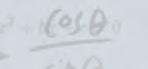
The equation is simple, offer your team the three essentials: safety, high resale value, and long-term efficiency. Subaru solves your fleet needs with precision. And it’s not just smart, it’s mathematically sound. Do the math, optimize your fleet costs.




































By Simon Upshon

Fleet management is rapidly evolving from a maintenance function to a strategic business operation. In the past, fleet teams focused on keeping vehicles running, managing repairs, and responding to failures. Today, they sit at the intersection of technology, sustainability, and fiscal responsibility.
Modern fleets, especially those in municipal and utility settings, operate as complex ecosystems of connected assets. Such vehicles now generate a constant stream of data through telematics, diagnostics, and onboard sensors. This information, when it’s properly collected and analyzed, has the potential to transform how organizations make decisions about maintenance, capital replacement, and operational efficiency.
The challenge is no longer data collection; it’s data interpretation. Having too much data can be a burden unless we can convert it into actionable insights that improve uptime, extend asset life, and reduce costs. That’s where predictive maintenance and analytics come in.
Every fleet moves through a natural progression of maintenance maturity. Here are the steps:
Reactive maintenance: This is the “fix-it-when-it-breaks” stage –unavoidable at times, but costly and disruptive. Reactive maintenance maximizes downtime, inflates repair expenses, and strains operations. It’s the least strategic and most expensive phase of fleet management.
Preventive maintenance: Preventive programs represent a major improvement. Maintenance is scheduled at regular intervals based on manufacturer recommendations – usually by mileage, hours, or time. This approach reduces major failures, but it’s still based on generic intervals, not the asset’s actual operating conditions.
Predictive maintenance: Predictive maintenance goes a step further. It uses live data and analytics to forecast failures before they occur, allowing interventions to be timed precisely. Instead of chang-
ing components early just in case, predictive maintenance lets us act just in time; when data suggests wear or performance thresholds are being approached.
For example, engine oil analysis can indicate early signs of contamination or wear metals before an engine seizes. Brake temperature data can reveal dragging calipers before a driver reports an issue. In electric vehicles, battery management systems can track cell degradation and thermal patterns that predict future performance losses.
By anticipating failures, predictive analytics transforms maintenance from a reactive expense into a proactive investment.
Fleet data is more than a collection of readings; it’s an asset with measurable value. Each vehicle tells a story through its diagnostic codes, fuel use, idling time, charging behaviour, and utilization rates. When structured and analyzed, this information helps answer critical questions:
Which assets are underutilized and could be redeployed or sold?
Which vehicle models or components are showing aboveaverage failure rates?
How does operator behaviour affect total cost of ownership?
What is the real-world lifecycle cost compared to forecasted replacement models?
By using these insights, fleet teams can align operational decisions with financial strategies.
For instance, understanding cost-per-kilometre trends helps determine optimal replacement timing, not just by age, but by data-driven lifecycle economics. Similarly, tracking energy consumption per route can validate the business case for electrification or hybridization.
Beyond internal efficiency, data analytics also strengthen accountability. Transparent reporting on fleet performance helps justify budgets, defend replacement requests, and demonstrate compliance with climate or regulatory goals.
In many municipalities, the fleet management information system (FMIS) acts as an operational command layer that integrates work
orders, telematics, and financial data into one platform. This integration is critical for predictive capability, as it allows real-time visibility across maintenance, utilization, and cost streams.
Building predictive capacity
Predictive maintenance requires more than software, it depends on strong foundations of data integrity, process discipline, and cross-departmental collaboration. There are three essential pillars to getting started:
Data Governance and Quality Control: Reliable analytics begin with consistent data. Standardizing equipment codes, failure types, and maintenance actions ensures clean inputs for analysis. If one mechanic records “starter issue” and another logs “won’t crank,” analytics tools will treat them as separate problems. Establishing structured data governance, through defined VRMS codes or standardized work order templates, is fundamental.
System Integration: Most fleets already have telematics and asset management tools in place, but they often operate in silos. Predictive maintenance relies on connecting these systems so they can share information. For example, fault codes from telematics should automat-
Predictive systems can alert technicians to risks, but it’s the experienced technician who interprets that data.
When these elements come together, fleets can even leverage machine learning to recognize fault patterns and automatically predict component failures, bringing industrial-level reliability practices into municipal fleet management.
As fleets electrify, predictive maintenance becomes even more critical. Electric vehicles (EVs) introduce fewer moving parts but far more digital systems. Battery performance, thermal management, and charging patterns all depend on software monitoring.
ically generate maintenance alerts or work orders in the FMIS. Financial systems should link repair histories to asset IDs to track lifecycle cost trends.
Analytical framework and visualization: Once data is structured and connected, the next step is turning it into usable intelligence. Dashboards can display metrics such as mean time between failures (MTBF), cost per km or hour of operation, or maintenance frequency by vehicle class. These indicators highlight emerging trends, such as increasing downtime in a specific vehicle type or abnormal energy consumption in electric units and allow managers to act before issues escalate.
Technology alone doesn’t create a predictive fleet, people do. Data analytics are most powerful when they support, not replace, human expertise. Predictive systems can alert technicians to risks, but it’s the experienced technician who interprets that data, validates the findings, and determines the appropriate intervention.
This evolution enhances, rather than diminishes, the technician’s role. By reducing repetitive servicing and emergency breakdowns, predictive maintenance frees up shop capacity for higher-value work like diagnostics, fabrication, and EV system servicing. It also improves morale: technicians gain ownership of process improvements and see the tangible results of their work.
On the management side, analytics improve communication and trust. Operations teams can see why vehicles are being rotated or replaced. Finance can track ROI in real time. Leadership gains confidence that capital requests are evidence-based and aligned with organizational goals.
Predictive analytics can help fleets understand long-term battery health, optimize charging schedules, and detect anomalies that might otherwise go unnoticed. Instead of relying on generalized warranty timelines, managers can base replacements or redeployments on data specific to their fleet’s operating profile.
Moreover, as EV and hybrid systems become more complex, data integration between telematics, charging infrastructure, and maintenance systems will define the next frontier of fleet intelligence.
Fleet data analytics and predictive maintenance are not merely operational tools, they are strategic enablers. They shift maintenance from a cost centre to a performance driver. When implemented effectively, the results are significant:
Reduced unplanned downtime and improved service reliability. Extended asset life and optimized replacement timing. Lower maintenance and energy costs, verified through realworld data.
Improved environmental performance, with measurable emissions and fuel savings.
Enhanced transparency for stakeholders and council reporting.
Ultimately, predictive analytics move fleet management from hindsight to foresight, from reacting to yesterday’s failures to planning tomorrow’s performance.
In a world where every operational dollar and ton of carbon counts, leveraging data isn’t just smart fleet management, it’s responsible leadership. FM/SP
By Mario Cywinski

Going back to the days when Mazda offered a CX-7 and CX-9, the company is using the same formula with its new CX-70 and CX-90. Available back in the midto-late 2000s, the CX-7 was the smaller brother to the top of the SUV range CX-9. In the early 2010s, Mazda discontinued the CX-7, shortly after the CX-5 model was introduced, as the two were only marginally different in size. The larger CX-9 continued to be a strong model for Mazda until it was replaced by the CX-90 in 2023. The CX-90 utilized a three-row architecture from its launch, something the CX-9 also featured. That left those who did not need or want a third row out of luck. For years, the only option for those who only wanted to have two rows of seats
was to go down to the smaller CX-5 or CX-50. Which for many was too small for what they needed.
Enter the all-new CX-70, the twin brother of the CX-90, without a third row of seats, added cargo area, and a unique exterior look. The CX-70 comes with a glossy black exterior trim, while the CX-90 features more chrome. The CX-70 comes in two hybrid versions, a MHEV (mildhybrid), or a PHEV (plugin-hybrid). We were able to drive the PHEV version, so going forward we will focus on that version.
Depending on where you live, and where you work, for most a daily commute is short. Whether it’s going to work, school, stores, or any other kind of errand, the electric-only
range of 42 kilometres is enough. If you charge the vehicle when you are at home (or at a Level 2 public charger), you will not need to use any gasoline. Level 2 charging from 20 to 80 per cent takes 1.3 hours, while Level 1 charging (regular 120V outlet) does the same amount of charging in 6.4 hours.
A Mi-Drive selector switch is available on every model and allows you to pick your driving mode. From Sport, with allows for the sportiest experience, to EV, which runs the vehicle on only the electric motor. Normal, for everyday driving, off-road, for going off the beaten path (or on snow), and towing (available on the GT model) round out the modes.
The CX-70 PHEV offers a 2.5 litre inline-four-cylinder e-SkyActiv
engine with i-stop. It is mated to a PHEV system that includes a 17.8 kWh battery, and an electric motor. Combined, the system offers 323hp and 369lbs-ft of torque, mated to an eight-speed automatic transmission. All trims offer all-wheel drive as standard equipment.
Mazda is known for vehicles (even its SUVs) that are powerful and fun to drive. The CX-70 is no exception. The engine makes passing and getting on the highway easy. If you are in EV mode (which uses only the electric motor rated at 173hp and 199lbs-ft of torque), the gas engine will kick in and give you the full power available.
Mazda has equipped the CX-70 with i-Activesense system, which includes smart brake support in the front, blind-spot monitoring
1. The CX-70 offers a 12.3-inch instrument cluster display, in addition to the 10.25-inch centre console display.
2. The cargo room is ample, and potential buyers must ask whether they need a third row or two-rows and more cargo space in the cargo area.


(now including vehicle exit warning), front and rear cross traffic alert, lane departure warning, emergency lane keeping assist, driver attention alert, and radar cruise control with stop and go. Rear seat alert is also available and records opening and closing of rear doors before the vehicle is turned on. When the vehicle is turned off, and the rear doors are not opened, an audible alert and message on the dash will let the driver know that something or someone has been left in the rear. Not so long ago, the instrument cluster on most vehicles was analog, with the essential information being the speed, rpms, fuel level, and coolant level. Some vehicles had other gauges, but those were the standard. Now, digital LCD
instrument clusters are the norm, with the amount of information available and customization on tap increasing with every vehicle generation. The CX-70 offers a 12.3inch instrument cluster display, in addition to the 10.25-inch centre console display.
Over the past few years, Mazda has put a lot of effort into making the interior of their vehicles more luxurious. Like its stablemate CX-90 and predecessor CX-9, the CX-70 is a premium looking and feeling vehicle. GS-L models get black leatherette seats, while GT models get black or garnet red Nappa leather seats. Other interior standard features include premium materials, heated front seats and
steering wheel, 10-way power drivers’ seat, power passenger seat; and available wireless phone charging, wireless Android Auto and Apple Car play integration, Alexa, heated rear seats, ventilated front seats, rear-door sunshades, and much more.
Mazda’s stable of SUVs has always driven “smaller” than their size. Meaning a large vehicle like the CX-70 handles and drives more like a crossover than a midsize SUV. The PHEV system is powerful, and the cargo room is ample. Potential buyers need to ask whether they need a third row or do they prefer two-rows and more cargo space in the cargo area since without the seats, there is more area under the cargo cover. FM/SP
Whether it’s going to work, school, stores, or any other kind of errand, the electric-only range of 42 kilometres is enough.
Price (in
freight and PDI): GS – L - $58,750 MSRP / GT$63,350 MSRP Engine: 1.2.5L e-SKYACTIV PHEV, i-stop, DOHC 16-valve, Inline-four
Power: 323HP, 369lbs-ft Torque
Transmission: 8-speed automatic with manual shift mode
Rated Fuel Economy): Gas –9.9/8.7/9.4L/100km (city/ hwy/combined) / EV/Gas –4.2Le/100km
Given the increasing complexity of the government procurement system, Canadian public institutions are under mounting pressure to implement proactive procurement training strategies for their organizations. This article highlights some of the key elements that should be incorporated into those long-term strategies.
As illustrated by multiple recent case studies, Canadian public institutions continue to face challenges in meeting their core institutional governance responsibilities and in developing organizational awareness of fundamental good governance standards. From senior-level officials responsible for institutional oversight and spending approvals to front-line staff responsible for managing specific operational contracts, public institutions need to promote an awareness of the proper roles and responsibilities at all levels of their organizations through each stage of the procurement cycle since accountability gaps and role confusion are major causes of procurement delays and project failures.
Ethics training is an inherent part of that equation, and that training should cover the core topics of conflict of interest, collusion, and bias since public sector contracting is subject to strict probity standards and many public institutions have repeatedly failed to meet those standards in recent years. Those probity standards also require the use of open, fair, and neutral competitive bidding procedures for even relatively low-value contract awards. Since public institutions often recruit senior officials, procurement professionals, and program staff from the private sector where open tendering is not the norm, public institutions need to develop proac-
tive strategies to train all staff who are involved in contracting decisions on the rules that regulate open tendering in the government sector.
The public procurement process is also subject to demanding time pressures, which are increasingly at odds with the bottlenecks created during the solicitation drafting process. An institutional training strategy should include advanced training for procurement staff, as well as business areas, on designing and drafting solicitation documents. This training should focus on the necessary skill sets for drafting contract specifications, developing pricing forms, and disclosing bid evaluation criteria since these three areas tend to be the primary causes of drafting delays. Public sector procurement professionals should also be trained on how to use a broad range of tendering and contracting formats since the project-specific details noted above need to be incorporated into the appropriate tendering and contracting architectures as part of the solicitation drafting process.
A public procurement training program should also focus on applying project management principles to each step of the procurement cycle so that project teams can effectively steer their time-sensitive procurements through the solicitation design and drafting stage, the bid evaluation stage, and the contract award stage of the procurement process.
Public institutions are also required to provide debriefings to unsuccessful bidders. This has become an increasingly complicated area in recent years since legal rulings have simultaneously increased the level of disclosure that public
institutions must provide to losing bidders to justify contract award decisions while also protecting the sensitive business information, including pricing information, of all bidders. Striking the right balance in meeting these competing transparency and confidentiality duties in an efficient and defensible manner requires advanced training for procurement staff and for the evaluation team members responsible for maintaining the evaluation records relied on to meet debriefing duties and to defend against any related bid protest challenges.
A procurement training strategy should also include contract management training since procurement contracts, no matter how well drafted, do not manage themselves. Contract managers should be trained on how to maintain proper contract administration records since contractual and administrative remedies for poor performance, including supplier termination and debarments, depend on a proper evidentiary trail. In addition to managing specific individual contracts, public procurement professionals should also be trained on how to properly manage supplier rosters, including master framework agreements and invitational second-stage tendering processes for awarding work to prequalified suppliers, since the use of supplier rosters has been subject to increasingly strict regulation in recent years.
Finally, public institutions need to develop a training plan that focuses on the proper use of negotiated RFPs since flexible solution-based tendering formats are quickly replacing rigid and prescriptive solicitation structures as the pri-

Paul Emanuelli is the general counsel of The Procurement Office and can be reached at paul.emanuelli@ procurementoffice. com.
“Public institutions need to develop proactive strategies to train all staff who are involved in contracting decisions on the rules that regulate open tendering in the government sector.”
mary instrument for awarding complex procurement contracts. That plan should include advanced training on the intricacies of the multi-staged group evaluation processes that are typically used in negotiated RFPs, and on the fundamentals of managing a multidisciplinary team during complex contract award negotiations.
Public institutions can no longer afford to be reactive in their approach to procurement training. Those organizations that adopt proactive long-term training strategies will be better positioned to meet the challenges of an increasingly complex public procurement system in future years. SP
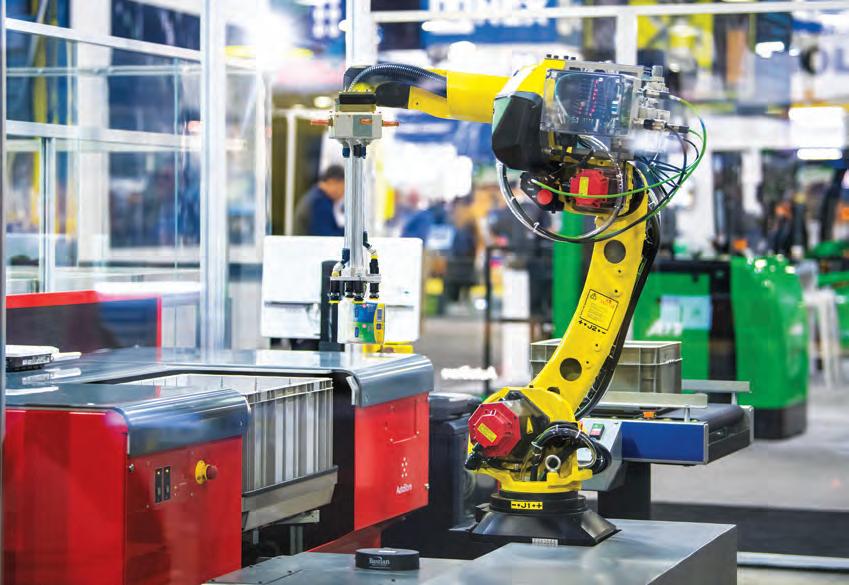

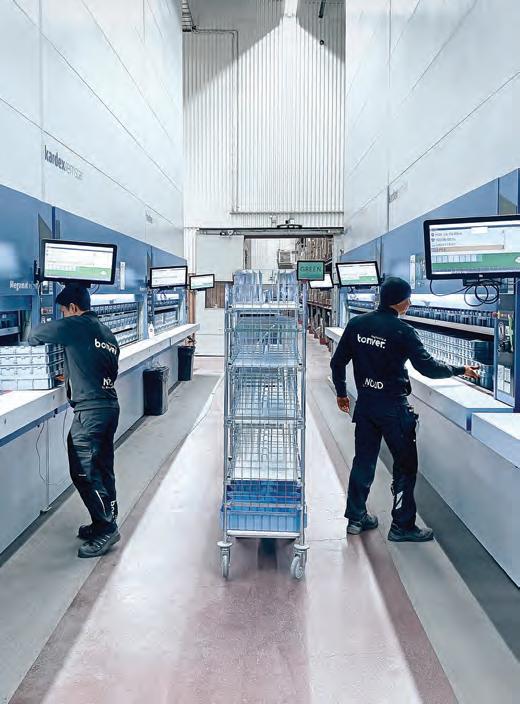
Discover the next step in your automation journey
Automation that’s rooted in strategy—the right technology at the right time for the right application—boosts team productivity, engagement and satisfaction. And that’s good for business. No matter what stage you’re in, GNJ Automation brings years of intralogistics expertise to help evolve your systems and empower your people.
READY TO AUTOMATE, INTEGRATE AND INSPIRE?
Connect with a member of our team and let’s start the conversation.