This publication has received funding from the European Union Erasmus+ program under agreement 2022-1-ES01-KA220-SCH-000089414.
This document refects the views only of the authors, and the European Commission cannot be held responsible for any use which may be made of the information contained therein.
ISBN: 978-84-09-70416-3
February, 2025
www.virion-project.eu
Enriching lives, opening minds.
Enriching lives, opening minds. Erasmus+
Enriching lives, opening minds.
Introduction
Objectives of the guidelines
This document is the result of an inter-disciplinary piece of work carried out in the context of the Erasmus+ project "VIRION - Virtual Reality Applied to School Education", n.º 2022-1-ES01-KA220-SCH-000089414. This initiative explores the use of Virtual Reality (VR) as an innovative educational tool aimed at transforming the teaching and learning of the STEM disciplines (Science, Technology, Engineering and Mathematics).
The content presented her is the product of a rigorous process involving research, software development and testing and analysis of results, carried out in four countries - Germany, Bulgaria, Spain and Finland – by fve European members, each providing their own experience in education and technology.
• URJC, Universidad Rey Juan Carlos (ES)
• HCU, HafenCity Universität Hamburg (DE)
• LUT, Lappeenranta-Lahti University of Technology (FI)
With the aim of promoting the use of VR in the feld of education, this document has been designed to support teachers and students of 14 to 16 years old in the acquisition of technical, digital and teaching skills. The purpose is not only to improve learning in the classroom but also to guide young people towards a more deliberate and creative use of the technologies which they already know (such as video games and social networks). In this way, we have sought to enable users to adapt to an ever-changing digital environment and contribute to the training of responsible digital citizens.
Eforts must be made to close the gap in the feld of education when it comes to the integration of emerging technologies such as VR. For example, although this tool has signifcant potential for education, many people in a leading role in education are unaware of what resources are at their disposal or how they could be used efectively. In addition, the inequality of access and lack of specifc teaching limit its use in the classroom. This study seeks to tackle those defciencies by providing a clear methodology, teaching tools and access to specialized content in order to
help teachers, education managers and politicians to implement VR in their education strategies.
Similarly, we have studied how VR may help solve problems such as early drop-out and poor performance in basic skills by ofering learning experiences which are more immersive and appealing. Numerous studies support the idea that VR not only aids the comprehension of complex content but also motivates students to connect learning with the technologies which are already part of their everyday lives. This is particularly relevant when it comes to STEM, where drop-out rates are higher, especially among girls. It is for that reason that we emphasize the need for inclusive approaches which stimulate interest and excellence in these areas.
In order to meet these objectives, the project includes:
• A methodological section to guide schools in the integration of VR as a learning tool, from the choice of appropriate hardware to the use of good teaching practice.
• A homepage with specialized content, centralising information about resources, tools and practical experiences related to VR.
• Case studies based on previous experience to inspire and guide people involved in education to implement this technology.
Who is the target audience of this White Book?
This material has been designed for any teachers and trainers who are interested in incorporating new technologies into their educational practices by ofering them practical methodologies and tools to enrich the classroom learning experience. It is also aimed at educational institutions and politicians connected to education who seek efective strategies to digitalise
teaching by facing such needs as technological training or adapted resources. Similarly, these initiatives encourage technological companies to take part in the creation of innovative educational content, promoting synergies between the felds of education and technology. Together, these recommendations aim to encourage the use of innovative technologies such as VR in education, by promoting its integration into teaching activities which motivate students, reduce gender inequality in STEM and ofer new perspectives for learning and professional development in an ever more digitalizad world.
Brief guide for using the text.
The text is made up of six chapters, each one designed to tackle key aspects of the project and provide a thorough understanding of the development and results:
1. Literature review in participating countries
A comparative analysis of academic articles and research studies on the use of VR in Germany, Belgium, Finland and Spain. This chapter shows the current scenario, contextualising the practices of today and establishing a solid basis for development of the project.
2. The future of the classroom
This chapter analyses the current uses of VR, both its implementation in educational settings and the advances in educational software in participating countries.
3. Methodology
Here we describe the design and development of VR content as adapted to STEM subjects, as well as the process of equipping teachers for its use in teaching. In addition, we include the design of specifc surveys and analysis of the data acquired to assess the impact of pilot tests on students.
4. Results
The presentation of the data obtained during the pilot tests with a general and a per-country focus.
5. Recommendations and User Guide
Practical proposals for designing educational applications and incorporating VR into the syllabus
6. Lesson Plans
Practical cases carried out by participating teachers who have compiled their experiences during the project.
VIRION aims to show that VR can be a transforming breakthrough for today’s challenges in education. Using these guidelines, teachers and the teaching bodies themselves will have access to practical tools and efective strategies to integrate this technology and ensure a more inclusive and appealing learning experience.
Brief Introduction to the Consortium Members
The Virion project is composed of fve partners, including universities, schools, and companies, each playing a crucial role in its success. Their contributions cover research, technological development, testing, and direct engagement with students aged 14 to 16. Together, they ensure that all essential aspects of the project are efectively managed.
Universidad Rey Juan Carlos
The Universidad Rey Juan Carlos (URJC), created in 1996, is the second largest university in the region of Madrid, with over 43,000 students - of whom 3,000 are international – spread over 5 campuses and 2 centres in Madrid. Currently, it ofers 88 undergraduate degrees, 72 Masters degrees and 10 doctoral programmers. The URJC was set up with the aim of giving balance to the demand and supply of university places in Madrid, also boosting the social and economic development of the south of the region.
The URJC has positioned itself as a reference in research work. Its emphasis on innovation and knowledge transfer is refected in initiatives such as the Open Science option and its participation in international networks, for example, the EULiST Alliance, to strengthen its global presence. The
university prioritizes diversity, inclusion and the interdisciplinary nature of its strategy of assessment and research. Using strategic programmes such as Plan 2020-2025, the URJC emphasizes internationalization, business collaboration and teaching excellence. In addition, it increases employability and the connection with the job market by means of strategic practices and alliances.
The URJC is a leader in research with institutes such as IEJI (comparative law), CETINIA (artifcial intelligence), CIETUR (tourism) and CEEM (applied economics), refecting its commitment to innovation and knowledge transfer. It includes companies in its teaching activities, promoting work experience and leads initiatives such as DCNC Science in CyberSecurity. It is also at the forefront of international projects for example the IEJI ones in Africa and Asia, the promotion of language learning with the Language Centre, healthcare and social integration with the CED, altogether establishing the URJC as a reference for teaching, research and innovation.
Premium Cine/Premium VR
Premium Cine/Premiun VR (www.premiumvr.eu), responsible for the development of VIRION's VR applications, is the XR division of Premium Cine, the parent company of the audio-visual group.
Founded in 2000 and dedicated to the production and distribution of audio-visual content for cinema, television and digital platforms, its main activity covers three key areas: audio-visual distribution (cinema, VOD, Home Video and TV), production of 2D content (4K and HD) and creation of 3D/VR and Augmented Reality (XR) content, including stereoscopic reality and 360º flming.
Since 2015, Premium Cine began to focus its eforts on the development of technology for the production of XR content (including Augmented Reality, Virtual and Mixed Reality) production as well as 3D production in
stereoscopy and 360º, marking a trend towards technological innovation.
The strategy of Premium VR is focused on becoming a reference in the creation of educational and social content in XR, especially aimed at the academic community. They have developed cultural and educational content since its foundation, adapting their technological and creative capabilities to create high-quality, immersive experiences.
The Premium VR work team includes professionals such as Pablo Chamorro (CEO), Ismael del Pozo (Director of the VR area), Juan Mas (Contents), Natalia Glez. (Marketing), Iván Vazquez (Music and Sound), Manuel Barahona and Jordan Amaya (VR Programming), Angela Abad (Graphic Design, David Barba (3D Modeling) and Félix Velázquez (Executive Producer). This group has gained experience in flming, post-production and marketing of VR content, positioning them as leaders in the development of educational content for learning portals based on artifcial intelligence.
Tsar Simeon Veliki
Tsar Simeon Veliki Secondary school is a municipal school for general education and the largest school in the Vidin district, Bulgaria, with more then 900 students aged 6 to 19 years. The school staf comprises 78 people, including 65 teachers and 9 management and administration personnel. Located in an area with high unemployment rates, the school is known for its pursuit of excellence in education, modernization of facilities, and implementation of ICT, foreign languages, and a European dimension in teaching.
After 7th grade, the school ofers intensive classes in History and Literature, Biology and Chemistry, all of them with intensive learning of English. The school houses the only natural science program (8th-12th grade) in the district. Extracurricular activities include an Ecology club, "Lego robotics" , Euroclub "Young Eu-
ropeans for Peace", Sport clubs and a Music and Art clubs. The school supports 21 students with special educational needs (SEN), 40 students from migrant families, and 90 students from the Roma minority.
In 2021, the school adopted a fve-year strategy emphasizing the STEM/ STEAM approach, digital competence development, and foreign language learning. It has since built a STEM lab and a natural science lab and acquired technologies like a 3D printer and Lego Education sets. Tsar Simeon Veliki school seeks to integrate new technologies such as VR into education.
The school is actively involved in Erasmus+ and eTwinning projects, providing opportunities for teachers and students to enhance their skills. It organizes eTwinning training events for sharing good practices, and one teacher is an eTwinning ambassador for Bulgaria. Tsar Simeon Veliki school tests project outcomes, ofering valuable insights for schools in Europe with limited VR experience.
HafenCity Universität Hamburg
HafenCity Universität Hamburg (HCU) is an interdisciplinary institution dedicated to the design and sustainable development of urban environments, combining architecture, engineering, natural sciences, humanities, and social sciences. Its research group, Digital City Science (DCS), employs advanced digital technologies to analyze and plan urban spaces. This multidisciplinary team comprises over 25 researchers specializing in urbanism, sociology, geoinformatics, computer science, and media technologies, developing interactive tools for citizen participation and decision-making.
FINLAND
SPAIN
BULGARIA
GERMANY
HCU has been involved in numerous national and international projects, including MICADO, which created digital dashboards to facilitate migrant integration; MOVE21, focused on sustainable multimodal urban mobility solutions; and SURE, a facilitation and synthesis research project on ten individual research and development projects focusing on sustainable urbanism in South-East and East Asia.
With extensive experience in European projects, DCS was engaged in around 50 research projects, securing around €10 million in funding. Additionally, DCS maintains strong ties with local and state agencies, such as Hamburg’s Authority for Urban Planning and Housing, the Ofice of Geodata, and the State’s agency for property management.
The research group excels at blending academic research with practical applications, designing innovative tools to address urban challenges. These include platforms for data management, interactive dashboards, and systems for urban planning and citizen engagement. With an international team representing over 15 countries, DCS brings a global perspective to its projects, fostering collaboration and knowledge exchange at both local and international levels.
LUT University
LUT University (Lappeenranta-Lahti University of Technology LUT) is a pioneering science university in Finland, established in 1969, combining the felds of technology, business and social sciences. With a community of approximately 8300 students and 1300 staf members LUT focuses on fnding sustainable solutions for clean energy, water, and air, contributing to societal and business renewal. Its teaching and research are organized into three schools: LUT School of Energy Systems, LUT School of Engineering Sciences, and LUT School of Business and Management. The university values courage, innovation through science, and the pursuit of well-being.
Junior University, LUT’s program for collaboration with local schools, has been operational for over 20 years, connecting schools with the latest research and student expertise. Since 2018, this collaboration has been integrated into the local school curricula, engaging students at various education levels—from early childhood to upper secondary education—and reaching approximately 3,500 students annually. The program has received recognition, including the ISCN Partnership for Progress Award (2020) and the International Green Gown Award in Creating Impact (2021).
The Junior University team consists of six professionals specializing in curriculum-based collaborations, STEM-related activities, upper secondary education, and Open University programs. The team’s collaborative approach ensures continuity, with shared responsibilities and weekly coordination meetings. The team also has experience managing externally funded projects, such as EU Structural Funds, providing familiarity with project implementation.
LUT University has been collaborating with local schools for over 20 years, connecting them with the latest research and student expertise. This cooperation, along with all its science and technology education activities, is now carried out through LUT's Junior University program. The university is a long-standing member of LUMA Centre Finland, a science education network aimed at inspiring children and youth in STEM felds. LUMA develops research-based teaching methods and supports lifelong learning for educators across all levels of education. The network's focus aligns with LUT's strategic priorities of fostering innovation, sustainability, and research-based education.
The project lead is an experienced educator with extensive connections among teachers, principals, and education oficials in Finland, along with a strong background in managing Erasmus+ KA2 projects in vocational education.
Aims
The goal of VIRION is to encourage secondary school students to improve their training in STEM subjects using active learning based on VR teaching material designed by the project’s research team. With this goal in mind, the following basic aims were set out for the project:
1. To test an innovative educational methodology based on VR content in public schools of the countries participating in the project (Bulgaria, Finland, Germany and Spain) with pupils aged from 14 to 16.
2. To train a group of teachers from the 12 teaching centres (three from each country) to take part in the project. The idea is for them to discover the possibilities aforded to education by VR and to know how to apply VR to teaching depending upon their needs, using content designed by VIRION. By doing so, we will be supporting innovation in teaching and boosting digital transformation in schools.
3. To publish four items of VR on the homepage, along with their respective user guides, making it available for free to all users. In addition, to facilitate its use, the dashboard will be AI-enabled (chatbot) so that it can guide users depending upon their needs and objectives.
4. To create a document which summarizes the results of the project clearly and, also, serves as a guide for the application of VR in teaching plans at schools, ofering examples of how it can be used by teachers. Basically, a document which provides tools and advice to face the foreseeable challenges which education will face in the coming years and which will help improve PISA results by focusing on STEM subjects.
Inasmuch as the project has an experimental design, uses an innovative methodology based on VR content and brings together four European countries with difering educational levels in terms of PISA results, the project makes it possible to compare the most signifcant similarities and diferences in the educational methodologies being applied and to know how to assess the use of VR both by teachers and students in Spain, Germany, Finland and Bulgaria.
From that point of view, the tests carried out in the schools were useful for the following secondary aims: (a) to compare the degree of satisfaction and the perceived level of learning obtained when using immersive narratives of an educational nature in VR among secondary tier students in the diferent countries (b) to analyze the factors which afect the perceived
level of learning obtained with these technologies in the four countries (c) to observe the existence of gender bias in the perceived level of learning obtained by students using these tools.
1Literature review in participating countries
Virtual Reality and education in the
European
context
Scientifc literature regarding VR and education has grown exponentially over recent years. In the Scopus database for bibliographic references and the category of Social Sciences about educational VR, the frst study was recorded in the USA in 1992. Since then, numerous works have been published in that feld, with most of them being recorded in the last decade.
The USA and China lead the ranking of published works however Europe, taken as a whole, boasts a signifcant role in research in the feld. Specifically, the UK, Spain, Germany and Turkey are the most prolifc countries. All four countries appear in the top ten for publications about VR applied to education in the aforementioned database.
The academic output of the countries which feature in the VIRION project generally reveal that research focuses more on the educational efects of VR, normally analysed using quasi-experimental methodologies. A signifcantly higher volume of studies being applied to the university sector has been observed, as opposed to Secondary or Primary education.
Based on the level of scientifc output on the subject studied in Scopus, the main results of the academic literature and projects in which VR has been applied in the feld of education in the four participating countries in the VIRION project are set out below.
Spain
In terms of the academic literature in Spain, the conclusions of the studies are, in general, positive, indicating that the use of VR in teaching has produced an increase in the eficiency of the teaching-learning process and an improvement in motivation. (Marrero Galván and Hernández Padrón, 2022). Most authors point to cognitive (knowledge acquisition) and affective (motivation, cooperation, etc.) advances, with these technologies, thus justifying the use of VR to motivate students. Similarly, other positive aspects of the use of VR have been revealed, such as an improvement in commitment, access to inaccessible environments, distance learning or even training empathy (Marrero Galván and Hernández Padrón, 2022). Along the same lines, studies such as Giakoni-Ramírez et al. (2023) show that both VR and AR have promising benefts which can support the teaching process.
From the point of view of the strategies for designing the content of VR for education, research in Spain concludes that gamifcation content helps students in their learning process (Castellano et al., 2023). That is the conclusion reached by, among others, Lucena-Antón et al. (2022), who encourage teachers to include games when choosing their VR-based teaching approaches to improve interaction and active learning in the delivery of subjects such as physiotherapy. Similarly, VR, when combined with problem-solving techniques for learning or research, is highly useful in the teaching of STEM subjects (Marrero Galván and Hernández Padrón, 2022).
Another high-profle strategy when designing educational material in VR is the creation of simulators and virtual laboratories. The studies of, among others, Tatiana Cox et al. (2022) show that groups which work with virtual laboratories obtain signifcantly better results than those using traditional methods. These pieces of work highlight the fact that these technologies stimulate students’ motivation and are a tool which must be considered for in-class work, thus confrming previous studies such as that of Mercado et al. (2019).
Along the same lines, Pontes Pedrajas (2022) carried out an experiment about the educational use of a simulation program to help students overcome the considerable dificulties of signifcant learning and favour an adequate understanding of a model of an electric current, with tasks of oriented discovery in a virtual environment. After using a virtual laboratory as the main educational resource, in this experiment it was observed how the mental models of students evolved very positively when it came to the workings of electric circuits. A considerable improvement in the quality of participants’ explanations of the problems set out in this subject was detected after the educational action was implemented.
Arce et al. (2022) developed an experiment in a virtual laboratory for teaching STEM subjects. According
to their results, this realistic environment of real-time simulation and 3D visualization gives students fexibility, helps them in the organization of their tasks and allows them to work autonomously. One of the most interesting fndings of this research has to do with the importance of the role of the teacher in following tasks. Students can have a wider contextual appreciation if they are asked to carry out individual tasks while at the same time being supervised by their teacher (in situ and on virtual platforms) and in the company of the other members of the group.
In the same way, other studies reveal high levels of motivation during teaching sessions with this technology, which facilitates interaction and optimum results in learning (Cabero-Almenara et al., 2023). Similarly, the studies of Bermejo et al. (2023) conclude that the application of VR improves immersion in the learning process, especially when studying the hotel industry, medicine and science, to university level.
Finally, studies such as that of De Moraes Rossetto et al. (2023) ofer an interesting comparison between VR and AR. VR-based material obtains better results than AR-based ones when it comes to acquiring knowledge.
By means of a questionnaire-based quantitative study, Cabero-Almenara et al. (2022) observe that students who work with VR show a high level of acceptance of these technologies as well as a favorable disposition to their usage. Similarly, the work of Marín et al. (2022) suggests that secondary school pupils believe VR may be used in class to promote learning, although a low level of penetration of these technologies has been witnessed in the context of Spain.
On the other hand, the study by Castaño-Calle et al. (2022) analysed the attitudes of teachers towards these tools. In general, they have a favourable opinion of them but their knowledge of them is still limited. The results support the relevance of increasing teachers’ knowledge and improving their skills, thus generating positive attitudes towards these tools.
The work of Marín-Díaz and Sampedro-Requena (2023) applied to secondary school teachers reveals that, as far as issues related to teaching methodologies are concerned, VR will promote autonomy and initiative in pupils at this stage of education, at the same time making the classroom and the learning process more active and, consequently, more participative. For that reason there exists the need to promote the training of teachers in the appropriate use, as expressed by participants. Training in the use of this technology is, precisely, another of the concerns expressed by teachers, who indicated that both teachers and pupils at secondary school level require training to enable them to implement VR in the classroom and promote signifcant learning (Palomo, 2020).
Research shows that appropriate training is needed for teachers as otherwise they may feel intimidated or incapable of using these new technologies in their classrooms (De Moraes Rossetto et al., 2023). As mentioned above, one of the goals of the VIRION project is to tackle that challenge.
Germany
The research on the German literature on VR shows that there is a research gap in the scientifc discussion of existing VR content and solutions and its usage in schools.
Horn et al. (2021) in a conference paper discuss the setting up of an educational AR-VR-catalogue within the “Digital gestütztes Lehren und Lernen in Hessen” (“Digitally supported teaching and learning in (the state of Hesse”) project and its AR/VR workgroup, predominantly composed of university researchers and lecturers. The authors discuss the steps undertaken for fnding and evaluating AR and VR pieces for both school and higher education. In a frst step, 308 pieces of content were identifed that were further narrowed down. For the fnal selection, content had to fulfll three main criteria: 1) Direct teaching content available or creation of own teaching content possible. 2). The software or its use is (freely) accessible o the content enables the development of new tasks or teaching scenarios that were previously unimaginable. 3) Use in a teaching scenario is allowed and/or desired (Horn et al. 2021: 81).
Finally, the authors further describe the process of developing criteria and adding additional information and commentary. No fgures are given about the fnal amount of AR-VR-content available at the time of publication, but on September 29th, 2023, it included 71 VR pieces for both school and university education.
VR eduNet was an EU-funded Interreg project in two regions of Austria (state of Upper Austria) and Czech Republic (South Bohemian Region). The project’s main report is available in German, Czech and English and while it is not a scientifc source per se, some of the results (VReduNet 2022) will be presented below.
One of the fndings was that the majority of companies surveyed in the Austrian region (n=20) already deal with this new technology, but mostly still at a more experimental stage (VReduNet 2022: 7, 9). Therefore, using VR in schools is also seen as an important step to prepare students for a professional world in which VR could play an increasingly important role. Another survey was aimed at schools, even though in the selection of investigated schools there was a bias to schools with an implied interest in technology and VR, e.g. vocational schools in the age group of 15-18 (ibid.: 10). It was found that in the Southern Bohemian Region 54% of the participating respondents had already at least tested a VR system, while the fgure for Upper Austria is 91%. Still, the project found that both VR and AR are not widely used in both regions, and the schools with a higher degree of use are technical schools with close cooperation with industry (ibid.: 1112). Still, 64% of responding schools in Upper Austria have some form of VR equipment available, while this is only true for 14% of responding schools in Southern Bohemia (ibid.: 12-13). Schools use mostly Oculus and HTC hardware, and also systems by Class VR in the Czech region. In technically oriented schools, more specialized VR systems are also in use (ibid.: 13). A longer chapter discusses the teacher training at University level (ibid.: 16 - 34).
The Büro für Technikfolgen-Abschätzung beim Deutschen Bundestag (Ofice of Technology Assessment at the German Bundestag) in 2019 prepared a report for the German parliament on the status quo, challenges and future development of VR. In a short chapter on education it only discusses some google VR products and also points to a cooperation between Samsung and textbook publisher Cornelsen that has
led to the development of an application example in biology (Kind et al. 2019: 58-59). However, according to research by the authors of this report, there have been no further reports of this cooperation since around 2017.
As part of a book on WebQuests, Spiegel (2022) mainly discusses Quests in the context of VR. While she points out that VR is already being used more intensively in business, she assesses that there is still little use of VR in the classroom (Spiegel 2022: 137). She sees the cause in the lack of digital equipment in schools, of personnel capacity for the maintenance and management of the hardware in schools, of training for teachers and the inadequate fnancial resources (ibid.: 142). The author also points to the comparatively intense activity of educational institutions on the VR platform Second Life (SL) while it was at its peak in the past and gives examples how SL was used in an educational context (ibid.: 140 –142).
Schollän (2019: 1-2) quotes from a Kantar-Emnid survey from 2017, that 48% of survey teachers are interested in using VR in teaching. Only 18% of responding teachers had their own experience with VR and only 4% had VR hardware available at this point. The author expects this to change in 2019 with the Digitalpakt, a federal funding for digital equipment in schools.
Finland
Finnish academic literature reveals that the cases where VR has been applied to studies are scarce and in most cases the application was very narrow. A study by Kosmas et al. (2021) found that while the interviewed higher education oficials think VR to be a good motivational and helpful tool in teaching, the technology is not yet mature enough. They stated that the main obstacles for adoption to be the lack of content available to justify the expenses related to the equipment and staf costs. Nonethe-
less, there are some instances of VR used in Finnish education as reported by articles.
VR glasses have been used in Laurea University of Applied Sciences in nursing since 2019. They have had the most success with teaching internal medicine, examining anatomy and physiology of the human body. Laurea University has also produced several 360 videos for VR glasses. These videos help students to visualize diferent aspects of their studies. For instance, Laurea University created a video on how a patient with schizophrenia experiences visual and auditory hallucinations (Heikkinen, 2022). According to a questionnaire where Laurea University mapped the students’ experiences with the VR glasses in their studies, the majority expressed that the VR glasses were useful, promoted their learning and made the subject more interesting (Nikula et al., 2022).
A mixed Reality Hub – group in the University of Helsinki has been researching on how to best use mixed reality in various diferent studies. They report that an immersive teaching method can greatly help motivate students and give them a better understanding of their studies. They state that the target felds spread wider than the typical science and technology departments, and hint to possible opportunities in studies of philosophy and business. (Media, 2018).
The University of Helsinki has tested VR technology in the teaching of forest sciences, educational sciences, and medicine among others. They report that while most students enjoy using VR in their studies, it is not suitable and appealing to all students. Still, to make the use of the technologies easier, they have had digitutors available for help and guidance (Vairimaa, 2018; Aalto, Halonen, & Paatela-Nieminen, 2017). It is good to highlight that while VR helps motivate and visualize the information for most students it can also be the opposite for other students which is why teaching should leave room for options.
One feld where VR glasses are tested and used for teaching abundantly is welding. Sampo University of Applied Sciences boasts the most modern virtual welding environment in Finland (Tähkä, 2020). A virtual teaching environment for a relatively dangerous subject is very useful since the students get to learn and make mistakes in a way that does not harm their person.
While most cases are from higher education institutions some high schools have also invested in VR technology. For instance, Konnevesi high school has 30 pairs of VR glasses and can bring a whole class into the
virtual world simultaneously. Konnevesi is one of the most advanced in the way of utilizing VR technology in high schools (Savela, 2022). According to Mari Jämsen, the deputy principal of Konnevesi, they use VR glasses in STEM education regularly and have found this to add concreteness, interest, and motivation toward the taught subject.
Bulgaria
The scientifc literature on the confuence between VR and education in Bulgaria has primarily focused on the university setting, although interesting works are also detected in secondary education, particularly focusing on STEM subjects. Likewise, there is a prevalence of studies on augmented reality (AR) and the use of holograms for educational purposes, with a frequency much higher than the application of VR. In this regard, the positive perception of students towards the use of mixed reality (MR) and AR is noteworthy. According to studies conducted in this country, learning by holograms gives students an experience that is really close to reality. The simulation teaches students how to act, how to think, how to predict situations. In this sense, MR has the potential to change the location and timing when it comes to learning. Moreover, this technology is able to introduce new and additional ways and methods of learning and solving problems. Furthermore, it can be concluded that MR applications developed for education increase student participation in classes, improve and increase memory.
Two main areas gather scientifc evidence on the use of these technologies (VR and AR) for educational purposes: (1) the study of medical areas and (2) training in historical and cultural heritage. In both medical education and the feld of engineering, a third essential element emerges in research on VR and education in Bulgaria: (3) the use of virtual laboratories.
In the feld of VR for medical training it is worth pointing out the work of Spiriev et al. (2022) who show that AR and VR allow users to zoom, pan, and rotate the
models, which may facilitate learning. These tools have the potential to help with a better understanding of complex anatomy, that opens the feld for further research in medical education.
Moreover, the research conducted by Georgieva-Tsaneva and Serbezova (2020) shows that students and teachers in the professional feld of health care assess virtual learning as an important factor in the process of acquiring new competencies. They believe that virtual resources are important to them, especially when it comes to building clinical psychomotor skills.
In this feld, some works focus on the analysis of the application of virtual clinical laboratories. The research conducted by Georgieva et al. (2021) emphasizes that the use of these immersive spaces allows the trainees to explore, to make mistakes and learn from them before ultimately applying the real procedure on a patient. These technologies have potential for creating authentic learning environment close to reality and with context that simulates real life workplace.
As regards Virtual laboratories in engineering education similar benefts have been detected in the use of this type of laboratories in the feld of electrical engineering. In this sense, Evstatiev et al. (2019) demonstrated the potential of these spaces for the use of virtual cables and handling them. Therefore, the students can gain experience, like that obtained through traditional laboratories, including the opportunity to safely experiment, without risks of electric shock or equipment damage.
Another relevant research conducted by Ivanova et al. (2019) compared the application of a virtual laboratory with traditional ones in the feld of engineering training. The results conclude that the virtual learning environment is more efective compared with the traditional lab setting in helping students to understand long measuring processes with more than 20 stages, too long even for the real lab conditions. The virtual
space signifcantly increased the possibilities for mathematical processing and analysis, storage and documentation of all students’ measuring results.
Research focused on the integration of VR in the teaching of Fine Arts show the applicability of the proposed approach and satisfaction with the acquired knowledge among the students (Staneva et al., 2022). On the other hand, Georgiev and Nikolova (2021) observed that the presentation of cultural artifacts in a more realistic, attractive, and child-friendly manner creates a newer and more exciting experience for them, which builds their national identity and patriotism. Finally, the research by Peteva et al. (2020) found that young people studying historical education are open to the new 3D technologies. They want to touch this unfamiliar world and are eager to get involved in such research projects. This type of students wants new technologies to become an invariable part of their courses.
Concerning AR in secondary school for STEM we should point out that while studies on the impact of AR and VR in secondary education in Bulgaria are not frequent, interesting work has been identifed, particularly in STEM subjects. According to the research conducted by Petrov and Atanasova (2020), it can be afirmed that the integration of AR has signifcant efects on the learning of the associated content. This research shows that the AR technology, especially when used in STEM education, allows students to explore, practice and interact with STEM content without worrying about fnancial or ethical issues, such as costly consumables or harm of animals. It provides opportunities for experiments and recovery from failure, while working in a safe environment. This research found many benefts to using AR in teaching STEM subjects, especially biology. Among them are: (1) the ease of use, (2) the high level of personalization, and (3) the possibility to run many diferent applications. AR technology ofers an immersive experience that (4) also allows for collaboration.
To conclude, as has been observed in other countries, an important issue that should be investigated as a further step is the possible discomfort for users during viewing the models in VR (Petkov et al., 2019). This includes the commonly reported VR side efect of motion sickness but also other forms of discomfort such as tired eyes and disorientation.
References
Aalto, T., Halonen, M., & Paatela-Nieminen, M. (2017, 11 26). Helsingin Yliopisto -Kasvatustieteellinen Tiedekunta. Retrieved from Liisa Ihmemaailmoissa - digiloikka opettajankoulutuksessa https://www.helsinki.f/f/kasvatustieteellinen-tiedekunta/ajankohtaista/uutiset-ja-verkkojutut/liisa-ihmemaailmoissa-digiloikka-opettajankoulutuksessa
Arce, E., Zayas-Gato, F., Suárez-García, A., Michelena, Álvaro, Jove, E., Casteleiro-Roca, J.-L., Quintián, H. ., & CalvoRolle, J. L. (2022). Experiencia blended learning apoyada en un laboratorio virtual para educación de materias STEM. Bordón. Revista De Pedagogía, 74(4), 125–143. https://doi.org/10.13042/Bordon.2022.95592
Bermejo, B.; Juiz, C.; Cortes, D.; Oskam, J.; Moilanen, T.; Loijas, J.; Govender, P.; Hussey, J.; Schmidt, A.L.; & Burbach, R. (2023). AR/VR Teaching-Learning Experiences in Higher Education Institutions (HEI): A Systematic Literature Review. Informatics, 10, 45. https://doi.org/10.3390/informatics10020045
Cabero-Almenara, J.; De-La-Portilla-De-Juan, F.; Barroso-Osuna, J.; & Palacios-Rodríguez, A. (2023). TechnologyEnhanced Learning in Health Sciences: Improving the Motivation and Performance of Medical Students with Immersive Reality. Appl. Sci., 13, 8420. https://doi.org/10.3390/app13148420
Cabero-Almenara, J.; Llorente-Cejudo, C.; & Martinez-Roig, R. (2022). The Use of Mixed, Augmented and Virtual Reality in History of Art Teaching: A Case Study. Appl. Syst. Innov., 5, 44. https://doi.org/10.3390/asi5030044
Castaño-Calle, R.; Jiménez-Vivas, A.; Poy Castro, R.; Calvo Álvarez, M.I.; & Jenaro, C. (2022). Perceived Benefts of Future Teachers on the Usefulness of Virtual and Augmented Reality in the Teaching-Learning Process. Educ. Sci., 12, 855. https://doi.org/10.3390/educsci12120855
Castellano, M. S., Contreras-McKay, I., Neyem, A., Farfán, E., Inzunza, O., Ottone, N. E., del Sol, M., Alario-Hoyos, C., Alvarado, M. S., & Tubbs, R. S. (2023). Empowering human anatomy education through gamifcation and artifcial intelligence: An innovative approach to knowledge appropriation. Clinical Anatomy, 1–13. https://doi.org/10.1002/ ca.24074
De Moraes Rossetto, A. G., Martins, T. C., Silva, L. A., Leithardt, D. R. F., Bermejo-Gil, B. M., & Leithardt, V. R. Q. (2023). An analysis of the use of augmented reality and virtual reality as educational resources, Comput. Appl. Eng. Educ. 1–15. https://doi.org/10.1002/cae.22671
Evstatiev, B., Gabrovska-Evstatieva, K. V. Voynohovska, V. & Beloev, I. (2019). Web-Based Environment for Virtual Laboratories in the Field of Electrical Engineering. 16th Conference on Electrical Machines, Drives and Power Systems (ELMA), 1-4. https://doi.org/10.1109/ELMA.2019.8771477
Georgiev, V., & Nikolova, A. (2021). Virtual Reality Simulations for Presenting Cultural-historic Content in e-Learning for Kids. Digital Presentation and Preservation of Cultural and Scientifc Heritage, 11, 267–272. https://doi. org/10.55630/dipp.2021.11.24
Georgieva D., Koleva G. & Hristova, I. (2021). Virtual Technologies in the Medical Professions - Creation of 360 - Degree
Environments for Health Care Training. TEM Journal, 10(3), 1314–1318. https://doi.org/10.18421/ TEM103-39
Georgieva-Tsaneva, G. N., & Serbezova, I. (2020). Virtual Reality and Serious Games Using in Distance Learning in Medicine in Bulgaria. International Journal of Emerging Technologies in Learning (iJET), 15(19), 223–230. https://doi.org/10.3991/ijet.v15i19.15753
Giakoni-Ramírez, F.; Godoy-Cumillaf, A.; Fuentes-Merino, P.; Farías-Valenzuela, C.; Duclos-Bastías, D.; Bruneau-Chávez, J.; Merellano-Navarro, E.; & Velásquez-Olavarría, R. (2023). Intensity of a Physical Exercise Programme Executed through Immersive Virtual Reality. Healthcare, 11, 2399. https://doi.org/10.3390/healthcare1117239
Heikkinen, S. (2022, 02 16). Health Capital Helsinki. Retrieved from Virtual reality to improve nursing education in Finland. Retrieved from https://healthcapitalhelsinki.f/vr-improves-nursing-education/
Horn, F., Dietze, A., Dörner, R., Grimm, P., Krömker, D., Luderschmidt, J., Tillmann, A., Ulges, A., n.d. Eine Kategorisierung und Katalogisierung von AR & VR Projekten für die (Hoch-)Schullehre
Ivanova, G.I.; Ivanov, Al.; Radkov, M. (2019). 3D Virtual Learning and Measuring Environment for Mechanical Engineering Education. IEEE 2019 42nd International Convention on Information and Communication Technology, Electronics and Microelectronics (MIPRO), 1463–1468. https://doi. org/10.23919/MIPRO.2019.8756940
Kind, S., Ferdinand, J.-P., Jetzke, T., Richter, S., Weide, S., 2019. Virtual und Augmented Reality : Status quo, Herausforderungen und zukünftige Entwicklungen. TA-Vorstudie. Büro für Technikfolgen-Abschätzung beim Deutschen Bundestag (TAB). https://doi.org/10.5445/IR/1000131346
Kosmas, P., Makridou, E., Pirkkalainen, H., Torro, O., & Vrasidas, C. (2021). Opportunities, challenges, and training needs in the use of VR in Higher Education and SMEs: The case of Cyprus and Finland. CHI Greece 2021: CHI Greece 2021: 1st International Conference of the ACM Greek SIGCHI Chapter (pp. 1–7). Athens: Association for Computing Machinery.
Lucena-Antón D, Fernández-López JC, Pacheco-Serrano AI, García-Munoz C, & Moral-Muñoz JA. (2022). Virtual and Augmented Reality versus Traditional Methods for Teaching Physiotherapy: A Systematic Review. Eur J Investig Health Psychol Educ., 12(12), 1780-1792. https://doi.org/ 10.3390/ ejihpe12120125
Marín-Díaz, V., & Sampedro-Requena, B.E. (2023). Views of secondary education teachers on the use of mixed reality. Frontiers in Education, 7. https://doi.org/10.3389/feduc.2022.1035003
Marín-Díaz, V.; Sampedro Requena, B. E.; Vega Gea, E. (2022). La realidad virtual y aumentada en el aula de secundaria. Campus Virtuales, 11(1), 225-236. https://doi.org/10.54988/cv.2022.1.1030
Marrero Galván, J. J., & Hernández Padrón, M. (2022). La trascendencia de la realidad virtual en la educación STEM: una revisión sistemática desde el punto de vista de la experimentación en el aula. Bordón. Revista De Pedagogía, 74(4), 45–63. https://doi.org/10.13042/Bordon.2022.94179
Media, H. Y. (2018, 05 31). Helsingin Yliopisto - Uutiset ja Tiedotteet. Retrieved from Jani Holopainen: Teknologia auttaa tekemään oppimisesta omannäköisen elämyksen, josta jää muistijälki. Retrieved from https://www.helsinki.f/f/uutiset/opetus/jani-holopainen-teknologia-auttaa-tekemaan-oppimisesta-omannakoisen-elamyksen-josta-jaa-muistijalki
Mercado, A. E., Sánchez, E. y Rodríguez, A. V. (2019). Estrategias de motivación en ambientes virtuales para el autoaprendizaje en matemáticas. Revista Espacios, 40(12), 14-21.
Nikula, M., Ojala, A., Hankaniemi, A.-K., Huikko, P., & Lahtinen, P. (2022). Virtuaalitodellisuus innostaa sairaanhoitaja- ja terveydenhoitajaopiskelijoita oppimaan hoitotyötä. Laurea Journal. Retrieved from https://journal.laurea.f/ virtuaalitodellisuus-innostaa-sairaanhoitaja-ja-terveydenhoitajaopiskelijoita-oppimaan-hoitotyota/#5c7f1c14
Palomo, C. (2020). Percepción y desplazamiento en el espacio híbrido con realidad mixta. Academia XXII, 11, 187–214. https://doi.org/10.22201/fa.2007252Xp.2020.21.76680
Peteva I., Denchev, S. & Trenchev, I. (2020) The use of mixec reality for cuyltural and historical education. INTED2020 Proceedings, pp. 2692-2699.
Petkov, T.; Mitkova, M.; Surchev, S.; Popov, S.; Todorov, M.; Sotirova, E.; Sotirov, S.; Bozov, H.; Minkov, M.; Tankov, I. (2019). An application of Virtual Reality technology in Education. IEEE 2019 29th Annual Conference of the European Association for Education in Electrical and Information Engineering (EAEEIE), 1–7. DOI:10.1109/EAEEIE46886.2019.9000415
Petrov, P.D. & Atanasova, T.V. (2020). The Efect of Augmented Reality on Students’ Learning Performance in Stem Education. Information, 11, 209. https://doi.org/10.3390/info11040209
Pontes Pedrajas, A. (2022). Uso didáctico de un laboratorio virtual para favorecer la progresión de los modelos mentales de los estudiantes sobre circuitos de corriente eléctrica. Bordón. Revista De Pedagogía, 74(4), 145–160. https://doi.org/10.13042/Bordon.2022.93290
Savela, S. (2022, 05 19). Historian tunnilla Anne Frankin taloon ja ympäristöopin tunnilla melomaan Antarktikselle –virtuaalitodellisuuden elämykset auttavat oppimaan. Yle. Retrieved from https://yle.f/a/3-12444788
Schollän, L., 2019. Chancen und Herausforderungen von Virtual Reality in ausgewählten Bildungskontexten. LBzM 20, 1–25. https://doi.org/10.21240/lbzm/20/16
Spiegel, Carmen. Virtuelle Realität als Lernort – VR-Quest als Methode im Unterricht. In: Frenzke-Shim, A., Schilling, T., 2022. WebQuests: Ein Handbuch für Schule und Hochschule. wbv Media GmbH & Company KG.
Spiriev, T., Mitev, A., Stoykov, V., Dimitrov, N., Maslarski, I., & Nakov, V. (2022). Three-Dimensional Immersive Photorealistic Layered Dissection of Superfcial and Deep Back Muscles: Anatomical Study. Cureus, 14(7), e26727. https://doi. org/10.7759/cureus.26727
Staneva, A., Rasheva-Yordanova, K., & Borissova, D. (2022). Integration Multimedia and Virtual Reality in the Online Teaching of Fine Arts. Digital Presentation and Preservation of Cultural and Scientifc Heritage, 12, 89–98. https://doi. org/10.55630/dipp.2022.12.6
Tähkä, S. (2020, 12 04). Sampo - Uutiset. Retrieved from Kone- ja tuotantotekniikka: oppimisympäristöjen kehittämisessä kuunnellaan työelämää herkällä korvalla. Retrieved from https://www.edusampo.f/tietoa_samposta/ saimaan_ammattiopisto_sampo/uutiset/kone-_ja_tuotantotekniikka_oppimisymparistojen_kehittamisessa_kuunnellaan_tyoelamaa_herkalla_korvalla.6273.news
Tatiana Cox, F., González, D., Magreñán, Ángel A., & Orcos, L. (2022). Enseñanza de estadística descriptiva mediante el uso de simuladores y laboratorios virtuales en la etapa universitaria. Bordón. Revista De Pedagogía, 74(4), 103–123. https://doi.org/10.13042/Bordon.2022.94121
Vairimaa, R. (2018). Oppiiko VR-lasit päässä paremmin? Virtuaali- ja yhdistetty todellisuus ovat pian arkea opetuksessa. Yliopisto. Retrieved from https://www.helsinki.f/f/uutiset/opetus/oppiiko-vr-lasit-paassa-paremminvirtuaali-ja-yhdistetty-todellisuus-ovat-pian-arkea-opetuksessa
VRedunet, 2022. Analyse 1 - Technische und didaktische Bereitschaft der Schulen. Available online (accessed 03-082024): https://vredunet.eu/wp-content/uploads/2022/12/AT_schools_DE.pdf
The future of the classroom – with VR 2
We would like to look into the future with youthe Future of Classrooms in which VR plays an increasing role.
This vision of the Future is based on our fndings from an analysis of the literature, a large number of interviews with industry experts and our own experiences in the VIRION project. It identifes the prerequisites and framework conditions that are necessary for the success of VR or that are already emerging today. We leave it up to the reader to decide whether this scenario is desirable or how realistic the framework conditions discussed are. Instead, it is intended to inspire readers to spin their own tales of the future of our classrooms.
Classrooms of the Future take advantage of the opportunities ofered by new digital tools and methods. These will be integrated into lessons and everyday school life and lead to an improvement in learning outcomes. VR in the classroom builds on pupils' current media experiences and offers them contemporary learning environments for subject areas that particularly beneft from VR. In virtual spaces, complex interrelationships are demonstrated that cannot be conveyed in normal school life, or only with great efort. This includes experiments and demonstrations in STEM subjects, excursions to faraway places in geography courses, or to historical places. The design of virtual spaces is reminiscent of the design of virtual environments that students are familiar with from their leisure media consumption, such as historical, futuristic or fantasy-like environments.
The VR content of the Classrooms of the Future will utilize the didactic and technical potential of VR. This includes problem solving, collaboration and immersion. The content to be taught is not simply presented. Instead, students learn to understand problems independently and acquire solutions. They often use the learning scenarios in virtual rooms in teams and can thus support each other in working on quests. This also leads to completely new constellations in which VR brings together students from diferent locations. The ability to work together over long distances has introduced the use of VR in foreign language teaching and intercultural education, one of the most important felds of application of VR in the Classroom of the Future. VR has also enabled the integration of sick and disabled pupils.
In the Classroom of the Future, VR is just one digital tool among others that will continue to be supplemented by traditional formats and mod-
ern non-digital methods. This mix of methods utilizes the strengths of diferent formats and their topic-appropriate combination to convey school content. It is true that in the Classroom of the Future, pupils and teachers have gained increasing experience in dealing with VR and the equipment available to them enables increasingly seamless integration into lessons. Nevertheless, VR has also proven to be unsuitable or too complex in some situations in the Classroom of the Future.
To ensure that VR is used as seamlessly as possible in the school context, schools have been equipped accordingly by their school authorities. This includes transport trolleys with which the headsets can be brought to the place of use and charged, as well as the use of appropriate software solutions for the management and targeted use of the devices in lessons. Teachers are given the opportunity to provide targeted assistance to pupils in need of help on request and to provide didactic, content-related or technical support where necessary. The necessary staf and other resources have been made available for the maintenance and care of the devices. This includes technical support staf and teachers who act as multipliers in their teaching staf. The classrooms have been prepared for the use of VR by setting up suficiently powerful Internet and charging facilities in the rooms used for VR.
The right setting was found during a phase of intensive testing of VR in the classroom. In recognition of the opportunities ofered by VR, a process was set up in which school authorities, model schools, hardware and software manufacturers, VR producers and distributors, pupils and parents were all involved, with close support from educational research. In this iterative process, not only was the right hardware equipment tested, but also the right scenarios for its use. As a result, didactic concepts were developed that utilize the strengths of VR. This process has also created a framework in which demand for VR content in schools has been created, which has led to increased
content production on the provider side. The previously perceived chicken-and-egg problem in terms of demand and supply of VR software for schools has therefore been broken up. In the context of this process, it was also possible to gain additional experiences of how hardware and software comfort can be further improved, for example by avoiding motion sickness. This experience was then continuously integrated into new applications.
Even if it has been shown that there are subject areas in which teachers are happy to freely choose from an extensive portfolio of available teaching content, this process has also underlined how important standardized teaching content is as part of a curriculum. For this reason, school boards and school authorities from diferent school districts, regions and European countries have come together over time to align curricula and jointly develop VR content that also takes into account the language requirements of all participating regions and countries.
The previously perceived chicken-and-egg problem in terms of demand and supply of VR software for schools has therefore been broken up. In terms of the available content, the school authorities in the participating countries can essentially choose from two license models: In the integrated model, national and international providers ofer inclusive packages of hardware and software and the procurement ofice in the school administration can then purchase the bundle of content that suits them best. The matching VR headsets, device trolleys and management tools promise a seamless and integrated user experience for teachers and students. These proprietary or closed systems are often not compatible with open applications, even if there are providers with open interfaces.
At the same time, there is an open model in which hardware and software content is standardized. This makes it possible for smaller VR providers,
educational scientists, teachers or other educational institutions such as museums to develop open VR content. Some school authorities prefer this licensing model and have promoted or commissioned the development of standards-compliant, open-interface and curriculum-related content. Content is available in corresponding catalogs or databases and can be fltered for suitable content, which is often free of charge. Over time, institutions have emerged that act as gatekeepers, checking VR content for suitability in terms of content, functionality and data protection, for example, and then recommending it for use in schools. In parallel, there are applications that allow teachers and students to build VR content themselves, use it collaboratively and share it with their classmates and other schools. This model uses commercially available devices, so the schools beneft from the high number of units sold. However, as with open systems, occasional incompatibilities remain and require increased resources for management at schools. In addition, some questions remain about the legal classifcation of content that is freely available on the internet.
Classrooms of the Future are classrooms in which VR plays an important role in teaching content. VR immerses students in engaging learning environments, enables problem-based learning and brings students together. With the experience we have gained in VIRION, we can create such a vision. However, in order to get closer to the Future of the Classroom, further eforts are needed from those involved in the education sector, particularly for the didactic improvement of concepts, for the development of curriculum-related content and to gain experience in schools. We hope that the experiences from our VIRION project will provide a good basis for setting up further comparable iterative processes.
Methodology 3
Strategy for The Creation And Development of The (4) Educational Apps
Creation And Development Of The Apps
Design of production strategies:
For the creation of the four VR apps that will meet the project's objectives, a careful selection process has been carried out involving technology, hardware, operating systems, development frameworks as well as distribution and implementation mechanisms.
Three groups of criteria have been considered: "A" (primary), "B" (secondary) and "C" (tertiary).
In Group A, the development criteria that facilitate the fulfllment of the objectives of evaluating the applicability of these technologies in the classrooms by students and teachers have been grouped together. These are:
• Usability
• Ergonomics
• Accessibility
• Availability
In Group B, the development criteria that facilitate the fulfllment of the evaluation objectives in terms of traction (getting students' interest and attention for the selected topic and teaching staf's attention for VR technology) and in terms of eficiency of the experiences, considering aspects such as the ease of acquisition and retention of information by students. These are:
• Variety
• Level of gamifcation
• Method of approaching the topic/lesson
In Group C, other development criteria have been grouped together related to objectives that, although not included in the main objectives of this frst phase of the project, we have considered useful for the following phases of the project , especially those related to the development of guides, methodologies, and even regulations for the production of
content by teachers, companies and institutions, in accordance with the requirements of the training programmes of regulated education in the EU. The most important are:
• Adaptability
• Stake
• Scalability of the method
Applicability:
Bearing in mind that VR experiments require specially designed hardware, this frst group of development criteria (usability, ergonomics and accessibility) focuses on the selection of the most appropriate software for this phase of the project within current possibilities and in line with the other two groups of development criteria.
To meet the usability criteria , the following characteristics have been taken into account:
It should be easy to use : wireless connections, controls with simple systems similar to the controllers and joysticks of the video game consoles that students are accustomed to .
• Value for money: Must be able to be used without drivers (hand and fnger tracking), Must be able to install third-party content and NOT be tied to or obliged to any distributor)
• Eficient hardware in line with the real technological moment of the average European school : Without wanting to be restrictive in this area given the diferences between regions and between schools, we have considered a minimum hardware:
• Screen resolution: 1800x 900 (the larger the better)
• Internal memory 128 GB
• RAM: 6GB
• WIFI 6
• Bluetooth 5.0
• USB (1)
• 3600mAh battery
To meet the ergonomic criteria , the following characteristics have been taken into account:
• It must be light : It should not exceed 500g in weight and although the total time for the sessions should not exceed 40 minutes of use, its fxing system must be comfortable and easy to adjust to allow rapid rotation between students.
• It should avoid isolation and provide mechanisms to avoid accidents: Using cameras that allow “passthrough” (view of the physical environment through screens) and space management systems that allow for rapid and automatic switching between real and virtual space, as well as alerts of interference in the student's physical space.
• It must be able to be used in a small space: The physical space required for its use in the classroom must not exceed 1.70m with an added 30cm of separation (2m total)
• Hygiene: The surface of the device that is in contact with the face must be washable and replaceable, and better if it has covering accessories such as paper face masks.
• Durability: The construction materials of the device, the controllers and their charging bases, if any, must be light but solid, ensuring a minimum duration in the school context. In the case of the controllers, they must also be easily replaceable and the manufacturer must have protective accessories for cases in which they are required.
To meet the accessibility criteria , the following minimum characteristics have been taken into account:
• Must have accessories for use with corrective vision glasses.
• You must have your own headphones.
• Must be able to track hands and fngers to facilitate communication through sign language.
To meet the availability criterion, have taken into account the following characteristics:
• Cost: It must be a device whose purchase price is viable for both institutions and individuals. Not exceeding 400€
• Manufacturers must be recognized brands that meet the criteria established by the EU, especially those relating to the regulations established by the EU in matters of security and privacy .
• Manufacturers must have the production capacity to ensure the supply of devices to institutions when the time comes.
• selected Device must be able to run applications developed with any of the tools used within the chosen development framework.
Traction and eficiency:
In order to obtain conclusions that allow us to validate the application of experiential training in the classroom using VR technologies, in terms of content development, we have taken into account aspects such as variety, the level of gamifcation and the way of approaching the chosen lesson for the following reasons:
• Variety: Although the initial commitment to our partners was to build two educational experiences, we ultimately decided to carry out four. This allows us to broaden the range of responses in the surveys carried out afterwards to help us determine the diferences in student preferences related to gender, age, character, aesthetics or commitment.
• Gamifcation level: Each of the four applications has been developed with a diferent degree of gamifcation, subsuming the topic or lesson in a video game environment to a greater or lesser extent. The objective of this method is to help us determine, with the help of teachers and based on the results, what the optimal level of gamifcation should be for each topic or lesson in the context of the oficial educational system.
• Approach to the topic: Likewise, each experience has a diferent way of approaching the selected lesson. We do this by taking advantage of both the varied action mechanics of the games and the enormous possibilities of visualization and manipulation that VR ofers us.
Geometry application provides a direct experience of manipulating geometric fgures through the use of virtual hands whose poses and actions
are used with the device controllers. This experience seeks to capture and maintain the student's attention through the use of physical forces in the manipulation of geometric fgures, thus avoiding the dispersion of their attention while producing a subtle diversion during said manipulation. This pleasant and fun sensation seeks to remove the perception of boredom and complexity sometimes associated with this subject.
While the electromagnetism application uses “fnd and use” mechanics, typical of “escape room” games, to familiarize the student with the components of electric circuits or with the concepts of “charges” and “magnetic felds,” in the biology application “The Cell,” the environment is used as an anchor for the student’s attention. On the other hand, in the chemistry experience “The Periodic Table,” repetitive interaction techniques are used to help the student memorize the elements of the table, their groups, and the position they occupy in the table, while the tedium of the necessary repetitive action is cured by an atmosphere of adventure and mystery.
These diferences in the way we approach the topic or lesson serve the same purpose: to help us establish the optimal criteria for the level of gamifcation, the acceptable levels of depth in user interfaces and preferences in student and teacher environment themes.
Other criteria considered (present and future):
We understand “adaptability” here as the capacity of applications or experiences to be experienced in diferent educational environments as a natural consequence of the disparity of classroom typologies, availability of resources and teaching methodologies in the diferent countries of the union. It is the need for this adaptability and its application in the current state of technology that has led us to choose the Android operating system as the basis for the development of the applications that are part of this frst phase of study, although we would like to take
advantage of these lines to state that, in our opinion, the future ecosystem of training experiences in VR must be directed towards its execution on servers via streaming .
Participation: For reasons of time, availability of project resources and operational eficiency in classrooms, during this frst phase of the project it has been decided to develop single-user experiences. Although this eliminates the educational advantages of the collaborative aspect of multi-user experiences, it facilitates the control of the test event by the teacher and avoids distortions in the responses to the surveys by the students, who could be tempted to answer infuenced by the supposed perceptions of the group. However, we want to emphasize the usefulness of multi-user experiences and the importance of focusing on them in future phases of the project.
We would also like to highlight here, from the perspective that concerns us as content creators, the importance of the scalability and integration criteria, as a fundamental characteristic of the content production methodology of the future ecosystem of regulated training content in the EU and cite some of the pillars on which we believe they should be based:
1. Must be independent of manufacturers and/or distributors
2. The development framework should provide content creation tools for faculty and ofer full interoperability and compatibility.
3. It should provide validation and publication tools for the teaching staf.
4. It should rely on the open source community for reasons of cost and ease of auditing.
Aiming in this direction we have carried out the development of these frst 4 pieces as we will describe in the following section.
Choice of development framework:
VR is an emerging technology that is in its early stages of consolidation, and although the frst industrial standards for the integration of construction tools have begun to appear, we are still at a point where most tools for developing quality experiences are tied to device manufacturers and developers of operating systems on which these experiences are run. These dependencies force developers to choose one development framework or another, which in many cases are mutually exclusive, with the well-known consequence of a highly fragmented environment.
We understand the concept “development framework” here as the set of software tools with which we create the VR experience. This set of tools includes in summary: The 2D and 3D audiovisual content creation tools (DCC), the programming language used, together with its interpreters and compilers, the content integration engine, systems, code and real-time representation (usually a video game or simulation engine), the sets of third-party libraries (classes, functions, drivers and other components for controlling the devices) and the packaging tools for the OS.
Although the viewer chosen to carry out the study that is the object of this project has been the “Meta Quest 2” viewer (in compliance with the applicability criteria) and the applications have been developed with this condition, in order to determine the most operational development framework for our project, we have carried out the creation of these frst 4 experiences using development frameworks with slight diferences in the essential (access to devices), always adjusting to this fundamental premise:
(*) “Each one of the Virion Apps must “run” correctly, not only on the selected devices but on any viewer, from any manufacturer, with an Android-based OS and with the minimum hardware mentioned above.”
Developer Notes on the Development Framework:
In addition to the aforementioned development frameworks, others have been tested using SDKs such as the excellent “ Ultimate XR ” from VRmada , the PICO VR libraries or the Steam SDK, among others, but in light of the experience gained in this development and with the aim of laying the foundations for a possible future ecosystem of educational applications within the framework of the oficial EU education system, from Premium Cine. We can say that the development framework based on OpenXR libraries is the one that ofers the compatibility, availability and scalability features necessary for the good performance of any experience on any
device. While the option of SDKs from device manufacturers is optimal for the development of experiences for their devices, it is very inconvenient, if not completely inoperative, for devices from other manufacturers.
The eforts of the Augmented and Virtual Reality (ARVR) working group of the Khronos group over the last few years to create open standard APIs that work on multiple platforms and devices have borne fruit to the point that the manufacturers of XR viewers themselves are trying to make their proprietary APIs compatible with the OpenXR standards.
For their part, integration engines such as Unity 3D, Unreal Engine and Godot have clearly demonstrated their position, prioritizing the use of the Open XR standard over the implementations of headset manufacturers. Scientifc and industrial simulation engines have already taken the same path.
This specifcation (OpenXR) has reached suficient maturity to ofer interoperability, hardware abstraction, third-party extensibility, simplifcation, and compatibility to a degree suficient to consider its use a certifcation requirement in the development of “Virion” experiences. Sufice it to say that the development of the last 2 applications of this project has taken less than half the time required for the development of the previous 2, largely as a result of the adoption of the Open XR libraries as the basis for the development framework.
Working with teachers
In the area of education, working together is essential in order to boost the exchange of good practices, innovation in teaching and the development of key competences in students. In this feld of collaboration in education and from an international standpoint the VIRION project was launched. It boasts the participation of 12 schools located in Spain, Finland, Germany and Bulgaria.
All of these centres represent diferent models of education and learning and they include innovative initiatives in areas such as STEM, social inclusion, languages, sustainability etc. Using projects and programmes, these schools have shown their commitment to the integral development of their academic community and their ability to adapt to global challenges by promoting European values and a vision of a shared future.
The aim of training teachers: Face-to-Face meetings
The VIRION project has been set up as an example of innovation in education focusing on the use of immersive technologies to tackle complex concepts in an interactive and dynamic way with the goal of improving pupils’ understanding and commitment. With this framework in mind it was necessary to organize face-to-face training sessions so that the teachers from the schools participating in the project could introduce the items of VR created by VIRION in their syllabi correctly. These meetings were a training exercise which had, as its goal, to bring about signifcant steps forward in the use of the virtual items in teaching, as well as promoting international collaboration and the exchange of good practices among the professionals of the participating countries.
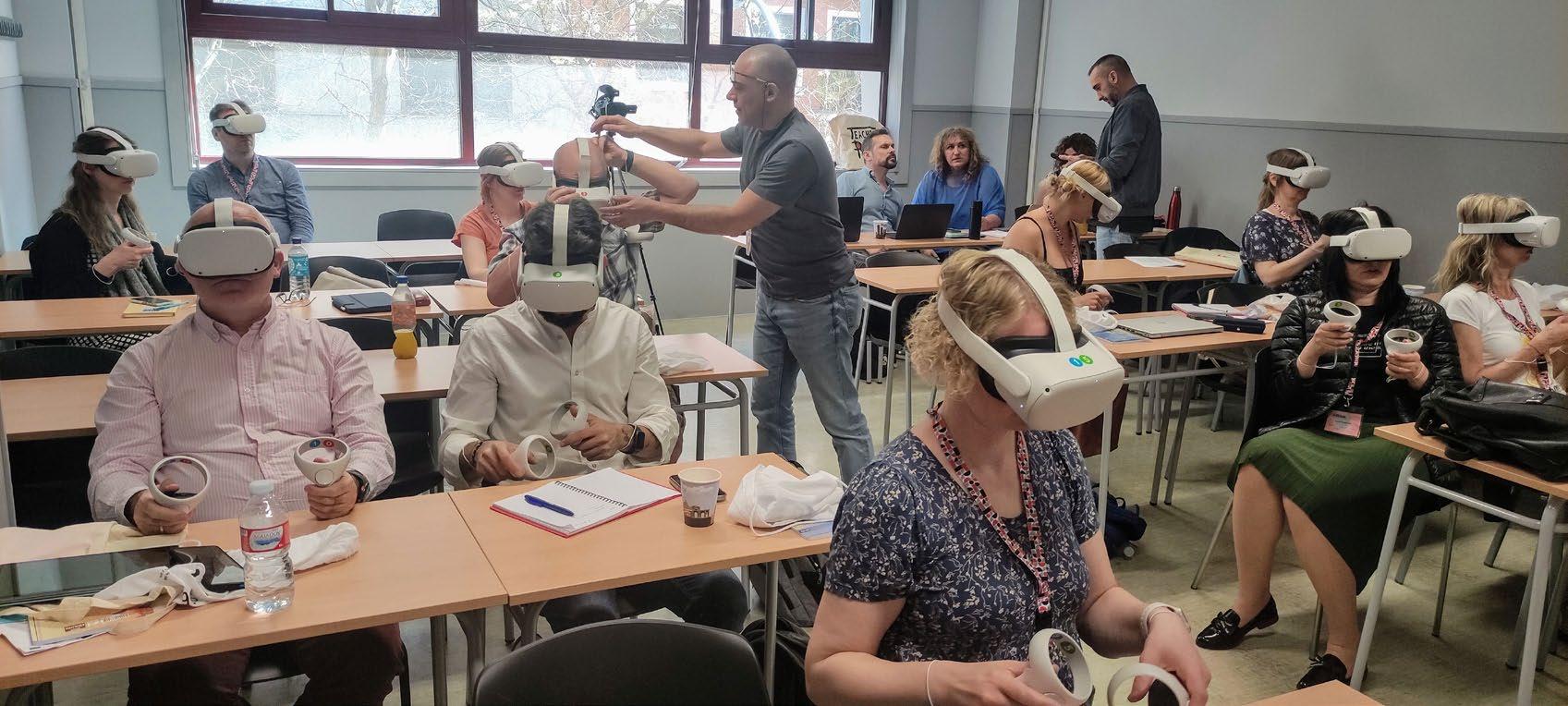
These meetings were held between the 15th and 19th of April, 2024 at the Universidad Rey Juan Carlos (URJC) in Madrid (Spain) and a group of representatives from the 12 centres taking part in the project attended. They would, in turn, have the task of relaying this training to their colleagues so that the maximum number of teachers would receive this training in the use of VR in the classroom.
These sessions were not only a technical training exercise but also a valuable place for open dialogue between teachers from the diferent institutions – a meeting which favored an atmosphere of collaboration where participants could share their experi-
With 770 students, it stands out for its focus on modern media and for being a Centre for Highly Gifted and Talented pupils.
With over 400 years of history, this high school with 900 pupils specializes in natural sciences and languages, and is a member of the STEM network of excellence since 2014.
This high school, with 1,300 pupils, focuses its educational model on environmental protection, STEM subjects, digital development and professional guidance.
IES La Arboleda (Alcorcón, Madrid)
This centre of education has 1,000 pupils and ofers training in Compulsory Secondary Education (ESO), Advanced Level and Professional Training (both medium and high level) as well as specialist courses of Video Game Development and VR.
This secondary school has 1,000 pupils in 4 areas of Compulsory Secondary Education (ESO) and 8 areas of Advanced Level Secondary Level, providing solid and diversifed training. https://www.educa2.madrid.org/web/centro.ies.margaritasalas.majadahonda
IES La Sisla (Sonseca, Toledo)
With a community of 1,200 pupils, the IES La Sisla stands out for ofering both professional training in key areas such as electricity, health, administration and care for the needy and training for those pupils who wish to access university.
https://www.ieslasisla.es/
Lappeenranta Kimpinen High School (Lappeenranta)
With 600 pupils, this school ofers quality education focusing on natural sciences and mathematics, guaranteeing integral academic development.
Integral school with 450 pupils ofering training in IT for Business and adapted education both full-time, part-time and one-to-one.
https://su-slaveykov-vidin.org/ SU “Petko Rachov Slaveykov” (Vidin)
With more than 190 years of history, this high school of 200 pupils specializes in business communication, accounting, IT and languages, such as English and German, in addition to being a member of the Association of Cambridge Schools of Bulgaria. https://soukula.org/ Sredno uchilishte “Vasil Levski” (Kula, Vidin)
With 900 students, this modern school ofers subjects specializing in humanities and natural sciences, and stands out as being the largest and most advanced school of the region. https://csv-vidin.eu/ “Tsar Simeon Veliki” Secondary School (Vidin)
ences, worries and expectations about the use of VR in the classroom. The debate which was generated led to an enriching exchange of ideas and best practice allowing people to identify common challenges and joint solutions. This group dynamic strengthened the cohesion of the group and ensured a joint understanding of the aims of the projects, establishing a support network among the participants which went beyond the event itself and made it possible for ongoing joint work to be carried out.
The sessions, held over 4 days, ofered a structured programme combining theory, practical workshops and spaces for debate and refection. This system made it possible for participants to grow familiar with the VR items and explore their application to teaching in a progressive and practical manner. After a welcome session in which the goals of the VIRION project were set out, participants received training about the appropriate use of VR glasses, safety measures and the confguration of virtual spaces, thus preparing the technical bases for the activities in the following days. The teachers worked with the VR applications designed by VIRION’s business partner, Premium Cine. These workshops included brief theory sessions followed by interactive practical sessions to explore the educational experiences in mathematics, biology, physics and chemistry. Participants could experience these items from the point of view of the pupil and discuss which strategies to use to introduce them efectively in the classroom. Particular importance was given to the need to document and assess the impact of the technologies employed and to ensure the quality of the results and their comparison between the diferent schools. In addition, the strategies for difusion were considered, highlighting international collaboration by means of the e-Twinning platform.
Over the course of the training week, the adoption and defnition of a common, active methodology was an essential element for the success of the project, especially considering the cultural and educational complexity of working with diferent countries. The diversity of educational ecosystems, approaches to teaching and cultural contexts is both a challenge and an opportunity for enriching the project. Establishing a shared focus made it possible to overcome these diferences and guarantee coherence in the implementation of the VR tools. By unifying criteria, the results obtained were similar and signifcant, irrespective of the context in which they were produced.
Piloting Sessions
The test sessions in the participating schoools were carried out following a structured protocol which guaranteed equity and rigor in the assessment process of the knowledge pills which were developed for the project. Each country had a set of 15 VR glasses which were distributed among the diferent centres
for the test. This allowed all the schools to access an essential resource for carrying out the tests in similar conditions thus ensuring a fair comparison of results.
The tests took place over 3 months of the school year and each centre planned and carried out the sessions, adapting them to their own specifc needs and the characteristics of pupils. The tests took place in small groups of 25 pupils plus the teacher in charge of the classroom who had the help of an additional designated assistant to ensure the correct completion of the activity. During these sessions, half of the pupils interacted individually with the four teaching items, while the rest waited their turn, thus preventing overuse and guaranteeing full concentration in each experience.
On completing the interaction with the knowledge pill, each student flled in an assessment test designed to record their impressions and assess the impact of the VR tool. This focus, based on the individual assessment of each item, was essential to avoid phenomena such as cognitive fatigue, surfeit or confusion caused by the simultaneous assessment of multiple content. In this way, the reliability of the process and quality of the data gathered were guaranteed.
This methodology- carefully designed and applied – ensured the validity and consistency of the results obtained, establishing a solid base from which to analyze the impact of the four pills in diferent contexts and under diverse academic conditions.
Method. Survey design.
One of the main problems observed in the scientifc literature about VR for education is the limited reach of the research carried out. In general, these studies focus on one single centre of education (one school), or, in
the best of cases, they use national samples based on a single country. Consequently, it is crucial to extend the focus of the research with international studies which compare the eficiency of these tools in different contexts, particularly in countries with diverse cultures. This is one of the strengths of VIRION, which carries out a comparison of four countries located in diferent geographic areas of Europe (Finland, Germany, Spain and Bulgaria) using the same VR material, created specifcally for this research and translated into the local languages.
Aims
The work for the pilot-testing of VR academic material sets out the following specifc objectives:
1. To measure the level of satisfaction and feeling of knowledge acquired using the VR lessons for STEM subjects among secondary school students in the four participating countries (Finland, Bulgaria, Spain and Germany).
2. To compare the level of satisfaction among the pupils from the four countries.
3. Based on the data gathered, to improve the teaching-learning processes in STEM subjects (at Secondary School level) in the European context, using VR and ofering a guide of good practice in the use of this technology.
4. To create academic materials in VR for STEM subjects which are freely available and free to use and adapt for all teachers.
Research design
A statistical study was carried out, based on a questionnaire about 4 immersive VR lessons with teaching content for STEM subjects, adapted to the syllabus of Secondary Education (Physics, Chemistry, Mathematics and Biology). The feld work was performed in 12
public secondary schools – three for each of the countries – between May and September 2024. It is worth pointing out that the key advantage of the project is that the immersive lessons were created specifcally for this research and written up in the language of each country. The use of pre-existing VR material was ruled out. The company specializing in VR interactive audiovisual production and content - Premium Cine – which belongs to the project alliance, was in charge of creating the immersive lessons.
The four VR items have a dynamic nature in which the students must overcome a series of challenges and tests to advance in the narrative and learn content. The research was divided into several phases:
1. Choice of content. The research team and the VR company, following the advice of teachers of the STEM subjects in the 12 schools, selected the specifc content for the VR narratives. The material chosen for each subject was: geometry and visualization of space (Mathematics), structure and cellular functions (Biology), the Periodic Table and its elements (Chemistry), and concepts of electricity and magnetism (Physics).
2. Design and development of the immersive lessons. The VR company Premium Cine, in coordination with the research team, created the immersive narratives following the META safety protocols.
3. Teacher training. The teachers from the twelve centres participated in an in-class training workshops in Madrid to familiarize themselves with the VR items and learn how to apply them in the classroom.
4. Application in the classroom. Each centre used the VR equipment for several weeks. Teachers explained the activities and how the equipment worked to students who tried them out and practised with the four lessons for as long as it took to interact with all the content or, at least, most of it.
5. Questionnaire for pupils. On completing their use of each VR item, students flled in a questionnaire, the results of which are set out in the study.
The questionnaire was based on Keller’s IMMS test (Instructional Material Motivational Survey) (2010), which focuses on four essentials variables in the teaching-learning process: (1) Attention, (2) Relevance, (3) Confdence and (4) Satisfaction of the student with the technology or methodology used, in this case, VR. These variables are based on Keller’s ARCS model (Attention, Relevance, Confdence, Satisfaction) (1987, 2010), which considers these four aspects as being fundamental for activating motivation in the process of education. Regarding attention, the study measures the tool’s ability to keep pupils focused on the tasks set out in the VR lessons. Relevance is defned as the level of usefulness perceived from the knowledge obtained. Confdence is related to the student’s perceived level of assurance during their interaction with the material. These three dimensions converge in the fourth, satisfaction, which predicts good results when the task is being performed (Cózar Gutiérrez et al., 2019). According to authors such as Cabero et al. (2017), these four variables are inter-related: attention is essential for relevance which, in turn, leads to confdence in learning and these three dimensions, together determine satisfaction.
The fnal test used in the VIRION project added two further dimensions, which were considered relevant for our research: (1) Design-Gamability-Interactiveness of the VR items and (2) Ease of use and navigation. Other variables of a socio-demographic nature were also added, such as gender or age, as well as other previous experience with VR and video games (see Table 1).
For the questionnaire, students had to express their degree of agreement with the statements in the text (see Table 1), where 1 means “Totally agree” and 5 “Totally disagree”. Although the original test uses the Likert scale with 7 levels (1-7), the fnal questionnaire only included 5 (1-5). The study carried out in Spain was approved by the Ethics Committee of the Universidad Rey Juan Carlos.
References
Keller, J. M. (1987). Development and use of the ARCS model of instructional design. Journal of Instructional Development, 10(3), 2–10. https://doi.org/10.1007/BF02905780
Keller, J. M. (2010). Motivational design for learning and performance: The ARCS model approach. Springer.
Q6. Do you own or have you used VR glasses in the past?
Q7. I have experience with video games and play them regularly Likert (1-5)
Dimension 1. Design-Gamability-Interactiveness
Q8. The lesson is like a game Likert (1-5)
Q9. I liked the design of the application Likert (1-5)
Q10. The lesson is interactive Likert (1-5)
Dimension 2. Ease of use and navigation
Q11. The item is easy to use
Likert (1-5)
Q12. The instructions of the lesson are easy to understand Likert (1-5)
Q13. Navigation is simple Likert (1-5)
Q14. I do not have any sensation of dizziness when navigating the lesson Likert (1-5)
Dimension 3. Attention
Q15. The virtual reality experience helps me pay attention
Q16. The design of the app helps me pay attention
Q17. Having a lot of exercises in the app helps me pay attention
Dimension 4. Relevance
Likert (1-5)
Likert (1-5)
Likert (1-5)
Q18. This class is related to things which I have already studied Likert (1-5)
Q19. After this experience, I am keen to learn more about the lesson Likert (1-5)
Q20. The lesson is useful from the academic point of view
Q21. I have learnt new things thanks to the lesson
Dimension 5. Confdence in the learning process
Likert (1-5)
Likert (1-5)
Q22. While working on this lesson, I was sure that I would learn the content Likert (1-5)
Q23. After working on this lesson, I feel more sure that I would pass an exam about the subject Likert (1-5)
Q24. The design of the lesson assures me that I will learn the content Likert (1-5)
Dimension 6. Satisfaction
Q25. I enjoyed the class so much with virtual reality that I would like to know more about its content
Q26. I enjoyed this lesson with virtual reality
Likert (1-5)
Likert (1-5)
Results 4
A total of 2,043 answers were received from Secondary School pupils from the four participating countries. By gender, 41.9% were female, 53.3% male and 3.8% preferred not to state their gender with 1% identifying as non-binary. The average age of students was 15.12 years old. In terms of previous experience with VR, 51.6% said they had used VR previously whereas 48.4% had no prior experience of this technology.
The results obtained show that the highest-rated dimension in VR has to do with an interactive design and gamifed nature of the items (Q8-Q10), with an average score in the three questions of 3.92/5. In fact, two of the items in this dimension recorded the two best scores of the whole questionnaire (Q10. The lesson is interactive: 3.97/5; and Q9. I liked the design of the application: 3.93/5). Therefore, the generally high satisfaction of pupils with the VR experience, (Q25 and Q26), with an average score in both questions 3.72/5, is more commonly a consequence of the interactive design of the lessons, i.e., in their structural make-up, than in other aspects which focus more on their strength and teaching relevance, as will be explained below.
The ease of use of software in VR is also particularly highly valued (Q11-Q14), a dimension which scores 3.63/5. The ability of this technology to hold users’ attention (Q15-Q17) and the perceived relevance of the knowledge acquired (Q18-Q21) score highly (3.48/5 in both cases), although they are far from the highest ranked dimension which, as we said above, is that which concerns the design and interactivity of the lessons.
However, even though the dimension related to the usefulness of the items records satisfactory results, the data of one of the questions included in that dimension – Q14, about the sensation of dizziness during the VR experience – are notably worse then those for the other questions in that dimension. That result coincides with previous studies which indicate that this type of technology is not exempt from problems such as stereoscopic tiredness of the eyes (Guo et al., 2024) and motion sickness which, even though there have been improvements in recent years, still exist (Chiroque, 2024).
The main aspect which must be improved is confdence/assurance of learning from the content. This dimension (Q22-Q24) is the one with the lowest average score (3.25/5). In fact, the three questions in this section are the ones with the lowest scores of the whole questionnaire. For that reason, for a correct inclusion of VR in classrooms, it is crucial that measures be established to ensure and strengthen the assurance and confdence in the learning acquired from using these tools. This can be achieved by imple-
menting this technology in controlled and safe environments, promoting learning by experience, creating materials which provide immediate feedback (thus allowing students to correct mistakes and improve their skills in real time, as well as monitoring their progress and detecting more easily the areas to be improved) and promoting collaborative learning experiences in these immersive, virtual environments (Makhataeva y Varol, 2020; Xu et al., 2022).
Therefore, formative assessments must be introduced over the course of the VR lessons so that students can measure their progress and better understand contents. Similarly, we recommend the creation of teaching material in VR with an efective, instructive design ensuring that the learning objectives are clear and reachable and, in particular, that guide the students through the content step by step. To do so, we recommend viewing (using video materials) and the teacher explaining beforehand which tasks are to be performed in VR, how they are related to the subject and the aims of the experience with this technology. Together, these strategies make up examples of best practice for obtaining optimum results with the use of these tools.
References
Chiroque Landayeta, V. E. (2024). Experiencias en el uso de la Realidad – Virtual. Cuadernos del Centro de Estudios de Diseño y Comunicación, 225. https://doi.org/10.18682/cdc.vi225.11247
Guo, M., Gao, H., Yang, S., Yue, K., Liu, Y., & Wang, Y. (2024). Evaluation of stereoscopic visual fatigue in virtual reality with exploration of brain dynamics. Displays, 102898. https://doi.org/10.1016/j. displa.2024.102898
Makhataeva, Z., & Varol, A. (2020). Augmented reality for robotics: a review. Robotics, 9(2). https:// doi.org/10.3390/robotics9020021
Xu, H., Chen, Y., Feng, Q., & Luo, H. (2022). Augmented reality in professional training: a review of the literature from 2001 to 2020. Applied Sciences, 12(3). https://doi.org/10.3390/app12031024
Outcomes from the pilot sessions
Table 1. General Data
5.
6.
Dimension 2. Ease of use and navigation
11. The item is easy to use
12. The instructions of the lesson are easy to understand
13. Navigation is simple
14. I do not have any sensation of dizziness when navigating the lesson 3.45
Dimension 3. Attention
15. The virtual reality experience helps me pay attention 3.58
16. The design of the app helps me pay attention
17. Having a lot of exercises in the app helps me pay attention
Dimension 4. Relevance
18. This class is related to things which I have already studied
19. After this experience, I am keen to learn more about the lesson
20. The lesson is useful from the academic point of view
21. I have learnt new things thanks to the lesson 3.35
Dimension 5. Confdence in the learning process 3.25
22. While working on this lesson, I was sure that I would learn the content 3.33
23. After working on this lesson, I feel more sure that I would pass an exam about the subject 3.19
24. The design of the lesson assures me that I will learn the content 3.23 Dimension 6. Satisfaction 3.72
25. I enjoyed the class so much with virtual reality that I would like to know more about its content 3.55
26. I enjoyed this lesson with virtual reality 3.9
General Chart 1. Gender
General Chart 1. Gender Female Male Prefer not to say Non-binariy
General Chart 2. Do you own or have you used VR glasses in the past?
General Chart 2. Do you own or have you used VR glasses in the past?
Table 2. Spain Data
6. Do you own or have you used VR glasses in the past?
12. The instructions of the lesson are easy to understand
14. I do not have any sensation of dizziness when navigating the lesson
Dimension 3. Attention
15. The virtual reality experience helps me pay attention
16. The design of the app helps me pay attention
17. Having a lot of exercises in the app helps me pay attention
Dimension 4. Relevance 3.56
18. This class is related to things which I have already studied 3.94
19. After this experience, I am keen to learn more about the lesson
20. The lesson is useful from the academic point of view
21. I have learnt new things thanks to the lesson
Dimension 5. Confdence in the learning process
22. While working on this lesson, I was sure that I would learn the content 3.15
23. After working on this lesson, I feel more sure that I would pass an exam about the subject 3.09
24. The design of the lesson assures me that I will learn the content 3.28
25. I enjoyed the class so much with virtual reality that I would like to know more about its content
26. I enjoyed this lesson with virtual reality
Table 3. Bulgaria Data
6. Do you own or have you used VR glasses in the past?
The virtual reality experience helps me pay attention
17. Having a lot of exercises in the app helps me pay attention
18. This class is related to things which I have already studied
19. After this experience, I am keen to learn more about the lesson
20. The lesson is useful from the academic point of view
21. I have learnt new things thanks to the lesson
22. While working on this lesson, I was sure that I would learn the content
23. After working on this lesson, I feel more sure that I would pass an exam about the subject
Table 4. Finland Data
15. The virtual reality experience helps me pay attention
16. The design of the app helps me pay attention
17. Having a lot of exercises in the app helps me pay attention
Dimension 4. Relevance
18. This class is related to things which I have already studied 2.95
19. After this experience, I am keen to learn more about the lesson
20. The lesson is useful from the academic point of view
21. I have learnt new things thanks to the lesson
Dimension 5. Confdence in the learning process
22. While working on this lesson, I was sure that I would learn the content
23. After working on this lesson, I feel more sure that I would pass an exam about the subject
24. The design of the lesson assures me that I will learn the content 2.61
Table 5. Germany Data
6. Do you own or have you used VR glasses in the past?
15. The virtual reality experience helps me pay attention
16. The design of the app helps me pay attention
17. Having a lot of exercises in the app helps me pay attention
18. This class is related to things which I have already studied 3.38
19. After this experience, I am keen to learn more about the lesson
20. The lesson is useful from the academic point of view
21. I have learnt new things thanks to the lesson
Dimension 5. Confdence in the learning process
22. While working on this lesson, I was sure that I would learn the content
23. After working on this lesson, I feel more sure that I would pass an exam about the subject
24. The design of the lesson assures me that I will learn the content 2.92
Table 6. Chemistry VR Material Data
I like the subject
6. Do you own or have you used VR glasses in the past?
7. I have experience with video games and play them regularly
Dimension 4. Relevance
18. This class is related to things which I have already studied
19. After this experience, I am keen to learn more about the lesson 3.64
20. The lesson is useful from the academic point of view 3.79
21. I have learnt new things thanks to the lesson 3.42
Dimension 5. Confdence in the learning process 3.41
22. While working on this lesson, I was sure that I would learn the content 3.41
23. After working on this lesson, I feel more sure that I would pass an exam about the subject 3.41
24. The design of the lesson assures me that I will learn the content 3.42 Dimension 6. Satisfaction
25. I enjoyed the class so much with virtual reality that I would like to know more about its content
26. I enjoyed this lesson with virtual reality 4.03
I like the subject
6. Do you own or have you used VR glasses in the past?
7. I have experience with video games and play them regularly
Table 7. Mathematics VR Material Data
Dimension 4. Relevance
18. This class is related to things which I have already studied
19. After this experience, I am keen to learn more about the lesson 3.38
20. The lesson is useful from the academic point of view 3.38
21. I have learnt new things thanks to the lesson 3.20
Dimension 5. Confdence in the learning process 3.14
22. While working on this lesson, I was sure that I would learn the content 3.21
23. After working on this lesson, I feel more sure that I would pass an exam about the subject 3.10
24. The design of the lesson assures me that I will learn the content
Dimension 6. Satisfaction
25. I enjoyed the class so much with virtual reality that I would like to know more about its content
26. I enjoyed this lesson with virtual reality 3.77
Table 8. Physics VR Material Data
6. Do you own or have you used VR glasses in the past?
Dimension 4. Relevance
18. This class is related to things which I have already studied
19. After this experience, I am keen to learn more about the lesson 3.34
20. The lesson is useful from the academic point of view 3.52
21. I have learnt new things thanks to the lesson 3.35
Dimension 5. Confdence in the learning process 3.1
22. While working on this lesson, I was sure that I would learn the content 3.26
23. After working on this lesson, I feel more sure that I would pass an exam about the subject 2.95
24. The design of the lesson assures me that I will learn the content
Dimension 6. Satisfaction
25. I enjoyed the class so much with virtual reality that I would like to know more about its content
26. I enjoyed this lesson with virtual reality 3.84
Table 9. Biology VR Material Data
I like the subject
6. Do you own or have you used VR glasses in the past?
7. I have experience with video games and play them regularly
Dimension 4. Relevance
18. This class is related to things which I have already studied
19. After this experience, I am keen to learn more about the lesson 3.49
20. The lesson is useful from the academic point of view 3.70
21. I have learnt new things thanks to the lesson 3.46
Dimension 5. Confdence in the learning process 3.34
22. While working on this lesson, I was sure that I would learn the content 3.43
23. After working on this lesson, I feel more sure that I would pass an exam about the subject 3.29
24. The design of the lesson assures me that I will learn the content 3.30 Dimension 6. Satisfaction
25. I enjoyed the class so much with virtual reality that I would like to know more about its content
26. I enjoyed this lesson with virtual reality 3.99
Recommendations and user guides 5
The experience of the pilot tests from the teachers’ perspective
With the use of VR in the participating centres, teachers have identifed recurring problems such as the dificulty in matching applications with the school syllabus, the initial complications with the use of VR glasses and the need for technical support inside the classroom. In addition, all teachers highlight the need to improve the applications so that they are more intuitive and functional for teaching.
However, not all countries have tackled the use of VR as a teaching tool from the same starting point. There are diferences between participants, related to specifc features of the region, which must be considered: in Germany and Finland the advanced technological infrastructure and greater familiarity with video games made it easier to adapt whereas in Spain and Bulgaria the lack of previous experience and restrictions in terms of technical support made its introduction more dificult. These results reveal that the introduction of VR in the classroom must be adapted to the conditions and resources of each context, with specifc training and content designed for the needs of each teaching environment.
Common problems:
1. Recognized teaching potential:
- In all countries, teachers acknowledged the high teaching potential of VR, especially for complex subjects and immersive viewing in sciences.
- Recognition of its novelty as a teaching tool. There is a consensus surrounding its ability to motivate students and enrich learning experiences.
2. Technical problems and adaptation:
- The teachers in the four countries spoke, to diferent degrees, about the initial problems associated with the technical confguration and need for support when installing and using VR glasses.
- The dificulties for some students and teachers in the use of controls and familiarization with the interface were recurring problems.
3. Fatigue and dizziness:
- In all of the countries, a signifcant number of students experienced tired vision, dizziness or discomfort after prolonged sessions, highlighting the need to regulate the time of use.
4. Challenges for syllabus integration:
- Teachers agree that VR is more efective as a complement for traditional methodologies rather than a substitute. They acknowledged the need to develop applications which match syllabus content.
5. Importance of working together:
- In every context, participants highlighted the efectiveness of working in pairs or groups, where one person guides and another uses the glasses, thus optimizing resources and promoting cooperation.
Specifc circumstances:
1. Previous experience and familiarity with the technology:
- In some contexts, teachers and pupils had more familiarity with advanced technology and video games, making it easier to use the glasses at frst.
- In other cases, previous experience with VR devices was limited, leading to a steeper learning curve.
2. Technical support and preparation:
- There are cases of detailed technical planning, including learning environments prepared beforehand and available technical support.
- In other contexts, the limited technical support and training made sessions more dificult.
3. Perceived usefulness of applications:
- Some participants considered applications intuitive after a brief adaptation period.
- Others reported greater dificulty in the use of glasses and controls, especially students with less technological experience.
4. Use in diferent subjects:
- In certain cases, VR was applied in a variety of subjects such a as mathematics, biology, chemistry and physics.
- In others, use was more limited, focusing on specifc subjects such as mathematics and chemistry.
5. Acknowledged level of innovation:
- Some perceived VR as a resource with potential to become a regular tool after some improvements in its content.
- In other contexts it was considered more of a complementary or fun experience, with no significant impact on methodology.
6. Perception of content design:
- In general, the feedback on the general design of applications was positive although some areas of improvement for the current content were identifed.
- In other cases, the quality of the contents was criticized and also the lack of “ft” with syllabus objectives.
Good practices for the design and use of VR applications
The incorporation of new technologies in education has brought new opportunities for enriching the teaching and learning processes. One of these tools is VR, ofering practical, interactive, 360° viewings, which is dificult to achieve with traditional simulators. However, to guarantee its success in teaching environments, a structured approach must be adapted, combining technological innovation with solid teaching principles.
This guide of best practices arises from the experience and analysis of teachers from Finland, Germany, Bulgaria and Spain who have employed VR applications in the context of the VIRION project. This practical guide will serve both software designers and teachers who want to start using VR in their classrooms, considering factors such as usefulness, syllabus appropriateness, student health and safety and the teaching potential of the tool.
The purpose of these recommendations is to maximize the educational impact of VR, promoting signifcant learning, student motivation and adaptation to the needs of each subject. These recommendations cover both the design of the applications and their incorporation into the classroom, two factors which must be complementary and be considered in unison to maximize the efectiveness of VR technology in the feld of education. This document not only stimulates its readers to explore the possibilities for technology in education but also establishes a framework for responsible, eficient and accessible use for all participants in the education environment.
Facilitating access and planning sustainability of VR technology
The implementation of VR in education must guarantee a fair access to the technology and plan its long-term sustainability, ensuring its educational, technological and economic feasibility.
Actions:
• To provide accessible devices and content: Guaranteeing the availability of afordable VR glasses and access to libraries with relevant content (ClassVR), including free, open access material.
• Training teachers in content creation: Training teachers to design personalized material in order to reduce dependence on external suppliers and promote educational autonomy.
• Planning technological renovation: Designing strategies to update equipment and software periodically thus ensuring compatibility with technological advances and optimizing use.
Example: A teaching kit including VR glasses, access to a platform such as ClassVR with scientifc simulations, intuitive software which allows teachers to design interactive personalized lessons. In addition, incorporating free content in key areas such as mathematics and science to help communities where budgets are limited.
Planned syllabus integration
It is important to ensure that VR activities are directly linked to the school syllabus and its learning objectives.
Actions:
• Software creators must work alongside teachers to design applications which match the requirements of the course.
• Including exercises which deal with abstract concepts which are hard to visualize (such as molecular structures or three-dimensional systems).
• Planning VR sessions are a complement for traditional teaching, not a substitute.
Example: Teachers should select specifc activities to explore VR. For example, in biology, during an anatomy class, students can interact with a 3-dimensional model of the heart to observe blood fow through cavities, valves and arteries.
User friendliness
The design of applications must be easy to use and understand, even for pupils with little technological experience.
Actions :
• Implementing introductory tutorials which explain the use of glasses and controls.
• Designing clear interfaces and intuitive buttons thus preventing information overload.
• Adapting the design for beginners to ensure that applications are accessible and easy to use, even for people with no prior experience in video games or virtual environments. Controls should be basic and navigation clear and simple.
Example: An application for geometry which allows 3-D fgures to be moved around with simple controls and clear feedback.
Inclusion and accessibility
The implementation of VR in education must guarantee fairness and meet the needs of all pupils, including those with limited abilities or from disadvantaged communities, favoring fair and inclusive access.
Actions:
• Asssiting special needs students: Developing adapted VR tools and applications for students with hearing, visual or physical disabilities to ensure their ac-
tive participation in learning activities.
• Designing accessible contents: Incorporating such functions as subtitles, audio descriptions and adapted controls which allow all students to interact comfortably with the VR applications.
Example: A teaching application for exploring virtual historic sites equipped with subtitles for students with hearing dificulties, a narrated description for students with sight impediments and controls adapted for students with limited mobility.
Appropriate duration
To regulate the time of use in order to prevent visual fatigue and dizziness of students.
Actions:
• Limiting sessions to 10-15 minutes per group with rest intervals in between.
• Incorporating a system of alerts to remind students when they should take a break.
• Prioritizing brief sessions for specifc concepts, avoiding prolonged complex activities in one given session.
Example: Alternating the use of VR with group discussions or back-up tasks outside the virtual environment.
Previous technical preparation
Setting up the space in the classroom and testing all devices before class to avoid technical problems during the session.
Actions:
• Checking glasses, controllers and software beforehand to make sure they are working properly.
• Setting up work stations with enough room so that students can move around safely.
• Providing clear instructions and checklists for the teachers in charge.
Example: Setting up the classroom with VR stations and synchronized tablets to guide students.
Working together and in pairs
Designing joint activities in which students work in pairs to optimize learning and minimize disruption.
Actions:
• Establishing alternating roles: one student uses the glasses and the other guides from a screen or tablet.
• Promoting cooperation to solve problems and complete tasks related to the content.
• Designing applications which require simultaneous actions from both roles.
Example: In a biology simulation, one pupil explores the cell while the other identifes organelles on a shared screen.
Variety and depth of content
Ofering content which can be adapted and regulated depending on the level and needs of the pupil, with clear objectives.
Actions:
• To include progressive levels of dificulty to stimulate continuous learning.
• To design applications with questions or tasks so as to encourage critical analysis and not only passive exploration.
• To avoid environments with overload or which are too simple so as not to distract or bore the student.
Example: A physics application which simulates electric circuits where the complexity of the connections on each level can be increased.
Supervision and active monitoring
Providing teachers with tools to monitor in real time what students are seeing in VR.
Actions:
• To develop software which refect on external screens what is being viewed on the glasses.
• To provide teachers with controls to pause or guide the activity if the student strays from the objective.
• To train teachers for the use of technologies and strategies of efective supervision.
Example: During a chemistry simulation, the teacher can point out mistakes or guide the student in real time from a projected screen.
Adaptation of VR to the specifcs of the subject
Designing applications with actions which could not be carried out in a normal classroom. VR must provide a diferentiating element that cannot be substituted by a real experience or on a 2-D screen.
Actions:
• To create fexible tools that allow the teacher to modify content according to the needs of the class.
• To enrich simulations with immersive features which are specifc to each subject.
• To include additional resources such as virtual libraries or interactive experiments.
Example: The use of VR in physics to simulate laboratory experiments.
Focus on health and safety
Prioritizing pupils’ physical and mental health, minimizimg the risks associated with VR.
Actions:
• Instructing students on how to use glasses in a safe way and detecting signs of discomfort.
• Assessing students’ aptitude for using VR beforehand, identifying possible medical restrictions.
• Incorporating mechanisms which ease movements in the virtual environment to reduce dizziness and vertigo.
Example: Including options for controlling sensitivity to adjust movements in highly dynamic simulations.
Assessment and continuous improvement:
To implement a feedback cycle for assessing the teaching impact and adjusting tools in accordance with results.
Actions:
• Gathering data about learning and the experience of students after each session.
• Involving teachers and students in the ongoing design of applications to identify areas for improvement.
• Defning clear indicators for measuring the success of applications, such as how well pupils retain concepts and their level of motivation.
Example: Promoting continuous training of teachers accompanied by ongoing technical support all of which covers both teacher training and the design and implementation of teaching applications.
Promoting collaboration with the industry
The collaboration between the education sector, technological industry and public institutions is essential for guaranteeing the creation, updating and sustainability of VR contents to be used in school programmes.
Actions:
• Joint development: Establishing strategic alliances with technological companies and universities to co-create VR teaching contents which match the aims of the syllabus and meet the specifc demands of the classroom.
• Promoting continuous updates: Encouraging public and private institutions to participate actively in the production and renovation of VR contents, making sure they are relevant and technologically state-ofthe-art
• Promoting public policies: Boosting government initiatives to promote the integration of VR in the education system by means of funding programmes, tax incentives for content developers and teaching training in technology.
Example: A collaboration programme between the Ministry of Education, technology companies such as Meta and local universities to develop interactive simulations for science with technical support and continuous training for teachers. In addition, launching a public policy to subsidize the purchase of VR equipment for rural and urban schools with limited resources.
Planning long-term sustainability
The integration of VR in education requires strategic planning to guarantee feasibility and relevance over time, bearing in mind economic, technological and teaching factors.
Actions:
• Cost evaluation: Carrying out detailed cost-beneft analysis of the implementation of VR compared to other teaching technologies, ensuring an eficient investment with a positive impact on learning.
• Planning technological updating: Designing strategies for the periodic renovation of equipment and software, maintaining compatibility with techno-
logical advances and avoiding the premature obsolescence of resources.
• Promoting the development of their own content: Training teachers so that they can create and adapt personalized teaching material, reducing the dependence upon external suppliers and promoting the autonomy of teaching institutions.
Example: A 5-year plan for schools which includes the renewal of VR equipment every 3 years, yearly training of teachers in the design of content using free or low-cost software and a periodic analysis of the educational and fnancial impact to guarantee the sustainability of the project.
Introduction to lesson plans and examples
Integrating VR Technology into Education
Traditional teaching methods often struggle to provide students with hands-on, immersive learning experiences—especially in subjects like Science, Technology, Engineering, and Mathematics (STEM). VR technology addresses this challenge by ofering interactive, visually enriched, and experiential learning environments. Virtual reality (VR) is transforming education by providing immersive learning experiences that enhance student engagement and understanding.
The integration of VR into school lessons aligns seamlessly with the STEM methodology. In this White Book we introduce lesson plans in Mathematics, Chemistry, Physics, and Biology, demonstrating how Oculus Quest 2.0/3.0 VR glasses and custom-designed VR applications developed within an Erasmus+ project VIRION can revolutionize classroom teaching.
Why use VR in STEM education?
Virtual reality (VR) ofers interactive and dynamic ways for students to engage with complex scientifc and mathematical concepts. The benefts of VR integration include:
• Enhanced visualization – Students can explore abstract or microscopic concepts (e.g., atomic structures, magnetic felds, cellular organelles) in a 3D space.
• Experiential learning – Hands-on experiences with VR applications reinforce theoretical knowledge through active participation.
• Increased engagement – VR’s novelty and interactivity foster deeper interest and motivation. Gamifcation elements enhance engagement, encouraging curiosity and exploration. Studies show that students using VR are more focused and motivated compared to traditional learning methods.
• Safe experimentation – VR allows for the simulation of hazardous experiments or inaccessible environments. Students can safely explore chemical reactions or electrical circuits without the risk of injury or material waste.
• Bridging the Gap Between Theory and Practice – Many students struggle to connect theoretical knowledge with real-world applications. VR simulations help bridge this gap by allowing them to interact with re-
alistic scenarios. For instance, in a Physics lesson, students can construct and manipulate electrical circuits within a virtual escape-room challenge.
Each subject-specifc lesson plan, developed by teachers participating in the VIRION project, incorporates VR applications (Math, Chemistry, Biology and Physics) specifcally developed for this project, aligning with modern pedagogical approaches.
Lesson plans and VR applications
Biology – Prokaryotic vs. Eukaryotic Cells
Lesson Objective: Compare and contrast the structure and functions of diferent cell types.
VR Application: Students enter virtual laboratories to build prokaryotic and eukaryotic cells by assembling their organelles.
Activities:
• Explore a virtual lab environment.
Mathematics – Geometry and Spatial Visualization
Lesson Objective: Develop spatial reasoning and understanding of geometric shapes and transformations.
VR Application: Students manipulate 3D geometric shapes (e.g., spheres, cubes, prisms) and apply Boolean operations (union, subtraction, intersection) to create complex structures.
Activities:
• Explore basic shapes and their properties in a virtual environment.
• Apply transformations (rotation, scaling) to visualize geometric principles dynamically.
• Work collaboratively to solve spatial puzzles.
Assessment: Observation of students' ability to manipulate shapes and solve spatial reasoning tasks.
• Identify and place organelles in their correct locations.
• Discuss cell functions and their impact on living organisms.
Assessment: Completion of virtual cell models and group discussions on structural diferences.
Physics – Electricity and Magnetism
Lesson Objective: Understand the principles of electrical circuits and magnetism through hands-on problem-solving.
VR Application: An escape-room-style experience where students solve puzzles related to circuits and magnetic felds.
Activities:
• Assemble an electrical circuit using virtual components.
• Identify devices that operate based on magnetism.
• Answer questions on electrical properties to unlock new levels.
Assessment: Students' ability to complete tasks and explain their reasoning in class discussions.
Chemistry – Periodic Table Exploration
Lesson Objective: Familiarize students with the periodic table and element properties.
VR Application: Students explore a virtual mine, identifying and categorizing elements based on their chemical families.
Activities:
• Navigate through diferent element families in a 3D environment.
• Retrieve and correctly place elements in a virtual periodic table.
• Analyze trends in atomic structure and properties.
Assessment: Refection discussions and completion of element-sorting tasks.
Key takeaways for teachers
Preparation Tips:
• Ensure VR equipment is functional and pre-installed with necessary applications.
• Familiarize students with VR navigation before engaging in subject-specifc tasks.
• Design refection activities to reinforce learning outcomes.
Challenges and Considerations:
• Initial setup may require extra time and technical support.
• Some students may need gradual acclimation to VR to prevent motion discomfort.
• Efective classroom management strategies are essential to maximize participation.
Lesson plan description and analysis
Lesson Plan Overview
The lesson plans have been developed as examples for Mathematics, Chemistry, Physics, and Biology to incorporate virtual reality (VR) as an interactive teaching tool. Each plan follows a structured approach to ensure that students achieve subject-specifc learning outcomes while gaining hands-on experience with VR applications using Oculus Quest 2.0/3.0.
Subject
Mathematics
Biology
Physics
Chemistry
Lesson Topic VR Application
Geometry & Spatial Visualization
Prokaryotic vs. Eukaryotic Cells
Electricity & Magnetism
Manipulating 3D geometric shapes
Virtual Cell Lab
Escape Room VR
Periodic Table Exploration Virtual Mine
Main Learning Objective
Enhance spatial reasoning and understanding of transformations
Identify and compare cell structures and functions
Understand electrical circuits and magnetism through problem-solving
Familiarize with element families and periodic trends
Context and Links with Previous Lessons
Each lesson builds on prior student knowledge:
• Mathematics: Students have prior knowledge of basic geometric shapes and formulas.
• Biology: Students are introduced to cell theory and have observed cells under a microscope.
• Physics: Previous lessons have covered fundamental electrical concepts and magnetic properties.
• Chemistry: Students have learned about atomic structure and chemical elements.
Cross-curricular links are also incorporated, especially between Science, Chemistry, and Technology, fostering an interdisciplinary approach to learning.
Learning Objectives & Outcomes
Each lesson plan aims to develop key competencies and subject-specifc understanding:
Subject
Mathematics
Biology
Physics
Chemistry
Learning Objectives
Identify and manipulate geometric shapes in a 3D space.
Compare and contrast prokaryotic and eukaryotic cells.
Solve electrical circuit and magnetism-based problems.
Explore the periodic table in an immersive VR environment.
Learning Outcomes
Students will construct and analyze complex shapes using Boolean operations.
Students will correctly assemble virtual cells and explain organelle functions.
Students will complete circuit-based challenges and explain key concepts.
Students will classify elements into their respective families and understand periodic trends.
Pre-Lesson
Preparation
Technical Setup:
• Ensure Oculus Quest headsets are functional and pre-installed with subject-specifc VR applications.
• Provide students with an introductory session on VR navigation and safety guidelines.
Additional Resources:
• Tablets or computers for supplementary explanations.
• Worksheets for pre- and post-VR assessments.
• Interactive whiteboards for demonstrations and discussions.
ICT and VR Resources, Skills, and Apps
Hardware
Oculus Quest 2.0/3.0
Software & Apps
VIRION VR Apps for each subject
Tablets/computers 3D modeling software (e.g., Tinkercad for Biology, GeoGebra for Maths etc.), Online Apps for creating quizzes, games and other e-assessment materials (MS Forms, Google Forms, Learning Apps, Kahoot! Etc).
Explore the periodic table in an immersive VR environment.
Both teachers and students require basic skills in VR navigation and digital manipulation of virtual objects.
Key Competencies Development
Competency
Description
Digital Competency Students learn to interact with and navigate VR environments.
Scientifc Reasoning Applying VR simulations to enhance conceptual understanding.
Collaboration & Communication Working in pairs to solve challenges and discuss fndings.
Problem-Solving Using VR tools to test and analyze scientifc concepts.
Formal and Non-Formal Methods Applied
Each lesson incorporates a combination of traditional and innovative teaching methods:
• Direct Instruction – Introduction and explanation of key concepts before VR activities.
• Guided Exploration – Students navigate VR applications with teacher support.
• Pair Work & Group Discussion – Students collaborate and refect on their VR experiences.
• Gamifcation – VR elements are designed as interactive challenges to increase engagement.
Lesson Structure & Activities
Each lesson follows a structured fow to maximize learning efectiveness:
Time (min) Activity
Teacher’s Role Student’s Role Assessment Strategy
5-10 min Introduction to VR & learning objectives Explain concepts, demonstrate VR tools
15-25 min VR Exploration & Guided Tasks Assist students with navigation and problem-solving
10-15 min Refection & Discussion Lead discussion, encourage peer feedback
Lesson Evaluation
Success Factors:
Listen, ask questions
Interact with VR environment, complete challenges
Observing student engagement
Monitoring student progress, answering questions
Share experiences, discuss fndings Group discussion, reviewing student refections
• High student engagement due to the immersive nature of VR.
• Active participation and improved conceptual understanding.
• Efective collaboration in problem-solving tasks.
Challenges & Solutions:
• Technical Issues: Ensure devices are set up in advance and provide technical support.
• Motion Sickness for Some Students: Allow gradual acclimatization and provide alternative participation options.
• Time Management: Plan VR sessions eficiently to balance interactive and discussion segments.
Future Recommendations
• Enhancing VR Content: Improve app functionalities based on teacher feedback.
• Expanding Subject Areas: Integrate VR applications into more disciplines.
• Developing Student-Created VR Content: Encourage students to create and modify virtual simulations for deeper learning.
Conclusion
Integrating VR into education ofers an innovative way to deepen student understanding through experiential learning. These lesson plans demonstrate how VR technology can be seamlessly embedded into classroom instruction, making complex scientifc concepts more accessible and engaging.
1 LESSON PLAN COUNTRY:
BULGARIA
Lesson Topic
Procaryotic vs eucaryotic cell
Subject
Biology 9 40 min 26
Type of the lesson Interactive, Practice-Based
Context
Links with previous lesson(s)
Cross curricular links before the lesson
Students are already familiar with the basics of cell types and structures and the fact that the cell is the basic unit of life and that all organisms are made up of at least one cell. They know the essence of Cell theory.
• Science
In the previous years in the Science classes they have studied about cells and their basic components. They have observed cells under microscope and have drawn what they see.
• Chemistry
In the Chemistry classes they got acquainted with the basic instruments and techniques used in the lab.
• Technology and Engineering: 3D modeling software is used studying and creating models of cells, cell structures and organic molecules. Challenge students to build similar virtual prototypes, fostering STEM skills.
Learning Objective:
Understand, compare and contrast the differences between eukaryotic and prokaryotic cells
Identify cell organelles and match them with their specific role and function within the cell.
Understand the relationship between the structures and functions of cells and their organelles.
Learning Outcomes:
By the end of this lesson, students will be able to:
1. Identify the key structures of prokaryotic cells.
2. Explain the functions of prokaryotic cell structures.
3. Identify the key structures of eukaryotic cells.
4. Explain the functions of eukaryotic cell structures.
5. Compare the structure and functions of prokaryotic and eukaryotic cells.
Pre Lesson-Preparation
Presentation on types of cells , worksheets, Virion’s Biology application
By the end of this lesson, students will develop the following key competencies:
• Science and technology competences;
• Digital competences;
• Personal, social and learning competences – collaboration and team work.
• Critical thinking, scientific reasoning, and problem solving to make informed decisions.
Formal and non-formal methods applied in the lesson:
Discussion on types and kinds of cells, Direct Instructions, Guided exploration, Differentiated Instructions, Technology-based learning, Group learning, Problem-solving tasks
Resources e.g. TEL, Other Adults, Materials and Equipment
Assessment Strategies Used to Ensure Progress of All Learners
Learner Activity Identify the techniques used to d ifferentiate for ALL L earners
Teacher Activity Objective s & Outcomes, Teaching A ctivities, R evisiting O utcomes & Consolidation
Link to Learning Outcome number
Time (min)
Computer, projector or interactive board.
V erbal responses . Observing students’ activity during the discussion
Watch the presentation. Take part in the discussion.
I ntroduction . Present power point: What’s the Difference? Plant, Animal, and Bacterial Cells
Discuss ion –What are the differences? W hich organisms are builtup of these cells?
Basic Unit of Life Worksheet (one per student)
Oculus VR glasses, 3D Virion biology app
5 1, 3
Observation.
Choose partners. Study the worksheet
Presents the objectives of the lesson and guides the forming of teams of two. Gives the worksheets.
5 1, 2, 3 , 4, 5
Observation.
One of the students explores procaryotic cell lab and the other –eucar yotic cell lab. Fill in the worksheets.
Guide through VR experience. Help teams if necessary. Circle to assist students . Have students discuss the functions of the organelles.
What was successful / not so successful? What was the impact of this on student progress?
Evaluation
Pupil Learning & Progression
All the students showed great interest and motivation and mostly achieved the intended learning outcomes My knowledge is based on the final discussions, students’ activities and attitude. Standards used are the standards adopted by Bulgarian Ministry of Education for Biology in 9 grade.
Based on the enhanced engagement and understanding of the concepts of structure and function on cellular level All pupils managed to complete their tasks in time and nearly all worksheets were perfectly filled in.
Teaching & Classroom Management
One of the prerequisites for creating an environment that facilitates positive behaviours is to know your students well, forming a small teams of two is another one. The introduction of the topic and the learning objectives in a way that will motivate students for highly conductive learning is also very important. And finally the innovative method of VR 3D modelling is very helpful.
Planning & Subject Knowledge
How could you further develop pedagogy to address errors and misconceptions in your planning?
• Introduction could be more motivating through a short quiz or Kahoot before the VR session to identify misconceptions and gauge students' prior knowledge.
• During the lesson, encourage students to explain their thinking processes and ideas. This can prevent misunderstandings and going into wrong direction.
• I should present to the class the common errors made during the VR session, and analyse and correct them together with the students.
• Students should be given more active part encouraging them to explain concepts to one another. This not only reinforces learning but also helps clarify misconceptions.
How could you develop imaginative and creative approaches to further match individual needs and interests?
• Individual approach: Create different challenges corresponding to students’ interests and capabilities with varying levels of difficulty in the VR environment.
• Independence: Give the students the opportunity to choose their tasks and even to create virtual scenes and ideas for VR activities
• Integrated learning: Combining different subjects like science, maths, history, arts and so on Cross-Disciplinary Projects: Combine mathematics with art or history by exploring how pyramids were used in different cultures, encouraging broader engagement.
Teaching with VR implementation
What was different compare the teaching without VR.
Students show great interest in this innovative learning technology, they are more motivated to participate in lesson activities and like the challenges.
What are the benefits.
Motivation and active participation helps achieve learning objectives . Problems, appeared during the lesson.
The first steps in VR setup required more time. Some students didn’t feel very well at the beginning.
Basic Unit of Life Worksheet
Team members:
………………………………………………………
1. Mark the structures of the procaryotic cell.
2. Mark the structures of the eucaryotic cell
3. Fill in the table. Mark with „+“ or „“ the presence or absence of the cell structures.
Cell structures
Capsule
Cell wall
Cell membrane
Cytoplasm
Nucleus
Nucleoid
Rhibosomes
Mitochondria
Golgi apparatus
Endoplasmic reticulum
Lysosomes
Procaryotic cell Eucaryotic cell
4. Task for excellence! Why procaryotic cells build up only unicellular organisms and eucaryotic cells build up both unicellular and multicellular organisms?
Lesson Plan country:
SCHOOL:
Lesson Topic
Structure of a eukaryotic cell
Subject Class Duration (min)
Name of the teacher
Biology 9 40 Irena Borisova
Type of the lesson Students number
Combined lesson – exercise and practical activities 26
Context
Links with previous lesson(s)
Cross curricular links before the lesson
The students have already studied and are familiar with the structures in the eukaryotic cell.
• Human and Nature, 5th and 6th grade – Photosynthesis and Respiration;
• Biology, 9th grade – Chemical Composition of the Cell and Prokaryotic Cell;
• English Language – Using Diagrams in English.
Learning Objective:
To develop knowledge about the structure and functions of cellular structures; to clarify the diversity of cells in relation to their location in the multicellular organism and the function they perform.
Learning Outcomes:
By the end of the lesson, each student should know and be able to:
1. Name groups of cellular organelles;
2. Identify and describe cellular structures using a diagram or model;
3. Characterize cellular structures based on their structure and function;
4. Establish connections and dependencies between structure and function at the cellular level;
5. Compare cell structures and identify functional relationships between them
Pre Lesson-Preparation
Presentation on Cell Structures – "In the World of a Mini-Galaxy: The Eukaryotic Cell" Worksheet
Virion’s Biology Application
ICT and VR Resources, Skills, and Apps
Hardware Equipment: VR headsets, tablets or computers for working with interactive applications, interactive whiteboard.
Teacher: Working with an interactive whiteboard and presentation software. Using Basic VR applications and 3D modeling software.
Students: Working with interactive educational applications. Navigating within a VR environment and performing simple manipulations of 3D shapes.
Software and Apps
3D Modeling App: Tinkercad VR Mode
VR Applications: Google Expeditions – for virtual exploration of cellular structures
Inside a Cell – Google Arts & Culture
Additional Educational Videos: Khan Academy
Key Vocabulary
The new words students will learn during the lesson.
By the end of the lesson, each student will develop the following key competencies: Science Competences – Comparing cell structures and identifying functional relationships between them.
Digital Competences – Using VR technology to explore cellular structures.
Initiative and Entrepreneurship – Designing and creating models of cellular structures.
Personal and Social Competences – Teamwork, collaboration, and critical thinking.
Formal and non-formal methods applied in the lesson:
Methods:
• Discussion
• Observation
• Independent work with a worksheet
• Building a diagram
• Group discussions
• Presentation
• Project-based activity
Resources e.g. TEL, Other Adults, Materials and Equipment
Assessment Strategies Used to Ensure Progress of All Learners
Learner Activity Identify the techniques used to d ifferentiate for ALL L earners
Teacher Activity Objective s & Outcomes, Teaching A ctivities, R evisiting O utcomes & Consolidation
Verbal responses. Observing students’ activity during the discussion Computer, projector or interactive board.
The students participate in the discussion by pointing out characteristic elements of the structure of the eukaryotic cell, as well as the cellular organelles studied so far, including their structure and functions.
1 Introduction: The teacher organizes a discussion on the structure of the eukaryotic cell and the types of cellular organelles according to their structure. A conclusion is made about the fundamental similarities in the structure of eukaryotic cells. The diversity of cells is clarified in relation to their location in multicellular organisms and the functions they perfo rm.
Eukaryotic Cell Structures Worksheet (one per student)
Observation and reflection, worksheets.
The students compare their charts with those on the board, correct any mistakes, and fill in any missing information. They identify the figures that illustrate the corresponding organelles.
2,3,4 The teacher distributes a worksheet to the students –a flowchart of organelles. A student is chosen to fill in the chart on the computer. The chart is then displayed using a multimedia projector after everyone has completed it.
Oculus VR glasses, 3D Virion biology app
5
10
Observation
The students could enter a virtual environment and explore cellular structures using VR headsets. по двойки.
2,3,4,5 Guidance through the VR experience. The students work in pairs –this encourages collaboration and the exchange of ideas.
20
T ake notes in the worksheet on the structures of the cell Worksheets, assessment
Present their worksheets, share experience.
5 Organize discussion and sharing team experience. Summarize the results of the students' work, comments on the knowledge and skills they demonstrated. A task (project) is assigned for the next lesson –to create a model of a cellular structure.
1 LESSON EVALUATION
What was successful / not so successful? What was the impact of this on student progress?
Evaluation
Pupil Learning & Progression
All the students showed interest and eagerness to work, and the majority of them achieved the planned learning outcomes. This is evident from the final discussions and activities of the students. Standards used are the standards adopted by Bulgarian Ministry of Educationfor Biology in 9 grade.
The progress in the students' knowledge is confirmed by the cellular structure projects presented to the class in the following lessons.
Teaching & Classroom Management
The lessons held in the non-traditional classroom have a different organization and activities for both the teacher and the students. These types of lessons contribute to greater interest and motivation for learning. Students are required to perform tasks related to more scientific communication and movement to successfully complete the tasks. The application of the innovative method of VR3D modelling is very beneficial and engaging.
Planning & Subject Knowledge
The update of knowledge at the beginning of the lesson can take the form of a short discussion to assess the level of prior knowledge and address any misconceptions.
Encourage students to share their feelings and thoughts while working with the Oculus headsets. This can help anticipate mistakes, which can be corrected in real-time.
Encourage students to explain concepts to each other. This promotes more effective learning and helps clarify misunderstandings.
Assign tasks and activities with varying levels of difficulty in the VR environment, adjusted to the interests and abilities of the students.
Allow students to create their own virtual laboratories and come up with ideas for VR activities.
Teaching with VR implementation
What was different compare the teaching without VR.
The students performed the tasks and activities from the challenges with interest.
What are the benefits
Non-traditional learning through experience in a VR environment leads to improvement in the understanding of new scientific concepts.
Problems, appeared during the lesson.
The initial setup for the VR experience required more time
The cellular organelles of a eukaryotic cell include
Name: ......................................................................................................... Class ............. № ........
Task: Complete the table by writing down the structure and function of each cellular organelle.
Cellular Organelle Schematic drawing Structure Function Cell Membrane
Endoplasmic Reticulum
Golgi Apparatus
Lysosomes
Peroxisomes
Vacuole
Mitochondria
Chloroplasts
Nucleus
Ribosomes
Cytoskeleton
Centrosome
Task: Complete the diagram so that it accurately reflects the structure of a eukaryotic cell.
1 LESSON PLAN
Lesson Topic
Cells and their functions
Subject Class Duration (min)
COUNTRY: GERMANY
SCHOOL:
STADTTEILSCHULE LOHBRÜGGE
Name of the teacher
Biology 9 90 Nele Kaestner
Type of the lesson
Students number
Interactive with different methods and social forms 26
Context
Links with previous lesson(s)
In our biology curricula for “Stadtteilschulen” in Hamburg is written:
“Information and communication
The basic concept of information and communication describes the fact that living beings record, forward, process, store and respond to sensitive information. Communication takes place at different system levels: In a multicellular organization
All organs, tissues, cells and their components are constantly involved in communication.”
And also:
Apply work techniques
The students…
E1.1 is properly taken into account with laboratory material and technical equipment the safety regulations.
E1.2 microscope properly, taking safety regulations into account https://www.hamburg.de/resource/blob/798368/4a4ae47a31b14fb40d06d07b4ebfe405/biologiedata.pdf (last accessed on January 27, 2025)
So, we have a unit of lesson hours to learn about all cell organelles and their functions, how they work together in the complex way of living beings. The students also have to learn to work with a microscope as part of the unit.
Cross curricular links before the lesson
Medical History
• About the discovery of cell organelles and the history myths about life and cells.
Art and Design
• Students can built their own cells with different materials like paper mache or playdough.
Science
• Students get an impression of a laboratory.
• They get the feeling of a science discovery.
Learning Objective:
To explore and deepen all cell structures and the difference between plant cells and animal cells in a different way with the 3D-structure.
Learning Outcomes:
By the end of this lesson students will be able to
1. use VR glasses
2. name the difference between animal and plant cell.
3. know all cell organelles by name.
4. have a visualisation of cells in 3D-structure what they will remember, when they also watch cells under the microscope.
Pre Lesson-Preparation
VR-glasses, IPads for connecting with the glasses, PC connected to glasses for presentation and to show what students have to do. A special learning plan like game instructions to make sure students know what to do. A paper sheets to save the learning growths.
ICT and VR Resources, Skills, and Apps
VR glasses with the learning apps, tablets, computer, Interactive board
IT skills the teacher and the students will need for this lesson.
Teachers need to be firm with VR glasses, the app, the using of interactive whiteboards and the connection with the glasses.
Students need to be able to work in an 3D-VR-Reality without feeling sick. They should try to handle with the navigation of the glasses.
Software and Apps
VIRION Biology App
Key Vocabulary
The new words students will learn during the lesson.
By the end of this lesson, students will develop the following key competences
1. Digital Literacy: Using VR technology to explore biologic contexts.
2. Biological competences: Knowing the cell structures of different cells (plant and animal cell) and having an idea of the 3D-structure.
3. Collaboration: Working in pairs, one person working in VR, the other one is guiding trough while she is watching on IPad what the other one is doing in VR.
Formal and non-formal methods applied in the lesson:
teachers lecture, direct instructions, couple working, group work, plenary discussions with reflection parts.
Assessment Strategies Used to Ensure Progress of All Learners Resources e.g. TEL, Other
Learner Activity Identify the techniques used to d ifferentiate for ALL L earners
Teacher Activity Objective s & Outcomes, Teaching A ctivities, R evisiting O utcomes & Consolidation
Interactive Whiteboard, presentation how to handle and VR glasses and IPads
Materials and Equipment 10 1 Teachers lecture about how to use VR glasses and teacher enlightenes the students of the possible health risks. F irst steps of trying to handle VR glasses. They sit in pairs. At first one person tries to handle, the other is watching the activities on the IPad
Questioning In the way the students try to get in the app, you can make sure that they understood how to handle it. Otherwise they would not have come in.
1 Pl enary talk about how it felt and which are difficulties in using L. talk about their difficulties and how they felt. Open talk with asking for more posts.
Students control and help each other. Teacher goes trough the rows being available for questions.
1 T he teacher request to change rolls. The other students is now watching the activities of the other trough IPad, while the other one is trying to handle VR.
Interactive Whiteboard, presentation how to handle and VR glasses and IPads 25 24 The teacher requests the students now to play the game and to fill out the paper sheet he will give to them, O ne student plays, the other one is watching his doing on IPad and fills out the paper sheet .
Students control and help each other. Teacher goes trough the rows being VR glasses and IPads Paper sheet with cell structures to get filled out.
VR glasses and IPads Paper sheet with cell structures to get filled out.
Students control and help each other. Teacher goes trough the rows being available for questions.
available for questions. 25
The students change roles, so that the one who was watching the doing of the other is now continuing the game. The other one is watching the doing of the other and fills out the rest of the paper sheet.
24 The teacher request s the students to change roles.
Plenary talk /
The students reflect this methods of teaching/learning.
1 The teacher asks the students to interrupt their gaming and to switch of the VRglasses. He is asking the students how it was and what their resume is about that way of learning cell structures.
working Paper sheet
The students overview their answers and correct them/ complete them if necessary
24 The teachers ask the students to overview their answers on the paper sheet in their working couples. The teacher announces that next lesson hour will start with comparing the answers in the paper sheet of all groups.
5
Couple
2 LESSON EVALUATION
What was successful / not so successful? What was the impact of this on student progress?
Evaluation
Pupil Learning & Progression
Did all the pupils achieve the intended learning outcome? (How do you know? What are the standards being used to measure success?)
For introduce into VR technology and to start the app, preferably to play the whole game, 90 min are not much time for the students. Obviously, the competence of the students to work with VR is quite different. Some are used to play with VR. It was easier for these students to get into the content of the app. They started earlier to work properly; the others needed more time to come into the handling VR. Other students needed many rests because of health problems like nausea. These where the reasons why the outcome was different as well.
The paper sheet was a good instrument to measure success.
But with the announcement that we will talk about all themes of the paper sheet, the teacher can make sure that at the end of the following lesson all students have all answers on their paper sheet.
How do you and your pupils know they have ALL made rapid progress? Again, how are you measuring these outcomes?
The pupils nouned their outcome was not that big as they expected. They said they would have learned the content even faster if they had worked conservatively with work sheets, books or explain videos, but they all said it was fun for them to try the new technology. Nevertheless, some of them said they even learned not that much because of their health problem while using the glasses.
For measuring the outcomes, the worksheet was necessary.
Teaching & Classroom Management
How has your planning and teaching created an environment that facilitates positive behaviours, highly conducive to learning?
It was a lot of planning and organising before, because our classrooms where not furnished for this kind of lessons. So, we needed a special room which also has enough sockets for loading the VR glasses.
Also, it is necessary to put all the tables away to avoid injuries while the students were acting in VR.
Planning & Subject Knowledge
How could you further develop pedagogy to address errors and misconceptions in your planning?
How could you develop imaginative and creative approaches to further match individual needs and interests?
I think it is very important to have enough time, also for brakes. It is necessary to let the students enough time for trying the VR without solving the challenge in biology app, otherwise they get lost.
So, it is a huge expense in planning and using the VR with a little success in learning. It is more an experience which is fun for the students and is motivating them. For that it is senseful to cooperate with the other classes in the same age, because than you can charge the expense with more colleagues, and it is profitable for more students.
Teaching with VR implementation
What was different compare the teaching without VR.
- huge expense
What are the benefits.
- Motivated students
- It was an access for students that normally are not that interested in this subject.
- The students honour your engagement in modern technology
Problems appeared during the lesson.
- sickness
- it took too long for some students to concentrate, because of less variety you have normally in a school lesson
- technical problems with the app
- individual problems were difficult to solve, because everyone is on a different level in that game
1 LESSON PLAN
Lesson Topic
COUNTRY:BULGARIA
Periodicity in the properties of the atoms of the chemical elements
Type of the lesson lesson for new knowledge
Context
Links with previous lesson(s)
Students already know that atom`s number (the number of protons) determines the place of the element in the periodic table.
Associate the number of electrons with the electronic configuration, which is a key for the regularities between periods and groups.
According to the place of the element in the periodic table students can determine valence and interaction between elements.
Cross curricular links before the lesson
Physics and Astronomy – nuclear structure, nuclear reactions
Biology and health education – the role of the chemical elements in biological processes
Mathematics – numerical dependence in the periodic table, determining the least common multiple
Learning Objective:
The change in metal and non-metal character in periods and groups is explained through demonstration. What is the connection between the atom`s radius, electronegativity and ionization energy
Learning Outcomes:
1. Students should understand the principles of the ordering og the chemical elements in the periodic table.
2. Students should be able to identify the regularity(interdependence) between periods and groups.
3. Students should apply their knowledge in finding and positioning chemical elements in the periodic table.
Pre Lesson-Preparation
Materials on the subject, scientific films, worksheets
ICT and VR Resources, Skills, and Apps
Interactive board, VR glasses the teacher – good knowledge for work in VR environment the students – basic skills for work in VR environment
Software for VR glasses
Key Vocabulary
Ionization energy
Atom`s radius
Electronic affinity
Electronegativity
Key competencies development:
1. Applying the scientific approach to analysing data and establishing regularities.
2. Analysing the interrelations between the structure of the atom and the properties of the elements
3. Using specialised software with interactive versions of the periodic table
Formal and non-formal methods applied in the lesson:
Discussion and questions
Teamwork
a game connected with the use of VR glasses
Assessment Strategies Used to Ensure Progress of All Learners
Learner Activity Identify the techniques used to d ifferentiate for ALL L earners
Teacher Activity Objective s & Outcomes, Teaching A ctivities, R evisiting O utcomes & Consolidation
Teacher`s introductory questions to help students Oral comments and answers
Students` activity: finding a chemical element and placing it in the correct place in the periodic table using VR glasses
Introduction, updating the knowledge from previous lessons
Navigator in the VR adventure
Teacher`s activity: dispute resolution, group support Discussion
Feedback
Students` activity: representing the qualities characterising the properties of the atoms for each discovered element
Summarising and assimilation
Summarising and assimilation
2 LESSON EVALUATION
What was successful / not so successful? What was the impact of this on student progress?
Evaluation
Pupil Learning & Progression
Combining different assessment methods such as participation in discussions and answering questions during the lesson, engagement in group activities, interactive games allow for an objective measurement of the knowledge, skills and competencies, acquired on the topic. This ensures that every student will have the opportunity to demonstrate their strengths.
By using the following indicators: practical activities by students and observation by the teacher distributing worksheets students` discussions
All these indicators will help to assess students` progress in a holistic way, reflecting both their knowledge, skills and motivation.
Teaching & Classroom Management
Creating a positive classroom environment is a key to motivating students and achieving effective learning.
These are some of the techniques I apply(use):
I engage students in discussions, debates through questions that provoke thought, students` participation in laboratory exercises independently and in teams
Planning & Subject Knowledge
Through participation in training courses and exchanging experience with colleagues who have participated in training courses that were new to me
Teaching with VR implementation
The lesson conducted using VR glasses has nothing to do with a traditional one. It requires diligent preparation, but it is worth. The interest and motivation of the students are enormous. They fulfilled the assigned task with great enthusiasm.
Worksheet
Write in the chemical sign of the first element you found…………..
Point its place in the Periodic system group and period
Write in the chemical sign of the second element you found…………..
Point its place in the Periodic system group………………. and period………………
Write in the chemical sign of the third element you found…………..
Point its place in the Periodic system group and period
Write in the chemical sign of the fourth element you found…………..
Point its place in the Periodic system: group………………. and period………………
Write in the chemical sign of the fifth element you found…………..
Point its place in the Periodic system group and period
Arrange the chemical elements that you found in ascending order of the Electronegativity
Arrange the chemical elements that you found in descending order of the Atomic radius
Arrange the chemical elements that you found in ascending order of the Ionisation energy
Arrange the chemical elements that you found in descending order of the Electronic affinity
1 LESSON PLAN
Lesson Topic
COUNTRY: GERMANY
SCHOOL:
Introduction to the Periodic Table of Elements
Subject Class Duration (min)
Chemistry 8 90 min
LEOPOLDINUM DETMOLD
Name of the teacher
Type of the lesson Students number
Introduction to a new topic: PTE 29
Context
Links with previous lesson(s)
Cross curricular links before the lesson
In this series of lessons, the pupils draw on their previous knowledge from Year 7, in which they can use the topic of substances and their properties and the topic of metals as previous knowledge.
It is the beginning of a new topic
Alternatively, the VR lesson can be held at the end of the series of lessons on the topic of the "periodic table". Students use the VR interaction to practically apply the knowledge they have already learned about the periodic table.
Learning Objective:
to learn about the Periodic Table of Elements and understand its basic structure. to categorize elements into groups and periods. to practice organizing elements using a VR-game
Learning Outcomes:
1) understanding the structure of the periodic table: Students can explain the basic structure of the periodic table, including the terms periods and groups.
Students can describe what periods and groups mean in the periodic table and how they group the elements according to their chemical properties.
2) assigning elements to groups and periods:
Pupils can correctly assign elements to a group (e.g. alkali metals, noble gases) and a period (e.g. 2nd period, 3rd period) based on their position in the periodic table.
Students can classify the elements into the appropriate groups and periods according to their electronic structure and chemical properties.
3) understanding the chemical properties of elements
Students understand that elements in the same group share similar chemical properties because they have the same number of valence electrons.
Students can recognize and describe basic properties of elements (e.g. reactivity, metallic character) in relation to their position in the periodic table.
Pre Lesson-Preparation
VIRION’s Chemistry application, Worksheets with a simplified version of the Periodic Table, Periodic Table poster (optional)
ICT and VR Resources, Skills, and Apps
Hardware: Oculus VR glasses, tablets/computers, whiteboard with beamer.
Teacher
• The teacher should have a solid understanding of how VR technology works, including setup, troubleshooting, and the general operation of VR headsets and controllers.
• Familiarity with the specific VR software and applications used for educational purposes is essential.
• The ability to troubleshoot basic technical issues, such as device connectivity or software malfunctions, is crucial for maintaining a smooth classroom experience.
Students
• The student should have a basic understanding of how to use technology, such as operating a computer or mobile device.
• Familiarity with basic VR interface navigation (e.g., using controllers, menu interactions, and adjusting settings) can be helpful.
• Comfort with digital tools and the ability to follow instructions for setting up and adjusting the VR equipment is necessary.
• The student should understand safety guidelines for using VR, including being aware of the space around them to avoid accidents or collisions with physical objects.
• Knowledge of how to take breaks and manage time to prevent eye strain or fatigue is important.
VIRION’s Chemistry application
Key Vocabulary
Periodic Table, Element, Period, Group (or Family), Valence Electrons, Alkali Metals, Alkaline Earth Metals, Halogens, Noble Gases, Atomic Number, Atomic Mass (or Atomic Weight), Electron Configuration, Isotope, Metals, Nonmetals, Metalloids
Key competencies development:
Scientific Understanding and Knowledge: Understanding the structure and organization of the Periodic Table.
Analytical and Critical Thinking: Analysing and categorizing elements based on their chemical properties.
Problem-Solving Skills: Applying knowledge to solve problems (e.g., categorizing elements correctly in the game).
Collaboration and Teamwork: Working together with peers in the game-based activity.
Technological Literacy: Using technology to enhance learning (e.g., through online tools or VR if applicable).
Communication Skills: Explaining scientific concepts and processes clearly.
Time Management and Focus: Managing time and maintaining focus during activities.
Formal and non-formal methods applied in the lesson:
• Direct Instruction: Introduction of concepts through lecture and visual aids.
• Guided Practice: Hands-on categorization exercises in pairs/groups.
• Interactive Game ("Periodic Table Challenge"): A competitive, timed game where students place elements on the Periodic Table.
• Group Collaboration: Problem-solving and group discussion to understand element properties.
• Reflection and Discussion: Class discussions and individual reflections on what was learned.
• Homework/Independent Practice: Extension activity to solidify understanding outside of class.
LESSON STRUCTURE & DETAILED PLAN OF ACTIVITIES
Resources e.g. TEL, Other Adults, Materials and Equipment
Assessment Strategies Used to Ensure Progress of All Learners
Learner Activity Identify the techniques used to d ifferentiate for ALL Learners
Teacher Activity Objective s & Outcomes,
Teaching A ctivities, R evisiting O utcomes & Consolidation
Resources: Large visual of Periodic Table or digital projector Interactive Periodic Table apps or websites (e.g., Ptable.com)
Assessment Strategy: Teacher asks quick formative questions to check for understanding (e.g., "Can anyone tell me what defines an element's group?"). Observes student responses and adjusts explanations as needed.
Learner Activity: Students take notes on the key concepts. Differentiation: Provide visual aids (chart of Periodic Table) and summaries for students who may need additional support. Some students can use online interactive Periodic Tables for a deeper exploration.
Objective : Introduce the structure of the Periodic Table, its periods, and groups.
Teaching Activity: The teacher presents an overview of the Periodic Table using a large visual (printed or projected). Discuss periods, groups, and the classification of elements (metals, nonmetals, metalloids).
Revisit Outcome: Teacher reinforces the link between elements’ position and their properties.
Resources: Worksheets with partial Periodic Table Teacher's guide with answers to help struggling learners Periodic Table charts
Assessment Strategy: Monitor students’ completion of the worksheet. Review their answers and ask probing questions to test their understanding of the Periodic Table’s organization.
L earner Activity: Students will work individually or in pairs to complete a worksheet. They categorize given elements based on their atomic numbers and properties. Differentiation:Advanced learners : Encourage them to explore periodic trends (e.g., electronegativity, ionization energy).
Objective: Reinforce categorization of elements into periods and groups.
Teaching Activity: The teacher gives a brief explanation of atomic number, and how these influence an element's position on the table.
Revisit Outcome: Remind students of the relationship between elements' positions and their properties.
10 min 1
20 min 1
Struggling learners : Provide simplified lists with clues and direct support.
Resources: Element cards (printed or digital)
Large printed or digital Periodic Table Timer for game
Assessment Strategy: Monitor students' understanding during the game by observing their choices and asking them to explain why they placed elements in specific groups and periods. This also assesses group dynamics and peer support.
Learner Activity: Students participate in the "Periodic Table Challenge" game. They are divided into teams and take turns categorizing elements by their groups and periods. Differentiation:Advanced learners : Provide elements that require more nuanced categorization (e.g., transition metals).Struggling learners : Provide simpler elements with more obvious properties (e.g., Noble Gases, Alkali Metals).
Objective: Engage students in applying their knowledge through an interactive game. Teaching Activity: Teacher explains the rules for the "Periodic Table Challenge" game. The teacher encourages participation, explains the scoring system, and sets a time limit.
Revisit Outcome: Teacher reviews key concepts (groups, periods) as students play.
Resources: Whiteboard for recording key ideas
Digital classroom tools (if available)
Assessment Strategy: Observe student participation in the discussion. Use questioning techniques to assess understanding and give constructive feedback based on students’ answers.
Learner Activity: Students share their observations and insights from the game. They reflect on what they learned and the connections they made. Differentiation:Advanced learners can explain periodic trends more deeply.Struggling learners can discuss what was most challenging in the
Objective: Encourage reflection on what was learned through the game and activities. Teaching Activity: Teacher leads a classwide discussion to reflect on the game. Questions such as "What patterns did you notice in elements of the same group?" and "How did the game help you understand the Periodic Table better?"
game and receive further clarification.
Assessment Strategy: Homework will be reviewed for accuracy in categorization and understanding of the element's properties. Teachers will assess how well students apply the Periodic Table’s concepts to realworld examples.
Learner Activity: Students work independently on their homework task, researching their assigned element. Differentiation:Advanced learners : Encourage more indepth research (e.g., isotopes, electron configurations).
Struggling learners : Provide a scaffolded template with specific questions about the element.
Objective: Solidify understanding through independent practice.
Teaching Activity: Teacher explains the homework task: Students will research a chosen element, its group, period, and properties, and write a short report.
Revisit Outcome: Reinforce the connection between elements’ properties and their placement in the Periodic Table.
min 1&2
Resources: Access to computers/tablets for online research Element information sheets or resources (websites, books) 5 min 1&2
Resources: Exit tickets or digital polling tool (if available)
Assessment Strategy: Quick exit tickets: Students write down one thing they learned and one question they still have. This helps gauge what’s clear and what needs more attention in future lessons.
Learner Activity: Students ask questions or provide final thoughts on the lesson. They summarize what they learned in their own words.
Objective: Recap and consolidate key learnings.
Teaching Activity: The teacher quickly summarizes the key concepts learned today and links them to the next lesson. Encourage any final questions or thoughts.
2 LESSON EVALUATION
What was successful / not so successful? What was the impact of this on student progress?
Evaluation
Pupil Learning & Progression
To assess the success of this lesson on the Periodic Table of Elements, the following strategies were be employed:
- Questioning
- Observation
- Group Discussions
- Collaborative Work
The pupils completed their tasks with obvious success. On the one hand, this is due to the high level of motivation generated by using the VR unit. On the other hand, it is due to the intuitive approach offered by the chosen material.
Teaching & Classroom Management
Active learning techniques, immediate feedback and a supportive classroom culture, help to encourage behaviours that gets students to learn deeply and for a long time.
Planning & Subject Knowledge
By anticipating misconceptions, using formative assessments, and applying scaffolded support, the teacher can help students correct errors as they occur and deepen their understanding of the Periodic Table. Active and reflective teaching practices ensure that misconceptions are addressed immediately, allowing for a more effective and inclusive learning environment. Additionally, continuous reflection on teaching methods, along with collaboration with peers, can lead to continuous improvement in addressing and preventing student errors.
Teaching with VR implementation
Benefits:
The VR-game tended to capture the students’ attention more effectively, especially when compared to traditional methods. The novelty and gamified aspect of VR made learning more engaging and fun, motivating students to actively participate.
The interactive features allowed the students to manipulate elements, visualize atomic structure, and explore different patterns in the Periodic Table.
The use of the VR-application is customized to suit different learning paces. Students were able to progress through interactive VR modules at their own speed, revisiting concepts as needed, which is difficult to achieve in a standard class setting without VR.
Problems appeared during the lesson.
The pupils were enthusiastic about the playful element of the app. However, the entertainment quality of the series of lessons led to reduced concentration in several pupils. This made it more difficult to motivate them to take notes and deepen the content in the “real world”.
1 LESSON PLAN
Lesson Topic
Periodic table
Subject Class Duration (min)
COUNTRY: GERMANY
SCHOOL: GOETHE-SCHULE FLENSBURG
Name of the teacher
Chemistry 10 90 Andreas Matz
Type of the lesson Students number Interactive lesson, pair work. 25
Context
Links with previous lesson(s) Pupils use their knowledge of the structure of the periodic table of elements. However, it could also be used without prior knowledge.
Cross curricular links before the lesson
Nothing
Learning Objective:
The students practice locating the elements in the periodic table.
Learning Outcomes:
1. Operation of the technology
2. Searching and sorting the elements
3. Reflection on their experiences
Pre Lesson-Preparation
Oculus Quest, Virion Chemistry App
ICT and VR Resources, Skills, and Apps
VR Glasses, iPad, WLAN
You need to know how to connect the iPad and the Oculus Quests. This must also be technically possible, i.e. the school's network must allow this connection.
Virion Chemistry App, Oculus Quest App
Key Vocabulary
Nothing
Key competencies development:
1. Using the VR technology of the Oculus Quest
2. Sorting elements into the PSE
3. They learn to look out for each other.
Formal and non-formal methods applied in the lesson:
The app itself is designed as a game
Partner work
Resources e.g. TEL, Other Adults, Materials and Equipment
Assessment Strategies Used to Ensure Progress of All Learners
Learner Activity Identify the techniques used to d ifferentiate for ALL L earners
Teacher Activity Objective s & Outcomes, Teaching A ctivities, R evisiting O utcomes & Consolidation
Oculus Quest, iPad, projection screen or display for demonstration
Observation: Do the learners understand how the devices are connected and used?
Listening, asking questions, and gaining initial impressions; visual demonstration, repetition of key points, use of simple language
Introduction to the Oculus Quest, explanation of how it works, demonstration of the app, and connection with the iPad
Oculus Quest, iPad, virtual app featuring the periodic table
Teacher observes learner activities, provides feedback, and addresses uncertainties.
One learner uses the Quest while their partner observes and ensures safety. Learners switch roles after 15 minutes. Pair work encourages collaboration and differentiation through individual pacing.
Notetaking materials for discussion, potentially additional visual aids
Assessment through reflection and discussion: Can learners explain what they learned?
Learners share their experiences, discuss what they have learned, and reflect on their progress.
Open discussion supports learners with different levels through targeted questions. Assessment is carried out through reflection and discussion.
1
2 Guidance and support during the use of the VR app (individual assistance for questions)
3 Reflection and discussion of the activity; collecting feedback on the learning experience
2 LESSON EVALUATION
What was successful / not so successful? What was the impact of this on student progress?
Evaluation
Pupil Learning & Progression
It is unrealistic for all students to achieve all the goals, that is not how teaching and learning works.
I think, yes, they achieve goals at different levels. I recognise this by the fact that they can only sort the respective caves if they can sort at least three elements.
All students never achieve rapid success. But the app allows some to work faster than others. And again: I notice this when they reach the next cave.
Teaching & Classroom Management
I used a good PowerPoint to explain, I gave them the opportunity to try things out and ask questions, I had the students work in pairs so that they could help each other.
Planning & Subject Knowledge
There were no errors or misunderstandings in my planning. The app itself urgently needs to be developed further, but I can't do that.
I have made suggestions on how the app can be significantly improved. I hope that these will be implemented.
Teaching with VR implementation
The pupils are initially highly motivated by the technology to engage with theoretical content, simply because the technology is exciting. Vr also opens up possibilities that normal lessons do not have (dangerous experiments, sub-microscopic things). However, the app itself still needs to be improved in order to utilise the possibilities.
The problem is that it takes up a lot of space and the technology itself is very expensive.
1 LESSON PLAN
Lesson Topic
Periodic Table of Elements
Subject
COUNTRY: FINLAND
Chemistry 9 75 25
Type of the lesson New skills
Context
Links with previous lesson(s)
Students will understand the structure and organization of the periodic table.
Students will learn about the significance of elements' positions on the periodic table.
Cross curricular links before the lesson
Learning Outcomes:
1. The students will understand the structure and organization of the periodic table.
2. The student will learn about the significance of elements’ positions on the periodic table
Pre Lesson-Preparation
Periodic table handouts, computer, document camera and screen, whiteboard and markers, element samples (if available), VR glasses
ICT and VR Resources, Skills, and Apps
VR glasses, computer
The teacher must know how to use VR glasses
VIRION VR Apps
Key Vocabulary
Periodic Table, Element, Group, Period
Key competencies development:
1. understanding of chemical concepts
2. analytical skills
3. scientific literacy
4. critical thinking
5. practical skills
6. communication skills
Formal and non-formal methods applied in the lesson:
Discussion, VR-glasses,
Resources e.g. TEL, Other Adults, Materials and Equipment
Assessment Strategies Used to Ensure Progress of All Learners
Learner Activity Identify the techniques used to d ifferentiate for ALL L earners
Teacher Activity Objective s & Outcomes, Teaching A ctivities, R evisiting O utcomes & Consolidation
1 Briefly review the structure of an atom. Discuss the concept of elements and how they differ from compounds. introduce the periodic table as a tool for organizing elements. discussion computer, document camera
3 Distribute periodic table handouts. Explain the layout of the periodic table (groups, periods, and blocks). Highlight key features such as atomic number, atomic mass, and element symbols. computer, document camera white board 25 5 use VR glasses VR glasses 1 5 2, 4, 6 If available, show samples of different elements or students choose one element and observe that. group work
s tudents explore the properties of these elements (e.g., appearance, state of matter).
computer, document camera, whiteboard
4 summarize the key points covered in the lesson. Answer any remaining questions from students. Provide a brief overview of what will be covered in the next lesson.
2 LESSON EVALUATION
What was successful / not so successful? What was the impact of this on student progress?
Evaluation
Pupil Learning & Progression
I provide a short quiz at the end of the lesson to assess understanding.
Teaching & Classroom Management
Planning & Subject Knowledge
Teaching with VR implementation
If we weren’t wearing VR glasses, we would have used the periodic table on the computer
What are the benefits: novelty and difference Problems, appeared during the lesson: how to use VR glasses.
1 LESSON PLAN
Lesson Topic Chemistry
COUNTRY: FINLAND
Subject Class Duration (min)
Notes about the class (number of the students etc.)
Chemistry 7th grade 45 16-20
Type of the lesson Normal lesson
Context
Links with previous lesson(s) Students has been studied before chemistry and periodic table. It will repeat previously.
Cross curricular links before the lesson -
Learning Objective:
Learn how to use different platform and environment.
Learn how to communicate to each other. Practise to co-operation when only one student is seeing things and need to explain other.
Practice patience, get used to use game controller.
Learning Outcomes:
By the end of this lesson students will be able to talk how to use new user interface Students will be memorized periodic table.
Pre Lesson-Preparation
Charging VR-devices and print lesson plan for students. Be ready to project app instruction to whiteboard.
ICT and VR Resources, Skills, and Apps
VR glasses
Teacher must be prepared and be able to help students, so virtual glasses and apps has to be tested before lesson.
Key Vocabulary
Elements in periodic table.
Key competencies development:
Students must use different environment for learning. They develop their digital skills. There is also possibility to learn foreign language
Formal and non-formal methods applied in the lesson:
Methods to use is telling others what elements each group picked up and what feature or purpose they found in specific element.
2 LESSON EVALUATION
What was successful / not so successful? What was the impact of this on student progress?
Evaluation
Pupil Learning & Progression
Most of the students succeeded to tasks and also having fun during lesson Valuation made during presentation to others.
Teaching & Classroom Management
Planning was quite light. Learning app offer appropriate task. It was clearly and focused one thing. Students work in pairs, and both have things to do. Afterwards they were able to increase their knowledge of elements.
Planning & Subject Knowledge
There would be also possibility made a little competition between students. One way is using the bingo grid where are example 4x4 grid and you have to make line of four. Which group will get the line first will win the contest.
Teaching with VR implementation
VR give you a nice addition to lesson. Someway it makes students eager to subject. So, learning with VR offers enthusiastic to learn subject while paying.
There might be problems using a new interface to students. For this experimental learning new interface might also be the main goal. Then students won’t get frustrated, if everything doesn’t go all right.
1 LESSON PLAN
Lesson Topic
COUNTRY: SPAIN
Exploring and Classifying Chemical Elements in a Virtual Mine
Subject
Chemistry
4ºESO 50
Notes about the class (number of the students etc.)
A class of 30 students, with 15 available VR headsets. Students will work in pairs, sharing one VR headset between two.
Type of the lesson
Interactive, practical lesson with the use of Virtual Reality (gamification).
Context
Links with previous lesson(s)
Cross curricular links before the lesson
Students have previously studied the structure of the periodic table and the main groups of elements in earlier lessons.
• Physics: Basic concepts on states of matter.
• Technology: Use of advanced technological tools (virtual reality).
Learning Objective:
To identify, classify, and organize chemical elements in the periodic table through an immersive virtual reality experience.
Learning Outcomes:
By the end of the lesson, students will be able to:
1. Visually identify chemical elements based on their characteristics.
2. Classify elements into the correct groups in the periodic table.
3. Collaborate in pairs to solve scientific tasks in a digital environment.
4. Gain a better understanding of the organization and layout of the periodic table.
Pre Lesson-Preparation
• Set up the VR headsets and ensure the application is loaded.
• Display instructions on a screen so students know how to use the application.
• Divide students into 15 pairs, with one VR headset per pair.
ICT and VR Resources, Skills, and Apps
15 VR headsets and controllers to be shared between pairs of students.
Virtual reality application for exploring chemical elements in a mine.
Basic handling of VR headsets and use of controls.
Key Vocabulary
• Periodic Table
• Alkali Metals
• Non-Metals
• Lanthanides
Key competencies development:
1. Digital Competencies: Using VR technology to explore scientific concepts.
2. Scientific Competencies: Classifying elements based on their properties.
3. Collaborative Work: Partner-based tasks and problem-solving.
Formal and non-formal methods applied in the lesson:
• Pair work
• Gamified learning
• Interactive exploration
Assessment Strategies Used to Ensure Progress of All Learners
Learner Activity Identify the techniques used to d ifferentiate for ALL L earners
Teacher Activity Objective s & Outcomes, Teaching A ctivities, R evisiting O utcomes & Consolidation
Resources e.g. TEL, Other Adults, Materials and Equipment 5 Introduction Explain the objectives and how to use the VR headset. Listen and ask questions. Observe initial participation. Screen, VR headsets
20 Identifying elements Supervise students as they explore the mine and find elements. Search for and collect elements in the mine, working in pairs. Check elements found by students. VR headsets, app 15 Classifying Guide students in classifying the elements on the periodic table. Classify elements in the virtual periodic table. Evaluate correct classification. Interactive periodic table 5 Reflection Ask questions about what they learned. Share experiences in group discussions. Provide feedback on the process. Screen 5 Conclusion Issue completion certificates for the activity. Celebrate task completion. Distribute certificates. Final certificate
2 LESSON EVALUATION
What was successful / not so successful? What was the impact of this on student progress?
Evaluation
Pupil Learning & Progression
Most of the students managed to classify the elements correctly.
The pair experience encouraged collaboration and shared learning.
Teaching & Classroom Management
The use of VR allowed for an immersive experience, although rotating pairs required effective time management
Planning & Subject Knowledge
To address errors and misconceptions, it is essential to plan for continuous assessment within the virtual reality environment. An effective pedagogical approach could include the following:
1. Immediate feedback in VR: Implement a system where students receive instant feedback when attempting to place elements on the periodic table. If an element is placed incorrectly, a notification could appear explaining why it does not belong in that position. This reinforces learning in the moment and helps correct misconceptions promptly.
2. Group review at the end: After the VR experience, hold a group session to discuss common errors observed during the activity. This allows for clarification of misconceptions that may have arisen among several students and facilitates collaborative feedback.
3. Additional review materials: Prepare visual guides or extra activities to reinforce the differences between element groups, such as metals, non-metals, and others. This can help clarify confusion observed during the game and ensure better content retention.
4. In-game hints: If a common pattern of errors is detected (e.g., confusion between lanthanides and actinides), the game could offer hints or brief reminders about the distinguishing characteristics of the elements before students attempt to classify them.
Teaching with VR implementation
Students showed great interest and engagement due to the VR technology. Alternating pairs for headset usage kept the activity dynamic and engaging.
This plan adjusts the lesson's duration and available resources, ensuring active participation for all students.
1 LESSON PLAN
Lesson Topic
Geometric bodies
COUNTRY: BULGARIA
Type of the lesson
Based on Teaching Approach: Technology-Based lesson
Based on Learning Objectives: Introduction Lesson
Based on Classroom Organization: Small Groups Lesson
Based on Subject Area: STEM Lesson
Based on Learning Methodologies: Inquiry-Based Lessons
Context
Links with previous lesson(s)
Cross curricular links before the lesson
Basic geometric figures – triangle, square, circle, etc.
Parallelogram and triangle theorems.
Transforming measures for length, volume and area.
Analytic geometry and coordinates of the peaks of geometric bodies.
Science – centre of gravity
Arts – drawing geometrics bodies in perspective.
Technology – geometric figures in architecture and design.
Learning Objective:
Students can distinguish basic geometric bodies – cube, prism, cylinder and sphere
Students study the properties of the geometric bodies and calculate area and volume via VR activities.
Develop logical and spatial thinking.
Learning Outcomes:
By the end of this lesson students will be able to:
1. Recognize and classify geometric figures
2. Use the formulas for calculating area and volume.
Teacher: Basic VR navigation, 3D modelling software usage.
3D modelling app (GeoGebra, Tinkercad VR mode).
Key Vocabulary
The new words students will learn during the lesson.
Prism Centre of gravity Pyramid, Base, Apex, Edge, Height
Key competencies development:
By the end of this lesson, students will develop the following key competencies …
1. Mathematical Competence: Understanding 3D shapes, spatial thinking.
2. Digital Literacy: Using VR technology to explore mathematical concepts.
3. Collaboration: Working in small groups to discuss VR experiences.
4. Initiative and entrepreneurship through teamwork for creating constructions and architecture models.
Formal and non-formal methods applied in the lesson:
Discussion on types and kinds of geometric forms and figures, Direct Instructions, Guided exploration, analysis of information.
Differentiated Instructions, Technology-based learning, Group learning, Problem-solving tasks, brainstorming.
Resources e.g. TEL, Other Adults, Materials and Equipment
Assessment Strategies Used to Ensure Progress of All Learners
Learner Activity Identify the techniques used to d ifferentiate for ALL L earners
Teacher Activity Objective s & Outcomes, Teaching A ctivities, R evisiting O utcomes & Consolidation
Link to Learning Outcome number
Time (min)
Interactive whiteboard GeoGebra, pictures of geometric figures
Verbal activity of students answering the questions.
Identify geometric figures . Give examples from real life for geometric figures and structures.
Introduces the topic and objectives of the lesson. Shows models o f geometric figures through objects in everyday life and their use.
5 1
Oculus VR glasses, VIRION maths app. Worksheets.
Observation of students' activities.
Students make their first steps with VIRION maths app. Study the worksheets.
Explain to the students how to r esearch basic geometric structures and their characteristics through VIRION maths app . Visual demonstration. Divide the class into teams of 5/6 students. Gives the worksheets one for each team.
10 1, 3
Ocul us VR glasses, 3D VIRION maths app
Assessment based on the results in the worksheets.
Use VIRION maths app to explore geometric figures, use formulas to calculate area and volume. Work only on stage 1 of the virtual maths app. Work together to fulfil the tasks from the worksheet.
Present challenge tasks. Guide through VR experience. Help teams if necessary. Circle to assist students.
20 1, 2
Peer feedback.
Discuss experiences. Openended questions.
Recap and reflect.
5 1, 2, 3
2 LESSON EVALUATION
What was successful / not so successful? What was the impact of this on student progress?
Evaluation
Pupil Learning & Progression
Most of the students achieved the intended learning outcomes. It is judged by the final discussions, students’ activities during the lesson and their attitude. Standards used are the standards adopted by Bulgarian Ministry of Education for Mathematics for 7th grade.
How do you and your pupils know they have ALL made rapid progress? Again, how are you measuring these outcomes?
Our knowledge is based on the enhanced engagement and understanding of the concepts and formulas, all pupils managed to complete their tasks in time. All the tasks in the worksheets were fulfilled very well.
Teaching & Classroom Management
How has your planning and teaching created an environment that facilitates positive behaviours, highly conducive to learning?
In order to create an environment that facilitates positive behaviours it is essential to know your students well, especially when forming the teams. The introduction of the topic and the learning objectives in a way that will motivate students for highly conductive learning is also very important. The innovative method of VR 3D modelling was very interesting and helped them achieve tasks they wouldn’t in formal classroom situation.
Planning & Subject Knowledge
Pre-assessment Activities: Introduce a short quiz or a discussion before the VR session to gauge students' prior knowledge and identify misconceptions.
• At the beginning of the lesson there should be a short discussion on the basic knowledge they need for the lesson and identify misconceptions.
• During the lesson students should be encouraged to share their thoughts and ideas, discuss the concepts and in this way prevent misunderstandings.
• The students must be informed in advance about common errors made during the VR session
• Students should be given more active part encouraging them to explain concepts to one another. This not only reinforces learning but also helps clarify misconceptions.
Teaching with VR implementation
What was different compare the teaching without VR.
Studying with VIRION maths app was very interesting for the students, they were more motivated to participate in the activities and liked the challenges very much.
What are the benefits.
Students’ motivation and active participation helps them achieve the learning objectives. Problems, appeared during the lesson.
The VR setup sometimes takes more time. Some students didn’t feel very well at the beginning and needed more assistance.
1 LESSON PLAN
Lesson Topic
Solid geometry
COUNTRY: FINLAND
Subject Class Duration (min) Notes about the class (number of the students etc.)
Mathematics 9th grade 45 14-20
Type of the lesson
Normal lesson
Context
Links with previous lesson(s) Students has been studied before solid geometry. It will repeat previously.
Cross curricular links before the lesson
Literature, how to read instructions. Visual perception.
Learning Objective:
Learn how to use different platform and environment. Practice patience, they need to wait and solve problems individual in new user interface.
Learn digital skills and using problem solving capasity
Learning Outcomes:
By the end of this lesson students will be able to talk how to use new user interface and solve problems. How to make solid particles with basic figures. Focus to understand that you can make particles combination, united, separated. Opening eyes to see patterns in real world also.
Pre Lesson-Preparation
Charging VR-devices and print lesson plan for students. Be ready to project app instruction to whiteboard.
ICT and VR Resources, Skills, and Apps
VR glasses
Teacher must be prepared and be able to help students, so virtual glasses and apps has to be tested before lesson.
Key Vocabulary
Students will learn some new terms and formulas solid geometry.
Key competencies development:
Students must use different environment for learning. They develop their digital skills. There is also possibility to learn foreign language
Formal and non-formal methods applied in the lesson:
Methods to use is group work and discussion about the new things. Sharing own observations to each other.
2 LESSON EVALUATION
What was successful / not so successful? What was the impact of this on student progress?
Evaluation
Pupil Learning & Progression
Most of the students succeeded to tasks. Valuation made with discussion all together and small groups.
Teaching & Classroom Management
Learning in different way and using virtual environment made possibility to focus strictly one task. Students also need to work individually part of the time. In classroom there is challenges to get focus in learning. When some students haven’t job to do. So, you have to made other learning task which doesn’t include VR-glasses.
Planning & Subject Knowledge
This would be using during normal schoolwork when there is difficulties to understand things in three dimensions. Visualization will help and increase knowledge. There might be specific task for learning. Info boards gives formulas etc. It would be nice to fill formulas oalso om paper while learning and playing VR-application.
There are differences with students and approaches to learning varies. You need to help a lot of some and that’s why instructions have to be more specific.
Teaching with VR implementation
Teaching with the VR gives you another way to help students visualize things, but you can’t know for sure what students will learn with VR. So, it’s a nice addition to lesson. Someway it makes students eager to subject. So, learning with VR offers enthusiastic to learn subject while paying.
Unfortunately, it will give some students nausea. There are also several problems with using devices. Mainly, how to find correct menu, correct app, correct user and so on. For teacher it almost impossible to help students because you can’t see the same what the student is seeing.
1 LESSON PLAN
Lesson Topic
COUNTRY: SPAIN
Exploration of Geometric Shapes in a Virtual Reality Environment
Subject
Duration (min)
Notes about the class (number of the students etc.) Mathematics
60 minutes
Group of 24 students divided into pairs to share 16 virtual reality headsets. Each pair took turns using the VR equipment, ensuring safety and observing the learning process.
Type of the lesson
Exploratory lesson aimed at learning geometry concepts through practical and interactive VR experiences.
Context
Students are familiar with basic geometric concepts (2D shapes), but this is their first experience with 3D shapes in an interactive, virtual reality environment. Links with previous lesson(s) Prior knowledge of simple geometric shapes (such as circles, squares, and triangles) will help them understand how these shapes combine to form 3D structures. The activity also reinforces spatial visualization and the relationship between 2D and 3D dimensions.
Cross curricular links before the lesson
This lesson connects with subjects such as Technology (use of new technologies) and Physical Education (collaborative work and safety).
Learning Objective:
Learn to identify and combine three-dimensional geometric shapes in an interactive environment, developing spatial visualization and collaborative skills.
Learning Outcomes:
By the end of this lesson, students will be able to:
1. Identify basic three-dimensional geometric shapes in a virtual reality environment.
2. Recognize how these shapes can be combined to create more complex figures.
3. Develop skills to work collaboratively in pairs in a shared learning environment.
4. Use digital tools to explore geometric concepts interactively
Pre Lesson-Preparation
Materials: VR headsets (16 units), introductory PowerPoint presentation, video tutorials on using the headsets.
Presentations: Video explaining the use of the application and the basic functionalities of the headsets.
Educational applications: Mathematics VR application that shows different 3D shapes and allows for manipulation.
ICT and VR Resources, Skills, and Apps
Hardware: VR headsets, tablets for control, interactive projector for initial demonstration.
IT skills: Ability to handle VR devices, switch users, and manipulate virtual objects using controllers.
Software and Apps: VR math application with 3D shape models.
Key Vocabulary
o Three-dimensional shapes
o Shape combinations o
Interactive exploration o
Virtual reality
Key competencies development:
By the end of the lesson, students will develop the following key competencies:
1. Digital competence: Using virtual reality for interactive learning.
2. Communication competence: Working in pairs to guide and support each other during the learning process.
3. Mathematical competence: Practical application of geometric concepts in a 3D environment.
Formal and non-formal methods applied in the lesson:
• Free exploration: Students explore the application independently.
• Pair work: One student uses the headset while the other supervises and supports.
• Teacher intervention: Teachers step in when technical or comprehension issues arise, taking over the headset temporarily to see what the student sees.
LESSON STRUCTURE & DETAILED PLAN OF ACTIVITIES
Resources e.g. TEL, Other Adults, Materials and Equipment
Assessment Strategies Used to Ensure Progress of All Learners
Learner Activity Identify the techniques used to differentiate for ALL Learners
Q&A session to verify understanding before startng exploraton.
Observe and ask questons about the headset functonality and the applicaton.
Students will understand how to manipulate objects and navigate the applicaton.
Inital explanaton on how to use the headsets and a practcal demonstraton using the projector.
Oneonone support for those struggling with headset manipulaton.
One student uses the headset while the other guides or problemsolves.
Students identfy basic shapes and experiment with combinatons on their own.
Supervise the exploraton actvity. Teachers intervene only when necessary.
10 1, 2
Check understanding through practcal examples in the app.
Guided reflecton for all.
Role change and repetton of the process.
Consolidaton of knowledge on geometric shape combinatons.
Review progress and clarify common issues.
20 1, 2, 3
20 2, 3, 4
Share experiences using VR.
Group discussion on the use of the app and what they learned.
Final reflecton and session closure.
10 1, 2, 3, 4
2 LESSON EVALUATION
What was successful / not so successful? What was the impact of this on student progress? Evaluation
Pupil Learning & Progression
The use of VR successfully captured students’ attention and promoted autonomous exploration of geometric concepts. There were technical difficulties with some headsets, but they were resolved by exchanging them between groups.
Students became familiar with the use of VR and explored geometric shapes independently. They made progress in understanding 3D shapes, though some needed additional technical support.
Teaching & Classroom Management
The lesson plan allowed for effective classroom management, with clearly defined roles for each pair and support when needed.
Planning & Subject Knowledge
Further use of VR with more shapes and interactive challenges could enhance the lesson, adapting it to different skill levels.
Teaching with VR implementation
The use of VR facilitated an immersive experience and hands-on learning that is difficult to achieve with traditional methods. Benefits included increased engagement and motivation. Challenges were related to initial understanding of functionalities.
2022-1-ES01-KA220-SCH-000089414
1 LESSON PLAN
Lesson Topic
“Electricity and Magnetism”
COUNTRY: BULGARIA
Type of the lesson Laboratory Exercise
Context
Links with previous lesson(s)
Cross curricular links before the lesson
Students already know the concepts of electric field and magnetic field. In previous lessons, quantities related to electric and magnetic fields have been studied.
Learning Objective:
• Science in the 6th grade on the subject “Man and Nature” students studied simple electrical circuits and magnetic fields. In the 7th grade, electrical circuits and electrical quantities are also studied.
• Mathematics
The values of current, voltage, resistance have a magnitude and a numerical value. Size and numerical value are known from mathematics.
• Technology and Engineering: In technology and entrepreneurship classes, electrical circuits are studied.
Understand the relationship between electric and magnetic fields, that changes in the electric field give rise to a magnetic field, changes in the magnetic field give rise to an electric field
That 2 fields are manifestations of 1 single object: the electromagnetic field. The propagation of the electromagnetic field in space is an electromagnetic wave. Light is also an electromagnetic wave.
Learning Outcomes:
By the end of this lesson, students will be able to:
1. Identifies electric charges as a source of electric field.
2. They will know that the flow of current through a wire creates a magnetic field.
3. Explain the that the alternating electric field creates a variable magnetic field.
4. They will know that changes in the magnetic field give rise to an electric field.
5. Explain the that 2 fields are manifestations of 1 single object: the electromagnetic field
Pre Lesson-Preparation
Virion’s Physics application, educational movies “Electricity and Magnetism”: https://www.youtube.com/watch?v=Elv3WpL32UE&ab_channel=NationalGeographic https://www.youtube.com/watch?v=XoVW7CRR5JY&ab_channel=ScienceClicEnglish
ICT and VR Resources, Skills, and Apps
Hardware equipment: computer, laptop, tablets, smartphone, VR glasses, Interactive board, multimedia and white screen.
IT skills the teacher: Basic VR navigation, computer and interactive whiteboard skills.
IT skills the students will need for this lesson: Navigating within a VR environment, computer and interactive whiteboard skills.
Software and Apps
VR Apps, PHYSICS VR EXPERIENCE INTERFACE
Key Vocabulary
The new words students will learn during the lesson.
• Electric cable
• Battery
• Bulb
• Switch
• Ammeter
• Fuse
• Voltmeter
• Electric cable
• Battery
• Bulb
• Switch
• Ammeter
• Fuse
• Voltmeter
Key competencies development:
By the end of this lesson, students will develop the following key competencies:
1. Science competences;
2. Digital competences;
3. technology competences;
4. engineering competencies;
5. VR navigation, computer and interactive skills;
6. Personal, social and learning competences – collaboration and teamwork.
7. “Electricity and Magnetism”: Virtual Reality can help students to interact with virtual circuits and magnetic fields to comprehend electrical and magnetic phenomena more effectively.
Formal and non-formal methods applied in the lesson: group work, discussion, role game.
Resources e.g. TEL, Other Adults, Materials and Equipment
Assessment Strategies Used to Ensure Progress of All Learners
Learner Activity Identify the techniques used to d ifferentiate for ALL L earners
Teacher Activity Objective s & Outcomes,
Teaching A ctivities, R evisiting O utcomes & Consolidation
Link to Learning Outcome number
Time (min)
Computer, projector or interactive board.
Observation.
Watch the educational movies .
Introduction . Present educational movies “ Electricity and Magnetism ” .
E valuating students' answers to see if they are correct and comprehensive . Use textbooks, notebooks and videos.
VR glasses, VR P hysics app
Take part in the discussion.
Reviewing, refreshing knowledge about “ Electricity and Magnetism ”.
5 1, 2
5 3, 4
Observation.
Passing through the "Electricity and Magnetism" rooms with VR glasses. “ Electricity and Magnetism ”: Virtual Reality can help students to interact with virtual circuits and magnetic fields to comprehend electrical and magnetic phenomena more effectively.
Guide through VR experience. Help teams if necessary. Passing through the "Electricity and Magnetism" rooms with VR glasses.
20 1, 2, 3, 4, 5
E valuating students' answers to see if they Students write down the results in class work notebooks.
Take part in the discussion. Sharing team experience.
Final question: What is electricity and electric field ? What is magnetism and magnetic field ?
5 3, 4, 5
Students write down the results in class work notebooks.
E valuating students' answers .
Share VR experience, discuss VR experiences in Electric and magnetic rooms with VR apps. Share what they have learned as they walk through the roomsElectricity room 1, 2 and Magnetism room 1, 2.
Is there a connection between these two fields ? What is an electromagnetic field ?
Organize discussion and sharing team experience. are correct and comprehensive .
Summary, conclusion, feedback .
5 1, 2, 3, 4, 5
2 LESSON EVALUATION
What was successful / not so successful? What was the impact of this on student progress?
Evaluation
Pupil Learning & Progression
All students showed interest, desire to learn through VR reality. They took an active part in the class.
With the observation and experiences with VR applications, the motivation for experiential learning increased and the expected learning outcomes were achieved. To assess students' knowledge, state educational requirements and state educational standards adopted by the Bulgarian Ministry of Education in Physics in 10th grade.
n the active participation of students in the class, their participation in the discussion and their answers.
Teaching & Classroom Management
Creating a friendly environment and atmosphere, no unnecessary stress and no negative emotions. Students are allowed to err, hey thus learn through "trial and error". For a pleasant atmosphere and high motivation, working in the VR environment and the VR experience is important.
Planning & Subject Knowledge
ainly by using VR apps, VR experience, VR glasses in classes. VR experience helps students to better assimilate the learning material
Teaching with VR implementation
Problems, appeared during the lesson.
Teaching with the implementation of VR achieves better visualization of the learning material, increased interest in the subject and motivation for learning, better assimilation of knowledge and skills by students. Greater durability of knowledge is achieved.
A larger number of VR glasses are needed, to have separate VR glasses for every 1 student per class, in order for the VR excuse to be more complete for better results.
1 LESSON PLAN
Lesson Topic
Electricity and magnetism
COUNTRY: FINLAND
Subject Class Duration (min) Notes about the class (number of the students etc.)
Physics 9th grade 45 14-20
Type of the lesson
Normal lesson
Context
Links with previous lesson(s)
Students has been studied before electricity and now figure out things they already know.
Cross curricular links before the lesson Literature, how to read instructions.
Learning Objective:
Learn how to communicate to each other. Practise to co-operation when only one student is seeing things and need to explain other.
Practice patience, they need to wait and solve problems individual in new user interface.
Learn digital skills and using own memory to solve tasks.
Learning Outcomes:
By the end of this lesson students will be able to talk how to use new user interface and solve problems. How to figure out that electricity is “hidden” many places. Focus to understand that you can also see things with “physics glasses” on.
Pre Lesson-Preparation
Charging VR-devices and print lesson plan for students. Be ready to project app instruction to whiteboard.
ICT and VR Resources, Skills, and Apps
VR glasses
Teacher must be prepared and be able to help students, so virtual glasses and apps has to be tested before lesson.
Key Vocabulary
Students will learn some new terms concerning electricity.
Key competencies development:
Students must use different environment for learning. They develop their digital skills. There is also possibility to learn foreign language
Formal and non-formal methods applied in the lesson:
Methods to use is group work and discussion about the new things. Sharing own observations to each other.
2 LESSON EVALUATION
What was successful / not so successful? What was the impact of this on student progress?
Evaluation
Pupil
Learning & Progression
Most of the students succeeded to tasks. Valuation made with discussion all together and small groups.
Teaching & Classroom Management
Learning in different way and using virtual environment made possibility to focus strictly one task. Students also need to work individually part of the time. In classroom there is challenges to get focus in learning. When some students haven’t job to do. There was opportunity to observation to other students and how they made process.
Planning & Subject Knowledge
This would be part during specific curriculum. Then it would increase knowledge. It could be better planning and time to make specific question what to answer after playing and learning VR-application.
There are differences with students and approaches to learning varies. You need to help a lot of some and that’s why instructions have to be more specific.
There is a lot of possibilities to create ingredients which would help imagination for students.
Teaching with VR implementation
Teaching without the VR is more effective and learning is deeper. You can’t know for sure what students will learn with VR. So, it’s a nice addition to lesson. Someway it makes students eager to subject. So, learning with VR offers enthusiastic to learn subject while paying.
Unfortunately, it will give some students nausea. There are also several problems with using devices. Mainly, how to find correct menu, correct app, correct user and so on. For teacher it almost impossible to help students because you can’t see the same what the student is seeing.
1 LESSON PLAN
Lesson Topic
COUNTRY: SPAIN
Electricity and Electromagnetism with Virtual Reality (Virion Project: VR methodologies for learning)
Subject Class Duration (min) Notes about the class (number of the students etc.)
Technology 4ºESO 55 20
Type of the lesson
Practical lesson with immersive technology (Virtual Reality) focused on the interactive exploration of the concepts of electricity and electromagnetism.
Context
Links with previous lesson(s)
Cross curricular links before the lesson
Students have previously studied the basic concepts of electricity, including current, voltage, and resistance. They have also worked with simple circuits in previous classes. This prior knowledge will help them understand the more complex interactions between electricity and magnetism that they will observe in the simulations.
Previous concepts from Mathematics (equations to calculate voltage, current and resistance), Physics (principles of force and energy) and Technology (use of digital tools and simulations) will be used. Basic technological skills that students have already acquired will also be applied.
Learning Objective:
Students will learn how electricity and magnetism interact, exploring phenomena such as electromagnetism and its application in common devices. Through immersive simulations, they will experience how magnetic circuits and fields work, and how electricity can generate magnetism.
Learning Outcomes:
By the end of this lesson students will be able to:
1. How magnetic circuits and fields work
2. How electricity can generate MAGNETISM
Pre Lesson-Preparation
The materials used in these activities previously are the classroom explanation, based on presentations, notes and questionnaires completed by the students. Once the topic was finished, virtual reality resources were used, basically glasses
ICT and VR Resources, Skills, and Apps
Required hardware equipment: VR glasses, computers and interactive whiteboard.
The teacher must have prior knowledge of both the subject and the new technologies applied to the classroom. To do this, training is received in the use of virtual reality glasses.
Interactive simulations of electrical circuits and electromagnetic fields, which will allow students to observe the behavior of electricity and magnetism in real time.
Key Vocabulary
Circuit, Electric current, Magnetic field, Electromagnetism, Resistance, Voltage
Generator, Electric motor
Key competencies development:
At the end of this lesson, students will have developed the following competencies:
1. Digital competencies: Advanced use of VR tools for scientific simulation.
3. Collaborative skills: Teamwork to solve problems based on simulations..
Formal and non-formal methods applied in the lesson:
I work in small groups to facilitate the use and discussion around the VR stations.
Debate and discussion about the phenomena observed in the simulation.
Team problem solving: Students will have to apply what they have learned to solve simulated challenges related to circuits and electromagnetism.
Resources e.g. TEL, Other Adults, Materials and Equipment
Assessment Strategies Used to Ensure Progress of All Learners
Learner Activity Identify the techniques used to d ifferentiate for ALL L earners
Teacher Activity Objective s& Outcomes, Teaching A ctivities, R evisiting O utcomes & Consolidation
Link to Learning Outcome number
Time (min)
Observation of initial participation . Presentation on interactive whiteboard, VR glasses.
Listen to the explanation and become familiar with the VR equipment.
Introduction : review of concepts of electricity and magnetism. Explanation of the use of VR glasses. Review the basic principles of circuits and current.
VR glasses with simulations of electrical circuits.
Review of interaction with simulation.
Use VR simulation to build a simple circuit and observe current flow .
Guide to Circuit Simulation in VR :
Creating a Simple Circuit and Observing Current and Voltage.
Understand the basic operation of circuits.
Simulation of electromagnetism in VR, VR glasses.
Evaluation of understanding through questions during the simulation.
Perform simulations to see how electricity generates a magnetic field and manipulate objects such as generators or motors.
Introduction to electromagnetism :
Guide to simulating the interaction between electricity and magnetic fields.
Observe how current generates a magnetic field and how an electric motor
010 1,2
1025 2,3
2545 4,5
Final discussion and consolidation : Questions about the relationship between electricity and magnetism, reallife examples. Reflect on how electricity and magnetism are connected. Participate in the discussion and answer questions about what was observed in the simulation. Final quiz to assess understanding. Tablet for selfassessment questions, printed resources.
2 LESSON EVALUATION
What was successful/not so successful? What was the impact of this on student progress?
Evaluation
Pupil Learning & Progression
Successes: Direct interaction with the VR simulation allowed students to understand abstract concepts, such as electromagnetism, in a more tangible and visual way. The students showed greater curiosity and commitment.
Aspects to improve: Some students needed technical support with the VR equipment. Integrating a short familiarization session before the main lesson could help in the future.
Results achieved: The majority of students managed to correctly explain the observed phenomena and relate them to practical applications (such as the operation of an electric motor).
Measurement of progress: Answers to the questions and the final questionnaire assessed general understanding.
Teaching & Classroom Management
Arranging the classroom in small groups, with shared access to technology, allowed students to collaborate effectively. The use of VR fostered a dynamic and participatory learning environment.
Planning & Subject Knowledge
To improve pedagogy and address errors and misconceptions, it is crucial to apply strategies that allow these errors to be identified and corrected effectively. This includes conducting pre-assessments to detect misunderstandings before the lesson and administering ongoing formative assessments during class. In addition, error-based learning should be encouraged, where errors are seen as opportunities for growth, and visual models or simulations should be used to facilitate the understanding of complex concepts. Immediate and personalized feedback is essential to correct errors quickly, and differentiation of instruction allows teaching to be adapted to different levels of students.
To develop creative approaches that suit individual needs, personalized projects can be offered that align students' interests with lesson topics. The use of emerging technologies such as virtual and augmented reality can motivate students with different learning styles. It is also useful to incorporate gamified activities to capture their attention and encourage collaborative learning through peer tutoring. Finally, providing flexible learning paths allows each student to progress at their own pace, promoting a more personalized and effective learning experience.
Teaching with VR implementation
Benefits: VR teaching allowed students to visually experience how electric current generates magnetic fields and how they are used in devices. This made abstract concepts more accessible.
Challenges: There were minor issues with some students adapting to using technology, which required more time than anticipated.
1 LESSON PLAN
Lesson Topic
Electricity and Magnetism
Subject
COUNTRY: SPAIN
Notes about the class (number of the students etc.)
4º Technology 3º ESO 660 25 students
Type of the lesson
An interactive lesson utilizing immersive technology (Virtual Reality) to explore the principles of electricity and electromagnetism
Context
Links with previous lesson(s)
Cross curricular links before the lesson
Skills in the use of materials and tools, mathematical skills for solving equations, handling units, use of simulation programs, making presentations, teamwork, etc.
Physics, Mathematics, and Computer Science
Learning Objective:
Understand the basic concepts that guide electricity and magnetism.
Apply the fundamental laws and principles governing electricity and magnetism.
Develop problem-solving skills in electricity and magnetism.
Explore the technological applications of electricity and magnetism.
Learning Outcomes:
Understanding of the physical phenomena that govern electricity and magnetism.
Relationship between electricity and magnetism.
Analysis of circuits.
Ability to carry out experiments related to electricity and magnetism.
Pre Lesson-Preparation
Summaries of key concepts in electricity and magnetism
Worksheets with exercises and problems
PDF file with the contents of the unit
PowerPoint presentations or similar
Virtual reality glasses pieces related to the topic
Preparation of materials for practices and projects
Exams and quizzes to measure student progress, with corresponding rubrics
ICT and VR Resources, Skills, and Apps
Interactive whiteboard or projector, virtual reality glasses, laptop, etc.
Students: basic computer skills, presentation software, simulation programs, excel and research skills.
Tinkercad, PhET Simulation Programs
Key Vocabulary
Electricity: Ohm’s Law, electric power, capacitor, electromagnet, relay
Magnetism: Magnetic field, magnetic force, magnetic flux, electromagnetic induction, transformer
Key competencies development:
Mathematical competence and competence in science, technology, and engineering
Digital competence
Personal, social, and learning-to-learn competence.
Entrepreneurial competence
Formal and non-formal methods applied in the lesson:
The project-based method or technological process will be used. After learning the concepts and laws governing Electricity and Magnetism, students will carry out practical exercises where they can observe the application of what has been studied in the unit. Students will work in groups of 3 or 4.
Resources e.g. TEL, Other Adults, Materials and Equipment
Assessment Strategies Used to Ensure Progress of All Learners
Learner Activity Identify the techniques used to d ifferentiate for ALL L earners
Teacher Activity Objective s & Outcomes, Teaching A ctivities, R evisiting O utcomes & Consolidation
Link to Learning Outcome number
Time (min)
Balloons, pieces of paper, wool or silk cloths . .
Direct observation to evaluate experimental skills, followed by a brief reflection on the practice and its results.
Students work in groups of 23, manipulating and observing the results .
Practice to observe static charge. Use wool cloths to charge objects and observe the force of attraction and repulsion between them.
Computer, tablet, VR glasses (to make the simulation more "real"), simulation programs .
Multiplechoice or shortanswer quizzes.
Use simulators to visualize experiences where students can progress at their own pace using interactive and adjustable tools.
Interactive simulation to visualize electron flow through a conductor (Tinkercad, PhET, etc.). Se explican cómo los electrones fluyen en un circuito y la relación entre corriente y voltaje.
Problem sets, calculators, projector or interactive board, Ohm's Law simulators
Written exam with rubrics for evaluation.
Students solve problems of varying difficulty, adapted to their capabilities.
Explanation and problemsolving using Ohm's Law to calculate voltage, current, or resistance in circuits.
Iron filings, magnets, paper or glass plates, notebooks, compasses, wires, and batteries
Students submit a practice report with diagrams and explanations.
Work in groups of 23, manipulate materials and observe results.
Practice for visualizing electric fields with iron filings and using compasses to detect magnetic fields.
55
55
165
110
Large iron nails, enameled copper wire, batteries, paper clips or screws, multimeter, toolbox
Use a checklist to verify the project's functionality and understanding of the concept.
Learn by doing with instructions that are more or less guided depending on the student’s abilities.
Project: Construct an electromagnet to experiment with how increasing the number of turns or the current affects the electromagnet’s strength.
Computer, tablet, VR glasses (to make the simulation more "real")
Write a report following an appropriate template that reflects clarity, originality, and critical analysis.
Investigate the operation of these devices, guided by the teacher. Work in groups or individually, based on comfort.
Operation of transformers and electric motors. Simulate the operation of these devices to check their basis on electromagnetic induction principles.
2 LESSON EVALUATION
What was successful / not so successful? What was the impact of this on student progress?
Evaluation
Pupil Learning & Progression
85% of students achieved good grades on the evaluation tests conducted. These results were based on the assessments for each activity.
Teaching & Classroom Management
The lesson was built on prior knowledge, continuously constructing student learning in a progressive manner, emphasizing practical experiences or simulations with virtual reality programs.
Planning & Subject Knowledge
Teaching with VR implementation
The use of virtual reality glasses proved to be a highly engaging resource, offering immersive and interactive experiences. It facilitated a better understanding and visualization of complex concepts and enabled students with special needs to participate inclusively. Some students experienced motion sickness and had to remove the glasses.
VIRTUAL REALITY APPLIED TO SCHOOL EDUCATION
WHITE BOOK
VIRION Team
Ricardo Roncero Palomar (URJC)
Marina Santín Durán (URJC)
David García Marín (URJC)
Victoria Mora De La Torre (URJC)
Rubén Villalba Jiménez (URJC)
José Luis Postigo Sierra (URJC)
Benjamin Dally (HCU)
Juiwen Chang (HCU)
Ghazal Nematgorgani (HCU)
Abdelrahman Abounida (HCU)
Jörg Rainer Noennig (HCU)
Jesús López Baeza (HCU)
Maiju Rintakumpu (LUT)
Nina Herttuainen (LUT)
Tsvetanka Stoyanova Todorova (TSVS)
Pablo Chamorro (Premium Cine)
Félix Velázquez (Premium Cine)
Juan Mas (Premium Cine)
Natalia González (Premium Cine)
Ismael Del Pozo (Premium Cine)
David Barba (Premium Cine)
Jordan Amaya (Premium Cine)
Manuel Barahona (Premium Cine)
Iván Manuel Vázquez (Premium Cine)
Ángela Abad (Premium Cine)
How to cite this document: Roncero, R.; Santín, M.; García Marín, D., & Mora, V. (Eds.). (2025). VIRION: Virtual Reality Applied to School Education, White Book. Madrid.
This project has been funded with support from the European Commission.
The support of the European Commission for the production of this publication does not constitute an endorsement of its contents, which refect the views of the authors alone. The Commission cannot be held responsible for any use that may be made of the information contained therein. Project Number 2022-1-ES01-KA220-SCH-000089414.
Each academic partner (URJC, HCU, LUT, and TSVS) is responsible for collecting data in the educational institutions of their respective countries.
The VIRION project extends its gratitude to the secondary schools that have contributed to this initiative.
This publication has received funding from the European Union Erasmus+ program under agreement 2022-1-ES01-KA220-SCH-000089414.
This document refects the views only of the authors, and the Commission cannot be held responsible for any use which may be made of the information contained therein.