BILLION DOLLAR BLOKES
Blair Chappell and Matthew Horncastle on riding the cycle and getting back to basics.

Are



Blair Chappell and Matthew Horncastle on riding the cycle and getting back to basics.
Are






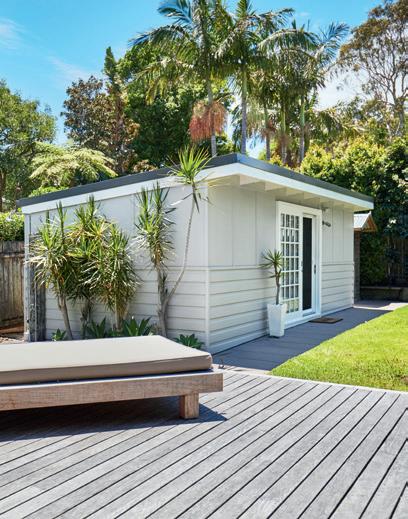
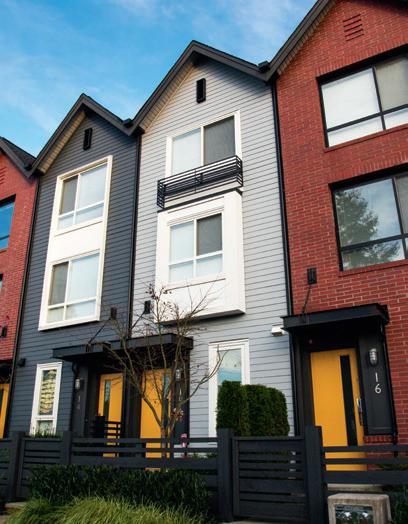


Green building isn’t just a “nice to have”; it can save thousands over the lifecycle of your home.
That is the finding of economics consultancy firm Infometrics, in research commissioned by New Zealand Green Building Council (NZGBC).
This research reveals that homes built to NZGBC’s 6 Homestar standards save more than $62,000 in electricity and mortgage interest over 30 years; while the upfront average build cost is insignificant – between 0.5-1.5 per cent.
But while this research offers a compelling reason for building green, less than 10 per cent of new properties in Aotearoa achieve green standards.
It’s all about perception. Most people believe that building to Homestar (or other green building standards) is prohibitively expensive. But the true cost is minimal – between $1,000-$2,000 to have an energy model designed that will ensure the right materials and products are put in the right place to make sure the house works.
In this issue we also investigate a leaky building saga in the making. Keeping homes watertight when they are being built is important; but some homes are so watertight water can’t escape them. These homes are unable to “breathe”; moisture created inside the home becomes trapped in walls and can rot the framing.
It’s an interesting story and definitely something to watch out for –the remedies are complex and involve a multifaceted approach and a lot of expertise.
Our cover stars this issue, Matthew Horncastle and Blair Chappell, will be well-known to anyone with an interest in property. As opinionated young men with loads of money, the founders of Williams Corporation have earned themselves plenty of media attention – much of it unpleasant.
But despite the naysayers predicting their downfall, Williams Corporation has recently celebrated a milestone – the creation of $1.3 billion worth of property. Gone are the private jets and megamansions – they are out and about donning their high-vis vests and creating more well-designed new builds around the country. It’s an interesting story and we hope you enjoy reading it.
Joanna Mathers

NZ PROPERTY INVESTOR
MAGAZINE PUBLISHER
Informed Media Limited PO Box 40128, Glenfield, Auckland 0747
PUBLISHERS
Joanna Mathers and Sally Fullam
EDITOR
Joanna Mathers E joanna@informedmedia.co.nz
DESIGN DIRECTOR
Sally Fullam E sally@informedmedia.co.nz
ACCOUNT MANAGER / ADVERTISING SALES
Joanna Mathers E joanna@informedmedia.co.nz M 021 250 7101
WRITER
Sally Lindsay
PROOFREADER
Síana Clifford
SUBSCRIPTIONS
Sally Fullam
Online nzpropertyinvestor.co.nz
E subs@informedmedia.co.nz
PH 022 431 9144
TO SUBSCRIBE GO TO nzpropertyinvestor.co.nz/subscribe
NZ Property Investor has been printed on accredited and fully recyclable paper sourced from sustainably managed and legally harvested forests.
NZ Property Investor sources expert advice on a range of specialist topics. We recommend you get your own independent advice before you take any action, and any action you take is strictly at your own risk. Opinions expressed by contributors are not necessarily those of NZ Property investor or Informed Media Ltd. Informed Media is not liable for any loss or damage (included but not limited to indirect or consequential loss) or for personal injury arising from any action taken.
© 2025 • Informed Media Limited Issue 257
NZ Property Investor is published by Informed Media Limited. The contents are copyright and may not be reproduced without the consent of the Editor. All rights reserved.



Carole Pedder
With over two decades of experience as a chartered accountant and business consultant, Carole is dedicated to understanding her clients’ businesses and providing strategic guidance for sustainable growth.

Debbie Roberts
Debbie Roberts is a financial adviser with 25-plus years’ property investment experience. She co-founded Property Apprentice in 2010 with her husband Paul to help others achieve financial freedom through property investment.

Shadi is the owner of Let’s Rent, an award-winning property management company in Auckland known for its personalised approach and commitment to excellence. With a passion for fostering strong relationships between landlords and tenants, Shadi has built a reputation for integrity, innovation, and professionalism in the industry.

Sarina Gibbon
Sarina is an independent tenancy consultant, industry advocate and established media commentator. Her clients include the Auckland Property Investors Association, Renti and several property management organisations.

Matt Ball
Matt Ball is PR and advocacy manager for the New Zealand Property Investors Federation. Matt has decades of experience in PR and politics, is a property investor and has been a renter. These experiences help him represent and advocate for property investors and push for policy changes that benefit the whole industry.

Matt Baker
Matt Baker joined PMG as CFO in February 2025. In this role, Matt oversees financial reporting, leads compliance, and contributes to property acquisitions and risk management. Before joining PMG, Matt built an extensive career in accounting and finance, spanning over 15 years in highly regulated industries across New Zealand and London.

Eve Prouse
Eve Prouse is a trusted property valuer and respected media commentator specialising in Auckland property markets – in particular South Auckland. Of Pacific heritage, Eve brings a unique, communityrooted perspective to her work.

David Faulkner
David is the general manager of property management for Property Brokers and is recognised as one of the leading experts in the New Zealand property management industry. He has been involved in the industry developing robust policies and procedures, training, and consultation services for many years.

Matthew Gilligan
Matthew Gilligan is a property investor, developer and tax adviser. He is managing director of chartered accounting firm Gilligan Rowe & Associates, where he heads the specialist property and asset planning divisions.

Leonie Freeman
Leonie Freeman is the chief executive of Property Council New Zealand. She has extensive experience in the property industry, having held top positions in both the public and private sector. From creating the concept of what is now realestate.co.nz, to buying and transforming her own residential property management business, she is a leading light in the industry.

Kris Pedersen
Kris Pedersen of Kris Pedersen Mortgages is a commentator on property and finance. His team sources top finance strategies.

Rachel Radford
Rachel Radford is the marketing lead for builderscrack.co.nz, New Zealand’s largest home improvement platform that connects homeowners with tradespeople. Her journalism background, combined with the platform’s comprehensive industry data, provides unique perspectives on nationwide property repairs and renovations.

Auckland has gained 100,000 new homes in the past seven years, writes Sally Lindsay.
Auckland Council’s planning rulebook – the Auckland Unitary Plan – took effect in late 2016 and has increased Auckland’s housing stock by 100,000.
The number of homes built has risen from 10,200 in 2018 to a record 18,100 in 2023, with 17,200 more in 2024. At the end of last year, there were 20,200 new homes in Auckland’s housing pipeline – 13,800 under construction and 6,400 consented but not yet started.
There is clear evidence that consents lead to construction and most projects make it through, says Gary Blick, the council’s chief economist.
“The vast majority of homes consented end up being built, with the data showing more than 90 per
cent become new homes and most begin construction within six months of consent.”
While not every demolition is tracked, he says research shows that for every nine new homes built, one will replace a demolished home while the remaining homes are entirely new, expanding Auckland’s housing supply.
This means about 89 per cent of new homes are net additions to Auckland’s housing stock. This occurs where single homes are replaced with terraced housing or apartments leading to more homes on the same piece of land.
Blick says this is a substantial increase from pre-Unitary Plan levels, highlighting how more flexible planning rules have made a real
• Keep track of arrears, repairs, inspections, owners
• Create tenancy agreements
• Mobile companion apps • Automatic bank feeds
• From just $8.50 per month
difference in delivering more homes.
A shift towards multi-unit housing, such as terraced housing and apartments, reflects people’s preferences, given their budget constraints, to use less land per house in exchange for locations closer to things they need, whether that’s jobs, transport, shops, schools, or other amenities, Blick says.
Looking ahead, he says the focus should remain on enabling housing capacity in accessible places, making it easier for people to live and work near major transport infrastructure – such as the $5 billion City Rail Link (CRL) –giving them faster commutes, better access to jobs and education, and easing pressure on roads.
The government has already stepped in and ordered the council to allow apartment and office buildings of at least 15-storeys high around the Maungawhau (Mt Eden), Kingsland, and Morningside CRL stations.
It has also told the council to upzone new buildings to at least 10-storeys high around Mt Albert and Baldwin Avenue stations, which are ripe for redevelopment, sitting close to Unitec’s campus and Mt Albert’s popular shops and cafes.
“The City Rail Link is a gamechanging investment in the future of Auckland. It will unlock significant economic opportunity, but only if we have a planning system to allow businesses and residents to take advantage of it,” Blick says.
“Enabling greater housing intensification along this corridor will help us maximise the benefits of this investment and provide more homes in a city geared up for growth.” ■
• Keep track of arrears, repairs, inspections, owners • Create tenancy agreements • Mobile companion apps
Automatic bank feeds
From just $8.50 per month


since
Property investors who fail to meet Healthy Homes Standards being targeted by tenancy services departments.
If landlords fail to bring their rentals up to the Healthy Homes Standards (HHS) the Tenancy Tribunal and the Tenancy Services Compliance and Investigations Team (TCIT) are expected to come down hard on them.
Landlords have had from 2021 until July 1 this year to comply with minimum standards for heating, insulation, ventilation, moisture ingress and drainage and draught stopping under the HHS. For many, the solution was simply adding a heat pump or underfloor insulation.
Now the deadline has passed, the Ministry of Business, Innovation and Employment (MBIE), which manages rental bonds for tenancies, is also likely to monitor landlords changing from property managers
to private arrangements, then audit those properties.
New or renewed tenancies must include a signed statement with details of the property’s current level of compliance. Landlords who do not include this statement when required can be fined up to $500 for each tenancy or other enforcement action.
Property managers have been firing landlords who refuse to bring their rentals up to HHS. They say some landlords are dragging their feet over making improvements they have known about for years.
Making a call to fire a landlord is difficult, but property management businesses say they don’t want to be responsible for non-compliant homes and non-compliant landlords, leaving tenants vulnerable.
In a recent Ministry of Housing and
Urban Development survey of HHS compliance, 17 per cent of landlords claimed they had fully met the standards and almost three-quarters had done something to prepare.
Landlords not meeting their obligations under the standards are in breach of the Residential Tenancies Act (RTA) and may face financial penalties of up to $7,200. In addition to the financial penalty, landlords may also be ordered to pay compensation to the tenant and to carry out necessary repairs to bring the property up to standard.
The New Zealand Property Investors Federation says some “accidental landlords” who have put their properties into the rental pool when they didn’t sell for the price they wanted, could be unaware of their obligations. ■


It’s not oversupply, but bad design that’s costing Kiwi developers, a new Squirrel report reveals.

With off-the-plan residential sales tough to come by, Squirrel Mortgages founder John Bolton says the problem is not an over-supply of properties for sale, but developers not building enough of the homes people want to live in.
He says it is easy to blame the problem on high stock levels. While there are pockets of over-supply of townhouses, that doesn’t explain the reason behind slow off-plan sales.
To help developers understand what investors and homebuyers are looking for, Squirrel undertook research through insights agency TRA into what matters for future buyers when looking at new homes.
Initial findings show that 89 per cent of prospective buyers will
consider buying a finished new build, 78 per cent an off-the-plan standalone home, and 58 per cent an off-theplan townhouse.
“So, the market is definitely there,” Bolton says. “But to succeed as a developer, quality design and getting their property market fit is critical.”
Bolton says some developers get the importance of building for their market, and as a result, do extremely well.
“On the single-house build, for example, I think developers have nailed it. There are plenty of group builders who are experts at delivering great homes that people love.”
But he says most of the problems are in the high-density space –townhouses and apartments.
“Developers are falling short with
a lack of consideration about how people want, and don’t want, to live.”
The research shows a good two-bedroom townhouse will need to have wide appeal to young families with one child or downsizers. The key to attracting buyers is that they have to want to live in the house, Bolton says.
“With high house prices, it’s not a short-term stepping stone.”
There’s a good chance that at least one person in the household works from home regularly.
If both bedrooms are being used as that, does the house have a cubby or some other space for a desk? Does it have a window with a pleasant outlook, or is the work space just tucked away somewhere and the householder is left staring at a wall?

Bolton says older buyers will want a toilet downstairs, so they don’t have to traipse up and down stairs. And if there is a toilet downstairs, it needs to be placed strategically – not somewhere everyone can hear you.
A green outlook makes people feel good. It brings in natural light and creates a sense of openness and indoor-outdoor flow.
“If you’ve got a dog, which about one in three people do, having a patch of grass out the back – even a small one – for them is a non-negotiable.”
Things like the height of ceilings can also make a huge difference in terms of how prospective buyers experience the home.
“In a small townhouse, going taller than the standard 2.4m ceiling height can bring in a whole lot of extra light and make it feel more spacious. Building homes that people actually want to buy means developers have to be thinking about all these little details.”
A few years ago, the government removed minimum on-site car-parking requirements for new developments, based on the argument that people are becoming less reliant on cars.
He says it’s not a solution for young families, who need a car to get their kids to school and weekend sports. And it’s also not a solution for professionals who rely on a car to get to work or visit their parents down country.
“Some might not care about a lack
of car parking, but others will be thinking ahead to what happens when they go to sell the property in 5-10 years’ time.”
Privacy – and more specifically inadequate soundproofing – is one of the biggest objections to highdensity living. Bolton says just because someone’s okay sharing a wall with their neighbours doesn’t mean they want to be able to hear their every movement (or vice versa).
Concrete inter-tenancy systems might cost more, but the added benefits – next to no noise transfer and significantly improved fire safety protection – are well worth thinking about if a developer wants their project to stand.
“Doing what they can to limit noise transfer in outdoor spaces is also just as important. What happens when everyone’s got their ranch slider open on a hot summer day?”
He says developers also should think about how to prevent noise transfer between neighbouring properties.
“A recessed porch can make a big difference to the acoustics when it comes to indoor-outdoor flow, but it’s not something we see in a lot of developments.”
For some developers, it feels like the name of the game is to build everything as cheaply and quickly as possible and cram as many units as possible onto a site.
“If that’s the case, developers are headed for trouble,” Bolton says. “Being cost conscious is important –obviously – but good design doesn’t have to cost the earth.”
He says many Kiwi developers, particularly townhouse developers, could learn from Johnny Ive, Apple’s chief design officer. His philosophy is best summed up by this quote:
“We’re surrounded by anonymous, poorly made objects. It’s tempting to think it’s because the people who use them don’t care – just like the people who make them. But what we’ve shown is that people do care. It’s not just about aesthetics. They care about things that are thoughtfully conceived and well-made. Our success [at Apple] is a victory for purity, integrity – for giving a damn.” ■

West Coast, South Island.
REINZ data shows the housing market was more subdued in June, with sales and prices losing the momentum from earlier in the year. Turnover has slowed in the past two months, and prices fell for the first time since late last year. The national median selling price was $770,000, up 0.5 per cent compared to May, but unchanged from June last year. Auckland’s median dropped by 3.4 per cent to $990,000. Ten of the 16 regions had an increase in median prices compared to June last year. The most significant increase was on the West Coast, up 35.5 per cent from $310,000 to $420,000. Southland reached a record high of $502,500 – the first record median price in any region since January. The number of properties sold across the country increased by 20.3 per cent year-on-year, from 4,877 to 5,865. However, in the month sales were down 4 per cent in seasonally adjusted terms, following a 3 per cent fall in May. The median time to sell rose to 48 days, the second month this rose again after having improved in the early part of this year. Looking at properties coming to market, there was a 2.5 per cent decline in listings compared to June last year, totalling 7,612 listings. Inventory levels across the country, however, continue to rise, increasing by 2 per cent year-on-year to 32,384 properties available for sale. Westpac senior economist Michael Gordon says with fixed-term mortgage rates having largely bottomed out, the housing market appears to be settling into a new holding pattern, albeit at higher levels of activity than a year ago. Interest among potential buyers is still apparent, with mortgage applications well above last year’s levels (but no longer rising). Against this, the stock of unsold homes on the market remains high and has hardly budged over the last year. ■
Average rents are still $17 a week lower than they were in June last year. The latest data from realestate.co.nz shows they rose slightly in June to $636 a week, up from $633 a week in May, but down 2.7 per cent from $653 in June last year.
Rents fluctuate across the country – in Wellington they dropped by a hefty 10.9 per cent to $625 a week compared to $701 a week at the same time last year. Renters in Hawke’s Bay also experienced a greater-thanaverage drop in rental prices, down 6.6 per cent from $677 in June 2024 to $632 this year.
In the South Island rents surged on the West Coast, with the average weekly price of $433, 9.1 per cent higher than the same time last year, when the weekly rent sat at $396. The average weekly rental price in Otago has also risen, from $571 in June last year to $616 the same month this year, a year-on-year increase of 8 per cent. Southland’s average weekly rent of $489 in June was the region’s highest on record, 6.1 per cent more than June last year when it was $461 a week.
The biggest monthly increase was in Coromandel, where the average asking rent increased by $42 a week, from $571 in May to $613 in June.
In Auckland, the country’s largest rental market by far, the monthly asking rent increased by just $2 a week, from $696 in May to $698 in June, but was down by $20 a week compared to June last year. ■
Further cooling in migrant arrivals to a two-and-a-half-year low –about half the historic average – is likely to dampen medium-term inflation and support lower interest rates. Stats NZ figures show just 14,800 people were added to the population in the year ended May compared to more than 84,000 the year before. In 12 months, 139,356 migrants arrived, down from 189,557 in the previous 12 months (-26.5 per cent). There was net gain of 16,415 people from India, 8,885 from China, 8,871 from Philippines and 5,687 from Sri Lanka. Of the migrants arriving, 33,170 had work visas, 30,157 had student visas, 29,208 were New Zealand or Australian citizens, 25,382 had visitor visas and 19,963 had residence visas. At the same time record levels of people left the country – 124,548 compared to 109,275 (+14 per cent) in the previous 12 months. Meanwhile, the number of New Zealanders who left for Australia last year was the highest in more than a decade – just under 30,000 – marginally higher than in 2023. However, it was the highest since it peaked in 2012, at nearly 44,000. ■
Barfoot & Thompson’s selling prices are slowing increasing. Auckland’s biggest real estate agency’s average selling price in rose from $1,085,751 in May to $1,130,835 in June, up by $45,084, or 4 per cent for the month, but down by $105,501, or 9 per cent compared to June last year. The median selling price increased by $53,000, or 6 per cent from $928,000 in May to $981,500 in June, but remained down by $38,500, or 4 per cent compared to June last year. The agency sold 876 properties, up by 29 per cent compared to June last year and the strongest in a June month since 2021. However, stock levels remain high, with Barfoot & Thompson having 5,831 properties available – a 17 year high. ■

The property market has hit 2.5 years of flat average asking prices, with the national price down 0.9 per cent year-on-year in June to $855,360, realestate.co.nz says. This reflects a market with minimal movement since December 2022. The national average asking price has not been over $900,000 since then. Vanessa Williams, realestate.co.nz spokeswoman, says the market reality is flat. “There is little movement and when there is any change, it tends to be in the regions.” Regional trends vary significantly. Southland had a second consecutive record-high average asking price of $568,647, up 8.6 per cent from the previous year. In contrast, Northland’s prices fell 9.1 per cent to $773,681 – the first time the region’s average asking price has dropped below $800,000 since July 2024. In Auckland, the country’s largest housing market, the average asking price declined to $982,679 in June, down from $1,023,760 in May, a drop of $41,081 (4 per cent). This is the first time this year that Auckland’s average asking price has been below $1 million. ■
Property values ticked up by 0.2 per cent in June, reversing two minor monthly falls of -0.1 per cent a piece in April and May, Cotality’s latest Hedonic Value Index (HVI) shows. At $815,389 in June, property values remain 16.1 per cent down from the January 2022 peak, however they have managed to edge up by a total of 1.1 per cent since September last year and by 0.6 per cent this year so far. Median values were unchanged in Auckland and Wellington compared to May, but up slightly for the month in Hamilton 0.3 per cent, Tauranga 0.6 per cent, Christchurch 0.6 per cent and Dunedin
0.2 per cent. Cotality chief property economist Kelvin Davidson says June’s figures emphasised the current variability of the market. “On the one hand, mortgage rates have come down a long way, and that benefits borrowers whether they’re in Whangārei or Winton,” he says. “But the normal upwards influence this would tend to have on sales volumes and property values is currently being dampened by other forces. In particular, the abundance of listings on the market means most buyers aren’t in a rush and can be quite tough when it comes to price negotiations,” he says. ■


Data from credit bureau Centrix and RBNZ show different pictures for mortgage arrears. Centrix figures show the number of mortgage holders struggling to make their repayments dipped by 700, or 1.44 per cent, from April to May. In total there were 21,900 borrowers overdue on their repayments. RBNZ data shows non-performing mortgage loans increased by $28 million in May to nearly $2.5 billion. That was a rise of 1.2 per cent from April and is up significantly from $1.2 billion in May 2023. Of this number $534 million was impaired, a rise of $30 million or 6 per cent from April. While mortgage arrears are improving, according to Centrix, 15,000 people are in hardship and struggling to pay their bills – an increase of 300 from April and up 14 per cent from a year ago. Almost half of
these cases (46 per cent) were due to difficulties paying mortgages, a rise of 19 per cent year-on-year. This has been happening since mortgage rates have come down by about 2 per cent since August last year. Non-performing loans have risen to just under 0.7 per cent of the country’s outstanding $372 billion mortgage book on housing stock worth $1.62 trillion, RBNZ data series reveal. Non-performing loans past due but not impaired have dropped a tad and stand at $1.915 billion, down from $1.916 billion in April. They stood at $1.57 billion a year ago. After the GFC non-performing loans rose to 1.2 per cent; they are not predicted to reach that level, despite mortgage holders suffering under high interest rates over 2022/23. The RBNZ had predicted they would peak at 0.7 per cent this year. ■

House price forecasts for this rest of this year have been downgraded by economists at the ANZ (the country’s biggest mortgage lender) and BNZ. ANZ is now forecasting just 2.5 per cent price growth, while the BNZ has dropped its forecast to between 2-4 per cent. For next year both the banks believe there will be 5 per cent growth. ANZ says because indicators of the balance between supply and demand continue to drift sideways, it has downgraded its forecast. ANZ chief economist Sharon Zollner says the 225 basis points of official cash rate (OCR) cuts delivered by the RBNZ in this easing cycle (from 5.5 per cent to 3.25 per cent) has been a tailwind to the housing market, but the upswing in house prices has been muted compared to other easing cycles. “We expect the housing market will heat up a touch next year following further OCR reductions and a strengthening and broadening economic recovery, leading to more significant increase in house prices of 5 per cent over 2026.” At BNZ chief economist Mike Jones says prices remain glacial. “Stirring shakier demand in with our existing concerns about elevated supply, points to this dynamic continuing. We’ve shaded our 2025 annual house price inflation forecast down to a 2-4 per cent range accordingly. Previously, it was 5-7 per cent. ■
The rate of decline in building consents has slowed. Stats NZ latest figures show 33,530 new dwellings were consented in the 12 months to May this year. The annual rate of decline is slowing, from -11.5 per cent in the year to May 2023, to -22.8 per cent in the year to May 2024 and -3.8 per cent in the year to May 2025. In the May month this year 3,151 new homes were consented, down just 0.8 per cent compared to May last year. Consents for stand-alone houses were up 2.4 per cent compared to the previous 12 months and apartment consents were up 6.2 per cent compared to the previous 12 months, while retirement village units were down 4.5 per cent for the year which follows a 47.3 per cent decline in the previous 12 months, and townhouses and home units were down 11 per cent. The total estimated value of residential building work consented in the 12 months to May this year was $17.391 billion, down 4.5 per cent compared to the previous 12 months. ■
The Reserve Bank may need to cut rates as inflation softens, writes Kris Pedersen .
New Zealand’s June quarter inflation data has come in softer than expected, and it may be the signal the Reserve Bank of New Zealand (RBNZ) needs to shift gears. Annual inflation rose modestly to 2.7 per cent from 2.5 per cent in March, but crucially, it remained within the RBNZ’s 1-3 per cent target band for the fourth straight quarter.
While this small uptick in headline inflation might raise eyebrows, the broader picture is one of easing domestic price pressures and growing slack in the economy – conditions that suggest the RBNZ may need to consider cutting the official cash rate (OCR) as early as August.
Most economists had expected a higher number – around 2.8 per cent to 2.9 per cent – so the actual outcome came as a relative relief. The drivers of inflation were largely out of the RBNZ’s control: imported costs, such as food and electricity, continue to lift prices, while petrol prices fell 8 per cent year-on-year, helping to soften the overall impact.
More importantly, underlying inflation remains contained. Core inflation, which excludes volatile items like food and fuel, ticked up just 0.1 percentage points to 2.7 per cent. That’s a far cry from the entrenched inflationary pressures that plagued the economy just 12-18 months ago.
Signs of easing are evident across the CPI basket. The share of goods and services declining in price increased to 35 per cent, up from 30 per cent last quarter. A growing portion of
the index either stayed flat or rose by less than 3 per cent annually –further proof that price pressures are broadening out to the downside.
The largest contributor to annual inflation was local authority rates, which rose 12.2 per cent, but even that spike dates back to the September 2024 quarter. Cultural services (including streaming) saw a sharp quarterly rise, but these are isolated categories – not systemic inflation drivers.
Given that the economy still has ample spare capacity, and that global risks are increasingly tilted toward a slowdown, there’s a growing argument that maintaining a restrictive stance may no longer be appropriate. Domestic inflation is cooling, consumer spending is softening,
and the broader CPI dynamics show inflation is no longer as sticky or widespread.
If the RBNZ waits too long, it risks over-tightening into a weakening economy. A measured rate cut in August could help support growth without reigniting inflation – a balancing act the RBNZ may now be compelled to perform.
At the moment, the three-year rate is appealing for conservative investors, but personally, I still prefer the 12-month option. I believe the OCR will need to fall further than what the Reserve Bank is currently forecasting. There could be benefit in trying to hedge over different rate terms, but in most cases, I believe 12 months gives time to take us closer to the bottom of this rate cycle and then I believe it makes more sense to hedge. ■
The interest rates specified in this table were accurate on 10 July 2025. Interest rates are subject to change without notice. Different fees and charges apply to each loan depending on the motgage lender. Seek expert advice to determine the mortgage lender that is right for you and your circumstances. A disclosure statement is available on request and free of charge.

Data from realestate.co.nz reveals a slight year-on-year bump in listings targeted at investors, even though the month-on-month figures are down.
While realestate.co.nz data shows investortargeted listings are at their lowest level since last December, they are actually up year-on-year. Listings nationwide sat at 2,930 in June – down from 3,804 in May. Regional listings also reflected this trend – with a 25 per cent drop in listings in Auckland (from 1,734 in May to 1,307 in June); another 25 per cent decrease (from 478 to 359) in Canterbury; and a 27 per cent drop off in Wellington. The only regions to buck the trend in June were Central North Island and Northland – which experienced 26 per cent and 5 per cent increases in investor-targeted listings respectively.
This drop in listings is likely to be seasonal, however: with year-on-year data painting a rosier picture.
“If we look year-on-year, investortargeted listings are up by 2.6 per cent, suggesting there is slightly more optimism among investors this June than at the same time last year. For
context, new listings for all residential dwellings across New Zealand were down 2.5 per cent year-on-year during June,” she continues.
The national average asking price of investor-targeted listings increased from $944,189 to $963,481 (2 per cent), with one-bedroom, threebedroom, and four-bedroom plus listings all heading slightly upwards.
“When comparing this to all residential listings, the increase in asking price bucks the national trend again,” says Williams.
“Average asking prices were down both month-on-month and year-on-year by 0.9 per cent, so while it’s a slight increase it’s a positive sign for investors.”
“We usually like to see three months of increases in a row to call it a trend –which hasn’t been the case – but if we look year-on-year, the average asking price is also up, so in line with the new listings lift during June, this could be an early sign of optimism in the investor market.”
realestate.co.nz has been helping people buy, sell, or rent property since 1996. Established before Google, realestate.co.nz is New Zealand’s longest-standing property website and the official website of the real estate industry.
According to realestate.co.nz data around new builds, apartments and units are taking longer to sell than older homes. Apartments are staying on the site 85 per cent longer and units 117 days longer than non-new builds.
If we look at the Canterbury market, we can see a drop-off in investortargeted listings for two-bedroom homes – from 164 in February to 74 in June.
As this area has a preponderance of new builds, often smaller typologies, it may indicate that investors are choosing to move their new-build apartments and units into the rental pool rather than trying to sell in a weaker market.
“The decline in investor-targeted listings in Canterbury could indicate less demand.
“If we look at the rental data for the region, there was a spike in new listings during March, but this didn’t carry on into June,” says Williams. ■


LEFT June saw Wellington experience a 27 per cent month-on-month drop-off in investor-targeted listings. Canterbury also saw a drop off since May, by 25 per cent.
Our experts address your property queries
Do you have a burning property investment question you need an answer for? Whether you are just starting out in property investment, or an experienced investor, email joanna@informedmedia.co.nz to have your questions answered.

Matthew Gilligan
Gilligan Rowe + Associates, gra.co.nz


Kris Pedersen
Kris Pedersen Mortgages, krispedersen mortgages.co.nz


Mark Withers
PKF Withers Tsang, pkfwt.co.nz
QWe have five investment properties. The property we live in is freehold and the mortgages on two of our investment properties are paid off. The current mortgage is $1.2 million. We are not strapped for cash but want to explore interest-only loans. Are there any advantages or disadvantages in doing this? We are just under 60 years of age.
AFirstly, I would recommend that you make sure that the bank who you have the mortgages with on the three investment properties doesn’t still hold security on your home or the two investment properties you’ve said are paid off. Almost every day I see clients who believe that a property has no mortgage connected to it, because they have paid a particular loan split off. But as the banks don’t immediately release the security, the mortgage itself is actually still in place and cross-secured against other property.
Sarina Gibbon Independent tenancy consultant, sarina@tenancy advisory.co.nz
Ryan Weir
Propertyscouts, propertyscouts.nz
In answering your questions about interest-only loans, it is a case of deciding your overall strategy. Going interest only which may give you better cashflow, which is fine if you want to concentrate on living more now versus reducing debt. You mention that you are not “strapped for cash”. If you are sitting on cash, consider restructuring part of your mortgage into either an offset or revolving credit, which may also decrease your mortgage payments and improve your cashflow, while still giving you the flexibility of having access to your cash. At your age I would recommend that you consider split banking the three investment properties if they are all with one bank, to give you more flexibility when you decide to retire. If you decide to sell one you need to be aware that if there is residual debt left over with that bank, that the bank will require you to go through a full loan application process at discharge. If you can’t meet their current loan affordability requirements then they will look to take full sales proceeds and apply that to your remaining debt. ■
Kris Pedersen

QWhat is the best way to manage rowdy tenants? We have tenants who pay their bills and keep the place clean, but they have parties most weekends. We don’t want to lose the tenants as they are looking after the house well, but the neighbours keep calling noise control. Are the tenants breaking any RTA rules? What advice do you have?
AThis isn’t a cookie-cutter situation. You’re not dealing with a broken pipe or unpaid rent. You’re managing people, with rights, obligations and opinions. There isn’t a singular “best way” to handle this. There’s only the right way for your situation, and it depends on things you haven’t told me: what kind of tenancy is this, how frequently the noise occurs, have there been any official warnings, and what is your tenant’s position?
Still, you’re piggy-in-the-middle and here is a framework to help you get to the best outcome.
You say the tenants are taking care of the place and paying on time. Good. That’s minimum standard, not a badge of honour. A good tenant understands they are part of a community. That means their right to party like it’s 1999 ends where someone else’s sleep begins.
This isn’t just about the law. Your relationship with your tenant isn’t
purely transactional; it is also custodial. There’s a person on the other side of this, living in a home you control. That puts you in a position of power. And how you use that power sets the tone of the relationship. Lead with humanity, and you build trust. Lead with blame, and you invite conflict.
Don’t rush to vilify. I often see landlords default to blaming tenants the moment someone else kicks up a stink. Check your bias. Sometimes the issue is real. Sometimes it’s just grown-ups needing to sort it out amongst themselves. So why are you volunteering as an unpaid therapist?
Now, you’ve asked about the RTA, so let’s talk about the RTA. Section 40(2) (c) prohibits the tenant from interfering with the “reasonable peace, comfort, or privacy” of any other person residing in the neighbourhood. So yes, repeated noise complaints could amount to a breach. You’d be within your rights to issue a 14-day notice to remedy. But unless the noise is extreme, repeated and well-documented, it is unlikely to meet the threshold for termination under s56. And no, being “a bit loud” on a Saturday doesn’t constitute harassment, so unlawful act claims won’t fly either.
Before you do anything, be clear about what you actually want. The RTA provides multiple pathways for dealing with rowdy tenants. It’s a bit like a choose-your-own-adventure game; you need to figure out what adventure
you’re up for this time. The direction you take depends very much on the leadership, discipline and purpose you bring to the situation.
• Want to keep the tenant and restore neighbour goodwill? Start with a direct conversation. Be specific, constructive and firm. If the behaviour continues, document it and consider issuing a 14-day notice. Or, if things escalate, serve an anti-social strike under s55A.
• Want the problem to go away without confrontation? Let noise control do its job. You are not the town’s sheriff. And you’re certainly not the neighbour’s mama.
• Want to end the tenancy and move on? Weigh up your legal rights (including checking that you’re not issuing a retaliatory notice), any obligations under a body corporate or title covenant, and your business goals. Be honest with yourself, are you making a strategic play or just trying to avoid discomfort?
Whatever you do, stop waiting for the law to give you a one-size-fitsall answer. It won’t. You’re running a tenancy, not a complaints department. This is about people management, business discipline and making decisions that support your long game, even when the bass is thumping next door. ■
Sarina Gibbon
QIs pressing the test button on a smoke alarm enough to meet my responsibilities as a landlord, or is there a better way to check they’re working?
AThis is something a lot of landlords get wrong. Pressing the test button on a smoke alarm doesn’t actually check if it can detect smoke – it just checks the battery and circuitry. So if it beeps, all you really know is that the power’s working, not whether the alarm will go off in a real fire. To properly test a smoke alarm, use a smoke alarm test aerosol – basically smoke in a can. They’re cheap and easy to find at most hardware stores. A quick spray under the alarm should trigger it if the sensor’s working. Also worth a reminder – smoke alarms are legally required within every bedroom or within 3m of every bedroom door, and on every level of the house, even if nobody sleeps on that floor. Landlords are considered PCBUs (Persons Conducting a Business or Undertaking) under the Health and Safety at Work Act. That puts a legal duty to take all reasonable steps to keep tenants safe – and that includes making sure smoke alarms are both installed correctly and working properly. So yes, press the button at inspections – but at least once a year, do a proper smoke test, check expiry dates, and give the alarms a clean.
Ryan Weir

QWe have just bought an investment property. We are looking at putting a workshop at the rear of the property to run our business from. It has dual access. The business will pay rent. The mortgage will need topping up, so it will be negatively geared. We are wondering about the best way to structure this in terms of the entity overseeing the IP.
AThat is a great question, but as is so often the case, it is not possible for me to give a definitive answer without knowing more detail. The appropriate structure for any asset or business depends on the specifics. In the context of this property, you have pointed out that it will be partially residential use and partially commercial use, and it will likely run at a tax loss. You also refer to the fact that you run your own
QI am looking at expenses for my tax return. We had an insurance payout for a bathroom leak. Do I use the full cost of repairs or just the difference between the payout and what the actual cost was?

AIf the repair is to an incomeearning asset and is not capital in nature the cost of the repair is tax deductible. That said, the cost of the repair is your actual net cost. So, if you have received an insurance refund in relation to the
business. If you run your business through a company (which hopefully you do) then one possible solution here would be to have a second company with identical shareholding acquire the property. We often recommend our clients employ a “wholly-owned group” structure, with the involvement of a trust to hold the shares in the business and investment companies (subject to the proviso that often the clients hold one share in each company personally, so as to be eligible to be allocated shareholder salaries when appropriate). So to sum up, a new company may well work for you here, particularly if you already have a company for your business activities. However, you should seek advice from a competent professional who can have a look at the entirety of your structure and come up with a solution that fits best.
Matthew Gilligan
repair, this is netted against the cost and the claim is for the net difference. It’s also worth stating the obvious, perhaps: the insurance premium itself is also a tax-deductible cost.
Mark Withers
Tel: 09 522 7955 | Email: info@gra.co.nz | www.gra.co.nz
chartered accountants specialising in property, tax and trusts



It’s gone for now, but it pays to be aware that interest deductibility could be back if the government changes, as Matt Ball from NZ Property Investors Federation explains.
When we paid our tax bills earlier this year, it was a reminder for many of the removal of interest deductibility. But the idea is not yet dead and buried.
In May the Green Party released its budget, which included a promise to remove interest deductibility. It sees it as a “loophole” that “wealthy landlords” don’t deserve. Te Pāti Māori also support the policy.
We’ll have to wait and see what Labour does. They haven’t committed to a tax policy yet, but are considering several options, including wealth tax, capital gains tax and removing interest deductibility.
We wanted to get a quick temperature check on how investors might react if the policy was reinstated. A snap member poll in June showed that while some investors will take it in their stride, 77 per cent of 224 respondents said they would have to take some action to mitigate the impact.
When we looked at what they say they’d do, it got interesting. Just under half of respondents said they’d put up rent – if possible. A difficult option now, and even in good times you can’t increase rent more than people can afford, but anecdotally it was a widespread option last time. Particularly from those who had well-under-market rents.
Ten percent said they’d stop using a property manager to reduce costs, and just under a third said they’d defer maintenance or upgrades, because they’d no longer be able to afford them. This is in line with a survey done by NZPIF following the removal of interest deductibility last time, which showed that landlords were indeed delaying maintenance and upgrades.
In a way, it’s the least-impact option. Stop, wait and hope.
Forty-two per cent said they’d sell some property to reduce or eliminate their mortgage. This of course only applies if you have more than one property.
Again, anecdotally, we know this happened last time, particularly as the policy started to bite and people were being hit by provisional tax bills.
Finally, just under a third said they’d sell their portfolio and get out of the business. That’s easy to say in a survey, but it’s a big step to take in the real world.
As best we can tell from last time, that doesn’t seem to have happened. When you look at the IRD numbers of taxpayers reporting rental income, it was stable, around 300,000, for the period interest deductibility was removed.
Whether or not you’d go through with selling rentals next time around would depend on many factors, including your own circumstances at the time and the state of the property market, but let’s imagine if that happened.
There are around 304,000 property investors in New Zealand, with around 565,000 homes between them, or just under two each. Based on the responses to our survey, up to 85,000 investors could sell all their property, meaning around 157,000 homes hitting the market. To put that into perspective, there were 71,881 houses sold in New Zealand in 2024.
The upheaval would be unprecedented. Unless all those homes – or even a high proportion – could be sold to other investors or to tenants, we are potentially looking at massive social upheaval. Families will be forced
to move house, kids will be forced to move schools, adults may have to change jobs, move towns and so on.
There’s no way that much supply could be handled without crashing the market, so it’s likely to happen over a longer period, possibly leading to depressed house prices over several years. The current housing market is a good example of what happens when supply exceeds demand. Imagine current conditions extending over three, four or more years as investors head for the exit. Homeowners are not going to be happy.
I find it hard to believe any government would want these things to happen. I also believe that if politicians really thought through the consequences of this policy, they would see that what I’ve pointed out above is possible. I get the feeling that some think we’re exaggerating, crying wolf to stop a policy that will cost us money.
What I don’t think they realise is that now investors have first-hand experience of the “tenant tax”, many won’t wait around to find out what happens. I know people who are selling properties “just in case”. Better safe than sorry.
My job – with your help – is to make sure our politicians understand the implications of bringing this policy back. I want to expand on the survey above by recreating a survey done by NZPIF back in 2021 when this policy was first proposed. I want to know if and how attitudes have changed since then and what investors are planning to do.
All you have to do is fill out the survey and share it with other investors you know. I’d love to get as big a response as possible, to make sure that politicians have to listen. Because they need to. The alternative is grim. ■
property accountants
asset protection consultants
tax advisers
property educators
Gilligan Rowe & Associates LP (GRA) is a chartered accounting practice that offers clients a full range of taxation and compliance accounting services coupled with specialist property, trust and asset planning advice. As well as completing accounting for individuals, businesses and property investors, GRA provide clients with knowledge through their educational programmes. Over the years we have helped thousands of clients increase their wealth through property investment, maximise their asset protection and minimise their tax liabilities.
We are recognised as leading experts in our fields and are committed to helping our clients succeed. To that end we offer a range of services.
Getting your structures set up correctly from the beginning is important. We adopt a holistic approach, with a focus on both asset protection and legally reducing tax.
• Asset protection
• Setting up trusts and companies
• Tax advisory
Book an initial review of your affairs, including property, tax and legal structures - FREE to new clients
Tel: +64 9 522 7955 | Email: info@gra.co.nz | www.gra.co.nz
Accountants with deep understanding of structures and tax planning.
• Annual accounts, tax returns, GST etc
• Insolvency and liquidation
• Budgeting and cashflow forecasts
Helping our clients succeed.
• Free webinars on property and tax
• Property School and Development School courses
• Property consultancy – portfolio planning

Profile Matthew Horncastle and Blair Chappell

Matthew Horncastle and Blair Chappell of William’s Corporation talk to Joanna Mathers about $1 billion worth of new builds, riding the property cycle, and proving the detractors wrong.
Photography Digital Simple
“We were young, loud, wealthy with a libertarian world view. This made us the perfect story, some loved us and wanted to see it go all the way. Others did not like the success and wanted to see us fail so they could tell everyone they told them so.”
Matthew Horncastle is used to making waves. He and co-owner/ co-founder of Christchurch-based developers Williams Corporation, Blair Chappell, have never shied away from the public eye.

Their upward trajectory from young bucks to property tycoons has been played out in the media; as were their difficulties during the post-Covid property bust.
But the pair – whose company went from selling 95 houses in a month to just three in a month after the market crash – have managed to ride the cycle and prove naysayers wrong. And they have recently celebrated an impressive milestone – $1.3 billion dollars-worth of new builds in 13 years.
“We were one of the largest companies in New Zealand, through one of the most violent economic environments and we transacted the business. Without missing any payments or losing any external capital – it cost us some of our equity to protect everyone else,” says Matthew.
It’s something they are very proud of.
In September 2017, Matthew and Blair were the cover stars of New Zealand Property Investor. Williams
Corporation – they share William as a middle name – had just achieved a $30 million turnover; they were just 23.
Matthew and Blair met when they were 10 years old. They both came from families who were involved in property and the Christchurch market.
Matthew’s father and mother started a property company – Horncastle Holdings, which became Horncastle Homes – which at its peak was one of the largest property companies in New Zealand. And Blair’s father, Grant Chappell, was the owner of a Harcourts office and a top agent in Christchurch.
Matthew had left school at age 16 and trained as a builder; Blair had earned a bachelor’s degree in information and communications technology. Together they had developed businesses in fencing, waste management and solar panels at a young age: “They were not overly successful,” says Matthew.
Development was their last stab at creating their own business; and despite the success of their families they were not given any financial help in growing their own company.
Blair Chappell (left) and Matthew Horncastle have played an integral role in the rebuild of Christchurch.

While they only made just $10,000 on their first development, they had a vision to be part of the rebuild of Christchurch.
“Our thesis was people wanted quality homes, good location and price and would sacrifice car parking and size,” says Matthew.
Christchurch traditionally is a very conservative city. Williams Corporation’s vision represented a property paradigm shift.
Taking sites in great locations with rundown houses, their model was to build high-quality townhouses, many without car parks, for sale to first home buyers at very competitive prices.
“[Our vision] was bold and different, it drew criticism, but sales happened faster than we could build,” says Matthew.
Quality has always been integral to the Williams Corporation ethos. They have long prided themselves on utilising engineering and innovation that allows for smart construction that goes beyond building code expectations.
“We have always made sure that each property is not just beautiful, but meticulously designed to last,” says Matthew.
“Engineering every element for longevity, we guarantee a product that stands the test of time and performance, not just looks great on day one.”
Their fast success reflected the appreciation for this quality and the mood for change in Christchurch. Pundits flocked to buy their builds – in a city destroyed by earthquakes, their vision reflected a wider renaissance of Christchurch as a modern, international city.
Blair Chappell (left) has a qualification in information and communications technology.
And at the peak of the property market – the boom time of 2020-2021 – Williams Corporation topped out at $53 million of sales in one month.
“From 2014-2021 we built a massive company from nothing,” says Matthew. “But then the market started dropping.”
The post-Covid property slump hit everybody. In 2021, the market started dropping – prices would eventually shrink by 20 per cent.
In the first six months of 2022, Insolvency and Trustee Service data reveals that more than 100 construction companies went into liquidation –25 per cent of all insolvencies in the country. In the first five months of 2023, 199 construction firms were liquidated, a 72 per cent jump compared to 116 in the same period last year.
So it was inevitable that Williams Corporation, one of the country’s leading developers, would be affected. They were always open about what was happening in the business.
“We had to reduce staffing from 214 to 65 and to move to smaller offices,” says Matthew.
“And there were a lot of negative stories about us – the general market did not believe we would be able to trade the cycle.”
Matthew and Blair’s struggles were ripe fodder in a media environment hooked on clickbait headlines.
“There was a time where there were negative articles about us 11 days in a row,” remembers Matthew.
And he feels that Williams Corporation was unfairly targeted.
“We’ve noticed a troubling trend in the press, an eagerness to spotlight supposed financial struggles that simply aren’t occurring,” he continues.
“That kind of coverage unnerves prospective Kiwi homebuyers, who start to question whether buying from us is safe. As a result, our staff bear the brunt of this fallout. When buyers grow hesitant due to media-driven uncertainty it has a direct impact on their earnings, morale, and livelihood.”
What upset them most, he says, is that that the team’s confidence was

shaken by narratives that painted them in a negative light, especially when they were working tirelessly to serve every client.
As an aside, a lesser-known aspect of the Williams Corporation empire is their wholesale property-backed funds, only available to wholesale investors.
Launching in 2019, with the idea that wealthy “mum and dad” type investors would be ideal backers for some of their projects, they soon realised they needed to scale up their vision.
“As our projects got larger, it was harder to find funders. So we realised that if we put all our funders together they could fund our projects together.”
The original redemption period was six months, with a clause that allowed them to extend to 12 months in challenging economic times. In their first fund update, the fund had $8.4 million – at the peak they had $158 million under management.
During the downturn they had to utilise this the redemption clause (leading to gleeful headlines in mainstream media alluding to
‘From 2014-2021 we built a massive company from nothing. But then the market started dropping’
Williams’ dire financial straits.)
But the wealth creation from the period leading up to the property crash, and Matthew and Blair’s personal equity, allowed them to protect all external parties.
“We never missed a legally due redemption, we never missed a dividend payment, we never had $1 of loss,” says Matthew.
Williams Corporation currently has $90 million under management and the fund has a loyal base of about $85 million that sticks with them.
While the naysayers may have doubted Williams Corporation’s ability to come out of the property crash alive, cost-cutting measures, plus new strategies and expectations, have seen them bounce back.
An aggressive expansion into Australia, launched in 2021 with offices in Sydney, Melbourne and Brisbane, had to be paused.
“We had a consented development in Brisbane, and about to start construction. But as the market started to weaken in New Zealand, we sold everything and brought the money home to keep our reserves as full as possible for the pending recession,” says Matthew.
And about two years ago, they started to identify new properties that had demand in the current market. They developed “extremely adorable” townhouse studios and one-bedroom townhouses in Bath St and Ferry Rd in Christchurch. Off the back of these, they launched larger developments –they have very affordable price points and some also feature communal
areas with a “wellness hub” including spa, sauna, cold-plunge pool, outdoor showers, grass and native landscaping.
These have brought transaction volume and margins into the group in a challenging market – one of the projects at 12 Bath St saw 51 of 57 units either sold or under contract before construction even started.
They have also launched a series of joint ventures so the group is less susceptible to the cyclical nature of property development.
These include a co-ownership company Own With Williams that provides equity for customers and allows them to purchase; a property management company called Managed by Williams; and Airhome, prefabricated homes that can be transported across New Zealand.
Matthew says that they have now settled into a good rhythm – selling 17-30 houses a month. While settlements by financial year are significantly lower than in the boomtimes, they are still healthy – in 2025, Williams Corporation completed and settled on 209 homes – a higher number than in 2020.
Their public persona has also undergone a strategic reset. Astute readers of public sentiment, Matthew and Blair realised that the Insta posts of private jets and mega mansions weren’t ideal when much of the country was struggling – including their own clients.
So they are once again donning high-vis vests and seen out and about on sites – getting back to basics.
Matthew is about to have a baby with his partner Hannah, a big reset for a workaholic who has built an empire from the ground up; and Blair has married his partner Georgia.
Their story should act as inspiration for others with big ideas; when executed with prescience and clear strategic direction, they can soar. They have managed to survive where so many others have failed. And they have been a key factor in the regeneration of a city that was broken and looking for visionaries to facilitate its resurrection. ■

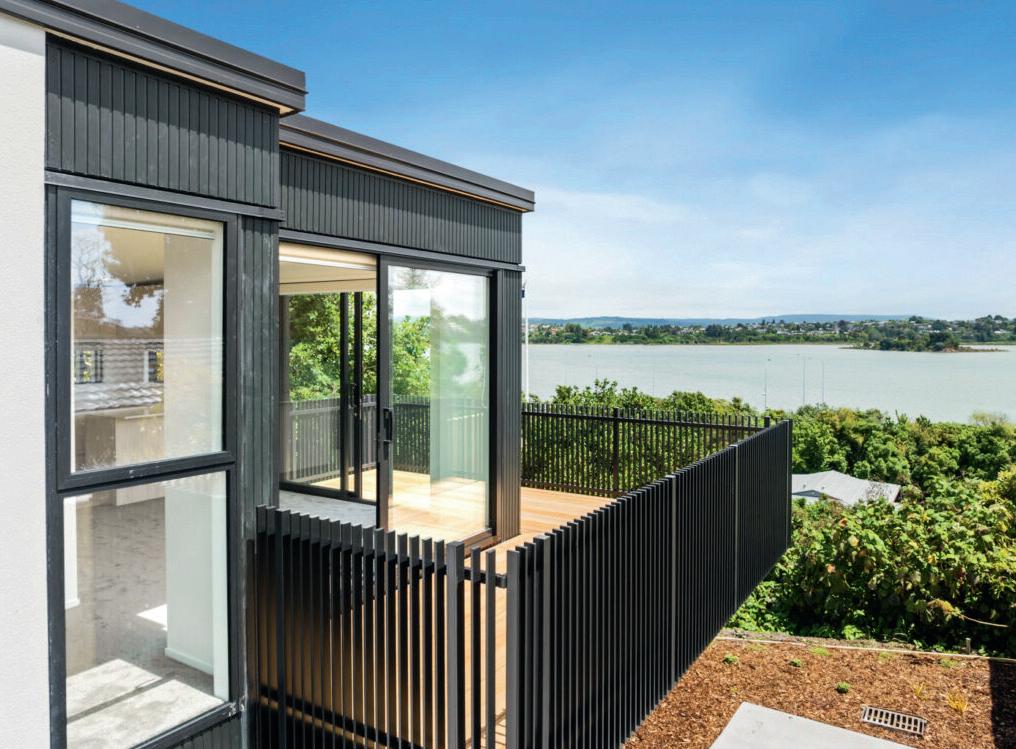




The best buildings incorporate cutting-edge design with in-depth analysis. In this two-part feature we explore why green building practices can increase the life-span and liveability of a home and look at a looming crisis around moisture in walls – and how to prevent it.

Wellington-based property investor
Jackie ThomasTeague has gone beyond what most landlords do for their tenants. Thomas-Teague has upgraded her 10 rental properties to ensure they meet New Zealand Green Building Council’s (NZGBC) HomeFit PLUS certification.
Part of her motivation for spending around $10,000 on each property was to improve life for her tenants. She recognises that more than 25 per cent of renters will be over 65 in the next few years – a much bigger demographic than currently.
After the retrofits, her tenants started telling her what a huge difference it had made to their lives.
“My tenants’ energy bills have dropped (on average) by about $100 a month, which means they have more money for discretionary spending.”
She has had no rent arrears since
Green building has benefits that not many fully understand. Sally Lindsay investigates why building sustainably is well worth the upfront investment.
the retrofit, as tenants are not having issues meeting their other regular payment obligations. And she has not raised her tenants’ rent despite the upgrades.
Recent research by economics consultancy firm Infometrics (commissioned by NZGBC) shows that homes built to NZGBC’s 6 Homestar standards can save more than $62,000 in electricity and mortgage interest over 30 years. The upfront average build cost is insignificant –0.5-1.5 per cent more standard homes.
Building to 6 Homestar standards creates warmer, drier, more comfortable and cost-efficient homes. But less than 10 per cent of new properties in Aotearoa achieve this standard.
There is a perception that building to Homestar (and other green building standards) is prohibitively expensive. But even if the upfront costs are higher, the benefits of building green can quickly outweigh the initial outlay.
Homestar ratings represent a home that performs well; and there is an increasing body of evidence showing it need not be expensive.
Matthew Cutler-Welsh, NZGBC residential business development manager, says people’s hesitancy around initial expenses are representative of a wider hesitancy to pay for good design.
But the true cost is actually minimal.
“[You will be paying between] $1,000-$2,000 for an energy model for a $1 million new home, which is massively impactful. It ensures the right materials and products are put in the right place to make sure the house works.”
There is more research to back up Cutler-Welsh’s contention that building to Homestar standards need not be expensive.

Engineering consultancy firm Aurecon (working with quantity surveyors Kwanto) found the cost of building to 6 Homestar varied from:
• no additional cost for a twobedroom terrace in Christchurch and Wellington, to
• 1.3 per cent extra for a four-bedroom stand-alone home in Christchurch.
NZGBC is leading the charge for better designed and built homes. It believes that the way people live, and what they expect from their homes, has evolved, but this is not reflected by the current Building Code.
Cutler-Welsh says there is a growing awareness that Building Code standards are no longer fit for purpose.
He says that people are increasingly concerned that buying houses off the plan – built to Building Code standards – leaves them vulnerable. He is aware of buyers having to spend an extra $20,000-$50,000 to ensure their homes are warm, dry and healthy.
While there have been some changes to the Building Code – raised insulation standards for example – this only meets minimum requirements internationally. And there is a particular issue with ventilation.
“[There are no] requirements for reliable ventilation; and the Building Code is completely silent on summer temperatures,” says Cutler-Welsh.
“So, there is nothing to protect homeowners and renters from summer heat and higher air-conditioning bills.”
In other countries, governments have strengthened their building standards. Scotland, which has a similar population to New Zealand, is aiming for a mandatory Passivhaus (passive house) building code by early 2028. The New Zealand government is not even contemplating that.
Premium Homes sales manager
Grant McSherry says the challenge is educating people that there are better options than building to the standard Building Code.
The Christchurch-based company builds to Health Based Building’s foreverbreathe specification, which is well above the Building Code.
He says many builders and architects focus 100 per cent on airtightness and claim their homes are green because they use less energy.
“To us that is the tip of the iceberg, and anybody could buy an existing
home and make that claim.”
Premium Homes use materials that are natural – low to no toxin – rather than synthetic; they do not wrap houses in plastic or install barriers for moisture. Rather, they use a wall system that relies on wool as the engine room to manage humidity.
This costs about 15 per cent more than a home erected to the Building Code standards, but the outlay can be regained in energy savings. The company is also finding the foreverbreathe-certified properties are increasing in value when sold.
“The houses might cost 15 per cent more to build, but in a recent sale, owners got 18 per cent more than they would have for a standard build. And that was in a hard, flat market.”
Toby Tilsley of Raglan-based Craft Homes has been building passive homes for the past 15 years, after getting tired of erecting “rubbish homes” to the Building Code standard.
“The Building Code has never really changed. Even though it is getting better slowly, it is still miles away from where it needs to be. The worst home can be legally built.”
Passive homes are the top tier of green New Zealand homes.
Because of the extra technology that goes into a passive home, a 200m2 home takes about 4,000 hours to build and costs about $6,500m2, compared to the average of $4,000m2
A passive home sits at about 20°C year-round and is mechanically ventilated, creating a healthier environment. Over an hour, a passive house might have 0.6 heat changes, whereas a standard home built to code can have seven to 11 heat changes.
“It is quite a significant difference. There is a lot less humidity and passive houses don’t need a lot of heating and cooling, keeping energy costs down. That is what people who approach us are mainly interested in.”
Tilsley says while the idea of building green appeals to most people, they forget about the cost. He feels this is a key reason why the Building Code hasn’t changed.
“Building companies will probably lobby against passive houses and the code changing too rapidly, because they believe it will drive up costs.”
But those living in homes built to healthy and green standards, can testify to how life-changing this can be. Thomas-Teague has seen this first hand.
“One of my tenants was frequently at the hospital emergency room with her child, who has asthma,” she says.
“They have not been back since the changes were made.”
To receive a Homestar rating, a house must meet additional performance and sustainability requirements above and beyond the New Zealand Building Code. Homestar provides a clear framework for better design and build for a more efficient home. It’s an independent rating tool for assessing the health, efficiency, and sustainability of homes across Aotearoa New Zealand. Homestar rates on a scale of 6 to 10 so that homeowners and professionals can better understand where their home or design fits and steps they can take to improve to a better, healthier standard. nzgbc.org.nz/introduction-to-homestar
Developed by NZGBC, HomeFit is an assessment and certification tool that homeowners can use to establish the warmth, dryness, safety and efficiency of their homes. The process begins with an online questionnaire that allows you to get an idea of how your home is performing. Once this is completed, you will be given suggestions on how to ensure your home is up to standard for HomeFit certification. An assessor can then be contacted through the website; they will come to the house and ensure it meets the criteria for HomeFit certification. HomeFitPLUS is a more stringent version of this: it requires homes to have more insulation (including wall insulation); more energy-efficient lights; energy-efficient heating; and energy efficient hot water. Having a HomeFitPLUS stamp for your home will differentiate it from the rest of the market when it comes to selling. homefit.org.nz

A passive home is a building designed to be exceptionally energyefficient and comfortable, requiring very little energy for heating and cooling. This is achieved through a combination of careful design, high-quality insulation, airtight construction, and sophisticated

www.eveprouse.co.nz



Alooming catastrophe may be hidden inside the walls of some of our newbuild homes. It’s a silent killer – moisture accumulation that cannot escape.
It comes from everyday activities such as cooking, showering, and even breathing: a family of four in one home can produce about 20 litres a day of moisture. In an airtight home without proper ventilation, this moisture can lead to condensation on walls, windows, and other surfaces.
This creates the perfect environment for mould and mildew. In large amounts, this can affect a home’s structure.
It is a problem that worsened as the building envelope was tightened to stop external water moisture from getting into houses after the scale of the leaky building crisis was revealed. That crisis is amongst the biggest human-made disasters in the country’s history, affecting about 174,000 homes.
It is still costing councils tens of millions of dollars. In the year to October 2024, Auckland Council alone had paid out $25 million in weathertightness-related claims.
The new disaster is a slow, rolling issue, similar to the leaky building crisis, Matthew Cutler-Welsh, New Zealand Green Building Council residential business development manager says.
New Zealand could be headed for another moisture-related building crisis, according to the New Zealand Green Building Council.
“It only becomes evident when moisture accumulates and mould starts to grow inside walls, but unless a wall is opened up, homeowners are unlikely to notice, until it becomes a really big problem. It’s a potential looming second round of leaky buildings, but this time from moisture accumulating from inside of homes, rather than from the outside.”
Blair Chappell from Williams Corporation explains that the risk is greatest when highly insulated, panelised envelopes are paired with inadequate ventilation strategies or when a home is undersized and over occupied and never ventilated by the occupants. He says that there needs to be a combination of measures used to prevent this.
“We use timber-framed construction with a drained and ventilated cavity,” he says.
“That assembly ‘breathes’ far more freely than poorly detailed SIP-panel builds, which don’t fully encapsulate the flow-on effects of a SIP panel (less breathability). Trapped vapour is much less prevalent in traditional timber construction.”
The problem has arisen from airtight homes being built after the New Zealand Building Code was tightened.
Clause E2 now requires roofs, wall claddings and openings to be built to prevent external moisture causing undue dampness or damage. However, this is a catch-22 situation.
“While we’ve stopped water getting into homes, we’ve prevented water moisture getting out,” says Cutler-Welsh.
Clause E3 of the code relating to internal moisture has not been updated to allow for moisture to easily get out, nor have ventilation requirements he says. The only real requirement is for waterproofing in the bathroom – making sure there are no liquid water leaks.
“There has been no action at all on ventilation requirements to help dry out houses. The more airtight the home, the more important ventilation becomes,” Cutler-Welsh says.
It is the one element of residential construction that has proven almost totally resistant to improvement.
“We may have made our homes more airtight, beefed up the insulation and installed much better windows, but the quality of air in these homes might be – if anything – getting worse.”
It has been a major problem overseas for some time. Recent reports and research have outlined “toxic home syndrome” as a condition affecting 15.3 million homes across the
UK, which has seen people’s health deteriorate as the result of poor quality air circulating inside their properties.
In New Zealand it is a growing industry concern, and it is the most obvious part of the Building Code that needs attention and urgent priority by the Ministry of Business, Innovation and Employment’s (MBIE), which administers the code, he says.
Writing in Newsroom earlier this year, Dr Griffin Cherrill, who has a PhD in Building Science from Victoria University, says the Building Code requirements for managing the indoor environment are relatively basic.
“Combined with this, we’re using an overly simplistic method to assess and minimise condensation and mould growth on internal surfaces. We need to find a better way to do this.”
Under the Building Code, the method used in clause E3 to assess moisture on the internal surfaces of timber-framed walls and roofs fails to adequately consider how thermal bridges influence surface temperature. This does not reliably eliminate the
‘It only becomes evident when moisture accumulates and mould starts to grow inside walls, but unless a wall is opened up, homeowners are unlikely to notice it until it becomes a really big problem’
MATTHEW CUTLER-WELSH
risk of condensation and mould, Cherrill stated.
Thermal bridges are created by building materials that bypass insulation – for example, a timber stud in a wall. Because timber is a less effective insulator, the more thermal bridges in a wall, the greater the influence on surface temperatures, and therefore, the risk of condensation and mould.
Cherrill says it makes more sense for the Building Code to use a wholebuilding simulation that calculates internal temperature and relative humidity, rather than focusing on individual components.
Whole-building simulations require detailed information about
a house to reliably calculate its internal climate. This includes the overall geometry of the building, the properties of materials that make up the construction, as well as good information about ventilation, heating and cooling systems, and how the house is used by the occupants.
He says adopting a whole-building approach to risk assessment could be used to demonstrate compliance not only with the Building Code’s internal moisture requirements but also with its energy-efficiency standard. It could also be used to assess and mitigate the risk of overheating, which is increasingly becoming an issue, especially in apartments.

Chappell says the industry’s challenge isn’t the Building Code itself. He says the industry needs to integrate ventilation, drainage, and occupant behaviour into one coherent system.
Moisture build-up is already affecting new houses. Six months after moving into their new homes, two of CutlerWelsh’s colleagues have mould growing on the windowsills from condensation accumulating on the window frames from their inadequately ventilated houses.
“If it is happening on the window frames there is a good chance it is happening in the walls as well,” he says.
One of the biggest culprits in new homes airtightness is plastic building wrap.
If not addressed properly, plastic
wrapping can trap existing moisture, worsening the problem. Even when homes are built to code, there can still be issues and health risks.
Plastic is now everywhere in the building and construction industry, which is the second-highest use sector for plastics behind packaging, accounting for 17 per cent of total plastic production globally. Without intervention, demand for plastic building materials is likely to almost double by 2050 to 150 million tonnes.
Cutler-Welsh, who is back at the NZGBC for a second time after leaving to delve into building science and materials, says in a lot of instances building wrap is a bit like choosing a rain jacket.
“You can buy a cheap PVC rain jacket, and it will keep the rain out, but you’ll sweat like hell. And that is what
is happening in a lot of our houses.
“What we need to be doing is putting the equivalent of a Gore-Tex jacket around our houses which keeps rain out but allows moisture vapour to go through.”
There is a well-established field of building science that has quantified the vapour permeability of different materials and figured out the right amount of insulation in houses and where to put the layers, he says.
The best way around the moisture problem is to retrofit ventilation. By that, Culter-Welsh means continuous mechanical ventilation. This excludes positive pressure ventilation systems installed in ceilings, which are the most common. “In most of the rest of the world, those would be illegal.”
He says homeowners should install a continuous extract negative pressure system, which could be as simple as swapping out the fans in a bathroom extractor that instead of turning off, drop down to a silent low speed and keep a low flow rate throughout the house continuously. This one step would cost only a few hundred dollars. ■

At Squirrel Property Finance, we back quality builders and developers with funding that actually works for you — flexible, pragmatic, and grounded in real expertise.
Whether it’s construction lending, equity release, or bridging finance, we connect you to smarter capital and a network of insight to accelerate better outcomes.
Let’s talk about your next project.
www.squirrel.co.nz/property-finance propertyfinance@squirrel.co.nz 0800 21 22 30 Contact Details:


The Queenstown property market continues to climb in value, but a glut of rentals is offering renters a wider range of properties to choose from.
Images Destination Queenstown
While Queenstown is a world-class adventure destination, offering everything from skiing and bungy jumping to skydiving and jet boating, there is more to the southern resort town than just adrenaline-fuelled activities.
Queenstown is home to an international community, with more than 50 nationalities living and working in the region, creating a dynamic and inclusive environment.
Situated in the southwest corner of the South Island, Queenstown has dramatic landscapes based around Lake Wakatipu and the Southern Alps.
It is also a gateway to some of the country’s other outstanding panoramas, including Fiordland National Park to the west and the arid Central Otago region to the east, making it a perfect base for experiencing the diverse beauty of the Southern Lakes.
The town’s economy is made up

of tourism, film, and innovation. Tourism is a significant driver of the many adventure sports available locally and the area is home to four ski fields.
Queenstown is experiencing growth in hospitality, construction and real estate because of its popularity as a place to live and work. Technology start-ups, sustainable agriculture, the wine industry, plus conferences and events, further diversify its economic landscape.


Bayleys Queenstown chief executive Stacy Coburn has lived in the region for the past 25 years and says it is a small town that wants to be big, has all the feel of a big city, but comes with a much better work-life balance.
“There is a big-city feeling, which delivers a lot of employment opportunities, focused on the tourism sector. Central Queenstown’s GDP is outperforming New Zealand’s average.”
Queenstown Lakes District is considered New Zealand’s most expensive property market. The average property value in the district

reached a new high of just over $2 million in May, significantly higher than other regions in the country, except Auckland.
According to REINZ data, property prices rose 6.11 per cent on average every year in the 20 years between May 2005 and May 2025.
Cotality (formerly CoreLogic) data over the 12 months from June 1 last year saw the region’s top 10 suburbs increase in price by between 0.1 per cent and 4.5 per cent: just two suburbs dropped – Arthurs and Jack’s Points.
Lake Hayes prices have risen
4.5 per cent (from $1,420,350 to $1,483,850), followed by Fernhill where prices have increased 4 per cent (from $1,198,400 to $1,246,800). Arrowtown prices have also risen by 4 per cent, from $2,402,650 to $2,499,300.
At Arthurs Point prices have dropped by 2.7 per cent from $1,450,700 to $1,411,200 and at Jack’s Point the drop has been 2.7 per cent from $2,090,700 to $2,031,950.
Coburn says there’s something for everyone down at the bottom end of the country, with housing catering to mid-range, high-end, first home buyers and property investors.



Three up-and-coming areas are Kingston Village, Frankton and Hanley’s Farm. Kingston Village is a key growth area with plenty of new developments, around 25 minutes’ drive from Frankton.
“It’s a key area with development consented for about 750 sections. About 40 sections were released in two stages; they sold in less than 10 minutes online.”
Coburn says the strategic growth of Queenstown is mostly down the southern corridor, which includes Hanley’s Farm, Jack’s Point and

FROM LEFT Kingston, at the southern end of Lake Wakatipu; fine dining at award-winning Amisfield restaurant; Queenstown Golf Course; Queenstown Bay; bikes at Gibbston Wineries; Atlas Beer Cafe on Steamer Wharf; Jack’s Point.
IMAGE View from Kawarau Falls Bridge.

eventually Homestead Bay, which will offer about 2,800 sections.
“That is going to help with the overspill and growth of Queenstown. But initially, Kingston Village is going to take a lot of that.”
He says the beauty of Kingston is that developers are creating a whole new village with restaurants, schools and amenities that will support the local community.
Initially Coburn expects there to be a mix of investors and owner-occupiers, with sections starting from $299,000.
“While there isn’t much there right now, it’s a great place to invest knowing
about the future that lies ahead.”
Just a 10-minute drive from Queenstown CBD and Arrowtown, Frankton is becoming a hub of its own – with supermarkets, The Warehouse, Kmart, more golf courses being developed, and expansion of high-end dining precinct Ayrburn.
Coburn says many investors have been attracted to the area by well-priced, high-quality developments. “The returns are a lot better than in Auckland, and there’s more demand on the horizon.”
Bayleys recently held an open home the weekend at Five Mile Villas
Annual change in Queenstown’s median price and sales volumes over five years:
Hayley Stevenson’s property management company Housemart has more rentals than tenants available. Recently Trade Me had 60 listings for rentals, down from 95 – a staggering number for the resort town.
The overhang of rentals is coming from the large number of new apartments being built, for example, at Five Mile, where 200 have been finished and the first tranche are available for rent.
Source: REINZ
Annual change in Queenstown’s sales volumes across price bands over three years:
Source: REINZ
Queenstown’s top 10
Source: Cotality
– mostly two-bedroom, one-bathroom homes and had about 250 people look through.”
Another development that’s just been launched and is expected to have the same level of demand, is Crest Chalets, with chalets and cabins of up to 59m2
Coburn says Frankton is highly attractive for people who work remotely and don’t want to stay in hotels or Airbnbs.
Sections at Hanley’s Farm are incredibly popular because they are flat, in the sun and close to a good school. Just 10 minutes from Frankton and the airport, Coburn says the area is
an attractive location for professionals, young couples and families.
“There are some people living in the area who have a home there as a second rental property and investment, but there’s also been a huge influx of Aucklanders who have bought homes there and have now moved into them.”
In a stark change from this time last year, when stories were coming out of Queenstown about seasonal workers and families living in their cars and tents in freezing temperatures, the resort town now has an excess of rentals.
Stevenson says this is bringing down rents and making existing rentals more affordable and stabilising the market. Before that rents were going up and up.
One-bedroom properties have come down $20-30 a week, and three-bedroom homes have dropped $60-80 a week, but it does depend on the quality of the property, she says.
Stevenson says it’s difficult to know whether the overhang is also attributable to fewer seasonal workers.
“We used to have a lot of inquiries, but those workers are probably now able to find a property without having to shop around.”
The shoulder season is also getting shorter – probably three to four weeks – and many workers are now staying all year round.
There is ongoing demand for rentals, with construction making up a large part of the workforce. Stevenson says many tradies have moved to Queenstown and set up their own plumbing, electrical, tiling, building and landscaping businesses, as it is always going to be a hotspot for investors.
Development and construction have generated a lot of work for the town and investors are often buying for the rental market initially and then either using the property as a holiday or permanent home later.
A few more Airbnbs have also come back into the long-term rental pool with owners having to pay GST on the accommodation and any cleaning fees from April last year.
“Everybody wants to take a little bite of the pie; and it adds up longterm, making investors more wary,” Stevenson says.
In Wānaka the supply of rentals has increased over the past year, particularly in Lake Hāwea, where some investment homes have come on stream recently. This supply is continuing with



property management firm Home & Co approached weekly by investors with newly bought properties they want rented. Colleen Topping, Home & Co chief executive, says rents are static compared with this time last year.
Lake Hāwea is an exception, the number of bonds lodged increased by 60 per cent between October last year and March this year. During that time the median rent increased by 8 per cent for three-bedroom homes, while two-bedroom homes at Lake Hāwea went up 20 per cent.
Average rents for a one-bedroom home are $450 a week and about $800 a week for a three-bedroom
property. At the top end of the market, rents for a long-term lease of 12 months of more are between $1,600$1,800 a week, excluding utilities, but generally including gardening services.
Topping says the majority of homes are rented to families or professionals moving to Wānaka, many from other parts of the country and Australia.
“It is a destination for professionals who can work remotely and is also popular as a town in which to raise families.”
The wealthy favour renting rural homes close to the lake. Northlake continues to be attractive to young professionals, tradies and small families
because of easy bike paths to schools, the skate park and other amenities and low-maintenance sections. Another favourite is established areas close to the medical centre and town. ■
For more information about investing in Queenstown, visit opia.org.nz








Alice and Caleb Pearson from Pearson + Projects on creative ways to customise a new build.

Attractive art and furniture can really make a room sing.
If you’ve purchased a home off the plans or recently moved into a new build, chances are the colour scheme is neutral, the flooring safe, and you can already think of a couple of changes you would like to make. Developers tend to play it safe with permanent material and colour selections, which makes sense, they’re designing for broad appeal, not individual taste.
But while that might feel bland, it also offers an opportunity – a blank canvas to add personality, style and function to how you live.
If you have a new home and didn’t get any choice in the colour or finishes, here are five easy ways to add personality or add value to your home working with what you have.

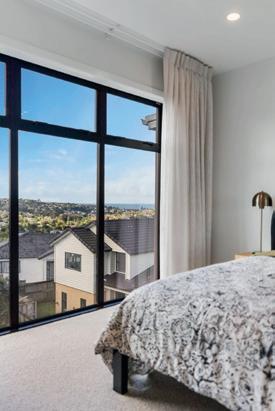
One of the simplest ways to give a room personality is to introduce a feature wall. From bright and bold to subtle and textured, there are endless options and combinations to find what suits you. It breaks up the monotony of neutral interiors and creates a natural focal point that can be low-risk and low-cost. A few of our favourites include the following.
• Paint: We love the use of paint, from a single wall, to colour-drenching a room. A great first step to add some design, but it can also be painted over if you change your mind.


Use curtains, including sheer curtains, to personalise a room. Wardrobe organisers can be lifesavers for cluttered homes.
• Wallpaper: Add colour, pattern, texture or murals – there are a wide variety of options on offer.
• Timber panelling: From battens to tongue-and-groove or reclaimed wood – panelling brings warmth and dimension.
and art It can be surprising how plain an empty new home feels. Adding furniture will completely change the style and feel of a room, and the good part of this option is it doesn’t permanently change anything in the house.
Depending on your budget and what you have, you can start small with decor and styling elements – think cushions, linen, art prints, plants or a rug. Or for more of an investment, pick a couple of statement pieces –a sculptural coffee table, a feature couch, a dining set – then layer with softer styling elements.
We regularly make use of wall art or a large print to add colour or create a focal point in a neutral room. Or a large well-placed mirror will spread light and make a room feel larger. Not everything needs to be a feature – you’d be surprised how a single feature piece of furniture or art can provide the impact or interest in a room you’re after.
In many new builds, window coverings will consist of standard roller blinds or entry-level curtains –with many more leaving this to the new owners to complete. Given how prominent window coverings can be, they can add real impact to a room. Here are a few options to consider.
• Curtains: With so many fabrics on offer, a coloured or textured curtain might be all the feature you need in a room. They will soften a space and can emphasise height. Consider going floor-to-ceiling where it is reasonable to make a subtle statement.
• Sheer curtains: Sheers are often used in living spaces as a practical option to let light in whilst adding privacy or paired with a curtain in a bedroom on a double track. These are not only practical but add a touch of luxury and depth.
• Shutters: A great option in certain rooms or situations, shutters will provide a clean and sharp finish.
This won’t sound glamorous, but upgrading entry-level wardrobes is one of the most useful improvements you can do. From a single shelf and rail, upgrading to a wardrobe organiser adds a lot of practical space to any home. You might be surprised how much additional storage is created in the same space.
And it’s not just bedrooms – this works for linen cupboards, under the stairs, and laundry spaces too. Never underestimate the value of purposeful storage.
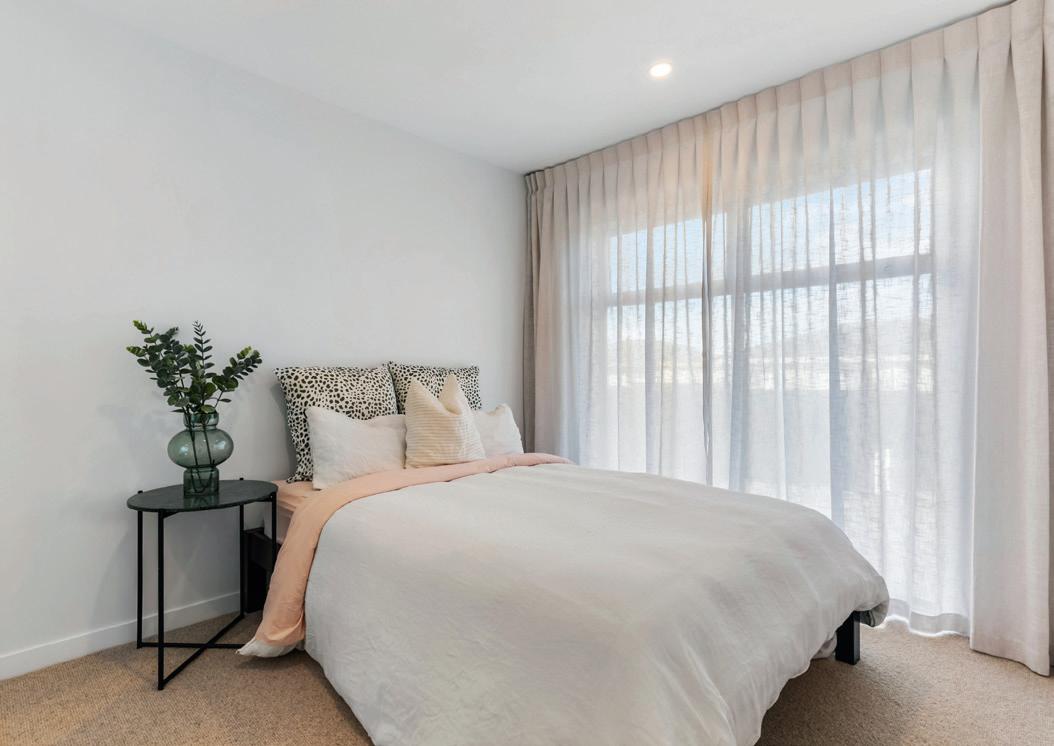


Project Alice and Caleb Pearson
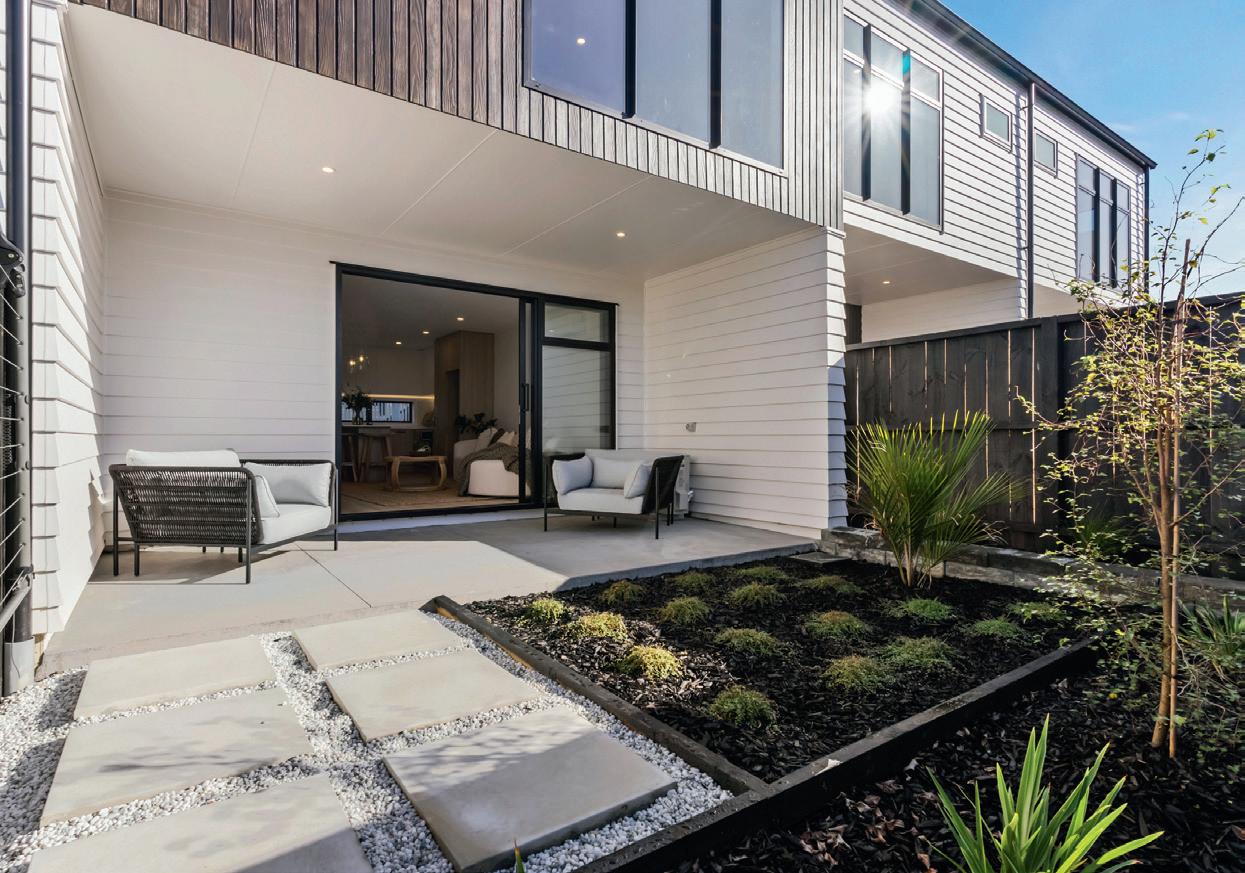
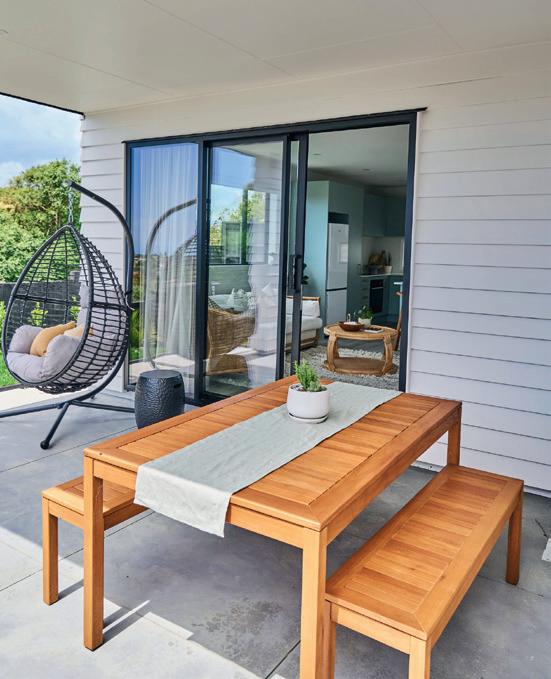
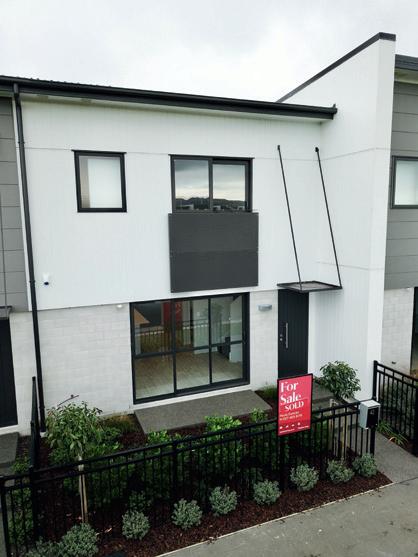
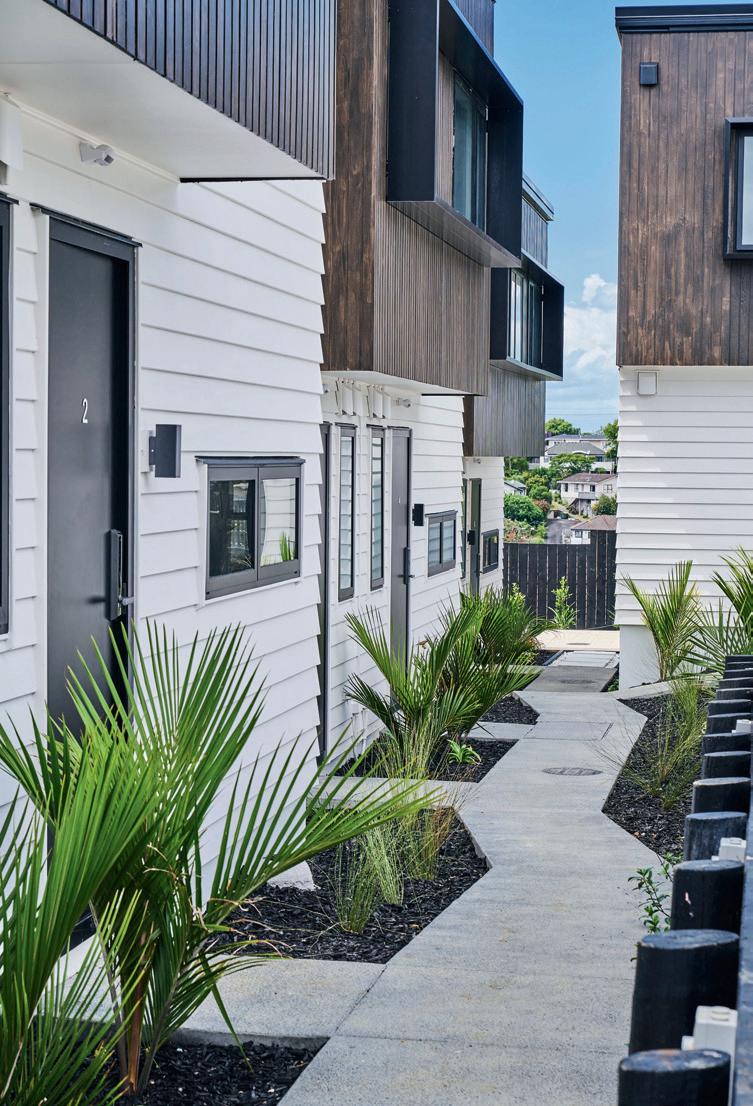
Thoughtful landscaping can transform a new build from boring to beautiful.
Landscaping additions are a great project that can be done anytime to your new home. With some considered planning there are often ways to extend your living space, add privacy and lift the kerb appeal. A few ideas to get started.
• Structural plantings: Feature trees, hedges, or sculptural grasses can layer and frame an exterior space.
• Paving, gravel, or decking: If you have space create outdoor “rooms”
for lounging, entertaining, or a barbecue zone. A pergola or roofed space will take this up a level.
• Small details: Whether it’s adding in planter boxes, planter beds, painting fences – small details make a new build a home.
Most new builds are a neutral canvas – but it’s your personal touches that turn it from a house into a home. It doesn’t have to be expensive or done before you move in. Small intentional additions or changes can make a big difference to how a house feels, functions and the value its occupants get from it.
A well-planned yard adds real value –not just for your lifestyle, but for future buyers or tenants too. ■






















Granny flats, minor dwellings, or secondary units can be one of the smartest value-adds for property owners and investors, as Rachel Radford from Builderscrack explains.

Granny flats offer investors an excellent means by which to add value to their homes.
Whether you’re chasing higher yields, looking to boost resale potential, or appeal to tenants, a well-designed secondary dwelling can be a game-changing addition to your portfolio.
Constructing a granny flat is set to become easier, with the government proposing changes that would allow builds of up to 70m2 without needing consent. The expectation is that the new rules will pass by the end of 2025 and come into effect in early 2026.
From planning and compliance, to budgeting and who to hire, here’s what you need to know about adding a granny flat.
A granny flat is typically built on the same land as a primary residential building and is traditionally used by homeowners for extended family or elderly relatives. However, investors see them as an opportunity to achieve several positive results, as they:
• generate more rental income from one property
• increase resale value, especially in competitive markets
• tap into the growing demand for smaller, affordable housing.
• maximise underused land, especially in suburban or highdensity zones.
An additional dwelling on site can give you a serious edge when selling or renting and now is a great time to get ahead of the curve by looking into the checklist of proposed conditions and your property’s feasibility.


Just because granny flats are small, doesn’t mean they have to feel cramped. A smart layout can make all the difference to appeal and long-term value.
If you’re building a granny flat to rent, think beyond a studio. A 60-to-70m2 granny flat can comfortably fit two bedrooms, a kitchen, and bathroom – ideal for short-term and long-term tenants. The proposed exemption conditions state that the building must follow a simple design. In addition to this, focus on:
• natural light and indoor-outdoor flow
• built-in storage and functional layouts
• thermal efficiency to meet healthy homes standards
• privacy and soundproofing from the main home.
These features attract higher-quality tenants and reduce turnover and maintenance costs.
Under the proposal, granny flats
LEFT Architects are excellent for establishing how to best use existing space; small units can be stylish and highly liveable.
exempt from council consent will need to be carried out or supervised by a Licensed Building Practitioner (LBP). You can find the following trade professionals on Builderscrack to help to ensure your granny flat is built to code with long-term value in mind.
Carries out the build and/or project management to meet NZ Building Code requirements, ensuring structural integrity and quality workmanship.
Architect or designer
Develops functional, safe, and visually appealing layouts – especially important if you want to maximise small spaces or add resale appeal with thoughtful design.
Draughtsperson
Translates your vision into detailed, technical construction drawings that meet all local regulations and compliance requirements.
Handles essential services like wiring, water supply, and drainage connections, which must meet NZ Building Code requirements.
Improves curb appeal and tenant satisfaction by creating outdoor
spaces that are tidy, private, and low-maintenance.
Even under the proposed national standards, you’ll need to confirm zoning requirements with your local council. Most granny flats will be permitted in residential and rural zones, but mixed-use, coastal or heritage

If you’re weighing up whether to build a granny flat, sell, or extend your current property, here’s a breakdown of the pros and cons of each option.
Build a granny fat
Pros: Adds dual-income potential, can improve cashflow, boost resale value, potentially easier process with proposed exemptions.
Cons: Requires upfront investment, may affect outdoor space and privacy, not all buyers see value in two dwellings.
Extend main dwelling
Pros: Can increase footprint, justify higher rent, attract long-term tenants, differentiate property amongst neighbouring properties.
Cons: More disruptive, typically more expensive with older homes, council permits and regulations, slower to execute.
Sell and reinvest
Pros: Unlock capital to redeploy in higher-yield areas or turnkey rentals.
Cons: Selling costs, market fluctuations, untapped granny flat potential under new conditions property, or appeal to multi-generational households, a well-designed minor dwelling adds versatility and value.
zones may still have stricter rules.
Setbacks, height-to-boundary, and land coverage requirements will still apply, and limitations (like stormwater capacity) on infrastructure will still need to be considered.
Even if your granny flat is exempt from building consent under the proposed rules, you’ll still need to meet conditions. Some of them include the following:
• the build must comply with the NZ Building Code
• if you plan to rent the dwelling out it must meet the Healthy Homes Standards
• notifying your local council before and after the build
• tenancies must comply with the Residential Tenancies Act (RTA).
Government and council resources can help you identify some of your property’s constraints when it comes to building a granny flat. However, if you’re planning to list your granny flat as a separate rental, it’s best to consult a property lawyer or experienced property manager first.
Until the law changes, small standalone dwellings still need a building consent. In the meantime, you can start assessing whether a secondary dwelling would be suitable for any properties in your portfolio. Adding a granny flat could be a great way to unlock the potential without selling or over-capitalising.
Builderscrack.co.nz is a leading online home-improvement platform that connects homeowners and trade professionals using patented NZ-made tech. Landlords, property managers and homeowners use Builderscrack. co.nz to find, hire and review verified tradespeople for everything from repairs to renovations.
39,000+ landlords
NZ‘s most trusted landlord software

Advertise your rental. Run tenant checks. Manage your property. All in the one place. Everything you need Advertise to find great tenants from just $55


These new builds from Williams Corporation are ideal for those wanting a quality investment opportunity.
Manchester Square, Christchurch, from $649,900
Located in the heart of Christchurch’s revitalised East Frame, Manchester Square comprises stylish one and two bedroom apartments, alongside spacious twobedroom townhouses, all meticulously crafted to high specifications. Importantly for property investors, this complex holds a rare, and highly sought-after, 365-day Airbnb resource consent, allowing full-year short-term rental operation. Positioned steps away from Worcester Street, the Terrace, Botanic Gardens, and the Te Kaha Stadium, Manchester Square presents a turnkey investment opportunity with robust income potential and minimal regulatory barriers, an ideal addition to any high-yield property portfolio.
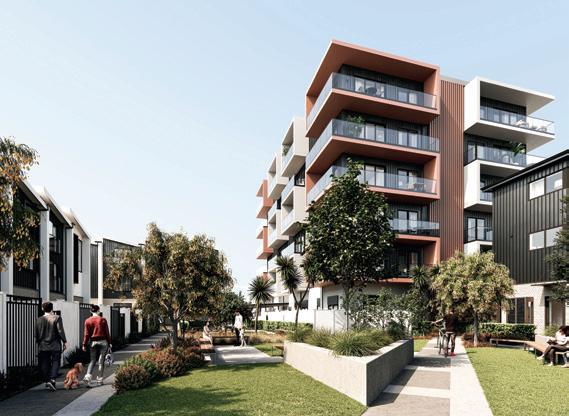


Wilmer Street, Christchurch, from $489,900
This contemporary development features one-bedroom townhouses and one and two bedroom apartments, all approved for 365-day Airbnb resource consent, offering full-year shortterm rental potential. The apartment building is serviced by an elevator, providing convenient access to upper-level units. Residents and guests can enjoy a resort-style communal leisure suite, including a cedar barrel sauna, a plunge pool, a spa, and external showers, enhancing both lifestyle appeal and investment potential in this central location. Situated in the heart of Christchurch’s Central City, the development offers exceptional connectivity to key attractions. Te Kaha Stadium, approximately 1.2km away, is set to open in April 2026, offering a 30,000 seat capacity for sports and entertainment events; Parakiore Recreation and Sport Centre, expected to open in late 2025, will be the largest aquatic and indoor recreation facility in New Zealand; and Hagley Park, just 1.4km away, provides expansive green spaces for recreation and leisure activities. With such amenities at your doorstep, 20 Wilmer Street presents an unparalleled opportunity for urban living and investment in Christchurch.
Porutu Street, Lower Hutt, from $645,900

This contemporary development offers one and two bedroom townhouses with high-end finishes, all approved for 365-day Airbnb resource consent, providing full-year short-term rental opportunities. Located in the Fairfield area of Lower Hutt, the development is approximately 15km from Wellington’s CBD, offering easy access to the capital’s amenities and employment hubs. Each unit is finished with high-end materials, ensuring a modern and durable living environment. Residents will appreciate the nearby Queensgate Shopping Centre, just a short drive away, offering a wide range of retail and dining options; Epuni Train Station, within walking distance, providing convenient rail access to Wellington City; and State Highway 2, easily accessible for commuting and travel.

Shelly Beach Road, Auckland, from $1,075,900
This exclusive development comprises 18 luxury residences, featuring a mix of one, two, and three-bedroom townhouses, all approved for 365-day Airbnb resource consent, offering full-year short-term rental opportunities. Situated in prestigious Saint Marys Bay, the development is approximately 2km from Auckland’s CBD, providing easy access to amenities and employment hubs. Residents will appreciate the nearby Ponsonby Central, just 1.5km away, offering a vibrant mix of retail and dining options; Westhaven Marina, approximately 1.2km away, providing waterfront leisure activities; and Victoria Park, within walking distance, offering expansive green spaces for recreation and leisure activities. With such amenities at your doorstep, 16 Shelly Beach Road presents an unparalleled opportunity for urban living and investment in one of Auckland’s most sought-after locations.
from $460,900
This boutique coastal development offers one-bedroom townhouses and one and two bedroom apartments, some with direct sea views. Select homes feature allocated off-street car parks, and select units also have resource consents, allowing short-term accommodation for up to 365 nights per year, enabling yearround Airbnb-style letting. All residents enjoy access to a resort-style communal leisure suite featuring a cedar barrel sauna, a plunge pool, a spa, and external showers enhancing both the seaside lifestyle and rental appeal of the waterfront setting. The development presents a compelling mix of location, lifestyle, and shortstay investment opportunities.

Founded in 2012 by childhood friends Matthew William Horncastle and Blair William Chappell, Williams Corporation leverages efficient connection and a shared mindset to drive high business productivity. williamscorporation.co.nz

Eve Prouse , registered property valuer, explores how you can make the best decision when buying a new build.
There’s something undeniably appealing about buying a brand-new home. The clean lines, the pristine finishes, the fresh landscaping that hasn’t yet been tested by a toddler or a trampoline. But when it comes to investment properties, newer doesn’t necessarily mean better.
As a registered property valuer, I’m often asked if buying a new build is a good strategy for investors. The answer? It depends. A new build can be a solid long-term asset, but only if you buy smart. That means looking beyond the gloss and applying tried-and-true investment principles.
Many new builds, especially in large subdivisions, are near-identical. That uniformity might appeal to developers, but it can be a challenge for investors. When too many similar homes hit the market, you’ll be competing for tenants and buyers with the same offering. Rental returns and resale value can take a hit.
Look for properties with small but meaningful points of difference: an extra off-street park, a larger section, better sun orientation, or more privacy. These can help your investment stand out and retain value.
You’re not buying your dream home; you’re buying a deal. Don’t fall into the trap of paying extra for the “premium” lot in a development. Focus on the numbers. Can you buy at or below market value? Will the rental income cover your costs? Have you confirmed the price with a registered valuation?
Independent valuations give you negotiating power and protect you from paying too much for a property that may not generate returns.
That coveted “new-build premium” doesn’t last long. Once tenants move in, the property is no longer new: and the value reflects that. If you’ve paid a premium price, you could be
‘Look for properties with small but meaningful points of difference: an extra off-street park, a larger section, better sun orientation, or more privacy’
underwater quickly, particularly in a flat or cooling market.
Ideally, you want to be buying under value. That margin gives you protection and ensures you’re making gains from day one, not playing catch-up for the next five years.
A fancy kitchen doesn’t pay the mortgage, tenants do. Before signing anything, secure two or three rental appraisals from reputable property managers, then compare those to similar current listings on Trade Me.
You may need to drop the rent slightly to reduce vacancy, especially in oversupplied suburbs. A few dollars less per week is far better than weeks without rent.
The core rules of property investing don’t change just because the house is new. Look for north-facing homes for natural warmth, practical layouts with at least two bathrooms, and proximity to public transport and schools.
Features like private outdoor spaces, good indoor-outdoor flow, and off-street parking matter just as much to tenants as they do to future buyers.
Just because a house is brand new doesn’t mean it ticks every box under the Healthy Homes Standards. I’ve seen plenty of new builds that miss the mark, especially multi-storey developments where heating solutions are skipped altogether.
Check whether a heat pump is installed – or, at the very least, whether it’s been pre-wired for one. Moisture control, ventilation, and insulation should also be independently verified.
Think beyond rental yield and consider what kind of lifestyle your future tenants will have. Is there a private, fenced outdoor area? Does the home feel safe and secure? Would a young family feel comfortable here?
Subtle details matter. For example, upper-floor windows should have restrictors if the home is likely to appeal to families. Covered outdoor areas are a bonus for year-round living, and natural light is always a winner.
Developers and sales agents often use urgency tactics: “It’s the last one” or “we’ve had three offers today”. Don’t buy into the pressure. Most new builds come with longer sales cycles and multiple identical units.
Take your time, do your due diligence, and negotiate hard. You have options, and in property, patience pays off.
A well-bought new build can offer reliable cash flow, minimal maintenance, and long-term potential. But buying smart means removing the emotion and focusing on the fundamentals: value, rental return, tenant appeal, and future growth. Do that, and your shiny new investment might just stay golden. ■
Eve Prouse is a registered property valuer and founder of Eve Prouse Property Valuations Limited, specialising in Auckland’s diverse property landscape, particularly South Auckland. Known for her sharp market insights and community-rooted approach, Eve is a respected media commentator and champion of inclusive, family-friendly business practices. For more of Eve’s expert tips you can follow her at @eveprousepropertyvaluations or her website eveprouse.co.nz .
Common sense prevails after years of uncertainty, as Leonie Freeman from Property Council New Zealand explains.

After years of frustration and bureaucratic delay, Auckland’s property sector finally has something to celebrate. The recent announcement by ministers Chris Bishop and Simeon Brown, confirming an agreement with Auckland Council to enable more housing density around City Rail Link (CRL) stations, is a game changer.
It’s a breath of fresh air after the stop-start journey of Plan Change 78 (PC78), Auckland’s intensification plan designed to implement the 2020 National Policy Statement on Urban Development (NPS-UD). While the intent was sound – allowing for growth in walkable, well-connected areas –the execution has been frustratingly
slow. Despite the NPS-UD being released five years ago, we’re still waiting for meaningful change on the ground.
Successive delays, extensions, and shifting political winds have created deep uncertainty in the market. Developers and investors have been left in limbo as Auckland Council grappled with the complexity of PC78. In recent months, council confirmed it would withdraw most of the plan (aside from the city centre), with a new plan change now due by October.
At Property Council, we’ve been clear in our message to central government: we need to hold our largest city to a higher standard. Auckland is the engine room of
New Zealand’s economy – but if we continue to stall on intensification, we risk choking that engine.
Uncertainty stifles progress. It delays investment decisions, freezes development, and ultimately costs jobs. It also undermines the government’s own housing growth agenda. We simply cannot afford more delays.
That’s why we welcome the joint announcement on CRL station catchments. This isn’t just good urban planning – it’s common sense. Mt Eden, Kingsland and Morningside are prime candidates for higher-density development. They’re close to major infrastructure, supported by billions in investment, and designed to

move people quickly and efficiently.
We must ensure the people can live nearby.
We’ve consistently advocated for intensification around key transport hubs. It’s a smarter way to grow – socially, environmentally, and economically. Walkable communities reduce car dependence and emissions, support thriving local businesses, and make better use of public investment.
The fact that central and local government have reached agreement together is significant. This kind of
‘Auckland is the engine room of New Zealand’s economy – but if we continue to stall on intensification, we risk choking that engine’
collaboration is exactly what’s needed to move our cities forward.
PC78 was always about more than just the CBD. There are many areas across Auckland where intensification makes sense – but progress has been glacial. Both Labour and National have supported intensification within walkable catchments, and the Property Council agrees: these catchments must allow for building heights greater than the minimum six storeys if we’re serious about increasing supply.
There remains a broader question about what happens across the rest of Auckland – and indeed, across the country. We’re pleased to see bespoke approaches for Auckland and Christchurch, but we must not
lose sight of the bigger picture.
New Zealand’s housing crisis won’t be solved by one plan change or one city. We need a coordinated, nationwide approach that empowers councils, developers and investors alike to get on with the job.
We’ll be making a submission once the new plan is released, and we encourage the wider sector to stay engaged. This is a critical moment for Auckland – and for the country.
The opportunity to shape a better, more liveable city is right in front of us. Let’s not waste it with more delays. Let’s build the kind of cities we all want to live in –connected, dense, vibrant, and ready for the future. ■
Property Council is the leading advocate for Aotearoa New Zealand’s largest industry - property.
We unite more than 10,000 property professionals and 550+ member companies to champion reduced red tape, encourage investment, and support thriving communities.
Our diverse membership includes New Zealand’s largest commercial, industrial, and residential property owners, developers, investors and associated professionals. They come together at more than 80 annual events and through the DevelopU training academy, which provide professional development, exceptional networking opportunities, and access to industry-leading insights.
As a not-for-profit organisation, we’re dedicated to building a stronger future for New Zealand’s property sector. Together, shaping cities where communities thrive.
Property Council New Zealand is the one organisation that collectively champions property. We bring together members from all corners of the property ecosystem to advocate for reduced red tape that enables development, encourages investment, and supports our communities to thrive.

The 2025
Budget introduced a surprise tax incentive
that many commercial property investors may have overlooked. PMG CFO Matt Baker explains what it means and why it matters.

While headlines zoomed in on the stimulus for manufacturers and high-growth businesses, Budget 2025’s Investment Boost presents potential material benefits for long-term property investors, especially those investing in significant capital expenditure projects.
At a time when yields are being closely watched and capital allocation is increasingly strategic, this policy change could tilt the scales, enhancing after-tax returns and making capital expenditure projects more attractive.
Here’s what you need to know.
The Investment Boost is a new 20 per cent tax deduction on qualifying capital expenditure, available in addition to standard depreciation. It’s designed to encourage business investment by improving after-tax returns.
To qualify, the expenditure must relate to new, depreciable assets available for use on or after May 22, 2025. This includes new commercial buildings and fit-outs but excludes residential property and second-hand
assets purchased within New Zealand.
For investors in commercial property funds, this means that certain costs associated with new developments or major refurbishments could deliver an immediate tax benefit to investors.
Let’s say a property fund invests $10 million into a new commercial building and fit-out. Under the new rules, 20 per cent of that qualifying spend, ie $2 million, can be deducted upfront. The rest is depreciated under normal rules.
This immediate deduction reduces taxable income, improving net returns and cashflow for investors.
Most property investors are familiar with the long-term benefits of tax depreciation. What’s new (and significant) is the timing and the fact that buildings are captured (currently buildings have a 0 per cent depreciation rate so don’t allow for any deductions from taxable income). Front-loading deductions into the early years of a project can materially improve net returns during periods that typically come with reduced cash flow, such as construction or initial lease-up phases.
In short, it improves the cash flow and after-tax return of a project by pulling some of the tax benefits forward, making projects that might
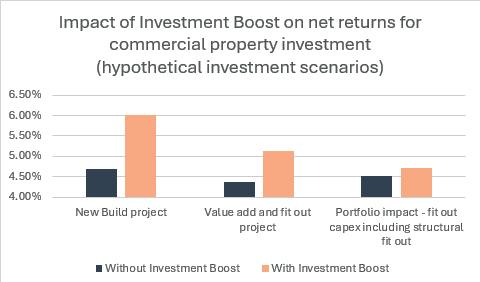
*
$15m cost ($8m building cost, $2m fit out, $5m land value)
• Only regular depreciation Gross return – 6 per cent
• Net return – 4.69% in year 1 (after tax deductions at 28%)
On a $100,000 investmentnet returns of $4,693
$15m overall cost for the asset, including a project spending $1m on fit out upgrade, plus $1m structural upgrade (considered part of the building)
Project completed after 9 months.
$300m portfolio with a depreciable fit-out spend of $8m and structural (building) fit-out spend of $4m.
Project completed at the start of the financial year.
have looked marginal on paper suddenly much more viable.
To understand the real impact, let’s consider three hypothetical scenarios. Each scenario is simplified – assuming a gross return on investment of 6 per cent per annum, and an effective tax rate of 28 per cent.
The examples highlight how even modest tax deductions can make a measurable difference to cash distributions, particularly when applied across a large portfolio or high-value development:
While the Investment Boost is currently set with no expiry date, investors should note the potential for changes down the line. Like many tax incentives, it is subject to changes driven by government priorities and Inland Revenue (IR) guidance, which may evolve.
• Only regular depreciation (only covering 3 months)
• Gross return – 6%
• Net return – 4.37% in year 1 (after tax deductions at 28%)
• On a $100,000 investmentnet returns of $4,367
• Only regular depreciation (assumes full year of depreciation)
• Gross return – 6%
• Net return – 4.52% in year 1 (after tax deductions at 28%)
• On a $100,000 investmentnet returns of $4,516
• $2m immediate tax deduction (20% on building and fit out) plus regular depreciation Gross return – 6%
• Net return – 6% in year 1 (after tax deductions at 28%) (+1.31% vs without Investment Boost)
• On a $100,000 investment - net returns of $6,000 (+$1,307 vs without Investment Boost) Tax benefits from the Investment Boost deductions would continue in year 2 and 3
• $0.4m immediate tax deduction (20% on upgrades) plus regular depreciation (only covering 3 months)
• Gross return – 6%
• Net return – 5.14% in year 1 (after tax deductions at 28%) (+0.77% vs without Investment Boost)
• On a $100,000 investment - net returns of $5,141 (+$775 vs without Investment Boost)
• $2.4m immediate tax deduction (20% on all fit out spend) plus regular depreciation (assumes full year of depreciation)
• Gross return – 6%
• Net return – 4.73% in year 1 (after tax deductions at 28%) (+0.21% vs without Investment Boost)
• On a $100,000 investment - net returns of $4,725 (+$209 vs without Investment Boost)
commercial property funds, this change is good news. It gives commercial property investors an additional lever to pull when assessing development or refurbishment opportunities, with tangible benefits passed on to you.
The Investment Boost is optional and can be implemented on a caseby-case basis and there can be system changes and work required to enable the full benefits to be realised. If you’re considering investing in a commercial property fund, now is a good time to ask:
• Does the fund manager have developments or value-add projects in the pipeline?
• Are they actively modelling the impact of Investment Boost on returns and implementing changes in their fixed asset processes?
• Do they have the governance in place to respond to changing policy settings?
As always, every investor’s situation is different. Speak to your accountant or financial advisor before making decisions. And keep an eye on further updates from IR as guidance around the implementation details are finalised.
PMG is one of New Zealand’s most established property funds managers. For more than 30 years, PMG has been invested in delivering long-term sustainability and value for investors through proactive commercial property management and investment.
PMG’s purpose is to create value and security for people in property, helping New Zealanders achieve financial freedom. It does this by offering a range of unlisted property funds, which cater for the differing needs of investors and provide them with choice, diversification and regular income. www.pmgfunds.co.nz
At PMG, we’re working closely with independent advisors to make sure we make full use of the available benefits for investors.
What can investors do now?
For seasoned investors already in
The answers to these questions could materially affect your after-tax return.
The 2025 Budget may have been light on dramatic economic moves, but this quiet tax tweak could punch well above its weight in the commercial property sector.
Disclaimer: The information in this article is general and current as of July 2025. It is not intended as regulated financial advice under the Financial Markets Conduct Act 2013 and does not consider your specific circumstances. PMG does not provide financial or tax advice. Please consult a licensed financial or tax advisor before making investment decisions.

Trent Bradley , director of Luminate, shares ten common borrowing mistakes and explains how advisors can help to prevent, or remedy, them.
I am constantly surprised at the number of times a client has come to Luminate, having missed out on a property because they had not gotten themselves organised when they headed out to buy. Clients can lose out on good investment properties, which can add value to their portfolio. A prime example is not being able to go unconditional on a purchase in a multi-offer situation.
Advisor tip Always take the time to get pre-approved. It’s a chance to review your property goals and strategise your purchase ahead of time. It also allows you to understand your financial
position and price range, putting you in the best negotiating position.
Over the years at Luminate, particularly when we take on new property investors, we see clients who have put all their loans under their personal names or collateralised all of their properties. This can create a number of issues. Poor structures can lead to cross-collateralisation (reduced flexibility), reduced borrowing power, and tax inefficiencies.
Advisor tip Use specific loan structures and split securities, take
interest-only options on deductible debt (where suitable), and the right ownership structure (trust, LTC, etc).
We often see investors (particularly in a low-interest-rate environment) choosing the lowest interest rate, ignoring long-term lending strategy or risk management. Cheap interest rates (particularly short terms) can result in missed opportunities. A common mistake is failing to split larger loans and consequently becoming exposed when loans come off into higherinterest-rate environments.
Advisor tip Prioritise long-term lending strategy and risk management, future lending potential, and consider offset or revolving facilities to give greater flexibility where appropriate –not just the rate.
All property investors are different, with different personal situations. Some people need more capacity for adversity than others. We all need to be realistic when taking on significant debt levels. Interest rate increases, rent shortfalls, or unexpected maintenance can quickly create day-to-day financing pressure, particularly in environments where banks tighten up. We saw this post-COVID.
Advisor tip Be realistic when putting your own personal budgets together and hold a realistic buffer for contingencies. Have a minimum of three months’ worth of expenses or have facilities (eg revolving credit) that can be drawn on in need.
Not choosing a specialist mortgage advisor can limit the options that you are presented in terms of structure, rates and other lender options. The advice you get is not as complete as it could be, particularly when the advisor (whether bank or mortgage broker) has limited expertise on investment structures, tax implications, future borrowing strategy or other lenders’ policy.
Advisor tip The right mortgage advisor who understands investment should be a partner in strategy as well as being able to present your application in the best possible light, arranging optimised lending facilities and helping you grow your portfolio.
Dealing with one bank can limit pricing, products, structuring and
Trent
access to capital. This can cost you more money in interest, ability to purchase other properties or to obtain more advantageous financial structuring or specialised investment products eg longer interest-only terms.
Advisor tip At Luminate, we never advise clients to multi-bank for the sake of it. However, where there are commercial reasons for splitting relationships, there can be significant upsides. Examples include splitting the home away from investment properties for risk minimisation when self-employed, and moving borrowing and securities to get out of commercial rates and back into the retail bank to save interest cost.
Property investors often finance their first or second property with no consideration for the third or fourth. They hit a “funding wall” when equity or servicing runs out because the loans weren’t structured with growth in mind.
Advisor tip Lending needs to always be structured to maximise borrowing capacity for risk management as well as growth. Loans need to be structured to preserve equity, maximise debt servicing and provide for future purchases.
Property investing is a business and needs to be treated that way. Look at financing through a tax outcome lens (eg maximising interest deductibility) and where possible, property sales need to be factored into the financing equation. Good tax structuring will save significant money long-term. Poor tax planning can be an expensive mistake, particularly in the case of bright-line tests.
Advisor tip Always get tax advice, particularly when purchasing further investment property, but even when upgrading your own home, as there are often structuring opportunities to
minimise tax impacts and maintain equity. If your compliance accountant appears limited, go to a property tax specialist such as NSA or Covisory.
Most investors are anti non-bank, assuming they are too expensive or increased risk. But non-banks can offer higher loan-to-value ratios, interestonly terms, and income flexibility that banks won’t – especially useful for investors with strong equity, but complex incomes. This can allow for more acquisition in growth environments or better terms when things get tough.
Advisor tip Non-bank lenders are simply another tool in the toolbox. We work with non-banks all the time and know how powerful a tool they can be for growth, bridging finance or structuring. Used strategically, even temporarily, they can improve your portfolio.
Everybody is busy and a common mistake is investors putting loans in place and then not reviewing them for years. We have even had investors come back and ask us what a loan was for and which property it related to! Things change. Markets, interest rates and lending policies can all move. Regularly reviewing your lending will enable you to maximise lending structures and minimise interest rates and risk through tighter management.
Advisor tip Loans should be reviewed annually (at a minimum) with a mortgage advisor who is an investor specialist. Rates, loan structures, equity position and strategic goals should be reviewed. Your next purchase could be hidden in a review.
We review all clients for free a minimum of every 12 months and we always discover something that needs to be dealt with or improved. ■


Debbie Roberts of Property Apprentice on how financial advice is essential for property investors wanting to map out their future.
When planning to create wealth with property investment in New Zealand, many aspiring investors focus on location, property type, or market timing. While these factors may be important, one critical aspect often overlooked – until it’s too late – is the quality of financial advice and support that you receive before, during, and after you invest.
Good financial advice goes beyond crunching numbers. It involves knowing how property investment fits into your overall financial picture by understanding your goals, risk profile, borrowing capacity, and long-term plan. The right advice can mean the difference between achieving financial freedom and making costly mistakes.
Housing is not an asset that can be easily liquidated or sold quickly. It often requires a mortgage to purchase, and as a long-term investment, it also comes with legal responsibilities.
Before buying, you need to know:
• how much can you afford comfortably, both now and when interest rates increase
• how property fits into your retirement or wealth-building goals
• what ownership structure is best for you (individual, trust, company, or joint ownership)
• what is the best mortgage structure and/or bank for you
• what are the tax implications of each purchase.
A financial adviser can help you map all this out and highlight risks you may not have considered. For instance, buying a property as a quick flip may sound appealing, but without understanding things like the GST implications, you could end up with an unexpected tax bill.
However, there are several different types of financial advisers.
‘Some of the people who benefit most from financial advice are first-time investors or homebuyers’
Financial advisers must have specific qualifications to provide financial advice in various fields, such as insurance, mortgages, and investments. For example, an insurance adviser can’t give mortgage or investment advice unless they have those qualifications as well.
Property investment in New Zealand has gone through several changes over the past few years. The current government reduced the bright-line tax period from 10 to two years and restored interest deductibility. The Reserve Bank of New Zealand (RBNZ) has implemented debt-to-income (DTI) restrictions. Coupled with rising insurance costs and ongoing updates to tenancy law, this creates a market where outdated strategies are no longer effective. Good financial advice can help you navigate changes.
Mortgage advisers can help you access and structure lending, and real estate agents can help you in your search for a property. However, they can’t create financial plans or give financial advice about property investing unless they hold the investment qualification as a financial adviser.
An investment adviser can model how different scenarios might impact your future net worth, and help you balance property investment with other goals (like paying off personal debt or investing in KiwiSaver and/or
managed funds), and ensure your cash flow is resilient to market shifts. It is essential to understand that some financial advisers also sell property. Some will offer their services for free, but usually only if you purchase a property they are selling, which is a significant conflict of interest. Also, some investment advisers only advise on products they sell, such as managed funds, but not investment properties (or vice versa).
There’s a common myth that financial advisers are only for the rich. In reality, some of the people who benefit most from financial advice are first-time investors or homebuyers. Setting things up correctly from the beginning can save you tens of thousands of dollars over the lifetime of your investment. Numerous studies worldwide have shown that individuals who receive financial advice achieve better results than those who don’t. However, you need to obtain this financial advice from a financial adviser who holds the relevant qualification(s).
Property can be a powerful tool to build long-term wealth. Whether you’re eyeing your first rental or growing your portfolio, partnering with experienced financial advisers and coaches/mentors can help you make smarter decisions, reduce risk, and stay on track toward your goals, no matter what the market throws at you. ■
Property Apprentice is the market leader in property investment advice. It is run by experienced coaches and financial advisers to give you the best support possible, to help you realise your goal of financial freedom. Visit propertyapprentice.co.nz, email info@propertyapprentice.co.nz or call 09 575 7736.


Anna Sedakova from myRent discusses why landlords are turning to technology.
In recent years, New Zealand landlords have had to navigate a wave of legislative reforms, heightened compliance requirements, and shifting tenant expectations. Property investment, once considered a relatively passive income stream, now requires an active and well-informed approach.
What’s changed? A lot. From Healthy Homes Standards and tenancy termination reforms to digital bond lodgement and upcoming rules around
pet bonds, the merry-go-round of change doesn’t seem to slow down. With significant financial penalties for non-compliance, it’s no longer enough to rely on memory, spreadsheets, or outdated paper systems. This is where technology has become a game changer for landlords.
Staying compliant used to be about having a solid tenancy agreement and
keeping the rent paid. Today, it’s about precision. Are your Healthy Homes records up to date? Have you served your notice correctly? Did your rent increase meet the required notice period?
Tech platforms like myRent help landlords keep a paper trail that meets legal standards, templates are updated when legislation changes, every communication is time-stamped and stored and notices are issued correctly and verifiably. Importantly, landlords receive reminders and guidance to keep them a step ahead – not one behind.
Another area where landlords –especially those new to the game – can trip up is during the application and screening process. The Office of
the Privacy Commissioner has issued clear guidance: landlords should only collect information that is necessary for each step of the tenancy process.
However, in practice, we still see landlords asking for excessive personal details too early, setting inappropriate conditions like employment requirements, or asking for pet bonds. Often, it’s not malice – just a lack of knowledge.
This is where smart technology makes a real difference. Landlords using digital platforms are alerted when their listing description or questions go too far, are gently guided by prompts and education, and can
fix their language and expectations before a problem arises. It protects tenants’ rights and keeps landlords out of trouble.
Tenants today expect transparency, digital access, and clarity – and rightly so. Technology empowers them to view rent statements, agreements, inspection reports, and maintenance records in real time. In turn, landlords have verifiable records of every interaction – including 14-day notices, rent arrears reminders, and maintenance updates.
When issues arise, having a clear
myRent.co.nz is New Zealand’s leading platform for self-managing landlords, helping tens of thousands of property investors stay compliant, organised, and in control. From listing to agreements, inspections to maintenance, myRent supports every step of the rental journey.
digital history protects both parties. This transparency reduces disputes and makes it easier to resolve problems without formal intervention.
Even the most diligent landlords can forget to do things – have a proper amendment document when changes to the agreement are made, carry out inspections on time, or provide the correct notice period for rent increases or tenancy terminations.
Good systems turn the “not-easyto-do” list into things that are done automatically.
Tech tools now help with:
• keeping up with legislative updates
• setting reminders for inspections and renewals
• appointing temporary managers if you’re heading overseas
• logging rent payments and chasing arrears
• creating and signing agreements and variations digitally
• ensuring every notice meets legal standards.
Platforms like myRent are designed to make property investment manageable, even if you’re juggling other work, family, or travel commitments. They let you be a confident landlord – not just a hopeful one.
You don’t need a large portfolio or a property manager to get the benefits of professional systems. With the rise of smart landlord platforms, even owners of one or two rentals can now run their properties like pros. You get control, clarity, and confidence –without the guesswork.
As property legislation continues to evolve, landlords who embrace digital tools will be better placed to adapt, comply, and thrive. Property investing may no longer be “set and forget” – but with the right systems, it can still be simple, smart, and rewarding. ■

Shadi Salehpour poses the question: will I be a better property manager if I was regulated?
The answer to the question in the intro (left) is: absolutely not.
I speak for a good number of business owners when I say this, regulation won’t make us better operators. Why? Because the majority of us are already committed to doing the right thing by our clients, our tenants, and our own businesses. We hold ourselves accountable (our reputation depends on it) especially when we have dedicated a lifetime to the property management industry.
Most of us got into this business for similar reasons, for the flexibility, the freedom, and the chance to work with people. You will often hear property managers say they are passionate about both the job and the relationships, and I tend to agree. While we are called property managers, we’re really people managers. But if we’re being completely honest, property management is also a solid business model too, one that can generate income even while you sleep. And that’s exactly why it attracts all sorts of operators. For me, it’s simple, it’s a great industry, so let’s protect its reputation at all costs.
Like most rules and regulations, I believe the Residential Property Managers Bill was aimed at the lowest common denominator. But would I have welcomed it? Of course with open arms and heart. Even though I’m still unsure what extra costs it may have added to our already stretched budgets, the question must be asked, would those costs have been passed on to landlords, and eventually to tenants? It would be naïve to think otherwise. I welcomed it, not because it would force me to lift my standards, but because of the protection it offered landlords and tenants from those not-so-great operators. From what I hear, some business owners tap into the rental account, hold on to overpaid rent, or don’t meet even the most basic legal responsibilities.
‘I welcomed it, not because it would force me to lift my standards, but because of the protection it offered landlords and tenants from those not-so-great operators’
These are property management business owners whose interest wasn’t the relationship, but the bank balance.
How many thousands of dollars are lost due to mismanagement of funds, from big companies to small companies? Rotten apples, yes, but also perhaps a lack of training, discipline, and systems and procedures.
Recently, a tenancy came to an end. I sent the usual SMS reminder asking the tenants to adjust their last automatic payment, their final rent was only $300. If I hadn’t sent them the message, they were paying their full weekly rent of over $1000. They were grateful and totally surprised.
Honestly, it would be easy to keep this money. Many tenants don’t ask for a final ledger, they trust us and our system ledgers. Though our accounts get audited at a substantial cost, we have made sending our tenants their statements as part of our “to-do list” when archiving our tenancy.
I also tell them it’s good to use for the next time they need to apply for a rental, as it shows their constants payments, they do like this aspect of it. That’s how it should be.
When business managing 1,000 tenancies, small amounts can add up quickly.
That’s why ethical practices must come first, even when no one’s watching.
The Residential Property Managers Bill, introduced under the previous Labour government, aimed to:
• establish minimum entry and training requirements
• set a nationwide code of conduct and practice standards
• introduce a formal disciplinary and complaints process.
It would have required every property manager and property management company to be licensed and listed on a public register, with accountability to an independent regulator. The Real Estate Authority (REA) was set to take on this role.
Importantly, the bill also gave the Tenancy Tribunal new powers, landlords found in breach of key responsibilities multiple times could be ordered to use a licensed property manager.
In 2023, the incoming government dropped the bill, to the relief of some (but not others) due to concerns around cost and added bureaucracy. I fully understand those concerns. But I also saw the opportunity: clearer standards, better consistency, and a united industry with one strong voice to act on behalf of those who need us most.
I believe regulation will return at some stage, it’s not going away.
As an industry, if we want to be seen as professional, respected, and taken seriously, regulation is the bridge that unites us.
It’s not there to punish good operators, but to protect the people we serve from those who give the rest of us a bad name.
For landlords out there, ask your property manager if they’re a member of REINZ. REINZ membership forms the backbone of what regulation would look like, and it gives you that extra peace of mind knowing your property manager is held to a higher standard. ■
Let’s Rent is an award-winning property management company in Auckland dedicated to providing exceptional service for landlords, property investors and tenants. Founded on the principles of integrity, personalised service, and attention to detail, Let’s Rent stands out for its innovative approach to property management. letsrent.co.nz

It’s a good idea to view break leases as a chance for a reset and a way to stress test your strategy, writes Sarina Gibbon.

Investors love telling each other how they bought a do-up from a desperate vendor and turned it into a cash cow. They are all in for opportunity in adversity, until adversity shows up in the form of a fixed-term tenant wanting out early. Then it’s betrayal, not business.
Let’s talk break lease. Because in a cooling market, these requests are becoming more common. They don’t just test your grasp of tenancy law, but also how well your investment strategy flexes under pressure.
The starting point is not controversial: fixed terms are fixed... until they are not. Life moves faster than contracts. A job relocates.
A house is bought. A better rental pops up down the road. As frustrating as it is, break lease is not illegal and it is certainly nothing new.
Too many landlords treat break leases as a one-size-fits-all. The tenant hits the red button and out comes red smoke. But the RTA provides three distinct pathways for break leases, each with its own implications.
1. Assignment (s43B): This is novation rebadged, of sorts. I call it a tenancy switch-a-roo; everything stays the same except the tenant. It must be done with your consent, and you can attach reasonable conditions, such
as the new tenant passing standard checks. Critically, in a depreciating market, you cannot recover the rent shortfall from the outgoing tenant. If the new tenant pays less, then you’ve agreed to a variation, and you absorb the difference.
2. Subletting (s44): In this tenancywithin-a-tenancy setup, your tenant becomes sub-landlord while still being your tenant. The rent to you stays the same. But now you’ve got someone occupying your property with whom you have no legal relationship. That’s reduced visibility with much higher risk. If you go this route, do it with your eyes wide open.

3. Surrender (s50(1)(d) and s43B(7): This is a clean break by mutual agreement. The upside? Total discretion. You get to reset the rent, the tenant profile and even use the downtime to renovate or reposition the property.
It would be a mistake to assume any one of these is the gold-standard option. They’re tools. The best landlords use the right one at the right time based on risk, opportunity and market conditions.
For years, landlords had the upper
hand. Renters stayed. Rents rose. Vacancy is as rare as a 15-year-old who takes the rubbish out and cleans the kitchen. In many centres, vacancy rates are up and median rents are slipping. What looked like fair rent 12 months ago now sticks out on Trade Me like a sore thumb.
So yes, I get why break leases make you go dark. The likely reality is you won’t be able to replace that tenant on the same rent. But the instinct to make the outgoing tenant absorb the shortfall, to punish them, so to speak, doesn’t hold up legally, especially in an assignment situation. You can’t keep the rent high and accept a lowerpaying assignee.
You also can’t charge a flat break lease fee. The RTA allows you to recover actual, reasonable and itemised costs. That’s it.
This is where the opportunity kicks in. You get to choose: treat a break lease as a disruption or use it as a strategic reset.
How often in your rental business do you get to stop and ask the following questions.
• Is this tenancy still aligned with my investment goals?
• What’s the opportunity cost of locking in another fixed term without recalibrating the numbers?
• Could this be a window to upgrade the tenant, the rent, or the property itself?
• Does staying the course protect value or quietly erode it?
Just because a tenant wants out, doesn’t mean you’re powerless. If the proposed assignee doesn’t pass the usual smell test, you don’t have to consent. If that is the case, the tenancy continues. The tenant remains liable and that means rent must be paid and paid on time. The law is on your side if you know how to use it.
Let’s be honest, a tenant asking to leave is already halfway out the door. Is it prudent to force someone to remain in possession of your property? You’re not in control, you’re at risk.
Break lease requests are the landlord’s version of a fire drill: they expose weak rents, problematic relationships, fixed mindsets and poor exit planning. But they also give you a chance to recalibrate.
Don’t cling to the last agreement out of habit or fear. Use this moment to create a better one; one that is smarter, more resilient and designed for the market you’re in now, not the one you signed up for last year. ■
Sarina Gibbon is an independent tenancy advisor with clients ranging from the Auckland Property Investors Association, Renti and several property management companies.

Carole Pedder , director at PKF Withers Tsang, on why chasing yield still makes sense.
Investing in property in New Zealand has always carried a certain appeal. For many, it’s about something more tangible than shares or managed funds. Property is one of the only investments
where you can directly add value if you are prepared to roll up your sleeves and put in some hard work. You can paint it, rent it, renovate it. You can even drive past it and smile smugly. Successful investors roll up their
sleeves. They make it their job to understand zoning rules, rental demand, building maintenance, and tenant relationships. They might add a carport or subdivide a backyard and add a second dwelling to increase the rental income. That ability to add value, to steer the ship, is what sets property apart.
But for all its romance, property investment demands a clear understanding of the financial mechanics that separate a good investment from a poor one –especially in the market that property investors are facing today.

Let’s start with the basics. Due to the cost of lending, many property investments operate at a cash loss. It might seem counter intuitive, but the hope of the investor is that that today’s cash losses (negative gearing) will be outweighed by tomorrow’s capital gains. Unfortunately, that strategy only works if the gain actually comes, and in this market, assuming
‘Too many first-time investors focus on the asking price of properties and forget to check what rent those properties will realistically achieve’
that capital growth will ride in to save the day for every property investment is optimistic.
That’s why I’m a fan of yieldfocused investing – chasing a positively geared property – where the rental income covers at best, the majority of its expenses, or at least, will cover the interest costs. This may not be as easy as betting on long-term capital gain, but it’s smarter. Positive cash flow keeps the dream alive, especially if, over time, your circumstances change and life becomes more challenging, like it is now for many people dealing with the current cost-of-living crisis.
Positive gearing: It’s simple maths: if your property brings in more income than it costs to hold, you’re ahead. That makes it sustainable. That also makes it a proper investment, not a cash drain disguised as a long-term financial strategy. Any capital gain made over time, then becomes the cream on top.
Negative gearing: This is when your rental investment costs more to hold than it can make in rental income, and you’re relying on future capital growth for it to be a worthwhile investment over time. That’s not inherently bad, and some seasoned investors have built entire portfolios this way. However most have a plan to move a negatively geared property as quickly as possible to positive, via either planned debt reductions, rental increases or improvements that add additional rental streams to the property. The only drawback is that it does require that you have deep pockets to fund the cash
shortfall each year in the meantime.
It’s important that before you buy anything, know your numbers. Specifically, your yield.
A quick rule of thumb is yield = (annual rent/purchase price) x 100.
Say you’re eyeing a property renting for $600 a week. That’s $31,200 a year. If your purchase price is $500,000, the yield is 6.24 per cent. Now compare that to your mortgage interest rate. If your interest rate is 7.5 per cent, you’re not breaking even. That means you’re in negative territory unless you can buy for less, raise the rent, or reduce costs.
Too many first-time investors focus on the asking price of properties and forget to check what rent those properties will realistically achieve. Spend more time looking at what similar properties rent for in the current market.
Do your homework and look for properties that have the potential for you to be able to increase the rental income. If this is not possible, make sure you understand to what extent you are able to financially top up any cash shortfall and for how long you would be prepared to do this for. Quite often it’s the burden of these top ups that motivates a property investor to list an investment for sale long before an adequate capital gain has been made.
Remember, rent pays the bills. Hope doesn’t. In the end, a good investment property should work for you, not wear you out.
As my colleague Mark Withers has often said to clients, “if this property doesn’t increase in value over five years, will I still be happy owning it?” ■

Lance Jensen discusses a client who has build a portfolio from nothing.

When Warren arrived in New Zealand from South Africa, all he had left in his wallet was $20. But fast-forward to today, and he owns seven properties spread across the Waikato. Here’s how Warren built a property portfolio from slow and determined progress.
Warren had always been interested in property. Even as a teenager, he believed bricks and mortar were a better long-term bet than shares.
But it wasn’t until he and his wife moved to New Zealand that this belief became a necessity. With just one income between them, he committed to saving – stashing away as much as he paid in rent, even when it meant surviving on just $80 worth of groceries a week.
He purchased his first house in 2011 for $225,000 with an $18,000
deposit. He says it was a leap into the unknown, spurred on more by principle than certainty.
“I just didn’t want to rent my whole life,” he says.
Warren’s journey wasn’t easy. At first, his wife didn’t share his vision for property investment.
Her philosophy was to “live for today”, while Warren was all about building for tomorrow. This mismatch added pressure to an already tight budget and eventually contributed to the breakdown of their marriage.
He also learned the hard way that not everyone respects your financial goals. When a friend-turned-tenant discovered Warren was buying another property, they stopped paying rent out of spite.
“We’d been friends for five years. Their kids were the same age as mine. But they just cut me off,” Warren says.
Disclaimer: Just remember this is a column in a magazine, going out to thousands of people. It’s not personal financial advice. But, it is an example of what can be achieved with personalised financial advice. If you are wanting to book a consultation, email us through the website at https://www.opespartners.co.nz/contact
“I wasn’t allowed on the property. I had to get a property manager. And then the Tenancy Tribunal wouldn’t evict them because it was close to Christmas.”
It was a stressful period, but one that taught him the importance of professional boundaries and solid property management.
Warren says it’s important to “invest in yourself first”. Education was a game changer for him.
He credits courses from Steve Goody and the Opes Partners podcast for helping him understand the property cycle, how to negotiate better, and how to make smarter decisions with debt. He also strongly recommends getting a good mortgage broker early on.
“If I’d done that sooner, I wouldn’t have had issues with silly things like a credit card affecting my borrowing.”
Warren also emphasizes mindset: “Stick to your plan. Don’t chop and change. It’s a get-rich-slow scheme – but it works.”
In the past six months alone, Warren has added three more properties to his portfolio. His most recent deal is a tidy, already-tenanted house he picked up for just $265,000 that rents for $500 a week.
“I’ve learned to buy when it’s a buyer’s market,” he says. “While I’m still young, I want to keep growing.”
Warren’s long-term goal is financial security – but not just for himself. He’s building a legacy. And from where he started, with $20 and a dream, he’s proof that consistency, resilience, and a bit of Kiwi know-how can take you a long way.
Warren’s experience might resonate with some potential investors.
Maybe you don’t have much right now, but you have big dreams. ■
If you want to discuss your options, the next step is to book a Portfolio Planning Session with us here at Opes Partners.





A place for the best landlords to shine.
If all you ever read is mainstream media, you’d be forgiven for thinking landlords were all ratbag slumlords. People love a horror story, so journalists trawl Tenancy Tribunal reports looking for the latest salacious case. It’s understandable.
Even though 85 per cent of landlords and tenants get on well: “tenant pays rent on time” and “landlord provides nice cosy home” aren’t exactly going to make the front pages.
Finding a good news story that’s worth printing is hard. It’s got to be something extraordinary, and they take
time to find and write. That’s where NZPIF’s Rent Skills Award can help.
The NZPIF Rent Skills Award recognises landlords who choose to do more than just collect rent and do the essentials. Landlords who create not just tenancies, but relationships, homes, communities, and futures. We want those landlords to come out from the shadows, to step forward and take the recognition (and a tidy reward) they deserve.
Each year, the NZPIF Rent Skills Award celebrates excellence and shines a light on how our members
lead the way to show how the private rental sector can and should operate.
All businesses have a choice in how they operate: transactional or relational. Do you take the money and move on or build relationships with your customers, so they become valued long-term clients? A residential rental accommodation business is no different.
Many investors start out viewing property investment as a side hustle or a long-term investment. But then
something shifts. There’s a satisfaction in providing a safe, healthy, and comfortable place to live. There’s enjoyment from competing with others, providing that extra bit of customer service, attracting the best clients and lifting your returns – or doing better in the downturn. That’s where the shift to excellence begins.
Some of the past entrants show us what’s possible.
Take Harry Pearson, for example. Known for planting more than 100 fruit trees across his properties, he’s an investor with a mission: to make sustainability practical.
His tenants have access to raised garden beds, fresh produce, and homes equipped with solar panels and ultra-low-emission wood burners. It’s not just greenwashing – it’s smart economics and compassionate housing. His tenants often save $25$50 per week in energy and grocery bills, while staying longer and treating the properties like their own. Harry’s even got an avocado named after him – the “Harricado”.
Or Rosalind Love and Tim Calder, who, through their Prime Campus initiative, provide student accommodation but also mentor other landlords on best practices for managing student tenancies. Recognising that student housing brings unique challenges, they’ve offered webinars, podcasts, and free resources to help others navigate it successfully.
These landlords understand that profit and purpose aren’t mutually exclusive.
Many of the most inspiring applicants aren’t just landlords – they’re community builders.
Jonathan Brunton, for instance, carefully curates his multi-flat
THANK YOU

properties to foster supportive environments. Solo mothers, retirees, and first-time renters find not just a roof but a micro-community. In one property, a shared vegetable garden became a hub of connection. Tenants share childcare, cook for each other during hard times, and uplift one another. Jonathan even creates and hand-delivers Christmas cards with his daughter to every tenant — a small gesture with a big impact.
Nicki Smith, a long-time member of the Taranaki PIA, was inspired by mentors in her local association. Now, she mentors others and has implemented a comprehensive “house manual” for all new tenants – particularly useful for first-time renters. From how to reset a blown fuse to managing rubbish collection, the manual empowers tenants to manage their homes confidently and independently. It’s a simple idea with profound effects on tenant autonomy and satisfaction.
At the core of every strong application is a simple belief: good tenancy is a two-way street. Respect, trust, and open communication were recurring values in nearly every submission. Many landlords shared stories of tenants who became long-term residents, not because rents were cheapest, but because the relationship was strong. Maintenance was prompt. Requests were listened to. Homes were cared for – by both parties.
The NZPIF Rent Skills Award isn’t just about a trophy or recognition – it’s about changing the narrative. Let’s get the spotlight away from “greedy investors” or “slumlords”. Let’s focus instead on the investors


and landlords who are mentors, educators, environmentalists, and community stewards.
This award gives these stories a platform. It honours those who:
• treat tenants with dignity
• innovate for affordability and sustainability
• invest in communities, not just buildings
• share knowledge freely to raise industry standards.
Importantly, it inspires others to do the same.
If you’re a landlord who cares – truly cares – about doing better, this award is for you. It’s not about being perfect. It’s about showing up, doing the work, and learning as you go.
You don’t have to plant a forest or invent an app. But if you’ve ever gone the extra mile for a tenant, thought carefully about your impact, or tried to make the rental experience more human – you’re already on the right path.
There’s also a nice financial incentive. $2,000 for the overall winner, $1,000 for second place, and four third-place prizes of $500 each.
By applying, you:
• join a community of like-minded, ethical landlords
• share your story to inspire others
• celebrate the good in an industry that needs more of it.
As one past applicant put it: “Being a landlord is about more than keys and contracts. It’s about making someone’s life better, even if just for a while. That’s what I want to be remembered for”.
If that resonates with you, it might be time to put your name forward –and help redefine what great renting looks like in New Zealand. ■





NEXT MEETING: Wednesday, August 27, 2025. 7pm
Monthly round-up of events and meetings at our property investor associations.
AUCKLAND
NEXT MEETING: Go to www.apia.org. nz/events for details on upcoming meetings. APIA hosts 100 events and presentations for its members each year.

NEXT MEETING: Wednesday, August 13, 2025. 7.30pm
TOPIC: Contact admin@waikatopia.org.nz for more information about this meeting.
NEXT MEETING: Tuesday, August 19, 2025. 7.30pm at Plymouth International Hotel, 220 Courtney St, New Plymouth. TOPIC: Contact taranaki@nzpif.org.nz for more information about this meeting.
NEXT MEETING: Wednesday, August 6, 2025. 7.30pm at 54 Pascal St, Palmerston North TOPIC: Belonging, autonomy, and purpose with Dr Ellen Joan Ford.
MARLBOROUGH
NEXT MEETING: Wednesday, August 20, 2025. 7.30pm at Ray White, 64 Queen St, Blenheim Central, Blenheim. TOPIC: Understanding social housing in Marlborough. Guest Speakers: Ruth Lloyd and Vanya Vitasovich, from Christchurch Methodist Mission.
NEXT MEETING: Tuesday, August 26, 2025. 7:30pm at Honest Lawyer, 1 Point Rd, Monaco, Nelson.
TOPIC: Contact nelson@nzpif.org.nz for more information about this meeting.
SOUTHLAND
NEXT MEETING: TBA
NEXT MEETING: Monday, August 11, 2025. 7pm at Tauranga Club, Level 5, Devonport Towers, 72 Devonport Rd.
TOPIC: Lessons from 25-plus years in the New Zealand property market with Debbie Roberts.
NEXT MEETING: Tuesday, August 12, 2025. 6pm at NZHL Office, 1109 Fenton St
TOPIC: Two seasoned investors share what happens after you hit financial freedom – the surprises, the lessons, and what really matters next.
NEXT MEETING: August 18, 2025. 7pm at Taradale Town Hall, Meanee Rd, Taradale. TOPIC: Steve Harries, life coach.
NEXT MEETING: TBA
TOPIC: Contact wairarapa@ nzpif.org.nz for more information about this meeting.
NEXT MEETING: August 14, 2025. 7pm at Lifepoint Church, 61 Hopper St, Mount Cook, Wellington.
TOPIC: Five top tips for buying a property: Whether you’re just getting started or looking to sharpen your property investment strategy, join us for an evening packed with practical insights and timely advice.
NEXT MEETING: August 19, 2025. 7pm at Chateau on the Park, 189 Deans Ave, Christchurch
TOPIC: Minor dwellings, transportable homes and effortless installation with Ecopile footings.
SOUTH CANTERBURY
NEXT MEETING: August 20, 2025. 7.30pm at Caroline Bay Community Lounge, Timaru Port, Timaru.
TOPIC: Contact south-canterbury@nzpif.org.nz for more information about this meeting.
NORTH OTAGO
NEXT MEETING: TBA
TOPIC: Contact northotago@nzpif.org.nz for more information about this meeting.
OTAGO
TOPIC: Contact southland@nzpif.org.nz for more information about this meeting.
NEXT MEETING: August 20, 2025. 7pm at OPIA Offices, 8 Turakina Rd.
TOPIC: Contact otago@nzpif.org.nz for more information about this meeting.
TOPIC: Contact northland@nzpif.org.nz for more information about this meeting. Join a property investor association for industry updates, networking and commercially independent information – a great way to protect your rental property investment.




Aug/Sept 2025
The key to any good Investment is Information. NZ Property Investor magazine, with the trusted data supplied by Corelogic would like to show you how you could use this data to optimise your next investment search.
1
Compare rents and values for 3 and 4 bedroom houses in a given suburb
Then consider what the rent and value increase would be if you renovated a 3 bedroom property into a 4 bedroom property.
Example: Manurewa North going from 3 to 4 beds, looks like an increase of about $200,000 and rent of about $80 a week.
2
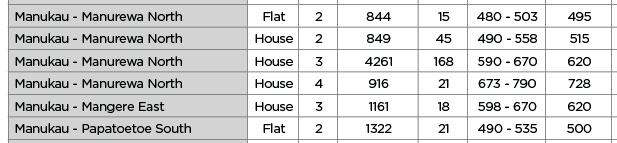
Estimate an increase in rent from a renovation
Example: If my house is in Manurewa North and has 3 bedrooms. If it currently rents for $590 and has 3 bedrooms, a renovation could push it up the rental range to the upper quartile. Currently $670. That’s an $80 increase. Estimate the 1 year increase. This can also be useful when estimating how the value of your property may have changed over the prior 12 months, which can then impact your ability to purchase your next property.
3
Estimate rental demand and how long it will take to find a tenant

For instance there were 48 bonds issued in Dinsdale South in the last month. That means there are about 12 3-bed houses renting in that suburb per week. That might tell you something about how much vacancy you might have.






The






If the Healthy Homes Standards are to work for tenants, both property managers and private landlords need to come to the party, writes David Faulkner .

The July 1 deadline for Healthy Homes Standards (HHS) compliance has come and gone. While it marks a significant milestone in improving rental housing across New Zealand, we must be honest: enforcing the rules by targeting property management companies is not the silver bullet some believe it to be. If anything, it risks doing more harm than good for the very people the legislation was designed to protect – tenants.
Cracking down on property managers might seem like a strong enforcement tactic, but it’s shortsighted. Many agencies, under mounting pressure, have already let non-compliant landlords go to avoid penalties. On paper, it looks like progress. In practice, it’s pushing vulnerable renters into the hands of private landlords with little oversight, some of whom are unprofessional or simply unwilling to bring their properties up to standard.
The unfortunate result? A growing black market of unregulated rentals. Tenants lose their only real advocates in the system – professional property managers who understand the law, guide landlords through compliance, and step in when things go wrong.
The solution isn’t to punish agencies trying to do the right thing. It’s to
partner with them. Property managers are in a unique position to spot the minority of landlords who stubbornly refuse to comply. Give these professionals the tools and incentives to report and work with the Tenancy Compliance and Investigations Team (TCIT), and we’ll see meaningful progress.
Let’s also be clear: any enforcement or penalties should land squarely on the landlord, not on the property management company acting in good faith. Shifting liability only creates a chilling effect, where agencies are incentivised to walk away from challenging tenancies. That doesn’t help anyone. It leaves tenants with fewer options and landlords with less accountability.
The post-deadline period also raises a new red flag: agency-switching. Every time a landlord drops one property manager for another, it raises questions about whether they’re trying to dodge compliance. That kind of confusion risks overwhelming Tenancy Services with red herrings, while truly non-compliant landlords slip under the radar.
The government needs to choose collaboration over confrontation. If the goal is genuinely healthier
homes, then the path forward must involve working with the industry, not against it. Property managers have the relationships, the reach, and the regulatory understanding to help lift housing standards across the board. But they need support, not suspicion.
And finally, it’s time to admit that the Healthy Homes Standards – while a positive step – are no longer fit for purpose in their current form. Some criteria remain vague, inconsistently enforced, and open to interpretation. Worse still, there’s no requirement for assessor training or certification. Anyone can assess a property, resulting in widespread confusion, disputes, and costly mistakes.
We need a smarter, evidence-based framework – one that mirrors systems like the UK’s Energy Performance Certificate (EPC). An EPC-style model would provide us with clear, independently verified data about a home’s efficiency and condition, helping renters make more informed choices and pushing the market toward higher-quality homes.
The standards may be in place, but the real work starts now. Let’s lift the rental market together – with clear rules, shared responsibility, and a system that protects those who need it most. ■

Funds available for non-consumer loans, up to 24-months fixed rate from 9.95%p.a.
No Reg. valuation required
Any location in New Zealand
No consumer lending
Capitalised interest available
Residential, commercial and rural
No SOP required

Henderson, Auckland
Finbase is a non-bank lender, offering tailored loans for property investors, developers, and traders, providing swift funding without main bank restrictions.
We offer advances up to $2.5 million without income verification. Finbase provides first ranking mortgage funding for short-term property projects, with a maximum loan term of 24 months.
Lending available up to 70% LVR of property.

Recently funded investments: Mangere, Auckland Security
Security
Value: $2,956,521
Purpose of funds: Equity release to repay existing lenders Exit strategy: Sale of security property
We assess loans based on LVR and the individual deal. We require first mortgage security over the property and a clear exit strategy.
Security description: 98m² dwelling, on a circa 610m² section
Purchase price: $705,500
Purpose of funds: Funds required to settle the purchase Exit strategy: Refinance to a main bank

Finbase offers several types of loans including bridging finance, property trading finance, and equity release.