SEP/OCT 2016
14
I N FO L I N K - B P N
FLOORS, FLOORING & ACCESSORIES
1
FINDING THE WAY WITH
CARPET TILES [WORDS] NICHOLAS RIDER
I
NCORPORATING THE PRINCIPLES OF WAYFINDING INTO YOUR BUILDING CAN OFFER A PLETHORA OF BENEFITS TO END USERS, INCLUDING INCREASED SATISFACTION, REDUCED STIGMA AND ISOLATION OF DISABLED USERS, AND IMPROVED ORIENTATION AND EXPERIENCE FOR NEW VISITORS. It can also boost productivity and health, says a 2010 Center for Inclusive Design and Environmental report, and given the studies detailing the impact wayfinding has on human psychology, occupant satisfaction, health, long-term performance, and the financial bottom line, ignoring it altogether is effectively reducing the inclusiveness of your building. Due to their modularity, and the fact they’re offered in an excess of sizes, colours, patterns and pile types, carpet tiles are considered to be one of the most effective materials among the many used to facilitate wayfinding. Carpet tiles are generally considered durable, and are easy to install, clean and replace. They also offer better acoustics than some other popular floor coverings, which is one of the reasons Graphite Architects chose carpet tiles for their Mingara Leisure Group Corporate Offices project in Newcastle.
the Australian market, other points for distinction include their backing type and sustainability. In recent years especially we’ve seen carpet tile manufacturers making efforts to improve the environmental footprint of their carpet tiles to create a sellable point of difference among their competitors, and a lot of these improvements have been in the material makeup of the tile backing. Most manufacturers now offer bitumen-, PVCand fiberglass-free products and some like Above Left, Shaw Contract Group and Interface (among others) go to great lengths to certify their products with key green building product certifiers like GECA, Green Star, Green Tag and more.
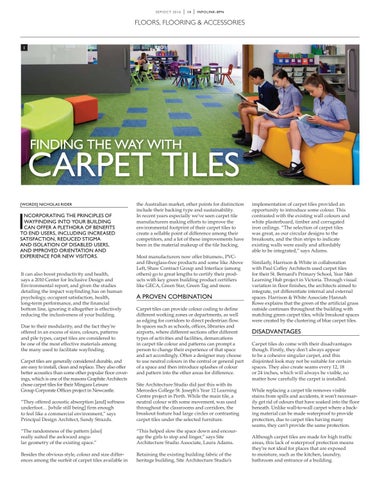
A PROVEN COMBINATION Carpet tiles can provide colour coding to define different working zones or departments, as well as edging for corridors to direct pedestrian flow. In spaces such as schools, offices, libraries and airports, where different sections offer different types of activities and facilities, demarcations in carpet tile colour and patterns can prompt a person to change their experience of that space and act accordingly. Often a designer may choose to use neutral colours in the central or general part of a space and then introduce splashes of colour and pattern into the other areas for difference.
“They offered acoustic absorption [and] softness underfoot… [while still being] firm enough to feel like a commercial environment,” says Principal Design Architect, Sandy Strazds.
Site Architecture Studio did just this with its Mercedes College St. Joseph’s Year 12 Learning Centre project in Perth. While the main tile, a neutral colour with some movement, was used throughout the classrooms and corridors, the breakout feature had large circles or contrasting carpet tiles under the selected furniture.
“The randomness of the pattern [also] really suited the awkward angular geometry of the existing space.”
“This helped slow the space down and encourage the girls to stop and linger,” says Site Architecture Studio Associate, Laura Adams.
Besides the obvious style, colour and size differences among the surfeit of carpet tiles available in
Retaining the existing building fabric of the heritage building, Site Architecture Studio’s
implementation of carpet tiles provided an opportunity to introduce some colour. This contrasted with the existing wall colours and white plasterboard, timber and corrugated iron ceilings. “The selection of carpet tiles was great, as our circular designs to the breakouts, and the thin strips to indicate existing walls were easily and affordably able to be integrated,” says Adams. Similarly, Harrison & White in collaboration with Paul Coffey Architects used carpet tiles for their St. Bernard’s Primary School, Year 5&6 Learning Hub project in Victoria. Through visual variation in floor finishes, the architects aimed to integrate, yet differentiate internal and external spaces. Harrison & White Associate Hannah Rowe explains that the green of the artificial grass outside continues throughout the building with matching green carpet tiles, while breakout spaces were created by the clustering of blue carpet tiles.
DISADVANTAGES Carpet tiles do come with their disadvantages though. Firstly, they don’t always appear to be a cohesive singular carpet, and this disjointed look may not be suitable for certain spaces. They also create seams every 12, 18 or 24 inches, which will always be visible, no matter how carefully the carpet is installed. While replacing a carpet tile removes visible stains from spills and accidents, it won’t necessarily get rid of odours that have soaked into the floor beneath. Unlike wall-to-wall carpet where a backing material can be made waterproof to provide protection, due to carpet tiles having many seams, they can’t provide the same protection. Although carpet tiles are made for high traffic areas, this lack of waterproof protection means they’re not ideal for places that are exposed to moisture, such as the kitchen, laundry, bathroom and entrance of a building.